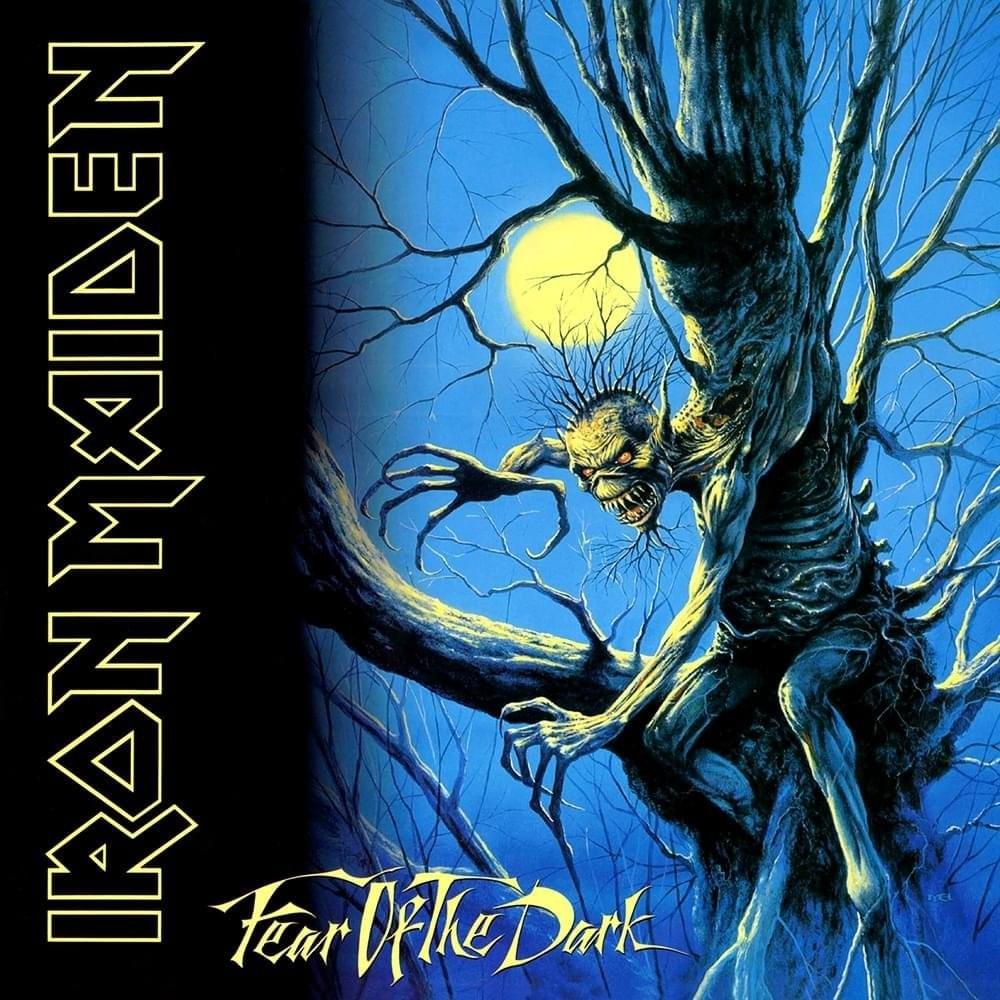
Horror Song of the Day: Fear of the Dark (by Iron Maiden)


If you’re new to Iron Maiden and want to experience a melodic metal song that doubles as a horror anthem, “Fear of the Dark” is a must-listen. Written and composed by Steve Harris, Iron Maiden’s bassist and primary songwriter, the song vividly captures that feeling of walking alone at night with the uneasy sensation that something might be lurking just out of sight. It’s a powerful exploration of a common fear—the discomfort and paranoia that darkness brings—which makes it feel like a spooky bedtime story set to powerful music.

What really makes this song stand out is how the music and Bruce Dickinson’s dramatic vocals work together to build tension and then release it. The guitars start slow and eerie, setting a creepy atmosphere, then shift into faster, catchy melodies that ramp up the excitement and nervous energy. Dickinson’s voice is full of drama and really sells that feeling of fear mixed with urgency. It’s not just heavy music; it’s storytelling with heart and melody.

Plus, the lyrics reference classic horror themes like watching scary movies and ancient folklore, which makes the song feel timeless and accessible. It’s a perfect gateway into how metal bands can blend melody with horror themes, making it approachable even if you’re not usually into heavy music. Overall, “Fear of the Dark” showcases Iron Maiden’s skill at creating music that is not only thrilling but also emotionally gripping and narratively rich.

Fear of the Dark

I am a man who walks alone
And when I’m walking a dark road
At night or strolling through the park
When the light begins to change
I sometimes feel a little strange
A little anxious when it’s dark

Fear of the dark, fear of the dark
I have a constant fear that something’s always near
Fear of the dark, fear of the dark
I have a phobia that someone’s always there

Have you run your fingers down the wall
And have you felt your neck skin crawl
When you’re searching for the light?
Sometimes when you’re scared to take a look
At the corner of the room
You’ve sensed that something’s watching you

Fear of the dark, fear of the dark
I have a constant fear that something’s always near
Fear of the dark, fear of the dark
I have a phobia that someone’s always there

Have you ever been alone at night
Thought you heard footsteps behind
And turned around, and no one’s there?
And as you quicken up your pace
You find it hard to look again
Because you’re sure there’s someone there

Fear of the dark, fear of the dark
I have a constant fear that something’s always near
Fear of the dark, fear of the dark
I have a phobia that someone’s always there

Watching horror films the night before
Debating witches and folklore
The unknown troubles on your mind
Maybe your mind is playing tricks
You sense, and suddenly eyes fix
On dancing shadows from behind

Fear of the dark, fear of the dark
I have a constant fear that something’s always near
Fear of the dark, fear of the dark
I have a phobia that someone’s always there

When I’m walking a dark road
I am a man who walks alone

Retro Television Review: Homicide: Life on the Street 1.1 “Gone For Goode”


Welcome to Retro Television Reviews, a feature where we review some of our favorite and least favorite shows of the past!  On Sundays, I will be reviewing Homicide: Life On The Street, which aired from 1993 to 1999, on NBC!  It  can be viewed on Peacock.

Today, I take a look at the pilot for a show that has been called one of the best of all time.

Episode 1.1 “Gone For Goode”

(Directed by Barry Levinson, originally aired on January 31st, 1993)

The opening credits for the first episode of Homicide: Life on the Street immediately announce that the show is not going to be a typical network cop show.  The music starts out as moody and low-key before eventually being dominated by a pulsating beat.  The images of dirty streets and crumbling rowhouses and of a dog running around behind a fence are all in black-and-white.  The faces of the cast appear, the majority of them in harsh close-up.  When viewed today, most of the faces are familiar.  Daniel Baldwin, Ned Beatty, Andre Braugher, Clark Johnson, Yaphet Kotto, Melissa Leo, Jon Polito, and Kyle Secor all flash by and the thing that the viewer will immediately notice is that it’s almost as if they’ve been filmed to remove any hint of glamour or attractiveness.  (Out of that impressive cast, only Baldwin, Johnson, Leo, and Secor are still with us.)

Gone for Goode tells several stories, introducing the detectives as they investigate various murders in Baltimore.  Meldrick Lewis (Clark Johnson) and Steve Crosetti (Jon Polito) are first seen searching for a bullet in a dark alleyway and arguing in only the way that two people who have worked with each other for a long time can argue.  Lewis continually refers to Crosetti as a “salami-head,” and Crosetti, who claims that he’s being kept up at night by his doubts about whether or not John Wilkes Booth was actually Lincoln’s assassin, repeatedly says that Lewis will regret that.  Later, Crosetti writes a complaint about the ethnic insults that he’s been forced to listen to but apparently, he never actually sends it.

When not arguing with each other, Crosetti and Lewis investigate “Aunt Calpurnia,” who has buried five husbands and whose niece has nearly been murdered three times.  Aunt Calpurnia has life insurance policies out on everyone.  While digging up Calpurnia’s former husband, Lewis comments that the body in the grave doesn’t look as large as the man in the picture that he’s been given.  The cemetery’s caretaker replies, “Nobody stays fat down there.”  Technically, that’s true but it also turns out that the wrong man was buried in the grave and the caretaker has no idea where anyone is actually buried.

Detective Felton (Daniel Baldwin) and Detective Howard (Melissa Leo) investigate the murder of a man who was found decaying in a basement.  Howard is the primary detective on the case because Felton, being a screw-up, has too many unsolved cases under his name on the dry-erase board that dominates the squad room.  Howard currently has a streak of solved homicides and that continues for her when the murderer just happens to call the crime scene and then agrees to come in for a talk.

Detective Stanley Bolander (Ned Beatty) guilts Detective John Munch (Richard Belzer, who would play the same character years later on Law & Order: SVU) into investigating a hit-and-run that happened months ago.  Munch, who earlier tells a suspect that he is not Montel Williams (“So don’t like to me like I’m Montel Williams”) and leaves both Bolander and the suspect confused as to who Montel Williams is, eventually discovers that the murder was committed by a brain-dread idiot who can only repeat, “I was drinking,” when he’s confronted with his guilt.

Finally, Lt. Al Giardello (Yaphet Kotto) assigns Felton to work with Frank Pembleton (Andre Braugher), a brilliant but arrogant detective who insists on working alone.  Pembleton and Felton’s partnership begins with Pembleton spending an hour in the station’s garage, searching for his squad car because Pembleton forgot to write down the parking space on the back of his keys.  (Of course the garage is full of identical white cars.)  When Felton says suggests just going upstairs and getting a new set of keys, Pembleton shouts that the next car he tries to unlock could be the right car.

Needless to say, the Pembleton/Felton partnership does not last and Pembleton instead ends up working with an eager newcomer to the squad, Tim Bayliss (Kyle Secor).  They two of them work surprisingly well together until Bayliss objects to Pembleton “fooling” a suspect into waving his right to an attorney.

As the episode comes to a close, Bayliss answers his first call in the squad room.  At the crime scene, in the middle of a torrential storm, he discovers the body of a small girl.

I have to say that the idea of trying to review Homicide: Life on The Street is a bit intimidating, just because the show has got an almost legendary reputation.  It’s often described as being the best cop show of the 90s, as well as being held up as a perfect example of a show that was too good to last.  It was never a hit in the ratings and came close to being canceled several times.  Because it was filmed in Baltimore, it was viewed as being an outsider amongst the New York and Hollywood-produced shows that dominated the airwaves.  Executive produced by Barry Levinson (who also directed Gone for Goode) and based on a non-fiction book by David Simon, Homicide is the show that is often cited as the precursor for The Wire, another show that was loved by the critics but not by its network or the Emmy voters.

The pilot is intriguing, largely because it seems determined to scare off its audience.  Unlike other television  detectives, who are inevitably portrayed as being crusaders who are obsessed with justice, the detectives in Homicide are a blue collar bunch who, for the most part, are just doing their job.  Sure, someone like Frank Pembleton might be brilliant.  And Stanley Bolander might truly mean it when he tells Munch that “we speak for the dead.”  And Bayliss does seem to be very enthusiastic about being a “thinking” policeman.  But the show suggests that most detectives are like Felton, Lewis, and Much.  They’re not particularly brilliant and their approach to the job can sometimes seem callous.  But occasionally, they get lucky and a murder is solved.  Indeed, if there is any real message to the pilot, it’s that criminals are stupid.  They get caught not because of brilliant police work but because they do stupid things, like calling the crime scene or failing to ditch the car that they sole.

That said, the pilot also does what a pilot is supposed to do.  It introduces the characters and gives them just enough space to make an impression, along with also leaving enough room for them to grow.  The characters may not all be instantly likeable but, fortunately, the strong cast holds your interest.  The pilot is very much a product of the 90s, with Munch ranting about Montel Williams and Crosetti mentioning Madonna at one point.  But, at the same time, it still feels relevant today.  Pop culture might change but murder remains the same.

Insomnia File No. 15: George Wallace (dir by John Frankenheimer)


What’s an Insomnia File? You know how some times you just can’t get any sleep and, at about three in the morning, you’ll find yourself watching whatever you can find on cable? This feature is all about those insomnia-inspired discoveries!
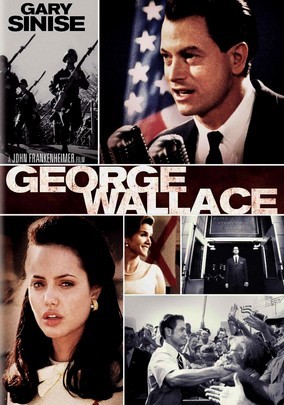
George Wallace

If, after watching Promise last night, you discovered that you were still suffering from insomnia, you could have watched the very next film that premiered on TCM.  That film was the 1997 biopic, George Wallace.

Like PromiseGeorge Wallace was originally made for television.  Also, much like Promise, George Wallace is a character study of a conflicted man who makes many people uncomfortable and it’s also well-acted by a cast of veteran performers.  That, however, is where the similarities end.  Whereas Promise was ultimately a rather low-key and human drama, George Wallace is an epic.  Clocking in at nearly 3 hours and telling a story that spans decades, George Wallace attempts to use one man’s life story as a way to tell the entire story of the civil rights movement.

That’s a tremendously ambitious undertaking, especially for a film that had to conform to the demands of 1990s television.  Therefore, it’s probably not surprising that the movie, as a whole, is uneven.  It’s not a bad movie but, at the same time, it doesn’t quite work.

First off, we need to talk about who the historical George Wallace was.

(Here’s where I get to show off my amazing history nerd powers.  Yay!)

George Wallace served a total of four terms as governor of Alabama.  A protegé of a populist known as “Big Jim” Folsom, Wallace first ran for governor in 1958.  He campaigned as a moderate who supported integration and, as a result, he was defeated by the KKK’s endorsed candidate, John Patterson.  (Oddly enough, a fictionalized version of Patterson was the hero of the classic and racially progressive 1955 film, The Phenix City Story.)  When Wallace ran again in 1962, he ran as an outspoken segregationist and defeated his former mentor, Jim Folsom.  Infamously, Wallace is the governor who stood in the schoolhouse door and announced that Alabama would never accept integration.  Unable to succeed himself, Wallace arranged for his wife, Lurleen, to be elected as governor.  Lurleen subsequently died in office, succumbing to cancer while Wallace was running for President as the candidate of the American Independent Party.  (As of this writing, Wallace is the last third party presidential candidate to carry any states.)  Reelected governor in 1970, Wallace married Folsom’s niece and made another presidential run.  However, after a string of primary victories, that campaign was cut short when Wallace was shot and crippled by Arthur Bremer.  (Bremer would serve as the inspiration for Robert De Niro’s Travis Bickle in Taxi Driver.)  Confined to a wheelchair, Wallace served as governor until 1978 and, in 1976, ran for President one final time.  After being out of office for four years, he was elected Governor for one final term in 1982.  Late in life (and, it should be pointed out, long after integration had been generally accepted as the law of the land), Wallace renounced his segregationist past and publicly apologized for standing in the schoolhouse door.  During his final campaign for governor, he won a majority of the black vote and he proceeded to appoint more blacks to state positions than any governor before him.

George Wallace lived a long, dramatic, and interesting life and he’s still a very controversial figure.  Who was the real George Wallace?  Was he a political opportunist who used racism to further his career?  Was he truly a racist who saw the error of his ways and repented or did he only pretend to renounce his former beliefs once they were no longer popular?  And, even if Wallace was sincere in his regret, did he deserve to be forgiven or should he always be remembered as the villainous caricature that Tim Roth portrayed in Selma?  If we forgive or make excuses for the actions of a George Wallace, do we run the risk of diminishing the success and importance of the civil rights movement?

And I, honestly, have no answers to those questions.  Unfortunately, neither does George Wallace.  But before we get into that, let’s consider what does work about this film.

George Wallace opens in 1972 with Wallace campaigning in Maryland.  Wallace is played by Gary Sinise and his second wife, Cornelia, is played by a very young Angelina Jolie.  Sinise and Jolie both give brilliant performances, perhaps the best of their respective careers.  Sinise plays Wallace as a calculating and charismatic politician who is also a very angry man.  Throughout every second of his performance, we are aware of Wallace’s resentment that his political success in Alabama has potentially made him unelectable in the rest of the country.  Watching Sinise as Wallace, you see a man who believes in himself but doesn’t necessarily like the person that he’s become.  Meanwhile, Jolie plays Cornelia like a Southern Lady MacBeth and watching her, I remembered how, at one time, Angelina Jolie really did seem like a force of nature.  The Angelina Jolie of George Wallace is the wild and uninhibited Jolie of the past (the one who once said, “You’re in bed, you’ve got a knife, shit happens.”), as opposed to the safe and conventional Jolie of the present, the one who is currently directing rather stodgy movies like Unbroken and By The Sea.

After Wallace is shot, the film goes into flashback mode.  We watch as Wallace goes from being a liberal judge to being the segregationist governor of Alabama.  Mare Winningham plays Lurleen Wallace while Joe Don Baker plays Big Jim Folsom.  They all do a pretty good job but the flashback structure is so conventional (and so typical of a made-for-tv biopic) that it makes the film a bit less interesting.

There’s also a character named Archie.  Played by Clarence Williams III, Archie is literally the only major black character in the entire film.  He is portrayed as being a former convict who has been hired to serve as Wallace’s valet.  While Wallace plots to thwart the civil rights movement, Archie stands in the background glowering.  At one point, he’s even tempted to kill Wallace.  However, after Wallace is shot, Archie helps to take care of him.  The film suggests that being shot and subsequently cared for by Archie is what led to Wallace renouncing his racist views.  (The film also suggests that Wallace was never that much of a racist to begin with and, instead, was just so seduced by power that he would say whatever he had to say to win an election in Alabama.)

At the end of the film, we’re informed that almost everyone in the film was real but that Archie was fictional.  The problem, of course, is that the film is suggesting that the fictional Archie is responsible for the real-life Wallace both rejecting racism and apologizing for the all-too real consequences of racism.  The film ends with the realization that the filmmakers were so convinced that audiences would not be able to accept an ambiguous portrait of a public figure that they created a fictional character so that Wallace could have a moment of redemption.

(It also doesn’t help that a film about civil rights only features one major black character and that character is a fictional valet who doesn’t get to say much.)

In the end, the film doesn’t seem to be certain what it’s trying to say about Wallace and the meaning of his dramatic life.  That said, I enjoyed watching George Wallace because of the acting and because, as a history nerd, I always enjoy seeing historical figures portrayed on-screen, even if the filmmakers don’t seem to be quite sure what they’re tying to say about them.

George Wallace was directed by John Frankenheimer, a good director who, it appears, was constrained by the demands of 1990s television.  If George Wallace were made today, it would probably air on HBO and would probably be allowed to take more of a firm stand one way or the other on Wallace’s character.  That said, it would probably also be directed by Jay Roach who, to put it lightly, is no John Frankenheimer.

Anyway, George Wallace doesn’t quite work but it’s definitely interesting.  Watch it for Gary and Angelina!

Previous Insomnia Files:

  1. Story of Mankind
  2. Stag
  3. Love Is A Gun
  4. Nina Takes A Lover
  5. Black Ice
  6. Frogs For Snakes
  7. Fair Game
  8. From The Hip
  9. Born Killers
  10. Eye For An Eye
  11. Summer Catch
  12. Beyond the Law
  13. Spring Broke
  14. Promise

Song of the Day: Powerslave (by Iron Maiden)


iron-maiden-powerslave-album

It took me awhile to get into Iron Maiden. I listened to them somewhat during the 80’s but it wasn’t until later in life that I truly appreciated the band for what they were and that was one of the great metal bands of all-time. “Powerslave” continues the mini-series in the “Song of the Day” series as another song with a great guitar solo section.

It’s a song steeped in Ancient Egypt imagery and mysticism and one written by band front man Bruce Dickinson. From the fifth and album of the same name, “Powerslave” is over 7 minutes of classic Iron Maiden that spoke not just to its headbanging followers, but to another group that was pushed even farther into the fringes of society when the album first came out: nerds.

Iron Maiden’s songs have always been more about lore, mysticism, history and classic literature than it was about sex and drugs the way 80’s metal (hair and glam metal movement) in the U.S. focused on. These things spoke to the geeks and nerds who spent time on AD&D and reading ancient and military history instead of parties, sports and the high school social scene.

The has two competing guitar solos that come midpoint in the song’s playing time with both Adrian Smith and Dave Murray getting a chance to shine and show-off their guitar skills. And yeah, Bruce Dickinson’s vocals were pretty amazing, as well…

Powerslave

Into the Abyss I’ll fall – the eye of Horus
Into the eyes of the night – watching me go
Green is the cat’s eye that glows – in this Temple
Enter the risen Osiris – risen again

Tell me why I had to be a Powerslave
I don’t wanna die, I’m a God, why can’t I live on?
When the Life Giver dies, all around is laid waste
And in my last hour, I’m a slave to the Power of Death

When I was living this lie – Fear was my game
People would worship and fall – drop to their knees
So bring me the blood and red wine for the one to succeed me,
for he is a man and a God – and He will die too

Tell me why I had to be a Powerslave
I don’t wanna die, I’m a God, why can’t I live on?
When the Life Giver dies, all around is laid waste
And in my last hour, I’m a slave to the Power of Death

(guitar solos)

Now I am cold but a ghost lives in my veins
Silent the terror that reigned – marbled in stone
A shell of a man God preserved – for a thousand ages
But open the gates of my Hell – I will strike from the grave

Tell me why I had to be a Powerslave
I don’t wanna die, I’m a God, why can’t I live on?
When the Life Giver dies, all around is laid waste
And in my last hour, I’m a slave to the Power of Death
Slave to the Power of Death…

Great Guitar Solos Series

Shattered Politics #68: The Skulls (dir by Rob Cohen)


Theskullsposter

What do George W. Bush, John Kerry, and Paul Giamatti all have in common?

They were all members of the Skull and Bones, which may be an organization that secretly controls the world.  Then again, it might also just be an organization for male students at Yale, a place for the sons of the rich and famous to get together, drink, and do whatever else rich kids do when they go to an Ivy League college.

One thing’s for sure — when you’re a member of the Skulls and Bones, you’re a Bonesman for life.  If you have any doubt about that, go ahead and watch the 2000 film The Skulls.  In The Skulls, Martin Lombard (Christopher McDonald) is such a loyal member of the Skulls that, even though he’s currently a provost at Yale, he’s still willing to break a student’s neck in order to keep him from revealing the society’s secrets.

Seriously, do all Ivy League administrators know how to break necks or just ones that were former members of the Skulls?  It just makes me glad that I went to UNT, a good school with absolutely no ivy on the walls.  A degree from UNT might not translate into membership into America’s elite but at least you don’t have to worry about being targeted by any dangerous secret societies.

(Unless, of course, you’re a TAM.  But that’s another story…)

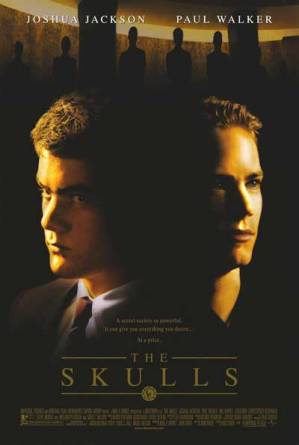
Anyway, the dead student’s best friend is Luke McNamara (Joshua Jackson).  We know Luke’s the hero because he doesn’t come from a rich family and he’s attending Yale on a rowing scholarship.  Shortly before Will’s death, Luke is invited to join the Skulls and does so because he thinks it will help him court rich art major Chloe (Leslie Bibb).  However, after Will death, Luke decides that he has to join so that he can find out the identity of the murderer.

Luke wrongly suspects that the murderer was his new friend and fellow Skull, Caleb Mandrake (Paul Walker).  What Luke doesn’t know is that the murder was actually ordered by Caleb’s father, Supreme Court candidate Litten Mandrake (Craig T. Nelson).  (As a sidenote, has anyone named Litten Mandrake ever not turned out to be evil?)  However, as Luke gets closer to the truth, the Skulls arrange for him to be arrested and put into a mental asylum.

Oh, and Martin Lombard starts chasing after him with a gun.

Remember, this is the same Martin Lombard who is a provost at Yale.  Now, I’m not saying that it’s out of the question that a Yale provost could chase after a student with a gun.  But, at the very least, it seems like a conspiracy as wealthy and powerful as the Skulls could afford to hire less recognizable henchmen.

In fact, watching The Skulls, you can’t help but suspect that this secret conspiracy is not exactly the smartest conspiracy in the word.  Not only do they do a terrible job of hiding their existence but they are continually outsmarted by a bunch of undergrads.

Anyway, eventually, it all leads to Luke challenging Caleb to a duel.  A mysterious Senator (William Petersen) shows up and says, “Well done, son, well done.”

It’s all kind of stupid.

http://www.youtube.com/watch?v=0d0qdIbUEXo

27 Days of Old School: #14 “The Trooper” (by Iron Maiden)


iron maiden the trooper

“The Bugle sounds and the charge begins”

I didn’t hear #14 the year it came out in 1983. I wasn’t too much into heavy metal at that age (still just 10). Now, once I got into high school and expanded my circle of friends (still not much but did include a couple who were into metal) I was finally introduced to heavy metal.

One of the first songs I really got into was Iron Maiden’s “The Trooper” from their Piece of Mind album. Even from the first time hearing the song I had an idea what the song about. I was already a huge hoarder of all things military history in my teen years and I knew the song was about the Charge of the Light Brigade during the Crimean War.

What I didn’t realize at that time was that the song itself was using a famous poem about said charge. So, in addition to getting me into heavy metal (which waxed and waned in the years since until meeting necromoonyeti online), I ended up learning about Tennyson and his poem about that fateful charge of British Light Cavalry against a well-defended and heavily-armed Russian artillery battery.

Also, seeing the cover for “The Trooper” with Eddie in full light cavalry regalia waving a cavalry saber and a bloodied, tattered Union Jack just hit me right in my wheelhouse.

Song of the Day: The Trooper (by Iron Maiden)


The latest choice for “Song of the Day” came to me while I was reading the last third of Max Brooks’ very awesome novel World War Z. In a later chapter in the novel when the survivors of the United States during an ongoing zombie apocalypse finally go on the offensive and leave the relative safety of the West Coast and the Rockies which provide a natural barrier from the hundreds of millions of zombies to the east. During this offensive the forces uses a particular song to lure zombies into an ambush zone where they could be destroyed en masse. The song the soldiers and their superiors used to help lure the undead and to also pump up the men was Iron Maiden’s “The Trooper”.

The song is another one of those Iron Maiden songs which takes its inspiration from a moment in military history and from a classic English poem. This time around the moment in military history is the Charge of the Light Brigade during the the Battle of Balaclava of the Crimean War (1854). The English poem which inspired the song was Lord Tennyson’s poem of the same name. This is classic heavy metal at its best. We have the galloping bass rhythm which sounds like the Light Brigade mentioned above making their courageous, but ill-fated charge into the muskets and cannons of the Russian forces.

I could continue to try and describe all the other musical details about this song, but I feel I’m ill-equipped to do so. I’m sure the site’s own music and metal expert necromoonyeti could better describe the awesome guitar work by Dave Murray and Adrian Smith during this song.

One thing that I am sure of is that if there ever was a zombie apocalypse and I found myself one of the survivors looking to take back the country then this would be part of my playlist when I’m destroying zed heads.

The Trooper

You’ll take my life but I’ll take yours too
You’ll fire your musket but I’ll run you through
So when you’re waiting for the next attack
You’d better stand there’s no turning back

The bugle sounds as the charge begins
But on this battlefield no one wins
The smell of acrid smoke and horses breath
As you plunge into a certain death

Ooooohhhhhhh

The horse he sweats with fear we break to run
The mighty roar of the Russian guns
And as we race towards the human wall
The screams of pain as my comrades fall

We hurdle bodies that lay on the ground
And as the Russians fire another round
We get so near yet so far away
We won’t live to fight another day

Solo

Ooooooooohhhhhhh

We get so close near enough to fight
When a Russian gets me in his sights
He pulls the trigger and I feel the blow
A burst of rounds takes my horse below

And as I lay there gazing at the sky
My body’s numb and my throat is dry
And as I lay forgotten and alone
Without a tear I draw my parting groan