Anyone who grew up during the late 80’s and through the early 90’s saw the return to it’s Golden Age of Disney animation. The Little Mermaid was the first to start it, but it was the follow-up animated film Beauty and the Beast which announced loudly that Disney was back after years upon years of lackluster and underwhelming animated films.
Disney is now in the midst of another era of dominating the film industry with both it’s live-action and animated films. Recent years saw Disney take some of its classic animated films of the past and adapt them into live-action films. We’ve gotten live-action version of Cinderella and Sleeping Beauty (redone as Maleficent)
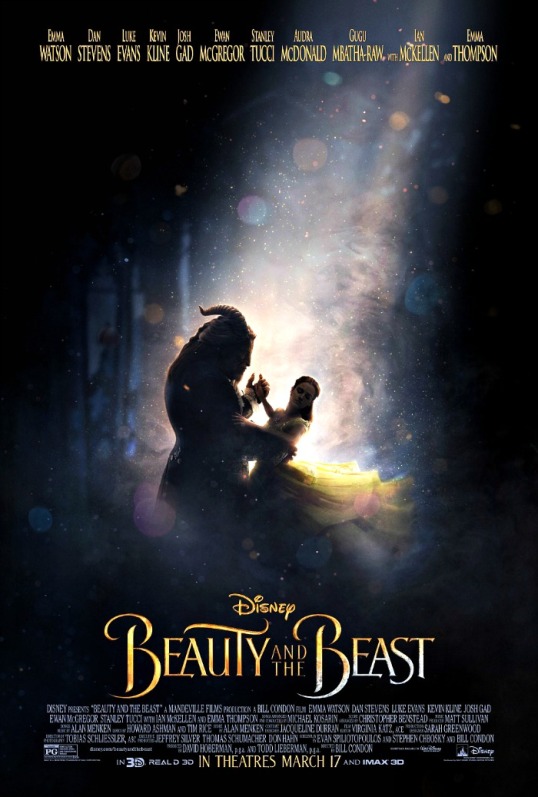
Next in line is the upcoming live-action adaptation of Disney’s own animated film (which itself was an adaptation of earlier films of the same title and premise) of Beauty and the Beast with Emma Watson, Dan Stevens and Luke Evans taking on the three iconic roles of Belle, the Beast and Gaston.
Beauty and the Beast is set to invite all as its guests on March 17, 2017.
Walt Disney Studios continues to adapt their classic animated films into live-action and the next in line is 1991’s classic film, Beauty and the Beast.
This animated film was an instant classic and the first to be nominated outside of the Best Animated Film category in the Academy Awards. It was nominated for Best Picture and, for some, it truly deserve not just the nomination but should’ve won the Best Picture award that year.
The teaser trailer makes great use of the music written and composed by Alan Menken and Howard Ashman for the film. We get both the prologue and the title track from the 1991 soundtrack in the teaser trailer. For those who saw the original animated film during it’s original first run in 1991 should be taken back to those days when Beauty and the Beast enchanted a global audience.
With a stellar cast led by Emma Watson, Dan Stevens and Luke Evans, this live-action adaptation has a lot to live up to.
Beauty and the Beast is set to invite all as its guests on March 17, 2017.
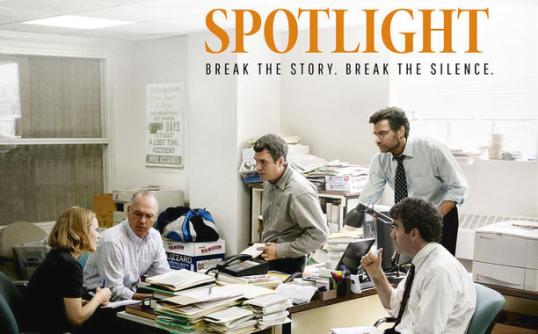
Earlier today, I finally got to see Spotlight, the film that is currently the front-runner to win the Oscar for best picture. Spotlight tells the story of how the Spotlight team, a group of journalists working for the Boston Globe, investigated the shameful history of sexual abuse of children by Catholic priests in the Archdiocese of Boston. Starting with charges against one priest, the Spotlight team eventually uncovered sexual abuse by at least 70 priests and also revealed that the revered Cardinal Law was involved in covering up the crimes.
Having now seen Spotlight, I can say it’s a good film. It’s well-made. It’s well-acted. The script contains some memorable lines. I’ve talked to a few friends of mine who have actually worked as journalists and they have all assured me that Spotlight gets the details of their profession correct and that it’s pretty much an authentic look at what it’s like to be a reporter at a major newspaper. There’s a lot of good things that can be said about Spotlight.
And yet, I’m not particularly enthusiastic about it. I think my main issue with the film is that it’s just such an old-fashioned and rather conventional film. It’s a throw back of sorts, an earnest exploration of a real-life outrage. (Even the fact that the heroes are journalists makes the film feel as if it was made a decade or two in the past.) On the one hand, you have to respect that director Tom McCarthy had the guts to tell his story in the least flashy way possible. But, occasionally, his by-the-book approach is not as compelling as you want or need it to be. Spotlight is a good film but it’s not a particularly challenging film and it’s the films that challenge us that truly stay with us after the final credits conclude.
Yes, it’s a good film but some are declaring that Spotlight is the best film of the year and I’m afraid that I just don’t see it. There are a lot of 2015 films that will probably still be fondly remembered 5 years from now: Ex Machina, Mad Max: Fury Road, Inside Out,Sicario, and others. When compared to those films, Spotlight feels more like an admirable made-for-TV movie. It feels more like something that should sweep the Emmys than the Oscars.
That said, Spotlight does feature some excellent performances. In fact, the entire cast does such a good job that it’s difficult to really single anyone out. They come together as a nearly perfect ensemble. (That said, I’m a bit torn on whether Mark Ruffalo came across as being passionate or merely mannered.) Michael Keaton, especially, does a good job, embodying everyone’s ideal image of a journalist with integrity.
Spotlight‘s a good film but my favorite Tom McCarthy movie remains Win Win.
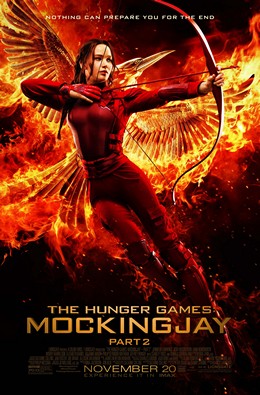
It probably sounds like I’m really excited that the final Hunger Games adaptation has been released. It may sound like I’m happy that the saga of Katniss Everdeen and her life in Panem has finally come to an end. And, to a certain extent, I am. After everything that Katniss has been through, she deserves some peace and, fortunately, the series has ended before Jennifer Lawrence got bored with playing the role. (To see what happens when actor gets bored with an iconic role, check out Daniel Craig in Spectre.) Even though I think it can be argued that Mockingjay Part Two is the weakest of all the Hunger Games films, it still allows both Katniss and the actress who brought her to life to go out on a high note.
There’s a part of me that cringes a little when I think about all of the films that were released as a direct result of the success of The Hunger Games. The Giver, The Maze Runner, Divergent, Tomorrowland, the list goes on and on. I’ve reached the point where I can now say that I am officially sick of sitting through adaptations of Young Adult dystopian fiction. And yet, I was still excited to see The Hunger Games: Mockingjay Part Two (even if that title is way too long and unwieldy). Regardless of the number of mediocre films that it may have inspired, The Hunger Games franchise has always remained compelling.
So, how was Mockingjay Part Two? Obviously, it doesn’t work as a stand-alone film. The pacing is totally off, characters appear and disappear almost at random, and it’s all rather confusing. If you haven’t seen the film that came before Mockingjay Part Two, I imagine that you would be totally confused by this film. But, when viewed as the fourth part of one gigantic epic story, the whole thing is rather brilliant.
When the film opens, Katniss is still being used a prop in Alma Coin’s (Julianne Moore) revolution. The majority of the film deals with her journey into and through the capital. She wants to track down and assassinate President Snow (the wonderfully evil Donald Sutherland) whereas Coin just wants to use her as a symbol to solidify her authority. As Katniss quickly realizes, there’s not much difference between Snow and Coin. However, it takes one great tragedy for Katniss to truly understand the truth about the Alma Coin and her revolution. If you’ve read the book, you’ll already know about and be prepared for that tragedy but it’s still a heart-breaking moment.
It’s also the most important moment in the franchise, one that reminds us that The Hunger Games has always been far more politically sophisticated (and thematically darker) than all of the films, books, and fan fic that has been inspired by it. This is a seriously dark and, some would say, cynical movie and, as a student of history, I appreciated that. I appreciated that Mockingjay didn’t try to force a happy ending on us and I also appreciated the fact that Mockingjay didn’t buy into the simplistic Manichaen worldview that is currently ruining worlds both real and cinematic. The film’s final scene may be hopeful but it’s never naive.
It’s a bit unfortunate that Mockingjay had to be split into two separate films. Mockingjay Part Two is full of exciting moments but there’s also a lot of scenes that feel like filler. You get the feeling they were included to make sure that Mockingjay Part Two’s running team was equal to the other films in the franchise. This is a film that features a lot of genuinely exciting action and some truly emotional moments. It’s also a film that features a lot of speeches. If only both parts of Mockingjay could have been released as one six hour film. I would have watched it!
The film also features the final performance of Philip Seymour Hoffman, playing the rule of Plutarch. Hoffman is not in many scenes and reportedly, he died before filming two of his biggest scenes. Those scenes were rewritten and his dialogue given to other actors. At one point, Woody Harrelson starts to read a letter that was written by Plutarch and it’s a sad scene because you’re aware that, originally, Hoffman was meant to deliver those lines in his trademark style. As it is, Hoffman only appears in a few minutes of Mockingjay Part Two and he doesn’t do much. But, when the film briefly features his bemused smile, you’re reminded of what a great actor the world lost when Philip Seymour Hoffman died.
Of course, the entire Hunger Games franchise has been full of great actors. Jennifer Lawrence brought Katniss to wonderful and empowering life and one of the joys of Mockingjay Part Two is getting to see her bring the character’s story to a close. But even beyond Jennifer Lawrence’s rightly acclaimed work, the entire cast of the franchise deserves a lot of credit. I’ve always loved Donald Sutherland’s interpretation of President Snow and he’s at his best here.
For that matter, if there ever is another Hunger Games film or a Hunger Games spin-off, why not make it about Jena Malone’s Johanna Mason? The way that Malone delivered her angry and frequently sarcastic dialogue was definitely one of the film’s highlights.
Regardless of whether there are any future films, The Hunger Games: Mockingjay Part Two is a worthy conclusion to a great story.
(By the way, as you may have guessed from the title of this post, December is science fiction month here at the Shattered Lens! We hope you enjoy it!)
Have you ever heard the old saying about how one vote can make all the difference? I’ve always had to laugh whenever I hear that because I know that, every election, my sister Melissa is going to cancel out my ballot by voting the exact opposite of how I vote. As a result, even though I’ve participated in almost every election since 2004, my vote has hardly ever really mattered.
(Then again, neither has my sister’s….)
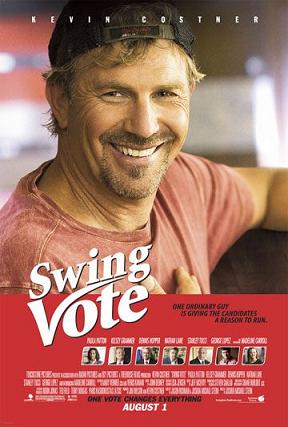
But anyway, the idea of one vote making all of the difference is taken to its logical extreme in the 2008 comedy Swing Vote. In Swing Vote, a presidential election comes down to who wins the state of New Mexico. And who wins the state of New Mexico will be determined by just one vote. You see, the popular vote in New Mexico is tied between the two candidates but it turns out that, due to a voting machine error, one man’s vote has not been counted. And now, that man has ten days to recast his vote.
(Why does he have ten days? Mostly because there would not be a movie if they just said, “Please cast your vote again…now!”)
Of course, the problem is that the guy never cast a vote in the first place. Instead, his vote was cast by his daughter (Madeline Carroll), who basically committed an act of vote fraud and violated federal law. But it’s cute because she’s super precocious and she just wants her Dad to stop being such a fuck-up.
Oh, did I mention that?
That’s right — the fate of America is in the hands of a complete and total fuck-up. His name is Bud and he’s played by Kevin Costner. He’s a rather stupid guy who has never been responsible a day in his life. He’s also a former felon, which really should have made him ineligible to vote in the first place. And, on top of that, he’s the type of alcoholic who promises his little girl that he’ll meet her at a scheduled place and time and then proceeds to get drunk inside.
OH MY GOD, WHAT A GREAT GUY!
But, we’re supposed to like Bud because he’s played by Kevin Costner and I really don’t get that logic. I always find it odd that, every year, we hear about how Kevin Costner is going to be in a few dozen films and how they’re all going to be hits and he’s suddenly going to be a big star again. I’m never quite sure why people are excited about this prospect. Whenever I see Costner on-screen (which, admittedly, doesn’t happen that often), I’m always struck by the fact that, regardless of the role, he really does come across as being an asshole. That really does seem to be his screen presence. That’s certainly the case in Swing Vote.
And maybe that’s the point of the film. Be sure to vote so that the fate of America doesn’t end up in the hands of Kevin Costner.
That said, I will say that Swing Vote deserves some credit for casting Kelsey Grammer as the President and Dennis Hopper as his opponent. Personally, I probably would have voted to reelect Kesley but I think Dennis would have done a good job as well.
(By the way, if ever do find yourself watching Swing Vote, imagine how much funnier the film would have been if it ended with Costner casting his vote and then announcing, “I voted third party!”)
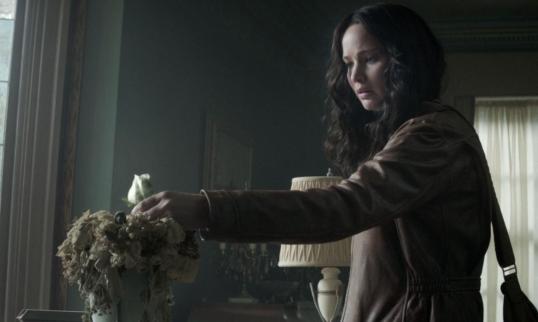
Of the three The Hunger Games films released so far, Mockingjay Part One is definitely the weakest. That does not, however, mean that it’s a bad film. It’s just that it doesn’t quite reach the grandeur of the first film, nor does it have the same political immediacy as the second one. However, there’s a lot of good things to be said about Mockingjay. Julianne Moore is perfectly cast as the charismatic but faintly sinister Alma Coin. Philip Seymour Hoffman’s performance reminds us of what a towering talent we lost earlier this year. Donald Sutherland continues to transform President Snow into a villain for the ages. Even though he’s only in the film for a few minutes, Stanley Tucci is perfectly vapid as Caesar Flickerman.
In fact, the only real problem with Mockingjay is that it’s so obviously a prologue to something bigger. Much as with The Maze Runner, we watch Mockingjay with the knowledge that it’s only part one and that the majority of the issues raised by the film will not be settled until next year. The film itself knows this as well and, as such, it lacks the immediacy and much of the excitement of the first two Hunger Games films.
But yet, with all those flaws in mind, Mockingjay still works and it’s largely because of Jennifer Lawrence’s performance as Katniss Everdeen. Whereas the first two Hunger Games films featured a Katniss who was always at the center of the action and always taking charge of any situation that she found herself in, Mockingjay features a Katniss who has far less control over her fate. (One of the neater ironies of the series is that Katniss was actually more independent as a prisoner of President Snow than as a “guest” of Alma Coin.) In Mockingjay, Katniss finds herself forced — with more than a little reluctance — to become the figurehead for the entire revolution and the film’s best moments are the ones in which others debate how to best “market” her. These scenes are all about how Katniss — who is now not only a celebrity but a political icon as well — deals with losing control over her own public image. Considering that Jennifer Lawrence’s rise to fame and acclaim occurred just as abruptly as Katniss’s, it’s probable that — even more so than in the previous films — the actress brought a lot of herself to the character.
So, yes, I would argue that Jennifer Lawrence does perhaps deserve some awards consideration for her performance in Mockingjay. However, she truly deserves it for the consistent quality of her performance throughout the entire Hunger Games franchise. From the very first film, Jennifer Lawrence’s performance has been iconic. Fiercely independent without giving into the usual cinematic clichés that come with that, Katniss Everdeen has provided an alternative role model for a generation of girls who, otherwise, might have only had the likes of Bella Swan to look up to.
If that’s not worthy of being honored, then I don’t know what is.
You can accuse Michael Bay of many things — overblown spectacle, formulaic hackery, using CGI as a massive crutch, general lack of anything resembling original vision — but false advertising ins’t among them : when you go see a Bay-directed flick, particularly a Bay-directed Transfomers flick, you know exactly what you’re in for.
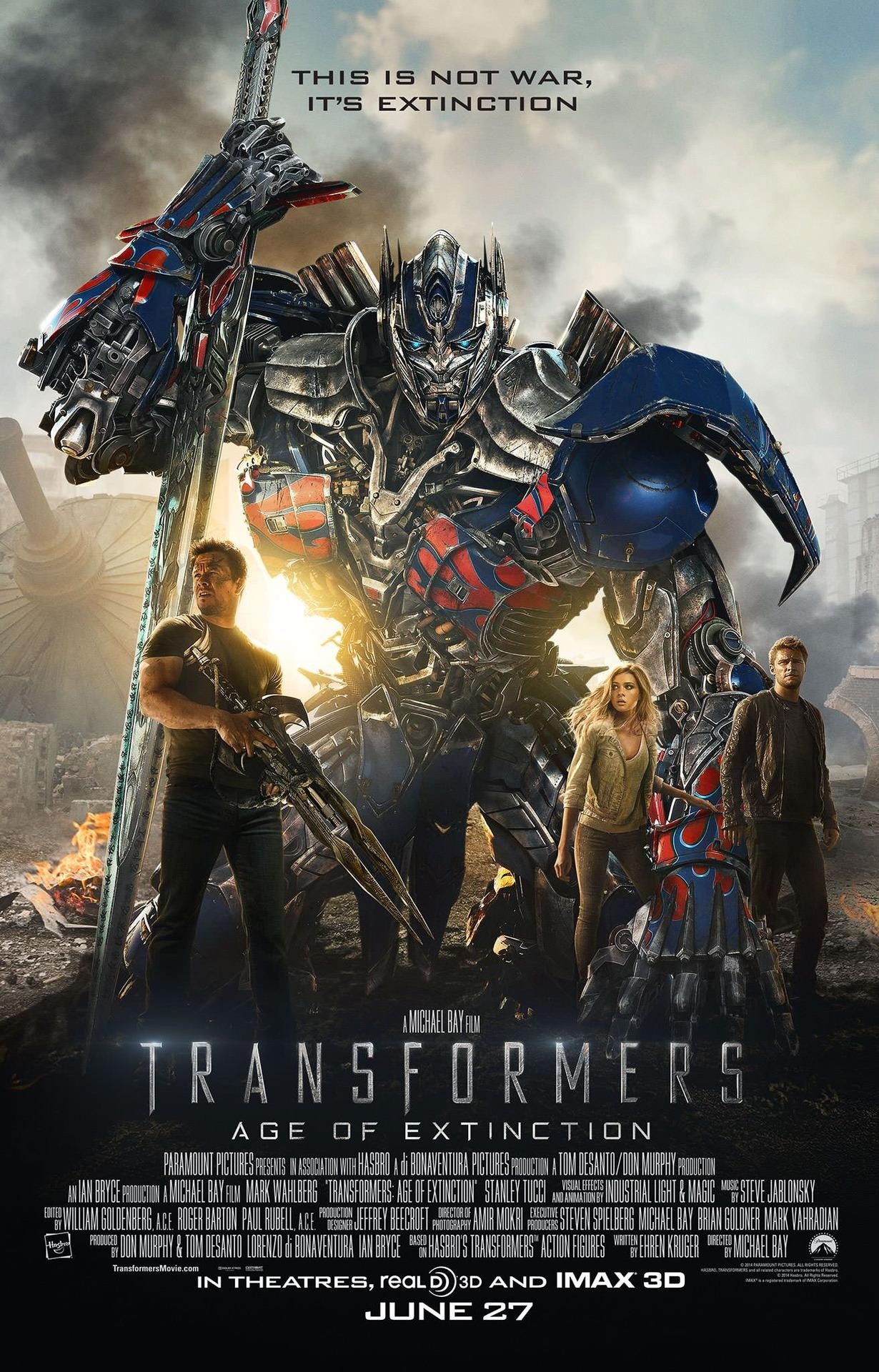
Oh, sure, his latest — Transformers : Age Of Extinction — alters the basic cosmetic trappings somewhat, most notably by banishing Shia LaBeouf to whatever hell for dead careers Megan Fox was earlier castigated to in favor of proven “action hero” star Mark Wahlberg, and yeah, Stanley Tucci is about the only major holdover (as far as human beings go) from previous entries in this series (look for more newcomers in the form of Kelsey Grammer and Nicola Peltz as Wahlberg’s daughter), but this is no reboot, by any stretch.
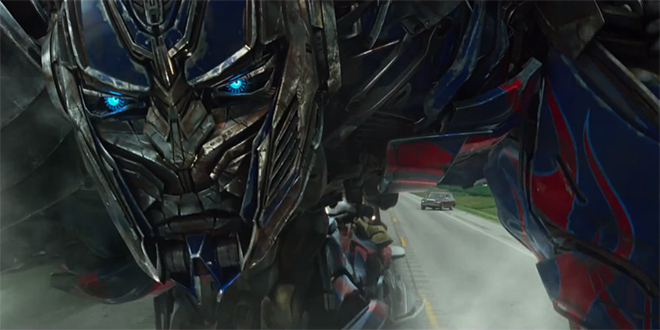
For one thing, the story continues directly on from the previous efforts, with the Transformers having been “driven underground,” so to speak, thanks to a government witch-hunt until no less than Optimus Prime himself is discovered and “resurrected” by Wahlberg’s Cade Yeager (there’s a focus-group-tested name if I’ve ever heard one) character, who —
Oh, fuck it. Does this even matter? Does even the most hard-core fan of this franchise — and that’s precisely what it is, a franchise — care what the plots of these films are about? If so, you have to feel a sort of pity for them, because Bay and screenwriter Ehren Kruger (who was supposed to be the “next big thing” once upon a time for a few minutes there) clearly don’t. Every single “slow” or “quiet” scene is obviously just set-up to carry us into the next big CGI set piece, so we won’t waste our time here with a terribly detailed breakdown of the story. Sound fair?
All in all, Transformers : Age Of Extinction is all about getting the job done, slapping the finished product up on the screen, and opening up those cash register drawers. In that respect — and that one only — you’ve gotta say “mission accomplished” here. This movie is making money hand over fist and evidently the public’s appetite for more and more robo-carnage is proving to be flat-out insatiable. We apparently love this shit.
The question I have is — who’s “we”? Like the ever-ephemeral “they” of “well, they say you should — ” and “they say it’s not good for you to —” fame, the target audience for these films eludes me. I don’t like ’em. Nobody I know likes ’em. Nobody whose reviews I read online likes ’em. Nobody anywhere seems to like ’em.
And yet there it is — an 87% CinemaScore rating and another sequel already germinating somewhere in the pipeline. How, exactly, does this happen?
The short answer is — I don’t know. There’s obviously an appreciative audience for these things out there somewhere, but I can’t figure out where it is, beyond perhaps in junior high schoolyards. That’s not enough to explain the phenomenon, though. I know it’s purely anecdotal, but when I went to see this film, the theater had maybe 30 or 40 people in it, and the crowd remained silent throughout. No clapping and cheering. No gasping in awe. No chuckles at the limp one-liners. And yet it wasn’t a rapturous, devotional silence these folks were in the midst of — it was just a kind of “blah” sense of resignation. We were here. This was happening. Everything, apparently, was as it should be. Until the end credits rolled, and we all left to do whatever it is we were supposed to do next.
And maybe that’s the genius and/or malevolence of what Bay and company have come up with here in a nutshell : Tranfromers movies, for all their empty-hearted and empty-headed spectacle, aren’t huge pop culture events anymore. But a lot of us — myself included — keep going to them because they’re supposed to be. And we’re supposed to be there for them. It’s almost like a kind of Orwellian mass conditioning going on : we’re told this is a big deal and, lemmings that we are, we don’t want to miss out on that. Final score : Michael Bay and Paramount Pictures 1, hope for humanity 0.
Pessimistic? Sure. But is there any reason not to be? A family of four left the theater at exactly the same time I did and their car was parked right next to mine. We followed the same route for a few blocks (I wasn’t purposely tailing them, I promise!) — until they pulled into a McDonald’s. And that pretty much says it all right there.
I know, I know, another Transformers extravaganza coming this summer. As if the last two wasn’t enough to swear me off the franchise. Well, guess what this one doesn’t have any of the actors from the first three and drops in a whole bunch of new ones to play war with the aforementioned robots who are more than meets the eye.
Instead of Shia LaBeouf in the lead role screaming like the most unheroic lead ever we get the manly man Mark Walhberg himself playing a Texas dad out to protect his daughter from the men in black while jump starting a rusted Optimus Prime on his spare time.
This fourth film looks to be a new start for the franchise that we all thought ended with a bang and a whimper with Transformers: Dark of the Moon, but there were still more Transformers that never made it to the bigscreen and what better way to do that than make a fourth. So, it looks like fans finally get Grimlock and the Dinobots plus a Decepticon that looks to be Galvatron.
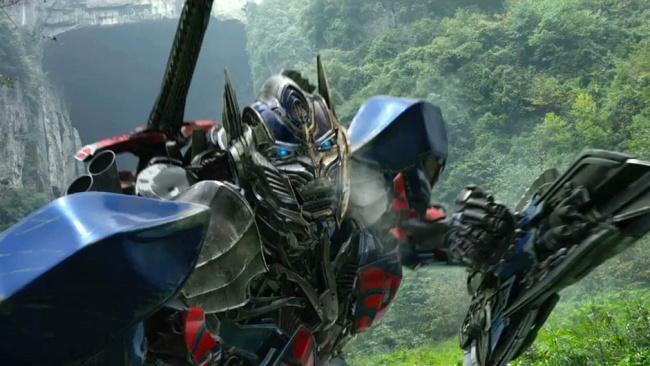
Again, I will be seeing this (it’s like the scifi blockbuster version of Saw) just for the fact that it doesn’t have Shia LaBeouf for people to listen to scream shrilly every two or three minutes. Plus, it has Optimus Prime wrestling and then riding Grimlock.
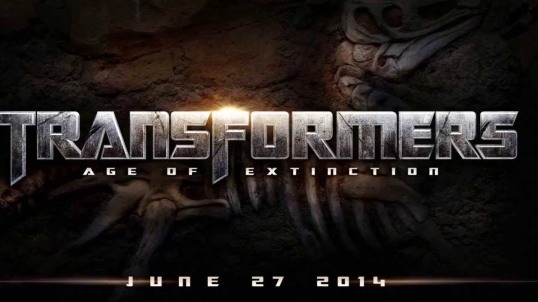
Transformers: Age of Extinction is ready to make our eyes explode on June 27, 2014.
Yes, it is another Transformers film about to descend on the population this coming summer.
Could we finally get a quality one after the last two which got worse and worse with each new entry? I can’t say for sure, but this fourth entry does have one thing going for it and that is the lack of Shia LaBeouf. Instead we get Mark Walhberg in the lead human role. Optimus Prime and Bumblebee return with new robots filling in the rest.
If there’s one thing about Transformers: Age of Extinction that will get me to see it once it comes out is the fact that it has Grimlock and his merry band of Dinobots finally making their appearance. Yes, Grimlock and that’s all I need.
Transformers: Age of Extinction is set for a July 27, 2014 release date.
For our latest entry in the 44 Days of Paranoia, we take a look at a film that might, at first, seem out-of-place in this series — The Hunger Games: Catching Fire.
Why is Catching Fire included in a series of films about conspiracy and paranoia? Because, even more than the first film, Catching Fire is a film with a political subtext. Beneath its franchise surface, Catching Fire is about how the government and media establishment manipulates its citizens and how, occasionally, the citizens are smart enough to manipulate them.
When reviewing Catching Fire, probably the first and most important question is how it compares to The Hunger Games. Is it that film’s equal, is it better, or is it worst? That’s not necessarily an easy question to answer because Catching Fire is a very different film from The Hunger Games.
One of the main reasons that I loved The Hunger Games is because, after a countless number of Twilight-style films that all featured teenage girls willingly sacrificing their independence for a boyfriend, The Hunger Games finally gave us a female protagonist who kicked ass and made no apologies for doing so. Katniss Everdeen was defined by her mind and her soul and not her relationship status. I loved The Hunger Games because, like Brave, it celebrated female strength and independence. While I have always been willing to defend the Twilight films for what they are, I would not want my niece or my future daughter to grow up to be Bella Swan. Katniss Everdeen, however, is a role model for both our times and our future. The Hunger Games was all about celebrating girl power and, for that reason, I loved it.
Katniss Everdeen is still a worthy and independent role model in Catching Fire but the film itself is far more political than The Hunger Games. Whereas The Hunger Games was all about establishing Katniss as a strong woman, Catching Fire is about how that strength can be used to challenge the status quo.
As the film opens, Katniss (played, of course, by Jennifer Lawrence, who I have such a girl crush on) and Peeta (Josh Hutcherson) have returned to District 12 after having “won” the 74th Hunger Games. Realizing that their act of defiance could lead to a full-scale revolution, President Snow (Donald Sutherland) attempts to co-opt their rebel image. He orders that Katniss and Peeta continue to pretend to be in love so that, during their Victory Tour, the citizens of the other districts will be convinced that Katniss’s actions were the result of love and not of defiance.
This is actually a very interesting premise and definitely that shows a lot more sophistication than what we, as filmgoers, have been conditioned to expect from a movie based on YA fiction. While thousands of films have depicted love as a form of political rebellion, Catching Fire is unique in suggesting that love (or the appearance of love) can also be used to maintain political suppression.
During the Victory Tour, both Katniss and Peeta balk at having to play the roles that Snow has assigned them. While at District 11, Katniss pays tribute to Rue and then watches in horror as Snow’s “peacekeepers” executes a man who dared to hold up the three-finger salute. Trying to avoid further violence, Katniss agrees to become engaged to Peeta.
Snow, however, realizes that, as long as Katniss is alive, she’ll be a threat to him. He announces a special all-star edition of The Hunger Games, in which all the tributes will be past winners. Since Katniss is the only female tribute from District 12 to have ever survived the Hunger Games, she knows that she’s going to have to compete for a second time. When Haymitch (Woody Harrelson) is selected to be the male tribue, Peeta immediately volunteers to go in his place.
The first hour of Catching Fire, which deals with the media and political manipulation surrounding the Victory Tour, is brilliant. The second half, which features Katniss and Peeta competing in their second Hunger Games, feels a bit familiar and rushed. It’s not that the second half of the film isn’t good. It’s just far more predictable.
But here’s what’s important — everything that worked about The Hunger Games works for Catching Fire. Josh Hutcherson seems a lot more confident here than he did in the first film, Donald Sutherland makes for a great villain, Stanly Tucci is a lot of fun as Caesar Flickerman (what a great name!), and the film is a visual feast. Among the new cast members, Jena Malone is perfectly cast as tribune Johanna Mason while Philip Seymour Hoffman is properly Philip Seymour Hoffmanish as the new director of the Hunger Games.
However, the film belongs to and works because of Jennifer Lawrence. Whether she’s playing Katniss or Mystique or Ree Dolly or Tiffany Maxwell or Rosalyn Rosenfeld, Jennifer Lawrence kicks ass.



 Through the Shattered Lens