Party Line (1988, directed by William Webb)


“Hot singles are waiting to speak to you!”

Remember those party line commercials that used to air late at night in the 90s?  For just a few dollars a minute, you could call and talk to someone claiming to be a hot woman in your area of town.  (The commercials always featured women because everyone understood that only men would be dumb enough to call the number.)  Even when I was a teenager, I knew that there was no way that a young, hot woman was sitting at home alone and waiting for a stranger to call her.  But obviously, some people thought they were true because those party lines commercials aired for a long time and really only went away once everything moved online.

In Party Line, Greta Blackburn and Leif Garrett plays homicidal siblings who have money to burn so they spend all of their time on the party line, enticing men to sneak away from their wives and come to their mansion so that they can be murdered.  Detectives Richard Hatch and Shawn Weatherly are assigned to find out why so many married men are turning up dead.  The chief of police is played by Richard Roundtree, who is so smooth that his main purpose in the movie is to remind us that not everyone has to use a party line to pick up women.  It’s a standard 80s thriller that has some moments of unexpected humor, largely due to the contrast between the beautiful and rich killers and the people that they target.  Richard Hatch is wooden in the role of the detective but Shawn Weatherly is attractive and likable as his partner,  Greta Blackburn makes for an excellent femme fatale while Leif Garrett is twitchy but convincing as a killer who likes to wear a bridal gown.

Party Line was made when the idea of adult phone lines was still a new one.  Apparently, when those lines first started to advertise, the part about it costing money wasn’t actually mentioned and could only be discovered by reading the small print at the bottom of a television screen.  Since the small print was not only very small but also usually accompanied by a picture of a blonde in lingerie, no one ever bothered to read it.  I was not one of them but I do know more than a few 90s kids who came home from school to discover a parent waiting to talk to them about the phone bill.  The world was a different place back then.  Today, everyone should know that most hot singles have something better to do than to talk to you and if they don’t, they’re probably killers like people in Party Line.  It’s not worth a dollar for each additional minute.


Police Academy 3: Back in Training (1986, directed by Jerry Paris)


Police Academy 3 opens with a state in the middle of a fiscal crisis.  Money has to be saved somewhere and the governor (Ed Nelson) has decided that it’s not necessary for the state to have two police academies.  I am not sure why the governor would be the one to make that determination since the previous two Police Academy films established that the academies are run by the city but I guess I should remember that I’m watching a Police Academy film and not ask too many questions.

Which academy is going to be closed down?  Will it be the academy run by Commandant Lassard (George Gaynes) or the one run by Commandant Mauser (Art Metrano, returning from the second film)?  Mauser is willing to use any dirty, under-handed trick to keep his academy open.  Meanwhile, Lassard has his most recent graduating class returning to instruct his latest batch of recruits.  Can Mahoney (Steve Guttenberg) and Michael Winslow’s human sound effects machine save the academy?

When I watched Police Academy 3 this weekend, I was surprised to discover that it wasn’t as bad as I remembered.  Maybe it’s because I watched it immediately after the first two films and my senses were dulled but Police Academy 3 turned out to be an amiable and enjoyably stupid comedy. It helped that two of the new recruits were played by Tim Kazurinsky and Bobcat Goldthwait.  Returning to the roles that they first played in the second movie, Kazurinsky and Goldthwait make for a good comedic team.  As for the rest of the Police Academy regulars, they all do their usual comedy bits like pros and without any fuss.  It’s predictable and sometimes, funny.

Police Academy 3 was the first Police Academy film to have a PG-rating and, as a result, the jokes were still as juvenile and crude as the first two movies but, at the same time, Police Academy 3 seems to have made peace with the fact that it’s target audience was a bunch of adolescent boys dropped off at the theater by their mothers.  Mauser is still regularly humiliated but no one gets a blow job while standing in front of a podium.  This is a Police Academy for the entire family, assuming that your family is easily amused and not too demanding.

Police Academy 3 is a dumb movie and the recurring joke about policemen accidentally entering the Blue Oyster Bar is even less funny the third time that it’s used.  There’s also a Japanese recruit who only seems to be included because, back in the 80s, American films were obsessed with making fun of Japan.  Despite all that, Police Academy 3 is still not as bad as the usual Police Academy sequel.

But what about Police Academy 4?  Check in tomorrow to find out if it’s also better than I initially remembered.

(It’s not.)

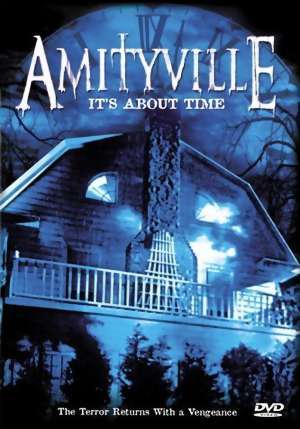
Horror On The Lens: Amityville: It’s About Time (dir by Tony Randel)


Amityville_Its_About_Time

Today’s horror on the lens is a haunted house film from 1992.  In Amityville — It’s About Time, Jacob (Stephen Macht) buys a new clock for his home but what he doesn’t realize is that the clock comes from the infamous Amityville House!  Soon, everyone in the family is acting strange.  Has the clock brought evil spirits with it or–

Well, let’s not even consider the other possibilities.  Of course the clock is full of evil spirits!

As I watched this film on YouTube last month, a lot of it seemed very familiar.  I quickly realized that this was because Amityville — It’s About Time used to show up on HBO all the time when I was a kid.  And while I never sat through the whole film, I did always somehow seem to manage to catch the most gruesome bits and pieces whenever it was on.  And yes, it did give me nightmares!

Of course, the movie would not give me nightmares today but still, it’s good for what it is.  Some of the scare scenes still work, especially the one involving the dog.  Stephen Macht makes for a good psycho and, in the spirit of Halloween, you can even forgive the plot for not making a bit of sense.

Interesting to note: The uber annoying Lenny is played by Jonathan Penner, who would later find some fame as a three-time contestant on Survivor.

(Also, needless to say, this film is rather tame by today’s standards but it’s still NSFW!)


Back to School #53: Dancer, Texas Pop. 81 (dir by Tim McCanlies)


dancer-texas-pop-81-movie-poster-1998-1020196368

Dancer, Texas Pop. 81 is a 1998 film about a small town in West Texas that only has a population of 81 citizens.  Just from my own experience of telling people about how much I happen to like this movie, I get the feeling that only 81 people may have actually seen it.  But no matter!  Regardless of how many people have actually seen it, Dancer, Texas is one of my favorite films about my home state.

Dancer starts out with a scene that is so quintessentially Texan that it might as well appear next to Texas in the dictionary.  Four teenagers — all of whom are scheduled to soon graduate from high school — sit out in the middle of the highway.  The road seems to stretch on forever.  The land around them is empty.  If you’ve ever been to West Texas, you know what type of land I’m talking about.  It’s the type of land where you feel like you can see forever.  In the far distance, we see a pair of headlights.

“Car’s comin'” one of them drawls, knowing that they’ve got at least another 15 minutes before that car ever gets anywhere near the tiny town of Dancer, Texas.

These four teenage boys make up 80% of the graduating class of Dancer’s high school and all four of them are planning on leaving town and heading for Los Angeles.  Keller (Breckin Meyer) is their leader, the big dreamer who can’t wait to get out of the state.  Terrell Lee (Peter Facinelli) is the son of the only rich man in town and he’s being pressured by his mother to stay in Dancer and to learn the oil business.  John (Eddie Mills) is the simplest of the four and also the most reluctant about leaving.  He simply wants to be a farmer and he can’t understand why his taciturn father refuses to say anything to keep him from leaving town.  And finally, there’s Squirrel (Ethan Embry), who is the weird one.  Every group needs a weird one and Squirrel is weird even by the usual standards of small town oddness.

Not much happens in Dancer, Texas.  That goes for both the film and the town.  Over the course of two days, all four of the boys are forced to decide whether they really want to leave or if they actually want to stay.  Adding an extra poignancy to their decision is the fact that there literally is no chance that life in Dancer is ever going to change.  Dancer is as it has always been and always will be.  Deciding to stay means staying forever.  And, as the film shows, that’s okay for some people and terrible for others.

I really like Dancer, Texas.  Yes, it does move at its own deliberate pace and yes, a few scenes do tend to get a bit too obvious in their sentimentality (just to name two of the complaints that I saw from some commenters over at the imdb).  Meyer, Facinelli, and Mills all give such wonderfully natural performances that it makes you all the more aware that Embry seems a bit out-of-place.  But, ultimately, none of that matters.  Dancer, Texas is one of the most honest and sincere films that I’ve ever seen and it’s a film that does my home state proud.

Lisa’s Rating: 8 out of 10

211