Shattered Politics #86: Casino Jack (dir by George Hickenlooper)


Casino_JackI had two reactions to the 2010 film Casino Jack.

My first reaction was to think, “Wow, Kevin Spacey really can act!”  I mean, don’t get me wrong.  I knew that, especially when working with a director who is strong enough to curb his natural tendency to go overboard, Kevin Spacey was capable of giving a great performance.  However, Spacey is one of those actors who has such a unique look and style about him that I think sometimes we forget that he’s capable of doing more than just playing variations on Kevin Spacey.*

And it is true that, in the role of real-life Washington D.C. lobbyist Jack Abramoff, Kevin Spacey gave a performance that was full of the usual Spacey tricks.  By that, I mean we got the Spacey voice going from a purr to a roar in just a manner of seconds.  We got the Spacey glare, where he narrows his eyes and stares at whoever has offended him with an intensity that lets you know that something bad is about to happen.  We got that somewhat strained Kevin Spacey smile, the way facial expression that lets us know that we don’t want to know what’s going on behind that friendly facade.

But, even though Spacey was up to his usual tricks, all of those tricks still came together to create a unique character.  As I watched the film, I forgot that I was watching Kevin Spacey.  Instead, I really felt that I was watching and listening to one of the most powerful lobbyists in American history.

And, when Abramoff was eventually arrested and prosecuted for defrauding his clients, I couldn’t help but feel a little bit of sympathy for him.  Spacey plays the character with such a combination of hyperactive charm and righteous fury that you can’t help but be a little bit enthralled by him.  That’s not to say that Kevin Spacey turns Jack Abramoff into a sympathetic character.  (Indeed, as good as Spacey is, there are a few moments when his contempt for Abramoff comes through and his performance suddenly turns into a one-dimensional caricature.)  But what Spacey does do is show that Jack Abramoff was less an inhuman monster and more the logical product of Washington culture.  The only difference between Abramoff and everyone else in Washington is that Abramoff got caught.

But, at the same time, the move itself is never quite as interesting as Spacey’s lead performance. The movie’s main theme appears to be that Washington is corrupt and we’d do better if we curtailed the power of lobbyists but … well, do you really need a movie to tell you this?  I mean I’m pretty much apolitical and I knew that long before I saw Casino Jack!

Casino Jack: Good performance.  Boring message.  Bleh movie.

http://www.youtube.com/watch?v=w1igM1mfzPI

* This is better known as the Christopher Walken syndrome.
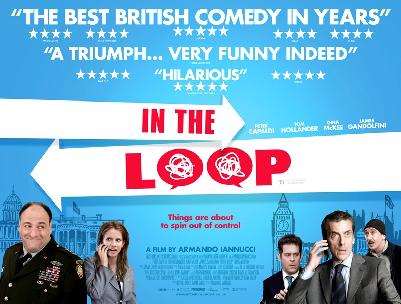
Shattered Politics #85: In the Loop (dir by Armando Iannucci)


In_the_Loop_poster

First released in 2009, In The Loop is one of the most brilliant political satires ever made.

The film opens in London, as a slightly ridiculous man named Toby (Chris Addison) starts his first day as the special assistant to the Secretary of State for International Development, Simon Foster (Tom Hollander).  And what a day to start!  Both the President of the United States and the British Prime Minister are eager to invade the Middle East and, during an interview the previous night, Simon accidentally announced that war was “unforseeable.”  This has led to people accidentally assuming that Simon is anti-war (Simon really doesn’t seem to have an opinion one way or the other) but it also means that the Prime Minister’s compulsively profane assistant, Malcolm Tucker (Peter Capaldi), is now running around the office and threatening people.

(I doubt that there’s any way that I can do justice to Capaldi’s performance here.  You simply have to see him.  He is a force of nature, a tornado of nonstop profanity and aggression.)

Not every government official in the U.S. is enthusiastic about going to war.  Both Assistant Secretary of State for Diplomacy Karen Clarke (Mimi Kennedy) and her former lover, Gen. George Miller (James Gandolfini) are opposed to the war.  Karen’s assistant, Liza (Anna Chlumsky), has even written a paper that explains why a war in the Middle East could not be won.  Karen hopes to use Simon as a spokesman to keep the British out of the war and, therefore, America as well.

(Toby, meanwhile, just wants to have sex with Liza.)

However, there are a few factors that complicate things.  First off, Malcolm is determined to make sure that the Prime Minister gets what he wants and if that means bullying and scaring everyone into supporting an unwinnable war, that’s exactly what he’s going to do.  Secondly, U.S. Assistant Secretary of State For Policy Linton Barwick (David Rasche) is eager enough to start a war that he’s actually started a secret committee to find a way to get into the war.  (The committee, of course, has been called the Committee For Future Planning.)  Third, and perhaps most importantly, Simon is an idiot.

Along with being both a satire of American-British relations (my favorite moment comes when a random American tourist tells Malcolm to stop cursing in public) and the lead-up to the Iraq War, In The Loop is also a devastating look at how government works.  In the Loop makes a good case that, for all the titles and the committee and the talk about doing what’s right, most government policy is the result of a combination of stupidity and needless aggression.  As played by Capaldi, Malcolm has no ideology or core beliefs.  He simply makes sure that the Prime Minister gets what he wants.

And if that means going to war, then Malcolm will do whatever it takes to push Britain into war.

Director Armando Iannucci is probably best known for creating two political comedies, the Thick of It and Veep.  And while I’ve never seen The Thick Of It, I absolutely love Veep.  From what I’ve read, all three projects share the same fictional universe.  (Capaldi’s Malcolm was the main character on The Thick Of It.)

Though, actually, I think it’s debatable just how fictional that universe is.  Ultimately, In The Loop is probably one of the most plausible satires that I’ve ever seen.

http://www.youtube.com/watch?v=_VDc7-YH1LA

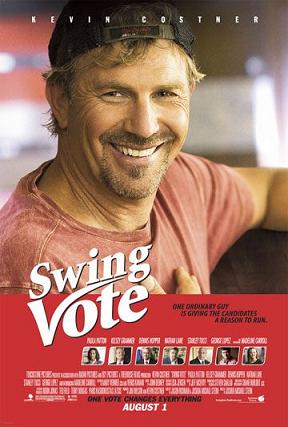
Shattered Politics #84: Swing Vote (dir by Joshua Michael Stern)


Swing_vote_08

Have you ever heard the old saying about how one vote can make all the difference?  I’ve always had to laugh whenever I hear that because I know that, every election, my sister Melissa is going to cancel out my ballot by voting the exact opposite of how I vote.  As a result, even though I’ve participated in almost every election since 2004, my vote has hardly ever really mattered.

(Then again, neither has my sister’s….)

But anyway, the idea of one vote making all of the difference is taken to its logical extreme in the 2008 comedy Swing Vote.  In Swing Vote, a presidential election comes down to who wins the state of New Mexico.  And who wins the state of New Mexico will be determined by just one vote.  You see, the popular vote in New Mexico is tied between the two candidates but it turns out that, due to a voting machine error, one man’s vote has not been counted.  And now, that man has ten days to recast his vote.

(Why does he have ten days?  Mostly because there would not be a movie if they just said, “Please cast your vote again…now!”)

Of course, the problem is that the guy never cast a vote in the first place.  Instead, his vote was cast by his daughter (Madeline Carroll), who basically committed an act of vote fraud and violated federal law.  But it’s cute because she’s super precocious and she just wants her Dad to stop being such a fuck-up.

Oh, did I mention that?

That’s right — the fate of America is in the hands of a complete and total fuck-up.  His name is Bud and he’s played by Kevin Costner.  He’s a rather stupid guy who has never been responsible a day in his life.  He’s also a former felon, which really should have made him ineligible to vote in the first place.  And, on top of that, he’s the type of alcoholic who promises his little girl that he’ll meet her at a scheduled place and time and then proceeds to get drunk inside.

OH MY GOD, WHAT A GREAT GUY!

But, we’re supposed to like Bud because he’s played by Kevin Costner and I really don’t get that logic.  I always find it odd that, every year, we hear about how Kevin Costner is going to be in a few dozen films and how they’re all going to be hits and he’s suddenly going to be a big star again.  I’m never quite sure why people are excited about this prospect.  Whenever I see Costner on-screen (which, admittedly, doesn’t happen that often), I’m always struck by the fact that, regardless of the role, he really does come across as being an asshole.  That really does seem to be his screen presence.  That’s certainly the case in Swing Vote.

And maybe that’s the point of the film.  Be sure to vote so that the fate of America doesn’t end up in the hands of Kevin Costner.

That said, I will say that Swing Vote deserves some credit for casting Kelsey Grammer as the President and Dennis Hopper as his opponent.  Personally, I probably would have voted to reelect Kesley but I think Dennis would have done a good job as well.

(By the way, if ever do find yourself watching Swing Vote, imagine how much funnier the film would have been if it ended with Costner casting his vote and then announcing, “I voted third party!”)


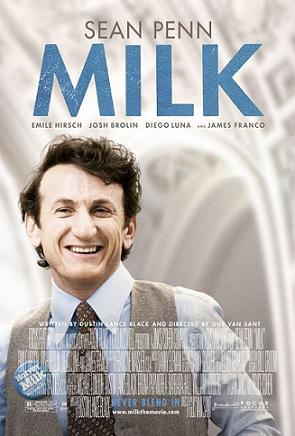
Shattered Politics #83: Milk (dir by Gus Van Sant)


Milkposter08

For the past three weeks, I have been in the process of reviewing, in chronological order, 94 films about politics and politicians.  It’s a little something that we call Shattered Politics.

And while I’ve had a lot of fun doing it, it does worry me a bit that I may have made the Shattered Lens into a far more cynical site to visit.  That’s largely because I don’t trust politicians or the government in general and, despite the fact that we started off with Abraham Lincoln and Mr. Smith Goes To Washington, the majority of the films that I’ve reviewed have reflected that fact.

So, in order to combat that cynicism, I’m going to recommend a film from 2008 that, despite being a biopic about a politician, is actually rather inspiring.  I am, of course, talking about the 2008 best picture nominee, Milk.

Milk tells the story of Harvey Milk who, in 1977, became the first openly gay man to be elected to a major public office.  Now, just consider that.  Up until 38 years ago, nobody who was openly gay had been elected to public office.  Nowadays, the idea of an out gay man or a lesbian running for public office is only shocking to a dwindling minority of homophobes.  Even down here Texas, which everyone up north always smugly assumes to be so intolerant, nobody is surprised when a gay or a lesbian not only runs for office but wins as well.  Sheriff Lupe Valdez has served as sheriff of Dallas Country for over ten years and, though she’s been controversial, none of that controversy has concerned her sexuality.  Meanwhile, Annise Parker has served three-terms as mayor of Houston, making Houston the biggest city in America to have an openly gay mayor.

However, before Lupe Valdez could be sheriff or Annise Parker could be mayor, Harvey Milk had to serve on the San Francisco Board of Supervisors.

Milk follows Harvey (Sean Penn, who won an Oscar for his performance) and his much younger boyfriend, Scott (James Franco) from the moment they first meet in New York to when they moved to San Francisco in 1970.  We see how Harvey first found fame as a neighborhood activist and how he challenged both the political and gay establishment of San Francisco in his campaigns for political office.  When he finally wins a seat on the Board of Supervisors, he does so at the cost of his relationship with Scott.  He enters into another relationship with the self-destructive Jack (Diego Luna), which ends tragically.

By winning office, Harvey becomes a spokesman for gays everywhere.  When a sinister state senator (Denis O’Hare) attempts to pass a bill that would forbid gays from teaching school, Harvey leads to opposition.  And, while Harvey’s career continues to rise, the career of another supervisor — Dan White (Josh Brolin) — plummets.

Elected at the same time as Harvey, Dan is an uptight former cop.  Though he and Harvey originally strike a somewhat awkward friendship (Harvey is the only supervisor to come to the christening of Dan’s child), Dan soon comes to resent Harvey.  (At one point, Harvey suggests that Dan might be closeted and Brolin’s tightly coiled performance certainly implies that Dan is repressing something.)  Eventually, Dan shoots and kills both the mayor (Victor Garber) and Harvey.

Though the film ends in violence and anger, it also ends with hope.  Though Harvey may be dead, the activists that he inspired are there to carry on.

Because the film was directed by a gay man, written by a gay man, and tells the story of a gay man, Milk is often dismissed, even by critics who liked it, as just being a gay film.  But, actually, it is a film that should inspire anyone who has ever felt like they’ve been pushed into the margins of our national culture.  By the film’s end, Harvey Milk has emerged as not just a gay hero but as a hero to anyone who has ever been told that their voice does not matter.  When Harvey says, repeatedly, “You’ve got to give them hope,” it’s hope for all of us.

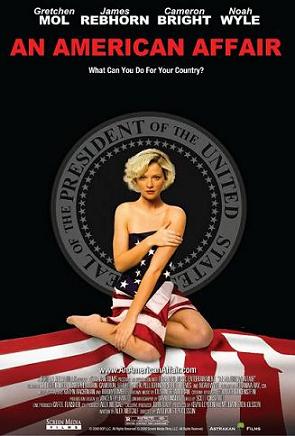
Shattered Politics #82: An American Affair (dir by William Olsson)


American_affair

Though the names may have been changed, the 2008 film An American Affair is clearly based on the true story of Mary Pinchot Meyer.

In the early 60s, Mary Pinchot Meyer was a celebrated member of the Washington D.C. social scene.  A talented painter, Meyer was also the ex-wife of CIA officer Cord Meyer and was an early proponent of LSD.  She also happened to the mistress of John F. Kennedy and reportedly use to smoke weed with him in the Oval Office.  It’s also been reported that she kept a diary, which mysteriously disappeared after Mary’s still unsolved murder in 1964.  Needless to say, many a JFK assassination conspiracy theory has featured Mary Pinchot Meyer as a supporting character.

In An American Affair, Meyer is renamed Catherine Caswell (Gretchen Mol) and she lives across the street from 13 year-old Adam Stafford (Cameron Bright).  While Catherine has secret meetings with the President and deals with her alcoholic ex-husband (played, quite well, by Mark Pellegrino), Adam watches from his bedroom window.  Eventually, Adam goes across the street and offers to work in Catherine’s garden.  Realizing that Adam has a crush on her, an amused Catherine agrees.  While the future of America is being determined all around him, Adam learns about life, love, and art from Catherine.

An American Affair is an odd mix of conspiracy film and coming-of-age dramedy but it actually work pretty well.  Gretchen Mol gives a good performance as the poignantly unstable Catherine and, despite the fact that Adam is kind of a creep at times, Cameron Bright manages to make the character sympathetic.  However, the film’s best performances come from James Rebhorn and Pellegrino, playing two menacing figures who always seem to hovering in the shadows.

An American Affair is a surprisingly good film.  I saw it on Netflix and so should you.

Shattered Politics #81: Charlie Wilson’s War (dir by Mike Nichols)


Charliewilsonwarposter

I hate to say it but Charlie Wilson’s War did not do much for me.

I hate to say that because this 2007 film is fairly well-acted, well-directed, and well-written (by Aaron Sorkin, whose scripts usually get on my last nerve).  And it deals with an important subject.  Taking place in the 80s, the film details how a Texas congressman (Tom Hanks), working with a profane CIA agent (Philip Seymour Hoffman) and an eccentric socialite (Julia Roberts), managed to create popular and political support for giving weapons to the Afghan rebels who were fighting the Soviet invasion of their country.  By doing so, Wilson helps to weaken the Soviet Union but, when his efforts to provide humanitarian aide to Afghanistan are less successful, he also contributes to the subsequent rise of the Taliban.

It should have been a film that I would normally rave about but … I don’t know.

I watched Charlie Wilson’s War.  I laughed at some of Tom Hanks’s facial reactions.  (Hanks is playing a womanizer here who may, or may not, have been high on cocaine when he first learned about the Soviet invasion of Afghanistan and it’s obvious that Hanks really enjoyed getting to play someone who wasn’t a traditionally upright hero.)  As I watched, I again considered what a loss we suffered when the brilliant Philip Seymour Hoffman died.  And, as I watched Julia Roberts, I again wonder why, despite the fact that she’s from Georgia, it is apparently impossible for Julia to sound authentically Southern.

(Of course, I’m sure some would argue that Julia wasn’t playing Southern here.  She was playing a Texan.  Well, I’m a Texan and I’ve never heard anyone down here sound like that.  Tom Hanks, meanwhile, actually managed to come up with a decent accent.  Wisely, he underplayed the accent, whereas I don’t think that Julia has ever underplayed anything in her life.)

And, at the end of Charlie Wilson’s War, I knew I had watched a good film but it was also a film that left me feeling curious detached.  To be honest, I almost think the film would have been better if Hoffman’s CIA agent had been the main character, as opposed to Hanks’s congressman.  Hoffman’s character, after all, is the one who nearly lost his job over his belief that the Afghan rebels should be armed.  All Hanks really has to worry about is whether or not he’s going to be indicted for using cocaine in Vegas.

However, I do think that Charlie Wilson’s War does deserve praise for one very specific reason.  Excluding the films made by native filmmakers like Richard Linklater and Wes Anderson, Charlie Wilson’s War is one of the few films that I’ve ever seen that actually portrays anyone from Texas in a positive light.  Even more shockingly, it’s a positive portrayal of a Texas politician!

(I know it must have been tempting to change history and pretend that Charlie Wilson was originally elected from somewhere up north…)

But, overall, Charlie Wilson’s War didn’t do much for me.  But, if you’re into military history and all that, you might enjoy the film more than I did.

(Plus, all you boys will probably enjoy Emily Blunt’s scenes….)

At the very least, you can watch it for Philip Seymour Hoffman.


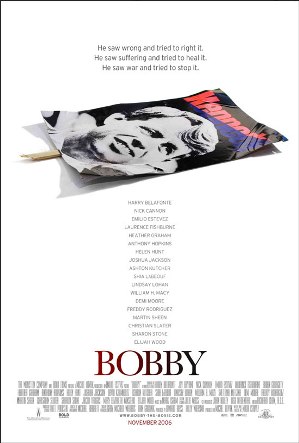
Shattered Politics #80: Bobby (dir by Emilio Estevez)


Bobby_poster

A few years ago, I was on twitter when I came across someone who had just watched The Breakfast Club.  

“Whatever happened to Emilio Estevez?” she asked.

Being the know-it-all, obsessive film fan that I am, I tweeted back, “He’s a director.”

Of course, I could not leave well enough along.  I had to send another tweet, “He directed a movie called Bobby that got nominated for bunch of Golden Globes.”

“Was it any good?” she wrote back.

“Never seen it,” I wrote back, suddenly feeling very embarrassed because, if there’s anything I hate, it’s admitting that there’s a film that I haven’t seen.

However, Shattered Politics gave me an excuse to finally sit down and watch Bobby.  So now, I can now say that I have watched this 2006 film and … eh.

Listen, I have to admit that I really hate giving a film like Bobby a lukewarm review because it’s not like Bobby is a bad film.  It really isn’t.  As a director, Emilio Estevez is a bit heavy-handed but he’s not without talent.  He’s good with actors.  Bobby actually features good performances from both Lindsay Lohan and Shia LaBeouf!  So, give Estevez that.

And Bobby is a film that Estevez spent seven years making.  It’s a film that he largely made with his own money.  Bobby is obviously a passion project for Estevez and that passion does come through.  (That’s actually one of the reasons why the film often feels so heavy-handed.)

But, with all that in mind, Bobby never really develops a strong enough narrative to make Estevez’s passion dramatically compelling.  The film takes place on the day of the 1968 Democratic California Presidential Primary.  That’s the day that Robert F. Kennedy won the primary and was then shot by Sirhan Sirhan in the kitchen of the Ambassador Hotel.  However, it never seems to know what it wants to say about Kennedy or his death, beyond the fact that Estevez seems to like him.

(Incidentally, it’s always interesting, to me, that Dallas is still expected to apologize every day for the death of JFK but Los Angeles has never had to apologize for the death of his brother.)

Estevez follows an ensemble of 22 characters as they go about their day at and around the Ambassador Hotel.  As often happens with ensemble pieces, some of these characters are more interesting than others.

For instance, Anthony Hopkins plays a courtly and retired doorman who sits in the lobby and plays chess with his friend Nelson (Harry Belafonte).  It adds little to the film’s story but both Hopkins and Belafonte appear to enjoy acting opposite each other and so, they’re fun to watch.

Lindsay Lohan plays a woman who marries a recently enlisted soldier (Elijah Wood), the hope being that his marital status will keep him out of Vietnam.  The problem with this story is that it’s so compelling that it feels unfair that it has to share space with all the other stories.

Christian Slater plays Darrell, who runs the kitchen and who spends most of the movie talking down to the kitchen staff, the majority of whom are Hispanic.  Darrell is disliked by the hotel’s manager (William H. Macy) who is cheating on his wife (Sharon Stone).

And then, you’ve got two campaign aides (Shia LaBeouf and Brian Geraghty) who end up dropping acid with a drug dealer played by Ashton Kutcher.  Unfortunately, Estevez tries to visualize their trip and it brings the film’s action to a halt.

Estevez himself shows up, playing the husband of an alcoholic singer (Demi Moore).  And Estevez’s father, Martin Sheen, gets to play a wealthy supporter of Kennedy’s.  Sheen’s wife is played by Helen Hunt.  She gets to ask her husband whether she reminds him more of Jackie or of Ethel.

(Actually, Martin Sheen and Helen Hunt are cute together.  Much as with Lohan and Wood, you wish that more time had been devoted to them and their relationship.)

And there are other stories as well.  In fact, there’s far too many stories going on in Bobby.  It may seem strange for a girl who is trying to review 94 films in three weeks to say this but Emilio Estevez really tries to cram too much into Bobby.

At the same time, too much ambition is better none.  Bobby may have been a misfire but at least it’s a respectable misfire.

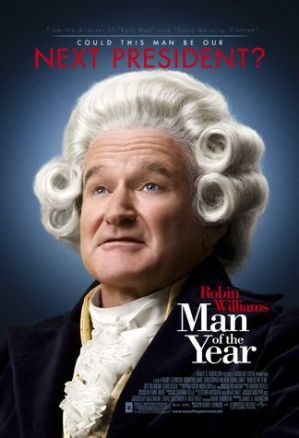
Shattered Politics #79: Man of the Year (dir by Barry Levinson)


Man_of_The_Year_(2006_film)

The 2006 comedy Man of the Year is a difficult film to review.  Some of that is because it’s not that interesting of a film.  It’s simplistic and predictable.  In fact, the only reason that I’m reviewing this film for Shattered Politics is because I needed an example of a bad, mainstream political film.

However, that’s not the only reason why it’s difficult to write about Man of the Year.  The bigger reason is that Man Of The Year stars Robin Williams and, in many ways, it’s typical of one of his later lesser films.  After his tragic death, it’s even harder to watch Robin Williams waste his talents in a bad film.

And, make no mistake about it, Man of the Year is a bad film.

Robin Williams plays Tom Dobbs.  Dobbs, we are told, is the most famous political commentator in America.  Watching the film, it’s obvious that Dobbs is meant to be the film’s equivalent of Jon Stewart and Stephen Colbert.  However, the difference is that Stewart and Colbert are both obviously liberal whereas, from what little we see of Tom Dobbs show, Dobbs doesn’t appear to have any positions beyond the few vague platitudes that pass for political thinking in most mainstream films.  Dobbs is against special interests.  He’s against career politicians.  He’s against … well, he’s against everything that most people are against and for everything that most people are for.  About the closest that Tom Dobbs come to being edgy is when he makes a stupid joke about Pope Benedict being German.

Anyway, Dobbs is recruited to run for President and he manages to get on the ballot in 13 states!  And he’s even doing well because, apparently in this film’s version of reality, Catholic voters have no problem supporting someone who makes fun of Pope Benedict for being German.  And he’s even invited to take part in a presidential debate.  When asked his first question in the debate, Dobbs starts talking and, because he’s being played by Robin Williams, he doesn’t stop.  The debate spirals out-of-control.  Dobbs goes on and on about the state of America, all the while assuming weird accents and slipping in and out of different personalities.

“Oh my God,” I thought, “he’s had a nervous breakdown.”

Except, of course, he hasn’t.  And, since this is a movie, everyone in America loves his performance.  On election night, Tom Dobbs apparently wins all 13 of his states and he’s elected President!

Except, of course, he hasn’t been.  It turns out there was an error with the voting machines.  Eleanor Green (Laura Linney), who works at the company that built the machines, figures out what happened.  In order to keep her from revealing the truth, the company drugs her and attempts to destroy her credibility and…

Wait, this is a Robin Williams comedy, isn’t it?  Well, it is and it isn’t.  Half of the film is devoted to Tom Dobbs saying things that are supposed to be funny but the other half deals with Eleanor trying to expose a giant cover-up without getting killed.  Director Barry Levinson can’t seem to figure out whether his film is supposed to be an unfunny comedy or a boring drama.  So, he tries to do both and … well, taken by that criteria, the film actually works.  If Levinson set out to be unfunny and boring, he succeeded.

One of the biggest dangers of making a film about a comedian is that, for the film to work, you have to believe that people would actually find the comedian to be funny.  When the jokes aren’t funny, it doesn’t matter how many reaction shots of people laughing that you stuff into the film.  Man of the Year is full of reaction shots.  During the debate, we continually see Eleanor’s teenage son laughing.  (How many teenagers, other than the weird ones and the ones assigned to do so for homework, actually watch a presidential debate?)  During one particularly painful moment, Tom starts rambling while traveling on the campaign bus and we are subjected to countless reaction shots of Christopher Walken and Lewis Black laughing so hard that they look like they might faint from exhaustion.

The problem is that it’s rare that a few hundred people will all start laughing and stop laughing at the exact same time.  Whenever you listen to a truly good comedian, you always hear a few giggles that indicate that at least a few audience members are still thinking about the last joke or else that they’re anticipating the next joke.  Often times, when a comedian says something especially funny or unexpected, you don’t even hear laughter.  You might hear a gasp of shock.  You might hear tittering.  You might hear applause.  You might hear someone shouting like they’re at a sporting event.

What I’m saying is that everyone reacts to humor in their own individual way.  Everyone has a laugh of their very own.  Uniform laughter, like the laughter in Man of the Year, sounds fake because it is fake.

Add to that, nothing that Tom Dobbs says is particularly funny.

So, no — don’t watch Man of the Year.  Watch Dead Poets Society.  Watch Good Will Hunting or Awakenings.  You could even watch Cadillac Man!  But don’t watch Man of the Year.

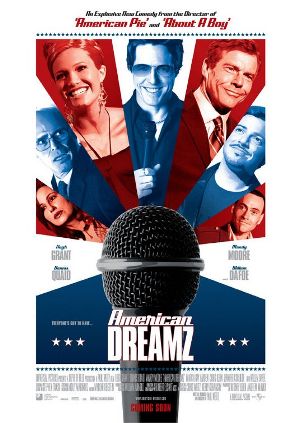
Shattered Politics #78: American Dreamz (dir by Paul Weitz)


Americandreamz

Nothing ages worse than heavy-handed satire and, if you need proof of that, just try watching the 2006 film American Dreamz.  American Dreamz is a satire of two things that are no longer exactly relevant, the presidential administration of George W. Bush and Simon Cowell-era American Idol.

Dennis Quaid plays President George W. Bush Joseph Stanton.  Stanton has just been reelected to a second term.  One morning, he impulsively decides to read a newspaper for the first time in his life and he ends up having a nervous breakdown.  “The world isn’t black-and-white,” he declares, “Instead, it’s gray.”  Sinking into a deep depression, Stanton isolates himself from the American people and his approval rating starts to plunge.  His evil Chief of Staff (William DaFoe, made up to look like Joe Biden but, I’m assuming, meant to be Dick Cheney) comes up with a plan to restore Stanton’s popularity.  President Stanton will serve as a guest judge on his favorite television show, American Idol American Dreamz!

(To be honest, I think Obama would be more likely to show up as a guest judge than Bush.)

The host of American Dreamz is a self-loathing Englishman named Martin Tweed (Hugh Grant).  Tweed hates both the show and himself.  Early on in the film, he’s literally seeing begging for American Dreamz to be canceled.  However, American Dreamz is the number one show in the country and the show must go on.

Along with President Stanton, the latest season of American Dreamz features a group of contestants who all have dramatically compelling backstories.  Sally Kendoo (Mandy Moore) emerges as a favorite, largely do to her ability to manipulate the camera and the fact that her well-meaning but simple-minded boyfriend (Chris Klein) was wounded in Iraq.

Oh wow — reality shows manipulate reality and contestants are rarely as innocent as they seem!?

Tell me more, American Dreamz!

Also competing on American Dreamz is Omer (Sam Golzari), a former jihadist who proved to be too clumsy to take part in the various propaganda videos being shot by his terrorist cell.  Omer was sent to America, where his love for show tunes eventually landed him on American Dreamz.  With the finale rapidly approaching, Omer has been instructed to blow both himself and the President up on national TV.

The satire of American Dreamz really wasn’t all that sharp when the film was first released and now, 9 years later, it feels even weaker.  Quaid and Grant both give good performances but the film’s attempts at humor largely fall flat because they’re all so predictable.  It’s not exactly mind-blowing to say that reality TV is fake or that politics has a lot in common with show business.  The film attempts to add some bite to its message by ending with a surprisingly dark twist but it’s just not enough.  Even a dark ending has to be earned.


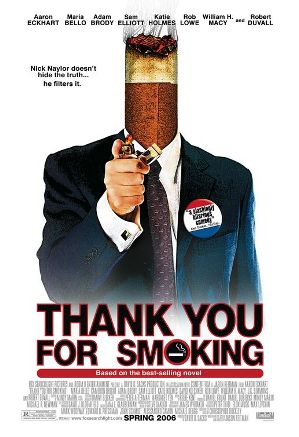
Shattered Politics #77: Thank You For Smoking (dir by Jason Reitman)


Thank_you_for_smoking_PosterI have always hated those Truth.com commercials.  Truth.com is an organization that claims to be dedicated to eradicating smoking.  Their smug commercials are essentially the height of hipster douchebaggery, a bunch of self-consciously cool people wandering around and harassing random people about whether or not they smoke.  And then, of course, there was the commercial where they all gathered outside a tobacco company and pretended to be dead.  Of course, the truth about Truth.com is that they are essentially the same people who, in high school, would get offended whenever anyone wore a short skirt.  I really can not stand people like that.  (And don’t even get me started on those assholes who appear in the Above The Influence commercials.)  Myself, I don’t smoke because I have asthma.  But, seriously, whenever I see a Truth.com commercial, I’m tempted to run down to 711 and start.

And so maybe that’s why I like the 2005 comedy Thank You For Smoking.

The hero of Thank You For Smoking is Nick Naylor (Aaron Eckhart), a lobbyist for the tobacco industry, who is first seen appearing on a talk show and winning over a hostile audience by announcing that the tobacco industry is going to be investing millions in researching way to keep young people from smoking and shaking the hand of a teenage honor student who is dying from lung cancer.  Over the course of the film, Nick shows us how he does business, everything from defending tobacco companies on talk shows to convincing a former Marlboro Man-turned-cancer-patient to drop his law suit.  When Nick isn’t working, he’s hanging out with his best friends (who are lobbyists for both the liquor and the gun industries), trying to bond with his son (Cameron Bright), or having sex with a reporter (Katie Holmes).

Now, in most movies, Nick Naylor would be the villain.  However, in Thank You For Smoking, Nick becomes a hero by default, if just because everyone who disagrees with him is even worse than he is.  Add to that, Nick has the benefit of being played by Aaron Eckhart while all of his opponents are played by balding actors with ugly beards.

Another reason that I liked Thank You For Smoking was because the main villain was a senator from Vermont and it’s about time somebody stood up to the tyranny of Vermont.  Ortolan Finistirre (William H. Macy) has built a career out of campaigning against the tobacco industries and why shouldn’t he?  Who, other than Nick Naylor, is willing to defend them?  Finistirre’s latest plan is to change the law so that every pack of cigarettes has to be branded with a skull and crossbones warning.

When Nick and Finistirre finally face off, it’s a battle between those who believe in allowing people the freedom to make their own choices and those who hide their totalitarian impulse behind claims that they’re working for the greater good.

Thank You For Smoking was Jason Reitman’s first film.  And while it may be a bit too episodic and it frequently struggles to maintain a consistent tone, it’s still a lot better than both Labor Day and Men, Women, & Children.