I review COOGAN’S BLUFF (1968) – starring Clint Eastwood!


Here at The Shattered Lens, we’re looking forward to celebrating the birthday of Clint Eastwood on May 31st. In anticipation, I decided to revisit COOGAN’S BLUFF (1968). 

Clint Eastwood is Coogan, a tough as nails deputy sheriff from Arizona, who’s ordered by his boss, Sheriff McCrea (Tom Tully) to go to New York City and bring back the escaped killer James Ringerman (Don Stroud). When he gets to New York, he’s informed by Lieutenant McElroy (Lee J. Cobb) that Ringerman has overdosed on LSD while in the state’s custody, he’s now in the Bellevue Hospital, and he will not be released to Coogan until the state Supreme Court says so. Stuck in the Big Apple with nothing to do but flirt with probation officer Julie Roth (Susan Clark), Coogan decides to take matters into his own hands and get Ringerman out of the hospital early. He bluffs the attendants at the hospital into turning Ringerman over to him so he can catch the first plane back to Arizona. It seems like a good plan until he’s ambushed by Ringerman’s girlfriend Linny (Tisha Sterling) and his friend Pushie (David Doyle), he gets conked on the head, and he loses both his gun and his prisoner. Now, in trouble with Lieutenant McElroy and Sheriff McCrea, Coogan is ordered back home to Arizona. Determined to get Ringerman at any cost, Coogan stays in the city and leaves a trail of broken hearts and bruised bodies on his way to capturing his man! 

Made in 1968 after Eastwood’s string of excellent spaghetti westerns with Sergio Leone, COOGAN’S BLUFF may be set in contemporary times, but Coogan still seems to be a product of the old west. A big part of the fun is watching him interact with the people of New York City, where everyone is trying to take advantage of him, whether it be the cab driver, the hotel clerk, or the hooker down the hall. When he finally gets to the police station, he sees a building that’s completely overrun with criminals and crazies. He soon finds that Lieutenant McElroy follows the law down to the letter, while he treats the law as more of a set of suggestions on his way to getting the bad guys. This leads to endless frustration and almost gets Coogan arrested multiple times throughout the film as he doesn’t want to deal with all the red tape. One thing that doesn’t change whether Coogan is in Arizona or New York is his success with the ladies. They all swoon and he more than willingly obliges. The only problem for his prospect of true love is the fact that getting his guy always comes first, and he’ll use that sex appeal to get whatever information he needs. One of the main action scenes in this film, the bar fight, is set up ironically when the woman he’s “using” turns the tables and instead sets him up to be pummeled. 

COOGAN’S BLUFF is Eastwood’s first film with director Don Siegel, with whom he’d make DIRTY HARRY a few years later. You can definitely see the genesis of Harry Callahan in Walt Coogan, a man who does whatever it takes to stop criminals, is quick with a whip, and usually pisses off his superiors along the way. In some ways, you could say that Walt Coogan set the mold for the hero of cop films for the next couple of decades! It also has that sense of humor that would be a mark of Eastwood’s cop films. This one includes a funny thread that runs throughout where every person he meets assumes he’s from Texas because he wears a cowboy hat, and he always corrects them that he’s from Arizona. I get this as I always make sure people know that I’m from Arkansas! 

Overall, I really enjoy COOGAN’S BLUFF due mainly to Clint Eastwood’s excellent performance in the lead role. It was a great start to his “post Leone” career and would influence action movie heroes from that point forward. 

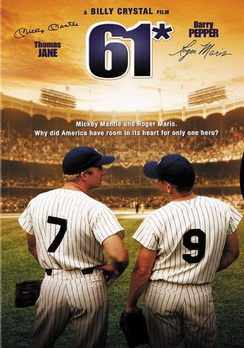
I Watched 61* (2001, Dir. by Billy Crystal)


61* is about two baseball player and two friends who couldn’t seem to be more different.

Roger Maris (Barry Pepper) is an introverted family man who doesn’t like it when reporters show up at his house in search of a story or a quote.  He’s a good ball player, one of the best, but he doesn’t want to be a celebrity.  Mickey Mantle (Thomas Jane) is a larger-than-life personality, a beloved figure on the field and in the dugout.  Mickey loves being famous and the fans love him.  Both Maris and Mantle are members of the New York Yankees.  Because Mantle is struggling with his drinking, he becomes Maris’s roommate when they’re on the road.  In 1961, the two friends both go after Babe Ruth’s record of 60 home runs in a season.  The press presents their season as a battle, a race to see who will be the first to hit the sixty-first home run of the season.  Mantle and Maris, though, are just swinging the bat and making plays.

I really enjoyed 61*, which is a baseball film made by and for people who love baseball.  I liked the contrast between the quiet Maris and the charismatic Mantle.  Even though Maris is a hard worker and a good ballplayer, Mantle is the fan favorite and the one that people actually want to break the record.  I appreciated that Maris and Mantle remained friends even when the press tried to turn them into rivals.  That’s what teamwork is all about.  Barry Pepper and Thomas Jane were great as Maris and Mantle and the movie showed how each man dealt with the stress of possibly breaking Babe Ruth’s record.

(Why is there an asterisk in the title?  Babe Ruth set his record in a season that only had 154 games.  The 1961 baseball season was 8 games longer.  The asterisk was added as a reminder that Maris and Mantle had 8 more games than Ruth did to try to break the record.  Baseball fans understand how important accurate statistics are to a player’s career and a team’s season.)

61* celebrates the way baseball used to be, a game played by athletes who had to depend on skill and teamwork instead of performance enhancing drugs.  The movie opens with Maris’s family watching as Mark McGuire closes in on breaking the record.  McGuire would only briefly hold the record.  He would lose it, for 48 minutes, to Sammy Sosa and then, three years after winning it back, he would lose it a second time to Barry Bonds.  Of course, Roger Maris won the record without using steroids so, as far as I’m concerned, it still belongs to him.

If you’re a baseball fan, 61* is a film that you have to see.

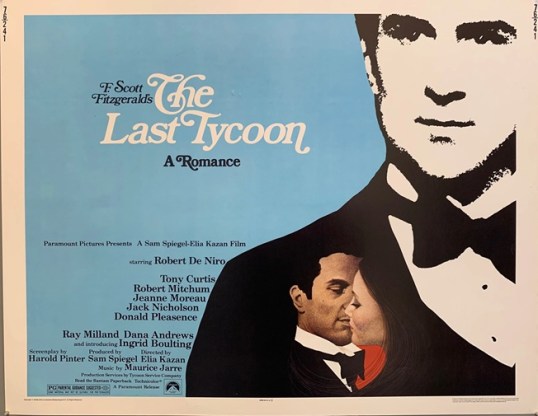
Icarus File No. 23: The Last Tycoon (dir by Elia Kazan)


Based on the final (and unfinished) novel by F. Scott Fitzgerald, 1976’s The Last Tycoon tells the story of Monroe Stahr (Robert De Niro).

Monroe Stahr is the head of production at a film studio during the early days of Hollywood.  Stahr is an unemotional and seemingly repressed man who only shows enthusiasm when he’s talking about movies.  He may not be able to deal with real people but he instinctively knows what they want to see on the big screen.  Stahr is a genius but he’s working himself to death, ignoring his health concerns while trying to create the perfect world through film.  He’s haunted by a lost love and when he meets Kathleen Moore (Ingrid Boulting, giving a remarkably dull performance), he tries to find love with her but, naturally, he doesn’t succeed.  Meanwhile, he has to deal with his boss (Robert Mitchum), his boss’s daughter (Theresa Russell), a neurotic screenwriter (Donald Pleasence), an impotent actor (Tony Curtis), and a lowdown dirty communist labor organizer (Jack Nicholson)!  Sadly, for Stahr, McCarthyism is still a few decades away.

There’s a lot of talented people in The Last Tycoon and it’s undeniably interesting to see old school stars — like Mitchum, Curtis, Dana Andrews, Ray Milland — acting opposite a Method-driven, 30-something Robert De Niro.  This is one of those films where even the minor roles are filled with name actors.  John Carradine plays a tour guide.  Jeff Corey plays a doctor.  This is a film about Golden Age Hollywood that is full of Golden Age survivors.  It’s a shame that most of them don’t get much to do.  The Last Tycoon is a very episodic film as Stahr goes from one crisis to another.  Characters show up and then just kind of disappear and we’re never quite sure how Stahr feels about any of them or how their existence really shapes Stahr’s worldview.  Robert De Niro may be a great actor but, as portrayed in this film, Monroe Stahr is a boring character and De Niro’s trademark tight-lipped intensity just makes Stahr seem like someone who doesn’t have much to offer beyond employment.  This is one of De Niro’s least interesting performances, mostly because he’s playing a not-particularly interesting person.  Mitchum, Pleasence, and the old guard all make an impression because they’re willing to coast by on their bigger-than-life personalities.  De Niro is trapped by the Method and a total lack of chemistry with co-star Ingrid Boulting.

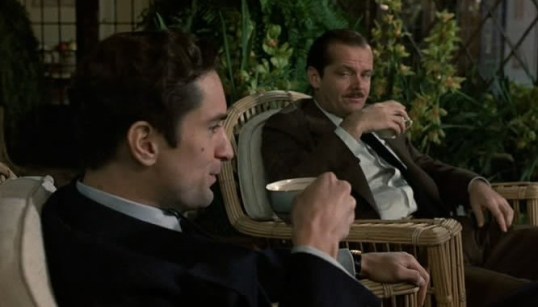
Still, this is the only film to feature both De Niro and Jack Nicholson.  (The Departed was originally conceived as a chance to bring De Niro and Nicholson together, with De Niro being the original choice for the role eventually played by Martin Sheen.)  Nicholson’s role is small and he doesn’t show up until the film is nearly over.  He and De Niro have an intense table tennis match.  Nicholson doesn’t really dig deep into Brimmer’s character.  Instead, he flashes his grin and let’s the natural sarcasm of his voice carry the scene.  It’s nowhere close to being as emotionally satisfying as the De Niro/Pacino meeting in Heat.  That said, Jack Nicholson at least appears to be enjoying himself.  His natural charisma makes his role seem bigger than it actually is.

Why was The Last Tycoon such a disappointment?  Though unfinished, the book still featured some of Fitzgerald’s best work and there’s a huge amount of talent involved in this film.  The blame mostly falls on Elia Kazan, who came out of retirement to direct the film after original director Mike Nichols left the project.  (Nichols reportedly objected to casting De Niro as Stahr.  While it’s tempting to think that Nichols realized that De Niro’s intense style wouldn’t be right for the role, it actually appears that Nichols and De Niro sincerely disliked each other as Nichols also abandoned the next film he was hired to direct when he was told that De Niro wanted the lead role.  Nichols choice for Monroe Stahr was Dustin Hoffman, which actually would have worked.  If nothing else, it would have provided a Graduate reunion.)  Kazan later said that he did the film solely for the money and it’s obvious that he didn’t really care much about the film’s story.  The film has some good scenes but, overall, it feels disjointed and uneven.  Kazan doesn’t really seem to care about Monroe Stahr and, as a result, the entire film falls flat.

Previous Icarus Files:

  1. Cloud Atlas
  2. Maximum Overdrive
  3. Glass
  4. Captive State
  5. Mother!
  6. The Man Who Killed Don Quixote
  7. Last Days
  8. Plan 9 From Outer Space
  9. The Last Movie
  10. 88
  11. The Bonfire of the Vanities
  12. Birdemic
  13. Birdemic 2: The Resurrection 
  14. Last Exit To Brooklyn
  15. Glen or Glenda
  16. The Assassination of Trotsky
  17. Che!
  18. Brewster McCloud
  19. American Traitor: The Trial of Axis Sally
  20. Tough Guys Don’t Dance
  21. Reach Me
  22. Revolution

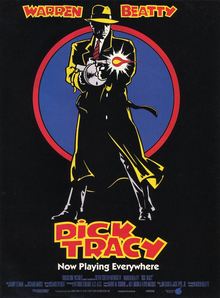
Dick Tracy (1990, directed by Warren Beatty)


The year is 1937 and “Big Boy” Caprice (Al Pacino) and his gang of flamboyant and often disfigured criminals are trying to take over the rackets.  Standing in their way is ace detective Dick Tracy (Warren Beatty), the yellow trench-wearing defender of the law.  Tracy is not only looking to take down Caprice but he and Tess Trueheart (Glenne Headly) are currently the guardians of The Kid (Charlie Korsmo), a young street kid who witnessed one of Caprice’s worst crimes.  Tracy’s investigation leads him through a rogue’s gallery of criminals and also involves Breathless Mahoney (Madonna), who has witnessed many of Caprice’s crimes but who also wants to steal Tracy’s heart from Tess.

Based on the long-running comic strip, Dick Tracy was a labor of love on the part of Warren Beatty.  Not only starring but also directing, Tracy made a film that stayed true to the look and the feel of the original comic strip (the film’s visual palette was limited to just seven colors) while also including an all-star cast the featured Madonna is an attempt to appeal to a younger audience who had probably never even heard of Dick Tracy.  When Dick Tracy was released, the majority of the publicity centered around Madonna’s participation in the film and the fact that she was dating Beatty at the time.  Madonna is actually probably the weakest element of the film.  More of a personality than an actress, Madonna is always Madonna no matter who she is playing and, in a film full of famous actors managing to be convincing as the members of Dick Tracy’s rogue gallery, Madonna feels out of place.  Michelle Pfeiffer would have been the ideal Breathless Mahoney.

It doesn’t matter, though, because the rest of the film is great.  It’s one of the few comic book films of the 90s to really hold up, mostly due to Beatty’s obvious enthusiasm for the material and the performances of everyone in the supporting cast who was not named Madonna.  Al Pacino received an Oscar nomination for playing Big Boy Caprice but equally good are Dustin Hoffman as Mumbles, William Forsythe as Flaptop, R.G. Armstong as Pruneface, and Henry Silva as Influence.  These actors all create memorable characters, even while acting under a ton of very convincing makeup.  I also liked Dick Van Dyke as the corrupt District Attorney.  Beatty knew audience would be shocked to see Van Dyke not playing a hero and both he and Van Dyke play it up for all its worth.  Beatty embraces the comic strip’s campiness while still remaining respectful to its style and the combination of Danny Elfman’s music and Stephen Sondheim’s songs provide just the right score for Dick Tracy’s adventures.  The film can be surprisingly violent at times but the same was often said about the Dick Tracy comic strip.  It wasn’t two-way wrist radios and trips to the Moon.  Dick Tracy also dealt with the most ruthless and bloodthirsty gangsters his city had to offer.

Dick Tracy was considered to be a box office disappointment when it was originally released.  (Again, you have to wonder if Beatty overestimated how many fans Dick Tracy had in 1990.)  But it holds up well and is still more entertaining than several of the more recent comic book movies that have been released.

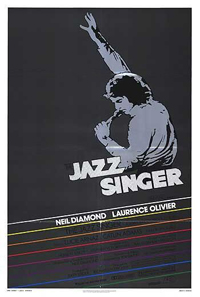
Film Review: The Jazz Singer (dir by Richard Fleischer)


In the 1980 remake of The Jazz Singer, it only takes the film seven minutes to find an excuse to put Neil Diamond in blackface.

Of course, the film was a remake of the 1927 version of The Jazz Singer, which featured several scenes of Al Jolson performing in blackface.  In fact, Al Jolson in blackface was such a key part of the film that it was even the image that was used to advertise the film when it was first released.  Back in the 20s, Jolson said that wearing blackface was a way of honoring the black artists who created jazz.  (As shocking as the image of Al Jolson wearing blackface is to modern sensibilities, Jolson was considered a strong advocate for civil rights and one of the few white singers to regularly appear on stage with black musicians.)  Regardless of Jolson’s motives, less-progressively minded performers used blackface as a way to reinforce racial stereotypes and, to modern audiences, blackface is an abhorrent reminder of how black people were marginalized by a racist culture.  You would think that, if there was any element of the original film that a remake would change, it would be the lead character performing in blackface.

But nope.  Seven minutes into the remake, songwriter Jess Robin (Neil Diamond) puts on a fake afro and dons blackface so that he can perform on stage at a black club with the group that is performing his songs.  The group’s name is the Four Brothers and, unfortunately, one of the Brothers was arrested the day of the performance.  Jess performs with the group and the crowd loves it until they see his white hands.  Ernie Hudson — yes, Ernie Hudson — stands up and yells, “That’s a white boy!”  A riot breaks out.  The police show up.  Jess and the three remaining Brothers are arrested and taken to jail.  Jess is eventually bailed out by his father, Cantor Rabinovitch (Laurence Olivier).  The Cantor is shocked to discover that his son, Yussel Rabinovitch, has been performing under the name Jess Robin.  He’s also stunned to learn that Yussel doesn’t want to be a cantor like his father.  Instead, he wants to write and perform modern music.  The Cantor tells Yussel that his voice is God’s instrument, not his own.  Yussel returns home to his wife, Rivka (Caitlin Adams), and tries to put aside his dreams.

But when a recording artist named Keith Lennox (Paul Nicholas) wants to record one Yussel’s songs, Yussel flies out to Los Angeles.  As Jess Robin, he is shocked to discover that Lennox wants to turn a ballad that he wrote into a hard rock number,  Jess sings the song to show Lennox how it should sound.  The arrogant Lennox is not impressed but his agent, Molly (Lucie Arnaz) is.  Soon, Jess has a chance to become a star but what about the family he left behind in New York?  “I have no son!” the Cantor wails when he learns about Jess’s new life in California.

I’ve often seen the 1980 version of The Jazz Singer referred to as being one of the worst films of all time.  I watched it a few days ago and I wouldn’t go that far.  It’s not really terrible as much as its just kind of bland.  For someone who has had as long and successful a career as Neil Diamond, he gives a surprisingly charisma-free performance in the lead role.  The most memorable thing about Diamond’s performance is that he refuses to maintain eye contact with any of the other performers, which makes Jess seem like kind of a sullen brat.  It also doesn’t help that Diamond appears to be in his 40s in this film, playing a role that was clearly written for a much younger artist.  Still, when it comes to bad acting, no one can beat a very miscast Laurence Olivier, delivering his lines with an overdone Yiddish accent and dramatically tearing at his clothes to indicate that Yussel is dead to him.  Olivier was neither Jewish nor a New Yorker and that becomes very clear the more one watches this film.  It takes a truly great actor to give a performance this bad.  Diamond, at least, could point to the fact that he was a nonactor given a starring role in a major studio production.  Olivier, on the other hand, really had no one to blame but himself.

Still, I have to admit that ending the film with a sparkly Neil Diamond performing America while Laurence Olivier nods in the audience was perhaps the best possible way to bring this film to a close.  It’s a moment of beautiful kitschThe Jazz Singer needed more of that.

IT COULD HAPPEN TO YOU (1994) – Nicolas Cage wins the lottery! Now what about that tip?!


As much as I enjoy writing about movies and talking about movies, I make a living by helping people with their annual income tax filings. That means from around January 15th through April 15th each year, almost every waking hour is spent focused on tax return preparation. While I’m working on these tax returns, I will often play movies or TV shows on one of my computer screens. These aren’t just any movies, though. These are movies or TV shows that make me feel good and help me relax while I’m working so many hours. Over the years, I’ve used movies like THE OTHER GUYS, THE HANGOVER, and ZOMBIELAND. A few years ago, THE ANDY GRIFFITH SHOW was on Prime, and I watched the entire 8 seasons through 3 times during tax season. One genre I hit hard this time of year is romantic films, both comedies and dramas. The main thing I’m looking for is happy endings. My favorite romantic films include NOTTING HILL, RETURN TO ME, HITCH, YOU’VE GOT MAIL, PERSUASION & SENSE AND SENSIBILITY. As a big fan of Nicolas Cage, IT COULD HAPPEN TO YOU, Cage’s 1994 romantic comedy with Bridget Fonda has joined that list over the years as well. Since today, January 7th, 2025, is Nicolas Cage’s 61st birthday, and tax season is coming, I thought I’d write about this charming film!

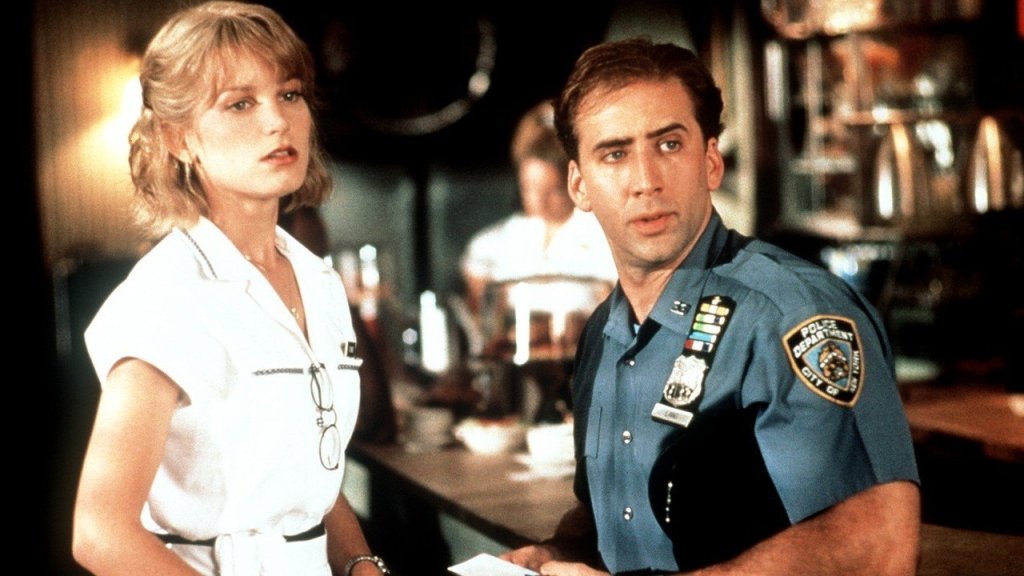
IT COULD HAPPEN TO YOU revolves around Charlie Lang (Nicolas Cage), a New York City cop who seems like an all-around good guy. One day he’s having coffee at a local diner with his partner Bo (Wendell Pierce), when they get a police call. Charlie finds himself without the money to give a proper tip to his waitress, Yvonne (Bridget Fonda), so he improvises on the spot and tells her he has a lottery ticket to be drawn on that very same night. Further, he goes on to tell her if he wins, he’ll split the winnings with her as a tip. The two cops head on out, Charlie happy that he gave her something, and Yvonne, who’s not having a good day anyway, just shakes it off knowing that it’s just another small tip she missed out on. But wouldn’t you know it, on this night the stars all align and Charlie’s number is drawn as a winner. Charlie and his wife Muriel (Rosie Perez) are ecstatic with their win, which amounts to around $4 million. In the middle of their celebration, Charlie remembers his promise to Yvonne and tells Muriel. To say she’s upset is an understatement, and she begs him to stiff the waitress. Charlie is just too honest for that, so he is able to convince Muriel that $2 Million is enough for them to live comfortably on. She begrudgingly agrees, but the fuse has been lit between Charlie and Muriel. The next day, Charlie goes back to the diner and tells Yvonne that they won. At first not believing it’s true, Charlie is able to convince Yvonne that he’s honoring his tip by giving her half of the winnings. We have found out that Yvonne is having severe financial problems, and this “tip” comes as a completely unexpected answer to her prayers. Alls well that ends well, right? As we all know, money can bring out the very best or the very worst in people and we see that play out throughout the rest of the movie. I’ll just put it this way, as Charlie and Muriel grow apart with their newfound money, Charlie and Yvonne grow closer together, bound by this amazing experience. 

It’s all a pretty crazy setup, but IT COULD HAPPEN TO YOU is a movie that I relate to idealistically. I really like Cage and Fonda in their roles. I’d love to be as honest and likable as Nicolas Cage’s character Charlie Lang. He is just a good guy, way down deep. I want to be that kind of guy. And Bridget Fonda’s character Yvonne is also very appealing. She’s presented as a lady going through a lot of personal issues, but who somehow seems to always show a kind and compassionate spirit to everyone around her, especially to others who are struggling. The scene where Charlie convinces her that he really is giving her half the money is quite an uplifting scene. Both of these characters have an honesty and attitude about life that resonates with me. Some people might argue that their characters should have more depth to make them more realistic and less one-dimensional, and they might be right, but I personally enjoy seeing them as just really honest and kind people. 

It should also be pointed out that you have to be able suspend your disbelief to enjoy IT COULD HAPPEN TO YOU. If your movies “have” to be realistic, this is not the movie for you. The entire premise is a fairytale, and the movie should be seen as such. For the movie to work, the good guys have to be really good guys, and the bad guys have to be really bad guys. I’ve mentioned earlier how kind both Charlie and Yvonne are throughout the film, with the money not changing their attitudes about life in any way. If anything, the money allows them to be even more kind and generous to others. Well, money has had the exact opposite effect on Muriel, and we soon learn that $2 Million isn’t enough for her and that the full $4 Million would not have been enough either. At this point, I’m not sure $100 Million would have been enough. In our fairytale story, she can’t be presented as a lady realistically struggling with her husband’s overly generous tip, she has to be presented as extremely selfish and cruel. I mean, how else is the story going to get Charlie and Yvonne together?!

All in all, IT COULD HAPPEN TO YOU works for me. I’ve said many times I’m a sucker for a good romance, and this film fits the bill for me. The main characters warm my heart as they are decent, kind and honest. I like a good fairytale. It’s one of the main reasons I enjoy the movies, and it doesn’t seem like we get enough good fairytales these days. 

Check out the trailer for IT COULD HAPPEN TO YOU below!

And if you’re looking for more awesome information about Nicolas Cage, check out John Rieber’s latest post where he celebrates Cage’s birthday with a movie marathon!

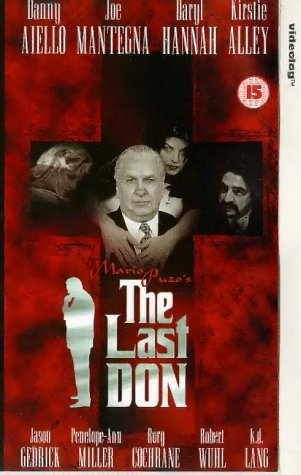
Miniseries Review: Mario Puzo’s The Last Don (dir by Graeme Clifford)


First broadcast over three nights in 1997, The Last Don tells the story of a powerful and respected Mafia family. They control politicians across the country and they own casinos in Vegas and their power even extends all the way to Hollywood. Despite having many enemies, the family has thrived due to the leadership of a wise but ruthless Don.  This Don remembers the old ways and imparts lessons about honor to the members of his own family.  Never let anyone know what you’re thinking.  Never side against the family.  If someone like you were to make enemies, they would become the Don’s enemies and then they would fear you …. you know, stuff like that.

However, times are changing and America is changing with it.  The underworld is no longer run by men of honor.  On top that, the Don is aging and in ill-health. Who will succeed him? One possible successor is respected by all but he’s stayed out of the dirtier aspects of the family’s business and, in fact, he seems to have no desire to be a feared man.  Another possible successor is ruthless and has a terrible temper.  He sometimes speaks out of turn, because the Don has a sentimental weakness for his children.  This possible successor’s anger is feared but perhaps fear is the future of the organized crime in America.  The old ways are changing but one thing remains the same.  The Don believes in America and he believes in family and….

Wait.

Okay, is it just me or does this all sound just a little bit familiar?

If it does, that’s probably because The Last Don is based on a novel by The Godfather‘s Mario Puzo.  Though the family may be called The Clerichuzios and the action may have been moved fro the 40s and the 50s to the 60s, 70s, and 80, the story is still the same basic one that was told in The Godfather.  Don Clerichuzio (Danny Aiello) is an honorable man whose time is coming to an end.  His grandnephew, Cross (Jason Gedrick), is the possible successor who isn’t crazy.  His grandson, Dante (Rory Cochrane), is the possible successor who is violent and doesn’t know how to negotiate.  Don Clerichuzio’s dream is for the family to become completely legitimate but good luck with that when the film business and the political world are just as corrupt as the Mafia.  I supposed one could argue that The Last Don is narrated by Don Clerichuzio while The Godfather has no narration at all but, seriously, once you have to add a voice-over to explain what’s going on, you have pretty much already last the war.

And yes, I did mention the film business.  When Francis Ford Coppola first read The Godfather, he famously hated the Hollywood sections of the book and, with the exception of Tom Hagen’s visit to Jack Woltz (and Woltz’s subsequent discovery of a horse’s head in his bed the next morning), Coppola refused to include them in the movie.  The second half of The Last Don, however, goes full Hollywood and, more or less, proves Coppola’s point.  Cross’s sister, Claudia (Michelle Burke, who also co-starred with Cochrane in Dazed and Confused), gets a job as an agent and one of her clients is the world’s most famous actress, the ludicrously named Athena Aquataine (Daryl Hannah).  When Athena has trouble with her crazy ex-husband (Chris Meloni, bringing a spark of genuine danger to the production), Cross helps her out, falls in love, and gets involved in the production of her next film.  This brings him into conflict with a studio exec named Bobby Bantz (Robert Wuhl).  Unfortunately, all of the Hollywood stuff is pretty dull.  One gets the feeling that Puzo was perhaps settling some old scores with the character of Bobby but Robert Wuhl is one of those goofy actors who belongs nowhere near a Mafia drama.  And don’t even get me started on country singer k.d. lang, who is bizarrely cast as a film director.

(Add to that, how can anyone take a character named Athena Aquataine seriously?  I never miss an Athena Aquataine movie!))

The Hollywood stuff distracts from the Mafia stuff, which is unfortunate because the Mafia stuff is at least occasionally interesting and it’s certainly better-acted than the Hollywood scenes.  Joe Mantegna plays Pippi, who is Cross’s father and who, years earlier, killed Dante’s father.  (Mantegna’s always good but it’s a struggle to take any character named Pippi seriously.)  Kirstie Alley plays Rose Marie, who is Dante’s mentally unstable mother and the Don’s only daughter.  Aiello, Mantegna, and Alley all give good performances, as do Burt Young and Seymour Cassel in the roles of family associates.  As for the “younger generation” of Clerichuzios, Gedrick is a bit dull but then again, Cross isn’t a very interesting character.  The slightly-built Cochrane is miscast as Dante but ultimately, that miscasting kind of works in that it reminds us that, due to his father being the scion of a rival family, Dante is destined to always be viewed as being an outsider.

As I said earlier, The Last Don was originally broadcast over three nights.  I watched the whole thing — all five hours of it — in one sitting and, yes, it was a bit of an endurance test.  It’s not just that it’s long but also that it keeps getting bogged down in all of the Hollywood stuff.  You don’t watch a film like this because you want to spend five hours watching Robert Wuhl mug for the camera.  You watch a film like this for the Mafia action and, for a film called The Last Don, there really wasn’t enough Mafia action.  It has its moments but it never feels as authentic as The Godfather, Casino, Goodfellas, The Irishman, The Sopranos or any of the other classic films and shows about the Mafia..  The Last Don needed to be extremely Italian but instead, it was only slightly Italian.  Robert Evans famously said that Coppola was selected to direct The Godfather because Coppola would make audiences “smell the pasta.”  There’s very little pasta in The Last Don.

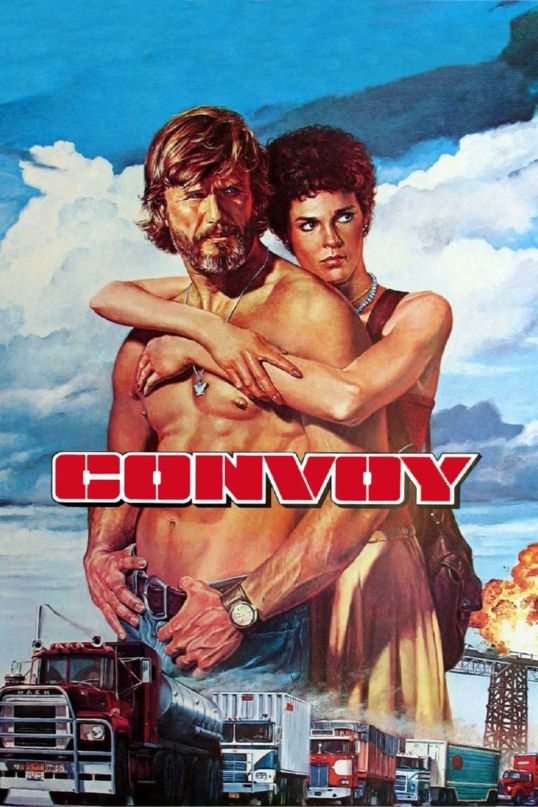
Film Review: Convoy (dir by Sam Peckinpah)


Well, it looks like we’ve got ourselves a Convoy!

The 1978 film Convoy opens with the image of a truck passing by some hills that have been covered with snow.  At a certain point, it actually looks like the truck is descending into a sea of white powder.  It’s an appropriate image because, to film lovers and cinematic historians, Convoy will always be associated with cocaine.

Convoy was meant to be a relatively small-scale B-movie, one that was meant to capitalize on the popularity of a novelty song, as well as the recent success of other car chase films.  Instead, it became a notoriously troubled production that went famously overbudget and overschedule as director Sam Peckinpah turned Convoy into a personal statement about modern cowboys and independence.  When the film was finally released, it was the biggest box office hit of Peckinpah’s storied career.  However, because so much money had been spent making the film, it still failed to make a profit and the film is regularly described as being one of the many flops of the late 70s that eventually led to the power in the film industry shifting away from the directors and over to the studio executives.  Many in Hollywood grumbled that it was Peckinpah’s well-known cocaine use that led to him having such trouble with what should have been a simple B-movie.  That’s probably a bit unfair to Peckinpah as it’s been written that just about everyone in Hollywood was using cocaine in 1978.

Add to that …. Convoy‘s not that bad.

Convoy tells the story of Rubber Duck (Kris Kristofferson), a legendary trucker who has never joined the Teamsters.  He’s an independent.  Rubber Duck’s nemesis is Sheriff Dirty Lyle (Ernest Borgnine), who is also an independent.  He’s never joined the policeman’s union.  As Rubber Duck puts it, “There’s not many like us anymore.”

Anyway, for reasons that are only vaguely defined, Rubber Duck leads a convoy of trucks across the southwest while being pursued by the police.  It has something to do with protesting the law enforcement tactics of Dirty Lyle, despite the fact that Rubber Duck appears to kind of like Lyle.  Soon hundreds of other independent truckers are joining Rubber Duck’s convoy, all to protest law enforcement.  Among those in the convoy are Pig Pen (Burt Young), Widow Woman (Madge Sinclair), and Spider Mike (Franklyn Ajaye), who just wants to get home to his pregnant wife.  Traveling with Rubber Duck is Melissa (Ali MacGraw), who is supposed to be some sort of photojournalist.  Rubber Duck and Melissa fall in love but there’s only so much you can do with a love story when it centers around two of the least expressive stars of the 70s.  During the chase, Rubber Duck picks up some non-truckers supporters, including some religious fanatics in a microbus.  He and the truckers also drive through and destroy a lot of buildings, which kind of makes it look like the cops might have had a point.

What sets Convoy apart from other chase films of the 70s is just how seriously it takes itself.  There’s an undercurrent of melancholy that runs through the entire film.  Rubber Duck seems to know that America is changing and as people become more comfortable with the idea of sacrificing their freedoms, his days as an independent trucker are numbered.  Dirty Lyle also seems to be stuck in a permanent existential crisis, taking no joy in being a crook but still forced to do so by being a part of an inherently corrupt government system.  There’s a scene where a truckstop waitress offers herself up as a gift to Rubber Duck on his birthday and Peckinpah films it as if he’s making an Italian neorealist drama about Rome after the war.  When Spider Mike says that he has to get home to his wife, he says it with the pain of a man who knows that the system only cares about control and not happiness.  These aren’t just truckers.  These are men and women who are on the front lines battling a creeping culture of oppression.

Surprisingly enough, the film’s serious tone actually works to its advantage.  You may not fully understand why Rubber Duck is leading that convoy but you hope that it succeeds because you get the feeling that the world might end if it doesn’t.  When the film ends with Ernest Borgnine laughing like a maniac, it comes across less like a moment of amusement and more like an acknowledgment that the universe is a tragic farce.  Life is a riddle wrapped inside an engima and only Rubber Duck and Dirty Lyle seem to understand that fact.

Add to that, this is a film about independents refusing to allow themselves to be limited by the regulatory state.  In its way, it’s one of the most sincerely Libertarian films ever made and, with all of us currently living under “lockdowns” and hoping that our governors don’t join those who have already surrendered their better instincts to their inner tyrant (sorry, Michigan, Kentucky, and New Jersey), Convoy remains an important film.  Go, Rubber Duck, go!


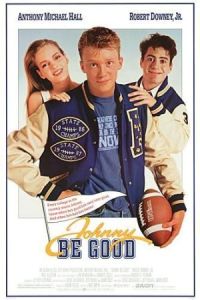
A Movie A Day #228: Johnny Be Good (1988, directed by Bud Smith)


Johnny Walker (Anthony Michael Hall) may be the best high school quarterback in the country but he has a difficult choice to make.  He promised his girlfriend, Georgia (Uma Thurman), that he would go to the local state college with her but every other university in the country wants him.  (Even legendary sportscaster Howard Cosell calls Johnny and advises him to go to an Ivy League college.)  As Johnny tours universities across the country, he faces every temptation.  By the time he makes his decision, will Johnny still be good?

The main problem with Johnny Be Good can be found in the first sentence of the above synopsis.  Anthony Michael Hall plays the best high school quarterback in the country.  By taking on the role of Johnny Walker, Hall was obviously attempting to prove that he was capable of more than just playing nerds for John Hughes.  But Hall is never convincing as a quarterback, much less the best in the country.  Though he bulked up for the role, it is impossible to imagine Hall in a huddle, coming up with the big play that wins the game.  It’s easier to imagine Johnny getting shoved in a locker and left there until the school year ends.  Hall seems to be lost in the role and the movie never seems to be sure who Johnny Walker is supposed to be.  (Two years later, Hall would again play a jock and give a far better performance in Edward Scissorhands.)

As for the rest of the cast, Robert Downey, Jr., who plays Johnny’s teammate and best friend, is even less convincing as a football player than Hall.  In the 1980s, Downey could play a quirky sidekick in his sleep but not a wide receiver.  Paul Gleason also shows up in the movie, basically playing the same role that he played in The Breakfast Club.  Uma Thurman is sweet and pretty in her film debut but it’s a nothing role.  Fans of Cannon Picture will want to keep an eye out for Steve James, in a small role as a coach.

Poorly written and slackly directed with few laughs, Johnny Be Good fails to take its own advice.

A Movie A Day #67: Animal Factory (2000, directed by Steve Buscemi)


Edward Furlong is Ron Decker, a spoiled 18 year-old from a rich family who is arrested and sent to prison when he’s caught with a small amount of marijuana.  Being younger and smaller than the other prisoners, Ron is soon being targeted by everyone from the prison’s Puerto Rican gang to the sadistic Buck Rowan (Tom Arnold).  Fortunately, for Ron, prison veteran Earl Copen (Williem DaFoe) takes him under his wing and provides him with protection.  Earl is the philosopher-king of the prison.  As he likes to put it, “This is my prison, after all.”  If he can stay out of trouble, Ron has a chance to get out early but, with Buck stalking him, that’s not going to be easy.

Based on a novel by ex-con Edward Bunker, Animal Factory was the second film to be directed by Bunker’s Reservoir Dogs co-stars, Steve Buscemi.  Though it was overlooked at the time, Animal Factory is a minor masterpiece.  Taking a low key approach, Buscemi emphasizes the monotony of prison life just as much as the sudden bursts of violence and shows why someone like Ron Decker can go into prison as an innocent and come out as an animal.  DaFoe and Furlong give two of their best performances as Earl and Ron while a cast of familiar faces — Danny Trejo, Mickey Rourke, Chris Bauer, Mark Boone Junior — make up the prison’s population.  Most surprising of all is Tom Arnold, giving Animal Factory‘s best performance as the prison’s most dangerous predator.