Cleaning Out The DVR, Again #24: Bloody Mama (dir by Roger Corman)


(Lisa is currently in the process of trying to clean out her DVR by watching and reviewing all 40 of the movies that she recorded from the start of March to the end of June.  She’s trying to get it all done by July 11th!  Will she make it!?  Keep visiting the site to find out!)

BloodyMama

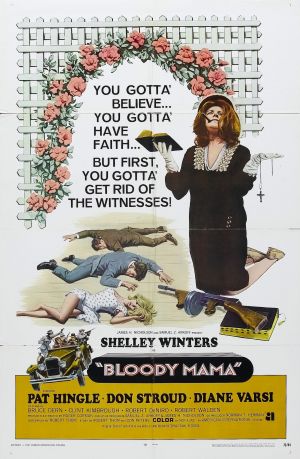
The 24th film on my DVR was the 1970 Roger Corman-directed gangster film, Bloody Mama.  I recorded it off of TCM on May 27th.

Bloody Mama opens with a cheerful song that goes, “Maaaaaama…Bloody maaaaama….” and it’s such an unapolegetically over the top song that it perfectly sets the tone for what’s to follow.  Bloody Mama is violent, occasionally perverse, and totally unashamed.  It doesn’t pretend to be anything that it isn’t.  It’s bloody and it’s about a mother and, in the best Corman tradition, it makes no apologies!

The film tells the heavily fictionalized story of the Barkers, a group of brothers who robbed banks and killed people in the 1920s and 30s.  The majority of them were killed in a gunfight with the FBI.  Also killed in the gunfight was their mother, Kate Barker.  Always aware of the danger of bad publicity, the director of the FBI, J. Edgar Hoover, announced that Ma Barker was actually the mastermind of the Barker gang and that she was even more dangerous than her sons.  Ever since, historians have debated whether Ma Barker was the criminal mastermind described by Hoover or if she was just the innocent woman described by … well, by everyone who actually knew her.

Bloody Mama, of course, leaves no doubt.  From the minute that we discover that Shelley Winters will be playing Ma Barker, we know that she’s the most dangerous woman alive.  As played by Winters, Ma Barker is a ruthless bank robber, one who has no fear of gunning down innocent bystanders and who never lets her love for her sons get in the way of ordering them to kill a witness.  As opposed to a lot of gangster films made in the late 60s and early 70s, the film never attempts to portray its title character as being a heroic or particularly sympathetic character.  Instead, what makes the character compelling is just how thoroughly Winters commits to the role.  It doesn’t matter what Ma Barker is doing or saying, Shelley Winters totally sells it.  When the gang is cornered by the police and one associate makes the mistake of yelling that he’s not a Barker, Ma reacts by gunning him down herself and you can’t help but appreciate the lengths that Ma will go to defend her family’s name.

As for her sons, they are an interesting group of perverts and drug addicts and they’re played some of the best character actors of the 1970s.

Herman Barker (Don Stroud) is a sadist but he’s also one of Ma’s favorites.  He travels with a prostitute (played by Diane Varsi), who quickly tires of the Barkers’s violent way of life.

Arthur Barker (Clint Kimbrough) is the most practical of the Barkers and therefore, he’s also the least interesting.

Fred Barker (Robert Walden) is bisexual, which is a fact that the film handles with all the sensitivity that we’ve come to expect from a film made in 1970 (which is to say, not much at all).  Fortunately, Fred’s lover is Kevin and Kevin is played by Bruce Dern and Bruce Dern is always a lot of fun to watch, especially when he’s appearing in a Corman film.

And then there’s Lloyd who sniffs glue and shoots heroin and who is played by an obscure young actor named Robert De Niro and … wait, Robert De Niro!  That’s right!  One of the pleasures of Bloody Mama is getting to see De Niro at the start of his career.  Unfortunately, he doesn’t really get to do much, though he does occasionally flash the same unhinged smile that would later show up in Taxi Driver.

Roger Corman has repeatedly cited Bloody Mama as being one of his favorites of the many movies that he directed over the course of his long career.  I don’t blame him.  It’s a thoroughly shameless and totally entertaining film!

Keep an eye out for Bloody Mama!

Just remember, the real-life Ma Barker was probably innocent.

Film Review: Chandler (1971, directed by Paul Magwood)


C1971chandler1handler (Warren Oates) is a former private investigator who quits his job as a security guard and gets back into the detective game.  An old friend of his, Bernie Oakman (Charles McGraw), hires Chandler to follow and protect a woman named Katherine Creighton (Leslie Caron).  Katherine is scheduled to testify against gangster John Melchior (Gordon Pinset) and Oakman tells Chandler that he believes Melchior may be planning on murdering her.  What Chandler does not know is that Oakman is being manipulated by a corrupt federal agent, Ross Carmady (Alex Dreier), who is planning on duping Chandler into killing Melchior so that Carmady can take over Melchior’s racket.  Though Chandler tries not to get emotionally involved in his cases, he ends up falling for Katherine.

In case you are keeping count, Chandler is the sixth Warren Oates film that I’ve reviewed this week.  Some of that is because TCM devoted all of Monday to showing his films but it’s also because Warren Oates was a really cool actor who died too soon and never got as much credit as he deserved.  Warren Oates combined the talent of a leading man with the face of a character actor and, as a result, he played some of the most memorable supporting roles of the 60s and 70s.  He was the tough guy who could talk a mile a minute and his upturned grin always showed up at the most unexpected of times.  Warren Oates brought humanity to outcasts and sympathy to villains.

Chandler is one of Warren Oates’s few leading roles.  Unfortunately, it’s not much of a showcase.  Director Paul Magwood and producer Michael Laughlin felt that the then-head of MGM, James Thomas Aubrey, interfered with the production of the film.  After the film’s release, Magwood and Laughlin took out a full-page, black-bordered ad in Variety that read:

Regarding what was our film Chandler, let’s give credit where credit is due. We sadly acknowledge that all editing, post-production as well as additional scenes were executed by James T. Aubrey Jr. We are sorry.

Chandler is a strange film to watch.  The plot is complicated but nothing really happens until the downbeat ending.  Much like Robert Altman’s far more successful The Long GoodbyeChandler tries to contrast the title character’s old-fashioned 1940s style and moral code with the 70s.  Chandler, who always wears a suit and drives an old car, is meant to be a man out of time.  Warren Oates does a good job, giving a Humphrey Bogart-style performance.  But since Chandler doesn’t seem to be sure what it is trying to say about either the 40s or the 70s, it’s all for naught.

Chandler is a forgettable film, one that is only worth watching for the rare chance to see Warren Oates as a leading man.

Warren Oates in Chandler

Warren Oates as Chandler


That’s Blaxploitaion!: BLACK BELT JONES (Warners 1974)


gary loggins's avatarcracked rear viewer

bb1

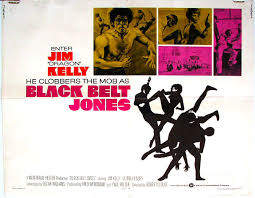
Here’s the recipe for the quintessential 70s flick: Take a huge hunk of blaxpolitation, add equal parts kung-fu action, throw in some Mafia type villains. Stick em all in a blender with some generic funk music, and you’ve got BLACK BELT JONES. This movie was made to cash in on all three crazes, and to make a star out of Jim ‘The Dragon’ Kelly, who appeared in director Robert Clouse’s previous kung-fu extravaganza ENTER THE DRAGON, starring the immortal Bruce Lee.  Kelly looked good onscreen, and had all the right martial art moves. Unfortunately, he couldn’t act his way out of a Chinese take-out box. Nobody can in this film except gorgeous Gloria Hendry, who plays Kelly’s kung-fu partner/love interest Sydney.

The plot’s basically just there to hang the action scenes on: Mafia chief Don Stefano tries to grab some land the city of Los Angeles wants for a new civic center. He sends Pinky, the local black gangleader, to…

View original post 309 more words

Shattered Politics #33: Detroit 9000 (dir by Arthur Marks)


Detroit9000

Pity poor Detroit!

For the past few years, it seems that, whenever someone has wanted to make the argument that America is heading in the wrong direction, Detroit gets mentioned.  The once thriving city and industrial center is now best known for high unemployment, high crime, and a declining population.  After years of civic mismanagement, Detroit went bankrupt.  Fairly or not, many people will always view Detroit as being the city that can’t afford to keep the lights on and where citizens can’t afford to pay their water bill.  It doesn’t matter how many “Detroit is making a comeback!” commercials run during the Super Bowl.

I have to admit that, for someone like me who lives on the other end of the country, Detroit might as well be on another planet.  (And that planet is called Michigan.)  I have no way of knowing what Detroit was like before the media started to bombard me with stories about the city’s decline.  And that’s one reason why I have to feel sorry for the city of Detroit.  Anything positive about Detroit will never be reported but you can rest assured that anything negative will be recorded, reported, and repeated until everyone in the country can recite the details by memory.

If I’ve got Detroit on the mind, it’s because I recently watched a fairly memorable crime film from 1973 that was set and filmed in Detroit.  It was a film that — long before Only Lovers Left Alive — attempted to use the city itself as a metaphor for the political issues and social concerns of the day.  In fact, the city was such an important part of the film that the film itself was even named Detroit 9000.

(Reportedly, the film was originally meant to be set in Chicago but, when the Chicago political establishment objected to the film’s violence, production was relocated to Detroit, where apparently the script’s violence was not a problem.)

Detroit 9000 opens with a fundraiser for Congressman Aubrey Hale Clayton (Rudy Challeneger), who is running for governor of Michigan.  A group of masked gunmen break into the hotel and rob the fundraiser.  (While the guests are forced to kneel on the floor while being robbed, a woman stands on stage and sings a gospel song, which just adds to the surreal feel of the scene.)  To investigate the case, the laid-back, casually corrupt Lt. Danny Basset (Alex Rocco) is partnered up with upright Sgt. Jesse Williams (Hari Rhodes).  Because Clayton is the first black man to ever have a real chance to be elected governor and because everyone robbed at the fundraiser was black, Williams believes that there had to be a racial motivation behind the robbery.  Danny, meanwhile, insists that it was just an ordinary robbery.

Detroit 9000 is a favorite film of Quentin Tarantino’s and, watching it, you can see why.  From the soundtrack to the hard-edged dialogue to the morally ambiguous heroes, Detroit 9000 is a masterpiece of 1970s exploitation.  The film ends with a genuinely exciting chase through the streets (and cemeteries) of Detroit that eventually gets so excessively violent that it takes on an oddly operatic beauty of its own.

And, in the underrated style of so many so-called grindhouse and exploitation films, Detroit 9000 has a lot more on its mind than most mainstream film.  Even today, I think you’d have a hard time finding a big-budget, studio production that would be willing to take as honest a view of race relations as Detroit 9000 does.  Beneath all of the exploitation trapping, there lies a film that was actually saying something about the way life was being lived in 1973 and which still has a lot to say about how life is being lived today in 2015.

And, much like Jim Jarmusch in Only Lovers Left Alive, director Arthur Marks finds a strange sort of life in Detroit’s abandoned buildings and dark alleys.  As odd as it may seem, this cynical and violent film will actually make you love Detroit more than a hundred “Detroit is making a comeback!” super bowl commercials ever could.