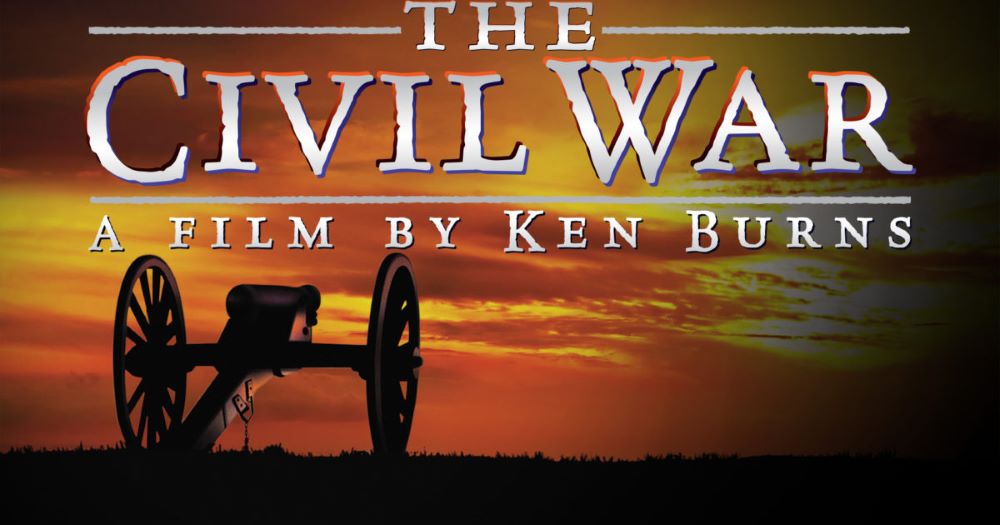
Review: The Civil War (dir. by Ken Burns)


“We are not enemies, but friends. We must not be enemies. Though passion may have strained, it must not break our bonds of affection.” — Abraham Lincoln

Ken Burns’ The Civil War stands as one of those rare documentaries that completely reshapes how people think about both history and the craft of documentary filmmaking. Released in 1990, it’s been over three decades since it first aired, yet it still feels monumental in its reach and emotional resonance. Instead of serving as a dry classroom recounting of battles and dates, it’s an experience that makes you feel the war’s human dimension—the people who fought it, lived through it, and were changed forever by its violence and ideals. Burns manages to take America’s bloodiest conflict and give it a pulse, telling the story not only through historians and statistics but through letters, diaries, and voices that make you feel connected to the 1860s as if it all just happened yesterday.

One of the most defining parts of The Civil War is its look and rhythm. Burns’ now-famous visual style—those slow pans and zooms across black-and-white photographs—became such a signature technique that it’s now built into editing software as “the Ken Burns effect.” It might sound simple, but the way he moves those still images feels like breathing life into ghosts. Every slow zoom on a soldier’s uncertain face, every fade over an empty battlefield, has meaning. Before Burns, most historical documentaries presented facts through re-enactments or stiff academic interviews. Burns dared to make photographs speak on their own. The pacing he uses is hypnotic—deliberate, unwavering, and emotionally tuned to each shot. It’s a visual rhythm that invites reflection instead of speed. The whole thing feels like time itself has slowed down so history can whisper its fullest story.

The narration, provided by David McCullough, ties the sprawling story together with a sense of calm authority. His voice is warm, measured, and almost timeless, acting less like a narrator and more like an old friend who knows the past intimately but never overstates it. McCullough’s presence builds trust—no hype, no theatrics, just thoughtful storytelling. Burns pairs that voice with readings from letters, diaries, and contemporary accounts, delivered by a lineup of talented voice actors like Jason Robards, Sam Waterston, and Morgan Freeman. Their readings never feel like performances; they feel lived in, restrained, and sincere. This combination of voice and image creates a tone that is both haunting and beautiful, one that makes history feel alive but not romanticized.

A huge part of why the series feels so moving is Jay Ungar’s “Ashokan Farewell.” Oddly enough, it’s not a Civil War-era tune at all—it was written in the 1980s—but it fits so organically with the documentary’s mood that it’s impossible to think about the series without hearing it. The plaintive fiddle melody has a mournful warmth, evoking the loss and longing that defines the entire project. Burns and his team used it in just the right measure: when the music plays, it deepens emotion rather than dictating it. Combined with other period-appropriate folk songs, banjo pieces, and hymns, the soundtrack acts as the emotional current guiding the story through landscapes of death, courage, and change.

The structure of The Civil War is deceptively simple but brilliantly executed. Spanning nine episodes and over eleven hours in total, it charts the war from its earliest, uneasy beginnings in the political debates over slavery and statehood through to its catastrophic conclusion and fragile aftermath. Burns understood that history isn’t static; it’s emotional and cumulative. The early episodes almost feel optimistic—the tone of youthful bravado and national pride fills the air as both sides believe the conflict will end quickly. As the series progresses, though, the optimism curdles into fatigue, despair, and grief. By the time the war drags into its later years, the imagery, narration, and music all carry the weight of shared tragedy. You begin to see how idealism eroded into acceptance of horror. The careful pacing of each episode allows viewers to feel that arc not just intellectually but emotionally.

Among the many creative decisions Burns made, choosing to anchor the series around personal letters was perhaps the most effective. Through these letters, anonymous soldiers, wives, and family members speak across time. Their words carry more power than any historian’s commentary could. One of the most unforgettable moments comes from Union officer Sullivan Ballou’s letter to his wife, written shortly before he was killed. His words are devastating in their tenderness and resignation, summing up both love and mortality in a way that feels timeless. Burns threads similar letters throughout the series—from soldiers on both sides, from civilians caught in the middle, and from the enslaved people whose freedom hung in the balance. Their voices form the emotional backbone of the documentary, constantly reminding us that this was not just a war of strategy but a catastrophe of human consequence.

Alongside these voices, there’s a chorus of historians offering perspective and context. Shelby Foote, with his Southern drawl and gift for anecdote, became one of the documentary’s most recognizable figures. His storytelling bridges the gap between scholarship and folklore, even if some critics later accused him of romanticizing the Confederate perspective. Counterbalancing that, historian Barbara Fields provides some of the series’ most profound reflections, particularly regarding race and memory. Her insistence that the war’s legacy continues to shape American identity feels just as relevant now as it did in 1990. Their alternating viewpoints give the documentary balance—emotion on one side, intellect and conscience on the other.

Burns’ handling of tone is one of the most striking things on a rewatch. It’s both deeply romantic in its love of storytelling and brutally realistic in its depiction of suffering. It doesn’t sanitize the war, but it doesn’t exploit it either. You’re never shown battle reenactments, explosions, or gore. Instead, Burns conveys the violence and despair through letters, photos, and silence. He trusts the audience to fill in the horror. That’s uncommon in modern documentary work, where there’s often pressure to explain or dramatize everything. In The Civil War, silence becomes a storytelling device. The pauses between sentences, the long holds on a tattered flag or a battlefield grave, carry meaning. The documentary refuses to rush toward catharsis; it lingers in grief.

In today’s media landscape—where documentaries tend to move fast and fight for attention—Burns’ slower, more contemplative approach stands out. Back in 1990, it riveted viewers. An estimated 40 million people watched it on PBS, an unbelievable number for a historical series on public television. For many Americans, it became their most vivid introduction to their own national history. It made people talk about Gettysburg, Lincoln, emancipation, and the moral aftermath of the war in living rooms across the country. It even sparked renewed interest in Civil War books, memorials, and battlefield preservation. Burns had tapped into something rare: a collective need to understand who Americans are by understanding what nearly destroyed them.

Even decades later, The Civil War holds up both artistically and historically. Watching it now, its moral clarity about slavery as the war’s central cause feels vital, especially in a time when debates over monuments and racial politics remain heated. Burns never let the series fall into the “states’ rights” trap that muddied so many earlier narratives. He continually foregrounded the human cost of defending or destroying the institution of slavery. Still, modern viewers might wish for even more emphasis on the experiences of Black Americans, beyond the selected diaries and Douglass excerpts. The documentary touched these stories with respect but within the limits of its early-1990s format. Later historians have expanded upon what Burns began, but his foundation remains solid.

Technically, the documentary’s aged well. Restored versions bring new clarity to the old photographs, and the audio’s crisp enough to make the letters feel freshly read. The storytelling, slow-moving as it is, rewards patience. It’s not content to skim across major events; it expects you to sit with sorrow, fatigue, and loss. Watching all eleven hours feels like reading an epic novel: it’s best done gradually, letting each episode resonate before starting the next. The cumulative effect isn’t just historical understanding—it’s emotional exhaustion tempered by awe.

The Civil War remains one of the greatest nonfiction works ever broadcast. It’s not simply about battles or leaders but about the psychology of a country divided by ideals and identity. It asks questions rather than delivering verdicts—questions about sacrifice, belief, morality, and what it means to be American. Few documentaries manage to tell old stories in ways that still feel alive, but Burns achieved that through patience, empathy, and an unshakable faith in the power of storytelling. Even now, it’s hard to watch without feeling the echo of those voices—some hopeful, some broken—that seem to reach out from still photographs and faded ink. Burns didn’t just document history; he let history speak for itself. That’s why The Civil War endures.

Perhaps it’s even more important now than when it first aired. In a time when historical revisionism has begun to creep from the fringes into mainstream discourse and when the nation feels dangerously forgetful of its own moral and political lessons, Burns’ documentary serves as both a warning and a reminder. It shows what happens when ideology overtakes humanity and when a country forgets the cost of its own divisions. Watching The Civil War today feels less like revisiting the past and more like confronting the present—proof that the ghosts of that conflict remain, quietly urging us not to repeat what we once swore to never forget.
Retro Television Review: Law and Order 6.13 “Charm City” and Homicide 4.11 “For God And Country”


Welcome to Retro Television Reviews, a feature where we review some of our favorite and least favorite shows of the past!  On Sundays, I will be reviewing Homicide: Life On The Street, which aired from 1993 to 1999, on NBC!  It  can be viewed on Peacock.

This week, Homicide crosses over with Law & Order.

Law & Order 6.13 “Charm City”

(Dir by Ed Sherin, originally aired on February 7th, 1996)

Homicide 4.11 “For God and Country”

(Dir by Ed Sherin, originally aired on February 9th, 1996)

This week, we have a two-part cross-over between Law & Order and Homicide.

On Law & Order, things start in New York City.  A chemical attack on a subway train leaves 20 people dead.  Because the train was specifically heading into Harlem and all of the victims were black, it is suspected that the attack was racially motivated.  In Baltimore, Frank Pembleton and Tim Bayliss hear about the attack and are reminded of a similar attack on a black church, which occurred five years prior.  Pembleton was the primary on the church attack.  He and Bayliss head to New York City, where they meet and quickly get on the nerves of Detectives Lennie Briscoe (Jerry Orbach) and Rey Curtis (Benjamin Bratt).

Pembleton’s investigation uncovers that a man from Baltimore, Brian Egan (Kevin Geer), not only had access to the chemicals used in both attacks but also that’s he currently in New York.  When Briscoe and Curtis arrest Egan and fail to get him to confess, Pembleton asks for permission to interrogate him.  Pembleton, being Pembleton, rather easily gets Egan to confess to having committed the church bombing.  However, before getting the confession, Pembleton pretends not to hear Egan say that he no longer wants to continue talking.  In typical Law & Order (if not Homicide) fashion, the confession is tossed out.

Jack McCoy (Sam Waterston) and Claire Kincaid (Jill Hennessy) still get their conviction.  (And Claire gets an admirer in the form of Tim Bayliss.)  However, it’s obvious that Egan was not working alone.  Egan says that he will never name names.

That changes when his wife is murdered and his teenage son goes missing.  Homicide opens with Bayliss investigating the poisoning of Egan’s wife.  He and Pembleton eventually track down Egan’s son and they get him to admit that he saw his uncle, former NSA agent Col. Alexander Rausch (J.K. Simmons), murder his mother.  Because Brian Egan has said that he’ll only reveal the truth of the conspiracy if his son is brought to New York, Briscoe and Curtis show up in Baltimore.

While Curtis, Bayliss, and Pembleton track down Colonel Rausch, Briscoe hangs out with Munch.  Their friendly banter goes south as soon as Briscoe mentions that he once knew a Gwen Munch in New York.  Gwen is John Munch’s ex-wife and John is not happy when he finds out that Briscoe slept with Gwen.  John Munch spends the rest of the episode drinking heavily.  Stanley Bolander would not approve.

As for Col. Rausch, he is captured and he turns out to be a smug snake.  (He’s played by J.K. Simmons, after all.)  Pembleton wants to see Rausch prosecuted for the church bombing and he especially wants to see racist Rausch publicly humiliated.  New York, however, wants to prosecute him for the subway attack.  Claire comes down to Baltimore and gets a judge to agree that Rausch should first be sent to New York.

Rausch doesn’t care.  He has a heart condition so he simply stops taking his heart pills and then drops dead while waiting for the train to take him to the Big Apple.  The episodes ends with Pembleton sobbing as he realizes Rausch will never be humiliated at a trial.  The New York cops shrug and say, “Sorry, Frank.”

I enjoyed this crossover quite a bit.  It was interesting to see two police dramas, each with a very different style, come together to tell one big story.  As Homicide always celebrated the lengths that Pembleton would go to get a confession in the Box, it was amusing to see what would actually happen to one of those confessions if it was brought to court.  Jack McCoy is not at all amused by Pembleton’s tactics.  Meanwhile, Briscoe, Curtis, and Claire was allowed to loosen up a bit when they went to Homicide and I enjoyed watching them shed their “just-the-facts” personas.  If the Law & Order episode was ultimately superior to the the Homicide episode, that’s just because the Law & Order episode featured an actual mystery to be solved whereas the Homicide episode occasionally felt as if it was padded out a bit.  On Homicide, it was obvious that Colonel Rausch was guilty and, from the minute he started to cough during the interrogation, it was easy to guess what his ultimate fate would be.

(I also have to say that it was interesting to compare this episode of Law & Order to watch Law & Order has become today.  How this show went from featuring McCoy confidently doing his job to Nolan Price essentially begging his co-counsel, on a weekly basis, to actually do her job is something that is worth considering.)

Overall, this was a good crossover.  For those who want to watch it, the Law & Order episode is available on Hulu and Disney+ while Homicide can be found on Peacock and Tubi.

Film Review: Heaven’s Gate (dir by Michael Cimino)


First released in 1981 and then re-released in several different versions since then, Heaven’s Gate begins at Harvard University.

The year is 1870 and the graduates of Harvard have got their entire future ahead of them.  At the graduation ceremony, Joseph Cotten gives a speech about how, as men of cultivation, they have an obligation to help the uncultivated.  Student orator Billy Irvine (John Hurt) then gives a speech  in which he jokingly says the exact opposite.  Amongst the graduates, Billy’s friend, Jim Averill (Kris Kristofferson), laughs at Billy’s speech.  It’s a bit of a strange scene, if just because all of the graduates appear to be teenagers except for Hurt and Kristofferson, who are both clearly in their 30s.  The graduates of Harvard sing to their girlfriends and dance under a tree and, for a fleeting moment, all seems to be right with the world.

Twenty years later, all seems to be wrong with the world.  Averill is now the rugged and world-weary marshal of Johnson Country, Wyoming.  Cattle barons are trying to force immigrant settlers to give up their land.  Gunmen, like Nate Champion (Christopher Walken) and Nick Ray (Mickey Rourke), are accepting contracts to execute immigrants who are suspected of stealing cattle.  When Averill stands up for the people of Johnson Country, the head of the Wyoming Stock Grower Association, Frank Canton (Sam Waterston), hires a group of mercenaries to ride into Johnson County and execute 125 settlers.  Billy Irvine, who now is dissolute alcoholic who works with Canton, warns his old friend Averill.  Averill, who has fallen in love with Ella (Isabelle Huppert), the local madam, announces that he will defend the immigrants.  Nate, who is also in love with Ella, considers changing sides.

Heaven’s Gate is loosely based on an actual event.  I actually have three distant ancestors who traveled to Wyoming to take part in the Johnson County War.  All three of them survived, though one of them was shot and killed in an unrelated manner shortly after returning to Ft. Smith, Arkansas.  That said, director Michael Cimino is clearly not that interested in the historical reality of the Johnson County War or the issues that it raised.  Just as he did with Vietnam in The Deer Hunter, Cimino uses the Johnson County War as a way to signify a loss of national innocence.  Averill and Irvine start the film as hopeful “young” men with the future ahead of them.  By the end of the film, one is dead and the other is living on a yacht and dealing with what appears to be crippling ennui.

Heaven’s Gate is a bit of an infamous film.  Though the film was pretty much a standard western, Cimino still went far over-budget and turned in a first cut that was over six hours long.  A four hour version was briefly released in 1980 but withdrawn after a week, due to terrible reviews and audience indifference.  A studio-edited version that ran for two hours and 35 minutes got the widest release in 1981.  Since then, there have been several other versions released.  Cimino’s director’s cut, which was released as a part of the Criterion Collection in 2012, runs for 212-minutes and is considered to now be the “official” version of Heaven’s Gate.

For years, Heaven’s Gate had a terrible reputation.  It’s failure at the box office was blamed for bankrupting United Artists.  After the excesses of the Heaven’s Gate production, studios were far more reluctant to just give a director a bunch of money and let him run off to make his movie.  (They should have learned their lesson with Dennis Hopper and The Last Movie.)  Described by studio execs as being self-indulgent and even mentally unstable, Michael Cimino’s career never recovered and the director of The Deer Hunter went from being an Oscar-winner to being an industry pariah.  (Some who disliked The Deer Hunter’s perceived jingoistic subtext claimed that Heaven’s Gate proved The Deer Hunter was just an overrated fluke.)  However, the reputation of Heaven’s Gate has improved, especially with the release of Cimino’s director’s cut.  Many critics have praised Heaven’s Gate for its epic portrayal of the west and, ironically given the controversy over The Deer Hunter, its political subtext.  It’s anti-immigrant villains made the film popular amongst the Resistance-leaning film historians during the first Trump term.

So, is Heaven’s Gate a masterpiece or a disaster?  To be honest, it’s somewhere in between.  Whereas it was once over-criticized, it’s now over-praised.  Visually, it’s a beautiful film but those who complained that the film was too slow had a point.  As with The Deer Hunter, Cimino takes the time to introduce us to and immerse us in a tight-knit immigrant community.  Personally, I like the much-criticized scenes of the fiddler on skates and Averill and Ella dancing in the roller rink.  Overall though, as opposed to The Deer Hunter, the members of the film’s victimized community still feel less like individual characters and more like symbols.  As for the political subtext, I think that any subtext of that sort is accidental.  (I feel the same way about The Deer Hunter, which I like quite a bit more than Heaven’s Gate.)  Cimino is more interested in the loss of innocence than whether or not the Johnson County War can be fit into some sort of nonsense Marxist framework.

The main problem with the film is that there is no center to keep everything grounded.  Kris Kristofferson had a definite screen presence but, as an actor who was incapable of showing a great deal of emotion, he lacks the gravitas necessary to keep from being swallowed up by Cimino’s epic pretensions.  Isabelle Huppert, an otherwise great actress, also feels lost in the role of Ella and Sam Waterston is not necessarily the most-intimidating villain to ever show up in a western.  Christopher Walken, as the enigmatic and intriguing Nate Champion, gives the best performance in the film but his character still feels largely wasted.

There are some brilliant visual moments to be found in Heaven’s Gate.  I even like the Harvard prologue and the ending on the boat, both of which are not technically necessary to the narrative but still add an extra-dimension to both Averill and Irvine.  But, in the end, Heaven’s Gate is big when it should have been small and epic when its should have been intimate.  It’s a misfire but not a disaster.  Even great directors occasionally have a film that just doesn’t work.  Speilberg had his 1941.  Scorsese has had a handful.  Coppola’s career has been a mess but no one can take his successes away from him.  Michael Cimino, who passed away in 2016, deserved another chance.

TV Review: The Dropout 1.8 “Lizzy” (dir by Erica Watson)


(Below, you will find spoilers for the final episode of The Dropout.  I would recommend not reading this post until you’ve watched the episode.)

After all the drama and the deception, The Dropout ended the only way that it could, with Theranos in ruins, Sunny out of Elizabeth’s life, and Elizabeth still unable to comprehend why everyone got upset with her in the first place.  While George Schultz tries to come to terms with his mistakes and Erika Cheung worries about whether or not she’s ruined her future career by coming out as a whistleblower, Elizabeth tries to do damage control by forcing Sunny out of Theranos and then going on television for a cringey interview that pretty much seals her fate.  Both David Boies and Linda Tanner (Michaela Watkins, who became the unexpected heart of this episode) tell Elizabeth that it’s important that she come across as being contrite and sincerely “devastated” by Sunny’s actions.  Elizabeth, however, can’t do it.  As she explains to her mother, Elizabeth has been locking away her emotions for so long that she no longer knows how to express or even feel them.

The end of the episode finds Elizabeth finally pursuing the life that she would have led if she hadn’t dropped out of Stanford, started Theranos, and gotten involved with Sunny.  She’s dating a younger man.  She’s going to Burning Man.  She owns a dog.  She’s ditched the turtleneck.  She’s let her hair down.  She’s speaking in her real voice.  She’s going by “Lizzie.”  She’s reverted back to being the somewhat flakey child of privilege that she was at the start of the miniseries.  Even while Linda Tanner confronts her with the number of lives that she and Theranos destroyed, Elizabeth doesn’t break her stride.  Elizabeth has decided that she’s moved on, even if no one else can.  It’s only when she’s alone that she briefly allow her composure to crack, just long enough to scream into the void.

Of course, the final title card informs us that it doesn’t matter how much Elizabeth wants to be Lizzie, the girl who goes to Burning Man with her boyfriend.  Having been convicted of defrauding her investors, Elizabeth Holmes is currently awaiting her sentencing.  She could end up spending the next twenty years in prison.  And, just as Phyllis Gardner predicted in the previous episode, Elizabeth has made it difficult for other female entrepreneurs to find success in Silicon Valley.

As the episode came to a close, with Elizabeth walking through the now empty offices of Theranos with her dog and an increasingly agitated Linda, I found myself thinking about how those offices progressed through the series.  Theranos went from a shabby office building in the worst part of town to being the epitome of Silicon Valley chic.  In the early episodes, the cluttered Theranos offices and labs were disorganized but there was also a very sincere earnestness to them.  Men like Ian Gibbons actually believed in what they were doing.  By the fourth episode, Theranos transformed into a secretive place that was fueled by paranoia.  With each subsequent episode, the offices became a bit less individualistic and bit more joyless.  In the final episode, the offices were dark and deserted, as empty as Elizabeth and Sunny’s promises.  Looking at those offices, it was hard not to mourn the lost idealism of those early days.  Sunny may have never shared that idealism.  The miniseries suggests that Elizabeth lost her idealism as soon as she finally started to get the positive publicity that she craved.  But the people who were there at the beginning believed in Theranos and its stated mission.  Even Elizabeth’s early investors were taking a chance because they thought she could make the world a better place.  In the end, Elizabeth and Sunny betrayed all of them.  As I said at the start of this review, The Dropout ended the only way that it could, with an empty office, a lot of broken hearts, and Elizabeth Holmes convinced that the world had somehow failed her.  Viewers may never fully understand what was going on in Elizabeth Holmes’s mind but they’ll never forget her or the story of Theranos.

The Dropout was a good miniseries, probably the best that we’ll see this year.  This is a miniseries that better be remembered come Emmy time.  Amanda Seyfried seems to be a lock to at least get a nomination.  Naveen Andrews deserves consideration as well.  The supporting cast provides an embarrassment of riches.  Sam Waterston, Dylan Minnette, Kurtwood Smith, Michaela Watkins, William H. Macy, the great Stephen Fry, Camryn Mi-Young Kim, Kate Burton, Anne Archer, and Laurie Metcalf, all of them are award-worthy.  Give them the Emmy campaign that they deserve, Hulu!

TV Review: The Dropout 1.5 “Flower of Life” (dir by Francesca Gregorini)


Who was Elizabeth Holmes?

Was she an idealist who got in over her head and ended up cutting corners with the best of intentions?

Was she a con artist who simply lied for the money?

Was she the abused and manipulated partner in a crime that masterminded by Sunny Balwani?

Or was she a sociopath who was simply incapable of feeling any empathy for the people that she manipulated and, in some cases, destroyed?

That’s the question that’s been at the heart of the first five episodes of The Dropout.  It’s also a question that the show’s version of Elizabeth Holmes (played, brilliantly, by Amanda Seyfried) is struggling with.  One gets the feeling that she herself doesn’t full understand what’s going on inside of her head.  For the first half of the episode 5, Holmes is an almost sympathetic character.  Still desperate for Sunny’s approval and seemingly convinced that Theranos can come up with some magic spell that will actually make the Edison work, Elizabeth comes across as being more self-delusional than malicious.  For the first half of the episode, it’s like we’re watching the socially awkward but earnest Elizabeth who we first met at the beginning of the series.  At her uncle’s funeral, she asks her mother if she ever had any hobbies when she was younger and her mom can only list several competitive activities that Elizabeth took part in.  But, as becomes clear, Elizabeth never did anything just for fun or just for enjoyment.  Instead, everything the she’s always done has been a part of an obsessive need to not only prove her own abilities but to also prove that she’s superior to other people.

Perhaps this strange mix of a grandiose self-image and gnawing insecurity is why she simply cannot bring herself to settle the lawsuit that’s been brought against her by Richard Fuisz (William H. Macy).  Instead, with the help of her newest mentor, George Shultz (Sam Waterston), Elizabeth brings in David Boies (Kurtwood Smith).  Boies is one of the leading lawyers in the United States.  Before getting involved with Theranos, Boies tried to put Al Gore in the White House.  After his involvement with Theranos, Boies tried to keep Harvey Weinstein out of jail.  Boies failed on both accounts but he was far more successful when it came to battling Fuisz’s lawsuit.  One of the key scenes in the episode comes when Schultz mentions that he and Boies are on different sides politically but that they’re willing to come together to protect Theranos.  It doesn’t matter that Schultz is a Republican and Boies is a Democrat.  What matters is that they’re both a member of the elite and Theranos, with its prestigious board of directors, is now a part of the elite as well.  Richard Fuisz, with his terrible haircut and his excitable manner, is far too gauche to be allowed to defeat Theranos.

Indeed, Elizabeth spends most of this episode worrying about the lawsuit and also what might happen if Ian Gibbons (Stephen Fry) is called to testify.  Gibbons’s name is on all of Theranos’s patents, along with Elizabeth’s.  Gibbons is perhaps the one person who can testify that Elizabeth had nothing to do with designing any of Theranos’s equipment.  When we first see Theranos’s legal team pressuring Ian to sign a statement saying that, as an alcoholic, he can’t testify, we’re left to wonder whether the team is working at the direction of Sunny, Boies, or Elizabeth.  When Ian points out that signing such a statement will end his career, no one seems to care.  Ian Gibbons goes home, plays with his dogs, listens to his favorite opera, says goodnight to his wife, and then kills himself.

Elizabeth’s reaction to Ian’s death tells us all we need to know about her and it pretty much erases whatever sympathy we may have had for her.  She’s a bit like a robot, trying to generate the “right” emotions but not quite sure the proper way to do it.  When told that Ian is dead and that the lawsuit is apparently dead as well, Elizabeth focuses on the finger puppets that she wants to stock in the Theranos Wellness Centers.  The puppets are for children to wear after getting their finger pricked but they’re also a part of Elizabeth’s fantasy world, a world where Theranos will be fine and she’ll be as famous and beloved as Steve Jobs.  And if that means that the Edison had to be built with technology with Sunny stole from another company, so be it.

The episode ends with Brendan (Bashir Salahuddin) quitting the company and George Schultz’s nephew, Tyler (Dylan Minnette), starting his first day.  Using her fake voice, Elizabeth gives a speech to her cult-like employees.  She talks about her uncle’s death and how it effected her and we know that it’s all a lie but Elizabeth sells it.  The only disconcerting note comes from Sunny, who can’t stop himself from casually threatening to fire anyone who doesn’t share Elizabeth’s version.  They’re a team.  Elizabeth knows how to sell Theranos.  Sunny knows how to terrify anyone who asks too many questions.

This was the first episode of the series to not be directed by Michael Showalter.  Instead, it was directed by Francesca Gregorini and there are a few scenes where you really do miss Showalter’s ability to balance the absurd with the dramatic.  That said, this episode worked due to the performances of not only Seyfriend and Naveen Andrews but also William H. Macy, Kurtwood Smith, and especially Stephen Fry.  Fry especially broke my heart, even though I knew enough about the real story of Theranos that I already knew that Gibbons was going to take his own life.  Still, Fry plays the role with such a wounded dignity that you are left with no doubt that Gibbons was the last of the true believers.  He gave his life for Theranos and, in the end, Theranos gave him nothing in return.

The episode ends with Richard calling Phyllis Gardner (Laurie Metcalf), who was last seen telling a very young Elizabeth that there was no way to make the idea behind Theranos a reality.  Phyllis tells Richard that Elizabeth is a fraud.  And I have to admit that, as a viewer who had just spent 50 minutes with Elizabeth Holes and Sunny Balwani and David Boies, it was nice to hear someone come straight out and say it.

Next week, Tyler Schultz starts working at Theranos and he discovers that everything is not as it seems!  It’s the beginning of the end for Theranos and I’m looking forward to watching it all come down.

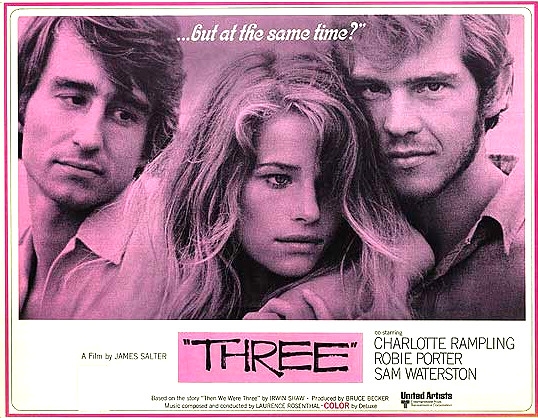
Film Review: Three (dir by James Salter)


Coming to us from 1969, Three is a film about three of the most boring people on Earth taking a vacation together.

Bert (Robie Porter) and Taylor (Sam Waterston, in his 20s but looking like he’s in his early 40s) are two American college students who are taking a trip through the Mediterranean.  We really don’t learn much about Bert and Taylor, beyond the fact that they’re close friends and they go to college together.  Though they visit several historical sites, they don’t really seem to get much out of it.  Though they both appear to be wealthy, they still make it a point to drive an old car.  It’s one of those affectations of poverty in which a certain type of rich person has always enjoyed indulging.

Anyway, Bert and Taylor wander around for a while and basically act like a bunch of stereotypical American tourists.  “Do you speak English?” they ask far too many people.  They drink too much at night.  They stare at every young woman who walks by.  They spend some time lying in a field and talking about life.  Unfortunately, since neither one of them has much depth, it’s kind of a boring conversation.  Bert, it appears, is a bit more experienced with the “ways of the world” that Taylor.  Taylor’s an idealist.  Yawn.

Eventually, Taylor meets an English tourist named Marty (Charlotte Rampling) and, despite the fact that she could obviously do better, she decides to travel around with Taylor and Bert.  Both Bert and Taylor find Marty to be attractive but they decide that all of three of them will just be friends, with no romance and no commitment.

Of course, it doesn’t really work out that way.  Taylor quickly falls in love with Marty but Marty is more attracted to Bert.  Bert, meanwhile, is kind of a jerk who picks up a French girl even after it’s obvious that Marty has feelings for him.  There’s an odd close-up of Bert blowing cigarette smoke on the French girl’s hands.  I’m not really sure why the shot was included in the film, beyond the fact that Three was made in 1969 and filmmakers in the late 60s were bizarrely obsessed with unnecessary close-ups.

Anyway, Three is an oddly lethargic story.  Sometimes, I enjoy films where nothing happens but with this one, it didn’t really feel as if either Taylor, Bert, or Marty had earned the right to suffer from ennui.  Instead, they just seemed like three shallow people who bumped into each other on vacation.  Films like this are only interesting if the characters are interesting but these three seem like they’re all destined to end up working in real estate and boring everyone with stories about the trip they took overseas during their senior year of college.  To be honest, the story is really only interesting if you assume that Taylor and Bert are actually in love with each other and that their obsession with Marty is their way of dealing with their own suppressed feelings for one another.  That’s pretty obviously the subtext of the story, though Three is too much of a product of its time to openly admit it.

It is somewhat interesting to see Sam Waterston playing a character who isn’t in his 60s but again, Waterston is one of those actors who comes across as if he was born middle-aged and that’s certainly the case in Three.  For the most part, Three is a pretty forgettable film, though the Mediterranean scenery is certainly nice.

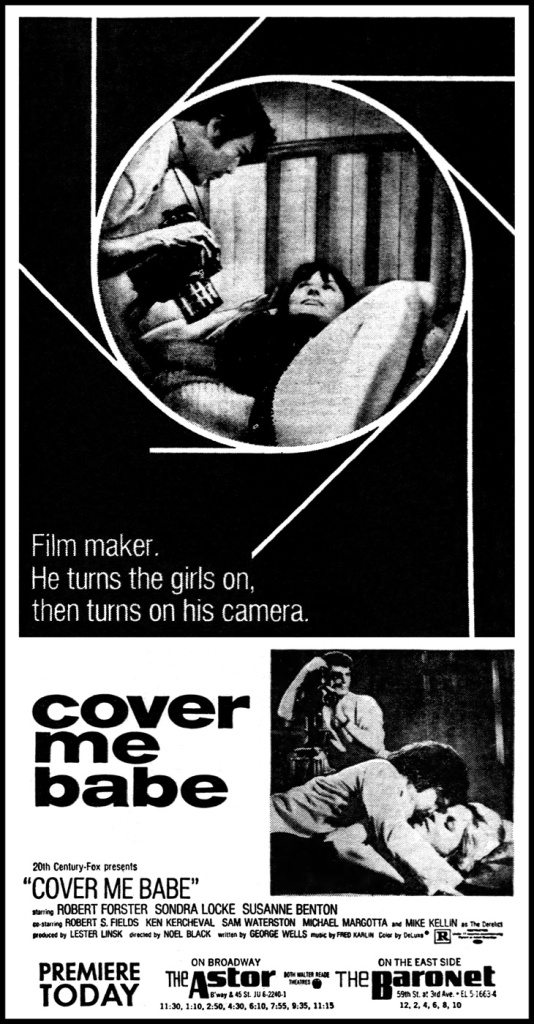
Film Review: Cover Me, Babe (dir by Noel Black)


I don’t know if I’ve ever come across a non-horror film that featured a more off-putting lead character than Tony, the protagonist of 1970’s Cover Me, Babe.

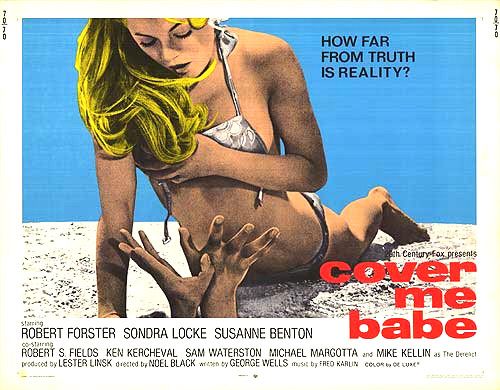
A film student, Tony (Robert Forster, even in 1970, who was too old for the role) aspires to make avant-garde films.  Everyone in the film continually raves about how talented Tony is.  The footage that we see, however, tends to suggest that Tony is a pretentious phony.  The film opens with footage of a student film that Tony shot, one that involves his girlfriend, Melisse (Sondra Locke) sunbathing in the desert and getting groped by a hand that apparently lives under the sand.  It was so self-consciously arty that I assumed that it meant to be satirical and that we were supposed to laugh along as Tony assured everyone that it was a masterpiece.  And, to be honest, I’m still not sure that Cover Me, Babe wasn’t meant to be a satire on film school pretension.  I mean, that explanation makes about as much sense any other.  (Hilariously enough, Tony’s film had the same visual style as the film-within-a-film around which the storyline of Orson Welles’s The Other Side of the Wind revolved.  At least in the case of Welles, we know that his intent was satirical.)

Tony is not only pretentious but he’s also a bit of a prick.  He treats Melisse terribly and he manipulates everyone around him.  He wanders around the city with his camera, filming random people and then editing the footage together into films that feel like third-rate Godard.  He answers every criticism with a slight smirk, the type of expression that will leave you dreaming of the moment that someone finally takes a swing at him.  Tony’s arrogant and he treats everyone like crap but, for whatever reason, everyone puts up with him because …. well, because otherwise there wouldn’t be a movie.  Of course, eventually, everyone does get sick of Tony because otherwise, the movie would never end.

A Hollywood agent (Jeff Corey) calls up Tony and offers to get him work in Hollywood.  Tony is rude to the guy on the phone.  Tony meets a big time producer who could get Tony work.  Tony’s rude to him.  Guess who doesn’t get a job?  Tony has to get money to develop his latest film from one of his professors so he’s rude to the professor.  Guess who doesn’t get any money?  Tony cheats on his loyal girlfriend.  Tony’s cameraman (played by a youngish Sam Waterston) walks out when Tony tries to film two people having sex.  By the end of the movie, no one wants anything to do with Tony.  Tony goes for a run on the beach.  He appears to be alienated and disgruntled.  We’re supposed to care, I guess.

The problem with making a movie about an arrogant artist who alienates everyone around him is that you have to make the audience believe that the artist is talented enough to justify his arrogant behavior.  For instance, if you’re going to make a movie about a painter who is prone to paranoid delusions and obsessive behavior, that painter has to be Vincent Van Gogh.  He can’t just be the the guy who paints a picture of two lion cubs and then tries to sell it at the local art festival.  You have to believe that the artist is a once-in-a-lifetime talent because otherwise, you’re just like, “Who cares?”  The problem with Cover Me, Babe is that you never really believe that Tony is worth all of the trouble.  The film certainly seems to believe that he’s worth it but ultimately, he just comes across as being a jerk who manipulates and mistreats everyone around him.

That said, from my own personal experience, a lot of film students are jerks who treat everyone them like crap.  So, in this case, I think you can make the argument that Cover Me, Babe works well as a documentary.  The fact of the matter is that not every film student is going to grow up to be the next Scorsese or Tarantino or Linklater.  Some of them are going to turn out to be like Tony, running along the beach and wondering why no one agrees with him about George Stevens being a less interesting director in the 50s than he was in the 30s.  As a docudrama about the worst people that you’re likely to meet while hanging out on campus, Cover Me, Babe is certainly effective.  Otherwise, the film is a pretentious mess that’s done in by its unlikable protagonist.  Everyone in the film says that Tony has what it takes to be an important director but, if I had to guess, I imagine he probably ended up shooting second unit footage for Henry Jaglom before eventually retiring from the industry and opening up his own vegan restaurant in Vermont.  That’s just my guess.

The poster has little to do with the film.

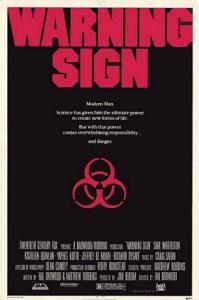
A Movie A Day #166: Warning Sign (1985, directed by Hal Barwood)


The world might end, again.

There is a laboratory in the middle of the desert.  While everyone thinks that the lab is developing pesticides, it is actually a secret government facility where the scientists have developed a chemical that will turn anyone exposed to it into a homicidal maniac.  While the scientists are celebrating the success of their project, Dr. Tom Schmidt (G.W. Bailey — yes, Captain Harris from the Police Academy movies) steps on a vial and releases the chemical.  The lab locks down and the army (led by Yaphet Kotto) arrives.  The government wants to let the scientists kill each other off but a pregnant security guard (Kathleen Quinlan) is also trapped in the lab and her husband, the county sheriff (Sam Waterston), is determined to get her out.

Warning Sign was blandly directed by Hal Barwood, a longtime associate of both George Lucas and Steven Spielberg.  (Barwood wrote the script for Spielberg’s The Sugarland Express and designed the title sequence for Lucas’s THX 1138.)  Barwood tried to take a very Spielbergian approach to Warning Sign, a mistake because successfully imitating Spielberg is easier said than done.  Replace the shark with germs and the ocean with a lab on lock down and Warning Sign is  like Jaws, without any of the suspense or humor.  Sam Waterston’s germaphobic sheriff feels like a knock off of Roy Scheider’s aquaphobic police chief while Jeffrey DeMunn, as an alcoholic scientist, stands in for both Richard Dreyfuss and Robert Shaw.    With the violence and the gore kept to a minimum, this is one of the most tasteful zombie films ever made.  Just compare it to George Romero’s The Crazies (or even the remake) to see how needlessly safe Warning Sign is.

44 Days of Paranoia #30: Nixon (dir by Oliver Stone)


For our latest entry in the 44 Days of Paranoia, we take a look at Oliver Stone’s 1995 presidential biopic, Nixon.

Nixon tells the life story of our 37th President, Richard Nixon.  The only President to ever resign in order to avoid being impeached, Nixon remains a controversial figure to this day.  As portrayed in this film, Nixon (played by Anthony Hopkins) was an insecure, friendless child who was dominated by his ultra religious mother (Mary Steenburgen) and who lived in the shadow of his charismatic older brother (Tony Goldwyn).  After he graduated college, Nixon married Pat (Joan Allen), entered politics, made a name for himself as an anti-communist, and eventually ended up winning the U.S. presidency.  The film tells us that, regardless of his success, Nixon remained a paranoid and desperately lonely man who eventually allowed the sycophants on his staff (including James Woods) to break the law in an attempt to destroy enemies both real and imagined.  Along the way, Nixon deals with a shady businessman (Larry Hagman), who expects to be rewarded for supporting Nixon’s political career, and has an odd confrontation with a young anti-war protester who has figured out that Nixon doesn’t have half the power that everyone assumes he does.

Considering that his last few films have been W., Wall Street: Money Never Sleeps, and SavagesI think it’s understandable that I’m often stunned to discover that, at one point in the distant past, Oliver Stone actually was a worthwhile director.  JFK, for instance, is effective propaganda.  Nixon, which feels a lot like an unofficial sequel to JFK, is a much messier film than JFK but — as opposed to something like Savages — it’s still watchable and occasionally even thought-provoking.  Thanks to Hopkins’ performance and, it must be admitted, Stone’s surprisingly even-handed approach to the character, Nixon challenges our assumptions about one of the most infamous and villified figures in American history.  It forces us to decide for ourselves whether Nixon was a monster or a victim of circumstances that spiraled out of his control.  If you need proof of the effectiveness of the film’s approach, just compare Stone’s work on Nixon with his work on his next Presidential biography, the far less effective W.

(I should admit, however, that I’m a political history nerd and therefore, this film was specifically designed to appeal to me.  For me, half the fun of Nixon was being able to go, “Oh, that’s supposed to be Nelson Rockefeller!”)

If I had to compare the experience of watching Nixon to anything, I would compare it to taking 10 capsules of Dexedrine and then staying up for five days straight without eating.  The film zooms from scene-to-scene, switching film stocks almost at random while jumping in and out of time, and not worrying too much about establishing any sort of narrative consistency.  Surprisingly nuanced domestic scenes between Anthony Hopkins and Joan Allen are followed by over-the-top scenes where Bob Hoskins lustily stares at a White House guard or Sam Waterston’s eyes briefly turn completely black as he discusses the existence of evil.  When Nixon gives his acceptance speech to the Republican Convention, the Republican delegates are briefly replaced by images of a world on fire.  Familiar actors wander through the film, most of them only popping up for a scene or two and then vanishing.  The end result is a film that both engages and exhausts the viewer, a hallucinatory journey through Stone’s version of American history.

Nixon is a mess but it’s a fascinating mess.

Other Entries In The 44 Days of Paranoia 

  1. Clonus
  2. Executive Action
  3. Winter Kills
  4. Interview With The Assassin
  5. The Trial of Lee Harvey Oswald
  6. JFK
  7. Beyond The Doors
  8. Three Days of the Condor
  9. They Saved Hitler’s Brain
  10. The Intruder
  11. Police, Adjective
  12. Burn After Reading
  13. Quiz Show
  14. Flying Blind
  15. God Told Me To
  16. Wag the Dog
  17. Cheaters
  18. Scream and Scream Again
  19. Capricorn One
  20. Seven Days In May
  21. Broken City
  22. Suddenly
  23. Pickup on South Street
  24. The Informer
  25. Chinatown
  26. Compliance
  27. The Lives of Others
  28. The Departed
  29. A Face In The Crowd

44 Days of Paranoia #19: Capricorn One (dir by Peter Hyams)


Last night, the temperature plunged here in Texas.  When I woke up this morning, I was confronted with a world that was literally frozen.  Needless to say, nobody in Dallas went to work today.  Instead, we all sat in our houses and tried to keep ourselves entertained.  I kept myself occupied by watching a film that was initially released way back in 1978 and which takes place in my home state.

The name of that film was Capricorn One and it’s the latest entry in the 44 Days of Paranoia.

Capricorn One begins with three astronauts preparing to take the fist manned space flight to Mars.  James Brolin is the stoic leader.  Sam Waterston is the guy who has a joke for every occasion.  And O.J. Simpson is … well, O.J. really doesn’t have much of a personality.  He’s pretty much just along for the ride.

However, it turns out that there really isn’t going to be a ride.  Just as the countdown begins, the astronauts are ordered to leave the capsule.  They are then transported to secret base in the Texas desert.  It’s here that they have a meeting with the Head of NASA, who is played by Hal Holbrook.  (It’s simply not a 70s conspiracy film if Hal Holbrook isn’t somehow involved).  Holbrook proceeds to deliver a stirring monologue where he talks about how he and Brolin have always dreamed of sending a manned flight to Mars.  However, as Holbrook explains, the life support system on the crew’s ship was faulty.  If Holbrook had allowed them to be launched, they would have died as soon as they left the Earth’s atmosphere.  However, if the mission had been canceled then there was a chance that the President would use that cancellation as an excuse to cut NASA’s funding.

So, as Holbrook explains, an empty spaceship has been launched into space.  As far as the American public is concerned, the three astronauts are currently on their way to Mars.  Now, in order to save the space program, they are going to have to fake the mission.  In a studio, a fake alien landscape has been set up and it’s from that studio that Brolin, Waterston, and Simpson will pretend to explore Mars.

Brolin, Waterston, and Simpson reluctantly agree to cooperate with the plan.  However, after doing the first fake broadcast, Brolin starts to have second thoughts.  Realizing that he can’t trust the three astronauts to keep a secret, Holbrook announces that the capsule’s heat shields failed during re-entry and that the crew of Capricorn One is now dead.  Now, all he has to do is have the three of them killed for real.

Meanwhile, a NASA technician (Robert Walden) stumbles onto evidence of the deception.  He subsequently vanishes but not before he tells reporter Elliott Gould about his suspicions.  While the three astronauts try to escape from Holbrook’s agents, Gould tries to find out what really happened to Capricorn One.

It’s probably half-an-hour too long, the plot is full of holes (the least of which being why Holbrook waited until after he had announced the fake deaths to order the real deaths), and director Peter Hyams allows a few scenes to run on and on while others seem to end with a jarring abruptness.  However, for the most part, Capricorn One is a well-acted and solidly entertaining film.  However, there are two things that make Capricorn One especially memorable.

First off, Capricorn One features one of the most exciting action sequences that I have  ever seen.  It occurs while Gould is investigating Walden’s disappearance.  After visiting Walden’s apartment and discovering that it’s inhabited by a woman who claims to have never heard of his friend, Gould is driving away when he discovers that his brakes have been disabled.  The car then starts to accelerate and Gould finds himself desperately trying to regain control as the car careens through the streets of Houston.  The scene is shot almost entirely from Gould’s point-of-view and, for five minutes, we watch as everything from other cars to unlucky pedestrians come hurtling towards the car.  For those few minutes, when the viewer and Gould become one, Capricorn One is not only exciting but it feels genuinely dangerous as well.

Secondly, Capricorn One features some of the oddest dialogue imaginable.  Peter Hyams not only directed the film but he also wrote the screenplay as well.  Watching the film, one gets the feelings that Hyams was so in love with his dialogue and with all of his quirky characters that he simply could not bring himself to cut anything or anyone.  As a result, the film is full of lengthy monologues.  When the characters speak to each other, they don’t have conversations as much as they trade quips.  Characters like Gould’s ex-wife (played by Karen Black) and his editor (David Doyle) show up for a scene or two, deliver monologues that are only tangibly related to the film’s plot, and then vanish.  Sam Waterston ends up telling the world’s longest joke while he climbs a mountain in the desert.  Towards the end of the film, Telly Savalas (who was in my favorite Mario Bava film, Lisa and the Devil) shows up as a foul-tempered crop duster and engages in a long argument with Gould who, despite being a reporter, never bothers to question why Savalas would have a crop dusting business in the middle of the desert.

But here’s the thing — it works.  As odd as some of the dialogue may be and as superfluous as some of the action is to the overall plot, it still all works to the film’s benefit.  The constant quirkiness works to keep the audience off-balance and to give Capricorn One its own unique rhythm.

Capricorn One — see it now before Michael Bay remakes it.

Other Entries In The 44 Days of Paranoia 

  1. Clonus
  2. Executive Action
  3. Winter Kills
  4. Interview With The Assassin
  5. The Trial of Lee Harvey Oswald
  6. JFK
  7. Beyond The Doors
  8. Three Days of the Condor
  9. They Saved Hitler’s Brain
  10. The Intruder
  11. Police, Adjective
  12. Burn After Reading
  13. Quiz Show
  14. Flying Blind
  15. God Told Me To
  16. Wag the Dog
  17. Cheaters
  18. Scream and Scream Again