(It’s tradition here at the Lens that, every October, we watch the original Little Shop of Horrors. And always, I start things off by telling this story…)
Enter singing.
Little Shop…Little Shop of Horrors…Little Shop…Little Shop of Terrors…
Hi! Good morning and Happy October the 25th! For today’s plunge into the world of public domain horror films, I’d like to present you with a true classic. From 1960, it’s the originalLittle Shop of Horrors!
When I was 19 years old, I was in a community theater production of the musical Little Shop of Horrors. Though I think I would have made the perfect Audrey, everybody always snickered whenever I sang so I ended up as a part of “the ensemble.” Being in the ensemble basically meant that I spent a lot of time dancing and showing off lots of cleavage. And you know what? The girl who did play Audrey was screechy, off-key, and annoying and after every show, all the old people in the audience always came back stage and ignored her and went straight over to me. So there.
Anyway, during rehearsals, our director thought it would be so funny if we all watched the original film. Now, I’m sorry to say, much like just about everyone else in the cast, this was my first exposure to the original and I even had to be told that the masochistic dentist patient was being played by Jack Nicholson. However, I’m also very proud to say that — out of that entire cast — I’m the only one who understood that the zero-budget film I was watching was actually better than the big spectacle we were attempting to perform on stage. Certainly, I understood the film better than that screechy little thing that was playing Audrey.
The first Little Shop of Horrors certainly isn’t scary and there’s nobody singing about somewhere that’s green (I always tear up when I hear that song, by the way). However, it is a very, very funny film with the just the right amount of a dark streak to make it perfect Halloween viewing.
So, if you have 72 minutes to kill, check out the original and the best Little Shop of Horrors…
(As some of you may have noticed, I shared this movie last year as well. However, since the video that I embedded in the previous post was subsequently taken down, I figured I might as well post it again this year. Plus, it’s Boris Karloff, Jack Nicholson, and Dick Miller! Why not post it twice?)
Have you ever woken up and thought to yourself, “I’d love to see a movie where a youngish Jack Nicholson played a French soldier who, while searching for a mysterious woman, comes across a castle that’s inhabited by both Dick Miller and Boris Karloff?”
Of course you have! Who hasn’t?
Well, fortunately, it’s YouTube to the rescue. In Roger Corman’s 1963 film The Terror, Jack Nicholson is the least believable 19th century French soldier ever. However, it’s still interesting to watch him before he became a cinematic icon. (Judging from his performance here and in Cry Baby Killer, Jack was not a natural-born actor.) Boris Karloff is, as usual, great and familiar Corman actor Dick Miller gets a much larger role than usual. Pay attention to the actress playing the mysterious woman. That’s Sandra Knight who, at the time of filming, was married to Jack Nicholson.
Reportedly, The Terror was one of those films that Corman made because he still had the sets from his much more acclaimed film version of The Raven. The script was never finished, the story was made up as filming moved alone, and no less than five directors shot different parts of this 81 minute movie. Among the directors: Roger Corman, Jack Hill, Monte Hellman, Francis Ford Coppola, and even Jack Nicholson himself! Perhaps not surprisingly, the final film is a total mess but it does have some historical value.
(In typical Corman fashion, scenes from The Terror were later used in the 1968 film, Targets.)
This October, I’m going to be doing something a little bit different with my contribution to 4 Shots From 4 Films. I’m going to be taking a little chronological tour of the history of horror cinema, moving from decade to decade.
Today, we start the 1960s!
4 Shots From 4 Films
Psycho (1960, dir by Alfred Hitchcock)
The Pit and the Pendulum (1961, dir by Roger Corman)
Long before Event Horizon (but, perhaps more importantly, shortly after the original Alien), there was 1981’s Galaxy of Terror!
Produced by Roger Corman and featuring production design and second unit work from James Cameron, Galaxy of Terror tells the story of what happens when, in the future, the crew of the Quest are dispatched to a mysterious planet. They’re on a rescue mission but what they don’t realize is that they’re heading into a trap!
The crew of the Quest is virtually a who’s who of cult actors.
The youngest member of the crew is Cos. Cos is scared of everything and, from the minute you see him, you can tell that he’ll probably be the first to die. Cos is played by Jack Blessing, who subsequently became a very in-demand voice over artist. You may not recognize the name or the face but you’ve probably heard the voice.
Captain Trainor, who is still troubled by a disastrous mission in the past, is played by Grace Zabriskie, who is rumored to have inspired Bob Dylan’s “Like A Rolling Stone” and who subsequently became a regular member of David Lynch’s stock company.
The fearsome Quuhod is played by one of the patron saints of exploitation filmmaking, the one and only SID HAIG! Quuhod doesn’t say much but Sid Haig doesn’t have to say much to make an impression.
Technical officer Dameia is played by Taaffe O’Connell. She suffers through the film’s most infamous and distasteful scenes, in which she’s assaulted by a gigantic space worm. That scene was apparently insisted upon by Roger Corman and it’s not easy to watch. At the same time, since the film takes place on a planet that is ruled by pure evil, the scene somehow works. It’s that scene that tells you that Galaxy of Terror is not going to be your typical B-movie. That is the scene that says, “This movie is going to give you nightmares!”
Ranger is played by Robert Englund! That’s right — the original Freddy Krueger himself. It’s interesting to see Englund in this role because Ranger is actually one of the only likable characters in the film. It’s strange to see the future Freddy Krueger being menaced by the same type of threats that he unleashed on Elm Street. But Englund does a good job in the role. In fact, he does so well that you wonder what would have happened in his career if he hadn’t been forever typecast as the man of your nightmares.
The arrogant and cocky Baelon is played by future director, Zalman King. It says something about King’s acting career that Galaxy of Terror is not the strangest film that he ever appeared in.
Burned-out Commander Ilvar is played by Bernard Behrens, who is one of those character actors who has a very familiar face. If you watch any movie from the 80s or 90s that features a weary homicide detective or an unsympathetic bureaucrat, it’s entirely possible that he was played by Bernard Behrens.
Kore, the ship’s cook, is played by Ray Waltson, who is another one of those very familiar character actors. Over the course of his long career, Waltson appeared in everything from The Apartment to The Sting to Fast Times At Ridgemont High to a countless number of TV shows and TV movies. Waltson was usually cast in comedic roles so it’s interesting to see him here, playing a role that is very much not comedic.
Alluma, an empath, is played by Erin Moran, who was best known for playing Ron Howard’s bratty sister on the somewhat terrible (but apparently popular and deathless) sitcom, Happy Days. Moran’s explosive death scene is another reason why Galaxy of Terror has a cult following.
And finally, the “star” of the film is Edward Albert, who plays Cabren. To return to my earlier comparison to Event Horizon, Edward Albert has the Laurence Fishburne role.
Anyway, our crew is sent on a rescue mission but, when they crash land on the planet Morganthus, they find themselves outside of a desolate pyramid. They make the mistake of exploring the pyramid and end up being confronted by their greatest fears. (They also eventually discover that one of their crewmates is a traitor.) It’s pretty much a typical sci-fi slasher film but it makes an impression because, thematically, it’s just so dark. The fears that attack the crew members are so ruthless and brutal that they will take even the most jaded of horror fans by surprise. Galaxy of Terror is relentless and merciless in its effort to scare the audience.
What especially distinguishes Galaxy of Terror is that, despite the obviously low budget, the entire film feels sickeningly real. A lot of credit for that has to go to James Cameron, who creates a lived-in future that actually feels a lot more plausible than anything to be found in Avatar.
So, if you have the chance, turn off the lights, watch the film in the dark, and prepare for a perfect Halloween nightmare!
Today’s Horror on the Lens is the 1959 Roger Corman film, Wasp Woman!
In this film, Janice Starlin (Susan Cabot) is the head of a cosmetic company. When she discovers that her sales are suffering because the public has noticed that she is getting older, Janice does what any dedicated CEO would do! She agrees to undergo a radical treatment involving the royal jelly taken from a queen wasp.
Do you think this treatment will make Janice look younger?
Or will it lead to her periodically transforming into a monstrous creature?
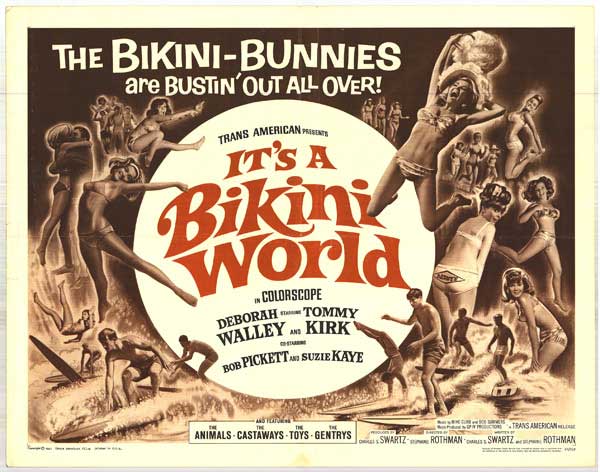
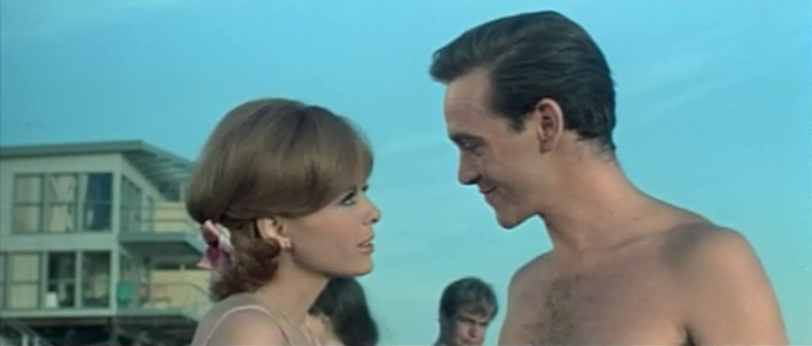
IT’S A BIKINI WORLD is one of the lowest of the low-budget “Beach Party” ripoffs you’ll ever see. Yet it has a certain charm to it, a likeable little “battle of the sexes” soufflé featuring some great 60’s rock acts and the undeniable appeal of beach bunny Deborah Walley.
Beach stud Mike Samson goes gaga for knockout new redhead Delilah Dawes (Samson and Delilah, get it?). She thinks he’s an egotistical jerk and gives him the big freeze-out, telling him she prefers the “serious type”, so Mike dons a pair of thick glasses and some nerdy duds, passing himself off as intellectual brother “Herbert”. Herbert takes her to museums and zoos, while Mike competes with her in skateboarding and boat races run by local customizer Daddy, owner of hangout The Dungeon. Delilah discovers Mike’s scam, and they compete in a final Cross Country Race that consists of car racing, motorcycles…
(Lisa is currently in the process of trying to clean out her DVR by watching and reviewing all 40 of the movies that she recorded from the start of March to the end of June. She’s trying to get it all done by July 11th! Will she make it!? Keep visiting the site to find out!)
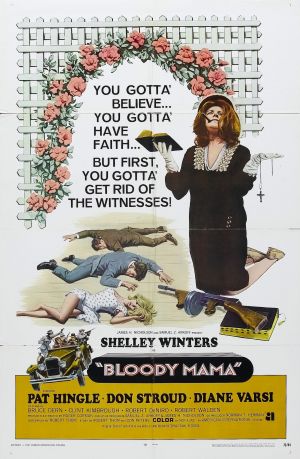
The 24th film on my DVR was the 1970 Roger Corman-directed gangster film, Bloody Mama. I recorded it off of TCM on May 27th.
Bloody Mama opens with a cheerful song that goes, “Maaaaaama…Bloody maaaaama….” and it’s such an unapolegetically over the top song that it perfectly sets the tone for what’s to follow. Bloody Mama is violent, occasionally perverse, and totally unashamed. It doesn’t pretend to be anything that it isn’t. It’s bloody and it’s about a mother and, in the best Corman tradition, it makes no apologies!
The film tells the heavily fictionalized story of the Barkers, a group of brothers who robbed banks and killed people in the 1920s and 30s. The majority of them were killed in a gunfight with the FBI. Also killed in the gunfight was their mother, Kate Barker. Always aware of the danger of bad publicity, the director of the FBI, J. Edgar Hoover, announced that Ma Barker was actually the mastermind of the Barker gang and that she was even more dangerous than her sons. Ever since, historians have debated whether Ma Barker was the criminal mastermind described by Hoover or if she was just the innocent woman described by … well, by everyone who actually knew her.
Bloody Mama, of course, leaves no doubt. From the minute that we discover that Shelley Winters will be playing Ma Barker, we know that she’s the most dangerous woman alive. As played by Winters, Ma Barker is a ruthless bank robber, one who has no fear of gunning down innocent bystanders and who never lets her love for her sons get in the way of ordering them to kill a witness. As opposed to a lot of gangster films made in the late 60s and early 70s, the film never attempts to portray its title character as being a heroic or particularly sympathetic character. Instead, what makes the character compelling is just how thoroughly Winters commits to the role. It doesn’t matter what Ma Barker is doing or saying, Shelley Winters totally sells it. When the gang is cornered by the police and one associate makes the mistake of yelling that he’s not a Barker, Ma reacts by gunning him down herself and you can’t help but appreciate the lengths that Ma will go to defend her family’s name.
As for her sons, they are an interesting group of perverts and drug addicts and they’re played some of the best character actors of the 1970s.
Herman Barker (Don Stroud) is a sadist but he’s also one of Ma’s favorites. He travels with a prostitute (played by Diane Varsi), who quickly tires of the Barkers’s violent way of life.
Arthur Barker (Clint Kimbrough) is the most practical of the Barkers and therefore, he’s also the least interesting.
Fred Barker (Robert Walden) is bisexual, which is a fact that the film handles with all the sensitivity that we’ve come to expect from a film made in 1970 (which is to say, not much at all). Fortunately, Fred’s lover is Kevin and Kevin is played by Bruce Dern and Bruce Dern is always a lot of fun to watch, especially when he’s appearing in a Corman film.
And then there’s Lloyd who sniffs glue and shoots heroin and who is played by an obscure young actor named Robert De Niro and … wait, Robert De Niro! That’s right! One of the pleasures of Bloody Mama is getting to see De Niro at the start of his career. Unfortunately, he doesn’t really get to do much, though he does occasionally flash the same unhinged smile that would later show up in Taxi Driver.
Roger Corman has repeatedly cited Bloody Mama as being one of his favorites of the many movies that he directed over the course of his long career. I don’t blame him. It’s a thoroughly shameless and totally entertaining film!
Keep an eye out for Bloody Mama!
Just remember, the real-life Ma Barker was probably innocent.
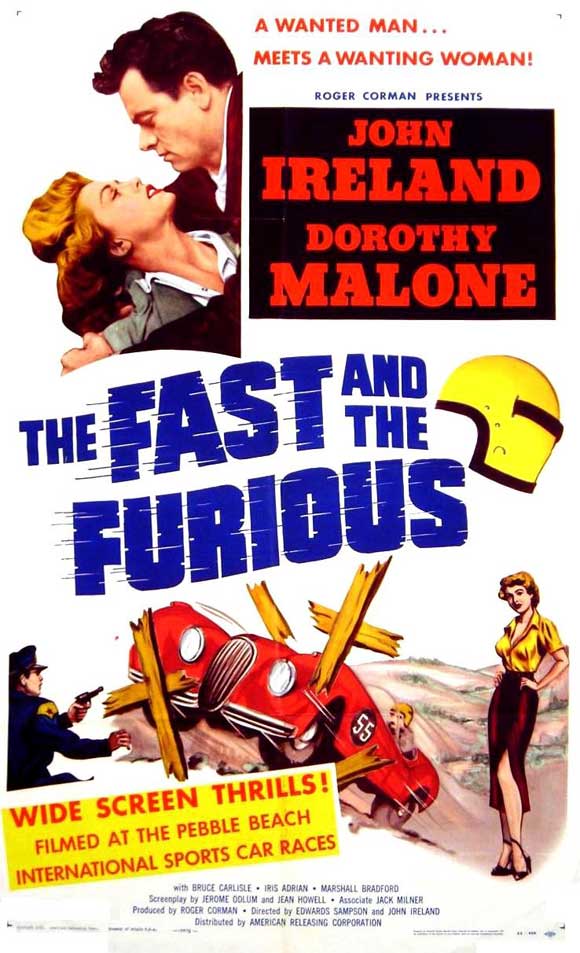
I’ve never seen any of those FAST AND FURIOUS movies with Paul Weller, Vin Diesel, and The Rock (yeah I know, Dwayne Johnson, but he’ll always be The Rock to me). Nope, not even one. I just never had much interest in them. I’d heard of the 1955 THE FAST AND THE FURIOUS, an early Roger Corman production, but never watched it either, until now. Seems I wasn’t missing anything.
THE FAST AND THE FURIOUS is Corman’s second film as producer, and first release for American International Pictures, under the moniker American Releasing Corporation. It’s an inauspicious debut for the company, to put it mildly. The story concerns escaped con Frank Webster, who kidnaps sports car racer Connie Adair and her white Jaguar (which is a nice car, by the way). They bicker with some tough-talking dialogue, as Frank plans on crossing the border to Mexico by driving the Jag in a…
How have I ignored Roger Corman here for so long, save for a short “Cleaning Out the DVR” review of THE TERROR ? The King of the Low Budget Quickies has long been a favorite filmmaker of mine, and has probably had more impact on American cinema than people realize. Well, now that TCM is running its month-long salute to AIP, I’m about to rectify that oversight. (By the way, Corman himself is cohosting the retrospective every Thursday night along with TCM’s own Ben Mankiewicz!)
American International Pictures scored a hit with 1960’s HOUSE OF USHER, an Edgar Allan Poe adaptation starring Vincent Price and directed by Corman. Studio honchos James Nicholson and Samuel Z. Arkoff looked at the box office numbers and, realizing they had a cash cow on their hands, asked Corman to produce a follow-up. Rapid Roger decided on PIT AND THE PENDULUM, shot in 15 days for less…
(I originally shared this film back in 2011 — can you believe we’ve been doing this for that long? — but the YouTube vid was taken down. So, I’m resharing it today!)
For today’s excursion into the world of public domain horror, I offer up the film debut of Francis Ford Coppola. Before Coppola directed the Godfathers and Apocalypse Now, he directed a low-budget, black-and-white thriller that was called Dementia 13. (Though, in a sign of things to come, producer Roger Corman and Coppola ended up disagreeing on the film’s final cut and Corman reportedly brought in director Jack Hill to film and, in some cases, re-film additional scenes.)
Regardless of whether the credit should go to Coppola, Corman, or Hill, Dementia 13 is a brutally effective little film that is full of moody photography and which clearly served as an influence on the slasher films that would follow it in the future. Speaking of influence, Dementia 13 itself is obviously influenced by the Italian giallo films that, in 1963, were just now starting to make their way into the drive-ins and grindhouses of America.
In the cast, keep an eye out for Patrick Magee, who later appeared as Mr. Alexander in A Clockwork Orange as well as giving a memorable performance in Lucio Fulci’s The Black Cat. Luana Anders, who plays the duplicitous wife in this film, showed up in just about every other exploitation film made in the 60s and yes, the scene where she’s swimming freaks me out to no end.
(One final note: I just love the title Dementia 13. Seriously, is that a great one or what?)




 Through the Shattered Lens