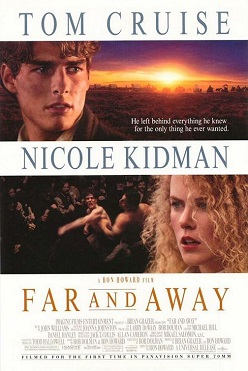
Far and Away (1992, directed by Ron Howard)


The year is 1892 and Joseph Donnelly (Tom Cruise) is a poor tenant famer in Ireland, used and exploited by the wealthy landowners.  Joseph falls in love with Shannon Christie (Nicole Kidman), the rebellious daughter of his landlord.  Shannon dreams of going to America, where rumor has it that land is being given away in the territory of Oklahoma on a first come/first serve basis.  Shannon even has some valuable spoons that she can use to raise money once they arrive in America.  Joseph, after being challenged to a duel by the Christies’ money manger, Stephen Chase (Thomas Gibson), also decides that heading to America might be a good idea.

Life in America is not as easy as Joseph and Shannon thought it would be.  They first end up in the dirty town of Boston, where Shannon loses her spoons and Joseph works for a corrupt political boss (Colm Meaney) and makes money as a bare-knuckles boxer.  They’ll reach Oklahoma eventually but not before Stephen and the Christies come to Boston and Joseph ends up working on the railroad and getting called “that crazy mick” multiple times.

Far and Away was Ron Howard’s attempt to make an American epic, in the style of John Ford.  It doesn’t work because Tom Cruise is too contemporary to be believable as a 19th century Irish immigrant and Howard tries so hard to push everything to an epic scale that it just makes it even more obvious how slight and predictable the movie’s story is.  Far and Away is full of big movie moments but it lacks the small human moments necessary to really engage its audience.  I will always remembers Far and Away because it was one of those films that seemed to take up permanent residence on HBO when I was growing up.  I didn’t really care about the film’s flaws back then.  Nicole Kidman was attractive and tall and she had wild red hair and back then, that’s all a movie needed to hold my attention.  Unlike Cruise, Nicole Kidman can effortlessly move between historical and contemporary films and, of the two leas, she comes off the best.  The movie is really stolen, though, by Colm Meaney, playing a ruthless political boss who could have taught Boss Tweed a thing or two.

Tomorrow is St. Patrick’s Day, when we will be celebrating the legacy of immigrants like the Christies and the Donnellys.  Far and Away tries to pay tribute to their courage and their refusal to give up, even when things were tough and deadly on the frontier.  For me, though, Far and Away will always just make me think of HBO in the 90s.

Film Review: After Hours (dir by Martin Scorsese)


Directed by Martin Scorsese, 1985’s After Hours opens in an office.  This isn’t the type of office that one might expect a Scorsese movie to open with.  It’s not a wild, hedonistic playground like the office in The Wolf of Wall Street.  Nor is it a place where an aging man with connections keeps his eye on the business for his friends back home, like Ace Rothstein’s office in Casino.  Instead, it’s a boring and anonymous office, one that is full of boring and anonymous people.  Scorsese’s camera moves around the office almost frantically, as if it’s as trapped as the people who work there.

Paul Hackett (Griffin Dunne) works in the office, at a job that bores him but presumably pays him enough to live in New York.  Paul is not a typical Scorsese protagonist.  He’s not a fast-talker or a fearsome fighter.  He’s not an artist consumed by his own passion or an amoral figure eager to tell his own story.  Instead, he’s just a guy who wears a tie to work and who spends his day doing data entry.  He’s a New Yorker but he doesn’t seem to really know the city.  (He certainly doesn’t know how much it costs to ride the subway.)  He stays in his protected world, even though it doesn’t seem satisfy him.  Paul Hackett is not Travis Bickle.  Instead, Paul is one of the guys who would get into Travis’s cab and, after spending the drive listening to Travis talk about how a storm needs to wash away all of New York’s sin, swear that he will never again take another taxi in New York.

One day, after work, Paul has a chance meeting with a seemingly shy woman named Marcy (Rosanna Arquette).  Marcy lives in SoHo, with an artist named Kiki (Linda Fiorentino) who sells plaster-of-Paris paperweights that are made to look like bagels.  Marcy gives Paul her number and eventually, Paul ends up traveling to SoHo.  He takes a taxi and, while the driver is not Travis Bickle, he’s still not amused when Paul’s last twenty dollar bill blows out the window of the cab.

Paul’s trip to SoHo doesn’t goes as he planned.  Kiki is not impressed with him.  Marcy tells him disturbing stories that may or may not be true while a search through the apartment (not cool, Paul!) leads Paul to suspect that Marcy might have disfiguring burn scars.  Paul decides to end the date but he then discovers that he doesn’t have enough change on him to take the subway home.  As Paul attempts to escape SoHo, he meets a collection of strange people and finds himself being hunted by a mob that is convinced that he’s a burglar.  Teri Garr plays a sinister waitress with a beehive hairdo and an apartment that is full of mousetraps.  Catherine O’Hara chases Paul in an ice cream truck.  Cheech and Chong play two burglars who randomly show up through the film.  John Heard plays a bartender who appears to be helpful but who also has his own connection to Marcy.  Even Martin Scorsese appears, holding a spotlight while a bunch of punks attempt to forcibly give Paul a mohawk.  The more that Paul attempts to escape SoHo, the more trapped he becomes.

Martin Scorsese directed After Hours at a time when he was still struggling to get his adaptation of The Last Temptation of Christ into production.  If Paul feels trapped by SoHo, Scorsese felt trapped by Hollywood.  After Hours is one of the most nightmarish comedies ever made. It’s easy to laugh at Paul desperately hiding in the shadows from Catherine O’Hara driving an ice cream truck but, at the same time, it’s impossible not to relate to Paul’s horror as he continually finds himself returning again and again to the same ominous locations.  In many scenes, he resembles a man being hunted by torch-wielding villagers in an old Universal horror film, running through the shadows while villager after villager takes to the streets.  Paul’s a stranger in a strange part of the city and he has absolutely no way to get home.  I think everyone’s had that dream at least once.

Paul is not written to be a particularly deep character.  He’s just a somewhat shallow office drone who wanted to get laid and now just wants to go home.  Fortunately, he’s played by Griffin Dunne, who is likable enough that the viewer is willing to stick with Paul even after Paul makes some very questionable decisions and does a few things that make him a bit less than sympathetic.  Dunne and John Heard keep the film grounded in reality, which allows Rosanne Arquette, Linda Fiorentino, Catherine O’Hara, and especially Teri Garr to totally play up the bizarre quirks of their character.  Teri Garr especially does a good job in this film, revealing a rather frightening side of the type of quirky eccentric that she usually played.

Scorsese’s sense of humor has been evident in almost all of his films but he still doesn’t get enough credit for his ability to direct comedy.  (One need only compare After Hours to one of Brian De Palma’s “comedies” to see just how adroitly Scorsese mixes laughs and horror.)  After Hours is one of Scorsese’s more underrated films and it’s one that everyone should see.  After Hours is a comedy of anxiety.  I laughed while I watched it, even while my heart was racing.

Insomnia File #35: Donnie Brasco (dir by Mike Newell)


What’s an Insomnia File? You know how some times you just can’t get any sleep and, at about three in the morning, you’ll find yourself watching whatever you can find on cable? This feature is all about those insomnia-inspired discoveries!

Last night, if you happened to be awake at 2:30 in the morning, you could have turned over to Starz and watched the 1997 film, Donnie Brasco.

Benjamin “Lefty” Ruggiero (Al Pacino) has spent his entire life as a loyal Mafia soldier.  It’s the only life that he knows and he can tell you some stories.  He remembers the early days, back when men like Lucky Luciano, Frank Costello, and Meyer Lansky were in charge of things.  Lefty is proud to say that, over the years, he’s successfully carried out over 20 hits.  Lefty is lucky enough to be an associate of an up-and-comer nicknamed Sonny Black (Michael Madsen).  While Sonny was in prison, Lefty kept an eye on Sonny’s family.  Lefty feels that Sonny owes him.  Whether Sonny feels the same way isn’t always quite clear.

Lefty’s problem is that everyone loves him but few people respect him.  The aging Lefty is viewed as being a relic and, at most, they merely tolerate his constant bragging.  Lefty may fantasize about the big bosses knowing who he is but, when he tries to greet one of them at a party, it becomes clear that he doesn’t have the slightest idea who Lefty is.  Lefty spends his time worrying that he’s dying and dreaming of one last opportunity to make a name for himself.

In fact, perhaps the only really good thing that Lefty has going for him is his friendship with Donnie Brasco (Johnny Depp).  Donnie is a jewel thief, a tough and volatile orphan who Lefty introduces to Sonny.  Sonny is immediately impressed with Donnie.  In fact, Sonny thinks so highly of Donnie that he assigns Donnie to look over his operations in Florida.  Lefty can only watch as his protegé’s star starts to eclipse his own.  But that’s not necessarily a bad thing.  As Lefty explains it, Donnie’s success is also Lefty’s success because Lefty is the one who brought Donnie into the crew.  Of course, if Donnie ever fails, the failure will be on Lefty as well.

As for Donnie … well, his name isn’t actually Donnie.  His real name is Joe Pistone and he’s a FBI agent.  When he first agreed to work undercover, he was told that the assignment would only last for a few months.  Instead, the months turn into years and, piece by piece, Joe vanishes as he transforms into Donnie.  The formerly soft-spoken college graduate is soon beating up waiters and chopping up bodies in basements.  His wife (Anne Heche) fears that her husband may no longer exist.  “I  am not becoming like them,” Joe/Donnie says at one point, “I am them.”

Donnie Brasco is hardly the first film to examine life in the Mafia.  It’s not even the first movie about an undercover FBI agent who manages to worm his way into the mob’s hierarchy.  What sets Donnie Brasco apart are the performances of Pacino, Depp, Heche, Madsen, and, as a talkative mob associate, Bruno Kirby.  As played by Pacino, Lefty may be a hardened killer but he’s also just a working class guy who wishes that his boss would just show him a little appreciation.  Lefty may be capable of casually shooting a guy in the back of the head but, at the same time, there’s something heartbreakingly sad about the sight of him tearing up a greeting card that he hoped to personally deliver to the big boss.  As for Johnny Depp, he gives a surprisingly restrained performance, rarely raising his voice except when he’s yelling at his family.  Donnie may appear outwardly calm but the stress of losing his identity is always present in his eyes.

Interestingly, for a mob movie, there’s little violence to be found in Donnie Brasco.  It’s not until 90 minutes in that we get the expected scene of rival mobsters getting ambushed and gunned down.  Donnie Brasco isn’t about violence.  Instead, the film’s heart is to be found in the  story of Lefty and Donnie’s odd friendship.  Instead of being about who is going to kill who, this film is about Lefty’s desire to be something more than he is and Joe’s struggle to remember who he used to be before he became Donnie.  It’s a touching and effective gangster film and one to keep an eye out for.

Previous Insomnia Files:

  1. Story of Mankind
  2. Stag
  3. Love Is A Gun
  4. Nina Takes A Lover
  5. Black Ice
  6. Frogs For Snakes
  7. Fair Game
  8. From The Hip
  9. Born Killers
  10. Eye For An Eye
  11. Summer Catch
  12. Beyond the Law
  13. Spring Broke
  14. Promise
  15. George Wallace
  16. Kill The Messenger
  17. The Suburbans
  18. Only The Strong
  19. Great Expectations
  20. Casual Sex?
  21. Truth
  22. Insomina
  23. Death Do Us Part
  24. A Star is Born
  25. The Winning Season
  26. Rabbit Run
  27. Remember My Name
  28. The Arrangement
  29. Day of the Animals
  30. Still of The Night
  31. Arsenal
  32. Smooth Talk
  33. The Comedian
  34. The Minus Man

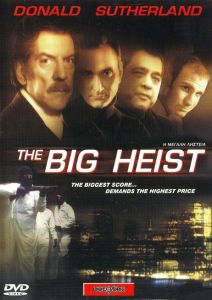
A Movie A Day #43: The Big Heist (2001, directed by Robert Markowitz)


the_big_heist_2001In 1978, low-level mob associate Jimmy Burke (Donald Sutherland) is released after serving a six years in prison.  As soon as he arrives home, he discovers that his son, Frank (Jamie Harris), has failed to keep up with the family business and that the Burke Crew is close to becoming a joke.  Looking for a big score, Jimmy masterminds a robbery at John F. Kennedy International Airport.  The so-called Lufthansa Heist becomes the largest cash robbery committed on American soil at that time.  Growing paranoid, Burke decides it would be easier to just kill all the members of his crew than to give them their cut of the robbery.  What Burke doesn’t realize is that his closest associates are destined to be his downfall.  Tommy DeSimone (Rocco Sisto) has offended John Gotti (Steven Randazzo) while Henry Hill (Nick Sandow) has become hooked on drugs and is considering turning informant.

If all this sounds familiar, that’s because part of this story was already told in Goodfellas.  The Big Heist was made for TNT and, because it focuses exclusively on the robbery, it goes into far more detail than Martin Scorsese’s film.  For instance, the character of Frank Burke was entirely left out of Goodfellas and it’s interesting to see how much more negatively Henry Hill is portrayed in The Big Heist.  Since it’s told from the viewpoint of Jimmy Burke instead of Henry Hill, The Big Heist makes for an interesting companion piece to Goodfellas but, at the same time, it never escapes the shadow of the other film.  With both movies employing voice over narration and frequent freeze frames, it’s impossible to watch The Big Heist without comparing it to Goodfellas.  Since Goodfellas was made by Martin Scorsese and The Big Heist was made for TNT, the former comes out on top.

It’s also hard to watch Donald Sutherland as Jimmy Burke without comparing his performance to Robert De Niro’s Jimmy Conway.  Though he never reaches the heights of De Niro’s performance, Sutherland is convincing as a sociopathic criminal mastermind.  Less convincing are Rocco Sisto and Nick Sandow, who both struggle to make an impression in roles previously made famous by Joe Pesci and Ray Liotta.