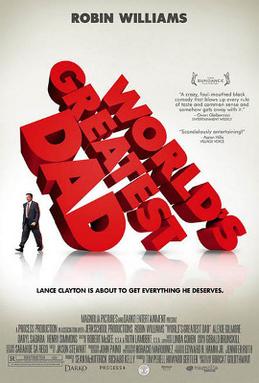
World’s Greatest Dad (2009, directed by Bobcat Goldthwait)


Lance Clayton (Robin Williams) is an English teacher who has a rotten teenage son named Kyle (Daryl Sabara).  Some teenagers go through a rebellious phase.  Some teenagers are troubled because of how they were raised or a recent trauma.  Some teenagers are misunderstood.  Kyle is just a disrespectful and stupid jerk who seems destined to do nothing his life.  He’s the type of fifteen year-old boy who uses his phone to secretly take upskirt pictures of his Dad’s girlfriend while they’re all out for dinner.

Those upskirt pics prove to be the last thing that Kyle sees as he’s looking at them where he dies in a case of autoerotic asphyxiation gone wrong.  Lance impulsively stages Kyle’s death to look like a suicide, both to preserve Kyle’s dignity and his own.  Lance, a frustrated writer, composes a suicide note and signs it with Kyle’s name.  When the note is leaked to the press, Kyle is hailed as a sensitive young man and becomes a hero to the former classmates who used to hate him.  Lance goes on to forge and publish a journal, which he claims was written by Kyle.  Kyle is hailed as a hero and Lance as the “world’s greatest dad.”  Lance enjoys the fame, until he doesn’t.

World’s Greatest Dad is a dark comedy, one that has the courage to often be downright unpleasant in its portrayal of how Kyle’s memory is idealized after his death.  It also features one of Robin Williams’s best performances.  Almost every performance that Williams gave had at least a hint of sadness to it.  In this film, he plays one of his saddest characters, a well-meaning teacher who cannot understand how his son has become such a jerk.  By writing the journal, Williams is not only deceiving the rest of the world but also himself.  He’s recreating Kyle as the son that he wanted as opposed to the one he got.  It’s one of Williams’s most emotionally honest and open performances.

For obviously reasons, it’s not easy to watch Williams playing such a depressed character, especially one who staes a suicide but the film really does show what a great actor Robin Williams could be.  In the end, his talent is what we should remember and celebrate.


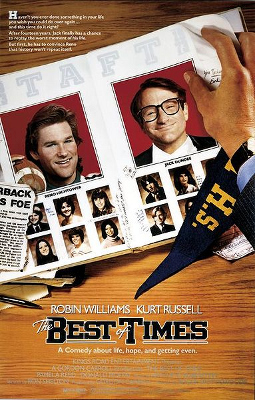
The Best Of Times (1986, directed by Roger Spottiswoode)


For years, banker Jack Dundee (Robin Williams) had been haunted by a pass that he dropped in high school.  The pass was perfectly thrown by quarterback Reno Hightower (Kurt Russell) but Jack couldn’t bring it in and, as a result, Taft High lost to its rival, Bakersfield.  Adding to Jack’s humiliation is that he now works for The Colonel (Donald Moffat), a confirmed Bakersfield fan who also happens to be Jack’s father-in-law.  When Jack visits a “massage therapist” (Margaret Whitton) and tells her about his problems, she suggests that he needs to replay the game.  Getting everyone interested in replaying the game is not easy.  No one wants to be humiliated a second time and Reno, who now fixes vans for a living, fears the he’s lost his edge.  Jack dresses up in the Bakersfield mascot’s uniform and vandalizes the town.  Finally, everyone is ready for the game.  Now, it’s a matter of town pride.

The Best of Times is a likable comedy about getting older and wishing you could have just one more chance to be young again and to have your entire future ahead of you.  Jack is haunted by that one dropped pass, feeling that it has cast a cloud over his entire life.  Reno is still a town hero but he’s struggling financially and in debt to Jack’s bank.  Replaying the game isn’t going to fix their lives but it is going to give them one last chance to relive their former glory and maybe an opportunity to learn that, even if they are getting older, they’re still living in the best of times.  The world that these two men live in is skillfully drawn and believable, with character actors like Moffat, M. Emmet Walsh, R.G. Armstrong, and Dub Taylor adding to the local color.  Jack and Reno’s wives are played by Holly Palance and Pamela Reed and they are also strong and well-developed characters.  Finally, Robin Williams and Kurt Russell are a strong comedic team.  Russell is perfectly cast as the aging jock and Williams gives one of his more restrained performances as Jack, allowing us to see the sadness behind Jack’s smile.

The stakes aren’t particularly high in The Best Of Times.  It’s just a football game between some middle-aged men looking to regain their youth.  But the story sticks with you.

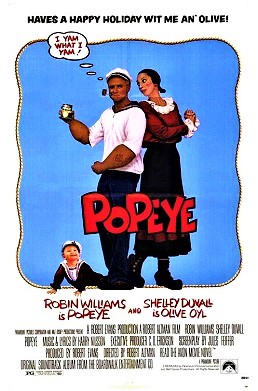
Popeye (1980, directed by Robert Altman)


I like Popeye.

Sometimes, I feel like I’m the only one.  Popeye got such bad reviews and was considered to be such a box office disappointment that director Robert Altman didn’t make another major film for a decade.  Producer Robert Evans, who was inspired to make Popeye after he lost a bidding war for the film rights to Annie, lost his once-sterling reputation for being able to find hits.  This was Robin Williams’s first starring role in a big screen production and his career didn’t really recover until he did Good Morning Vietnam seven years later.  Never again would anyone attempt to build a film around songs written by Harry Nilsson.  Screenwriter Jules Fieffer distanced himself from the film, saying that his original script had been ruined by both Robert Evans and Robert Altman.  Along with Spielberg’s 1941 and Michael Cimino’s Heaven’s Gate, Popeye was one of the box office failures that signaled the end of the era in which directors were given a ton of money and allowed to do whatever they wanted to with it.

I don’t care.  I like Popeye.  I agree with the critics about Nilsson’s score but otherwise, I think the film does a great job of capturing the feeling of a comic strip come to life.  Altman was criticized for spending a lot of money to construct, from scratch, the seaside village that Popeye, Olive Oyl (Shelley Duvall), Bluto (Paul L. Smith), Wimpy (Paul Dooley), and everyone else called home but it does pay off in the movie.  Watching Popeye, you really are transported to the world that these eccentric characters inhabit.  If the film were made today, the majority of it would be CGI and it wouldn’t be anywhere near as interesting.  Featuring one of Altman’s trademark ensemble casts, Popeye create a world that feels real and lived in.

Mumbling the majority of his lines and keeping one eye closed, Robin Williams is a surprisingly believable Popeye, even before he’s force fed spinach at the end of the movie.  Paul L. Smith was an actor who was born to play the bullying Bluto and there’s something very satisfying about seeing him (literally) turn yellow.  As for Shelley Duvall, she is the perfect Olive Oyl.  Not only does she have the right look for Olive Oyl but she’s so energetic and charmingly eccentric in the role that it is easy to see what both Popeye and Bluto would fall in love with her.  Though the humor is broad, both Williams and Duvall bring a lot of heart to their roles, especially in the scenes where they take care of their adopted infant, Swee’Pea.  Popeye may be a sailor but he’s a father first.

Popeye deserves a better reputation than it has.  It may not have been appreciated when it was originally released but Popeye has a robust spirit that continues to distinguish it from the soulless comic book and cartoon adaptations of today.

Retro Television Review: Homicide: Life On The Street 2.1 “Bop Gun”


Welcome to Retro Television Reviews, a feature where we review some of our favorite and least favorite shows of the past!  On Sundays, I will be reviewing Homicide: Life On The Street, which aired from 1993 to 1999, on NBC!  It  can be viewed on Peacock.
This week, the second season begins with a special guest star.

Episode 2.1 “Bop Gun”

(Dir by Stephen Gyllenhaal, originally aired on January 6th, 1994)

The 2nd season of Homicide opens with a murder.  That’s not surprising, considering the name of the show and the fact that it’s taking place in Baltimore, which had (and has) one of the highest murder rates in the country.  However, this time, the victim is an innocent tourist from Iowa, gunned down because she and her family took a wrong turn and ended up in a neighborhood that was far from the wharf.  With the press in a feeding frenzy over how unsafe Baltimore is, the bosses want the shooter to be caught and sentenced quickly.

Detective Beau Felton, the primary on the case, is overjoyed.  Sitting in the squad room and joking about how the victim’s husband didn’t even know what type of gun was used in the robbery-turned-murder, Felton brags that he is going to be making so much overtime off of this case.

Unfortunately, the victim’s husband happens to be in the squad room and he overhears Felton.  Angry, tired, and still wearing a shirt stained with his wife’s blood, Robert Ellison (played by special guest star Robin Williams) demands that Felton be taken off the case.

Giardello takes Ellison into his office and explains that Felton is the primary and he can’t be replaced.  Giardello also lists all of the other murders that Felton has recently worked.  Felton deals with violent death every day.  Giardello says that Felton is going to solve the case but he’s not going to “feel” Mrs. Ellison’s death the same way that her family does.

It’s an interesting scene and undoubtedly, a realistic one.  From the very first episode, Homicide has emphasized the gallows humor that goes along with being a homicide detective in a big city.  This episode, though, marks the first time that we get to see how an outsider would react to that attitude.  Significantly, Felton never apologizes and, even after the shooter is arrested, Ellison never forgives Felton for his comments.  Whenever the two interact, it’s obvious that they don’t like each other.  But they’re forever linked by one act of violence.

Felton ends up arresting three men.  Two of them are accused of robbing the Ellison family and being accessories to the murder.  They end up with 30 years in prison.  The accused shooter is Vaughn Perkins (Lloyd Goodman), a teenager who has never had any trouble with the police and who not only tries to write Ellison a note of apology but who also pleads guilty and accepts a life sentence.  (Ellison, in another example of this show choosing realism over sentimentality, refuses to read the note.)

Kay Howard is convinced that Vaughn is covering for the other two men, saying that Vaughn just seems too quiet and meek to be a cold-blooded murderer.  At the end of the episode, she goes down to the prison and meets with Vaughn, who now goes by the name Abu Aziz.  Though he initially tries to act hard, the former Vaughn Perkins finally admits that he was holding the gun during the robbery because he thought he could “control” the situation and keep anyone from getting hurt.  But when Mrs. Ellison refused to give up a locket, he panicked and shot her.  He lost control and, in a split second, he changed the lives of everyone involved.  Feeling defeated by the sad reality of Baltimore, Kay leaves the prison and heads back to work.

When Homicide returned for a second season, it was only given a four-episode order.  With the show on the cusp of cancellation, Homicide only had four hours in which to prove itself.  Originally, Bop Gun was scheduled to be the second season finale.  NBC, wanting to take advantage of having Robin Williams as a guest star, instead decided to move the episode to the start of the season.  That was probably a good idea.  Bop Gun is a good episode that reintroduces us to squad room and also features an excellent performance from Robin Williams.  Williams could, to be honest, be a bit hit-and-miss when it came to dramatic roles but he does wonderful work here, perfectly capturing Ellison’s anger, sadness, and desperation.  He starts the episode as a stunned innocent but, by the end of it, he’s become a much more hardened individual, one who has no interest in Vaughn’s heartfelt but too little and too late apology.  Just Vaughn now has to act hard to survive in a physical prison, Ellison has had to shut off his feelings so that he can survive in his emotional prison.

(As a sidenote, Ellison’s son is played by a very young Jake Gyllenhaal, whose real-life father directed this episode.)

If the first season occasionally felt a bit too much like an insider’s view of the Homicide Department, this episode gives us the point of view of an outsider.  Through Ellison’s eyes, we are reintroduced to the detectives.  Felton may not be a great cop or even a likable human being but he gets the job done in this episode.  And while Felton will now move on to the next case, Robert Ellison will spend the rest of his life thinking about that one day in Baltimore.

Because of the holidays, this is my final Homicide review of 2024!  These reviews will return on January 5th!
 

Live Tweet Alert: Join #FridayNightFlix for The Best of Times


As some of our regular readers undoubtedly know, I am involved in a few weekly live tweets on Twitter and Mastodon.  I host #FridayNightFlix every Friday, I co-host #ScarySocial on Saturday, and I am one of the five hosts of #MondayActionMovie!  Every week, we get together.  We watch a movie.  We tweet our way through it.

Tonight, at 10 pm et, #FridayNightFlix has got 1986’s The Best of Times!  When Robin Williams teams up with Kurt Russell, it’s time for football action!

If you want to join us this Friday, just hop onto twitter, start the movie at 10 pm et, and use the #FridayNightFlix hashtag!  It’s a friendly group and welcoming of newcomers so don’t be shy.

The Best Of Times is available on Prime and Tubi!  See you there!

10 Oscar Snubs From The 2000s


Welcome to the aughts. The new century started out with the terror of 9-11 and it ended with the collapse of the world’s economy. In between, a lot of films were released. Some of them were really good. A few of them were nominated for Best Picture. Most of them were not.  As always, there were snubs aplenty.

2000: Michael Douglas Is Not Nominated For Wonder Boys

I recently saw someone online bemoaning the fact that Michael Douglas appears to be fated to end his career as a supporting character in the MCU as opposed to playing the type of “mature” roles with which he made his reputation.  And I actually think that person had a good point.  Michael Douglas, whose performances once epitomized the last few decades of the 20th Century, does seem a bit out of place surrounded by CGI and responding to the overly quippy dialogue of the MCU.  If you want to see a truly good Michael Douglas performance that doesn’t involve anyone shrinking, check him out in Curtis Hanson’s Wonder Boys.  Though Wonder Boys won the Oscar for Best Original Song and picked up nominations for Editing and Adapted Screenplay, Michael Douglas’s wonderful lead performance was overlooked.

2001: Mulholland Drive Is Almost Totally Ignored

Considering the reverence with which it is now viewed, it’s interesting to note that Mulholland Drive only received one Oscar nomination, for David Lynch’s direction.  The film was not nominated for Best Picture.  Naomi Watts and Laura Harring both went unnominated.  At the time, I imagine the film was too strange for Academy voters and its origin as a television pilot probably worked against it.  Today, it is regularly cited as one of the best films ever made.

2002: Leonardo DiCaprio and Tom Hanks Are Not Nominated For Catch Me If You Can

Catch Me If You Can was that rarest of movies, an underrated Steven Spielberg production.  Christopher Walken was nominated for Best Supporting Actor and the film’s score was nominated as well.  But both Leonard DiCaprio and Tom Hanks went unnominated, despite doing some of the best work of their careers.

2002: Robin Williams Is Not Nominated For One Hour Photo

One Hour Photo featured what I consider to be Robin Williams’s best and most poignant performance.  It was also perhaps his most frightening performance, which probably explains why the Academy shied away from honoring it.

2003: Scarlet Johansson Is Not Nominated For Best Actress For Lost In Translation

Though Bill Murray got most of the awards attention, Scarlet Johansson’s performance was just as important to the success of Lost In Translation.

2004: Eternal Sunshine of the Spotless Mind Is Not Nominated For Best Picture or Best Actor

Even before he decided to present himself as being an expert on vaccines and modern art, I wasn’t a huge fan of Jim Carrey’s.  That said, even I have to admit that he deserved a nomination for Eternal Sunshine of the Spotless Mind.  The film itself was only nominated for two Oscars.  Kate Winslet was nominated for Best Actress and Charlie Kaufman won the Oscar for Original Screenplay.  The film deserved quite a bit more.

2007: Once Is Not Nominated For Best Picture

This is one snub that I haven’t quite gotten over.  Once, a beautiful independent film from Ireland, deserved far more love than it received from the Academy.  That said, it did win the Oscar for Best Original Song and Glen Hansard gave one of the best acceptance speeches in Oscar history.  So, there is a little justice.

2008: The Dark Knight Is Not Nominated For Best Picture

If ever there was a comic book movie that deserved to be nominated for Best Picture, it was this one. To me, I think the main reason why The Dark Knight is superior to so many other comic book movies is because, even with Batman and the Joker running around, it still feels as if it’s taking place in the real world.  The smartest decision that Christopher Nolan made was to use a real city for Gotham instead of constructing a phony-looking set.  The fact that The Dark Knight received 8 nominations without also receiving a nomination for Best Picture leaves little doubt that the film’s lack of a nomination was due to its origins as a comic book movie.  There was such an uproar about The Dark Knight failing to pick up a Best Picture nomination that the Academy increased the number of Best Picture nominees to ten.  (Of course, that’s didn’t do much to help anything.)

2008: Robert Downey, Jr. Is Not Nominated For Best Actor For Iron Man

The MCU is now so big that it’s easy to forget that, if Robert Downey, Jr. hadn’t been a convincing Tony Stark in 2008, the whole thing would have never happened.  Going back and watching the early MCU films, before they got bogged down in their own formula, can be an eye-opening experience.  Downey’s performance in the first Iron Man holds up extremely well.  He goes from being an irresponsible businessman to being a hero and he’s convincing at every turn.  He gave such a good performance that it convinced even those of us who weren’t comic book readers to stick around and see what was coming up next in the Marvel Cinematic Universe.

2009: George Wyner Is Not Nominated For Best Supporting Actor For A Serious Man

Not all snubs involve big stars or famous actors.  Some of them involve talented character actors like George Wyner who totally knock their one scene out of the park but who still don’t get the recognition that they deserve.  In A Serious Man, Wyner plays the rabbi who tells Larry Gopnik (Michael Stuhlbarg) the parable of the dentist who found Hebrew phrases on the teeth of one of his patients.  It’s a mesmerizing scene, thanks to George Wyner’s skill as a storyteller.

Agree?  Disagree?  Have a snub of your own that you’d like to mention?  Let us know in the comments!

Coming up next, we go from the 2010s to the present day!

Here’s The Trailer For Robin’s Wish


When I first heard that there was a documentary coming out about the final days of Robin Williams, I feared for the worst.  I worried that it would be one of those exploitative programs that featured reenactments and tabloid reporters sharing every sordid rumor that they had ever heard about the man.

However, the trailer for Robin’s Wish seems to indicate that the film is actually meant to be both a tribute to Williams and an educational tool about Lewy body dementia, the disease that is believed to have led to him ending his life.  Let’s hope that it is.

Robin’s Wish will be released on September 1st.

https://www.youtube.com/watch?v=BkSBPzfLYcM

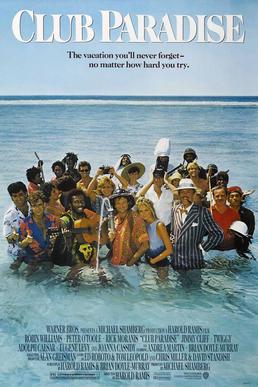
Club Paradise (1986, directed by Harold Ramis)


I think I was nine or ten years old when I first saw Club Paradise on HBO.  I remember thinking it was pretty funny.

I recently rewatched Club Paradise and I discovered that ten year old me had terrible taste in movies.

Robin Williams plays Jack Moniker, a Chicago fireman who gets blown out of a building while rescuing a dog.  Living off of his disability payments, he retires to the island of St. Nicholas, which is basically Jamaica but with less weed.  Jack and reggae musician Ernest Reed (Jimmy Cliff) open up their own Club Med-style resort, Club Paradise.  Jack doesn’t know much about the resort business but he does know how to put together a good brochure.  Almost the entire cast of SCTV shows up at Club Paradise, looking for a tropical vacation.  Things quickly go wrong because Jack doesn’t know how to run a resort and there’s also an evil developer (played by Brian Doyle-Murray) who wants Club Paradise to fail so that he can get the land.

Club Paradise has got a huge and impressive cast, the majority of whom probably signed on because they were looking forward to a paid Caribbean vacation.  Peter O’Toole plays the British-appointed governor of St. Nicholas.  Twiggy plays Jack’s girlfriend.  Joanna Cassidy plays a reporter and Adolph Caesar is cast in the role of St. Nicolas’s corrupt prime minister.  Because the film was directed by Harold Ramis, it is full of Ramis’s co-stars from SCTV.  Andrea Martin tries to get her husband to enjoy the islands as much as she’s enjoying them.  Joe Flaherty is the crazed pilot who flies people to the resort.  Rick Moranis and Eugene Levy play two nerdy friends who are both named Barry and who are only interested in scoring weed, getting laid, and working on their tan.  Rick Moranis and Eugene Levy playing nerds?  It’s a shock, I know.

There’s enough funny people in Club Paradise to ensure that there are a few isolated laughs.  Not surprisingly, the movie comes to life whenever Moranis and Levy are onscreen.  (If I had to guess, I imagine they were the reason why ten year-old me liked this movie so much.)  Needless to say, Jimmy Cliff also provides a killer soundtrack.  But Club Paradise ultimately doesn’t work because the script is too disjointed and it feels more like an uneven collection of skits than an actual film.  It’s impossible to tell whether we’re supposed to think of Club Paradise as being the worst resort ever or if we’re supposed to be worried that the bad guys will shut it down.  For a movie like this, you need a strong central presence to hold things together.  Unfortunately, Robin Williams’s style of comedy is too aggressive for the role of Jack.  The role was originally written for Bill Murray and it shows.  Most of Jack’s lines sound like things you would expect Bill Murray to say in his trademark laid back fashion and it is easy to imagine Murray redeeming some of Club Paradise‘s weaker scenes simply by attitude alone.  Instead, Robin Williams is so frantic that you never buy he could be happy living a laid back life on a Caribbean island.  As played by Williams, Jack often comes across as being unreasonably angry at everyone staying at Club Paradise and it’s hard to care whether or not he manages to save his resort or not.

Club Paradise was a bomb at the box office.  Harry Shearer, who was originally credited with working on the screenplay, hated the movie so much that he requested his name be removed from the credits.  (Instead, credit is given to Edward Roboto.)  As a result of the film’s failure, it would be 7 years before Harold Ramis would get to direct another movie.  Fortunately, that movie was Groundhog Day and this time, Ramis was able to get Bill Murray.

Horror Film Review: One Hour Photo (dir by Mark Romanek)


I guess some people might argue that the 2002 film, One Hour Photo, isn’t really a horror film.

It’s an argument that I can understand.  The film does have its scary moments, like the scene where Sy Parrish (Robin Williams) dreams that his eyes are exploding.  But there aren’t any ghosts or vampires or hockey mask-wearing slashers to be found in One Hour Photo.  Even the film’s most disturbing moment — in which we see that Sy’s apartment is nearly empty except for a giant collage of pictures that cover his living room wall — is more depressing than scary.

It’s really a very sad movie.  In fact, it’s probably even more sad today than when it was originally released.  Now, when you see Robin Williams’s sad eyes and you hear him talking about how reality can never live up to a photograph, it’s impossible not to think about the actor’s 2014 suicide.  I remember that, when One Hour Photo and Insomnia came out in the same year, there was a lot of talk about how unexpected it was to see Robin Williams playing such dark characters.  Now, of course, that darkness is a key part of Robin Williams’s persona.

In hindsight, it’s also sad because one watches the film with the knowledge that, even if Sy hadn’t lost it at the end of One Hour Photo, he still probably be a lost soul in 2019.  When we first meet Sy, he’s working at the one-hour photo lab in SavMart.  He talks about how much he loves developing pictures.  When someone mentions that they’ve been thinking about getting a digital camera, Sy nervously chuckles and says, “Don’t do that, you’ll put us out of business.”  Of course, in 2019, people take pictures with their phones and even digital cameras are viewed as being something of a relic.  If Sy were around and free today, I doubt he’d have a job.  If he did have a job, it’s doubtful it would be one that would allow him to cover his wall with someone else’s photos.  Instead, in 2019, I imagine Sy would be one of those people following strangers on social media and printing out all their pictures and probably sending them unsolicited DMs and private messages.

Sy is obsessed with the Yorkin family, Will (Michael Vartan), Nina (Connie Nielsen), and their son, Jake (Dylan Smith).  Even though the family barely knows who Sy is, he knows them because Sy has spent years developing (and stealing) their photos.  Sy views them as being the perfect family.  They’re the family that he wants to be a part of.  “Sometimes I think of myself as being Uncle Sy,” he says at one point.  But then Maya Burson (Erin Daniels) brings in her photos to be developed and Sy learns that the reality of the Yorkins is not as perfect as the photographs.  And Sy loses it.

Actually, there’s quite a few reasons why Sy loses it and the film suggests that, if the Yorkins had never stepped into SavMart, Sy would have found another family on which to obsess.  Something is missing inside of Sy.  Incapable of dealing with reality, Sy instead deals with posed pictures of happy times.  Towards the end of the film, there’s a throw-away line that attempts to offer some sort of insight into why Sy is such a lost soul.  Personally, I think the film works better without an explanation.  Why is less important than the fact that Sy exists.

In the end, One Hour Photo qualifies as a horror film not because of any paranormal danger but because it’s a film about the horror of everyday life.  You never know who might be watching you.  That friendly clerk who waits on you at the grocery store might be following you home and imagining that he’s a part of your life.  You never know.  One Hour Photo is the film that suggests that, lurking behind every friendly smile, there’s a blank Sy Parrish.  It’s a scary thought.

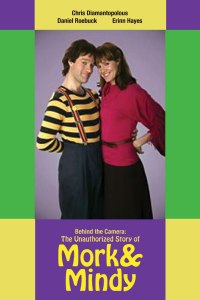
A Movie A Day #225: Behind The Camera: The Unauthorized Story of Mork & Mindy (2005, directed by Neil Fearnley)


The year is 1978.  A television producer named Garry Marshall (Daniel Roebuck) teaches America how to laugh again by casting Pam Dawber (Erinn Hayes) and a hyperactive stand-up comedian named Robin Williams (Chris Diamantopoulos) in a sitcom about an alien struggling to understand humanity.  Despite constant network interference, the show makes Robin a star but, with stardom, comes all the usual temptations: lust, gluttony, greed, pride, envy, wrath, and John Belushi.

The Behind The Camera films, which all dramatized the behind the scenes drama of old television shows, were briefly a big thing in the mid-aughts.  Because they were lousy, they never got good reviews but they did get good ratings from nostalgia-starved baby boomers and gen xers.  I think The Unauthorized Mork & Mindy Story was the last one produced.  It probably would have been better if there had been any sort of drama going on behind-the-scenes of Mork & Mindy but, according to this movie, everyone got along swimmingly.  Williams may get hooked on cocaine but the film squarely puts the blame for that on John Belushi.  The script, which was obviously written with one eye on avoiding getting sued, is sanitized of anything that could have reflected badly on anyone who was still alive when the movie aired.

Stuck with unenviable task of having to play one of the most famous people in the world, Chris Diamantopoulos was not terrible as Robin Williams.  Considering how sanitized the script was, not terrible is probably the best that could be hoped for.  There was not much of a physical resemblance but Diamantopoulos nailed the voice and some of the mannerisms.  Erinn Hayes looks like Pam Dawber but, just as in the actual show, the movie gives her the short end of the stick and focuses on Williams.

For aficionados of bad television, this is mostly memorable for Daniel Roebuck’s absolutely terrible performance as Garry Marshall and a scene in which Williams is heckled in a comedy club but an overweight man who steps out of the shadows and announces that he’s John Belushi!  Roebuck’s performance as Garry Marshall begins and end with his attempt to impersonate Marshall’s familiar voice.  He was much better cast as Jay Leno in The Night Shift.  As for Belushi , since he was not around to sue or otherwise defend himself, the movie goes all out to portray Belushi (who was played by Tyler Labine) as being an almost demonic influence on Williams.   The film’s portrayal of Belushi is even worse and probably more inaccurate than Wired and that’s saying something!

To quote Mork himself: Shazbot!  This movie is full of it.