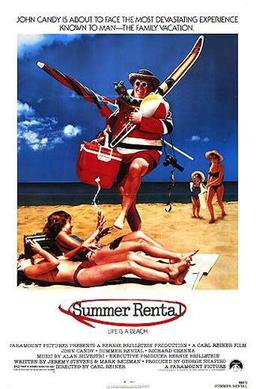
After a blow-up at work, air traffic controller John Chester (John Candy) is given five weeks of paid leave. He takes his family to Florida, where they rent a beach house and discover that their summer town is controlled by snobbish sailing champion Al Pellett (Richard Crenna). It’s the snobs vs slobs as Pellett tries to kick John and his family out of their summer rental and John tries to prove himself to his son and daughter (Joey Lawrence and Kerri Green) by winning the local sailing championship. Luckily, John has Sully (Rip Torn), a modern-day pirate captain, on his side.
John Candy was a remarkable talent. It’s just a shame that he didn’t appear in more good films. He will always be remembered for films like Splash, Uncle Buck, Planes, Train, and Automobiles, and Only The Lonely but unfortunately, most of his starring roles were in lightweight, forgettable far like Summer Rental. Candy is likable as John Chester and sympathetic even when he’s losing his temper over every minor inconvenience. But the film itself never really does much to distinguish itself from all of the other 80s comedies about middle class outsiders taking on the richest man in town. Candy is stuck playing a role that really could have been played by any comedic actor in 1985. It’s just as easy to imagine Dan Aykroyd or even Henry Winkler in the role. It feels like a waste of Candy.
The best thing about the film is Rip Torn’s performance as Sully. Torn’s performance here feels like a dry run for his award-winning work as Artie on The Larry Sanders Show. I would have watched an entire movie about Sully. As it is, Summer Rental is inoffensive and forgettable.
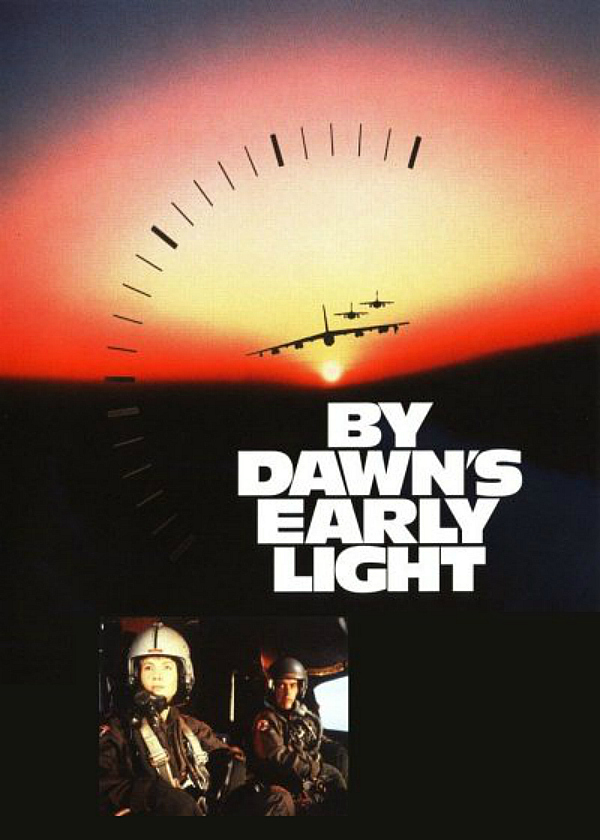
1990’s By Dawn’s Early Light is a film adaptation by HBO of William Prochnau’s novel Trinity’s Child. The film, when it first aired on HBO, seemed dated since the Soviet Union was ultimately going through its death throes as the military build-up initiated during the Reagan Administration crippled the USSR economically (they too tried to match the build-up in conventional and nuclear forces). Yet, despite the ending of the Cold War, recent events domestically and around the world has shown that the world never truly left behind the shadow of nuclear war.
The film is simplicity in the way the plot unfolds. A failed coup by dissident Soviet military commanders fails, but it’s after-effects of creating a “hot war” between the US and the USSR succeeds as both US President and Soviet Premiere make mistakes in their decisions. Decisions heavily influenced by their military commanders who see only black and white in how their respective nations should respond militarily. By Dawn’s Early Light shares some similarities to the classic 60’s Cold War films like Dr. Strangelove and Fail-Safe. Both films deal with the human frailties and flaws helping influence events that could lead to nuclear Armageddon for the whole planet. By Dawn’s Early Light concentrates on several storylines to highlight the stress and difficulties individuals must face to either follow their orders to their inevitable conclusion or allow their conscience to help make the moral decisions in trying to stop the madness spiraling out of control. Though some people’s decisions are left wanting, the film ends with a glimmer of hope that may just bring the world from the brink of annihilation.
The acting by the cast of Rebecca DeMornay, Powers Boothe, James Earl Jones, Darrin McGavin, Martin Landau and Rip Torn are well done. Rebecca DeMornay and Powers Boothe anchor one of the subplots as romantically involved B-52 crew pilots whose conflict comes from their own intimate closeness affecting command decisions and from the stress of families lost by the rest of the bomber crew. Darrin McGavin, Rip Torn and Martin Landau anchor the other subplot of competing Presidents. One a physically incapacitated US leader trying to avert escalating the conflict to the point of no return with another recently sworn in who fears of losing a nuclear war and thus wanting to strike back full and hard. In between these two leaders is the diabolical performance by Rip Torn as a warmongering Army colonel who sees only winning the war as the only objective. At times, the performances do become hampered by the simplicity of the script, but the cast power through to the end.
In the end, the film might look a bit dated in its production design (this was 1990 and many years before HBO became known for premiere television production) but the story itself is very current and relevant. What might have been a nice Cold War relic fairy tale when it first aired in 1990 on HBO has taken on more of a cautionary tale as more nations begin to acquire nuclear weapons with some of these nations not just enemies of the US and the world in general, but also led by men whose hold on sanity seem tenuous at best. By Dawn’s Early Light is a great piece political “what if” that hopefully remains just that and not a prediction of reality to come.
In 1984’s CityHeat, Clint Eastwood plays Lt. Speer, a tough and taciturn policeman who carries a big gun, throws a mean punch, and only speaks when he absolutely has to.
Burt Reynolds plays Mike Murphy, a private investigator who has a mustache, a wealthy girlfriend (Madeleine Kahn), and a habit of turning everything into a joke.
Together, they solve crimes!
I’m not being sarcastic here. The two of them actually do team up to solve a crime, despite having a not quite friendly relationship. (Speer has never forgiven Murphy for quitting the force and Murphy has never forgiven Speer for being better at everything than Murphy is.) That said, I would be hard-pressed to give you the exact details of the crime. CityHeat has a plot that can be difficult to follow, not because it’s complicated but because the film itself is so poorly paced and edited that the viewer’s mind tends to wander. The main impression that I came away with is that Speer and Murphy like to beat people up. In theory, there’s nothing wrong with that. Eastwood is legendary tough guy. Most people who watch an Eastwood film do so because they’re looking forward to him putting the bad guys in their place, whether it’s with a gun, his fists, or a devastating one-liner. Reynolds also played a lot of tough characters, though they tended to be more verbose than Eastwood’s.
That said, the violence in CityHeat really does get repetitive. There’s only so many times you can watch Clint punching Burt while various extras get gunned down in the background before it starts to feel a little bit boring. The fact that the film tries to sell itself as a comedy while gleefully mowing down the majority of the supporting cast doesn’t help. Eastwood snarls like a pro and Reynolds flashes his devil-may-care smile but, meanwhile, Richard Roundtree is getting tossed out a window, Irene Cara is getting hit by a car, and both Kahn and Jane Alexander are being taken hostage. Tonally, the film is all over the place. Director Richard Benjamin was a last-minute replacement for Blake Edwards and he directs without any sort of clear vision of just what exactly this film is supposed to be.
On the plus side, CityHeat takes place in Kansas City in 1933 and the production design and the majority of the costumes are gorgeous. (Unfortunately, the film itself is often so underlit that you may have to strain your eyes to really appreciate it.) And the film also features two fine character actors, Rip Torn and Tony Lo Bianco, are the main villains. For that matter, Robert Davi shows up as a low-level gangster and he brings an actual sense of menace to his character. There are some good things about CityHeat but overall, the film is just too messy and the script is a bit too glib for its own good.
Burt Reynolds and Clint Eastwood had apparently been friends since the early days of their careers. This was the only film that they made together. Interestingly enough, Reynolds gets the majority of the screentime. Eastwood may be top-billed but his role really is a supporting one. Unfortunately, Reynolds seems to be kind of bored with the whole thing. As for Clint, he snarls with the best of them but the film really doesn’t give him much to do.
A disappointing film, CityHeat. Watching a film like this, it’s easy to see why Eastwood ended up directing himself in the majority of his films.
In the 1999 Best Picture Nominee, The Insider, the American media takes a beating.
Al Pacino plays Lowell Bergman. Bergman is a veteran newsman who, for several years, has been employed as a producer at 60 Minutes. He is a strong believer in the importance of the free press and he’s proud to be associated with both 60 Minutes and CBS News. He’s one of the few people who can manage the famously prickly correspondent, Mike Wallace (Christopher Plummer). When we first see Bergman, he and Wallace are in the Middle East and arranging a tense interview with the head of Hezbollah. It’s easy to see that Bergman is someone who will go anywhere and take any risk to get a story. It’s also apparent that Bergman thinks that the people that he works with feel the same way.
That all changes when Bergman meets Jeffery Wigand (Russell Crowe), a recently fired tobacco company executive who initially agrees to serve as a consultant for one of Bergman’s story but who leaves Bergman intrigued when he reveals that, due to a strict confidentiality agreement, he’s not allowed to discuss anything about his time as an executive. As the tobacco companies are currently being sued by ambitious state attorney generals like Mississippi’s Mike Moore (who plays himself in the film), Bergman suspects that Wigand knows something that the companies don’t want revealed.
And, of course, Bergman is right. Wigand was fired for specifically objecting to his company’s effort to make cigarettes more addictive, something that the tobacco industry had long claimed it wasn’t doing. Wigand’s pride was hurt when he was fired but he knows that breaking the confidentiality agreement will mean losing his severance package and also possibly losing his marriage to Liane (Diane Venora) as well. However, Wigand is angered by the heavy-handed techniques that his former employer uses to try to intimidate him. He suspects that he’s being followed and he can’t even work out his frustrations by hitting a few golf balls without someone watching him. When Wigand starts to get threats and even receives a bullet in the mail, he decides to both testify in court and give an interview to Wallace and 60 Minutes.
The only problem is that CBS, after being pressured by their lawyers and facing the risk of taking a financial loss in an upcoming sell, decides not to run the interview. Bergman is outraged and assumes that both Mike Wallace and veteran 60 Minutes producer Don Hewitt (Philip Baker Hall) will support him. Instead, both Wallace and Hewitt side with CBS. Left out in the cold is Jeffrey Wigand, who has sacrificed almost everything and now finds himself being attacked as merely a disgruntled employee.
Directed by Michael Mann and based on a true story, The Insider is what is usually described as being “a movie for adults.” Instead of dealing with car chases and super villains and huge action set pieces, The Insider is a film about ethics and what happens when a major media outlet like CBS News fails to live up to those ethics. (No one is surprised when the tobacco company tries to intimidate and silence Wigand but the film makes clear that people — or at least people in the 90s — expected and hoped for more from the American press.) Wigand puts his trust in Bergman and 60 Minutes largely because he believed Bergman’s promise that he would be allowed to tell his story. It’s a promise that Bergman made in good faith but, in the end, everyone from the CBS executives to the tobacco companies is more interested in protecting their own financial future than actually telling the truth. Wigand loses his family and his comfortable lifestyle and Bergman loses his faith in the network of Edward R. Murrow. It’s not a particularly happy film but it is a well-made and thought-provoking one.
Pacino and Crowe both give excellent performances in the two lead roles. Pacino, because he spends most of the film outraged, has the flashier role while Crowe plays Wigand as a rather mild-mannered man who suddenly finds himself in the middle of a national news story. (Crowe’s performance here is one of his best, precisely because it really is the opposite of what most people expect from him.) Crowe does not play Wigand as being a crusader but instead, as an ordinary guy who at times resents being put in the position of a whistleblower. (Director Mann does not shy away from showing how Bergman manipulates, the reluctant Wigand into finally testifying, even if Bergman’s motives were ultimately not malicious.) That said, the strongest performance comes from Christopher Plummer, who at first seems to be playing Mike Wallace as being the epitome of the pompous television newsman but who eventually reveals the truth underneath Wallace’s sometimes fearsome exterior.
The Insider was nominated for Best Picture. Somehow, it lost to American Beauty.
After being passed over twice as a result of both a “brushing incident” with a Russian submarine and an embarrassing tattoo, Lt. Commander Thomas Dodge (Kelsey Grammer, playing Dodge as being the laid back opposite of Frasier Crane) has finally been promoted and given his own submarine to command. The catch is that the submarine is a rusty piece of junk from World War II and he’s been assigned a crew of misfits. Captain Dodge is to take part in a war game. Admiral Winslow (Rip Torn) wants Dodge to prove that even an out-of-commission submarine can be dangerous by infiltrating Charleston Harbor undetected and then blowing up a dummy warship in Norfolk Harbor. If Dodge is successful, he’ll get a nuclear submarine to command. If he fails, he’ll be assigned of desk job and probably leave the Navy. While the sympathetic Winslow encourages Dodge to “think like a pirate,” the antagonistic Admiral Graham (Bruce Dern) pulls out all the stops to make sure Dodge fails.
I imagine that Down Periscope was probably pitched as Police Academy In The Navy and it follows the general rules of the Police Academy films, right down to casting Lauren Holly as the one woman on the submarine who has to overcome her own insecurities and prove herself to all the men. Unfortunately, none of the misfits on the crew are as memorable as the cadets from Police Academy and the movie’s attempts to mix juvenile humor with suspenseful naval action are not at all successful. Having Rob Schneider go totally over the top as Dodge’s second-in-command while having William H. Macy give a serious performance as the captain assigned to prevent Dodge from reaching the harbor indicates that Down Periscope has a definite identity problem.
Harry Dean Stanton plays Howard, who is the submarine’s chief engineer and who uses whiskey as a fuel to keep the submarine moving. Toby Huss has a few amusing moments as the electrician who keeps electrocuting himself. Grammer, Dern, and Macy have more than proven their talents in other projects and Rip Torn will always be remembered for bringing Artie to profane life on The Larry Sanders Show. Director David Ward also directed Major League and wrote The Sting. A lot of talent went into making Down Periscope so it’s a shame the film wasn’t more memorable.
It isn’t the past. It isn’t the present. It’s the future.
The moon has been colonized and, on Earth, the Mayflower II is preparing for its first international flight. It will be carrying passengers from Houston to the lunar station. Test pilot Ted Striker (Robert Hays) claims that the Mayflower II is not ready to make the trip but he’s been in the Ronald Reagan Hospital For The Mentally Ill ever since he had a nervous breakdown after losing his squadron during “the war.”
Aboard the Mayflower II is Ted’s ex-wife, Elaine (Julie Haggerty), and her new boyfriend, Simon (Chad Everett). Simon says the Mayflower II is in perfect shape but he also turns into jelly whenever things get too rough. Piloting the Mayflower II is Captain Clarence Oveur (Peter Graves) and waiting on the Moon is Commander Buck Murdock (William Shatner). The crew of the Mayflower II is going to have a tough flight ahead of them. Not only is the shipboard computer making plans of its own but one of the passengers (Sonny Bono) has a bomb in his briefcase. Also, Ted has broken out of the hospital and is on the flight, boring people with his long stories.
Every successful film gets a sequel and when Airplane! was a surprise hit in 1980, it was inevitable that there would be an Airplane II. Robert Hays, Julie Haggerty, Lloyd Bridges, Peter Graves, and Stephen Stucker all returned. Unfortunately, Jim Abrahams, the Zucker brothers, Robert Stack, Kareem Abdul-Jabbar, and Leslie Nielsen did not. (The directors and Nielsen were all working on Police Squad and their absence is strong felt.) Airplane II recreates many of the same jokes as the first Airplane! but without the first film’s good nature or genuine affection for the disaster genre. Airplane! was made for the love of comedy. Airplane II was made for the love of money and, while there are more than a few amusing moments, the difference is obvious and there for all to see.
Not surprisingly, Airplane II is at its funniest whenever William Shatner is on screen. In the role of Bud Murdock, Shatner pokes fun at his own image and shows himself to be a good sport. He’s still not as funny as Leslie Nielsen or Robert Stack in the first film but that’s because, unlike Stack and Nielsen in their pre-Airplane! days, there had always been a hint of self-parody to Shatner, even in his most dramatic roles. If Stack and Nielsen shocked people by showing that they could do deadpan comedy, Shatner’s performance just confirmed what most suspected, that he had always been in on the joke. Still, he’s the funniest thing in Airplane II and, whenever I rewatch this movie, I am happy he was there.
Airplane II was a box office failure, which is why the world never got an Airplane III. Fortunately, the world did get Hot Shots and The Naked Gun.
On tonight’s episode of Ghost Story, Lynn Loring plays Janet. Janet has inherited her mother’s house. (Her mother died in a mental hospital.) Janet is determined to fix up the house and her cousins (Rip Torn and Geraldine Page) are more than happy to help! Or are they?
This is a pretty good episode, largely due to the fact that Rip Torn and Geraldine Page play the cousins. Torn and Page were married at the time and they both appear to be having a blast playing their odd roles. This episode reminds me a bit of Jess Franco’s A Virgin Among The Living Dead. It originally aired on December 8th, 1972.
An odd film, Robocop 3. Released in 1993, this was the third and final film in the original Robocop franchise. While the action is still set in Detroit and Robocop is back (albeit now played by Robert John Burke) and Nancy Allen shows up long enough to get killed off, Robocop 3 feels strangely separate from the previous two Robocop films. If the first two Robocop films were dark, satirical, and over-the-top in their violence, the third film is a family friendly adventure film that reimagines Robocop as being some sort of fair housing activist.
And, on top of all that, Robocop can fly now. Admittedly, that’s because Robocop gets fitted for a jetpack that he didn’t have in the previous films but he still looks incredibly ludicrous flying through the streets of Detroit. Since the Robocop armor has always looked very bulky and very heavy, it’s hard to believe that he could fly as quickly and as smoothly as he does in this film.
There’s a new set of villains too. Rip Torn has replaced Dan O’Herilhy as the CEO. And listen, I like Rip Torn. He will always be a hero to me because he bit Norman Mailer’s ear off. But Torn is far too obviously evil in the role of the CEO. O’Herlihy smartly played the Old Man as being avuncular and amoral. You could look at him and understand how he rose to his position of prominence. Torn’s performance is a bit more cartoonish but then again, Robocop 3 is the most cartoonish of the series.
The CEO wants to tear down Old Detroit so the residents of Old Detroit are fighting back. Leading the CEO’s forces — called the Rehabbers — is Paul McDagget (John Castle), who is a complete and total madman but who, at the same time, is never quite as memorable as Kurtwood Smith or Tom Noonan. He’s really just another generic militaristic bad guy. Normally, you would expect Robocop to be on the side of the company and the police but he’s been reprogrammed by an 8 year-old hacker named Nikko (Remy Ryan). Robocop is now working with the rebels. One of the rebels is played by Stephen Root, proving once again that you never know where Stephen Root might pop up.
Robocop 3 has none of the satiric bite of the first two movies. Instead of being a symbol of authoritarianism gone beserk, Robocop becomes a generic do-gooder. The violence is toned down and, with the addition of a kid sidekick, it’s obvious that this Robocop was meant to be a safer version of the character. Unfortunately, a safe Robocop equals a boring Robocop. You watch this movie and you wonder what happened to the Robocop who shot Ronny Cox out of a window.
“My friend’s call me Murphy,” he says towards the end of the film, “You can call me Robocop.” That seemed to indicate that Robocop had quite a future ahead of him of doing the right thing and standing up to big evil corporations but Robocop 3 was such a bomb at the box office that Robocop’s further adventures would only be seen on TV. The franchise was rebooted back in 2014, in a film that my friend Mark called “Rubber Cop.” After Rubber Cop fell flat, it was announced that Robocop would be rebooted for a second time, this time with a movie that would serve as a direct sequel to the first Robocop and which would ignore the sequels and the first reboot. Personally, I think it might be time to let Robocop retire. He had a good run.
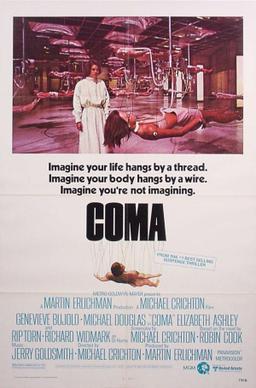
Michael Crichton’s 1978 film, Coma, tells the story of strange things happening at a Boston hospital.
Seemingly healthy patients are having complications during routine surgery, complications that leave them brain dead. Dr. Susan Wheeler (Genevieve Bujold) thinks that there’s something bigger going on than just routine medical complications. First, her best friend (Lois Chiles) falls into a coma while undergoing an abortion. Then, Tom Selleck falls into a coma while having knee surgery. Dr. Wheeler investigates and discovers that all of the patients were operated on in the same operating room and that all of them were shipped to a mysterious facility after their surgery.
Yep, it sounds like a conspiracy. However, no one is willing to listen to Dr. Wheeler. Not her boyfriend (Michael Douglas). Not Dr. George (Rip Torn), the chief anetheisologist. Not Dr. George Harris (Richard Widmark), the chief of surgery. Dr. Wheeler thinks that it’s all a conspiracy!
And, of course, it is. As the old saying goes, the only thing that a conspiracy needs to succeed is for people to be remarkably stupid and almost everyone in Coma is remarkably stupid. Admittedly, some of them are in on the conspiracy but it’s still rather odd how many people apparently don’t see anything strange about healthy people going into a comas and then being shipped to a mystery facility.
Coma is probably best known for the scene where Susan manages to sneak into the mystery facility and she finds herself in a room full of suspended bodies. Visually, it’s an impressive scene. It’s truly creepy and it also captures the detached sterility that most people hate about medical facilities. At the same time, it’s also the only visually striking moment in the entire film. Every other scene in Coma feels flat. Whenever I’ve watched this film, I’m always a little bit shocked whenever anyone curses because Coma looks more like an old made-for-TV film than anything you would ever expect to see in a theater.
My point is that Coma is a remarkably boring film. It has a potentially interesting story but my God, is this movie ever a slog. It’s pretty easy to guess what’s going on at the institute so there’s not a whole lot of suspense to watching Susan try to figure it all out. When the truth is revealed, it’s not exactly a shocking moment. For that matter, you’ll also be able to guess which doctor is actually going to turn out to be the villain. There’s really no surprises to be found.
Coma was the second feature film to be directed by Michael Crichton. With the exception of the scenes in the institute, the visual flair that Crichton showed in Westworldis nowhere to be found in Coma. The film moves at a tortuously slow place. A part of me suspects that, as a doctor, Crichton related so much to the film’s characters that he didn’t realize how dull they would be for those us who don’t look at a character like Rip Torn’s Dr. George and automatically think, “He’s just like that arrogant bastard I worked under during my residency!” Call it the Scrubs syndrome.
For some reason, Coma is a film that people often recommend to me. I don’t know why. Trying to sit through it nearly put me in a coma.
Cotter (Don Murray) is an alcoholic Native American who works as a rodeo clown. One day, when he’s too drunk to do his job, a bull rider is killed as a result. All of the other bull riders track Cotter down in his trailer and tell him that his days of being a clown are over. They tell him that if they ever see him anywhere near another rodeo, they’ll kill him. It’s a dramatic scene that would probably be more powerful if Cotter wasn’t wearing a clown make-up while rolling around on the floor in a drunken stupor.
With nowhere else to go, Cotter returns to his hometown and tries to surprise his old friend Roy (Rip Torn) by jumping through Roy’s front door while wearing his clown make-up. However, when Cotter jumps into the living room, the only person he meets is Roy’s half-naked wife, Leah (Carol Lynley) and she promptly fire two barrels worth of buckshot at him. Showing the reflexes that would have saved that bull rider’s life if only Cotter had been sober, he manages to duck out of the way.
When Roy comes home, he’s at first excited to see his old friend. He even invites Cotter to stay with them. Leah slowly warms up to Cotter. However, the other townsfolk are suspicious of Cotter because of his heritage and his reputation for being a hard drinker. When a local rancher turns up dead, almost everyone immediately assumes that Cotter must be responsible. Not even Roy is willing to stand up for his friend.
Made for a low-budget, Cotter is a well-intentioned film that doesn’t work. A large part of the problem is that, while Don Murray and Rip Torn were both good actors, they both overact in Cotter. For some reason, both of them yell the majority of their lines. Torn was a good bellower but Don Murray, who was usually a far more low-key actor, seems uncomfortable in his role. While it is true that Don Murray first found stardom playing a headstrong cowboy in Bus Stop, it’s also that, from the 60s onward, Murray was always best cast as men of authority and it’s hard to buy him as an irresponsible character like Cotter. Maybe the film would have worked better if Torn and Murray had switched roles. Carol Lynley seems more comfortable with her role than either one of the two male leads, though she doesn’t get to do much beyond suffer at the hands of Roy and eventually fall in love with Cotter. Also giving a good performance is Sherry Jackson, cast as a sympathetic barmaid, though she’s also not given much to do beyond reacting to Cotter and Roy.
Cotter doesn’t have a bad message and it at least acknowledges that Cotter’s alcoholism is largely his way of dealing with the prejudice that he’s suffered his entire life, though Cotter’s monologue on the subject would have probably been more effective if it had been delivered by an actual Native American actor instead of the very white Don Murray. Unfortunately, good intentions aside, Cotter just never really comes together as a movie.