Icarus File No. 7: Last Days (dir by Gus Van Sant)


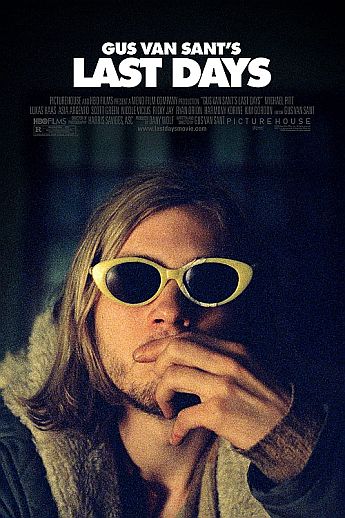
From 2002 to 2005, director Gus Van Sant offered audiences what he called his “Death Trilogy.”  2002’s Gerry followed two friends as they got lost in the desert and it featured what appeared to be a mercy killing.  2003’s Elephant was a mediation on the Columbine High School massacre and it featured several murders.  Finally, with 2005’s Last Days, Van Sant ended the trilogy with a film about a suicide.

Michael Pitt plays a world-famous musician who is suffering from depression.  Though the character is named Blake, no attempt is made to disguise the fact that he is meant to be Kurt Cobain.  When we first see Blake, he has just escaped from a rehab clinic and is walking through a forest.  There are no other human beings around and, perhaps not coincidentally, this is the only moment in the film in which Blake seems to be happy.  He even sings Home on the Range, shouting the lyrics like a little kid.

When he reaches his home, Blake’s demeanor changes.  He walks around the house with a rifle and pretends to shoot the four other people — Luke (Lukas Haas), Scott (Scott Patrick Green), Asia (Asia Argento), and Nicole (Nicole Vicius) — who are sleeping in his house.  Later, when those people wake up and attempt to speak to him, Blake is largely unresponsive.  When a detective comes to the door and asks if anyone has seen Blake, Blake hides.  When a record company exec calls to tell Blake that it’s time for him to tour again and that he’ll be letting down both his band and the label if he doesn’t, Blake hangs up on her.

Who are the people staying in Blake’s house?  Luke and Scott are both musicians but apparently neither one of them are in Blake’s band.  When Luke asks Blake to help him finish a song, Blake can only mutter a few vague words of encouragement.  Scott, meanwhile, appears to be more interested in Blake’s money.  Everyone in the film wants something from Blake but Blake wants to be alone.  In the one moment when Blake actually gets to work on his own music, his talent is obvious but so is his frustration.  With everyone demanding something from him, when will he ever have time to create?  With everyone telling him that it is now his job to be a rock star, how will he ever again feel the joy that came from performing just to perform?   

As one would expect from a Van Sant film, Last Days is often visually striking, especially in the early forest scenes.  In many ways, it feels like a combination of Gerry and Elephant.  Like those previous two films, it is fixated on death but stubbornly refuses to provide any answers to any larger, metaphysical  questions.  Like Elephant, it uses a jumbled timeline to tell its story and scenes are often repeated from a different perspective.  However, it eschews Elephant‘s use of an amateur cast and instead, Last Days follows Gerry’s lead of featuring familiar actors like Michael Pitt, Lukas Haas, and Asia Argento.  Unfortunately, though, Last Days doesn’t work as well as either one of the two previous entries in the Death Trilogy.

Last Days runs into the same problem that afflicts many films about pop cultural icons.  Kurt Cobain has become such a larger-than-life figure and his suicide is viewed as being such a momentous cultural moment that any attempt to portray it on film is going to feel inadequate.  No recreation can live up to the mythology.  The film itself feels as if it is somewhat intimidated by the task of doing justice to the near religious reverence that many have for Cobain.  As enigmatic as Gerry and Elephant were, one could still tell that Van Sant knew where he wanted to take those films.  He knew what he wanted to say and he had confidence that at least a few members of the audience would understand as well.  With Last Days, Van Sant himself seems to be a bit lost when it comes to whatever it may be that he’s trying to say about Cobain.  This leads to a rather embarrassing scene in which Blake’s ghost is seen literally climbing its way towards what I guess would be the immortality of being an icon.  One might wonder how Cobain himself would feel about such a sentimental coda to his suicide.

Last Days is a film that I respect, even if I don’t think it really works.  It does do a good job of capturing the ennui of depression and one cannot fault Van Sant for his ambition or his willingness to run the risk of alienating the audience by allowing the story to play out at its own slow and deliberate pace.  But ultimately, the film cannot compete with the mythology that has sprung up around its subject.
Previous Icarus Files:

  1. Cloud Atlas
  2. Maximum Overdrive
  3. Glass
  4. Captive State
  5. Mother!
  6. The Man Who Killed Don Quixote

Insomnia File #40: The Spanish Prisoner (dir by David Mamet)


What’s an Insomnia File? You know how some times you just can’t get any sleep and, at about three in the morning, you’ll find yourself watching whatever you can find on cable? This feature is all about those insomnia-inspired discoveries!

If, at 3 in the morning on Wednesday, you were struggling to get to sleep, you could have flipped over to Flix and watched the 1998 film, The Spanish Prisoner.

Joe Ross (Campbell Scott) is an engineer.  He’s a quiet, polite, and always considerate man.  At one point, he’s told that he’s “too nice” and, watching him, you can’t help but agree.  Joe works in an otherwise bland office where the walls are covered with menacing posters that, in an accusatory manner, announce, “SOMEONE TALKED!”  Paranoia is in the air but Joe, for whatever reason, seems to be incapable of sensing it.

Joe has just invented something called The Process.  It’s deliberately left obscure just what exactly The Process is but we do know that it stands to make Joe’s boss, Mr. Klein (Ben Gazzara), a lot of money.  When Mr. Klein invites Joe and the company lawyer, George (Ricky Jay), to an island retreat, Joe assumes that it’s so Mr. Klein can offer him a lucrative cash bonus as a reward for creating the process.  Instead, it turns out that Mr. Klein has no interest in giving George any extra reward.  Instead, Klein feels that Joe should just be happy to be a part of the company.

On the island, Joe takes a picture of a mysterious man named Jimmy Dell (Steve Martin).  Jimmy offers to give Joe a thousand dollars for the camera.  Joe, instead, hands over the camera for free.  Later, Jimmy tracks down Joe and apologizes for his behavior.  He and Joe strike up an unlikely friendship on the island.  Upon learning that Joe will soon by flying back to New York, Jimmy gives Joe a package to deliver to his sister.  Joe agrees.

It’s not until Joe is on the plane and in the air that he starts to wonder about what’s inside the package.  It doesn’t help that his secretary, Susan (Rebecca Pidgeon), won’t stop talking about you never really know anyone and how easy it is to trick an innocent person into becoming a drug mule.  Finally, Joe steps into the plane’s lavatory, unwraps the package, and….

And that’s all I can tell you without spoiling the film.  The Spanish Prisoner is a film about a dizzying confidence game, one that is full of nonstop twists and turns.  No one in the film turns out to be who you thought they were when you first saw them.  At times, it can be a bit hard to keep up with the plot but that’s actually a part of the fun.  The Spanish Prisoner keeps you guessing and, fortunately, Campbell Scott gives a likable enough performance that you’re willing to explore the maze at the heart of this film with him.  Steve Martin is also wonderfully sinister as Jimmy, using his own “nice guy” image to keep us off-balance.

As you might expect from a film written and directed by David Mamet, the dialogue is heavily stylized.  The characters all move and speak at their own odd rhythm.  Lines that should be innocuous take on a dangerous edge and it becomes impossible not try to read between the lines of even the simplest of exchanges.  It creates a rather dream-like atmosphere, one in which you’re never quite sure what’s real and what’s just another part of the game.

The Spanish Prisoner is an intriguing mystery and one that seems like it will definitely reward repeat viewings.

Previous Insomnia Files:

  1. Story of Mankind
  2. Stag
  3. Love Is A Gun
  4. Nina Takes A Lover
  5. Black Ice
  6. Frogs For Snakes
  7. Fair Game
  8. From The Hip
  9. Born Killers
  10. Eye For An Eye
  11. Summer Catch
  12. Beyond the Law
  13. Spring Broke
  14. Promise
  15. George Wallace
  16. Kill The Messenger
  17. The Suburbans
  18. Only The Strong
  19. Great Expectations
  20. Casual Sex?
  21. Truth
  22. Insomina
  23. Death Do Us Part
  24. A Star is Born
  25. The Winning Season
  26. Rabbit Run
  27. Remember My Name
  28. The Arrangement
  29. Day of the Animals
  30. Still of The Night
  31. Arsenal
  32. Smooth Talk
  33. The Comedian
  34. The Minus Man
  35. Donnie Brasco
  36. Punchline
  37. Evita
  38. Six: The Mark Unleashed
  39. Disclosure

Embracing the Melodrama Part II #93: Boogie Nights (dir by Paul Thomas Anderson)


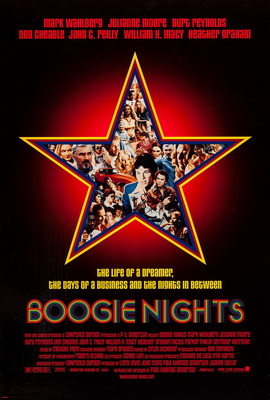
Boogie_nights_ver1The 1997 film Boogie Nights (which, amazingly enough, was not nominated for best picture) is a bit of an overwhelming film to review.  It’s a great film and, if you’re reading this review, you’ve probably seen Boogie Nights and you probably already know that it’s a great film.  And if you haven’t seen Boogie Nights, you really should because it’s a great film.  So, this review, in short, amounts to: Great film.

Boogie Nights takes place in the late 70s and the early 80s.  Eddie Adams (Mark Wahlberg) is a high school dropout who works as a busboy, lives with his parents, and has a really big cock.  (Indeed, one of the film’s most famous lines is, “This is a giant cock.”)  When we first meet Eddie, he’s likable and cute in a dumb sort of way.  Then he meets adult film director Jack Horner (Burt Reynolds) and becomes a star.  At first, everything is great.  Eddie changes his name to Dirk Diggler and no longer has to deal with his abusive mother (a chilling Joanna Gleason).  Jack and Amber Waves (Julianne Moore) become his new parents.  He gets a cool older brother in the form of actor Reed Rothschild (John C. Reilly, totally nailing the “People tell me that I look like Han Solo,” line).  He makes friends with other adult film actors, like the desperately unhip Buck (Don Cheadle), the free-spirited (and secretly very angry) Rollergirl (Heather Graham), and the poignantly insecure Jessie St. Vincent (Melora Walters).  He gets new admirers, like Scotty J. (Philip Seymour Hoffman).  He also gets addicted to cocaine.  And while Dirk falls from stardom, the adult film industry is taken over by gangsters like Floyd Gondolli (Philip Baker Hall) and self-styled artists like Jack Horner find themselves pushed to the side.

And you may have noticed that I mentioned a lot of actors in the paragraph above.  That’s because Boogie Nights is a true ensemble piece.  It’s full of great performances and memorable characters.  Along with everyone that I mentioned above, the cast also includes William H. Macy as cinematographer “Little Bill” Daggett.  From the minutes we first meet Little Bill, we get the feeling that he might be a little bit too uptight for pornography.  Maybe that’s because his wife — played by the inspiring sex positive feminist and veteran adult film star Nina Hartley — is constantly and publicly cheating on him.  Macy and Hartley do not have as much screen time as the rest of the cast but, ultimately, their characters are two of the most important in the film.

And then there’s Robert Ridgely, who is marvelously sleazy as the paternal but ultimately icky Col. James.  When we first meet the Colonel, he’s almost a humorous character.  But then, suddenly, there’s one chilling scene where he opens up to Jack Horner and we are forced to reconsider everything that we had previously assumed about both the Colonel and his business.

And how can we forget Luis Guzman, as a club owner who desperately wants to appear in one of Jack’s films?  Or Ricky Jay as a plain-spoken cameraman?  Or how about Thomas Jane, playing one of those tightly wound characters who you know is going to be trouble as soon as you see him?  And finally, nobody who has seen Boogie Nights will ever forget Alfred Molina, singing along to Sister Christian and running down the street, clad only in black bikini briefs and firing a shotgun.

But it’s not just the actors who make Boogie Nights a great film.  This was Paul Thomas Anderson’s second film and, under his direction, we feel as if we’ve been thrown straight into Dirk’s exciting and ultimately dangerous world.  When the film begins, the camera almost seems to glide, capturing the excitement of having everything that you could possibly want.  But, as things go downhill for Dirk, the camerawork gets more jittery and nervous.   A sequence where Anderson cuts back and forth between Jack trying to shoot a movie on video (as opposed to his beloved film) and Dirk nearly being beaten to death in a parking lot remains one of the best sequences that Anderson has ever directed.

And then there’s the music!  Oh my God!  The music!

And the dancing!

And the singing!

I’ll be the first admit that I have no idea whether or not Boogie Nights is a realistic portrait of the adult film industry in the 70s and 80s.  But ultimately, Boogie Nights is not about porn.  It’s about a group of outsiders who form their own little family.  At the end of the film, you’re happy that they all found each other.  You know that Dirk will probably continue to have problems in the future but you’re happy for him because, no matter what happened in the past or what’s going to happen in the future, you know that he’s found a family that will always love him.

As I mentioned at the start of this appreciation, Boogie Nights was not nominated for best picture.  Titanic was named the best picture of 1997.  As I’ve said before, I loved Titanic when I was 12.  But, nearly 18 years later, Boogie Nights is definitely the better picture.

It has stood the test of time.