In 1976’s Grizzly, something is making a national park a lot less inviting.
Campers are turning up dead. Bloody body parts are being found buried underneath leaves. It’s obvious that a bear is to blame but reports seem to indicate that this isn’t just any bear. This is a super bear, standing 8 feet tall and capable of knocking down an observation tower and picking up a helicopter. This is the most dangerous bear known to man and the park has to be closed.
Closing the park during tourist season!? Surely not!
Does this all sound familiar? Grizzly came out a year after Jaws. In all fairness to Grizzly, there were a lot of movies that ripped-off Jaws. As a matter of fact, there are still movies ripping off Jaws. The Jaws films eventually ended up ripping off themselves with three sequels. Still, it’s hard to ignore just how blatantly Grizzly rips off Jaws. We get shots from the bear’s point of view. Christopher George plays the sheriff who keeps demanding that the park be closed down until the bear has been taken care of. Andrew Prine is the hippie bear expert. Richard Jaeckel is the crotchety old man who knows more about bears that just about anyone else in the world. In Jaws, they needed a bigger boat. In Grizzly, they need a bigger helicopter. Jaws features scenes of people fleeing from the water. Grizzly features an unintentionally funny shot of hundreds of panicked campers fleeing down the side of a mountain.
Grizzly is Jaws, without the water and without the wit. And yet, in its own grim way, it works well enough. The fact of the matter is that bears are scary and the bear in Grizzly is really, really big. The gore effects are memorably grotesque and, perhaps even more so than Jaws, Grizzly goes out of its way to establish that anyone can die. As for the actors, I’ve always enjoyed seeing Christopher George in films like this. He was one of those actors who always seemed to try to give a convincing performance, even when he was appearing in a film that no one would mistake for a classic. Richard Jaeckel and Andrew Prine also do their best to bring their characters to life.
Finally, I should mention that the film ends on a properly silly and over-the-top note. Actually, it’s not that much different from the ending to Jaws. It’s just that Jaws was made with such skill that even the silly moments worked. Grizzly was directed by William Girdler, who was no Steven Spielberg. At the end of Grizzly, I found myself shouted, “Why didn’t someone just do that in the first place!?” Then again, if they had, we never would have gotten all of those point of view shots of the bear wandering through the forest while growling like an 70s obscene phone caller.
As a final note, I defy anyone to watch Grizzly without imagining Werner Herzog narrating the bear’s activities. It cannot be done!
“And kill any officer in sight. Ours or theirs?” — Victor Franko
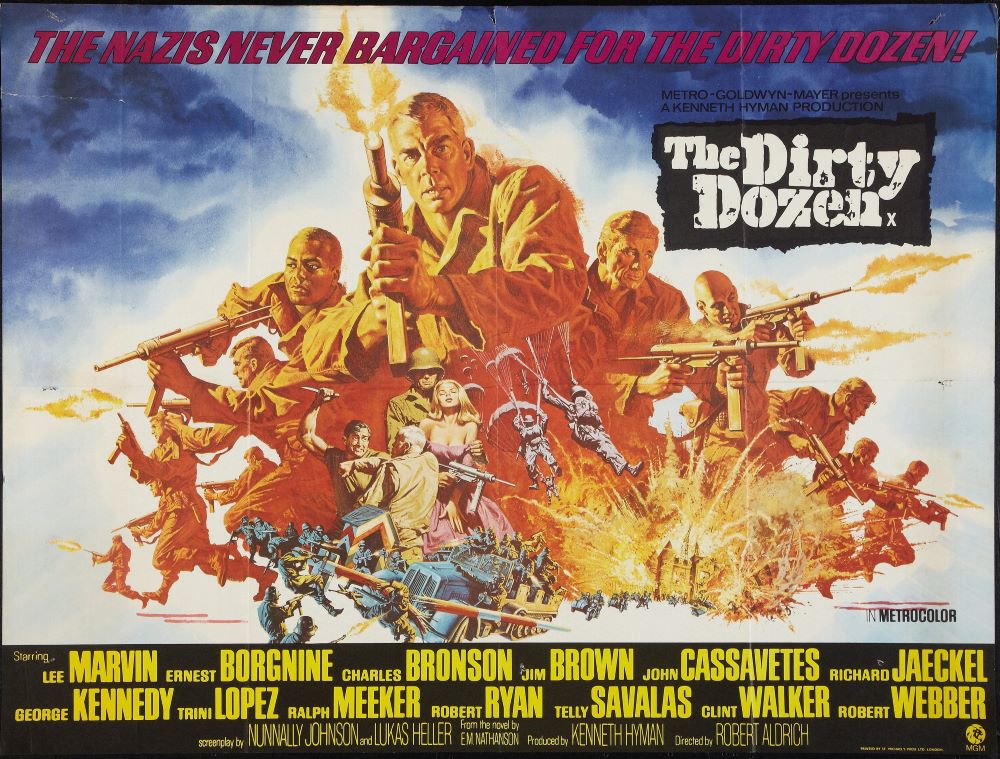
The Dirty Dozen is one of those war movies that feels like it was built in a lab for maximum “guys-on-a-mission” entertainment: big stars, a pulpy premise, plenty of attitude, and a third act that goes full-tilt brutal. It is also, even by 1967 standards, a pretty gnarly piece of work, and how well it plays today depends a lot on how comfortable you are with its mix of macho camaraderie, anti-authoritarian swagger, and disturbingly gleeful violence.
Directed by Robert Aldrich and released in 1967, The Dirty Dozen is set in 1944 and follows Major John Reisman (Lee Marvin), a rebellious U.S. Army officer assigned to turn a group of twelve military convicts into a commando unit for a suicide mission behind enemy lines just before D-Day. The deal is simple and grim: survive the mission to assassinate a gathering of German high command at a chateau, and your death sentence or long prison stretch gets commuted; fail, and you die as planned, just a little earlier and with more explosions. It is a high concept that plays almost like a war-movie prototype of the “villains forced to do hero work” formula that modern blockbusters keep revisiting.
The film’s biggest asset is its cast, stacked with personalities who bring a rough, lived-in charm to what could have been a lineup of interchangeable tough guys. Lee Marvin’s Reisman is the glue: a cynical, gravel-voiced officer who clearly hates bureaucratic brass almost as much as the criminals he is supposed to whip into shape, and Marvin plays him with a dry, weary sarcasm that avoids hero worship even as the film asks you to root for him. Around him, you get Charles Bronson as Wladislaw, a capable former officer with a chip on his shoulder; John Cassavetes as Franko, the volatile, insubordinate troublemaker; Jim Brown as Jefferson, whose physical presence and final-act heroics leave a strong impression; and Telly Savalas as Archer J. Maggott, a violently racist, fanatically religious, and almost certainly deranged soldier sentenced to death for raping and beating a woman to death. Savalas never softens that portrait, playing Maggott with a creepy combination of sing-song piety and sudden bursts of viciousness that makes him deeply uncomfortable to watch and the one member of the Dozen who feels like an outright monster even compared to the other killers. He sells Maggott’s self-justifying religiosity—quoting scripture, talking about being “called on” by the Lord—as both delusional and dangerous, so every time he starts sermonizing, it feels like a warning siren that things are about to go bad, and that pays off in the finale where his obsession with “sinful” women sabotages the mission. Even smaller roles from Donald Sutherland, Clint Walker, and others get memorable beats, which helps the ensemble feel like an actual crew rather than background noise.
For much of its runtime, the film plays like a rough-and-rowdy training camp movie, and that middle stretch is where a lot of its charm sits. Reisman’s solution to building teamwork is basically to grind the men down, deny them basic comforts, and force them to build their own camp, leading to the nickname “the Dirty Dozen” when their shaving kits are confiscated and they slip into permanent grime. The squad slowly gels through a mix of forced labor, competitive drills, and a memorable war-games exercise where they outsmart a rival, straight-laced unit led by Colonel Breed (Robert Ryan), which lets the film indulge in its anti-authority streak by making the rule-breakers look smarter than the regulation-obsessed brass. Savalas’s Maggott adds a constant sense of volatility to these scenes, his presence giving the group dynamic a genuine horror edge that keeps the movie from becoming a simple “lovable rogues” fantasy and making viewers eager to see him punished.
That anti-establishment energy is one of the reasons The Dirty Dozen hit so hard with audiences in the late 1960s, especially as public attitudes toward war and authority were shifting in the shadow of Vietnam. The movie clearly enjoys showing higher-ranking officers as petty, hypocritical, or out of touch, while Reisman and his misfit killers get framed as the ones who actually understand how war really works: dirty, improvisational, and morally compromised. Critics at the time noted that this defiant attitude, coupled with the convicts’ transformation into rough heroes, gave the film a rebellious appeal that helped it become a box office smash even as traditional war films were losing their shine.
Where the film becomes more divisive is in its moral perspective, or arguably its lack of one. From the start, these are not misunderstood saints: several of the men are condemned to death for murder, others for violent crimes and serious offenses, and the script never really suggests they were framed or unfairly treated. Yet once they are pointed at Nazis, the movie largely invites you to cheer them on, leaning into the idea that in war, the ugliest tools might be the most effective, and that conventional standards of justice and morality can be suspended if the target is the enemy. Maggott stands apart here as the line the film refuses to cross into sympathy, with Savalas’s committed and unsettling performance underlining how poisonous he is even to other criminals.
The climax at the chateau is where this tension really spikes. The mission involves infiltrating a mansion where German officers and their companions are gathering, rigging the place with explosives, and driving the survivors into an underground shelter that is then sealed and turned into a mass deathtrap with gasoline and grenades. It is a sequence staged with brutal efficiency and undeniable suspense, but it is also deeply unsettling, essentially pushing the protagonists into orchestrating a massacre that includes unarmed officers and civilians in evening wear, and the film offers minimal reflection on that horror beyond the visceral thrills. Maggott’s instability forces the team to react mid-mission, heightening the jagged tonal mix of rousing action and casual atrocity.
This blend of rousing action and casual atrocity did not sit well with many critics in 1967. Contemporary reviews complained that the film glorified sadism, blurred the line between wartime necessity and psychopathic cruelty, and practically bathed its criminals “in a heroic light,” encouraging what one critic called a “spirit of hooliganism” that was socially corrosive. Others, however, praised Aldrich for making a tough, uncompromising adventure picture that pushed back against sanitized war clichés, arguing that the cruelty and amorality felt like a more honest reflection of war’s ugliness, even if the film coated it in action-movie swagger and gallows humor. Savalas’s Maggott amplifies this debate, singled out by fans as a great, memorable character who adds real repulsion without turning into a cartoon.
From a modern perspective, the violence itself remains intense but not especially graphic by contemporary standards; what lingers is the attitude around it. The movie’s glee in letting some of these characters off the moral hook, contrasted with the genuinely disturbing behavior of someone like Maggott, creates that jagged tonal mix: part old-school “men on a mission” yarn, part cynical commentary on the kind of men war turns into tools. Depending on your tolerance, that mix either gives the film an edge that keeps it from feeling like simple nostalgia, or it plays as carelessly flippant about atrocities that deserve more introspection than a last-minute body count and a fade-out.
On a craft level, though, The Dirty Dozen still works surprisingly well. Aldrich keeps the film moving across a long runtime by building distinct phases: the recruitment and introduction of each convict, the training and bonding section with its rough humor and humiliation, and the final mission that shifts into suspense and near-horror. The action is clear and muscular, the editing sharp enough that you rarely lose track of who is where, and the sound design—even recognized with an Academy Award for Best Sound Effects—helps the chaos of the finale land with blunt impact.
At the same time, the structure exposes a few weaknesses. The early sections do such a good job of sketching out personalities that some characters feel underused or abruptly sidelined once the bullets start flying, and the film’s length can make parts of the training montage drag, especially if you are less enamored with its barracks humor and macho posturing. The writing also leans on broad types—psychopath, wisecracking crook, stoic professional—which the cast elevates, but the script rarely pushes them into truly surprising territory, beyond a few late-movie acts of sacrifice.
Still, as a piece of war-movie history, The Dirty Dozen earns its reputation. It helped popularize the template of the misfit team thrown into an impossible mission, a structure that later shows up everywhere from ensemble war pictures to superhero teams and modern “suicide squad” stories. Its mix of black humor, anti-authoritarian streak, and violent catharsis captures a specific late-1960s mood, even as its politics and ethics remain muddy enough to spark debate decades later. Savalas’s turn as Maggott ensures that edge never dulls, keeping the film’s thrills packaged with a moral outlook as messy and conflicted as the men it sends to kill.
For someone coming to it fresh now, the film plays as a rough, sometimes exhilarating, sometimes queasy ride: entertaining as pulp, compelling as an ensemble showcase, and troubling in the way it treats brutality as both a necessary evil and a spectator sport. If you are interested in the evolution of war cinema or the origins of the “ragtag squad on a suicide mission” trope, The Dirty Dozen is absolutely worth watching, with the understanding that its strengths—like Savalas’s chilling Maggott—come wrapped in those ethical ambiguities.
Welcome to Retro Television Reviews, a feature where we review some of our favorite and least favorite shows of the past! On Saturdays, I will be reviewing Baywatch, which ran on NBC and then in syndication from 1989 to 2001. The entire show can be purchased on Tubi.
Today, I start a new series of reviews. Since I already did Baywatch Nights, it just made sense to go ahead and do Baywatch. All together, this show ran for 11 and a movie so it should only take 241 weeks to finish up the series….
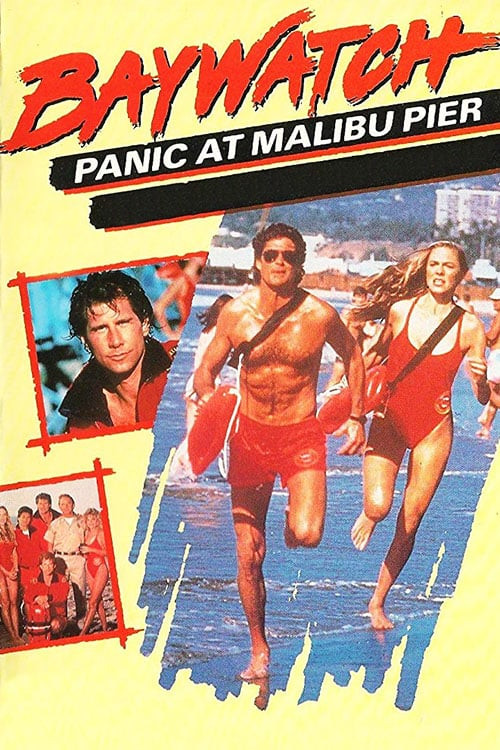
“Baywatch: Panic At Malibu Pier”
(Dir by Richard Compton, originally aired on April 29th, 1989)
It’s not easy being a lifeguard.
That would seem to be the main theme running through Panic at Malibu Pier, the two-hour movie that also served as a pilot for Baywatch. Consider the drama:
Mitch Buchanan (David Hasselhoff) loves the beach and he loves getting in the water but it’s cost him his marriage and now, his ex-wife (Wendie Malick) is suing for sole custody of their young son, Hobie (Brandon Call). Hobie doesn’t like going to school. He doesn’t understand why he can’t just spend all day on the beach like his father. Mitch, meanwhile, has been promoted to lieutenant of Baywatch and he’s now no longer supposed to do rescues. He’s just supposed to supervise the other lifeguard. His boss, Captain Thorpe (Monte Markham), is very insistent on that. Mitch explains that he doesn’t even like wearing socks. Ewwww. You have to wear socks, Mitch!
Eddie Kramer (Billy Warlock) is a rookie lifeguard. He finished at the top of his class but he’s also a tough kid from Philadelphia who grew up in the foster system. Shauni (Erika Eleniak) is another rookie lifeguard who freezes up when she has to provide CPR to a drowned girl. Her mentor, Jill (Shawn Weatherly), tells Shauni that it happens to every lifeguard. I bet it’s never happened to Mitch. Shauni seems to have a crush on Eddie and Eddie seems to be driven to prove himself. Eddie has guts because he wears a Philadelphia t-shirt in California.
Al Gibson (Richard Jaeckel) is the veteran lifeguard who is reaching retirement age and who dies at the end of the episode and gets a big lifeguard funeral on the beach.
Trevor (Peter Phelps) is the Australian lifeguard who calls everyone “mate.”
Finally, Craig Pomeroy (Parker Stevenson) is the attorney who prefers to spend his time in his lifeguard tower. Even when he should be at the office and working for his clients, Craig just hangs out at his tower. He saves the life of a disturbed teenager named Laurie (Madchen Amick). Laurie subsequently becomes obsessed with him. When the married Craig tells her to stay out of his lifeguard tower and stop taking off all of her clothes, she accuses Craig of assaulting her. Later, she tries to murder Craig’s wife (Gina Hecht). This all could have been avoided if Craig had just gone to his office like he was supposed to.
This pilot film for Baywatch has everything that the show would make famous — stiff line deliveries from the supporting cast, red swimsuits, David Hasselhoff’s earnestly goofy sincerity, slow motion, and plenty of musical montages. Amongst the guest cast, Madchen Amick stands out at the obsessive Laurie, showing an ability for handling melodrama that would be put to good use on Twin Peaks. Take a drink every time Mitch says, “Rescue can,” and see how long you can go before passing out. Unlike a lot of pilots that don’t really resemble the eventual show, Panic at Malibu Pier is unmistakably Baywatch.
And, watching it, you can see why the show eventually became a success. The beach scenery is nice. The men are athletic, the women are pretty, and the slow motion is cool the first time you see it. Of course, the most important thing about the pilot — and the show itself — is that it doesn’t require a good deal of attention. It’s one of those things where you can step away from the screen for a few minutes and then come back without having worry about having missed anything important.
Panic at Malibu Pier was a ratings hit. Baywatch followed. We’ll get into that next week.
Welcome to Retro Television Reviews, a feature where we review some of our favorite and least favorite shows of the past! On Tuesdays, I will be reviewing the original Fantasy Island, which ran on ABC from 1977 to 1984. Unfortunately, the show has been removed from most streaming sites. Fortunately, I’ve got nearly every episode on my DVR.
And now, it’s time for …. wait? What? *sigh* Okay.
Episode 6.10 “Operation Breakout/Candy Kisses”
(Dir by George W. Brooks, originally aired on January 15th, 1983)
My fantasy would be to be able to review this episode.
Ever since Fantasy Island was yanked down on all the streaming sites, I’ve been watching the show off of my DVR. A few years ago, I recorded nearly every episode off of one of the retro stations. (Sadly, the station also appears to no longer be broadcasting the show.) Unfortunately, nearly is not all and this is one of the episodes that I did not record. So, obviously, I can’t review it.
I can talk a little bit about it because I did watch this episode a few years ago. When I read the plot description on the imdb — Wheelchair-bound Kentucky racehorse breeder Rowena Haversham wants one last chance to win a race; and self-professed failure Danny Clements of Boston wants to turn his life around by breaking an American agent out of a tough foreign prison. — a bit of it came back to me. I remembered that Rowena (Ann Turkel) was given what she thought was a magic riding crop but that, at the end of the episode, Roarke revealed that the only magic was Rowena’s belief in herself. I think Rowena was transformed into a younger version of herself and she befriended a young rider played by Jill Whelan and ended up falling in love with Whelan’s father, who played by John Beck and not Gavin MacLeod. And I remember that Ben Murphy played the guy who entered the prison to save the American spy but it turned out that the prison was run totally by women and the spy was having the time of his life. I remember bits and pieces but it’s been a few years and I still wouldn’t feel comfortable even trying to tell you whether or not the episode worked.
So, consider this to be a placeholder. If I ever find Fantasy Island streaming somewhere or if someone is kind enough to reupload the show to YouTube, I’ll come back and review this episode.
Until then, my fantasy is for an official home video release of the entire series as opposed to just the first few seasons. Seriously, this is a fun show and one that still has a lot of fans. Yanking it off of Tubi to make room for the Fox reboot that only lasted for two seasons really doesn’t make a bit of sense.
John Carpenter has directed 18 features film, from 1974’s Dark Starto 2010’s The Ward. Some of his films have been huge box office successes. Some of his films, like The Thing, were box office flops that were later retroactive recognized as being classics. Carpenter has made mainstream films and he’s made cult favorites and, as he’s always the first to admit, he’s made a few films that just didn’t work. When it comes to evaluating his own work, Carpenter has always been one of the most honest directors around.
Amazingly, Carpenter has only directed one film that received an Oscar nomination.
That film was 1984’s Starman and the nomination was for Jeff Bridges, who was one of the five contenders for Best Actor. (The Oscar went to F. Murray Abraham for Amadeus.) Bridges played the title character, an alien who is sent to Earth to investigate the population and who takes on the form of the late husband of Jenny Hayden (Karen Allen). The Starman takes Jenny hostage, though its debatable whether or not he really understands what it means when he picks up her husband’s gun and points it at her. He and Jenny drive across the country, heading to Arizona so that he can return to his ship. Pursued by the government (represented by the sympathetic Charles Martin Smith and the far less sympathetic Richard Jaeckel), the Starman learns about emotions, eating, love, and more from Jenny. Jenny goes from being fearful of the Starman to loving him. Carpenter described the film as beingIt Happened One Night with an alien and it’s not a bad description.
After Jenny and the alien visitor make love in a boxcar, the Starman says, “I gave you a baby tonight,” and that would be an incredibly creepy line coming from a human but it’s oddly charming when uttered by an alien who looks like a youngish Jeff Bridges. Bridges definitely deserved his Oscar nomination for his role here. Speaking with an odd accent and moving like a bird who is searching for food, Bridges convincingly plays a being who is quickly learning how to be human. The Starman is constantly asking Jenny why she says, does, and feels certain things and it’s the sort of thing that would be annoying if not for the way that Bridges captures the Starman’s total innocence. He doesn’t mean to be a pest. He’s simply curious about everything.
Bridges deserved his nomination and I would say that Karen Allen deserved a nomination as well. In fact, it could be argued that Allen deserved a nomination even more than Bridges. It’s through Allen’s eyes that we see and eventually come to trust and then to love the Starman. Almost her entire performance is reactive but she makes those reactions compelling. I would say that Bridges and Allen deserved an Oscar for the “Yellow light …. go much faster” scene alone.
Carpenter agreed to make Starman because, believe it or not, The Thing had been such a critical and commercial flop that it had actually damaged his career. (If ever you need proof that its best to revisit even the films that don’t seem to work on first viewing, just consider Carpenter’s history of making films that were initially dismissed but later positively reevaluated. Today, The Thing, They Live, Prince of Darkness, and In The Mouth of Madness are all recognized as being brilliant films. When they were first released, they all got mixed reviews.) Carpenter did Starman because he wanted to show that he could do something other than grisly horror. Starman is one of Carpenter’s most heartfelt and heartwarming films. That said, it also features Carpenter’s trademark independent streak. Starman not only learns how to be human but, as a result of the government’s heavy-handed response to his arrival, one can only assume that he learns to be an anti-authoritarian as well.
Starman is one of Carpenter’s best films and also a wonderful showcase for both Karen Allen and Jeff Bridges.
It isn’t the past. It isn’t the present. It’s the future.
The moon has been colonized and, on Earth, the Mayflower II is preparing for its first international flight. It will be carrying passengers from Houston to the lunar station. Test pilot Ted Striker (Robert Hays) claims that the Mayflower II is not ready to make the trip but he’s been in the Ronald Reagan Hospital For The Mentally Ill ever since he had a nervous breakdown after losing his squadron during “the war.”
Aboard the Mayflower II is Ted’s ex-wife, Elaine (Julie Haggerty), and her new boyfriend, Simon (Chad Everett). Simon says the Mayflower II is in perfect shape but he also turns into jelly whenever things get too rough. Piloting the Mayflower II is Captain Clarence Oveur (Peter Graves) and waiting on the Moon is Commander Buck Murdock (William Shatner). The crew of the Mayflower II is going to have a tough flight ahead of them. Not only is the shipboard computer making plans of its own but one of the passengers (Sonny Bono) has a bomb in his briefcase. Also, Ted has broken out of the hospital and is on the flight, boring people with his long stories.
Every successful film gets a sequel and when Airplane! was a surprise hit in 1980, it was inevitable that there would be an Airplane II. Robert Hays, Julie Haggerty, Lloyd Bridges, Peter Graves, and Stephen Stucker all returned. Unfortunately, Jim Abrahams, the Zucker brothers, Robert Stack, Kareem Abdul-Jabbar, and Leslie Nielsen did not. (The directors and Nielsen were all working on Police Squad and their absence is strong felt.) Airplane II recreates many of the same jokes as the first Airplane! but without the first film’s good nature or genuine affection for the disaster genre. Airplane! was made for the love of comedy. Airplane II was made for the love of money and, while there are more than a few amusing moments, the difference is obvious and there for all to see.
Not surprisingly, Airplane II is at its funniest whenever William Shatner is on screen. In the role of Bud Murdock, Shatner pokes fun at his own image and shows himself to be a good sport. He’s still not as funny as Leslie Nielsen or Robert Stack in the first film but that’s because, unlike Stack and Nielsen in their pre-Airplane! days, there had always been a hint of self-parody to Shatner, even in his most dramatic roles. If Stack and Nielsen shocked people by showing that they could do deadpan comedy, Shatner’s performance just confirmed what most suspected, that he had always been in on the joke. Still, he’s the funniest thing in Airplane II and, whenever I rewatch this movie, I am happy he was there.
Airplane II was a box office failure, which is why the world never got an Airplane III. Fortunately, the world did get Hot Shots and The Naked Gun.
Well, actually, it’s not Loyalty Day for everyone. In fact, a lot of the world’s citizens are celebrating Communist May Day today. However, here in the United States, it’s Loyalty Day. Even if you are an American, it’s possible that you’ve never heard of Loyalty Day. It was first celebrated in 1921 and it was intended to provide a non-Communist alternative to International Workers Day. It wasn’t until 1955 that Loyalty Day was officially recognized by Congress.
Loyalty Day is defined as follows in 36 U.S.C. § 115:
(a) Designation.— May 1 is Loyalty Day.
(b) Purpose.— Loyalty Day is a special day for the reaffirmation of loyalty to the United States and for the recognition of the heritage of American freedom.
(c) Proclamation.— The President is requested to issue a proclamation—
(1) calling on United States Government officials to display the flag of the United States on all Government buildings on Loyalty Day; and
(2) inviting the people of the United States to observe Loyalty Day with appropriate ceremonies in schools and other suitable places.
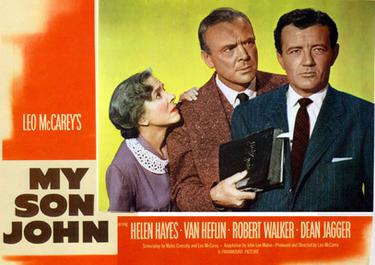
Though released before it officially became a holiday, the 1952 film, My Son John, is perfect for Loyalty Day.
The John of the title is John Jefferson (Robert Walker, in his final role), an employee of the State Department. While his younger brothers (played by Richard Jaeckel and James Young) are two high school football stars who are looking forward to serving their country in Korea, John is an intellectual who considers concepts like patriotism to be simplistic and naive. While his father (Dean Jagger) sings patriotic songs at the American Legion hall, John rolls his eyes at such middle class activities. (“If you don’t like your Uncle Sammy,” move to another country, John’s father sings.) The only person to whom John is especially close is his nervous mother, Lucille (Helen Hayes).
However, John is keeping a secret from even Lucille. He’s a double agent, working for the communists! With FBI agent Stedman (Van Heflin) hot on his trail, will John ever be able to see the light about the communists? And, how will the communists respond to John having doubts about the cause?
My Son John was a dream project for Hollywood director Leo McCarey. (It’s not a coincidence that the devoutly Catholic McCarey made a film about a devoutly Catholic family who discovers that one of their own has become a communist.) McCarey carefully supervised every detail of the film and he was even able to talk stage legend Helen Hayes into starring in the film, her first in 14 years. My Son John is full of scenes of shadowy communists, smug intellectuals, and all-American FBI agents marveling at the strength of Lucille Jefferson’s faith. Everything that is today often cited as a negative aspect to living in the suburbs is presented as being a positive in My Son John. The film’s communists come into a world of happy families, big houses, and well-manicured lawns and they set out to make everyone else as miserable as they are. There’s nothing subtle about either McCarey’s approach or Helen Hayes’s performance but, as is often the case with propaganda, the film is crudely effective.
My Son John was Robert Walker’s final film. In fact, he died before completing work on the film, leading the ending being rewritten. (No longer would John personally deliver a commencement address. Instead, his words come out of a tape player that has been rolled out on stage. A holy light shines down on the player while The Battle Hymn of the Republic plays in the background. It’s bizarre but it’s also probably the most memorable part of the movie.) Scenes from Strangers On A Train were rather awkwardly spliced into final moments of My Son John, never mind the fact that Robert Walker’s gleefully evil performance as Bruno Antony had little in common with his self-tortured performance as John Jefferson.
Surprisingly, considering that My Son John was released at the height of the anti-Communist era, the film was not a success at the box office. (Audiences seemed to better appreciate low-budget and pulpier anti-communist films, like I Was A Communist For The FBI.) Still, thanks to the Internet, My Son John is still available to be viewed on this Loyalty Day.
So, remember — if you don’t like your Uncle Sammy …. well, actually, the cool thing about this country is that you don’t have to like your Uncle Sammy. You have the right to decide for yourself how you feel about old Uncle Sammy. That’s an idea that is worth being loyal to.
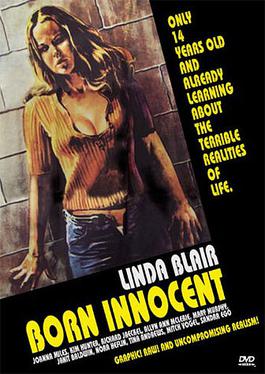
Welcome to Retro Television Reviews, a feature where we review some of our favorite and least favorite shows of the past! On Sundays, I will be reviewing the made-for-television movies that used to be a primetime mainstay. Today’s film is 1974’s Born Innocent! It can be viewed on Tubi!
Fresh off of her Oscar-nominated role in 1973’s The Exorcist, 15 year-old Linda Blair starred as Christine “Chris” Parker in Born Innocent.
Chris is a 14 year-old who has frequently been caught running away from home. When you consider her home life, it’s easy to understand why she keeps running away. Her father (Richard Jaeckel) is quick to lose his temper and obviously has no clue how to relate to a teenage daughter. When he gets angry at Chris, he beats her. Chris’s mother (Kim Hunter) spends all of her time smoking cigarettes, watching TV, and refusing to acknowledge what Chris is going through. Chris’s older brother (Mitch Vogel) has escaped from their abusive home but he’s now got a family of his own and there’s no room for Chris. With no other options available to her, Chris resorts to frequently running away from home. In the eyes of the system, this makes her both a delinquent and a repeat offender. However, as quickly becomes apparent, Chris is very naïve and hardly a criminal. Instead, she’s just someone trying to escape a terrible situation.
After getting caught once again, Chris is sent to a juvenile detention center. Unfortunately, because of overcrowding, Chris is sent to one of the toughest centers, one where she is surrounded by people who have done a lot more than just run away from home. Everyone knows that Chris doesn’t belong at the center but there’s no where else to send her. With the exception of one teacher (played by Joanna Miles), the staff is too overwhelmed to look after Chris. Meanwhile, the other inmates see Chris as being an easy victim and they start to bully her. Eventually, Chris loses her innocence and becomes just as ruthless and angry as her former victimizers.
Born Innocent is often described as being an exploitation film and, indeed, one can just look at the artwork at the top of this review and see how the film was advertised when it was eventually released on video. That said, the film itself may be undeniably melodramatic but there’s also a sincerity and a sensitivity to it that sets it apart from other women in prison films. Born Innocent is all about how the System creates criminals. From the start of the film, it’s obvious that being locked up is the last thing that Chris needs. Instead, Chris just needs someone to be willing to listen to her but the System would rather just toss her in juvenile hall and then forget about her. Only Chris’s teacher cares about her but, by the time they actually meet, it’s already too late for Chris. She’s already been tossed into a situation where the only thing that matters is survival. Born Innocent is controversial for a scene in which Chris is attacked by several other inmates and sexually assaulted with with a plunger. It’s a shocking scene and I can only imagine have television audiences in 1974 reacted to it. In this scene and the scenes that immediately follow, Linda Blair gives a harrowing performance that captures the emotional trauma of what Chris has been put through. It’s not easy to watch and that’s the point.
Unfortunately, Blair is a bit less convincing during the second half of the film, in which Chris becomes progressively more and more cold-hearted. The idea is that Chris, in order to protect herself, becomes just as intimidating as the girls who attacked her. Unfortunately, the vulnerability that made Linda Blair ideal for The Exorcist and the first half of this film also make it difficult to take her seriously as cold-hearted sociopath. During the second half of the film, Blair tries so hard to come across as being tough that she never convinces us. Later, in films like Savage Streets, Blair would become one of the toughest badasses around but, in this film, she still come across as being essentially born innocent.
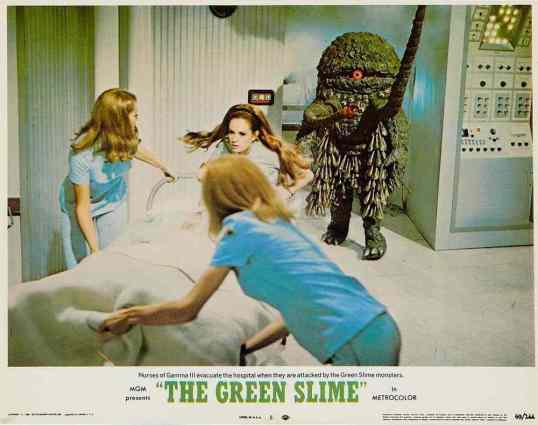
The 1968 film, The Green Slime, is meant to be a hybrid of a horror movie and a sci-fi film. One might even call it a forerunner to Alienif one wanted to run the risk of being ridiculed for the rest of one’s life. It’s about an alien life form that manages to sneak into a space station. Once it’s inside the space station, it starts to rapidly multiply and it turns out that everything that the humans do to try to stop it just causes more of the monsters to show up!
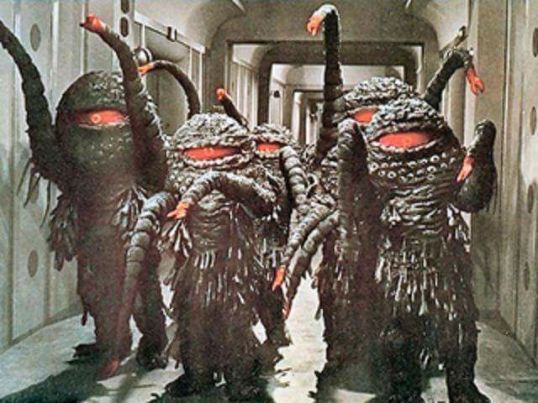
Seriously, that should be some major nightmare fuel but instead, the monsters are just too cute to believed.
Okay, maybe cute is the wrong word. When Jeff and I watched this movie, I asked him if he could come up with a better term to describe the monsters than “cute.” He suggested “cheap.” And yes, the monster do look rather cheap. It’s obvious that the monsters are made out of rubber and, half the time, their arms just seem to flail around at random. That’s actually one of the things that makes them so cute!
It’s also one of the things that makes The Green Slime memorable. Today, we tend to take it for granted that anything can be done via CGI so it’s interesting to see a film like this. The Green Slime was originally released 52 years ago, long before CGI. The special effects may look cheap but there’s an undeniable appeal to their quaintness. The special effects are a lot like the monsters themselves. They’re cheap. They’re not particularly convincing. But, in their own weird way, they’re definitely charming.
Of course, they’re not at all scary. That’s a bit unfortunate as far as the film is concerned. Remember how, in the Alien movies, you’re always scared to death that the alien is going to jump from out of nowhere because 1) the alien is absolutely terrifying to look at and 2) anyone caught by the alien is destined to die a terrible and agonizing death? Well, that’s not the case with The Green Slime. The Green Slime just kind of runs around and looks …. well, cute.
That said, The Green Slime cannot be allowed to make its way to Earth so the folks on the space station are going to have to figure out how to defeat it. That’s not going to be easy because the two rival commanders (payed by Robert Horton and Richard Jaeckel) are currently both in love with the same woman. Lisa Benson (Luciana Paluzzi) is the space station’s doctor and needless to say, she’s going to have her hands full. If you’re a Bond connoisseur, you might recognize Luciana Paluzzi from Thunderball. Myself, I was just happy that the doctor was a redhead named Lisa. I could automatically relate to her. Plus, there’s nothing more entertaining than hearing your name repeated over and over again.
The Green Slime was an American-Japanese co-production. The cast is a mix of American and European actors while the film’s crew was predominantly Japanese. Originally, The Green Slime was envisioned as being an American/Italian co-production and Antonio Margheriti was in talks to direct. When that plan fell through, MGM moved the production to Japan and teamed up with the Toei Company. One can only imagine what the film would have looked like if it had been directed by Marheriti. One imagines that the aliens would have been a bit less cute.
Fortunately, cute they are! The Green Slime fails as both a horror and sci-fi film because the aliens themselves never seem like a legitimate threat but I still like the film. If nothing else, it pays tribute to the name Lisa and that’s definitely something that I can get behind.
In a southwestern metropolis, a mysterious criminal is stealing cars and outrunning the police. When the insurance company realizes that the cops are never going to be able to do their job, they decide to bring in an outside hire to solve the crimes. They turn to a paisley-shirt wearing private investigator named Pete Novick (played by Joe Don Baker). Novick’s a hard-drinking, hard-living P.I. who is going to solve the case no matter what. Authority figures like police Captain Hogan (Morgan Woodward) hate him. Women like cop Niffty Nolan (Tyne Daly) and psychic New Blossom (Lana Wood) want to have him. Men like mechanic Billy (Richard Jaeckel) want to hang out with him. You get the idea. It’s a Joe Don Baker movie.
Speedtrap is basically one car chase after another, the majority of which are excitingly filmed and continue until almost every car involved has been destroyed. Though the movie was directed by Earl Bellamy, it has the feel of a Hal Needham film as it keeps the characterization to a minimum and instead focuses on vehicular mayhem. Speaking of Hal Needham, it’s also easy to imagine Burt Reynolds, in his B-movie days, playing the role of Pete Novick but not even he would have been as perfect for the role or the movie as Joe Don Baker. Baker shambles through the movie, all the while keeping the same passive-aggressive grin on his face. There’s nothing smooth about Joe Don Baker, which is why he was fun to watch in a movie like this. Whether he’s having a one-night stand with a psychic (only in order to help for “totally relax” so that she can have her visions) or going out of his way to annoy almost every single person that he meets, he’s undeniably Joe Don Baker. During one chase scene, an annoyed Novick snaps, “Beep beep my ass!” Only Joe Don Baker could have pulled that off.
Eventually, the thief steals the wrong car. This one has a suitcase in back that’s full of the mob’s money. This gives Robert Loggia a chance to ham it up as a mafia don who wants Novick to capture the thief and then turn him over to the syndicate. Novick, however, has even less respect for the mob than he does for the police. The mafia subplot is a distraction but Timothy Carey plays Loggia’s main henchman and brings with him a few moments of genuine menace to the film.
Speedtrap has never gotten a DVD or Blu-ray release but it’s an entertaining B-movie and it deserves one. How about it, Shout Factory? A million Joe Don Baker fans are looking to you.


 Through the Shattered Lens