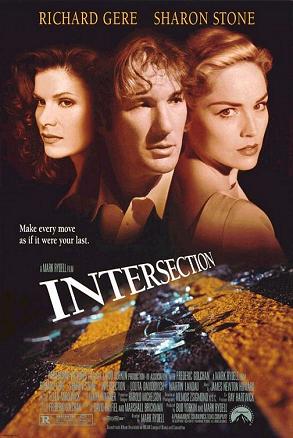
A Movie A Day #69: Intersection (1994, directed by Mark Rydell)


This one is just dumb.

Vincent Eastman (Richard Gere) and his wife, Sally (Sharon Stone), own an architectural firm.  Vincent is supposed to be creative and passionate but mostly he’s just Richard Gere in mom jeans.  Sally is a brilliant businesswoman but she is also emotionally repressed to the point of being frigid.  Vincent eventually starts having an affair with a travel writer named Olivia (Lolita Davidovich), who is everything that Sally is not.  Despite Martin Landau telling him that he has to make a decision because, and I quote, “Keep everything under one roof. That’s a basic rule of architecture,” Vincent cannot choose between his hateful wife and his loving mistress.  First he writes a letter to Olivia, telling her that he can not leave his wife.  Then, he sees a little girl who, like Olivia, has curly red hair and he takes that as a sign that he should leave his wife.  He calls Olivia and leaves a gushing message on her machine, telling her that he’s leaving Sally.  But before the letter is sent or the message is heard, Vincent is in a car crash that leaves him in a coma.  As both his wife and his mistress wait outside his hotel room, Vincent has visions of his two lovers swimming by him and struggles to decide who to follow.  Even in a coma, Vincent is an indecisive prick.

Intersection was on HBO while I was sick.  I watched it and it just made me feel worse.  Intersection was made during a weird period of time when Richard Gere was a romantic star and Sharon Stone was trying to prove that she was a serious actress.  Stone lobbied to be cast against type as Sally but she plays the role as so hard and bitchy that there’s never any question as to whether or not Vincent should leave her for Olivia.  Lolitia Davidovich (whatever happened to her?) does what she can with Olivia but the character never has any existence beyond her relationship with Vincent.  As for Richard Gere, when he starts hyperventilating about seeing a little girl who looks like his mistress, you’ll want to report him to social services.

Sadly, Intersection was directed by Mark Rydell and written by Marshall Brickman, two people who did great work before Intersection and have done very little since.

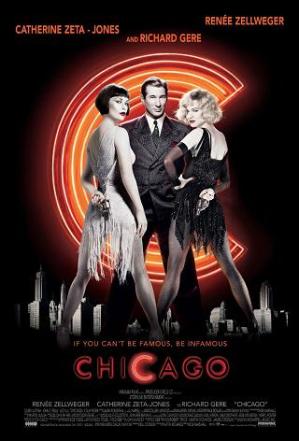
Embracing the Melodrama Part II #102: Chicago (dir by Rob Marshall)


ChicagopostercastIt’s strange to refer to a best picture winner as being underrated but that’s exactly the perfect description for the 2002 film Chicago.

When Chicago was named the best picture of 2002, it was the first musical to take the top prize since The Sound of Music won in 1965.  Until the box office success and Oscar triumph of Chicago, it was assumed by many that a musical had to be animated in order to be successful.  After Chicago won, the conventional wisdom was changed.  Dreamgirls, Nine, Rock of Ages, Hairspray, Jersey Boys,  Into the Woods, Les Miserables, none of these films would have been produced if not for the success of Chicago.  It’s also due to Chicago that television networks are willing to take chances on shows like Glee and Smash.  And while I think a very valid argument could be made that we would all be better off without Glee, Smash, and Rock of Ages, you still can not deny that Chicago both challenged and changed the conventional wisdom.

https://twitter.com/Delanynder/status/606251356136042496

And yet, despite its success and its continuing influence, Chicago is one of those best picture winners that often seems to get dismissed online.  Some of that’s because, by winning best picture, Chicago defeated not only The Two Towers (which is arguably the best installment in Peter Jackson’s Lord of the Rings trilogy) but also Roman Polanski’s searing masterpiece, The Pianist.  Critics often point out that The Pianist won for best adapted screenplay, best actor, and best director but Chicago somehow managed to win best picture.  They suggest that the Academy was either worried about the implications of giving best picture to a film directed by Roman Polanski or else they were blinded by Chicago‘s razzle dazzle.  They argue that Chicago was merely an adaptation of an iconic stage production, whereas The Pianist and The Two Towers were both the result of visionary directors.

Well, to be honest, I think those critics do have a point.  The Pianist is one of the most emotionally devastating films that I have ever seen.  The Two Towers is the perfect mix of spectacle and emotion.  And yet, with all that in mind, I still love Chicago.

And it’s not just because of scenes like this:

Or this:

Or even this scene of Richard Gere tap dancing:

If you’ve been reading this site for a while then you know my bias.  You know that I grew up dancing.  You know that I love to dance.  And you know that I automatically love any film that features a dance number.  And, since you know my bias, you may be thinking to yourself, “Well, of course Lisa likes this….”  And you’re right.

But you know what?  Even if nobody danced a step in this film, I would still enjoy it.  (Though it would be odd to see a musical with absolutely no dancing.)  Chicago is not just about spectacle.  Instead, it tells a very interesting story, one that is probably even more relevant today than when the film was first released.

Set in 1924, Chicago tells the story of Roxie Hart (Renee Zellweger).  Married to the decent but boring Amos (John C. Reilly), Roxie wants to be a star.  She has an affair with slrazy Fred Casely (Dominic West), believing that he has showbiz connections.  When Fred finally admits to her that he lied in order to sleep with her, Roxie reacts by murdering him.  Because Roxie is pretty and blonde and claims to have been corrupted by the big, bad, decadent city, she becomes a celebrity even while she sits in jail and awaits trial.

Also in the jail is Velma Kelly (Catherine Zeta-Jones), a nightclub singer who killed her husband and sister.  Roxie idolizes Velma but, after Velma snubs her, a rivalry forms between the two.  Roxie hires Velma’s lawyer, the slick Billy Flynn (Richard Gere).  During the trial, Roxie becomes even more popular, Velma grows jealous, and the only innocent women on death row — a Hungarian who can’t speak English — is ignored and executed because she doesn’t make for a good news story.

Chicago is a cynical and acerbic look at both the mad pursuit of celebrity and the pitfalls of the American justice system.  In its way, it’s the film that predicted the Kardashians.  (If Roxie had been born several decades later, it’s not difficult to imagine that she’d build her career off of a sex tape as opposed to murder.)  Renee Zellweger and Catherine Zeta-Jones are both sociopathic marvels in their respective roles.  Even Richard Gere, who, in other films, can come across as being oddly empty, is perfectly cast and surprisingly witty in the role of Billy.

Director Rob Marshall does a great job of making this stage adaptation feel truly cinematic.  At no point does Chicago feel stagey.  Perhaps Marshall’s smartest decision was to tell the entire film through Roxie’s eyes.  Every musical lives and dies based on whether it can convince the audience that it would perfectly natural for everyone onscreen to suddenly break out into song.  Chicago is convincing because, of course, Roxie would view her life as being a musical.

And did I mention that the film features a lot of great dancing?

Because it so seriously does….

So, yes, it can be argued that Chicago beat out some worthier films for the title of best picture of the year.  But, regardless, it’s still a good and memorable film.

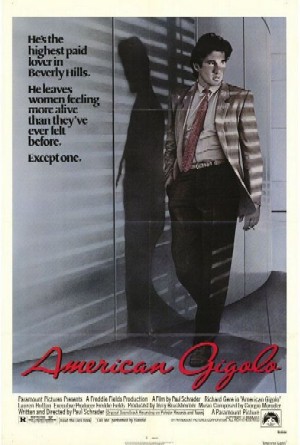
Embracing the Melodrama Part II #63: American Gigolo (dir by Paul Schrader)


American_gigolo_postWell, here we are!  A month and two days ago, I announced the start of Embracing the Melodrama Part II, a 126-film series of reviews.  At the time, I somewhat foolishly declared that I would manage to review all of these films in just three weeks!  Four weeks later and we have finally reached the halfway point.

So yeah…

Anyway!  We started this series of reviews with 1927’s Sunrise and we have worked our way through the films of the 30s, the 40s, the 50s, the 60s, and the 70s.  And now, as we hit the halfway point, it’s appropriate that we start a new cinematic decade.

In other words, welcome to the 80s!

Let’s start the 80s off with the 1980 film, American Gigolo.  Directed by Paul Schrader, American Gigolo is — much like Schrader’s Hardcore and The Canyons — a look at the sleazier side of life in California.  Julian Kaye (Richard Gere) is the most successful male escort in Los Angeles.  He’s handsome, he’s confident, he speaks multiple languages, and he maintains a proper emotional distance from … well, from everyone.  He’s got a fast car, expensive clothes, a great apartment, and — because it is the 80s after all — a small mirror that is perpetually coated in cocaine residue.

We don’t really learn much about Julian’s past.  We don’t know much about who he was before he became the American Gigolo.  (If this movie were made today, American Gigolo would be a part of the MCU and would end up joining The Avengers.)  However, the film is littered with clues.  For instance, we know that he used to work exclusively for Anne (Nina Van Pallandt) but he’s become so successful that Anne has lost her hold over him.  Before Julian worked for Anne, he worked for Leon (Bill Duke), a gay pimp.

Julian’s sexuality is a big question mark throughout the entire film.  Though all of his current clients are female and Julian brags about his ability to leave a woman feeling sexually satisifed, the film leaves it ambiguous as to whether or not he actually likes women.  (It’s suggested — though never explicitly stated — that Julian slept with men while he was working for Leon.)  Ultimately, for someone who has sex for a living, Julian seems oddly asexual.  It’s hard not to feel that Julian is only truly capable of desiring his own carefully constructed image.

Is Julian capable of love?  That’s the question that Michelle Stratton (Lauren Hutton) has to consider.  Michelle is unhappily married to a member of the U.S. Senate but she’s having an affair with Julian.

Michelle’s relationship with Julian is tested when Julian is accused of murdering one of his clients.  While Julian begs both his clients and his business associated to provide him with an alibi, he discovers that he’s basically alone.  Convinced that someone’s trying to frame him, Julian destroys his apartment and his car searching for clues.  As he grows more and more paranoid, his perfect image starts to crack and Michelle has to decide whether or not to sacrifice her marriage to protect him.

American Gigolo is technically a murder mystery but the murder doesn’t really matter.  Instead, it’s a character study of a man who is empty inside until, in Job-like fashion, he loses everything.  It’s also a very watchable exercise in pure, sleek, and probably cocaine-fueled style.  Richard Gere has always been an oddly hollow actor (and that’s not necessarily meant as a criticism) and that suggestion of inner emptiness makes him the perfect choice for the role of Julian Kaye.

American Gigolo is making the premium cable rounds right now.  Keep an eye out for it and don’t be surprised if you find yourself singing Call Me afterwards.

Scenes I Love: An Officer and a Gentleman


1578861_640px1

The latest “Scenes I Love” comes courtesy of An Officer and a Gentleman.

This ending sequence to the film has become an iconic scene when one talks about some of the best romantic scenes in film. The film itself was your modern take on the age-old two people from the wrong-sides of the track falling for each other.

The ending scene made the film memorable in the end. It helped that the song written and composed for the film, “Up Where We Belong,” and sung as a duet by Joe Cocker and Jennifer Warnes became as big of a hit as the film itself.

bc5485fe6adbae2_life_on_the_fast_lane

You know that a scene has become a cultural mainstay when The Simpsons did a parody of it which ended up being just as memorable as the original.

Up Where We Belong

Who knows what tomorrow brings
in a world few hearts survive
All I know is the way I feel
when it’s real I keep it alive the road is long
There are mountains in our way
but we climb the stairway every day

Love lifts us up where we belong
where the eagles cry on a mountain high
love lifts us up where we belong
far from the world below up where the clear winds blow

Some hang on to used to be
live their lives looking behind
All we have is here and now
all our lives out there to find
The road is long and there are moutains in our way
but we climb the stairway every day

Love lifts us up where we belong
where the eagles cry on a mountain high
love lifts us up where we belong
far from the world we know
where the clear wind blows

Time goes by no time cry
life’s you and I alive

Love lifts us up where we belong
where the eagles cry on a mountain high
love lifts us up where we belong
far from the world we know
where the clear winds blow

Love lifts us up where we belong
far from the world we know
where the clear winds blow

Love lifts us up where we belong
where the eagles cry on a mountain high

Is It Too Late To Hate On Movie 43?


Originally,  I wasn’t planning on ever seeing Movie 43.

Remember Movie 43?  That’s the comedy with the huge ensemble cast that came out in January and stayed in theaters for about a week.  The trailers looked terrible, the commercials looked terrible, and finally, the reviews were terrible.  In fact, the reviews were so terrible (Richard Roeper called it the Citizen Kane of bad movies) that, at first, I was perfectly content never to see it.

However, as time passed, I continually heard Movie 43 referred to as being one of the worst films ever made.  Every 12 months, I post my picks for the 26 worst films of the year and I knew that Movie 43 was one of those films that would either appear on that list or, if it didn’t, I would have to be willing to defend the title’s absence.

I realized that before I could either defend or condemn, I would have to sit through the movie.  After all, I figured, it’s only 90 minutes of my life.

90 minutes that I’ll never get back, I might add.

Movie 43 is an anthology film in which 13 separate comedic sketches are loosely linked together by one overarching story.  For the most part, this is a film that was presumably made both for adolescent boys and for men who still think like adolescent boys.  Most of the humor is derived from bodily functions and there’s a real strain of misogyny running through the entire film.  However, the film’s problem is not that it’s crude and misogynistic but that it manages to be so dull about being crude and misogynistic.  If you think its hilarious when Meg is insulted on Family Guy or when Seth McFarlane smirks after making an anti-Semitic comment, you might enjoy Movie 43 but the rest of us are going to find far less to enjoy.

Oddly enough, there are actually two different versions of Movie 43 in circulation.  In the version that was released in U.S. theaters, the various vignettes are tied together by a story in which an insane director (Dennis Quaid) pitches scene after scene to a callous movie executive (Greg Kinnear).  In the version that was released in the UK, they’re linked together by a story about 3 teenagers searching for the most offensive film ever made.  To be honest, both versions are pretty stupid but I prefer the one about the 3 teenagers, if just because that way I can pretend that neither Dennis Quaid nor Greg Kinnear had anything to do with this movie.

As for the sketches themselves, there’s 13 of them and they are a mixed bag as far as both humor and quality are concerned:

1)      The Catch (dir by Peter Farrelly)

Kate Winslet and Hugh Jackman go on a blind date.  Jackman has testicles hanging from his neck and only Winslet thinks this is an odd thing.  This skit goes on forever.

2)      Homeschooled (dir by Will Graham)

Liev Schreiber and Naomi Watts explain how they’re making sure that their teenage son is getting the full high school experience despite the fact that he’s being homeschooled.  They do this through a combination of hazing and incest.  This skit worked pretty well, mostly because of the dedication that Schreiber and Watts brought to their absurd roles.

3)      The Proposition (dir by Steve Carr)

Uhmm…yeah.  So, this is the skit that opens with Anna Faris asking Chris Pratt to defecate on her.  I skipped over it because, quite frankly, life is too short.

4)      Veronica (dir by Griffin Dunne)

Neil (Kieran Culkin) is working the night shift at a depressing grocery store when his ex-girlfriend Veronica (Emma Stone) comes in.  They argue about who infected who with an STD.  Little do they realize that Neil has accidentally turned on the intercom and everyone in the store can hear them.  I actually kind of liked this short skit.  Culkin and Stone had a lot of chemistry and it was well-directed by Griffin Dunne.  Plus, it only lasted 2 minutes and, therefore, ended before the joke got old.

5)      iBabe (dir by Stephen Brill)

The iBabe is an MP3 player that happens to look like a life-size nude woman.  Unfortunately, a fan was built into the iBabe’s vagina and now, teenage boys are being dismembered while fingering and fucking iBabe.  Richard Gere plays the President of the company that makes iBabe.  I’ve never thought of Richard Gere as being a comedic actor and his performance here does nothing to change that.

6)      Superhero Speed Dating (directed by James Duffy)

Robin (Justin Long) goes speed dating and Batman (Jason Sudekis) tries to mess things up for him.  This skit – which also features (and wastes) Uma Thurman, Kristen Bell, and Bobby Cannavale – is so incredibly bad that I don’t even know where to begin.  Between this film and his appearance in last year’s The Conspirator, I’m having to rethink my slight crush on Justin Long.

7)      Machine Kids (directed by Jonathan Von Tulleken)

This commercial parody asks us to consider the children who work inside copiers and vending machines and how they are effected when we criticize those machines for not accepting our dollar.  This was actually so weird that I couldn’t help but love it.

8)      Middleschool Date (dir by Elizabeth Banks)

7th grader Amanda (Chloe Moretz) is having her first “middle school” date with Nathan (Jimmy Bennett) when she starts her first period.  In response, Nathan and his older brother (Christopher Mintz-Plasse) panic.  Believe it or not, this was actually one of the better parts of Movie 43, if just because the scene’s humor comes not from Amanda getting her period but instead from how every male around her descends into histrionics as a result.   It helps that this was the only part of Movie 43 that was both written and directed by women.  It also helps that director Elizabeth Banks is so clearly on Amanda’s side.  The end result is one of the few moments in Movie 43 that doesn’t feel misogynistic. 

9)      Tampax (dir by Patrik Forsberg)

This is another fake commercial.  Two girls are at the beach.  One uses tampax tampons and the other doesn’t.  Guess which one gets eaten by a shark?  As opposed to the previous skit, this bit of menstrual humor was obviously written and directed by a man (and the message, not surprisingly, is “Ewww!  Girls are scary and dangerous!”) but I’m going to have to admit that this one made me laugh if just because, like Middleschool Date, it reminded me of some of the period horror stories that I used to hear (and believe) back when I was younger.  (Though I was raised to be more concerned about bears than sharks…)

10)  Happy Birthday (dir by that noted comedian, Brett Ratner)

Pete (Johnny Knoxville) kidnaps an angry leprechaun (Gerard Butler) and gives it to Brian (Seann William Scott).  The leprechaun’s equally angry brother (also played by Gerard Butler) shows up and violence ensues.  Watching this skit was like being told a joke by someone who has no sense of humor.

11)  Truth or Dare (dir by Peter Farelly and Patrik Forsberg)

Halle Berry and Stephen Merchant are on a first date and Merchant has testicles on his neck…oh wait.  Sorry, that was Hugh Jackman and Kate Winslet’s skit.  In this skit, Berry challenges Merchant to game of truth or dare.  It escalates as the dares get continually more and more outrageous.  Whoops?  Did I say outrageous?  I meant to say stupid and oddly dull.  Watching this skit was like listening to a someone who has no sense of humor continue to tell a joke even though everyone else has already guessed the punchline.

12)  Victory’s Glory (dir by Rusty Cundieff)

In this parody of “inspirational” sports movies, Coach Jackson (Terrence Howard) speaks to his basketball team before they play their first game against an all-white team.  The gist of the speech is that Jackson’s team is going to win because they’re black and the other team is white.  This skit started out strong but, like a lot of Movie 43, it ran on for a bit too long.

13)  Beezel (dir by James Gunn)

This was actually my favorite part of Movie 43.  Unfortunately, since Beezel shows up in the middle of the end credits, I get the feeling that a lot of disappointed audience members had probably already walked out of the theater before it even began.  Beezel is a cartoon cat who has an unhealthy obsession with his owner (Josh Duhamel).  When Duhamel’s girlfriend (played by Elizabeth Banks) catches Beezel masturbating to pictures of Duhamel in a swimsuit, Beezel responds by plotting her demise.  Beezel was actually the only part of Movie 43 that truly felt edgy and unpredictable.  This is largely because this segment was directed by James Gunn, one of the few truly transgressive artists currently working in mainstream film.

So, here’s the question: is Movie 43 the worst film of 2013 as so many critics have claimed?  A few isolated moments aside, Movie 43 is pretty bad.  Even the parts of the film that do work can’t hope to compete with the pure horrifying incompetence of that parts that don’t.  However, thanks largely to James Gunn and Elizabeth Banks, it’s still a smidgen or so better than Tyler Perry’s Temptation.  (For all of its failings, Movie 43 never suggests that AIDS is God’s way of punishing wives who stray.  Nope, for that message, you have to go to Tyler Perry.)

Movie 43 is not the worst film of 2013.

It just seems like it.
I Got Your Golden Globes Right Here…


We’re halfway through Oscar season and that means that it’s time for the Golden Globes to weigh in.  To be honest, I think the Golden Globes are somewhat overrated as an Oscar precursor.  For the most part, the Golden Globes usually honors the films that are on everyone’s radar and then they come up with one or two nominations that nobody was expecting.  However, those surprise nominations rarely seem to translate into anything once it comes to time to announce the Oscar nominations.

So, while Salmon Fishing In The Yemen did receive a few surprise nominations (and those nominations were deserved, by the way), I doubt that we’ll see the movie mentioned on January 10th when the Oscar nominations are announced.

From the reaction that I’ve seen on the usual awards sites,  a lot of the usual suspects are upset that Beasts of the Southern Wild was completely snubbed.  Actually, they’re not just upset.  They’re about as outraged about this as they were when The Social Network lost best picture to King’s Speech.  The way they’re carrying on, you would think that someone had just informed them that David Fincher’s version of The Girl With The Dragon Tattoo was a thoroughly unneccessary rehash of an already brilliant film.  Seriously, the facade of Stone has fallen and tears are being shed.

Myself, I’m more annoyed that neither The Cabin In The Woods nor Anna Karenina are getting the love that they deserve.

Anyway, with all that in mind, here are the Golden Globe nominations!

BEST DRAMA
“Argo”
“Django Unchained”
“Life of Pi”
“Lincoln”
“Zero Dark Thirty”

BEST DRAMA ACTOR
Daniel Day-Lewis, “Lincoln”
Richard Gere, “Arbitrage”
John Hawkes, “The Sessions”
Joaquin Phoenix, “The Master”
Denzel Washington, “Flight”

BEST DRAMA ACTRESS
Marion Cotillard, “Rust and Bone”
Jessica Chastain, “Zero Dark Thirty”
Helen Mirren, “Hitchcock”
Naomi Watts, “The Impossible”
Rachel Weisz, “The Deep Blue Sea”

BEST COMEDY/MUSICAL PICTURE
“The Best Exotic Marigold Hotel”
“Les Miserables”
“Moonrise Kingdom”
“Silver Linings Playbook”
“Salmon Fishing in the Yemen”

BEST COMEDY/MUSICAL ACTOR
Jack Black, “Bernie”
Bradley Cooper, “Silver Linings Playbook,”
Hugh Jackman, “Les Miserables”
Ewan McGregor, “Salmon Fishing in the Yemen”
Bill Murray, “Hyde Park on Hudson”

BEST COMEDY/MUSICAL ACTRESS
Emily Blunt, “Salmon Fishing in the Yemen”
Jennifer Lawrence, “Silver Linings Playbook”
Judi Dench, “Best Exotic Marigold Hotel”
Maggie Smith, “Quartet”
Meryl Streep, “Hope Springs”


BEST SUPPORTING ACTOR 
Alan Arkin, “Argo”
Philip Seymour Hoffman, “The Master”
Christoph Waltz, “Django Unchained”
Leonardo DiCaprio, “Django Unchained”
Tommy Lee Jones, “Lincoln”

BEST SUPPORTING ACTRESS
Anne Hathaway, “Les Miserables”
Helen Hunt, “The Sessions”
Amy Adams, “The Master”
Sally Field, “Lincoln”
Nicole Kidman, “The Paperboy”

BEST DIRECTOR
Ben Affleck, “Argo”
Ang Lee, “Life of Pi”
Steven Spielberg, “Lincoln”
Quentin Tarantino, “Django Unchained”
Kathryn Bigelow, “Zero Dark Thirty”

BEST SCREENPLAY
“Silver Linings Playbook”
“Argo”
“Django Unchained”
“Zero Dark Thirty”
“Lincoln”

BEST ORIGINAL SCORE
“Anna Karenina”
“Life of Pi”
“Argo”
“Lincoln”
“Cloud Atlas”

BEST ORIGINAL SONG
“For You” from “Act of Valor”
Music by: Monty Powell, Keith Urban Lyrics by: Monty Powell, Keith Urban

“Not Running Anymore” from “Stand Up Guys”
Music by: Jon Bon Jovi Lyrics by: Jon Bon Jovi

“Safe and Sound” from “The Hunger Games”
Music by: Taylor Swift, John Paul White, Joy Williams, T Bone Burnett Lyrics by: Taylor Swift, John Paul White, Joy Williams, T Bone Burnett

“Skyfall” form “Skyfall”
Music by: Adele, Paul Epworth Lyrics by: Adele, Paul Epworth

“Suddenly” from “Les Miserables”
Music by: Claude-Michel Schonberg Lyrics by: Alain Boublil, Claude-Michel Schonberg

BEST ANIMATED FILM 
“Brave”
“Frankenweenie”
“Wreck-it Ralph”
“Rise of the Guardians”
“Hotel Transylvania”

BEST FOREIGN LANGUAGE FILM 
“The Intouchables”
“Amour”
“A Royal Affair”
“Rust and Bone”
“Kon-Tiki”

Scenes I Love: Jim James Sings Goin’ To Acapulco in I’m Not There


When I’m Not There was first released in 2007, most critics gave most of their praise and attention to Cate Blanchett’s performance as one of the film’s six different representations of Bob Dylan.  In fact, Blanchett was even nominated for Best Supporting  Actress for grabbing her crotch and wearing a painfully fake mustache.  When I first saw I’m Not There, I thought that Blanchett’s performance was overrated.  Having recently rewatched it on DVD, I’ve changed my opinion slightly.  I now think that her performance as “Jude Quinn” is probably the worst performance she’s ever given.  Once you get over the fact that Cate Blanchett’s playing a man, the quicker it becomes obvious that she’s not a very convincing man. 

In fact, on subsequent viewings, I’ve come to realize that the only part of the film that really works for me is the final section.  This is the section where an aging Bob Dylan is played by (of all people) Richard Gere.  This is the section where Gere is known as Billy the Kid and he ends up wandering through a surrealistic frontier town while searching for his dog.  The town is full of people who look like they escape from an especially grim Fellini film and Bruce Greenwood pops up as Pat Garrett.  When I first saw I’m Not There, this final sequence seemed drawn out and rather silly.  However, on subsequent viewings, I’ve come to appreciate the fact that, with this end sequence, director Todd Haynes is at least finally being honest about being pretentious.

Another point in this sequence’s favor is that it features a haunting performance of Dylan’s Goin’ To Acapulco by Jim James and Calexico.  The contrast between the heartfelt delivery of the song, the intellectual pretensions of the entire film, and the inherent Hollywood slickness of Richard Gere all add up to create a scene that I truly love.