Lisa Reviews An Oscar-Nominated Horror Film: Jaws (dir by Steven Spielberg)


JAWS_Movie_poster

There’s little that is more intimidating than trying to write a review of the 1975 best picture nominee, Jaws.

I mean, seriously, what’s left to be said about this film?  Jaws is one of those movies that everyone has seen and everyone loves.  And, even if someone somehow hasn’t seen the film, chances are that they still know all about it.  They know that it’s a movie about a giant shark that attacks Amity Island, just as the summer season is starting.  They know that the town’s mayor refuses to close the beaches, because he doesn’t want to lose the tourist dollars.  They know that the final half of the film is three men (Roy Scheider, Richard Dreyfuss, and Robert Shaw) floating around in a boat, searching for a shark.  And they certainly know that, whenever you hear John Williams’s iconic theme music, it means that someone is about to get attacked.

Jaws is such a part of our culture that probably not a single day goes by without someone saying a variation on “we’re going to need a bigger boat.”  Did you know that, on twitter, Ben Gardner’s boat has its own account?  And despite getting pretty graphically dismembered about halfway through Jaws, poor little Alex Kintner has an account as well!

What’s amazing about Jaws is that, even though everyone’s seen it and it’s been parodied a few thousand times, Jaws remains incredibly effective.  I still find myself cringing whenever the shark catches Alex Kintner and that geyser of blood explodes out of the ocean.  I still jump whenever the shark suddenly emerges from the water and scares the Hell out of Roy Scheider.  I still laugh at Richard Dreyfuss’s hyperactive performance and I instinctively cover my ears whenever I realize that Robert Shaw is about to drag his nails across that chalk board.

And then there’s that music, of course!  Even after being used, misused, and imitated in countless other films, the Jaws theme still fills me with a sort of existential dread.  The mechanical shark was notoriously fake-looking and was rarely seen onscreen as a result.  The camera and the music stand in for the shark and it works beautifully.

The one unfortunate thing about Jaws is that it’s been so critically acclaimed and so embraced by audiences that I think people tend to forget that it is primarily a horror film.  Mainstream critics tend to look down on horror as a genre so, rather than admit the obvious, they claim that Jaws is more of a thriller than a horror film.  Or they talk about how it’s actually meant to be a political allegory or an environmental allegory or an examination of male bonding.

So, let’s just make this clear.  No matter what the elitist critics or even Steven Spielberg himself may say, Jaws is primarily a horror film, with that relentless killer shark serving as a prototype for such future horror fiends as Michael Myers, Jason Voorhees, Freddy Krueger, and both of the Ghostface and Jigsaw Killers.  (Jaws even opens with a stereotypical slasher movie death, as a nude and stoned swimmer is suddenly attacked by an unseen killer.) If not for Scheider, Shaw, and Dreyfuss floating in the endless ocean, you would never have had films — like the Blair Witch Project — about people being lost and stalked in the wilderness.  And when that shark attacks and graphically rips apart its victims, how different is it from something you might find in a George Romero or Lucio Fulci zombie film?

On the basis of Jaws and Duel, I think it can be argued that, if Steven Spielberg hadn’t become America’s favorite director of crowd-pleasing, Oscar-contending blockbusters, he could have been one of our best horror directors.  Sadly, Spielberg has pretty much abandoned horror and I doubt that Jaws would be as effective if it were made today.  (I suspect that the temptation to resort to a cartoonish CGI shark would be too great.)

But that’s all speculation.

What matters is that Jaws remains one of the greatest films ever made.

And it’s a horror film!
 

Lisa Watches An Oscar Nominee: The Goodbye Girl (dir by Herbert Ross)


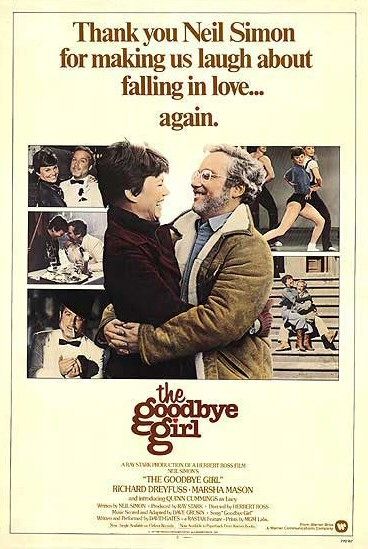
Goodbye_Girl_movie_poster

After I watched San Francisco, I decided to watch yet another film that I had DVRed during TCM’s 31 Days of Oscar.  I had several films to choose from and I ultimately decided to watch the 1977 best picture nominee The Goodbye Girl because, in general, I like movies from the 70s.  Add to that, the film was described as being a comedy and who am I to turn down the chance to laugh?

The Goodbye Girl asks the question, “What would happen if two of the most annoying people on Earth were forced to live together and then ended up falling in love with each other as a result?”  Paula (Marsha Mason) is recently divorced and is trying to raise her 10 year-old daughter, Lucy (Quinn Cumming), while also trying to relaunch the dance career that she put on hold when she got married.  As played by Marsha Mason, Paula is probably one of the most humorless characters to ever be at the center of a romantic comedy.  It’s not just that Paula is written to be a very angry character.  (For the most part, Paula has every right to be angry).  Instead, it’s that Mason gives such a totally sour performance that you get the feeling that Paula has probably never smiled once over the course of her entire life.  When, later on in the film, she does smile, it feels forced and unnatural.  You worry that her face is going to split in half.

In the course of one very bad week, she is abandoned by her actor boyfriend (he’s going to Italy to shoot a film) and she discovers that, before he left, her ex also sublet their apartment to another actor.  That actor is Elliott Garfield (Richard Dreyfuss), who is hyperactive, immature, self-centered, and very, very talkative.  He does things like play guitar in the nude and meditate in the morning.

Once Elliott shows up and barges his way into the apartment, a familiar pattern is established.  Elliott does something eccentric.  Paula yells at him.  Elliott yells back.  Paula yells in reply.  Elliott yells some more.  Even if you never quite buy the idea that the two of them would ever fall in love, you’re glad when they do because at least it gives them something to do other than yell.

(Of course, The Goodbye Girl was written by Neil Simon, which means that not only are Elliott and Paula yellers but they’re also very quippy yellers.  And while I guess we should be happy that Elliott tells the occasional joke, the constant barrage one liners is ultimately rather alienating.  Every time you think that the film is about to make an interesting point about human relationships, Elliott says something quippy and ruins the mood.)

Which is not to say that The Goodbye Girl is a terrible movie.  The scenes where Elliott rehearses and then appears in a terrible production of Richard III are brilliantly done and wonderfully satirize theatrical pretension.  As well, during its second hour, the film settles down a little bit.  Or, I should say, Richard Dreyfuss settles down and actually starts to give a performance that’s more than just a collection of nervous tics.  It helps that once Elliott and Paula are in love, they don’t yell at each other quite as much.  There’s even a rooftop dinner scene where the two actors finally show a hint of chemistry.

Ultimately, The Goodbye Girl is an uneven film that feels a lot like a sitcom.  It’s one of those films that you watch and, even though it’s not terrible, you still find yourself thinking, “This was nominated for best picture?”

Shattered Politics #59: Night Falls on Manhattan (dir by Sidney Lumet)


Night_falls_on_manhattan_poster

Oddly enough, right after I watched City Hall, I watched yet another 1997 film about politics and police corruption in New York.  And while Night Falls on Manhattan is definitely not one of Sidney Lumet’s best films, it’s still definitely an improvement on City Hall.

Night Falls on Manhattan tells the story of what happens when two veteran detectives — Liam Casey (Ian Holm) and Joey Allegreto (James Gandolfini) — attempt to arrest drug dealer Jordan Washington (Shiek Mahmud-Bey).  Liam ends up getting shot multiple times before Jordan, disguised as a police officer, flees the scene.  As the cops search for Jordan, they accidentally shoot and kill one of their own.

In short, Manhattan has gone crazy and only the prompt capture and conviction of Jordan Washington will set things right.

However, the police don’t have to spend too much time searching for Jordan because, the very next day, he turns himself in.  He’s accompanied by a veteran radical lawyer named Sam Vigoda (Richard Dreyfuss).  Vigoda announces that yes, Jordan is a drug dealer and yes, he did shoot Liam Casey.  However, Vigoda claims that Jordan has been paying off the cops and that Liam and Joey weren’t actually trying to arrest him.  Instead, they were specifically looking for an excuse to execute him.

Flamboyant District Attorney Morganstern (Ron Leibman) know that his office has to convict Jordan.  And luckily, he has a secret weapon.  Liam’s son, Sean (Andy Garcia), just happens to be a former cop and an assistant district attorney.  He assigns Sean to handle Jordan’s prosecution.

Sean, it turns out, has political ambitions of his own and, by prosecuting Jordan, he not only gets revenge for the shooting of his father but he also furthers his own career.  (He also gets a girlfriend, in this case an associate of Vigoda’s who is played by Lena Olin.)  When Morganstern has a heart attack, Sean suddenly finds himself being mentioned as a candidate to replace him in the upcoming election.

However, even as Sean appears to be shoo-in to be the next district attorney, he also discovers that neither Liam nor Joey were as innocent as he originally assumed..

Night Falls In Manhattan is an occasionally diverting legal and political thriller.  As a director, Sidney Lumet had an obvious feel for New York culture and, as a result, the film feels authentic even when the plot occasionally veers into melodrama.  As opposed to City Hall, you never doubt the plausibility of Night Falls On Manhattan.  Though Andy Garcia is a bit an odd choice to play an Irish-American (and it’s particularly difficult to imagine him being, in any way, related to Ian Holm), the rest of the film is well-cast.  Fans of The Sopranos will enjoy a chance to see James Gandolfini playing someone who, because he’s on the “right” side o the law, is actually more dangerous than Tony Soprano and Rob Leibman is thoroughly believable as a bullying crusader against crime.

After I watched Night Falls on Manhattan, I did some checking online and I was surprised to discover that the film is apparently not better known than it is.  While it definitely uneven, Night Falls On Manhattan is an interesting look at crime, ethics, and urban politics.

Shattered Politics #56: The American President (dir by Rob Reiner)


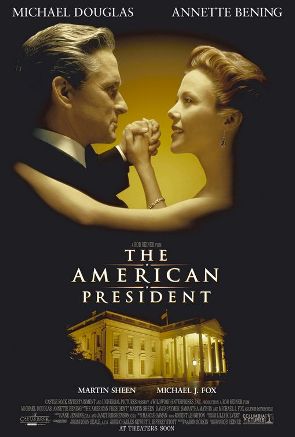
The_American_President_(movie_poster)

Way back in October, around the same time that I first decided that I would do a series of reviews of political films and that I would call it Lisa Gets Preachy (subsequently changed to Shattered Politics), I noticed that the 1995 film The American President was scheduled to be shown on TVLand.

“Hey,” I said, “I’ve definitely got to watch and review that!”

So, I set the DVR and I recorded The American President.

And then, I just left it there.

You have to understand that it’s rare that I ever leave anything unwatched on my DVR.  Usually, within an hour of recording a program, I’ll be watching it.  I have even been known to go so far as to make out very long lists of everything that I have on the DVR, just so I can make check them off after I’ve watched.  As a general rule, I am way too obsessive compulsive to just leave anything sitting around.

But, for whatever reason, I could never work up any enthusiasm for the prospect of actually watching The American President.  I knew that, eventually, I would have to watch it so that I could review it.  Unlike those folks criticizing American Sniper on the basis of the film’s trailer, I never criticize or praise a film unless I’ve actually watched it.  But  I just couldn’t get excited about The American President.

Can you guess why?  I’ll give you a hint.  It’s two words.  The first starts with A.  The second starts with S.

If you guessed Aaron Sorkin, then you are correct!  Yes, I do know that Sorkin has a lot of admirers.  And, even more importantly, I know that it’s dangerous to cross some of those admirers.  (I can still remember Ryan Adams and Sasha Stone insanely blocking anyone who dared to criticize the underwritten female characters in Sorkin’s script for The Social Network.)

But what can I say?  As a writer, Aaron Sorkin bothers me.  And since Sorkin is such an overpraised and powerful voice, he’s that rare scriptwriter who can actually claim auteur status.  The Social Network, for instance, was not a David Fincher film.  It was an Aaron Sorkin film, through and through.

And, after having to deal with three seasons of the Newroom and countless Aaron Sorkin-penned op-eds about why nobody should be allowed to criticize Aaron Sorkin, I’ve reached the point where dealing with all of Aaron Sorkin’s signature quirks is a bit like listening to the drill while strapped into a dentist’s chair.  I am weary of pompous and egotistical male heroes who answer every question with a sermon.  I am tired to endless scenes of male bonding.  I have had enough with the quippy, quickly-delivered dialogue, all recited as characters walk down an endless hallways.  I have no more sympathy for Sorkin’s nostalgic idealism or his condescending, rich, white dude version of liberalism.

Most of all, I’m sick of people making excuses for an acclaimed, award-winning, highly-paid screenwriter who is apparently incapable of writing strong female characters.  I’m tired of pretending that it doesn’t matter that Aaron Sorkin is apparently incapable of viewing female characters as being anything other than potential love interests or silly distractions who need to be told to go stand in a corner while the menfolk solve all the problems of the world.

Fortunately, as a result of The Newsroom, quite a few critics are finally starting to admit what they always knew to be the truth.  Aaron Sorkin is not the messiah.  Instead, he’s a somewhat talented writer who doesn’t understand (or, in my opinion, particularly like) women.  At his best, he’s occasionally entertaining.  At his worst, he’s pompous, didactic, and preachy.

And, of course, Aaron Sorkin is the man who wrote The American President.

So, The American President just sat there until a few days ago when I sighed to myself and said, “Okay, let’s watch this thing.”  As I watched it, I promised myself that I would try to see past the fact that it was an Aaron Sorkin-penned film and just try to judge the film on its merits.

But here’s the thing.  It’s nearly impossible to separate one’s opinion of Sorkin from The American President.  If you didn’t know that Sorkin had written The American President, you’d guess it after hearing the first few lines of dialogue.  The film, itself, was directed by Rob Reiner but it’s not as if Reiner is the most interesting of directors.  (What’s odd is that Reiner’s first films — This Is Spinal Tap, The Princess Bride, Stand By Me — are all so quirky and interesting and are still so watchable decades after first being released that you have to wonder how Reiner eventually became the man who directed The Bucket List.)  In short, The American President is totally an Aaron Sorkin film.

President Andrew Shepherd (Michael Douglas) is a liberal Democrat who, as he prepares to run for a second term, has a 63% approval rating.  However, when Shepherd decides to push through a gun control bill, he finds that approval rating threatened.  And then, when he listens to environmental lobbyist Sydney Wade (Annette Bening) and tries to push through legislation to reduce carbon emissions, his approval rating is again threatened.  And then, to top it all off, he starts dating Sydney.  It turns out that Sydney has protested American policy in the past.  And, since this is an Aaron Sorkin film, everyone outside of the Northeast is scandalized that President Shepherd is having premarital sex in the White House.

And, to top it all off, there’s an evil Republican named Bob Rumson (Richard Dreyfuss) who wants to be President and is willing to use the President’s relationship with Sydney to further his own evil Republican ambitions.

But, ultimately, it’s not just those evil Republicans who make it difficult for Sydney and the President to have a relationship.  It’s also the fact that the President agrees to a watered down crime bill and that he does not hold up his end of the bargain when it comes to reducing carbon emissions.

“You’ve lost my vote!” Sydney tells him.

But — fear not!  There’s still time for President Shepherd to give a speech that will be so good and so brilliant that it will, within a matter of minutes, totally change every aspect of American culture and save the day.  How do we know it’s a great speech?  Because it was written by Aaron Sorkin!

Actually, I’m being too hard on the film and I’ll be the first admit that it’s because I’m personally not a huge fan of Aaron Sorkin’s.  But, to be honest, The American President is Aaron Sorkin-lite.  This film was written before the West Wing, before the Social Network, before that Studio Whatever show, and before The Newsroom.  In short, it was written before he became THE Aaron Sorkin and, as such, it’s actually a lot less preachy than some of his other work.  It’s true that, much like The Newsroom, The American President is definitely Sorkin’s fantasy of how things should work but at least you don’t have to deal with Jeff Daniels throwing stuff or Emily Mortimer not knowing how to properly forward an email.

Instead, it’s a film that will probably be enjoyed by those who share its politics.  (And, make no mistake, The American President is more interested in politics than it is in the love story between Andrew and Sydney.)  Michael Douglas does well in the role of the President.  Meanwhile, Annette Bening is so likable and natural as Sydney that it almost make up for the fact that she’s yet another Sorkin woman whose existence is largely defined by looking up to her man while inspiring him to do the right thing and forgiving him when he doesn’t.  Personally, I would have been happy if the film had ended with Sydney telling the President, “Thanks for finally doing the right thing but I have a life of my own to lead.”

But that wouldn’t be the Sorkin way.

Back to School #13: American Graffiti (dir by George Lucas)


Well, this is certainly intimidating.  I know I’ve said this many time before but it deserves to be repeated: it’s often a hundred times more difficult to review a great film than it is to review a merely mediocre one.  When a film fails, it’s usually easy to say why.  The acting was bad.  The directing was uninspired.  The plot didn’t make any sense.  Or maybe the film has been so overpraised that you, as a reviewer, are almost obligated to be tougher on it than you would be with any other film.  However, it’s never as easy to put into words just what exactlyit is that makes a movie great.

Take the 1973 Best Picture nominee American Graffiti for instance.  I could tell you that this is a very well-acted film and that it features an ensemble of very likable performers, many of whom subsequently went on to become stars and celebrated character actors.  Then again, you can say the same thing about countless other films.

american-graffiti-1973-03-g

I could say that director George Lucas does such a good job putting this film together that it’s hard to believe that he’s the same man who would later be responsible for all three of the Star Wars prequels.  Then again, I could also say the same thing about how odd it is that the same man who directed the entertaining Final Destination 5 was also responsible for the far less enthralling Into The Storm.

i007737

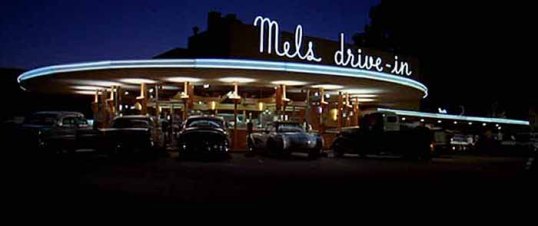
I could tell you that the film serves as a valuable time capsule in that not only does it feature a loving recreation of small town America in the early 60s but that it’s also a chance to see what Richard Dreyfuss, Ron Howard, and Charles Martin Smith all looked like when they still had hair.  But then again, I also praised The Young Graduates for being a time capsule as well.

MelsGraffiti

Let’s face it — it’s difficult to define the intangible qualities that make a film great.  Often times, it’s a case of simply knowing it when you see it.  I’ve seen American Graffiti a few times.  The last time I saw it was at a special Sunday showing at the Alamo Drafthouse.  And, on that early Sunday afternoon, the theater was packed with people who had paid for the chance to see the 40 year-old film on the big screen.  I’m 28 years old and it’s significant that, while the majority of the audience was older than me, there were quite a few people who were younger.  American Graffiti is one of those films that obviously spoke to audiences when it was first released and continues to speak to audiences today.

As I mentioned in my review of Rebel Without A Cause, films about teens tend to age quickly and, often times, one generation’s masterpiece will turn out to be a later generation’s joke.  When a film like Rebel or American Graffiti survives the test of time, it’s because the film has managed to capture a universal truth about what it means to be young and to have your entire life ahead of you.

American Graffiti takes place over the course of one long night in Modesto, California in 1962.  The film follows several different characters, the majority of whom have just graduated from high school.  What these characters all have in common is that one phase of their life has ended and a new one is about to begin.  Over the course of that one night, all of them are forced to say goodbye to their past identities and, in some instances, are forced to face their future.

Curt and the Pharoahs

For instance, there’s Curt (an amazingly young Richard Dreyfuss), a neurotic intellectual who spends the night trying to decide whether or not he actually wants to leave for college in the morning.  Complicating Curt’s decision is a mysterious blonde who mouths “I love you” at him before driving away.  While searching for her, Curt finds himself unwillingly recruited into the Pharoahs, a somewhat ludicrous small town gang that’s led by Joe (played, in hilariously clueless fashion, by Bo Hopkins.)  Curt, incidentally, is my favorite character in the film.  He’s just adorable, which admittedly is not a reaction that one often has to Richard Dreyfuss.

(Curt is also featured in one of my favorite scenes, in which he smokes a cigarette with a lecherous teacher named Mr. Wolf.)

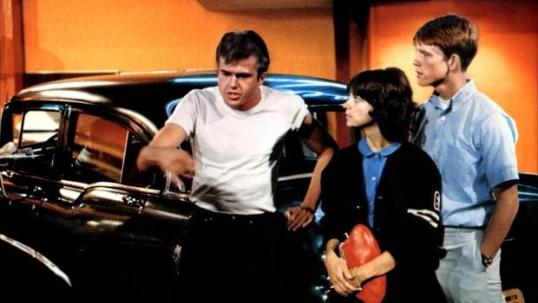
Cindy Williams, Ron Howard, and Charles Martin Smith

Curt’s sister (Cindy Williams) is dating Steve Bolander (Ron Howard).  Steve is the former class president and, unlike Curt, he’s very excited about leaving home.  Ron Howard gives such a likable performance that it actually takes a few viewing to realize just how big of a jerk Steve really is.

Terry and Debbie


And then there Terry (Charles Martin Smith) who wears big glasses and has bad skin.  Terry gets to spend the night driving around in Steve’s car and manages to pick up a girl named Debbie (Candy Clark).  For Terry, this is his night to actually be somebody and what makes it all the more poignant is just how obvious it is that Terry will probably never get another chance.  Though he may not realize it, those of us watching understand that this is literally going to the be the best night of Terry’s life.

(Incidentally, much like Ron Howard, Charles Martin Smith would go on to become a film director and gave the world the amazingly sweet Dolphin Tale.)

John Milner

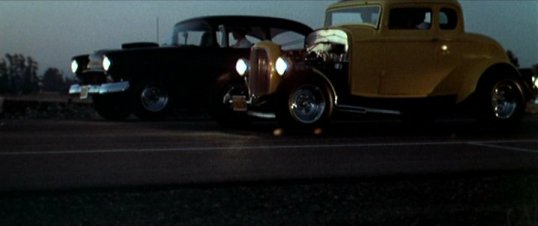
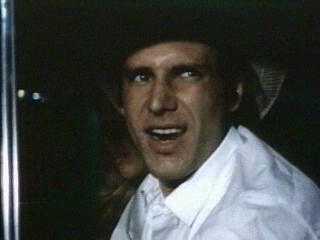
And finally, there’s John Milner (Paul Le Mat).  John is a little older than the other main characters.  He spends most of his time in his car, driving around and getting challenged to race.  He’s the epitome of late 50s/early 60s cool, with an attitude and a look that he obviously borrowed from James Dean and Marlon Brando.  Over the course of the night, he is forced to deal with a bratty 13 year-old stowaway (MacKenzie Phillips) and a mysterious challenger named Bob Falfa (played by a youngish Harrison Ford, who wears a cowboy hat and speaks with a country twang).

Harrison Ford in American Graffiti

The film follows these characters through the night and then, at the end of it, we get the famous epilogue where we discover that all of the male characters have pretty much ended up exactly how we thought they would.  In some cases, that’s a good thing.  And in other cases, it’s not.  It’s a good ending that’s kept from being great by the fact that none of the film’s female characters rate so much as even a mention.

So, what else can be said about American Graffiti?

It’s a great film.

Isn’t that enough?

American Graffiti

A Quickie With Lisa Marie: Red (dir. by Robert Schwentke)


Red (which I saw at the dollar theater this previous Monday) is a lot like the boy who took you to Homecoming: likable, occasionally enjoyable, but ultimately rather forgettable.  It’s a movie that you enjoy for what it is but, at the same time, it’s hardly a film I could ever imagine watching twice.  I never went out with Taylor again after Homecoming either. 

Anyway, the movie itself is about a retired CIA agent (Bruce Willis) who spends all of his time flirting on the phone with Sarah (Mary Louise Parker) who works for the company that sends Willis his pension checks.  (Willis always rips the checks up so he’ll have an excuse to call Parker.)  As the Christmas season approaches, Willis is paid a visit by a bunch of men dressed in black who proceed to blow up his house.  Willis escapes death, kidnaps Parker (under the pretense that her life is in danger because of how much they talk but mostly just so he can date her), and sets about getting all of his fellow retired spies (Morgan Freeman, John Malkovich, and Helen Mirren) together.  Meanwhile, a determined, young, and hot CIA agent (Karl Urban) has been assigned to track Willis down and kill him.

The plot is really pretty standard but director Robert Schwentke keep things interesting by both playing up and acknowledging just how ludicrous the standard action movie is.  If nothing else, this is a film that respect its audience.  It undesrstand that we understand that we’re watching an action movie and it assumes that we’ve seen enough action movies that we know how the genre is supposed to work.  And while Schwentke pulls off all of the standard action moves like a pro, what makes the movie memorable are the small moments where he plays with and subverts our expectations. 

He’s helped by his cast, a solid group of professionals who could play these roles in their sleep but yet, to their credit, still appear to invest themselves in the film.  All of the performers make strong individual impressions yet still manage to gel perfectly as an ensemble.  As opposed to most films of this sort, you really believe that these characters are old friends and that they do have a shared history.  One of the film’s main strengths comes from observing how all the different characters respond to each other — nobody has the exact same reaction.  This is kind of what Sylvester Stallone tried to pull off with The Expendables.  The difference here, I suppose, is that Red features John Malkovich, Morgan Freeman, Helen Mirren, and Bruce Willis while Stallone had to work with Jason Stathan and Terry Crewes.

Among the cast, Malkovich is probably the real crowd pleaser as a former MK-Ultra experiment.  He is convincingly insane in his role and he gets almost all of the film’s best one liners.  He also has a scene where he deflects an incoming rocket in a way that made the audience cheer.  However, for me, the best part of the film was the unexpected chemistry between Parker and Willis.  Through all of the action sequences and self-referential humor, you really do hope they end up together.

That said, there’s still something missing from the film.  It never quite goes as far as you would like in embracing the inherent absurdity of the action genre and, after a strong start, the film does have some trouble maintaining its frantic pace.  Add to that, Richard Dreyfuss shows up and and throws the whole ensemble out of whack by attempting to chew any piece of scenery he can get his teeth on.  Still, for what it is, Red is an enjoyable little movie and sometimes, that’s enough.

A Quickie With Lisa Marie: I Knew It Was You: Rediscovering John Cazale (dir. by Richard Shepard)


Despite only appearing in 5 films and dying 8 years before I was born, John Cazale is one of my favorite actors.  You might not recognize his name but, if you love the films of the 70s, you know who John Cazale is because he appeared in some of the most iconic films of the decade.  Though he’s probably best known for playing poor Fredo in first two Godfather films, Cazale also appeared in The Conversation, Dog Day Afternoon, and The Deer Hunter.  All five of his films were Oscar-nominated for best picture and three of them won.  All five are, in their own individual ways, classics of modern cinema and, though he was never more than a supporting player, Cazale gave performances of such unexpected emotional depth that he elevated each of these films just by his very presence.  Tragically, Cazale died at the age of 42 of lung cancer.  At the time, he had just finished filming The Deer Hunter and he was engaged to marry an up-and-coming actress named Meryl Streep.

I Knew It Was You is a documentary that both attempts to tell the story of Cazale’s life as well as pay tribute to him an actor.  While it fails somewhat to do the former, it succeeds flawlessly as a tribute.  The film is filled with footage of Cazale’s legendary performances and watching these clips, you’re struck by not only Cazale’s talent but his courage as well.  As more than one person comments during the documentary, it takes a lot of guts to so completely inhabit a role like The Godfather’s Fredo Corleone.  While other actors might be tempted to overplay a character like Fredo (essentially winking at the audience as if to say, “I’m not a weakling like this guy,”) Cazale was willing to completely inhabit his characters, brining to life both the good and the bad of their personalities.  Watching the clips, you realize that Cazale, as an actor, really was becoming stronger and stronger with each performance.  On a sadder note, this documentary make it  painfully obvious just how sick Cazale was in The Deer Hunter.  The contrast between the nervous, lumbering Cazale of Dog Day Hunter and his gaunt, unbearably sad appearance in The Deer Hunter is simply heart breaking.

The documentary is full of interviews with actors and directors who either worked with or were inspired by John Cazale and you’re immediately struck by the affection that they all still obviously feel for him even 30 years after his death.  Among those interviewed are Steve Buscemi, Al Pacino, Meryl Streep, Robert De Niro, Francis Ford Coppola, Sidney Lumet, Sam Rockwell, and Richard Dreyfuss.  (I thought I knew every bit of Godfather trivia but I learned something new from this film when I found out that Richard Dreyfuss came close to being Fredo before Coppola saw Cazale in a play.)   Perhaps most interesting are the interviews where actors like Pacino, De Niro, and Gene Hackman talk about how acting opposite John Cazale caused them to give better performances than they might have otherwise.  If nothing else, it’s a good reminder that a classic film is, more often than not, a collaborative effort.

Where this documentary drops the ball is in detailing who Cazale was as a person.  Though everyone’s affection for him is obvious, we learn little about what drove the man who was so sad and tragic as Fredo Corleone.  Cazale’s upbringing is covered in about 2 minutes of flashy graphics and his untimely death (and his struggle to complete his Deer Hunter role) is also covered a bit too quickly.  There’s a fascinating and inspiring story there but this documentary only hints at it.  For reasons I still can’t figure out, this thing only lasts 40 minutes.  Even just an extra 15 minutes would have been helpful.

Hollywood director Brett Ratner is also interviewed and I imagine this probably has something to do with the fact that Ratner co-produced this documentary.  So, I guess Ratner is a Cazale fan and good for him but it’s still kinda jarring to see him there with directors like Lumet and actors like Pacino and De Niro.  Ratner, to be honest, is the only one of the people interviewed who actually comes across as having nothing of value to say.  Which isn’t all that surprising when you consider that Ratner is pretty much the golden child of bland, mainstream filmmaking right now.

Still, even if it never reaches the heights of Werner’s Herzog’s My Best Fiend, I still have to recommend I Knew It Was You as a touching tribute to a truly great actor.  As a bonus, the DVD contains two short films featuring a very young and intense John Cazale.  Watching him, you can’t help but mourn that he wasn’t in more movies but you’re so thankful for the legendary performances that he was able to give us.

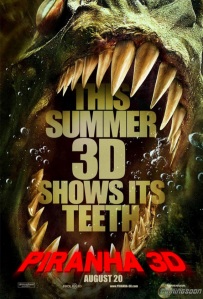
Review: Piranha 3-D (directed by Alexandre Aja)


Yesterday, I had two concerns about going to see the new horror film, Piranha 3-D.

First off, I know that 3-D has been hailed as “the future of movies” and that apparently, Webster’s is considering whether to recognize 3Dgasm (which is the response that certain film goers have to 3-D regardless of whether the movie itself is actually good or if it’s just Avatar) for inclusion in the next edition of the dictionary.  However, 3-D often makes me sick to my stomach and I mean that literally.  3-D makes me feel car sick.  Considering that I love movies, if 3-D is the “future” than I’m probably being punished for something.  That’s right.  Avatar was just a result of my bad karma. 

As for the second concern, I can’t swim and I am terrified of being underwater.  Hanging onto the edge while wading in the shallow side of my uncle’s swimming pool is about as submerged as I can get without having a major freak out.  It’s not just drowning that scares me.   When I was 17, my family spent the summer in Hawaii and my sisters (being the meanies that they are) had a lot of fun with the fact that I’d spend hours lying out on the beach but I refused to even step into the ocean.  It made sense to me.  There were jellyfish and sharks and those weird little black coil things just floating around in the ocean.  Thanks to seeing Piranha 3-D, I now know that there are also cute little fish that will eat you.

I dealt with my fear of the water by asking my sister Erin (who can actually swim because she’s cool and I’m not) to see the movie with me and to keep me calm if I started to have a panic attack.  She agreed and she did an admirable job.  She also helped me deal with my fear of 3-D when, during the coming attractions, she said, “Why don’t you take a Dramamine?”  Now, according to Erin, the only reason she said this was because apparently I was “going on and on” about it.  That’s not how I remember it but I just happened to have some Dramamine in my purse and I quickly popped a few.

If you’ve ever taken Dramamine then you know the way that it works is by basically kicking your ass until you pass out for a few hours.  (I occasionally resort to using it whenever I’m getting hit with insomnia.)  Within minutes of taking it, the Dramamine was saying, “Sleep, Lisa…”  “But I want to see the movie,” I replied.  “That wasn’t a request,” the pill responded.  “Dammit, will you two shut up!?” Erin snapped.  (That may have not actually happened.) 

The point of all this is that I stayed awake through the entire movie, despite having taken the most powerful sleeping pill in existence.  True, my mind did go a little bit goofy (Erin says I was “babbling” through the entire film) but it never shut down.  That’s the type of movie Piranha 3-D is.  The story moves so quickly and the mayhem is so over-the-top and excessive that the brain never gets a chance to relax enough to check out.

Piranha 3-D begins with an earthquake in Arizona.  The earthquake opens up a passageway to an underground lake.  As look would have it, the underground lake is full of a bunch of prehistoric piranha.  These piranha quickly move up to an above-ground lake where they promptly eat Richard Dreyfuss.  Having gotten a taste of Dreyfuss, they apparently decide to eat every other human being they come across and who can blame them?

Actually, the bloody and graphic demise of Richard Dreyfuss was the first clue I had that this film was going to work.  Needless to say, Dreyfuss is the last surviving star of the original killer fish movie, Jaws.  In Jaws, Dreyfuss is plays a character named Matt Hooper.  In Piranha, he’s just named Matt.  By introducing him and then promptly killing him off, Piranha lets us know that it understands the legacy of previous horror blockbusters (like Jaws) but that it has no intention of respecting it.  In other words, this scene lets us know early on that the film is on the side of the fish.

Anyway, it turns out that its spring break and as a result, Lake Victoria, Arizona is full of stupid, drunken college students who are determined to hang out in the water no matter how many people get eaten.  Sheriff Julie Forrester (Elisabeth Shue) struggles to maintain order on the streets with the help of her loyal deputy (a very likeable Ving Rhames).  Julie is also a single mother and, the morning after ol’ Richard Dreyfuss gets devoured, her oldest son Jake (Steven R. McQueen, grandson of the star of Enemy of the People) blows off his baby-sitting duties and agrees to help sleazy Derrick Jones (Jerry O’Connell) film the latest installment of Girls Gone Wild on the lake.  Sleazy, speedo-clad Derrick (and the fact that O’Connell looks really good in it doesn’t make that red speedo any less ludicrous) attempts to initiate Kelly (Jessica Szhor), the “good” girl who Jake likes into the world of straight-to-video, jailbait porn.  Kelly, by the way, kinda has a boyfriend, a guy named Todd who will eventually end up killing a lot of people with a motorboat.  Even before this, we know he’s a bad guy because he’s named Todd.  Nobody named Todd or Tad is ever good in a horror movie.

Director Alexandre Aja doesn’t take much time introducing his cast of characters and he takes even less time in letting the fish devour them.  So, no, the characters aren’t exactly all that developed.  But it doesn’t matter really.  With what little they have to work with, the cast works wonders.  They know exactly what type of film that they’re in and they know why they are there and they embrace their roles as piranha fodder with an impressive sense of commitment.  Best of all is O’Connell who turns sleazy, coke-fueled egomania into some sort of art form.

The real star of the film, of course, is director Alexandra Aja who takes a mainstream genre piece and who, much like his fellow French director, Jean Rollin, transforms it into a piece of pure grindhouse exploitation.  Aja may use the clichés of the genre but he never blindly embraces them.  Instead, he uses them to comment on both the genre and the audiences expectations of what those cliches mean.  Aja takes everything we’ve come to expect — the blood and gore, the standard plot device of Shue’s children being stranded out on the lake, and the sudden death of nameless extras — and he then pushes them just a little further than the audience is expecting,  As a result, he not only comments on those expectations but he forces the audience to question them as well.

This is never more apparent than in the film’s climatic piranha attack.  This is when the piranha finally get around to attacking all of the swimmers at once.  This is the scene that we all know is coming and that we’ve all been expecting and Aja does not disappoint.  Things start out as you might expect.  Close-up of bikinis.  Drunk idiots in the water.  A wet t-shirt contest.  Rhamas and Shue come up in a boat and start yelling, “Everybody out of the water!”  Because they’re a bunch of drunk dumbfugs, everyone responds by jumping into the water.  Cut to an ominous piranha point-of-view shot.  Suddenly, one woman — floating out in an inntertube — shouts, “Something bit me!”  And suddenly, all Hell breaks loose.

This is the scene you knew was coming and you’ve seen it a hundred times before.  What makes it memorable here is just how far director Aja takes things.  These fish don’t just bite their victims.  They literally devour them while the camera lingers over every piece of flesh that floats through the ocean.  As everyone struggles to get out of the water, they get their skulls split open by passing boats.  In the background, we see various feet, hands, and other body parts randomly floating in the water.  One older man pulls his friend’s torso onto the beach and cradles it while screaming, “I love you, man!  I love you!”  As Shue tries to pull people out of the water, we see a teenager that’s already on the boat start to shake as his life expires.  As I mentioned before, Todd tries to escape by forcing his motorboat through the crowd of terrified swimmers and graphically dismembers a lot of people in the process.  It’s an incredibly graphic sequence, one that starts out as fun but which just keeps going and going,  Director Aja understands that the audiences is expecting — probably even looking forward to — seeing a little blood.  So, instead he assaults us with a lot of blood and he does so in such a way that the audience is forced to question why a little blood is fun but a lot of blood is disturbing.  It’s as if Aja is saying, “You wanted to see people die, well — here they are, dead.  You feel better now?”

As for the 3-D, Aja proves himself to be one of the few filmmakers to understand that 3-D is not the future of movies.  It’s just another gimmick to be exploited and exploit it he does.  However, he does so brilliantly and he is so shameless about it that watching Piranha 3-D simply serves to reiterate just how silly the whole 3-D craze really is.  Every short is a tracking shot.  The CGI piranha float across the screen, stopping momentarily to stare straight out at the audience and almost wink.  The men in the audience seemed to be especially happy about all the boobs that literally seem to swing out of the screen and across the theater but they were a bit less enthused when a disembodied penis came floating out of the screen.  By not only fully embracing the ludicrous possibilities of 3-D but by also doing so without any shamefaced attempts to justify its use, Piranha 3-D is perhaps the greatest 3-D movie ever made.