Retro Television Reviews: The Love Boat 2.8 “A Time for Everything / The Song Is Ended / Accidental Cruise / Anoushka”


Welcome to Retro Television Reviews, a feature where we review some of our favorite and least favorite shows of the past!  On Wednesdays, I will be reviewing the original Love Boat, which aired on ABC from 1977 to 1986!  The series can be streamed on Paramount Plus!

This week, hearts are broken on a special 90-minute episode of The Love Boat!

Episode 2.8 “A Time for Everything / The Song Is Ended / Accidental Cruise / Anoushka”

(Dir by Roger Duchowny, originally aired on November 4th, 1978)

What a sad episode!

Seriously, this cruise is all about heart break.

For instance, when Russian Commissar  Anoushka Mishancov (Loretta Swit) first boards the boat, Doc Bricker is upset when he’s assigned to keep an eye on her.  As has been established over the previous 32 episodes, Doc prefers to spend his time talking to women who are about twenty years younger than him and who are from capitalist countries.  Anoushka, on the other hand, is a communist (boo!) who, for some reason, is boarding the Pacific Princess so that she can learn about how Americans handle catering.  (I said it was weird.)  At first, Anoushka is so determined to do her duty that she insists on wearing her uniform at all times.

However, after Anoushka reveals that she does find old Doc Bricker to be a little bit intriguing, Julie tells her that she’s going to have to loosen up if she’s going to capture Doc’s attention.  Which, Anoushka does at dinner that night….
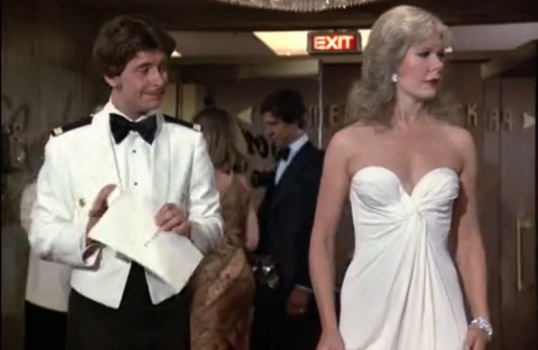
Eyes up, Gopher!

Doc does notice Anoushka.  In fact, he falls in love with her and, at the end of the cruise, he asks her to marry him!  Anoushka confesses to having fallen in love with Doc but then she explains that she also loves her country.  (Really?  It’s just Russia.)  Doc loves America and Anoushka loves Russia and, as a result, they cannot marry.  Anouska leaves the ship and a heart-broken Doc looks like he’s actually about to cry.  And let’s give credit where credit is due.  It’s a really well-acted scene.  Doc Bricker has always been a fairly ludicrous character but, in this episode, Bernie Kopell does a good job of suggesting that, even if he is a lecher, Doc Bricker is a lecher with a heart.

While Doc is falling in love with a commie, Captain Stubing is getting to know Vicki (Jill Whelan), the 9 year-old daughter of Captain Stubing’s former lover, the late Georgina (played, in flashbacks, by Melendy Britt).  Vicki was originally supposed to travel with her aunt, Delores (Sandra Deel).  However, something has come up and Delores will not be able to travel with her.  Captain Stubing agrees to look after Vicki and even allows Vicki to stay in his quarters.  Over the course of the cruise, Captain Stubing and Vicki bond.  Everyone agrees that they have the same eyes.  Of course, that’s because Vicki is actually Captain Stubing’s daughter!

Vicki wants to live on the ship but the Captain explains that a cruise ship is not a good place for a nine year-old to grow up.  Stubing considers retiring and living on dry land but Doc Bricker reminds Stubing that he would never be happy if he wasn’t on the ocean.  Stubing promises that Vicki can return to the boat whenever she has time off from school and he tells her that, when she gets older, she could even “be a cruise director, like Ms. McCoy.”

(In other words, don’t even think of trying to become a captain, girl!)

Now, of course, Vicki did later return to the ship.  In fact, she returned just a year later and became a regular during the third season.  I guess Captain Stubing decided that going to school on dry land wasn’t that important after all.  (We’ll find out when we reach the third season!)  That said, even with that in mind, it was undeniably sad to watch as Stubing sat in his cabin and struggled to hold back the tears after Vicki left the ship.  Much like Bernie Kopell, Gavin MacLeod gave a surprisingly heartfelt and sincere performance in this episode.

It wasn’t all sadness

Luckily, it wasn’t all heartbreak on this episode.  After getting drunk and boarding the boat by mistake, Sandy Beal (Jo Anne Worley) and Victor Marshall (Soupy Sales) fell in love for real.  And jingle writer Charlie Godwin (Robert Goulet) ran into his old song-writing partner (Richard Dawson) and the two of them saved Charlie’s marriage to June (Juliet Mills).  There were two happy endings but they were overshadowed by all the sadness.

This was a good episode.  Even The Love Boat needs a little heartbreak every once and a while.

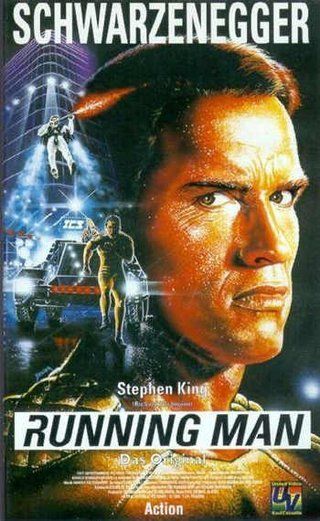
Guilty Pleasure No. 60: The Running Man (dir by Paul Michael Glaser)


“Killian, here’s your Subzero… now plain zero!”

Uhm, excuse me, Mr. Schwarzenegger, but a man just died.  He probably had a family who just watched you kill him on national television….

Oh well, it happens!  In the role of Ben Richards, Arnold Schwarzenegger kills quite a few people over the course of the 1987 film, The Running Man, but they were all bad.  In fact, when we first meet Ben Richards, he’s a cop who is trying to save lives.  His superiors want him to open fire on a bunch of protestors who simply want enough food to eat.  When Richards refuses to do it, he is framed for perpetrating “the Bakersfield Massacre” and is sent to prison.  When he is recaptured after escaping, he is given a chance to compete on America’s number one game show, The Running Man!  Hosted and produced by Damon Killian (Richard Dawson, oozing smarm in a performance that — in a fair world — would have received Oscar consideration), The Running Man is a show in which prisoners are given a chance to win prizes like a trial by jury or maybe even a pardon.  While the audience cheers and puts down bets, the prisoners are stalked by professional killers like Buzzsaw (Gus Rethwisch), Dynamo (Erland Van Lidth), Fireball (Jim Brown), and Sub-Zero (Professor Toru Tanaka).  Along with Killian, Captain Freedom (Jesse Ventura) provides commentary and analysis on how the game is going.  Ben soon finds himself joined by Amber (Maria Conchita Alonso), who proves herself to be just as tough as he is.

Seen today, The Running Man feels more than a bit prophetic.  Due to worldwide economic collapse, the poor are getting poorer while the rich are getting richer.  The American government has become both increasingly corporate and increasingly authoritarian.  The citizens are entertained and manipulated by “reality” programming.  On camera, Killian is a charismatic host who delivers his lines with faux sincerity and who loves to meet and give away prizes to the public.  (There’s something both undeniably creepy and also rather familiar about the way that Killian sniffs the hair, rubs the shoulders and holds the arms of the audience members to whom he’s speaking.  It’s all very calculated and one gets the feeling that Killian washes his hands as soon as the camera are off of him.)  Behind the scenes, he drinks, smokes, curses, and is full of contempt for everyone around him.  He may not be happy when Ben outsmarts and kills the show’s stalkers but he definitely cheers up when he hears how good the ratings are.  The film is set in 2017, which was 30 years in the future when The Running Man was first released.  Seen today, The Running Man’s 2017 feels a lot like our 2017….

That said, The Running Man is also a big, flamboyant, and undeniably entertaining film.  It’s also surprisingly funny, at times.  Living in a dystopia ahs turned everyone into a quip machine.  None of the bad guys die without Schwarzenegger making a joke about it.  (“Buzzsaw?  He had to split.”  Yes, he did.)  The show’s vapid studio audience, who go from cheering the prospect of witnessing a bloody death to crying when their favorite stalker is killed, is both disturbing and humorous.  (Also memorable is the faux somber dance number that is performed while the show memorializes all the dead stalkers.)  For all the costumed heroes and villains, the film is practically stolen by an older woman named Agnes who becomes Ben Richards’s favorite fan.  The gaming “quads” may be dark and dangerous and full of angry people but they’re also full of advertisements for Cadre Cola.  Dey Young of Rock and Roll High School and Strange Behavior fame has a cameo as Amy, who pays six dollars for a can of Cadre.  (That may seem like a lot for a can of anything but Cadre is the official cola of The Running Man!  Damon Killian endorses it!  And, of course, when The Running Man was produced, the studio was owned by Coca-Cola so the jokes about Cadre’s corporate dominance also serve as a “take that” towards the corporation who put up money for the film.  Either that or Cadre is stand-in for Pepsi.)

It’s easy to compare The Running Man to The Hunger Games films but The Running Man is infinitely more fun, if just because it doesn’t make the mistake of taking itself as seriously as The Hunger Games did.  (Add to that, The Running Man manages to wrap up its story in 90 minutes, whereas The Hunger Games needed four movies.)  Like The Hunger Game, The Running Man is based on a book, in this case a very loose adaptation of one of the pulpy novels that Stephen King wrote under the name of Richard Bachman.  While King said that he enjoyed the film, he also asked that his real name not be listed in the credits because the film had little in common with his book, which is fair enough.  The Running Man may have been inspired by a Stephen King novel but it’s an Arnold Schwarzenegger production through-and-through.

Previous Guilty Pleasures

  1. Half-Baked
  2. Save The Last Dance
  3. Every Rose Has Its Thorns
  4. The Jeremy Kyle Show
  5. Invasion USA
  6. The Golden Child
  7. Final Destination 2
  8. Paparazzi
  9. The Principal
  10. The Substitute
  11. Terror In The Family
  12. Pandorum
  13. Lambada
  14. Fear
  15. Cocktail
  16. Keep Off The Grass
  17. Girls, Girls, Girls
  18. Class
  19. Tart
  20. King Kong vs. Godzilla
  21. Hawk the Slayer
  22. Battle Beyond the Stars
  23. Meridian
  24. Walk of Shame
  25. From Justin To Kelly
  26. Project Greenlight
  27. Sex Decoy: Love Stings
  28. Swimfan
  29. On the Line
  30. Wolfen
  31. Hail Caesar!
  32. It’s So Cold In The D
  33. In the Mix
  34. Healed By Grace
  35. Valley of the Dolls
  36. The Legend of Billie Jean
  37. Death Wish
  38. Shipping Wars
  39. Ghost Whisperer
  40. Parking Wars
  41. The Dead Are After Me
  42. Harper’s Island
  43. The Resurrection of Gavin Stone
  44. Paranormal State
  45. Utopia
  46. Bar Rescue
  47. The Powers of Matthew Star
  48. Spiker
  49. Heavenly Bodies
  50. Maid in Manhattan
  51. Rage and Honor
  52. Saved By The Bell 3. 21 “No Hope With Dope”
  53. Happy Gilmore
  54. Solarbabies
  55. The Dawn of Correction
  56. Once You Understand
  57. The Voyeurs 
  58. Robot Jox
  59. Teen Wolf

Live Tweet Alert: Join #FridayNightFlix for The Running Man!


As some of our regular readers undoubtedly know, I am involved in a few weekly live tweets on twitter.  I host #FridayNightFlix every Friday, I co-host #ScarySocial on Saturday, and I am one of the five hosts of #MondayActionMovie!  Every week, we get together.  We watch a movie.  We tweet our way through it.

Tonight, at 10 pm et, I will be hosting the first #FridayNightFlix of 2022!  The movie? 1987’s The Running Man!

If you want to join us this Friday, just hop onto twitter, start the movie at 10 pm et, and use the #FridayNightFlix hashtag!  It’s a friendly group and welcoming of newcomers so don’t be shy.

The Running Man is available on Prime and Paramount!  See you there!

Retro Television Reviews: Fantasy Island 1.14 “Call Me Lucky/Torch Song”


Welcome to Retro Television Reviews, a feature where we review some of our favorite and least favorite shows of the past!  On Tuesdays, I will be reviewing the original Fantasy Island, which ran on ABC from 1977 to 1986.  The entire show is currently streaming on Tubi!

This week, the first season of Fantasy Island comes to a close!

Episode 1.14 “Call Me Lucky/Torch Song”

(Dir by Cliff Bole, originally aired on May 20th, 1978)

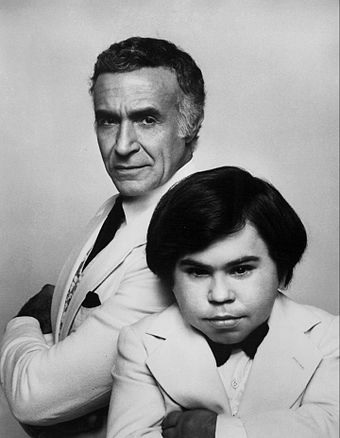
As always, this week’s episode of Fantasy Island brings us a collection of guest stars who have all flown to the island to have their fantasies granted.  However, none of these fantasies are quite as interesting as the rather bizarre relationship of Mr. Roarke and Tattoo.

I’ve often commented on the fact that, during the first season of this show, Mr. Roarke and Tattoo seemed to harbor a strong dislike for each other.  Tattoo was always complaining that Mr. Roarke wasn’t charging enough for the fantasies.  Mr. Roarke often chastised Tattoo for his attempts to hit on the guests.  Even though they were supposed to be good friends and business partners, nearly every episode seemed to end with Mr. Roarke getting rather exasperated with Tattoo.  Reportedly, Ricardo Montalban and Herve Villechaize did not get along off-screen and, as I’ve said before, it often seems like that dislike bled into their performances on the show.

This episode begins with Tattoo smoking a pipe and wearing a monocle.  As he explains to Mr. Roarke, he’s trying to be appear sophisticated so he can “get all the broads.”  He also says that he’s specifically trying to act like Mr. Roarke.  Now, I know enough about passive-aggressive behavior that I immediately realized that Tattoo’s compliment was basically his way of accusing Mr. Roarke of being a pompous jackass.  Mr. Roarke obviously figured it out as well because, a few scenes later, he takes a twenty dollar bill away from Tattoo and gives it to a guest on the island.  When Tattoo objects, Mr. Roarke suavely replies, “Finders keepers, losers weepers.”  At the end of the episode, when Tattoo gets his twenty back, Roarke promptly snatches it away from him.  It’s hard not to notice that, even with two fantasies to keep an eye on, Mr. Roarke’s main concern seems to be making sure that Tattoo doesn’t get anything that he wants.

As for the fantasies, the first one deals with Harry Beamish (Richard Dawson), a degenerate gambler who has lost his family due to his need to make bets and risk his cash.  Harry’s fantasy to be the luckiest guy in the world and, for a day or so, he is.  Every bet that he makes pays off.  Tattoo even starts to follow Harry around at the race track so that he can too can make money.  (Fantasy Island has a racetrack?)  But then Harry’s ten year-old son, Joey (Brad Savage), shows up.  It turns out that Joey’s fantasy is for his father and his mother to get back together.  (Mr, Roarke mentions that he only charged Joey $5 for the fantasy so Tattoo does have a point about Roarke not charging enough.)  When Harry realizes that Joey idolizes him and is planning on following in his footsteps, Harry realizes that it’s time to stop gambling and be a father.  Awwwwww!

The other fantasy deals with Edith Garvey (Kathryn Holcomb), whose fantasy is to go back to the 20s and become a torch singer.  Under the name of Kitty Abilene, she finds a good deal of success.  She also falls in love with her piano player, Neil (Edd Byrnes).  Unfortunately, two rival gangsters go to war over who owns her contract.  Edith’s fantasy ends at the exact moment that the local speakeasy is attacked by crime boss Big Al.  Fortunately, it turns out that Neil is also a guest on the island and that he was having a fantasy of his own.  Edith and Neil leave the island together.  Awwwwww!

The fantasies weren’t bad and, being the 20s loving history nerd that I am, I enjoyed the gangster action.  But, ultimately, it was the passive aggressive hostility between Mr. Roarke and Tattoo that made this episode memorable.  The first season ended with Roarke rolling his eyes at Tattoo.  Will their relationship improve during the second season?  We’ll find out next week!

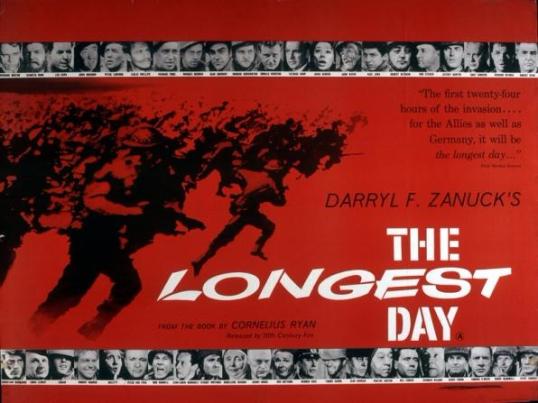
Lisa Reviews An Oscar Nominee: The Longest Day (dir by Ken Annakin, Andrew Marton, Bernhard Wicki, Gerd Oswald, and Darryl F. Zanuck)


As my sister has already pointed out, today is the 73rd anniversary of D-Day.  With that in mind, and as a part of my ongoing mission to see and review every single film ever nominated for best picture, I decided to watch the 1962 film, The Longest Day!

The Longest Day is a pain-staking and meticulous recreation of invasion of Normandy, much of it filmed on location.  It was reportedly something of a dream project for the head of the 20th Century Fox, Darryl F. Zanuck.  Zanuck set out to make both the ultimate tribute to the Allied forces and the greatest war movie ever.  Based on a best seller, The Longest Day has five credited screenwriters and three credited directors.  (Ken Annakin was credited with “British and French exteriors,” Andrew Marton did “American exteriors,” and the German scenes were credited to Bernhard Wicki.  Oddly, Gerd Oswald was not credited for his work on the parachuting scenes, even though those were some of the strongest scenes in the film.)  Even though he was not credited as either a screenwriter or a director, it is generally agreed that the film ultimately reflected the vision of Darryl F. Zanuck.  Zanuck not only rewrote the script but he also directed a few scenes as well.  The film had a budget of 7.75 million dollars, which was a huge amount in 1962.  (Until Steven Spielberg’s Schindler’s List, The Longest Day was the most expensive black-and-white film ever made.)  Not only did the film tell an epic story, but it also had an epic length.  Clocking in at 3 hours, The Longest Day was also one of the longest movies to ever be nominated for best picture.

The Longest Day also had an epic cast.  Zanuck assembled an all-star cast for his recreation of D-Day.  If you’re like me and you love watching old movies on TCM, you’ll see a lot of familiar faces go rushing by during the course of The Longest Day.  American generals were played by actors like Robert Mitchum, Robert Ryan, Henry Fonda, and John Wayne.  Peter Lawford, then the brother-in-law of the President of the United States, had a memorable role as the Scottish Lord Lovat, who marched through D-Day to the sounds of bagpipes.  When the Allied troops storm the beach, everyone from Roddy McDowall to Sal Mineo to Robert Wagner to singer Paul Anka can be seen dodging bullets.  Sean Connery pops up, speaking in his Scottish accent and providing comic relief.  When a group of paratroopers parachute into an occupied village, comedian Red Buttons ends up hanging from the steeple of a church.  When Richard Beymer (who is currently playing Ben Horne on Twin Peaks) gets separated from his squad, he stumbles across Richard Burton.  Among those representing the French are Arletty and Christian Marquand.  (Ironically, after World War II, Arletty was convicted of collaborating with the Germans and spent 18 months under house arrest.  Her crime was having a romantic relationship with a German soldier.  It is said that, in response to the charges, Arletty said, “My heart is French but my ass is international.”)  Meanwhile, among the Germans, one can find three future Bond villains: Gert Frobe, Curt Jurgens, and Walter Gotell.

It’s a big film and, to be honest, it’s too big.  It’s hard to keep track of everyone and, even though the battle scenes are probably about an intense as one could get away with in 1962 (though it’s nowhere near as effective as the famous opening of Saving Private Ryan, I still felt bad when Jeffrey Hunter and Eddie Albert were gunned down), their effectiveness is compromised by the film’s all-star approach.  Often times, the action threatens to come to a halt so that everyone can get their close-up.  Unfortunately, most of those famous faces don’t really get much of a chance to make an impression.  Even as the battle rages, you keep getting distracted by questions like, “Was that guy famous or was he just an extra?”

Among the big stars, most of them play to their personas.  John Wayne, for instance, may have been cast as General Benjamin Vandervoort but there’s never any doubt that he’s playing John Wayne.  When he tells his troops to “send them to Hell,” it’s not Vandervoort giving orders.  It’s John Wayne representing America.  Henry Fonda may be identified as being General Theodore Roosevelt II but, ultimately, you react to him because he’s Henry Fonda, a symbol of middle-American decency.  Neither Wayne nor Fonda gives a bad performance but you never forget that you’re watching Fonda and Wayne.

Throughout this huge film, there are bits and pieces that work so well that you wish the film had just concentrated on them as opposed to trying to tell every single story that occurred during D-Day.  I liked Robert Mitchum as a tough but caring general who, in the midst of battle, gives a speech that inspires his troops to keep fighting.  The scenes of Peter Lawford marching with a bagpiper at his side were nicely surreal.  Finally, there’s Richard Beymer, wandering around the French countryside and going through the entire day without firing his gun once.  Beymer gets the best line of the film when he says, “I wonder if we won.”  It’s such a modest line but it’s probably the most powerful line in the film.  I wish The Longest Day had more scenes like that.

The Longest Day was nominated for best picture of 1962 but it lost to an even longer film, Lawrence of Arabia.