The TSL’s Horror Grindhouse: Bait (dir by Kimble Rendall)


What happens when you take The Mist and combine it with Jaws?

Well, you’d probably end up with a movie that’s a lot more interesting than 2012’s Bait.

Bait opens in an Australian supermarket and it’s nice to see that supermarkets in other countries are just as bad as supermarkets in America.  Two teenagers make out in the underground parking garage.  A former lifeguard stocks the shelves.  (The lifeguard, incidentally, was previously traumatized when he saw a friend of his eaten by a shark.)  The sister of that friend who got eaten by a shark shops with her new boyfriend.  The store manager gives people orders.  Two masked men try to rob the place, which leads to shoot out with the police.  It’s just a typical day!

Until, of course, the tsunami hits!

Now, on the one hand, the tsunami hit at the perfect time because it kept the masked men from shooting anyone else.  On the other hand, the tsunami hit at absolutely the worst time because apparently, sharks can survive anything.  Not only is the supermarket flooded but now, there is now a giant shark swimming through the aisles!

Our survivors all scramble to the top of the aisles, where they find themselves stranded.  Not only is the water shark-infested but there is also the risk of being electrocuted by broken wires!  The survivors are going to have to set aside their differences and work together if they’re going to escape the deluge of sharks and bad feelings!

Of course, if you know anything about these type of movies, you know that a group of people can never set aside their differences and work together until at least a handful of them have been eaten.  At one point, our survivors attempt to escape by building a makeshift shark cage out of grocery carts.  That actually might not a bad idea but it just looks so silly!

Anyway, the main problem with Bait is that the film, much like the characters, has no place to go.  The idea of a shark invading a supermarket has potential but once everyone’s stranded on top of their aisles, the action slows down to a crawl and we spend way too much time listening to thinly drawn characters shout insults at each other.  The characters are trapped but, unfortunately, so is the audience.

I was actually far more interested in the couple that was stuck in the flooded parking garage.  Those scenes, of the two of them trying to figure out how to escape from their car, had a claustrophobic intensity that the scenes in the supermarket lacked.  Lincoln Lewis and Cariba Heine were fun to watch as they bickered with each other and debated who was more to blame for their predicament.  Perhaps because they were separated from all of the noisy drama in supermarket, Lewis and Heine actually seemed to be having fun with their roles.

Anyway, Bait is one of those films that tends to show up fairly regularly on the SyFy network.  It’s not a particularly good movie but it is a reminder that the cinematic legacy of Jaws will outlast us all.  To be honest, if the sharks ever get together and form some sort of anti-defamation league, the film industry is screwed.

Book Review: The Zero Factor by William Oscar Johnson


Consider this.

William Henry Harrison was elected President in 1840.  A few months later, he became the first President to die in office, the result of giving a rambling inauguration speech in the rain.

Abraham Lincoln was elected in 1860.  He was assassinated by an actor in 1865.

James A. Garfield was elected in 1880.  He was shot and subsequently died of medical malpractice in 1881.

William McKinley was reelected in 1900.  He was assassinated by a leftist in 1901.

Warren Harding was elected in 1920 and was murdered by his wife in 1923.

Franklin D. Roosevelt was reelected in 1940.  He died of natural causes in 1945.

John F. Kennedy was elected in 1960.  He was assassinated by a lone gunman in 1963.

The second President to die in office, Zachary Taylor, was elected in 1848 but died in 1850!  (In his case, he was either poisoned or died of natural causes.  It depends on which book you read.)

That is the Zero Curse.  For a period of 120 years, any president was elected in a zero year died before the end of his term.  Some people thought it was a coincidence.  Some people thought it was a supernatural occurrence.  Whatever it was, it was a strange piece of American history.

In fact, it even inspired a novel!  The Zero Factor was published in 1980, presumably to capitalize on that year’s presidential election.  The Zero Factor tells the story of Augustus “Gus” York, a Republican governor who is nominated for President after the convention deadlocks.  Gus is honest, homespun, and naive.  To everyone’s shock, Gus narrowly wins the election.

Gus is an ethical President whose moderate political stances manage to alienate every powerful person in the world.  Not surprisingly, a group of evil rich people hire an assassin to take out President York.  Will Gus be able to survive the zero factor!?

So, this may seem like a strange book to review for October and I’ll be the first to admit that I nearly scheduled this review for November.  However, the book does feature three rather odd scenes where Gus is haunted by the ghosts of the zero year presidents.  Those scenes are actually a lot of fun.  I especially liked the description of Franklin Roosevelt’s ghost rolling around the Presidential bedroom while his eyes glow a ghostly yellow.  Best of all, Gus gets advice from the ghost of my favorite scandalous president, Warren G. Harding!  Thanks to President Harding and the gang, The Zero Factor can be classified as a book for October.

As for the rest of the book, it’s a well-written political thriller.  At times, the book’s politics can be rather heavy-handed (why write about a Republican President if you’re just going to make him act like a Democrat?) and the portrayal of the gay assassin is dated and a bit cringe-inducing.  But Gus is a likable character and I appreciate any book that takes the time to rehabilitate Warren Harding.

As for the Zero Curse, it was broken by the President who actually was elected in 1980, Ronald Reagan.  George W. Bush continued to break it in 2000.  (That said, both Bush and Reagan were targeted by potential assassins during their presidencies.)  The next zero year election will be 2020, an election that looks like it’s going to involve a record number of elderly candidates.

Horror Film Review: Jaws 3 (dir by Joe Alves)


So, this is a strange one.

As the title states, this 1983 film is the third sequel to the Jaws.  As I pointed out in my reviews of the first film and Jaws 2, the first two films all starred Roy Scheider and took place on Amity Island.  In fact, it can be argued that Amity Island was almost as important to the success of the first two films as the shark.  When Martin Brody conquered his fears and got out on the water, it wasn’t just to destroy a shark.  It was also to protect a community under siege.

Well, there’s no such community like Amity Island in Jaws 3.  And there’s no Roy Scheider either.  Instead, our hero is Martin Brody’s son, Mike.  Mike is all grown up and working as the senior marine biologist at SeaWorld Orlando.  Mike is now played by a very young and very bearded Dennis Quaid.  This leads to an interesting situation where Mike — who grew up in New England and whose father was a former New York City cop — has a very pronounced Texas accent.  That’s not a complaint, of course.  I’m from Texas so I’m always happy to see (and hear) a fellow Texan in a movie.  Plus, Dennis Quaid’s a likable actor.  Still, it somehow seems appropriate that the third installment of the Jaws franchise would feature a New Yorker growing up to be a Texan.  I mean, if we’re going to accept that the same outlandish event can keep happening to the members of the same family then I guess anything’s possible.

The other Brody son, Sean, is also featured in the film.  Sean is now played by John Putch and, when he first shows up to visit Mike, he’s dressed like he just got off work at the rodeo.  You have to kind of wonder if maybe the trauma of nearly getting killed in Jaws 2 led to both of the Brody boys rejecting their New England roots and embracing the ways of the west.  Say what you will about Texas and all the states in between El Paso and Los Angeles, we’re pretty much shark free.

Anyway, this is a Jaws films so you can guess what happens.  A big shark ends up getting loose in SeaWorld and Mike tries to close the park down, just to be overruled by the park’s manger, Calvin Bouchard (Lou Gossett, Jr.).  Meanwhile, a hunter named Philip Fitzroyce (Simon MacCorkindale) announces that he will personally track down and kill the shark.  As you might guess just from the fact that his last name is Fitzroyce, Philip is arrogant and speaks with a posh accent.  Mike takes an immediate dislike to him but I was happy whenever Philip showed up, mostly because Simon MacCorkindale gave a performance that was so over-the-top that it was fun to watch.  Whenever MacCorkindale and Gossett got together in the same scene, the film stopped being about the shark and instead became a contest to see who could overenunciate their dialogue with the most style.

(In the end, MacCorkindale won, but only narrowly.  A few years after Jaws 3, Gossett would co-star in The Principal and would go on to secure his spot in the Overenunciation Hall Of Fame by pronouncing the word “drugs” in such a way that I first thought he was talking about druids.)

One of the reasons why Jaws 3 seems odd when watched today is because it was originally released in 3-D.  (In fact, the film’s original title was Jaws 3-D.)  As a result, there’s a lot of scenes of people either walking towards or pointing directly at the camera.  Whenever anyone holds up a pole or a harpoon or anything similar, you know that they’re going to end up pointing the end of it straight at the viewer.  At the start of the film, when the shark bites a fish in half, the fish’s head ominously floats closer and closer to the camera.  There’s a lot of scenes that were obviously designed to make audiences says, “Oh my God!  I feel like I could reach out and touch it!” but, in the non-3D version, those scenes are just weirdly paced and slightly out-of-focus.  (At one point during the film, the picture was so blurry that I actually checked to make sure I had my contacts in.)

Add to that, there’s more than few scenes where it’s obvious that the shark has been superimposed into the action.  If the first two Jaws films featured big sharks, Jaws 3 often seems to feature a cartoon shark.  In short, what may have been impressive in a theater in 1983 to an audience wearing special glasses is far less impressive when you’re watching the movie at 3 in the morning on AMC.

The other weird thing about this film is that it was actually filmed at SeaWorld Orlando.  I’m going to guess that the film was supposed to serve as a 99-minute advertisement and a lot of time is devoted to people talking about how much they love SeaWorld.  At the same time, this film also features the park’s manager refusing to shut down the park and basically putting everyone’s life in danger.  If anything, the film’s main message seems to be, “If you go to SeaWorld, you’ll die.”  You have to wonder if some executive lost his job after Jaws 3 came out.

Anyway, Jaws 3 is a silly movie that never quite comes to life in the way that both Jaws and, to a lesser extent, Jaws 2 did.  Yes, the shark’s ruthless and we get to hear the familiar music and there’s some cute dolphins but otherwise, the movie itself is just kind of bland.  Rumor has it that Jaws 3 was originally going to be a comedy called Jaws 3 People 0.  That probably would have made for a more memorable movie but, at the same time, I got some good laughs out of the scene where the tourists in an underwater tunnel realized that a shark was watching them so, in the end, everything worked out for the best.

Horror on the Lens: Plan 9 From Outer Space (dir by Ed Wood, Jr.)


Plan 9 from Outer Space (1959)

Watching Ed Wood’s infamous Plan 9 From Outer Space is something of an October tradition here at the Shattered Lens!  And you know how much I love tradition!

Some people say that this film has a reputation for being the worst film ever made.  Personally, I don’t think that it deserves that reputation.  Is it bad?  By traditional standards of quality, I guess it can be argued that Plan 9 From Outer Space is a bad movie.  But it’s also a lot of fun and how can you not smile when you hear Criswell’s opening and closing statements?

Enjoy and be sure to read Gary’s review!

(And also be sure to read Jedadiah Leland’s tribute to Criswell!)

(On another note: Watch this as quickly as you can because, over the least year or so, it seems like all the films of Ed Wood get yanked off YouTube as soon as they are posted.  Copyright violations, they say.  Personally, I think that’s shameful.  First off, Ed Wood is no longer alive.  Wood had no children and his widow died in 2006, having never remarried.  Whatever money is being made off of his films is not going to support his family.  Wherever he is, I think Ed would be more concerned that people see his films than some faceless corporation make money off of them.)

(It seems like, every year, someone threatens to either remake Plan 9 or produce a sequel.  Again, the original is all that is needed.)

Horror on TV: One Step Beyond 2.24 “The Mask” (dir by John Newland)


For today’s televised horror, we have an episode of the 1960s anthology series, One Step Beyond.  From what I’ve been able to gather, One Step Beyond was like The Twilight Zone, except that it often claimed that it’s stories were all based on fact.

In The Mask, a World War II-era fighter pilot crashes in the Sahara.  Though he’s eventually rescued, he’s forced to wear a mask while recovering from his injuries.  When the mask is removed, everyone is shocked to discover that Lt. Harold Wilesnki not only look like an ancient Egyptian prince but he also seems to have the prince’s memories as well!

The Mask originally aired on March 1st, 1960.

Enjoy!

Book Review: 666 by Jay Anson


Published in 1981, 666 is a book that will make you wonder, “How do people not know what 666 means?”

It’s the story of Keith and Jennifer, an attractive young couple who move into a new home and immediately become fascinated by the empty house across the way.  The empty house’s address is 666 Sunset Brooke Lane and no one finds that strange.

Keith decides to explore the house and discovers not only a coin that was minted by the Roman Empire but also a stained glass window that appears to feature someone who looks exactly like him.  Keith does find that strange but it still doesn’t occur to him that there might be a clue to be found in the address.

Jennifer friend, David, decided to rent out 666 Sunset Brooke Lane and immediately starts to have visions of not only Christians being tortured during the reign of Nero but also of a naked Jennifer standing on the house’s front porch.  And yet, David never associates this with the house’s address.

Keith’s brother is a priest (!) who is investigating a local Satanic cult and yet somehow, it never occurs to him to be concerned about 666 Sunset Brooke Lane.

Anyway, it all ends in (tame) sex, violence, and tragedy, as these things often do.  The main lesson that I took away from this book was that you should be concerned if a notorious murder house suddenly appears in your backyard.  It’s a lesson that I won’t forget.

666 was written by Jay Anson, who had previously written a “non-fiction” book called The Amityville Horror666 is a story about four incredibly dumb people, all of whom inspired me to shout, “Why don’t you just leave the damn house!?” more than a few times.  That said, it’s also enjoyably pulpy and the main characters are all so thinly drawn and unlikable that you really don’t mind when they start dying.  Though you’ll be shaking your head at many of the book’s implausibilities, the final chapters are crudely effective and, when it’s time to describe the torture techniques of ancient Rome, Anson goes all out.

Plus, the book has a really cool inside cover!

Italian Horror Spotlight: Hatchet for the Honeymoon (dir by Mario Bava)


“My name is John Harrington. I’m 30 years old. I am a paranoiac.”

So declares John Harrington (Stephen Forsyth) at the start of the 1969’s Hatchet for The Honeymoon.  Along with being a paranoiac, John Harrington is also handsome, charming, and apparently quite successful.  He owns a bridal dress factory in France, a business that he inherited from his mother after her untimely death.  On the outside, everything looks perfect but appearances can often be deceiving.

John’s wife, Mildred (Laura Betti), knows that John is hiding secrets.  She regularly taunts John, reminding him that he’s not only impotent but that he’s also has an unhealthy obsession with his memories of his mother.  John’s mother died when he was very young.  He witnessed her death but he’s repressed the memory of who actually killed her.  John is determined to recover those memories.

So, what does John do?

Does he go to a hypnotist?  Does he dig through old police files and search for clues?  Does he ask someone to analyze his dreams?  That’s what you or I might do but John, you must remember, is a paranoiac.  Somehow, John has realized that, whenever he commits a murder, he remembers just a little bit more about the night his mother died.  So, in order to learn the truth about his mother’s death, John is murdering the models who work at his bridal salon.  Apparently, it’s very important that his victims be wearing a wedding dress when they die….

Okay, now you’re probably already thinking that this sounds like a somewhat bizarre movie.  Well, believe it or not, things are about to get a lot stranger.

After John meets a new model named Helen (Dagmar Lassander), he decided that he doesn’t need Mildred yelling at him anymore.  So, he puts on a wedding veil and murders Mildred.  However, even in death, Mildred won’t leave John alone.  Mildred’s ghost shows up and announces that everyone will be able to see her but John.

So now, John is having to deal with everyone assuming that his wife is with him, even though he can’t see her.  As you might guess, this makes it a bit difficult for John to convince potential victims to come back to the salon with him.

And, from there, it just keeps getting stranger and stranger….

Hatchet For The Honeymoon was written and directed by one of the most important figures in the history of Italian cinema, Mario Bava.  A master technician with a wry and occasionally self-mocking sense of humor, Bava worked in every genre, from peplums to spaghetti westerns to poliziotteschis, but he’s best remembered for his work in the horror genre.  Bava is often credited with having directed the first giallo film and his often-violent thrillers are still influential to this day.

Hatchet For The Honeymoon is often described as being one of Bava’s lesser films but I don’t agree with that judgment.  If nothing else, Hatchet For The Honeymoon is probably one of Bava’s more playful movies.  From the increasingly bizarre twists and turns of the film’s plot to John Harrington’s wonderfully overwrought narration, the entire film has an almost improvisational feel to it.  One gets the feeling that Bava is poking fun at the conventions of the giallo genre.  The usual omnipresent, black glove-wearing killer has been replaced by an impotent wedding dress designer who can’t even escape the ghost of his dead wife.

(Reportedly, Mildred wasn’t originally in the script and was only added because Bava wanted to work with actress Laura Betti.  Perhaps that explains why Mildred often seems to be standing outside of the story, mocking not only John but also the mechanics of the thriller plot.)

As one would expect from a Bava film, Hatchet for the Honeymoon is frequently a visual marvel, a pop art-inspired mix of dark shadows and red blood.  The wedding dresses are to die for and so is the cinematography.  I especially liked the darkly ominous shots of John surrounded by the lifeless mannequins in his salon.  Early on, when we get a shot from John’s point of view, the image is slightly blurred and the angle seem just a bit off, a reminder of John’s twisted impression of the world around him.  When John walks up stairs to the kill his wife, the sound of his movement seems to echo through his ornate but sterile home.

If Stephen Forsyth sometimes seems to be a bit stiff in the role of John, it’s an appropriate reminder that John is an empty shell and all of his feelings and emotions are manufactured.  Laura Betti does a wonderful job nagging him in life and her palpable joy about getting revenge in death is one of the best things about the movie.

Hatchet For The Honeymoon is an exuberantly weird film and definitely one that needs to be seen by anyone seeking to fall in love with Italian horror.

Horror Film Review: Mom and Dad (dir by Brian Taylor)


Mom and Dad, which was released earlier this year, is the story of many things.

It’s a story of the suburbs, the perfect place to buy a home and raise your family.  Nice lawns, big houses, friendly people, and plenty of buried resentment.  It’s a place that can either represent a new beginning or the death of all of your childhood dreams.  It all depends on how you look at it.  Mom and Dad opens with a suburban mom leaving her newborn in a car that has been strategically parked on the railroad tracks.

Mom and Dad is also the story of a family.  The Ryans may seem like they have it all but one only needs to look at their morning routine to see that things aren’t as perfect as they may appear.  Teenager daughter Carly (Anne Winters) is dating a guy who she knows her parents dislike.  Her younger brother, Josh (Zackary Arthur), is something of a brat.  Carly’s father, Brent (Nicolas Cage), is stuck in a monotonous job while her mother, Kendall (Selma Blair), had to give up her career to raise two children who don’t seem to appreciate her at all.  On top of all that, the grandparents (one of whom is Lance Henriksen) are coming over later for dinner.  The Ryans are a family who spend more time looking at their phones that actually talking to each other.

Mom and Dad is also the story of static.  It’s not just the metaphorical static that makes it difficult for the Carly to understand her parents.  It’s also a very real static, a hissing and popping noise that suddenly comes over radios, pa systems, and televisions and which, for reasons that are never really made clear, fills parents with rage.  When a parent hear the static, they suddenly become obsessed with killing their children.  Kendall’s sister attempts to smother her newborn while a group of new fathers gather in the hospital, shaking with rage as they stare at their babies.  Elsewhere, parents gather outside the high school, waiting for their kids to get out of school so that they can kill them.

As for Carly and Josh, they find themselves locked in their basement while, outside, Brent and Kendall plot their demise.  What makes all of this particularly disturbing (and, at times, darkly humorous) is that it’s not like the parents turn into glass-eyed zombies.  Instead, their personalities remain largely the same, except for the fact that they’re now obsessed with killing their children.  When Brent and Kendall discuss wanting to murder their children, they speak about everyday frustrations.  Brent wants to murder Carly because he caught her hanging out with her boyfriend.  Kendall wants to kill her son and her daughter because she feels like she’s had to give up her entire life just to be their mother.  The static didn’t drive Mom and Dad crazy.  Instead, it just really reminded them that sometimes, children can be a real pain in the ass to deal with.

When it was initially released, the film got a lot of attention for a scene in which an enraged Brent sledgehammers a pool table while singing The Hokey Pokey and yes, it is a classic Nicolas Cage scene.  That Cage goes totally and gloriously over-the-top as Brent shouldn’t come as a shock to anyone.  (For the record, I always enjoy a good Nicolas Cage freakout.)  Even better though is Selma Blair, who is as subtle as Cage is wild.  When Kendall talks about everything that she’s sacrificed to be a stay-at-home mom, it’s a poignant moment.  She may be trying to kill her children but you still feel for her.  Cage is, as usual, entertainingly bizarre but Blair actually gives the film some unexpected depth.

It’s a wild and deeply subversive film and definitely not for everyone.  It also features a wonderful third act twist and one of my favorite endings of the year.  Mom and Dad has its flaws but, for those who like a little satire with their horror, it’s definitely worth seeing.

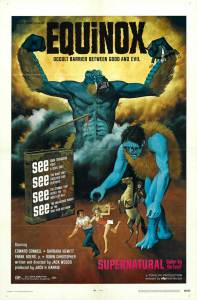
Horror on the Lens: Equinox (dir by Jack Woods and Dennis Muren)


Today’s horror on the lens is a film that Gary reviewed a few years ago.  

First released in 1970, Equinox is a low-budget film about a bunch of kind of dumb teenagers who find a book and end up getting chased around the woods by a bunch of angry monsters.

Equinox is a fun little movie.  The acting may not be the greatest and this is one of those films where everyone always seems to do the stupidest possible thing at the worst possible time but there’s a lot of charm to be found in the monsters.  This film is thought, by many, to have inspired the Evil Dead and there are some definite similarities.

Enjoy!

Horror on TV: The Twilight Zone 3.24 “To Serve Man” (dir by Richard L. Bare)


“It’s a cookbook!”

During the month of October, we like to share classic episodes of horror-themed television.  That was easier to do when we first started doing our annual October horrorthon here at the Shattered Lens because every single episode of the original, black-and-white Twilight Zone was available on YouTube.  Sadly, that’s no longer the case.  In fact, there is exactly one episode of the original Twilight Zone on YouTube.

Fortunately, that episode is a classic.  In 1962’s To Serve Man, an alien (Richard Kiel) comes to Earth and invites people to return to his home planet with him.  He leaves behind a book.  When everyone learns that the title of the book is To Serve Man, they excitedly decide that the book must be an instruction manual on how to help mankind.  The truth, as we learn in the episode’s classic finale, is something a little bit different.

Here’s the episode!  Watch it before YouTube yanks it down.

(This episode originally aired on October 2nd, 1962.  It was directed by Richard L. Bare from a script by Rod Serling.  It was based on a short story by Damon Knight.)

Enjoy!