TV Review: Night Gallery 1.1 “The Dead Man/The Housekeeper” (dir by Douglas Heyes and John Meredyth Lucas)


As I wrote yesterday, I recently decided to sit down and watch every episode of the horror anthology series, Night Gallery.  Yesterday, I watched and reviewed the pilot movie.  Tonight, I watched the first episode of the weekly series.

Though the pilot originally aired in 1969, Night Gallery did not start to air as a regular series until December of 1970.  The first episode of season one was broadcast on December 16th, 1970.  As all of the episodes did, it stated with Rod Serling walking through a dimly lit museum and inviting the audience to look at a macabre painting.  Each painting was inspired by a different story.  Or were the stories inspired by the paintings?  To be honest, I don’t think the show ever made that clear.

The first episode featured two stories, both of which dealt with mad scientists.
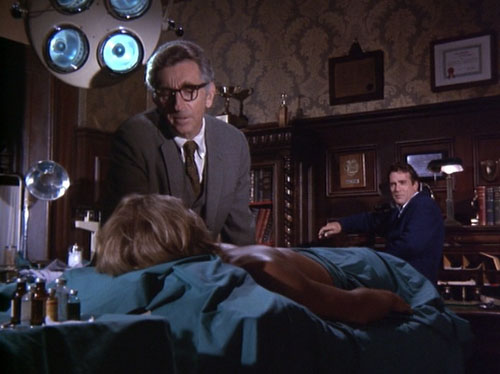
The Dead Man (written and directed by Douglas Heyes)

The first segment was The Dead Man, an enjoyably atmospheric if somewhat difficult-to-follow story about a scientist, a young man with an amazing ability, and the woman who is torn between the two of them.

Carl Betz plays Max Redford, a doctor who has discovered that, under hypnotic suggestion, John Michael Fearing (Michael Blodgett) can simulate any medical condition, no matter how severe.  When Max reveals his discovery to his associate, Dr. Talmadge (Jeff Corey), Talmadge is concerned that Fearing will suffer permanent damage as a result of Max’s experiments.  Nonsense! Max explains.  All he has to do is give Fearing the proper signal and he’ll pop right out of his condition, as good as new.

Max decides to put Fearing to the ultimate test by having him simulate death.  However, when Fearing goes under, he dies for real.  Was it just an accident or did Max — who suspects that Fearing was having an affair with his wife (Louise Sorel) — secretly mean for Fearing to die?

The Dead Man raises some intriguing questions about life, death, and medical ethics.  It also has a quartet of good performances with Carl Betz doing an especially good job as Max.  Michael Blodgett showed up in a lot of early 70s films and TV shows and he was always convincing as a decadent hedonist.  The entire segment is full of creepy atmosphere but the ending is a bit of a let down.  After a great set-up, the segment just kind of fizzles out.
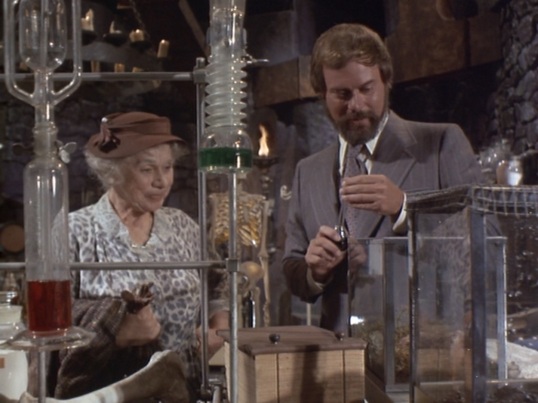
The Housekeeper (written by Heyes, directed by John Meredyth Lucas)

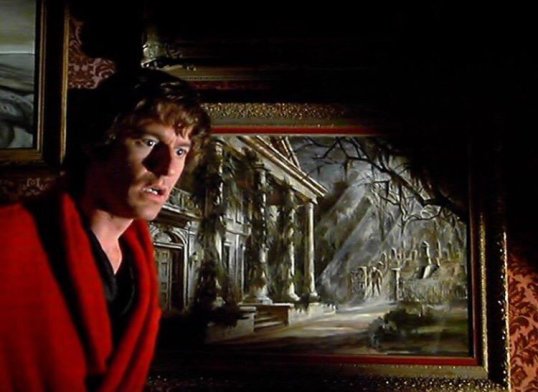
In the second segment, our mad scientist is named Cedric Acton (Larry Hagman).  Whereas Max Redford, in the previous segment, was misguided, Cedric Acton is just crazy.  Through the use of black magic (it involves a frog), Cedric has been experimenting with soul and brain transference.  (There’s an oinking chicken and a clucking pig in his laboratory, just in case anyone’s wondering how the experiments are going.)

Because Cedric loves his wife’s body but hates her personality, he wants to put the soul of his kindly housekeeper (Jeanette Nolan) into the body of his wife, Carlotta (Suzy Parker).  At first, the experiment is a success but things get complicated and …. well, I’m not really sure what it all leads to because this is one of those stories that just kind of ends without really offering up any type of resolution.

The Housekeeper is meant to be a comedy but it’s a bit too mean-spirited to really work.  This segment really calls out for karma to intervene and for Cedric’s soul to end up in something else’s body but instead it just ends with Cedric continuing his experiments.  It’s more than a little dissatisfying.  Larry Hagman does a good job playing Cedric, though.  He’s convincingly crazy.

Especially after the pilot, it’s hard not to be disappointed by the first episode of Night Gallery.  Both stories had potential but they were let down by weak endings.  Oh well.  Hopefully, tomorrow’s episode will be an improvement!
Film Review: Night Gallery (dir by Boris Sagal, Barry Shear, and Steven Spielberg)


Night Gallery was a horror anthology series that aired on NBC in the early 70s.  Each episode featured Rod Serling, of Twilight Zone fame, serving as the curator of a museum where all of the paintings have a somewhat macabre theme.  (One could even say that the museum was a …. wait for it …. night gallery!)  Serling would give each painting a properly pithy introduction and then the audience would see the story behind the artwork.  It was a bit like the Twilight Zone, except the Night Gallery episodes were in color, they were all horror-themed, and, for the most part, they steered away from social commentary.  The series ran from 1970 and 1973 and it still airs in syndication and on some of the retro stations.  (I believe it currently airs on Comet TV.)  Even if it wasn’t as consistently good as Twilight Zone, it’s still a pretty fun little series.

Two Christmases ago, I was gifted  Night Gallery: The Complete Series on DVD.  Though I’ve watched several episodes from the DVD, I recently realized that I have never actually sat down and watched every episode in order.  With the world currently shut down due to the pandemic (a development that, if we’re going to be honest, sounds like something Rod Serling would have used on the Twilight Zone), I figured what better time to watch the entire series then now?

I started out by watching the Night Gallery pilot film.  This originally aired on November 8th, 1969, a full year before Night Gallery became a weekly series.  It features three different stories (all written by Rod Serling) of the macabre.  As with every episode of the subsequent series, each story is introduced by Serling standing in front of a painting.  In the pilot, though, the museum is rather bare and the painting’s are a bit minimalist.  I have to admit that, as a lover of the baroque, I was a bit disappointed in that aspect of the pilot.

But what about the stories themselves?  Read on!

The Cemetery (dir by Boris Sagal)

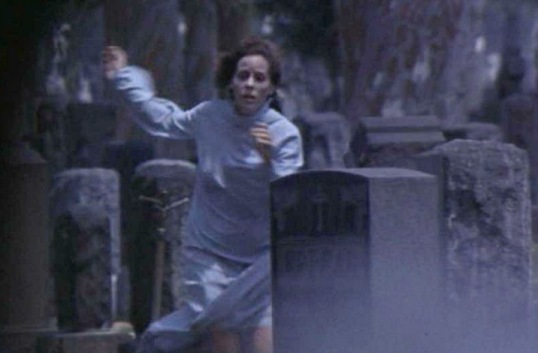
The first story was The Cemetery, a cheerfully gruesome little tale that featured Roddy McDowall and Ossie Davis.  McDowall plays Jeremy, a spoiled young man who murders his uncle so that he might inherit the dead man’s estate.  At first, it looks like McDowall’s plot is a complete success but then McDowall notices a painting of the family graveyard hanging above a staircase.  (To be honest, it seems odd to hang a painting of a graveyard in the foyer but I guess that’s something old rich people do.)  The painting keeps changing.  One minute, the painting looks normal.  The next minute, it features a newly dug grave.  And then something emerging grave.  And then something heading towards the house….

Is Jeremy losing his mind or is the painting warning him that his uncle has risen from the dead and is seeking revenge!?  You’ll probably be able to guess the answer long before poor Jeremy but no matter.  This is a fun little horror story and it benefits from two enjoyably arch performances, from McDowall and, in the role of a butler who may have an agenda of his own, Ossie Davis.

Eyes (dir by Steven Spielberg)

Of the three stories presented in the pilot, Eyes probably gets the most attention from critics because it not only stars Joan Crawford in one of her final performances but it was the professional directorial debut (if you don’t count Amblin’) of 22 year-old Steven Spielberg.  Spielberg apparently had some issues dealing with the veteran crew members, many of whom didn’t like the idea of taking orders from a 22 year-old.  (It probably didn’t help that pictures from that era suggest that Spielberg looked several years younger than his age.  Let’s just say that it’s easy to understand why he eventually grew that beard.)  I’d like to think that Joan Crawford yelled at everyone and defended Spielberg and maybe even Rod Serling came down with Luca Brasi and said, “You’re going to the give this kid the respect he deserves or your brains are going to be all over that union contract.”  I don’t know if that’s true but it’s a nice thought.

That said, Eyes is pretty good.  Even if the crew doubted him, Spielberg proved himself as a director with this story.  It’s about a hateful and selfish woman (Joan Crawford) who happens to be both rich and blind.  She has manipulated a doctor into performing an experimental operation that will allow her to see.  The only catch is that the operation will only be good for 22 hours and a donor (Tom Bosley, as a bookie who is in trouble with the mob) will be required to give up his eyes so that Crawford can have those 22 hours.

On the one hand, this is very-much a Rod Serling-type tale.  It’s easy to imagine Eyes, with its belief in karma and its final macabre twist, as a Twilight Zone episode.  At the same time, Spielberg very much brings his own signature style to the film, livening up dialogue-heavy scenes with interesting camera angles and getting good performances from Crawford, Barry Sullivan, and Tom Bosley.  Eyes is a clever story but, for modern viewers, the most interesting thing about it will be discovering that, even at the age of 22, Spielberg already had a clear directorial style.

The Escape Route (dir by Barry Shear)

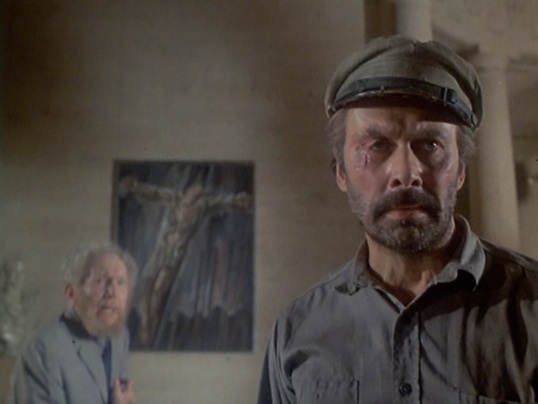
The Escape Route is about an Nazi war criminal named Joseph Strobe (played by Richard Kiley) who is hiding out in South America and spending all of his time nervously looking over his shoulder.  One day, he enters a museum where he finds himself drawn to two paintings.  One painting features a man who has been crucified in a concentration camp, which we learn was Strobe’s trademark back when he, himself, was a camp commandant.  The other painting features a fisherman in a peaceful setting.  Even though Strobe imagines himself as the peaceful fisherman, his attention keeps getting redirected to the painting of the concentration camp.  Soon, Strobe realizes that a survivor of the camp (played by Sam Jaffe) is also in the museum and that he is studying the painting as well.

Compared to Eyes and especially The Cemetery, The Escape Route may seem like a rather low-key story but it has a power that sneaks up on you.  Hiding out (as many real-life Nazi war criminals did) in South America, Strobe is full of excuses for his past and he may indeed be sincere in his wish that he had just become a fisherman as opposed to a brutal Nazi.  But, in the end, Strobe can neither escape his past nor his final punishment.  Justice cannot be escaped, no matter how hard Strobe tries to outrun it.  In the end, there is no escape for the wicked.  Richard Kiley and Sam Jaffe both give excellent performances.  The Escape Route will stick with you.

As a series, Night Gallery was a bit uneven but the pilot stands as a classic of its type, featuring three short films that all deserve to be remembered.

As for me, I’m going to try to watch an episode or two a day.  I may review a few more Night Gallery episodes here on the Shattered Lens.  As I said, the series itself was a bit uneven and not every episode is as good as the pilot.  Still, there’s definitely some gems to be found in the Night Gallery and I’ll share them as I come across them.

Music Video Of The Day: I Belong To Me by Jessica Simpson (2006, dir by Matthew Rolston)


I went to the same high school as Jessica Simpson!

Of course, I didn’t go there at the same time that Jessica did.  Jessica was long gone by the time I started the 9th grade.  As well, I actually graduated while Jessica dropped out so she could become a super-rich celebrity instead.  That said, I did take a few classes that were taught by Jessica’s former teachers, who all agreed that Jessica was a sweet person.  To be honest, most of my classmates made a big deal about being kind of cynical about going to the same high school as Jessica Simpson.  You’re never more jaded than you are between the ages of 13 and 18.  Myself, I’ve always liked Jessica Simpson because we’re both from Texas and we both occasionally play dumb for the laughs.

Anyway, this song was written when Jessica was going through a very public divorce from Nick Lachey.  It’s an empowerment song that also happens to be really depressing, which is really the best type of song there is.  There’s something to be said for a good depressing song and a good depressing video.

Enjoy!

Cleaning Out The DVR: Black Hearted Killer (dir by Roxy Shih)


Earlier tonight, I continued my quest to clean out my DVR by watching the Lifetime film, Black Hearted Killer.  This originally aired on April 5th and I missed it because …. well, to be honest, I don’t remember why I missed it.  I mean, April 5th — that was like a month ago which, in 2020 time, is the equivalent of several years.  Well, whatever my reason for missing it was, I’m sure it was an acceptable one.  Fortunately, I set my DVR to record the film.

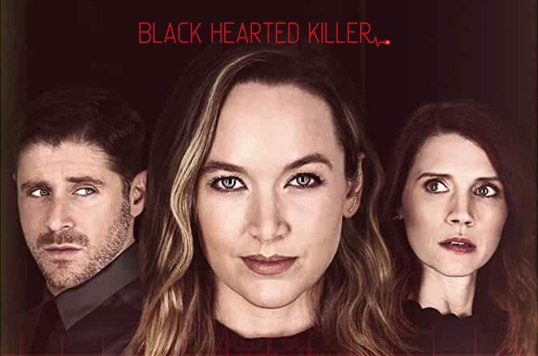
Black Hearted Killer tells the story of three people and one heart.  When their daughter is tragically killed in an auto accident, Juley (Julie McNiven) and Dennis (Jon Abrahams) agree to donate her organs.  They don’t want to know who is going to get their daughter’s organs but they do agree to allow the hospital to tell the recipients where the organs came from.  Months later, Juley and Dennis are approached by Vera (Kelley Jackle).  Vera tells them that she has their daughter’s heart beating away inside of her and that she owes her life to them.  Dennis is like, “That’s nice.  Go away now.”  Juley, however, invites Vera to become a part of their life.

Juley is still struggling to recover from her daughter’s death.  She’s still haunted by nightmares.  Having Vera around allows Juley to feel as if she’s close to her daughter.  Dennis, however, is more suspicious of Vera and the effect that she’s having on Juley.  Dennis suspects that Vera’s motives may not be pure.  Not surprisingly (because this is a Lifetime film after all), it turns out that Dennis is right.

Black Hearted Killer is an entertaining Lifetime film.  By this point, we all kind of know what the general plot of these films is going to be.  From the minute that Vera shows up, we know that she can’t be trusted just because she’s a stranger in a Lifetime films and strangers always turn out to be trouble in these films.  The fact that the plot is kind of predictable is really one of the main appeals of a film like this.  We don’t watch to be surprised.  Instead, we watch so we can shake our heads at characters who apparently haven’t seen as many Lifetime films as we have.  In this film, it didn’t really take Vera long to show her true nature and she was an entertaining psycho.  Kelley Jackle did a good job playing her and Julie McNiven and Jon Abrahams were both well-cast as the couple who she victimizes.  I also liked Juley and Dennis’s house which, as veteran Lifetime observes know, is a very important part of any successful Lifetime movie.  The nicer the house, the better the movie.

As I watched the film, I found myself thinking about organ donation.  I guess, if I died and my organs were donated to someone else, it wouldn’t bother me because I would be dead and I probably wouldn’t know what was happening.  A part of me does worry about getting stranded in Purgatory without my liver but I guess I’d make do.  Still, I would have to wonder who would end up with my mismatched eyes or my heart or my …. well, you get the idea.  I would hope it wouldn’t be anyone mean.  If you get one of my organs, treat it nicely.


Cleaning Out The DVR: A Killer In My Home (dir by Farhad Mann)


When the lockdown was first announced down here in Texas, my initial reaction was, “Well, at least I can clean out my DVR now….”

Unfortunately, it didn’t really work out like that.  First off, I got caught up trying to work my way through my collection of DVDs and Blu-rays.  Then, I ended up getting distracted by my efforts to binge my way through The Sopranos, Oz, and Deadwood.  And suddenly, here we are!  It’s nearly June.  The lockdown is in the process of ending.  And I’ve barely made a dent on working my way through the 230 programs that I have on my DVR.

Earlier today, I decided to finally get to work by watching the Lifetime film, A Killer In My Home.  A Killer In My Home originally aired on the Lifetime Movie Network back in February.  I was on vacation at the time so my wonderful sister was nice enough to record it for me.  Watching it was an interesting experience, just because there weren’t any COVID-19-themed commercials.  Instead, there were a ton of commercials for Tom Steyer and Mike Bloomberg.  I mean, seriously — whenever you think about how bad 2020 may be right now, just remember that, even before everything shut down, we had to spend a month and a half dealing with the Tom and Mike charm offensive.

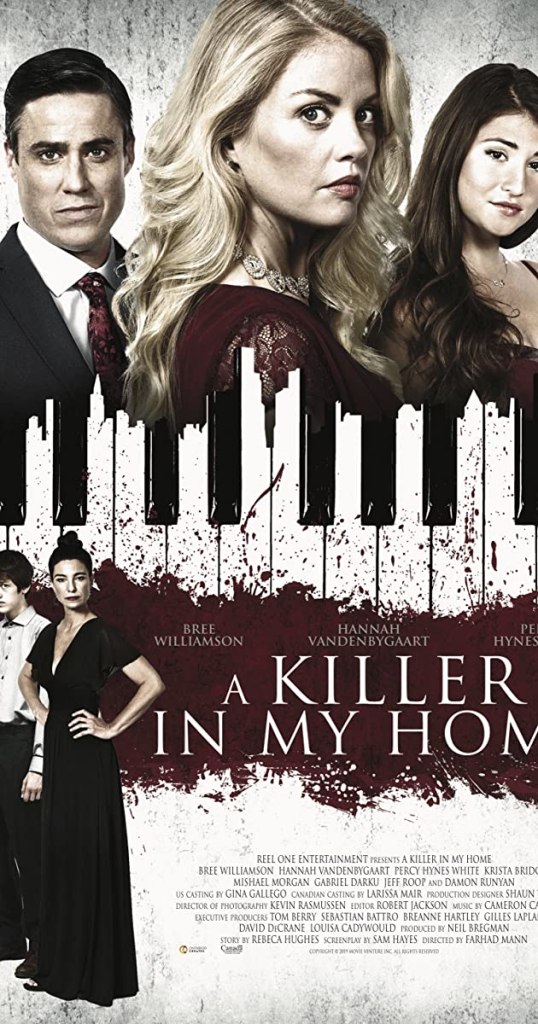
As for the film itself, it tells the story of Allison Wright (Bree Williamson) and her daughter, Hollie (Hannah Vandenbygaart).  Allison and Hollie appear to have the perfect life.  Not only do they live in a huge house but Hollie appears to have the perfect future ahead of her.  Soon, she’ll graduate high school, get a nice car, and go to a good college.  But then, Allison’s husband and Hollie’s father suffers a heart attack!  While he’s dying in the hospital, he’s visited by Jenna Fallon (Krista Bridges) and her withdrawn son, Joshua (Percy Hynes White).  When Allison demands to know why Jenna is visiting her dying husband, Jenna explains that she had an affair with Allison’s husband and Joshua was the result.  Apparently, Allison’s husband spent years visiting and financially supporting Jenna and Joshua.  Now that he’s dead, Jenna and Joshua have no one left to provide for them.

Now, if you were Allison, what would you do in this situation?

Would you say, “Tough shit, you whore.  Get out of here and take that bastard with you!”

Or

Would you say, “Why don’t you come live in our guest house?”

Now, to the film’s credit, Allison’s initial reaction is to tell Jenna and Joshua to go away.  However, a few weeks later, Allison has a change of heart and she allows Jenna and Joshua to move into the guest house.  Jenna and her son are supposed to stay away from the main house and out of Allison and Hollie’s lives.  Needless to say, things don’t work out like that.

Soon, strange things start to happen.  There’s a break-in at the house.  Despite her efforts to ignore him, Joshua still tries to talk his half-sister.  Jenna starts to throw biker-populated parties at the guest house.  Despite the fact that she claims to have no money, Jenna is able to buy her son an expensive jeep.  Allison comes to realize what we realized from the beginning: Jenna has sinister motives of her own!  The only question is whether or not Joshua shares those motives or if he’s just a pawn trapped in a game he didn’t intend to play.

A Killer In My Home is okay.  If I’m not as enthusiastic about it as I am about other Lifetime films, it’s because I never believed that Allison would 1) allow Jenna to stay in the guest house and 2) allow her to continue to stay in the guest house even after it became obvious that some seriously strange stuff was going on.  Allison lost my sympathy by doing that.  However, I did really like Krista Bridges’s performance as the unstable Jenna and I though Hannah Vandenbygaart gave a good and sympathetic performance as the daughter who is basically just sick of dealing with the adults in her life.  I could definitely relate.

Finally, the house was nice.  Lifetime movies always feature the nicest houses and A Killer In My Home featured one of the best!

Music Video of the Day: I Love Rock ‘N’ Roll, covered by Britney Spears (2001, dir by Chris Applebaum)


It’s Britney!

This video was filmed at the Inn, which is a bar in Long Island.  The video features Britney performing with her then-backing band.  It also features a speaker that appears to be on the verge of exploding and a motorcycle.  To be honest, if I was performing this song, I would probably want a motorcycle on stage with me too.  This is a song that just makes you want to ride a motorcycle.

(Seriously, I’ve always had like a major weakness for motorcycles.  It’s not so much that I like to ride them as much as I just like to lean up against them.)

I can remember that, when this cover was first released, a lot of people complained that it wasn’t as good as the previous versions and Britney also got a lot of criticism for saying that she had been inspired by Pat Benatar’s cover when the cover was actually performed by Joan Jett.  Myself, I like Britney’s cover.  It’s fun to dance too and Britney always seemed like she was happy when she was performing it.  So, the haters can just shut up as far as I’m concerned.

Free Britney!

Enjoy!

Music Video of the Day: The End of Everything by Noah Cyrus (2020, dir by John Boswell)


Don’t worry, everyone.  We’ve got another few trillion years to go before the universe ends.  We’ll all be dead by the time the sun goes supernova but hopefully, this site and all of my film reviews will still be here to provide future readers with some sort of solace before they’re vaporized into nothingness.

Enjoy!

The Things You Find on Netflix: The Stand at Paxton County (dir by Brett Hedlund)


The Stand at Paxton County, which is currently playing on Netflix, opens with an ominous title card warning us that what we’re about to see is “based on a true story.”

I may be alone in this but I find the term “based on a true story” to be fascinating.  It’s signifies that the film that we’re about to watch was inspired by something that actually happened but it’s not actually a recreation of that event.  It’s an invitation to watch and to try to figure out how much is true and how much is just a product of a screenwriter’s imagination.  “Based on a true story” is a real cinematic tease.

The Stand at Paxton County tells the story of Janna Connelly (Jacqueline Toboni), an army medic who is still haunted by her memories of serving in Afghanistan.  When her rancher father, Dell (Michael O’Neill), has a heart attack, Janna returns home to Paxton County, North Dakota.  What she discovers is that, after she left home, the ranch fell into disrepair.  Dell only has one ranch hand, a seemingly amiable doofus named Brock (Greg Perrow) and it doesn’t appear that Brock’s been doing a very good job.

When Sheriff Bostwick (Christopher McDonald) shows up to do a compliance check on the ranch, he finds a lot of problems.  When he returns with a cold-eyed veterinarian named Dr. Morel (Marwa Bernstein), Dell is informed that his ranch is in such disrepair that the sheriff can take away his livestock and essentially put Dell out of business!

How can the sheriff get away with this, Janna asks.  Dell explains that, years ago, the voters of the state voted down a proposition that would have given law enforcement the right to confiscate a rancher’s livestock.  However, a bunch of unelected lobbyists and left-wing activists went ahead and forced the law through the state legislature!  Now, the sheriff can pretty much do whatever he wants and anyone who tries to stand up for their Constitutional rights is subject to harassment and perhaps even murder!

While all of this is going on, Brock vanishes from the ranch.  It turns out that Brock is a professional bad employee who goes from ranch to ranch and goes out of his way to mess things up so that the ranchers lose their livestock.  The livestock is then sold to the highest bidder or sometimes the sheriff will just keep a horse for himself.  With Brock gone, Janna hires sexy Matt (Tyler Jacob Moore) to be the new ranch hand and then sets out to get justice for her father.

I had mixed feelings about The Stand at Paxton County.  On the one hand, I’m not a fan of the government regulation in general and I’m always happy to watch a libertarian-themed film.  Christopher McDonald’s smug and corrupt sheriff felt like a stand-in for all of the authoritarian-minded politicians and bureaucrats who have recently come out of the woodwork and used the COVID-19 pandemic to increase their own power.  (“Hey, it’s Clay Jenkins!” I said as soon as the sheriff showed up.)  So, on that level, I enjoyed the film.

Unfortunately, The Stand at Paxton County doesn’t just stick to criticizing the government for overstepping their authority.  Instead, it also portrays animal rights activists as being a part of a sinister financial conspiracy and that’s where it lost me.  It’s a lot easier to buy into the idea of a corrupt sheriff than it is to imagine the head of the PSCA sitting in a darkened war room and ordering his minions to torment one rancher, all so he can resell the rancher’s livestock.  That doesn’t mean that activists should be immune from criticism or that there isn’t a legitimate argument to be made that even well-intentioned regulations are vulnerable to abuse.  But the film’s portrayal of its central conspiracy just got a bit too cartoonish to be effective.  Once the villains went from being smug to being downright evil, it became impossible to take the movie seriously.  If the film had simply stuck to criticizing government overreach instead of imagining a shadowy conspiracy, it would have been a lot more effective.

The Stand at Paxton County has some lovely shots of the North Dakota countryside and Christopher McDonald is a wonderfully smarmy villain.  I always appreciate a film that has an anti-authoritarian subtext but The Stand At Paxton County is ultimately dragged down by its own heavy hand.

Film Review: The American Dreamer (dir by Lawrence Schiller and L.M. Kit Carson)


Since today would have been Dennis Hopper’s 84th birthday, I decided to watch the 1971 documentary, The American Dreamer.

Filmed in 1970, between the success of Easy Rider and the release of Hopper’s infamous follow-up to that film, The Last Movie, The American Dreamer is a cinematic portrait of a very specific time in both Dennis Hopper’s life and American film history.  Dennis Hopper was 34 years old at the time The American Dreamer was shot and he was at the top of his career.  As a result of the success of Easy Rider, he was regularly touted as being the future of American film.  He was a self-styled revolutionary who specialized in spacey yet compelling monologues about how American movies were about to enter into a new age.  Eager to try to capture the same audience that had made Easy Rider a success, Universal Pictures gave Dennis Hopper a million dollars and allowed him to take the money to South America, where he used it to film The Last Movie, a film that was designed to show who Hopper truly was as a filmmaker.  The American Dreamer was filmed while The Last Movie was in post-production and we do see a few scenes of Hopper editing the film.

That said, Hopper doesn’t really seem to be too interested in talking about the specifics of The Last Movie.  He does talk a lot about how he’s leading a revolution that’s going to forever alter the American cultural scene but again, Hopper doesn’t really go into too many specifics when it comes to his artistic vision.  He’s more into slogans than details.  Fortunately, Hopper was a compelling speaker so he holds your attention regardless of how incoherent his frequent monologues are.  The American Dreamer may not convince you that Dennis Hopper was a great director but it does prove that he was a good actor.  In this film, he’s acting the role of being an outlaw and a visionary.

As vague as he is about his artistic vision, Hopper gets a bit more specific whenever he’s talking about his love of weed, sex, and guns.  In between leading encounter groups with all of the women who are living with him in New Mexico, Hopper brags about being such a considerate love that he’s a “male lesbian.”  In another scene, Hopper talks to three giggling girl in a bathtub.  He explains that free love is a part of the revolution and that he’s helping people get over their hang-ups.  It’s impossible not to cringe as Hopper comes across less like a lovable eccentric and more like one of those cult leaders who ends up living in a compound in Nevada and getting into a stand-off with the government.

Hopper’s a bit more likable when he’s filmed rolling a joint.  Watching the film, you can tell that he was a man who truly loved getting stoned and he actually lets down his guard a bit and grins once he’s ready to light up.  However, Hopper is probably at his most natural and likable when he’s shooting a gun in the desert.  Hopper spends a good deal of the film talking about his love for guns.  On the one hand, it’s a bit alarming as Hopper doesn’t exactly come across as being the most stable person on the planet.  On the other hand, Hopper appears to be having such a good time that it’s hard not to be happy for him.  Hopper explains that, when you’re an outlaw and you’ve living in New Mexico, you have to have guns for your own protection and he makes a pretty good argument.  One of the frequent misconceptions about Hopper is that he was a hippie.  (This despite the fact that Easy Rider more or less ridiculed the hippies.)  The American Dreamer, with its emphasis on individual freedom and the right to protect yourself, shows that, even during the height of the Hollywood counterculture, Hopper’s outlook was essentially libertarian.  Watching The American Dreamer, it’s easier to understand how Hopper went from directing Easy Rider to becoming one of the few Republicans in Hollywood.  Indeed, whenever the bearded and often unwashed Hopper is seen walking through the desert or firing a gun at a cross, he comes across less like the revolutionary visionary that he’s trying to be and more like an old soul in a new world.

With its frequent use of freeze frames and its intentionally ragged editing, The American Dreamer is very much a film of its era.  That’s actually the main appeal of The American Dreamer.  It captures a very unique and very specific point of time.  It captures an artist during the brief period between his biggest success and his greatest failure and while the film may be frustrating on a narrative level, it’s fascinating as a time capsule.  The film is probably more poignant when viewed today than it would have been back in 1971 because, today, we know that The Last Movie bombed and that Hopper’s revolution ended as quickly as it began.  It was not Dennis Hopper who determined the future of American film but instead Steven Spielberg and George Lucas.  Hopper struggled, both professionally and personally, through the rest of the 70s and the early 80s before finally kicking drugs and emerging as not just as an in-demand character actor but also something of a pop cultural icon.  Watching The American Dreamer, it’s fascinating to compare the older Hopper — the one who gave witty interviews and who joked about his past excesses — with the pretentious and self-serious Hopper of the early 70s.

Still, The American Dreamer shows that Dennis Hopper was always a compelling figure.  It’s impossible not to roll your eyes while watching and listening to the youngish Dennis Hopper but, nonetheless, you do continue to watch and listen.

Music Video of the Day: Angel in Blue Jeans by Train (2014, dir by Brendan Walter and Mel Soria) (Happy Birthday, Danny Trejo!)


Happy birthday, Danny Trejo!

Today’s music video of the day features Danny Trejo riding a motorcycle through the desert and doing other badass, Danny Trejo-type things.  I know that a lot of people will watch this video and think to themselves, “My God, he can sing too!”  However, believe it or not, Trejo is just lip-syncing.  I know.  I was shocked to find that out, too.  That said, Trejo does a pretty good job lip-syncing and it’s possible that he may have been singing during the filming.

Seriously, who doesn’t love Danny Trejo?  Not only is he a good actor who appears to sincerely want to improve the lives of other people but he’s got a pretty inspiring personal story too.  So today, we happily wish the best of birthdays and we invite you to….

Enjoy!