Film Review: Insignificance (dir by Nicolas Roeg)


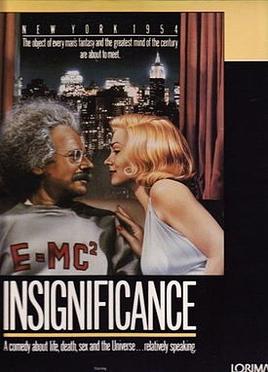
The 1985 film, Insignificance, opens in New York City in the 1950s.

On the streets of New York, a crowd has gathered to watch as the Actress (Theresa Russell), a famous sex symbol, is filmed standing on a grate while wearing a white dress.  Beneath the street and the Actress, a fan has been set up and the crowd of onlookers cheers as the Actress’s skirt is blown up around her hips, again and again.  Standing in the crowd, the Actress’s husband, the Ballplayer (Gary Busey), watches and shakes his head in disgust.  After the scene has been shot, the Actress hops in a taxi while the Ballplayer chases after her.  A very famous man is in town and the Actress is on her way to pay him a visit.

In a nearby bar, the Senator (Tony Curtis), drinks and talks and sweats.  Though it may not be obvious from looking at him, the Senator is a very powerful man.  He’s leading an investigations into subversives who may be trying to bring down the United States government.  He may look like a small-time mobster but the Senator can make and destroy people on a whim.  He’s come to New York on a very specific mission.  He and his goons are planning on pressuring another famous man into testifying before the Senator’s committee.

Though they don’t know it, both the Actress and the Senator are planning on dropping in on the same man.  The Professor (Michael Emil) is a world-renowned genius.  When we first see him, he is sitting alone in a hotel room and looking at a watch that has stopped at 8:15.  The public may know the Professor for his eccentricities but, in private, he is a haunted man.  The Professor’s work was instrumental in the creation of the first atomic bomb.  And now, with both the U.S. and Russia stockpiling their atomic arsenals and the world seemingly on the verge of war, the Professor fears that his work will be the end of humanity.

Though none of the characters are actually named over the course of the film, it should be obvious to anyone with even a slight knowledge of American history that the four main characters are meant to be versions of Marilyn Monroe, Joe DiMaggio, Joe McCarthy, and Albert Einstein.  Insignificance imagines a meeting between these four cultural icons and really, it’s not difficult to imagine a scenario in which they all could have met.  Joe DiMaggio actually was present during the filming of the subway grate scene from The Seven Year Itch and most accounts record his reaction as being not that different from what’s portrayed in Insignificance.  Albert Einstein was suspected of having communist sympathies and several scientific figures (including many who worked on the Manhattan Project) were investigated during the McCarthy era.  Finally, Marilyn Monroe was often frustrated by her “dumb blonde” image and said that she found Albert Einstein to be a very attractive man.  When she died, a biography of Einstein was reportedly found on her nightstand.

In the film, the Senator pressures The Professor to appear before his committee.  It’s not long after the Senator leaves that the Actress arrives.  The Actress announces that she’s fascinating by the theory of relativity and, using balloons, toys, and a flashlight, she proceeds to demonstrate the theory for the Professor.  The befuddled Professor is impressed.  The Actress informs the Professor that he’s at the top of her list.  Meanwhile, downstairs in another hotel room, the Senator is met by a prostitute who bears a resemblance to the Actress. The Ballplayer sits in the hotel bar, tearing up a picture of the Actress and wondering why their marriage is failing.

Because this film was directed by Nicolas Roeg, the film is full of seemingly random flashbacks.  We see the Senator as an altar boy, trying to impress a smiling priest.  We see the Ballplayer getting yelled at by his domineering father.  We see the Actress, growing up poor and being ogled, at first by the young boys at an orphanage and later by Hollywood execs.  Meanwhile, The Professor continually sees the destruction of Hiroshima.  His visions are apocalyptic and, towards the end of the film, he even gets a glimpse into a possible future of atomic hellfire.  It’s a film about fame and cultural transition, a film where people look to celebrities for hope while doomsday comes closer and closer.

Or something like that.  To be honest, I wanted to like Insignificance more than I actually did.  As is typical with so many of Nicolas Roeg’s films, Insignificance has an intriguing premise but the execution is a bit uneven.  There are moments of absolute brilliance.  Theresa Russell and Gary Busey both give perfect performances and the film’s final apocalyptic vision will haunt you.  And then there are moments when the film becomes a bit of a slog and the dialogue starts to get a bit too pretentious and on-the-nose.  Michael Emil has some good moments as the Professor but there are other moments when he seems to be lost.  Meanwhile, Tony Curtis gives such a terrible performance as The Senator that he throws the entire film off-balance.  Curtis bulges his eyes like a madman and delivers his lines like a comedian doing a bad 1930s gangster impersonation.

That said, Insignificance is still an interesting film.  It’s uneven but intriguing.  Though the film may take place in the 50s and may deal with a quartet of historical figures, it’s themes are still relevant in 2020.  People still tend to idealize celebrities.  Politicians still hold onto power by exploiting fear.  The possibility that everything could just end one day is still a very real one.  Insignificance is a film worth watching, even if it doesn’t completely work.
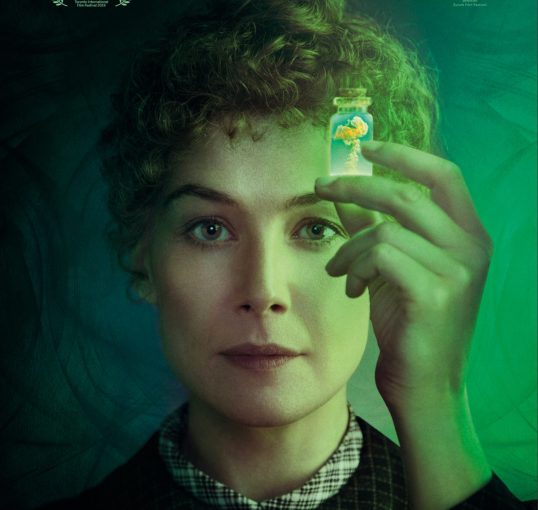
Film Review: Radioactive (dir by Marjane Satrapi)


If you want to talk about the birth of the modern world, you have to talk about Marie Curie.

That’s the argument made by the biopic, Radioactive.  It’s a compelling argument and it’s very much correct.  Born in Poland and a citizen of France, Marie Curie was the 1st woman to win the Nobel Prize, the 1st person and only woman to win the Nobel Prize a second time, and the only person to win a Nobel Prize in two scientific fields.  She shared her first Nobel Prize (in Physics) with her husband, Pierre.  After Pierre’s tragic death, Marie won her second Nobel, this time for Chemistry.  Both her daughter and her son-in-law would go on to win Nobel Prizes of their own and the Curie family continues to produce notable scientists to this very day.

Marie Curie is best known for her pioneering research on radioactivity, a coin that she termed.  She developed techniques for isolating radioactive isotopes.  She discovered that radioactivity could be used to battle aggressive forms of cancer.  Without her research, there would be no nuclear power, no chemotherapy, no X-ray machines, and no atomic weaponry.  Marie Curie is one of the few people about whom it can legitimately be said that they changed the world.  Of course, Curie herself later died of a radiation poisoning.

Radioactive opens with Marie (played by Rosamund Pike) on the verge of death, before flashing back to show us her early life and she went from being an obscure scientist to becoming the world renowned Madame Curie.  We watch as she meets and falls in love with Pierre Curie (Sam Riley).  The film celebrates not only their love for each other but also takes a look at Marie’s struggle to escape from Pierre’s shadow.  Though she was acknowledged as his partner and won her first Nobel Prize with him, it’s not until Pierre is trampled death by a bunch of horses that Marie’s genius is truly acknowledged.  The scenes in which Marie expresses her frustration at being overshadowed by her husband are some of the best in the film, largely because the film doesn’t make the mistake of attempting to portray Pierre as intentionally stealing all of the glory for himself.  Instead, society just assumes that Pierre deserves most of the credit because …. well, Pierre’s a man and Marie’s a woman.

Unfortunately, Radioactive makes some perplexing narrative choices.  Throughout the film, there are random moments when we get a sudden flashfoward and see random people interacting with radioactivity.  For instance, we go to a hospital in the 1950s and we listen as a doctor explains that he’s going to use radioactivity to help a patient combat cancer.  Another scene features the atomic bomb being dropped on Hiroshima.  We see the nuclear tests in Los Alamos.  One moment, Marie is crying in the middle of the street.  The next minute, an ambulance drives past her, on the way to Chernobyl.  On the one hand, it’s easy to see what the film’s going for.  It’s showing us everything, good and bad, that will happen as a result of Marie Curie’s work.  It makes the very relevant argument that sometimes, in order to get something good (less pollution, treatments for cancer) you have to risk something bad, like the possibility of being vaporized by an atomic bomb.  But the flashforwards are handled so clumsily that they actually detract from the film.  When I watched the sequence taking place at the hospital, I found myself wondering if Marie Curie discovered bad acting before or after she discovered radioactivity.  This is probably one of the few instances where a biopic would have been helped by taking a more traditional approach to its material.

On the plus side, Radioactive does feature a very good performance from Rosamund Pike, who really deserves to be known for more than just killing Neil Patrick Harris in Gone Girl.  (Don’t spoiler alert me.  The film’s nearly 6 years old.  If you haven’t seen it yet, you weren’t ever going to.)  Radioactive is currently playing on Amazon Prime and you should definitely watch it if you’re planning on keeping radioactive isotopes in your desk at work.  Seriously, don’t do it.

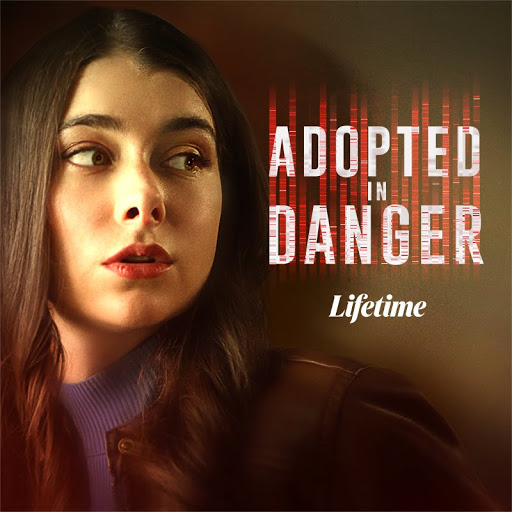
Lifetime Film Review: Adopted in Danger (dir by Craig Goldstein)


DNA tests are tempting, aren’t they?

I mean, I’ve often been tempted to get one, even though I pretty much know all about my family history.  My maternal grandmother was born in Spain while my grandfather’s parents came to this country from Italy.  On my father’s side of the family, everyone is pretty much Irish with a little bit of German and French mixed in.  Despite the fact that I know all of this, it’s still tempting to do the whole DNA thing because then I’d have percentages to go along with my family history.  Percentages make every story better, or so I’ve heard.

Of course, there’s a lot of other people who get DNA tests because they’re hoping that they’ll turn out to have a really badass ancestor or that they’ll find some evidence that they’re actually more interesting than they appear to be.  Remember when Elizabeth Warren got that DNA test that proved she had less Native American ancestry than the average American?  That’s not a story that you’ll see repeated in a 23andMe commercial but it’s one that I found fascinating as an example of the importance that people put on having interesting ancestors.  I mean, technically, what’s wrong with saying, “Yes, my family’s boring but I’m not?”  Instead, we all want to say, “I’m interesting and so is everyone who has ever shared my DNA!”

That said, I’ll still probably never get a DNA test.  People always assume that DNA tests and ancestry research are going to bring them good news (“and then I discovered that I’m descended from the first person to ever open up a fast food restaurant in the state of Wyoming and it just changed everything….”) but it seems to me like they’re just asking for trouble.  Sure, you might be descended from a great and respected historical figure.  Then again, you also might discover that the people you thought were your parents stole you from the hospital.  You might discover that your father was actually the Goatman or something.  (It could happen.)  I mean, seriously, why take the risk when you can just take your grandmother’s word that, just because some your ancestors fought with Franco in the Spanish Civil War, that doesn’t mean that they necessarily agreed with him about everything.

In Adopted in Danger, Candace (Allison Paige) actually does have a fairly good reason for wanting to get a DNA test.  She’s adopted and she has no idea who her birth parents are.  At the very least, she would like to know where she came from just so she can have a complete medical history before she and her husband try to start a family.  That certainly seems reasonable but, unfortunately, it turns out to be a lot more trouble than its worth.  Candace’s DNA indicates that she’s the daughter of real estate developer Tom Mason (Jason Brooks).  However, when Candace goes to see Tom and tells her that he’s her father, Tom refuses to consider the idea.  Tom, in fact, accuses her of just being after money and kicks her out of his office.

Why is Tom so adamant that he’s not Candace’s father?  That’s something that Candace and her friends investigate, in between drinking a lot of wine.  And I do mean a lot of wine.  I think this film may have set a record as far as scenes involving friends drinking wine and discussing DNA might be concerned.  However, all of that wine cannot stop the murderous schemes of a powerful family with a secret to hold and soon, Candace finds herself and everyone she knows being targeted.

The main problem with Adopted in Danger is that it’s fairly predictable.  I kept waiting for a big twist that would reveal that there had been a mix-up with the DNA or that Tom Mason was some sort of imposter or something that would have taken me by surprise but nope.  There’s no mix-up with the DNA.  Tom Mason is Tom Mason.  It’s just he comes from a terrible family and they don’t want anyone to know that Candace is his daughter.  Everything plays out the way you would expect it to play out.

That said, if you’re going to solve a mystery, you might as well do it while hanging out with your two BFFs.  DNA, in Adopted in Danger, may show where you’re from but but your friendships and your lovers show who you are and that’s not a bad message at all.

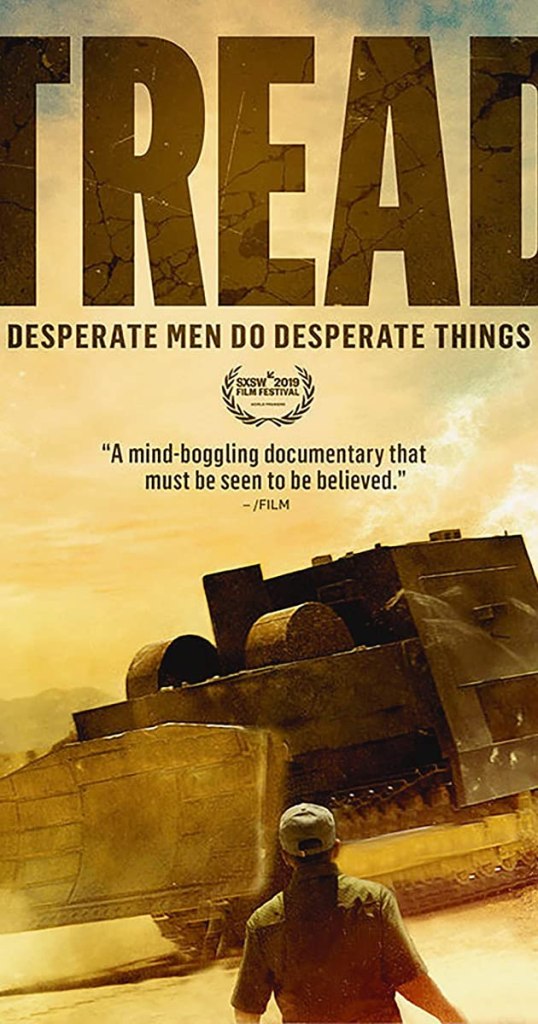
The Things You Find On Netflix: Tread (dir by Paul Solet)


On June 4th, 2004, the small town of Granby, Colorado was briefly the center of the nation’s attention.

On that day, an armor-plated bulldozer rumbled down the streets of Granby.  The driver of the bulldozer was a local business owner named Marvin Heemeyer.  Heemeyer, who had previously been at the center of a zoning controversy, spent two hours driving the bulldozer through various buildings in Granby.  He destroyed the muffler shop that he had once owned.  He destroyed a nearby concrete plant.  He drove through the Granby City Hall.  He smashed the bulldozer through the offices of the local newspaper.  He demolished the home of a family who he felt had conspired against him.  He took out a hardware store.  For two hours, the police chased him, firing their weapons at the bulldozer and discovering that nothing could slow him down.  In fact, it wasn’t until one of the bulldozers’ treads dropped into the hardware store’s basement that the rampage stopped,  Unable to free the tread, Marvin Heemeyer committed suicide by shooting himself in the head.

Before he went on his rampage, Heemeyer recorded himself talking about why he was going to do what he did.  He mailed those tapes to his brother in South Dakota a few hours before getting in the bulldozer.  His brother later turned those tapes over to the FBI.  In the tapes, Heemeyer discussed what he felt was years of harassment by the Granby town council and the zoning board.  He described himself as being an “American patriot” and he even went so far as to say that he felt his rampage was predestined.  He also went on to express amazement that he was able to spend two years openly modifying the bulldozer and turning it into a tank without anyone asking him what was going on.  He also made clear that when he entered the bulldozer for the last time, he knew that he was never going to leave it.  He truly was going on a suicide mission.

Those tapes are at the center of Tread, a documentary about Marvin Heemeyer and his 2004 rampage.  The film alternates between people discussing their memories of Marvin and that day and the taped voice of Marvin himself attempting to explain his motivations.  Almost everyone who is interviewed talks about what a friendly and genuinely nice person Marvin seemed to be.  Even though Marvin spent two years planning his rampage, no one — not even his girlfriend — appeared to suspect a thing.  Even in the weeks directly before his rampage, Marvin was making plans for the summer.  One friend of Marvin’s does speculate that Marvin spent “too much time alone.”

As many people interviewed point out, Marvin was, by most measures, a successful businessman.  He had a reputation for being the best welder in the county and he opened up a muffler shop in a building that he bought for $44,000.  He later sold that building for $400,000.  However, as the tapes reveal, Marvin didn’t view selling his shop for a profit as being a success.  Instead, he viewed as something that he was forced to do by the town council and their refusal to side with him in a zoning dispute that he had with the manufacturers of a concrete plant.  Marvin felt that the town was ruled by one family and that family was conspiring against him and singling him out for harassment.

I’m about as anti-government as they come so my natural instinct, when Tread began, was to be sympathetic to Marvin’s anger, if not his solution.  And, having now watched the documentary, I still have no doubt that Marvin probably was, to an extent, targeted by the zoning board and the town council.  The fact of the matter is that it’s rare that people don’t let the least amount of power go to their head.  That’s especially true when it comes to small towns.  There seems to be a natural pettiness that comes along with having power.  That’s true regardless of whether you’re the mayor of a small town in Colorado or the governor of a state like …. oh, I don’t know, let’s just say Michigan and New Jersey.  At the same time, when you listen to Marvin’s voice on tapes, it’s obvious that there was more going on in Marvin’s head than just anger over the zoning dispute.  When Marvin talks about how God obviously wanted him to modify the bulldozer and use it to destroy the town, you realize that, if it hadn’t been the zoning dispute, it probably would have been something else.  Marvin comes across as time bomb while the town leaders come across as being the people who unknowingly lit the fuse.

I have to admit that, until I watched this documentary, I had never heard of him but a simple Google search revealed that, in the years following his death, Marvin Heemeyer has gone on to become a hero to certain anti-government activists.  Though it’s been 16 years since he unleashed his bulldozer on the town of Granby, his story still feels relevant today.  There’s still a lot of angry people out there and, if anything, the people in power have gotten even more heavy-handed and arbitrary in their behavior today than they were in 2004.  That said, if you’re looking for a film that either vilifies or blindly celebrates Marvin Heemeyer, Tread is not that film.  Overall, Tread portrays Marvin Heemeyer as being a complicated man who, in the town of Granby, found the perfect reason (or, depending on how much sympathy you may or may not have for him, excuse) to strike out.

It’s currently available on Netflix.

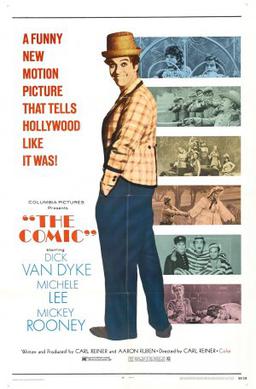
Film Review: The Comic (dir by Carl Reiner)


The 1969 film, The Comic, details the long and not particularly happy life of silent screen star Billy Bright (played by Dick Van Dyke).  Billy Bright tells us his story from beyond the grave.  The film opens with his funeral, which is sparsely attended and features the type of self-consciously mawkish eulogies that are usually trotted out whenever a generally unlikable person dies.  The only sign of life at the funeral comes when Billy’s oldest friend, Cockeye (Mickey Rooney), throws a pie at one of the speakers.  The speaker says that the pie was Billy’s final joke.

Billy Bright was a funny performer but a miserable man.  That’s pretty much the entire plot of The Comic.  We see the young Billy, performing in silent films and winning laughs through the seemingly impossible contortions through which he puts his body and his face.  Off-screen, Billy marries one of his co-stars (Michele Lee) and starts a production company.  When she discovers that he’s been cheating on her, their divorce is a major Hollywood scandal.

Even before the coming of the talkies, Billy struggles with alcohol.  Once the talkies do come, his career is pretty much over.  Billy became a star in silent films and he stubbornly wants to continue to make silent films, despite the fact that there’s no longer an audience for them.  Billy quickly goes from being a star to being forgotten.  He’s reduced to walking down Hollywood Boulevard with Cockeye and looking at the names under his feet.  When he reaches his name, he discovers that someone has dropped their gum on it.

Billy finally does get his comeback in the late 60s but it’s not much of a comeback.  He appears on a talk show and it’s hard not to cringe a little as the clearly infirm Billy duplicates some of his silent era pratfalls.  He’s reduced to appearing in a rather awkward commercial for a laundry detergent called, I kid you not, White-ee.  “That’s White-ee, baby!” his commercial co-star says after a freshly cleaned Billy emerges from a washing machine.

The idea that most funny performers are actually rather serious and depressing off-stage is certainly nothing new.  Judd Apatow has basically built an entire career out of making films about how funny people are actually carrying around tons of emotional baggage.  The thing distinguishes The Comic from so many other films about angsty comedians is that Billy Bright himself never seems to have a single moment of self-awareness.  Usually, films about miserable celebrities will at least have one scene where the main character realizes that his misery is all his fault.  Billy Bright is pretty much a jerk from the minute we meet him and he’s still a jerk when the film ends.  He’s the type of guy who makes a big deal about picking up his son from school but who still manages to grab the wrong kid because it’s been so long since he’s spent any time with his family that he’s really not sure what his son looks like.  Towards the end of the film, we see him watching one of his old films and what we notice is that he doesn’t seem amused at all.  Is he thinking about how he lost it all or is it possible that this man who made millions laugh never really had much of sense of humor himself?  The film leaves it to you to decide.

The Comic was written and directed by Carl Reiner, who undoubtedly knew quite a few Billy Brights in his life.  As such, the film feels authentic in a way that a lot of other films about creative people do not.  The Comic is a well-made film.  It’s hard not to appreciate the film’s obviously affection for Old Hollywood.  That said, Billy Bright is such an unpleasant character that I found the film difficult to enjoy.  Van Dyke is genuinely funny whenever he’s doing Billy’s silent film shtick and he’s genuinely tiresome when Billy’s ego gets out of control.  It’s a good performance as a generally unlikable character.  How you react to The Comic will probably depend on how much sympathy you can summon up for a character who doesn’t really seem to deserve any.

Lifetime Film Review: The Baby Monitor Murders (dir by Danny J. Boyle)


Apple Springs, Washington might seem like a nice little town but appearances can be deceiving.  Mallory Raymond has gone missing and no one can find her.  The local sheriff seems to suspect that her husband, Glenn (Dustin Lloyd). may have had something to do with it.  Meanwhile, Glenn is spending all of his time in the park where Mallory was last seen.  Is he searching for his wife or is he searching for another victim?

While Mallory is busy disappearing, Cassie (Natalie Sharp) is busy returning.  Cassie grew up in Apple Springs and she’s just returned from college.  She thought she was going to get an internship with a music label but that fell through.  Now, it looks like like Cassie is going to have to spend the entire summer stuck at her parent’s house.  That’s fine with her parents, of course.  They’re heading to Paris and they need someone to housesit.

Not wanting to spend another summer working at the local diner, Cassie is very happy when she just happens to run into Chloe Paine (Nicole LaPlaca), a lawyer who is planning on returning to work but who desperately needs someone to look after her daughter, Becca.  Chloe asks Cassie if she wants the job and Cassie accepts.

Soon, Cassie is spending hours a day over at the Paine house, taking care of Becca.  She gets to know Chloe’s husband, the seemingly friendly Tom Paine (Jon Cor).  She also gets to know Glenn, who it turns out just happens to work with Tom.  Cassie can’t help but notice that Tom and Glenn seem to always be arguing about something.

Strange things start to happen.  One night, Cassie is sure that she’s being watched.  Another night, she hears a menacing voice come over the baby monitor but, when she checks out Becca’s room, she doesn’t find anyone there.  And then, much like Mallory before her, Chloe disappears!

Where has Chloe gone?  Has she been kidnapped?  Has she been murdered?  And if that’s the case, who’s responsible?  Is it Tom, the seemingly perfect husband who seems to have a few secrets hiding underneath the friendly surface?  Or is it Glenn, who appears to be obviously unstable but who swears that the only thing he cares about is discovering what happened to his wife?  Even though almost everyone tells Cassie that she should just quit her job and stay away from the Paines, Cassie knows that would mean abandoning Beeca and that’s not something that she’s willing to do….

The Baby Monitor Murders, which initially aired way back in January, was originally entitled The Babysitter and really, that’s a better title for the film.  While the scene with the voice coming over the baby monitor is an undeniably creepy one, it’s also a rather minor one.  The film’s focus is much more on Cassie and her growing realization that she’s found herself in a dangerous and potentially deadly situation.  Natalie Sharp gives a good and sympathetic performance as Cassie, making her devotion to Becca feel believable and, as a result, giving this film a bit more emotional depth than the typical Lifetime film.  The mystery itself is frequently intriguing and you’ll find yourself going back and forth on whether Glenn or Tom is the one who Cassie should be weary of.  All in all, The Baby Monitor Murders is a good Lifetime film that will keep you guessing.

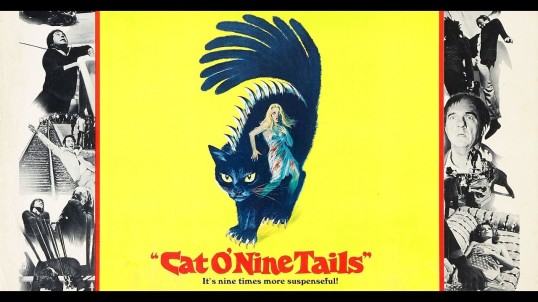
Song of the Day: Main Theme From The Cat O’Nine Tails by Ennio Morricone


Today’s song of the day the main theme from Dario Argento’s The Cat O’Nine Tails.  Ennio Morricone’s score brought a lot of atmosphere to Argento’s classic giallo.

And here it is:

Previous Entries In Our Tribute To Morricone:

  1. Deborah’s Theme (Once Upon A Time In America)
  2. Violaznioe Violenza (Hitch-Hike)
  3. Come Un Madrigale (Four Flies on Grey Velvet)
  4. Il Grande Silenzio (The Great Silence)
  5. The Strength of the Righteous (The Untouchables)
  6. So Alone (What Have You Done To Solange?)
  7. The Main Theme From The Mission (The Mission)
  8. The Return (Days of Heaven)
  9. Man With A Harmonic (Once Upon A Time In The West)
  10. The Ecstasy of Gold (The Good, The Bad, and the Ugly)
  11. The Main Theme From The Good, The Bad, and the Ugly (The Good, The Bad, and the Ugly)
  12. Regan’s Theme (The Exorcist II: The Heretic)
  13. Desolation (The Thing)
  14. The Legend of the Pianist (The Legend of 1900)
  15. Theme From Frantic (Frantic)
  16. La Lucertola (Lizard In A Woman’s Skin)
  17. Spasmodicamente (Spasmo)
  18. The Theme From The Stendhal Syndrome (The Stendhal Syndrome)
  19. My Name Is Nobody (My Name Is Nobody)
  20. Piume di Cristallo (The Bird With The Crystal Plumage)
  21. For Love One Can Die (D’amore si muore)
  22. Chi Mai (various)
  23. La Resa (The Big Gundown)
  24. Main Title Theme (Red Sonja)


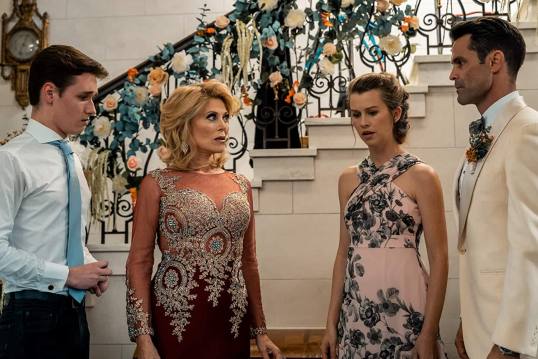
Lifetime Film Review: Engaged To A Psycho (dir by Sam Irvin)


After dating for a very long time, Deanna (Anna Hutchison) and Karl (Jason-Shane Scott) are finally getting married!

Yay!  Everyone loves a big wedding!

And, even before Karl asks Deanna to marry him, he’s purchased a large house for them to live in!

Yay!  Everyone loves a big house!

But first, Deanna needs to meet Karl’s family and that means going to an even bigger house!

YAY!  EVERYONE LOVES AN EVEN BIGGER HOU….

Wait a minute …. Deanna hasn’t met Karl’s family, yet?

Seriously, everyone, that should be a big red flag.  I don’t care how rich your boyfriend is, you don’t accept his marriage proposal before you’ve met his family.  After all, his family could be …. well, the could be crazy.  Or they might meet you and then decide that they don’t like you or maybe they like you but they still think that their son (or brother or stepbrother) could do better.  Or — and this especially happens in Lifetime movie — someone might start murdering all the members of your wedding party.

All of that happens in Engaged To A Psycho.  Engaged To A Psycho premiered on the Lifetime Movie Network back in May but, according to the imdb, the film was actually around a while before making it’s official LMN premiere.  It played in Canada back in 2018 and then, in 2019, it showed up on television in the UK, Spain, and France.  At the time, it was known as Murder at the Mansion.  By the time it premiered here in the States, the name had been changed to Engaged To A Psycho.  (Lifetime was going through a Psycho cycle.  Try saying that six times fast.)

Anyway, regardless of the title, Engaged To A Psycho is a fun little movie.  As soon as Deanna shows up at, she meets Karl’s mother, Ivy (Audrey Landers) and his adopted sister, Ruby (Melissa Bolona).  Ivy makes it clear that she thinks her son could have done better than Deanna.  Ruby, meanwhile, is almost too friendly and seems to be trying way too hard to convince Deanna that Deanna is welcome in the family.  It soon becomes obvious, than even though the family is living in a gigantic mansion, the rooms and the hallways are full of secrets, lies, and murder.  Soon people are dying all over the place.

One thing I liked about Engaged To A Psycho is that there were plenty of POV shots from the killer’s point of view.  It gave the whole a film a sort of giallo feel while also hiding the killer’s identity.  It also led to a lot of scenes of people looking straight at the camera and saying stuff like, “I knew it was you!  Wait here while I go tell everyone!”  Well, needless to say, the killer isn’t big on waiting.

The other thing I liked about Engaged To A Psycho is that it had a sense of humor about itself.  Ivy is so extremely unimpressed by Deanna that it actually becomes rather hilarious how dismissive she is.  It doesn’t matter how many times Deanna nearly gets killed, Ivy refuses to accept her word that there’s something strange going on.

I liked Engaged to a Psycho.  There were a lot of murders, a lot of archly delivered dialogue, and a lot of big houses.  What more can you ask for?

Guilty Pleasure No. 47: The Powers of Matthew Star


A few weeks ago, I was looking through the Guide and I noticed that MeTV had apparently started airing a show called The Powers of Matthew Star.

The name immediately intrigued me, though I wasn’t quite sure why.  I think that some of it just had to do with how silly it sounded.  The Powers of Matthew Star.  Of course, someone named Matthew Star would have powers.  But what type of powers?  Since his last name was Star, it would probably be a good guess that they would be extraterrestrial powers and since his first name was Matthew, it stood to reason that he was either an angel or a human-alien hybrid, or perhaps an alien pretending to be a human.

As I pondered just who Matthew Star could be and what his powers were, I suddenly realized the real reason why the title jumped out at me.  I had actually heard of this show before.  Several years ago, while I was reviewing all of the Friday the 13th films for this site, I came across several references to The Powers of Matthew Star.  That was because the show had featured by Amy Steel (who survived Friday the 13th Part II) and Peter Barton (who did not survive Friday the 13th — The Final Chapter).

Because The Powers of Matthew Star airs at four in the morning (Sunday morning, to be exact) I set the DVR to record it.  I’ve now watched a handful of episodes and I like the show, even though I’m still not really sure what’s going on.

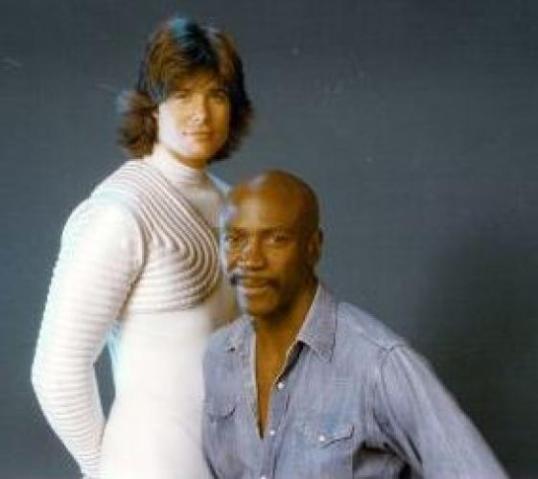
As I suspected, Matthew Star (played by Peter Barton) is an alien who is pretending to be a human.  Each episode opens with a narrator explaining how Matthew Star ended up on Earth but I have to admit that I’ve found the narration next to impossible to actually follow.  As far as I can tell, Matthew Star is actually a member of alien royalty but, after his home planet was either conquer or blew up, he had to go to Earth in order to hide out from another alien race that wants to destroy him.  Because he looks like a teenager, Matthew has to go to high school and deal with high school stuff while, at the same time, solving crimes for the government.  As far as his powers are concerned, he can apparently move stuff with his mind but he has to be careful about moving too much because then his cover might get blown and the aliens that are searching for him might destroy Earth.

Matthew’s guardian is Walt Shepherd (Louis Gossett, Jr.), who is a teacher at the high school and who knows about Matthew’s powers.  I think Walt is actually supposed to be another alien, though the episodes I’ve seen have not exactly been clear about this.  Matthew’s best friend is Pam (Amy Steel), who is the editor of the school newspaper.  Matthew has a crush on her but he’s not sure if he can ask her to prom because he’s an alien and he’s got other aliens looking for him.

From what I’ve seen, the show’s a bit silly.  For instance, one episode featured Matthew and Shepherd going to Italy on some sort of top secret government job.  The very next episode featured Matthew using his powers to win a high school football game and it ended with a message about the importance of education.  Despite my love of Italy, I preferred the football game episode to the secret agent episode.  The football game episode was so achingly sincere that it was hard not to enjoy it.

And really, from what I’ve seen, that’s the main appeal of The Powers of Matthew Star.  It’s silly and the plot is difficult to follow but there’s an overwhelming sincerity to the show’s portrayal of Matthew as an alien who just wants to save the Earth, enjoy high school, and work up the courage to ask Pam out on a date.  If I had been alive and like 13 years old in 1982, I would have had such a huge crush on Peter Barton.  Barton is incredibly likable as Matthew Star and he and Amy Steel are a cute couple whenever the show allows them to get together.

Unfortunately, according to Wikipedia, it appears that the whole high school angle of the show was dropped after the first 12 episodes.  (MeTV is only 7 episodes in.)  Starting with the 13th episode, Matthew was no longer a high school student, Amy Steel was no longer on the show, and every episode featured Matthew and Shepherd exclusively using their powers to defeat terrorists and other criminals.  That doesn’t sound like it’ll be as much fun.  I’ll probably stop DVRing the show once that happens.

Until then, though, I’m enjoying the adventures of Matthew Star, alien royalty-turned-high school student!

Previous Guilty Pleasures

  1. Half-Baked
  2. Save The Last Dance
  3. Every Rose Has Its Thorns
  4. The Jeremy Kyle Show
  5. Invasion USA
  6. The Golden Child
  7. Final Destination 2
  8. Paparazzi
  9. The Principal
  10. The Substitute
  11. Terror In The Family
  12. Pandorum
  13. Lambada
  14. Fear
  15. Cocktail
  16. Keep Off The Grass
  17. Girls, Girls, Girls
  18. Class
  19. Tart
  20. King Kong vs. Godzilla
  21. Hawk the Slayer
  22. Battle Beyond the Stars
  23. Meridian
  24. Walk of Shame
  25. From Justin To Kelly
  26. Project Greenlight
  27. Sex Decoy: Love Stings
  28. Swimfan
  29. On the Line
  30. Wolfen
  31. Hail Caesar!
  32. It’s So Cold In The D
  33. In the Mix
  34. Healed By Grace
  35. Valley of the Dolls
  36. The Legend of Billie Jean
  37. Death Wish
  38. Shipping Wars
  39. Ghost Whisperer
  40. Parking Wars
  41. The Dead Are After Me
  42. Harper’s Island
  43. The Resurrection of Gavin Stone
  44. Paranormal State
  45. Utopia
  46. Bar Rescue