Sometimes, it takes a really good actor to give a really bad performance.
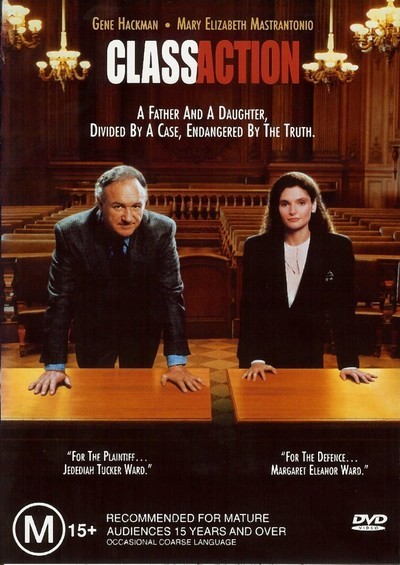
That’s what I found myself considering tonight as I watched the 1991 film, Class Action. I recorded this film off of Starz a few months ago, mostly due to the fact that I usually enjoy legal dramas. Class Action is about a father and a daughter, both of whom are attorneys, who find themselves facing each other in court. Gene Hackman plays Jedediah Ward Tucker while Mary Elizabeth Mastrantonio played Maggie, his daughter.
From the very first scenes, Jed Tucker is portrayed as being a firebrand, a crusader who stands up for the little guy against big corporate interests. (“Jed Ward is a great man!” one his clients exclaims while the other lawyers nod along in agreement.) Tucker is flamboyant, loud, perpetually outraged, in love with attention, and determined to make the world a better place. This is the type of role that would probably encourage any actor to overact just a bit. However, when you cast someone like Gene Hackman in the role, the performance becomes a masterclass in overacting. Gene Hackman was never a particularly subtle actor to begin with and casting him as Jed Tucker guarantees about two hours of Hackman bellowing, smirking, occasionally flirting, and basically coming across less like Gene Hackman and more like someone doing a particularly antic impersonation of Gene Hackman. Hackman goes so over overboard in the role that it becomes rather fascinating to watch. You watch and you ask yourself, “How much louder can he get? He much more obviously can he telegraph his intentions? Just how Gene Hackmanish is Gene Hackman going to get in this film?” Don’t get me wrong, Gene Hackman was a great actor. (He famously retired in 2004, after the indignity of appearing in Welcome to Mooseport.) One need only watch Bonnie and Clyde, The French Connection, Unforgiven, and The Royal Tennenbaums to see that Gene Hackman was a great actor. But sometimes, it takes a great actor to give a memorably bad performance.
Gene Hackman’s performance, as overbaked as it may be, is actually the only interesting thing about Class Action. It’s a well-made but ultimately rather silly mix legal maneuvering and family drama. Jed was a terrible father so Maggie becomes a corporate attorney in order to spite him. Class Action so embraces the idea that all professional women are motivated by daddy issues that even Aaron Sorkin would probably look at it and say, “Whoa, that’s really demeaning.” At one point, Maggie says to her father, “Have you ever considered that I might be a good attorney?,” just to have her father smirk and say that’s only because he’s her father. Jed’s response is to be expected, as he’s kind of an arrogant windbag. The problem is that the movie itself doesn’t seem to be willing to consider that Maggie could be a good attorney.
The other problem, of course, is that Class Action makes its good guys and its bad guys so painfully obvious that it’s hard to take any of the conflicts seriously. Of course, the big corporate law firm is going to be evil and of course, Jed Ward’s associates are going to be saints even if Jed isn’t. Laurence Fishburne plays Jed’s protégée and he gets stuck with all of the worst lines. Far more entertaining is future U.S. Senator and presidential contender Fred Dalton Thompson, playing a doctor who explains why it actually costs less for a car company to settle a lawsuit than to fix a design flaw.
Class Action is a forgettable film, not so much terrible as just bland. That said, if you want to hear some vintage Gene Hackman-style yelling, this might be the film for you.
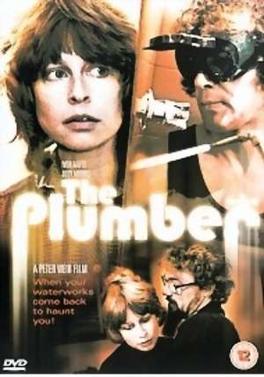
Peter Weir’s 1979 film, The Plumber, is essentially a battle of wills between two very different characters.
Jill Cowper (Judy Morris) is a masters student in anthropology. She’s educated, articulate, liberal-minded, and upper middle class. She’s married to Dr. Brian Cowper (Robert Coleby), a highly respected academic who is on the verge of being offered a position with the World Health Organization.
Max (Ivar Kants) is the plumber at the Cowpers’s building. We don’t find out much about his background, though it’s hinted that he’s had some previous trouble with the law. Max is friendly and talkative and, as soon becomes clear, amazingly determined. When he shows up at the Cowpers’s apartment, he tells Judy that he’s simply doing a check on all the building’s bathrooms. When Judy lets him in to do his inspection, Max announces that he needs to fix something with the plumbing. It should only take a day or two.
Except, of course, it takes more than a day or two. Max continually shows up at the apartment, usually waiting until Brian has left for the day. His comments to Jill become more and more intrusive and, whenever Jill takes offense, Max says that she’s misinterpreting him and that he’s just trying to be friendly. When Jill tells Brian that she thinks Max is intentionally destroying the plumbing so that he’ll have an excuse to be in the apartment, Brian refuses to believe her. When Jill tells her best friend, Meg (Candy Raymond), about what’s going on, Meg says that Max seems handsome and harmless.
Meanwhile, Max continues to work in the apartment’s bathroom, eventually turning it into a maze of pipes that seems to be constructed specifically to trap anyone unfortunate enough to enter the room….
The Plumber was originally made for Australian television. Though it was given a limited theatrical release in the United States (largely due to the arthouse success of Peter Weir’s previous films, The Last Wave and Picnic at Hanging Rock), The Plumber feels very much like a made-for-TV movie or perhaps an extended episode of an anthology series. It has a brisk 76-minute running time and visually, it features none of the striking imagery that one typically associates with Weir’s cinematic work. There’s no beautiful or majestic shots of the outback (like in Picnic at Hanging Rock) or the ocean (like in Master and Commander: Far Side of the World). Instead, the film takes place in the type of ugly and soulless cityscape that Harrison Ford was escaping from in Witness.
That said, The Plumber is still a memorable piece of work, one that feels perhaps more relevant today than when it was first released. Anyone who has ever dreaded having to take their car in for repairs or having to call someone out to fix an appliance will be able to relate to what Judy goes through with Max. The film is a reminder that, as much as we tell ourselves otherwise, we really are at the mercy of strangers. Judy may be better educated than Max and she may have more money than Max but what she doesn’t have, at least until the end of the film, is Max’s animal cunning. Max knows exactly what to say to get inside of the apartment and, once he’s inside, he knows exactly what to do to make it impossible for Judy to keep him from returning.
As upsetting as Max’s actions are, what’s even more upsetting is how everyone refuses to believe Judy when she tries to tell them what’s going on. Judy is told she is overreacting. Judy is told that she just doesn’t understand how these things work. Max gets offended that Judy doesn’t appreciate all of the hard work that he’s doing for her, despite the fact that she never asked him to do any of it. He does everything short of telling her that she needs to smile more. He’s the ultimate toxic presence, invading Judy’s life and refusing to leave. Everyone has had to deal with a Max but, for women, he’s an especially familiar and loathsome figure. The film may have clearly been made for Australian television but its themes are universal.
Because almost all of the action takes place in one small apartment, The Plumber is undeniably stagey. (It’s easy to imagine it as being a two-act play.) However, it’s also very well-acted and occasionally even darkly humorous. (As loathsome as Max is, it’s hard not to laugh a little when you see the maze of pipes he’s constructed in the bathroom.) It occasionally shows up on TCM so keep an eye out.
I used to really like Katy Petty and then I ended up getting annoyed with her because Firework was so extremely overplayed and the whole “feud” with Taylor Swift just made me roll my eyes at both of them. However, I’ve recently come back to liking Katy Perry and appreciating her style of music. While everyone else was getting self-important and embracing the gloom, Katy was discovering how to live again, as you can hear with this song and see in this video. Ultimately, this song is right. It’s not the end of the world and some people out there kind of need to accept that.
As you can tell by looking below, I didn’t really watch a lot of television this week. That’s because I was busy watching movies and cleaning the house and organizing my books and my DVDs and my Blu-rays and then working on compiling my lists of all the movies that I’ve watched since 2007, which is a project that’s going to take at least a few months to complete. (Letterboxd is seriously addictive.) So, I watched far less television than usual and I guess that’s a good thing. I have to admit that I really didn’t miss it. To be honest, there was actually something liberating about not caring about it. That said, I’ll probably watch way too much TV next week. That’s just the way these things seem to go.
I also didn’t take a lot of notes about what I did watch. Unfortunately, I just didn’t have time to do so this week. So, my thoughts below are largely based on memory and, as you’ll see, some shows were more memorable than others.
Allo Allo (Sunday Night, PBS)
“Listen carefully, I shall say this only once.”
The British airmen are still stuck in occupied France, the Germans are still trying to find the painting, and Rene is still just trying to find some time to focus on cheating on his wife. For reasons that are way too complicated to explain, the airmen had to fake their deaths this week. Apparently, people faking their deaths is something that happened pretty regularly on this show.
Anyway, this show continues to amuse me with its combination of humor both clever and low. For whatever reason, British sitcoms have always done better at portraying the humor of chaos than American sitcoms.
American Idol (Sunday Night, CBS)
Admittedly, it’s been like three years since I regularly watched this show so you’re going to have to excuse me for being annoyed about stuff that everyone else is probably already used to. Such as, it’s weird to me that there’s only one episode a week and that all of the voting is apparently done and over with in two hours. It definitely moves things along at a quicker pace than back in the old days but it still seems like whoever sings last is going to get screwed just by the fact that their supporters are going to have less time to vote. Of course, I’m foolishly assuming that people are actually casting their votes based on the night’s songs as opposed to who they’ve wanted to win since the show began.
I watched on Sunday. I felt bad for Arthur Gunn, who I felt should not have been eliminated. Later in the week, one of the people who did make it to the top 5 dropped out of the competition because of video that surface of him wearing a sheet when he was 13 years old. It was felt that he looked like he was pretending to be a member of the KKK, though his mother says that he was just pretending to be one of the killers from The Strangers: Prey By Night. So, I guess we’re down to the Top 4 now and American Idol will be ending a week early? Or will one of the previous eliminated singers get a second chance? I guess we’ll find out tomorrow!
I miss Vote for the Worst. They always provided such clarity in confusing times.
Baywatch (Weekday Evenings, H&I)
This week on reruns of Baywatch, the fifth season ended and the sixth season begun. David Charvet left the show and was replaced by David Chokachi, playing a swimmer-turned-lifeguard named Cody who my sister and I nicknamed “The Bulge” as soon as we saw him in the revised opening credits. Gena Lee Nolin also joined the cast, playing a bad girl lifeguard named Neely.
Though the cast may have changed, it’s still the same old Baywatch. The main theme of this show seems to be that no one should go to the beach because the beach is a seriously dangerous place. Every episode also features at least one drowning victim spitting up water after being revived by a lifeguard.
Season 6 did start with Mitch telling Stephanie that he was thinking of becoming a private investigator. Hello Baywatch Nights! Here’s hoping that H&I airs that show at some point in the future as well.
Hill Street Blues (Weekday Mornings, H&I)
As I mentioned last week, Jeff warned me that there was a massive drop-off in quality at the start of the 6th season of Hill Street Blues and my God, was he ever right. None of the episodes that I watched this week — all of which were from the sixth season — were particularly memorable. Some of them were actually rather regrettable. For some reason, it appears that, during season 6, the writers decided to abandon all of the established characters and instead devote their time to detailing the violent and sleazy adventures of Lt. Norman Buntz (played by Dennis Franz). Buntz is the type of fascistic cop who, in previous seasons, would have been portrayed as being a menace or an aberration. As such, it’s strange to see him now portrayed as being the center of the show. I’ve already spent a few months watching over a hundred episodes of this show and I’d like to see it all the way through to the end but I have to admit that the Norman Buntz Show doesn’t hold much appeal for me.
Intervention (Mondays, A&E)
On Monday afternoon, I watched two episodes of this A&E mainstay. In both cases, the interventions worked. One thing I noticed is that no one bothered to dress up for any of the interventions. One guy didn’t even bother to take off his backwards baseball cap. I’m just going to say right now that if anyone ever does any sort of intervention for me, they better make some sort of effort to look good. Don’t come to my intervention looking like it’s laundry day or something.
The Last Drive-In (Friday Nights, Shudder)
I caught the second half of this week’s Last Drive-In. (During the first half, I was hanging out with the #FridayNightFlix crew and watching Joe Don Baker in Mitchell.) The movie was an entertainingly gruesome film from 1981 called Dead & Buried. As always, Joe Bob Briggs was the perfect host.
Moone Boy (Sunday Night, PBS)
The Old Guys wrapped up last week so, in its place, PBS is now airing this sweet and funny Irish sitcom, which aired from 2012 to 2015. Chris O’Dowd plays Sean, who is the imaginary friend of 12 year-old Martin Moone, an imaginative boy whose drawings often come to life (or, at least, they do in his mind). In the first episode, Martin’s bike was stolen by two bullies and Martin’s father ended up bonding with the father of the two miscreants. It was a funny episode, well-acted by O’Dowd and, in the role of Martin, David Rawle.
Open All Hours (Sunday Night, PBS)
This week, both Granville and Arkwright were miserable and lonely but, again, they avoided killing each other. Granville, however, did appear to give it some serious thought. In the end, he just left a small explosive device in the store. “Where does that boy go at night?” Arkwright wondered before nearly blowing his hand off.
The Rookies (Sunday Mornings, H&I)
Another Sunday, another two episodes of this old 70s cop show. I’m not sure why I’m still watching these episodes, beyond the fact that I’ve gotten into the habit. The opening credits are stylish and it’s always interesting to see how people dressed in 1973 but, for the most part, this is not a particularly interesting show.
The first episode featured Michael Ontkean having to prove that yet another shooting was justified. This is the third episode in which Ontkean’s character has had to justify shooting someone. Considering that he hasn’t even been a cop for more than a year (hence the title of the show), that’s somewhat disturbing. The second episode was something about the rookies trying to get the community to accept the presence of a camp for troubled and disturbed teenagers. It all worked out in the end. Ontkean didn’t have to shoot anyone for once.
Upstart Crow (Sunday Night, PBS)
Will got his theater but it nearly cost him a pound of flesh. Kate finally got a chance to act but failed to convince everyone that she was actually a man when she made the mistake of getting a vegetarian lunch. It all led to a courtroom drama and, fortunately, things worked out for the best. Will even got a new play out of all the drama. Upstart Crow continues to be a truly delightful discovery. (I should perhaps clarify that it’s a discovery for me. The show itself first aired in 2016 and had a dedicated fan base long before I came across it on PBS.)
Yes, Minister (Monday Morning, PBS)
On this week’s episode, Jim was placed in charge of transportation policy and quickly discovered that, as Sir Humphrey has often pointed out, it’s never good to be put in charge of anything. This seemed like a funny episode, if just because it was hard not to compare Jim’s distaste for transportation policy to the dorky (and kind of weird) enthusiasm that some people here in America currently have for debating infrastructure policy. Unfortunately, because the episode got off to a late start, my DVR did not record the last five minutes or so. I was not happy about that. Hopefully, Jim managed to push all of the transportation duties off on to someone else.
The year was 1996 and Justin, JC, Chris, Lance, and Joey were so depressed over losing “you” that they had to go into outer space and start dancing. Listen, we’ve all been there. Thank you, *NSYNC, for not holding back.
This music video of the day is dedicated to anyone who has ever unfollowed me on social media.
The Chase, a small-town Texas melodrama from 1966, opens with Robert Redford escaping from prison.
Redford is playing Bubber Reeves. Bubber, we’re told, has spent the last few years in a tough Texas prison, convicted of a murder that he didn’t commit. Now, he’s on the run and he’s probably returning to his hometown. His wife, Anna (Jane Fonda), still lives there, though Anna is now having an affair with Jake Rogers (James Fox). Jake is the son of the most powerful man in town, Val Rogers (E.G. Marshall). Jake also used to be Bubber’s best friend but now, he’s wracked with guilt about his affair with Anna.
Meanwhile, the townspeople are all worried that Bubber is going to seek revenge on the people who were responsible for him going to prison. Some of them know that he was actually innocent and some of them think that he’s actually the killer that he’s been made out to be but what they all have in common is that they’re worried about what Bubber’s gong to do when he shows up. Maybe they should have thought about the possibility of him getting mad and vengeful before they gave him a nickname like Bubber.
Anyway, Sheriff Calder (Marlon Brando) is convinced that Bubber is innocent but the townspeople still want him to allow them to gun Bubber down as soon as they see him. Sheriff Calder, however, is determined to keep the peace and make sure that the law prevails. He’s a man of unimpeachable integrity, working in a town full of people who are too cowardly to concern themselves with doing the right thing.
As everyone waits for Bubber to arrive. tempers come to the surface, a good deal of alcohol is consumed, and secrets are revealed. It all ends in tragedy, of course. One of the final scenes clumsily recreates the assassination of Lee Harvey Oswald. The Chase wouldn’t be an achingly self-serious film from 1966 if it didn’t.
There’s a few obvious problems with The Chase, the main one being that Robert Redford, who was 30 years-old when The Chase was released, looks surprisingly good for someone who has spent the last few years locked away in a tough Texas prison. Redford manage to escape from prison and run through a swamp without getting one single hair out of place. There’s nothing particularly dangerous about Redford in this film, which is surprising when you consider that The Chase was made just three years before Redford’s convincing turn as a laconic (if charming) killer in Butch Cassidy and the Sundance Kid. For The Chase to work, Bubber Reeves would have to be a force of nature but, whenever Redford’s on screen, you just find yourself wondering how someone who looks that good got stuck with a nickname like Bubber. The townspeople talk about Bubber like he’s a wild outlaw but Redford is just too laid back to pull it off. He comes across less like a wanted criminal and more like a California surfer who has somehow found himself in rural Texas.
As for the rest of the cast — well, there’s a lot of them. It’s a big ensemble film and good luck to anyone trying to keep track of who is related to who. Surprisingly enough, Marlon Brando is very convincing as a Texas sheriff, never allowing Sheriff Calder to turn into a stereotype. Less surprising is the fact that Robert Duvall, playing an frustrated husband, is also convincing in his role. Brando and Duvall, of course, would both go on to co-star in The Godfather. (Supposedly, when shooting of The Godfather began, Duvall was the only member of the cast with no fear of joking around with Brando, largely because they had bonded while working on The Chase.) Unfortunately, as good as Brando and Duvall are, they’re both let down in the hair department. Brando gets stuck with a hairpiece while Duvall is forced to go with a comb-over.
Some of the other performers are good and some of them are bad but none of them are particularly convincing as the residents of a small Texas town. James Fox, for instance, is very British. Jane Fonda and Angie Dickinson (cast as Calder’s wife) seem to be bored. E.G. Marshall is believably rich but never believably Southern. The other performers all tend to overact, especially once the people in town start drinking, shooting, hitting, and, in some cases, dancing. Somehow, Shelley Winters is not in the film, even though it seems like she should be.
The Chase was directed by Arthur Penn and written by Lillian Hellman. (The screenplay was based on a play and novel by Horton Foote.) Penn would follow up The Chase with Bonnie and Clyde and Alice’s Restaurant, two films that also dealt, for more successfully, with The Chase‘s themes of violence, community hypocrisy, and outlaw romanticism. Jane Fonda would go on to play Lillian Hellman in the 1977 film, Julia. For Julia, Fonda was nominated for an Oscar. For The Chase, she was not.
The Chase is one of those films that wants to say something important but doesn’t seem to be quite sure what. It’s a long and dramatic movie that doesn’t really add up to much. In the end, I think the main lesson to be learned here is not to allow your children to get a nickname like Bubber. There’s just no escape from a bad nickname.
Last night, fully intent on just viewing one movie before going to bed, I decided to watch the 1977 film, Short Eyes.
Why I thought that was a good idea, I’m not sure. Even though I didn’t know much about the film, I did know that it was a gritty prison drama that was written by an ex-con, filmed in an actual New York prison, and that a few prisoners appeared in small roles in the film. So, I really can’t claim that I didn’t realize that I was about to watch something that probably wasn’t going to be deal with particularly pleasant subject matter. I think my main reason for watching it, to be honest, was just that it had been sitting there on my Prime watchlist for nearly a year. My main motivation can be summed up as “If not now, when?” Of course, if I had know that “Short Eyes’ was apparently prison slang for someone who is a pedophile, I might have thought twice about watching.
The Short Eyes of the title is Clark Davis (Bruce Davison), a young man from a vaguely wealthy background who is being held on charges of raping a young girl. Clark is one of only three white men being housed in his cell block. As Clark soon discovers, everything in prison is determined by your race and what you’re accused of doing. As a white man, he’s already in the minority and, because he’s a “short eyes,” he soon discovers that not even the other whites are willing to watch his back. The only person who is vaguely sympathetic to Clark is Juan (Jose Perez), a longtime prisoner who is determined to not allow prison to turn him into an animal. Juan tells Clark that he needs to get a transfer to protective custody but it soon becomes apparent that’s not going to happen. The prison guards feel no obligation to protect Clark and Clark himself almost seems to have a death wish.
As Clark explains to Juan, he’s not sure whether he’s guilty or not. He says that he blacks out and sometimes, he’s not sure what he did. Clark thinks he’s innocent but, at the same time, he also confessed to Juan that he has molested other girls. Juan knows that Clark’s a dead man if he doesn’t get out of prison but he also know that, even if Clark is innocent this time, he won’t be in the future. When the other prisoners decide to kill Clark, Juan has to decide whether to let it happen or to risk his safety by trying to stop it.
Short Eyes is one of the most thoroughly unpleasant films that I’ve ever watched but that obviously was the point. This is a film about the reality of prison, that it’s a dirty, brutal, and inhumane place where the weak are targeted and anyone who goes against the system — whether it’s the system enforced by the guards or the even more important system created by the prisoners — will be punished. It’s not at all fun to watch but, if anyone wants to know why incarceration tends to just create hardened criminals as opposed to rehabilitating them, they should find some answers in the film’s portrait of prison life.
The film is based on a play and, in many scenes, it’s a bit too theatrical for its own good. Clark delivers a lengthy monologue about his previous actions and, while it’s well-delivered by Davison, it also goes on and on and you never quite understand why he’s opening up to Juan in the first place. (Juan, himself, angrily responds that he never asked to be Clark’s father confessor.) The scenes of the prisoners just hanging out and talking are also well-acted but again, they tend to drag on for a bit too long. Musicians Curtis Mayfield and Freddy Fender both appear as anonymous prisoners and both sing songs, which brings the film’s already uneven narrative momentum to a complete halt. Just as the inmates will never be able to escape prison, the film never escapes its theatrical origins. While the decision to film Short Eyes in an actual operating prison brings a good deal of authenticity to the production, the production’s staginess ultimately works against it.
At its best, this is a well-acted portrait of people trapped in a man-made Hell. Jose Perez gives an excellent performance and Bruce Davison will make your skin crawl as Clark, a character about whom most viewers will have very mixed feelings. Nathan George and Joseph Carberry are both properly intimidating as the heads of, respectively, the black prisoners and the whites.
This is definitely not a film to watch late at night, unless you’re actively trying to generate nightmares. (Of course, if that’s your goal, have it!) As for me, I stayed up an extra two and a half hours just so I could watch another movie after Short Eyes. As a result, I spent all of Saturday tired but I still think I made the right decision.
When I watch this video, I get the feeling that Muse has been abducted by aliens and they’re being forced to perform in a sort of space casino. That’s the feeling I get from the production design and just the general look of the band. And really, when you think about it, it makes sense. If I was an alien looking for entertainment, I would definitely beam up Muse.
I’m not going to say much about this video, beyond that fact that it reminds me — in a good way — of Jakalope. If Degrassi were still on the air (RIP), Mothica would definitely be playing during all of the big scenes.
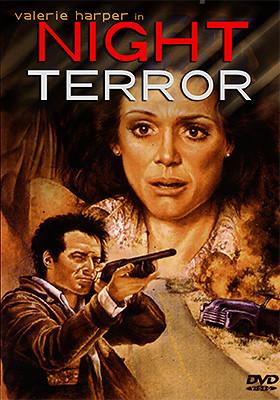
So sang Jim Morrison in the song Riders on the Storm. Now, whatever you may think of Jim Morrison and the Doors (personally, I think the music was good, Jim was pretentious as Hell, and I look cute in my Doors t-shirt), this is a perfect description of the character who is at the center of the 1977 film, Night Terror. He’s played by Richard Romanus and, in the credits, he’s simply called The Killer. The Killer spends his times driving up and down the highway, killing people seemingly at random. We never learn why exactly the Killer does what he does, though the film does offer up a few hints. For one thing, he has no voice. He carries an electrolarynx with him and holds it up to his throat whenever he wants to speak. Of course, he only does this two times in the film and, both times, it’s to basically howl with rage. In another scene, he can clearly be seen to be wearing military-style dog tags. Given when this film was made and the unfortunate popularity of the “deranged Vietnam vet” trope in the 70s and 80s, it’s easy to pick up on what exactly the film is implying.
Night Terror follows one night in the life of both The Killer and Carol Turner (Valerie Harper). Carol is just trying to get to Denver, where her son is in the hospital. When she sees a police officer pulling over a sports car for speeding, Carol decides to ask the cop for directions. Unfortunately, the sports car belong to The Killer and, as soon as the cop turns his back on him, out comes the shotgun. Carol slams down on the accelerator and speeds off, with the Killer pursuing her in own his vehicle. Unfortunately, Carol’s station wagon (which comes with wood paneling because, again, this is a movie from 1977) is nearly out of gas. What follows is a fairly tense game of cat-and-mouse, as Carol tries to hide from the Killer while the Killer stalks the highway, relentlessly searching for her. Along the way, a few familiar character actors pop up. John Quade is a homeless man living in a gas station. The great Nicholas Pryor is another motorist, one who proves to be not much help. Making things all the more dangerous for Carol is that the Killer knows what she looks like but she has no idea what the Killer looks like.
Night Terror owes an obvious debt to Steven Spielberg’s Duel and a host of other 70s car chase films. While Night Terror really can’t compare to the Duel, it does do a good job of creating and maintaining suspense. Fortunately, the film never makes the mistake of tying to turn Carol into some sort of badass action girl. She’s just an average person who has found herself in a terrifying situation and, as played by Valerie Harper, she’s never less than relatable. Richard Romanus, meanwhile, makes for a terrifying killer. The fact that he occasionally flashes a rather child-like smile only serves to make his single-minded pursuit of Carol all the more frightening. We never learn much about what’s led The Killer to becoming what he is but Romanus gives such an intense performance that we don’t need to understand him in order to be scared of him. He’s a nightmare come to life.
Night Terror ends on a somewhat awkward note, as if the filmmakers suddenly remembered that they were making a made-for-TV movie as opposed to a feature film. But, that said, Night Terror is an effectively scary and suspenseful road film. It can currently be viewed on YouTube.


 Through the Shattered Lens