Actually, it is. This video dropped on Christmas Day. Well, okay, in all honesty, it dropped on December 26th, 2001. That’s close enough as far as I’m concerned. Anyone who thinks that singing about heartache while standing on a mountain in the desert isn’t a Christmas tradition has obviously never spent December in West Texas. That said, this video was filmed in Arizona and Utah and Britney really was standing on top of those mountains and singing her heart out.
Welcome to Retro Television Reviews, a feature where we review some of our favorite and least favorite shows of the past! On Sundays, I will be reviewing the made-for-television movies that used to be a primetime mainstay. Today’s film is 1974’s Born Innocent! It can be viewed on Tubi!
Fresh off of her Oscar-nominated role in 1973’s The Exorcist, 15 year-old Linda Blair starred as Christine “Chris” Parker in Born Innocent.
Chris is a 14 year-old who has frequently been caught running away from home. When you consider her home life, it’s easy to understand why she keeps running away. Her father (Richard Jaeckel) is quick to lose his temper and obviously has no clue how to relate to a teenage daughter. When he gets angry at Chris, he beats her. Chris’s mother (Kim Hunter) spends all of her time smoking cigarettes, watching TV, and refusing to acknowledge what Chris is going through. Chris’s older brother (Mitch Vogel) has escaped from their abusive home but he’s now got a family of his own and there’s no room for Chris. With no other options available to her, Chris resorts to frequently running away from home. In the eyes of the system, this makes her both a delinquent and a repeat offender. However, as quickly becomes apparent, Chris is very naïve and hardly a criminal. Instead, she’s just someone trying to escape a terrible situation.
After getting caught once again, Chris is sent to a juvenile detention center. Unfortunately, because of overcrowding, Chris is sent to one of the toughest centers, one where she is surrounded by people who have done a lot more than just run away from home. Everyone knows that Chris doesn’t belong at the center but there’s no where else to send her. With the exception of one teacher (played by Joanna Miles), the staff is too overwhelmed to look after Chris. Meanwhile, the other inmates see Chris as being an easy victim and they start to bully her. Eventually, Chris loses her innocence and becomes just as ruthless and angry as her former victimizers.
Born Innocent is often described as being an exploitation film and, indeed, one can just look at the artwork at the top of this review and see how the film was advertised when it was eventually released on video. That said, the film itself may be undeniably melodramatic but there’s also a sincerity and a sensitivity to it that sets it apart from other women in prison films. Born Innocent is all about how the System creates criminals. From the start of the film, it’s obvious that being locked up is the last thing that Chris needs. Instead, Chris just needs someone to be willing to listen to her but the System would rather just toss her in juvenile hall and then forget about her. Only Chris’s teacher cares about her but, by the time they actually meet, it’s already too late for Chris. She’s already been tossed into a situation where the only thing that matters is survival. Born Innocent is controversial for a scene in which Chris is attacked by several other inmates and sexually assaulted with with a plunger. It’s a shocking scene and I can only imagine have television audiences in 1974 reacted to it. In this scene and the scenes that immediately follow, Linda Blair gives a harrowing performance that captures the emotional trauma of what Chris has been put through. It’s not easy to watch and that’s the point.
Unfortunately, Blair is a bit less convincing during the second half of the film, in which Chris becomes progressively more and more cold-hearted. The idea is that Chris, in order to protect herself, becomes just as intimidating as the girls who attacked her. Unfortunately, the vulnerability that made Linda Blair ideal for The Exorcist and the first half of this film also make it difficult to take her seriously as cold-hearted sociopath. During the second half of the film, Blair tries so hard to come across as being tough that she never convinces us. Later, in films like Savage Streets, Blair would become one of the toughest badasses around but, in this film, she still come across as being essentially born innocent.
I watched a little television this week but not a lot of it. It’s the holidays and I’ve been busy decorating and gift buying. Plus, I had to go the freaking DMV on Thursday to get my license renewed and that took almost all day. Anyway, here’s a few thoughts on what I did watch:
Abbott Elementary (Wednesday Night, ABC)
Abbott Elementary was cute this week. It was kind of nice to see everyone’s life outside of the school. I guess Ava’s boyfriend was a famous basketball player or somebody? I will admit that I did laugh when he got out of that limo, looked down at Janine, and said, “She’s even shorter than you said.” That said, I’m a little worried that Janine is going to settle for Maurice and fall into the same trap that she found herself in with Tariq.
The Amazing Race (Wednesday Night, CBS)
Yay! I was so excited when Derek and Claire crossed that finish line. I always felt that neither one of them was really treated fairly on Big Brother so it was nice to see them get rewarded. Plus, they’re just an adorable couple. I wrote about the finale of The Amazing Race over at Reality TV Chat Blog.
California Dreams (YouTube)
Surf dudes with attitude …. next week, I’m starting Season 3 and I’m looking forward to it. Season 3 through 5 are the classic California Dreams era. Basically, California Dreams can be split into two separate parts: the pre-Lorena era and the Lorena era. Lorena is the character to whom I’ve always related.
Usually, Chef Ramsey seems to secretly like all of the chefs, even the ones that he sends home. But last night, I got the feeling that his dislike for Vlad was very, very real. I feel a bit bad for Vlad but, at the same time, using a cake thermometer to cook meat is not something that a head chef should ever do. That’s like something I would do and there’s no way I’d last more than one dinner service on Hell’s Kitchen.
Law & Order (Thursday Night, NBC)
Once again, Nolan complained that he wasn’t sure if he could “morally” prosecute a case. Fortunately, this week, McCoy kind of told him to stop bitching and just do his job. Good for McCoy! I mean, I have yet to see any evidence of Price’s high morals causing him to refuse his paycheck.
Wow! I was stunned when Cody was voted out. Jesse will betray anyone but I also think he’s probably now in a very strong position to win the game next week. I wrote about Survivor at Reality TV Chat Blog.
Like I said, I didn’t watch much this week. I’ve been busy getting ready for the holidays and for a special person’s birthday. I hope everyone’s having a wonderful month! Can you believe 2022 is almost over?
Welcome to Retro Television Reviews, a feature where we review some of our favorite and least favorite shows of the past! On Saturdays, I will be reviewing California Dreams, which ran on NBC from 1992 to 1996. The entire show is currently streaming on YouTube!
The second season continue as California’s favorite garage band continues to pursue stardom.
Episode 2.16 “Rebel Without A Clue”
(dir by Don Barnhart, originally aired on January 15th, 1994)
When he discovers that he’s running the risk of being sent to summer school, Sly finally gets serious about American History and studies for the big test. He gets an A but, since he’s never gotten an A before, his teacher accuses him to cheating. The school disciplinary board also accuses him of cheating, despite the efforts of Jake to defend him. Sly is suspended and told that he’ll have to make up the class in summer school. Jake commends Sly for being a rebel and for refusing to ask for a second chance but Sly really doesn’t want to go to summer school. So, he dresses up like Ben Franklin and, at the school dance, he demands that the history teacher give him an impromptu test.
The teacher agrees with the condition that, if Sly misses just one question, he’ll be expelled.
WHAT!? Seriously, what type of school is this? You’re punished for getting an A? You’re expelled for missing one question? Is any of this legal? Couldn’t Sly and his parents take the school to court? I mean, this is just weird but it doesn’t matter because Sly gets all the questions correct. He not only gets his A but he also wins Jake’s respect somehow.
Meanwhile, both Tiffani and Sam want to sing the Dreams’s newest song. Jake votes for Sam (and votes against his girlfriend, though who knows if they’re still dating at this point as it’s been a few episodes since they last showed each other any hint of affection). Matt votes for Tiffani. It’s up to Tony to break the tie! Tony votes for …. both of them. The song becomes a duet. That seems like such an obvious solution that it’s kind of amazing that no one thought of it beforehand.
This was a weird episode but Jake and Sly made a good team. Michael Cade (who played Sly) was a good enough actor that he could even make you feel sorry for a character whose catch phrase was “Ba-boom!” That’s no small accomplishment.
Episode 2.17 “Dirty Dog Days”
(dir by Don Barnhart, originally aired on January 29th, 1994)
This episode opens with Tony and Matt playing basketball in the garage and immediately, I noticed that Tony looked considerably younger and Matt looked a bit shorter than he did in the previous episode. Plus, his hair was quite a bit darker. After Tony tried to pull off a trick shot, Jake came roaring up on his motorcycle. The audience want crazy but I couldn’t help but notice that Jake seems like the old surly Jake from the start of the season as opposed to the more light-hearted version who appeared in the previous episode.
“Where are the girls?” Jake asks, “I want to jam.”
“Tiffani’s waxing her board,” Matt says, “and Jenny’s waxing her legs.”
Jenny? Jenny’s not on the show anymore, Matt! She left a long time ago!
As you probably already guessed, this episode was shown out of order. It was originally meant to be the second episode of the season but NBC decided to air it as the second-to-last. As a result, Jenny is suddenly back and Sam is nowhere to be seen. Jake is not dating Tiffani but he is crushing on Jenny.
As for the episode, Sly’s cousin is dying so Sly steals his radio equipment. Jake goes on the air, pretending to be a DJ named Midnight Mike. For some reason, he introduces the Dreams as being the Dirty Dogs, a British band who is visiting California. (This gives Matt a chance to speak with the worst fake British accent that I’ve ever heard.) It turns out that the radio still works and soon, everyone is talking about the Dirty Dogs. Sly decides that they should use the radio to play the Dreams, under the name of the Dirty Dogs. Everyone loves the music but it doesn’t really do the Dreams any good because no one believes that the Dirty Dogs are actually the Dreams. Got all that?
Somehow, Kelly and Jenny don’t understand that Jake is Midnight Mike and they decide that the Dirty Dogs must have stolen the Dreams’s music and that Midnight Mike “accidentally put us on as the Dirty Dogs.” Jake is particularly upset to discover that Jenny has a crush on Midnight Mike but not on him. This is one of those plots that could have easily been resolved by everyone just being honest and not stupid but then again, there would be no show if that was what everyone did.
Eventually, the FCC shows up. They want to arrest Midnight Mike for his pirate radio activities! Stupid government.
Meanwhile, Sly has announced that the Dirty Dogs will be performing at Sharky’s but instead, it will just be The Dreams performing while wearing dog masks. Instead of telling Tiffani and Jenny the truth, they tell them that they will be pretending to be the Dirty Dogs because Sly “lied” about knowing the Dirty Dogs so they’ll be performing to get Sly out of trouble and …. okay, I’m getting a headache just trying to explain this stuff.
Eventually, the Dreams perform, the FCC is outsmarted, and Jake tells the truth to Jenny. Jenny says that Jake may be the one man she’s met who is just as cool as she thought Midnight Mike was. Yay! They’re in love …. except, of course, Jenny’s leaving for music school or she’s going back to music school, depending on how you want to deal with all of the weird continuity errors that were created by showing this episode out-of-order.
To my surprise, I actually liked his episode, just because of how totally incoherent the plot was. It’s one thing to come up with a plot that makes no sense. It’s another thing to unapologetically embrace making no sense and dare people to stop watching. It’s hard not to admire that type of confidence. Once again, Jay Anthony Franke and Michael Cade went out of their way to have as much fun as possible while making no sense. Plus, the song that the Dreams/Dirty Dogs performed was actually pretty good. For once, the Dreams rocked out.
Welcome to Retro Television Reviews, a new feature where we review some of our favorite and least favorite shows of the past! On Fridays, I will be reviewing One World, which ran on NBC from 1998 to 2001. The entire show is currently streaming on Tubi!
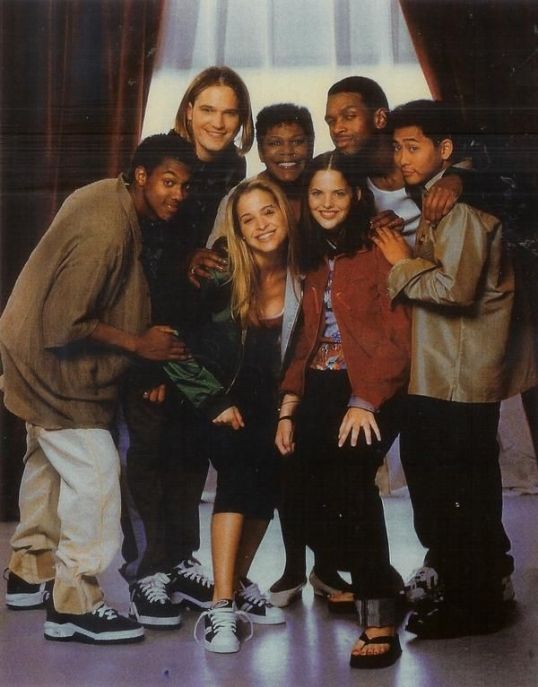
The Cast of One World
This week, Jane makes a new friend and Cray gets a new car! That’s life when you’re living in one world.
Episode 3.3 “The Two Year Itch”
(Directed by Mary Lou Belli, originally aired on October 7th, 2000)
Early on in this episode, Sui’s purse is stolen.
“My life was in that purse!” Sui says.
“You mean like your money and your ID card?” Marci says.
“No, I mean my gum!”
This is a joke format that One World used quite frequently and it always felt incredibly awkward. It’s certainly not a reflection of how real people talk. Perhaps that’s understandable, given that this is a TNBC show. But One World was also meant to be edgy and realistic, a step away from the silliness of Saved By The Bell. The show’s combination of corny jokes and real world issues was strange at best and cringey at worst.
As for the rest of this episode, it follows Jane as she tracks down Jessie, the runaway who stole Sui’s purse. It turns out that Jessie is a homeless teenager who is struggling to survive, just as Jane once was. Jessie has an attitude, just like Jane once did. Jane decides to take Jessie home with her. Jane arranges for Jessie to crash in the hippie van that the family refurbished last season but Jane also goes out of her way to try to keep the Blakes from discovering that Jessie is there. Why? Because this is a stupid show.
Anyway, the Blake kids see Jane sneaking around and keeping secrets and they decide that she must be on drugs. An attempted intervention leads to the Blakes discovering that Jessie has been living in the van. Jessie runs away but later, she decides to go to social services and “enter the system” so she can find a family like Jane’s. It’s a good thing that the American foster system is known for being efficient and well-managed.
In the B-plot, Cray is selected to appear in an orange juice commercial. Cray becomes totally focused on getting an agent and pursuing a show biz career. Dave asks Cray why he’s behaving like this and asks, “Why can’t you just rob a liquor store like other child actors?” In all fairness, Brandon Baker is actually kind of funny as he lets fame go to his head. But again, he gets tripped up by One World‘s dumb joke structure. When he finds out that he’s being replaced as the spokesman for the orange juice company, we get this gem:
“You are being replaced.”
“By a big star?”
“By JoJo the Wonderchimp.”
Seriously …. So. Cringey.
Episode 3.4 “The Race Car”
(Directed by Mary Lou Belli, originally aired on October 14th, 2000)
The Warehouse, Miami’s “hottest under-21 club,” is holding a contest. Whoever can keep their hand on a car for the longest amount of time wins it! Cray wins the car, despite the fact that Marci is assistant manager of the Warehouse and Cray should have been disqualified for being a relative. Since Cray is only 13, he needs to find someone to drive him around all the time. St. Neal refuses to do it. Ben can’t do it because his license is suspended because he keeps parking in handicap spots. (The audience laughs, even though it’s really not funny.)
Jane agrees to drive Cray around but Jane also leaves the keys in the car. When Neal and Ben decide to take the car for a joyride, they get approached by a cop who demands to know if they own the car. When Neal attempts to explain that the car belongs to his “little brother,” the cop accuses Neal of being a gang member and arrests him. When Ben attempts to explain that Neal is not in a gang, he gets arrested as well.
While Neal and Ben languish in jail, Sui and Marci get ultracompetitive over a tennis game and opening up a jar of pickles. Naturally, Sui is the ultimate winner because Sui is the coolest character ever.
During this episode, Karen mentioned several times that she was pregnant. This was a plot development that I has forgotten and, from the amount of times that it was mentioned during this episode, I’m guessing the writers had only recently remembered it as well.
The episode ends with Neal telling off the racist cop while also defending good cops and making it clear that the bad cop was just an aberration, which is the type of ending that would get this show slammed by the AV Club today. Back in 2000, though, the audience loved it.
Welcome to Retro Television Reviews, a feature where we review some of our favorite and least favorite shows of the past! On Thursdays, I will be reviewing City Guys, which ran on NBC from 1997 to 2001. The entire show is currently streaming on Tubi!
Let’s get this over weight. No, no …. I’m not at all second-guessing my decision to sit through every episode of City Guys. Not at all …. this is definitely the best decision that I’ve ever made.
Episode 3.3 “Alley Oops”
(Dir by Frank Bonner, originally aired on September 18th, 1999)
Oh God. This episode not only features a lot of bowling but Ms. Nobel gets a storyline as well.
Even though it’s never been mentioned before, it turns out that Jamal, Chris, Al, and Dawn are all on the same bowling team. What? Like seriously, where did this come from? Anyway, it turns out that the team would be great except for the fact that Dawn is a terrible bowler. Okay, that makes sense. There’s never been any indication that Dawn would be a good bowler. And since Dawn has never been portrayed as being a member of the group’s “inner circle,” you have to kind of wonder how she ended up on the team in first place.
Anyway, there’s a big game coming up against a Puerto Rican team that is led by the flamboyant Lupe Guadalupe (Jose Urbina). One of the interesting things about City Guys is that for all of its “Open up your eyes, we’re all the same” rhetoric and liberal posturing, it was a show that had absolutely no problem making fun of people of either Asian or Spanish descent. Lupe and his team all speak with exaggerated accents and randomly drop Spanish words into their conversation, which the live studio audience finds to be hilarious. On the one hand, Lupe is a stereotype. On the other hand, he’s also the best character in this episode because he never stop taunting the City Guys. Lupe is the better bowler and he knows it and he makes no apologies and it’s impossible not to enjoy the exaggerated rituals that he goes through before rolling the ball down the lane. Considering that this show often acted as if Jamal and Chris were the center of the universe, it’s good to see a character who doesn’t have any respect for them and who is actually better than them at something. Go Lupe!
Anyway, realizing that she sucks, Dawn fakes a wrist injury so that L-Train can take her place on the team. L-Train is a great bowler and it looks like the City Guys might win the trophy! But then Dawn cheers too hard and the cast on her wrist flies off. Everyone really she wasn’t actually injured and an important lesson is learned about something. I don’t know what the lesson was to be honest. I don’t bowl.
While this was going on, Ms. Nobel developed a crush on the new substitute teacher, Mr. Washington. But then she saw Mr. Washington with a younger woman and she assumed she was his girlfriend. It turns out she was just his sister so yay! Ms. Nobel’s getting it tonight.
Let’s move on….
Episode 3.4 “Face The Music”
(Dir by Frank Bonner, originally aired on September 18th, 1999)
“Lionel,” Ms. Nobel tells L-Train towards the end of this episode, “I think you learned an important lesson tonight. Before you show your songs to anyone, you should copyright them.”
Finally! A lesson that all of City Guys‘s audience could take to heart!
Anyway, in this episode, it’s revealed that L-Train is a huge fan of the blues, a songwriter, and a follower of Slick Willie (Sherman Hemsley), a veteran bluesman. Much as with the bowling league, all of this kind of came out of nowhere but, by this point, I’m kind of used to that as far as City Guys is concerned. L-Train, Chris, and Jamal go to see Slick Willie perform at the local blues club. L-Train lets Slick Willie see one of this songs. Slick Willie steals the song and puts it on his next album.
Didn’t the same thing happen to Jake on California Dreams?
This felt like a bit of a throw-away episode, as if Peter Engel called the writers into his office and said, “We’ve got Sherman Hemsley for a day, find something for him to do!” and the writers panicked and just recycled an old California Dreams script. It’s funny that a show about copyright law basically stole its plot from another show. How much you want to bet that we’ll never hear another word about L-Train being an aspiring blues musician?
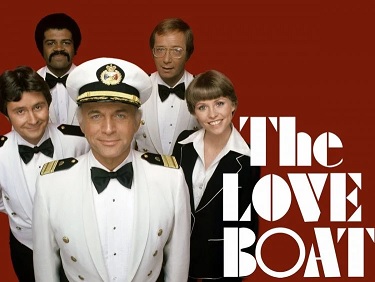
Welcome to Retro Television Reviews, a feature where we review some of our favorite and least favorite shows of the past! On Wednesdays, I will be reviewing the original Love Boat, which aired on ABC from 1977 to 1986! The series can be streamed on Paramount Plus!
It’s time for love and monkeys!
Episode 1.14 “Isaac’s Double Standard / One More Time / Chimpanzeeshines”
(Dir by James Sheldon and Richard Kinon, originally aired on January 14th, 1978)
This is a bit of an odd episode.
It’s odd because it features yet another stowaway. Somehow various characters were always managing to stow away on the boat. This week, the stowaway was a chimpanzee. How did a chimpanzee get on the boat? Gopher brought her on. Apparently, Gopher was under the impression that he had the week off so he agreed to look after a friend’s chimpanzee. Then he discover that he actually was working that week so he decided that it would be a good idea to smuggle the chimpanzee onto the boat. Of course, it doesn’t take long for Isaac and Julie to discover that Gopher has a chimpanzee in his cabin. Neither one of them appears to be surprised that Gopher has a friend who owns a chimpanzee. Me, I would want more information on whether or not Gopher’s friend worked for a circus or a zoo or a research lab. I mean, most people just don’t own chimpanzees as pets. Instead, everyone just accepts that Gopher is living with a monkey and that it is now their duty to keep Captain Stubing from finding out.
Of course, the chimpanzee gets loose. She runs around the ship, stealing food and clothes and surprising passengers. Fortunately, she’s a well-trained chimpanzee and she doesn’t try to kill anyone. In real life, Chimpanzees are known for being extremely dangerous and unpredictable. On shows like this, they’re adorable!
While looking for the chimp, Gopher meets and has a romance with Anne Parker (Kim Lankford), who has just had a nose job. She’s insecure about her new nose. Everyone assures her that her new nose looks great. And it does! As someone who spent most of her teen years planning on getting a nose job, I was really impressed with it. (For the record, I still have my original nose and I now realize I wouldn’t change it for the world.)
While Gopher is dealing with the chimp, Isaac is freaking out because his mother (Pearl Bailey) is on the ship with her new boyfriend (Arthur Adams) and they’re sharing a cabin! Isaac is being a little bit hypocritical because he happens to be sharing a cabin with his girlfriend, Charlene (Tracy Reed). Isaac finally realizes he’s not being fair and he accepts the fact that his mother is having sex at his workplace. So, it all works out.
Meanwhile, in our third storyline, Nanentte Fabray is a singer who is hired to provide the cruise’s entertainment. She’s upset to discover that her pianist (Don Adams) is also her ex-partner. Don’t worry, they get back together by the end of the cruise. Of course, everyone’s too busy looking for the chimpanzee to notice.
This was not a terrible episode, just an odd one. The Nanette Fabray/Don Adams storyline was pretty forgettable and, though it’s always cool when Ted Lange actually gets to do something other than make drinks, Isaac’s family situation played out predictably. What made this episode stand out, for better or worse, was all the business with the chimpanzee. How Gopher kept his job after that, I have no idea. Chimpanzees have been known to kill people if they get stressed out and being dragged onto a cruise ship by a stranger seems like it would be a stressful situation. Still, after all that, Gopher kept his job. I’m beginning to think that Captain Stubing might not be the disciplinarian that the crew things he is.
Next week, we’ve got more love but hopefully less monkeys.