Film Review: Hustle (dir by Jeremiah Zagar)


As I’ve mentioned in the past, there are essentially two Adam Sandlers.

The first Adam Sandler is the comedic actor who, after getting off to a good start with Billy Madison and Happy Gilmore, has appeared in some of the most critically-derided films ever made.  This is the Adam Sandler who has won multiple Razzies for Worst Actor, whose films were often used, in the days before the MCU and DCEU, as an illustration of everything that’s wrong with Hollywood, and who is best known for keeping his friends steadily employed.

The second Adam Sandler is a sad-eyed character actor who has appeared in a string of dramatic and challenging films and who has consistently proven himself to be a sensitive dramatic lead.  The second Adam Sandler plays the same type of characters as the first Adam Sandler but with an added dose of regret.  If the first Adam Sandler specializes in characters with no self-awareness, the second Adam Sandler plays characters who are so self-aware that they’re often paralyzed by ennui.  The second Adam Sandler would probably be a multiple-Oscar nominee if not for the first Adam Sandler.  

If you only knew Adam Sandler from Punch-Drunk Love, Uncut Gems, The Meyerowtiz Stories, and his other dramatic films, you would be totally justified in thinking that he had to be one of our most acclaimed actors.  By that same token, if you only know him from Grown Ups, Jack and Jill, and his other comedies …. well, you would be totally justified in having the opposite opinion.  I think that’s one reason why critics get so much more frustrated with Sandler’s dumb comedies than they do with other comedies.  By the point, we all know how good Sandler can be when he wants to be.

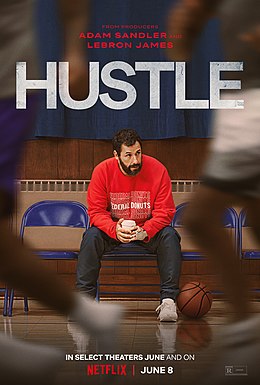
Hustle, Sandler’s latest film, casts Sandler is another dramatic role.  Sandler plays Stanley Sugarman, a middle-aged scout for the Philadelphia 76ers.  Stan spends almost all of his time traveling across Europe, checking out international basketball players who are hoping for a chance to come to America and play in the NBA.  As a result, Stan is frequently away from his wife (Queen Latifah) and he’s missed his daughter’s last few birthdays.  Stan, who was a college basketball star but who never made it into the NBA because of his own dumb decisions, may make a lot of jokes but one need only look at his perpetually downcast eyes to see that Stan is not a happy man.  The only thing that’s really keeping him going is that the owner of the 76ers, Rex Merrick (Robert Duvall), is planning on making Stan an assistant coach.

Unfortunately, the same night that Rex tells Stan that he’s going to be promoted, Rex dies.  Rex’s apparently sociopathic son, Vin (Ben Foster), takes over the organization and announces that Stan will continue as a scout.  (When Stan mentions that he hasn’t shared a birthday with his daughter in his years, Vin smirks.  You know, just in case you needed another excuse to dislike the character.)  Stan heads back to Europe.  In Spain, when his plans to scout a local player don’t work out, Stan stumbles across a pick-up game and discovers a local construction worker named Bo Cruz (Juancho Hernangómez, an actual basketball player who makes a surprisingly assured debut).  Bo is nearly 7 feet tall, he’s got a daughter at home, and he just happens to be a phenomenal basketball player. 

With the help of a Facetime call to Dirk Nowitzki (one of the many former and current basketball players to appear in Hustle), Stan is able to convince Bo that he actually is an NBA scout.  Stan takes Bo back to America but it turns out that 1) Bo has a criminal record that makes the league weary of him and 2) Vin would rather humiliate Stan than give Bo a fair chance.  Driven to quit his job, Stan devotes his time to trying to get Bo ready to enter the NBA draft.  Not only is Stan trying to make Bo’s dreams come true but he’s also trying to find some redemption for his own past mistakes.  And, of course, Stan is also trying to save his career because it’s not like his daughter’s film school is going to be pay for itself!

Basketball is my least favorite sport, largely because I can’t stand the sound of all those squeaky shoes on the court.  And Hustle is a film that was definitely made for basketball fans.  Between all the player cameos and the jokes about Philadelphia sports fan, Hustle has a very specific audience in mind.  That said, Hustle is such a sweet-natured and sincere movie that it can be enjoyed and appreciated even by those of us who aren’t into basketball (or sports in general).  Hustle hits all of the expected sports movie clichés but, wisely, it keeps the focus on Stan and Bo’s friendship.  Neither Stan nor Bo are portrayed as being perfect.  Instead, they’re two men who are trying to do their best, despite both carrying a lot of emotional baggage.  As such, the film becomes less about getting drafted and joining team and more about making peace with both the past and the present.  Sandler and Hernangómez both give heartfelt performances and director Jeremiah Zagar does a good job of framing the action.  This is a film about basketball that was made be people who obviously love basketball but, fortunately, the rest of us can enjoy it too.
The TSL’s Grindhouse: Bad Georgia Road (dir by John Broderick)


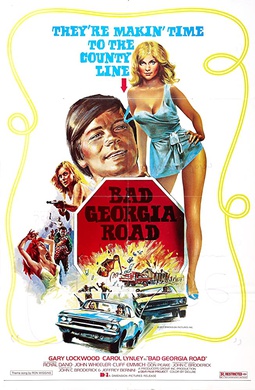
This 1977 film is, for the most part, set in Alabama so I don’t know why it opens with a shot of a car driving down a country road while someone on the soundtrack sings about running moonshine down a “bad Georgia road.”  Then again, I’ve been to both Alabama and California and it’s pretty obvious that, while the film may be set in the former, it was filmed in the latter.  Those hills and mountains in the background definitely belong more to Hollywood than anywhere in the South.

As for the film itself, it’s about Molly Golden (Carol Lynley), a spoiled New York fashion designer who inherits an Alabama farm from an uncle that she barely knew.  When Molly finds out that the land is worth $100,000, she promptly quits her job and moves to Alabama, accompanied by her friend and assistant, Larch (John Kerry and no, not that politician with the private plane).  Molly is planning on selling the land and then heading back north with her money.  Unfortunately, it turns out that her uncle died owing everyone in the county money so, as a result, his farm is worthless and Molly is now in debt.

What is Molly to do?  Fortunately, her uncle’s two farmhands — Leroy (Gary Lockwood, who once co-starred in 2001: A Space Odyssey) and Arthur (Royal Dano) — are onhand to explain to her that her uncle was a moonshiner.  Molly decides to become a moonshiner, too!  Her plan is for Leroy and Arthur to do all the work and for her to make all the money.

While all of this is going on, Molly is also falling for Leroy.  She doesn’t want to admit because she’s a sophisticated New Yorker while Leroy is a redneck slob.  This leads to some conflict between the two of them, as she’s always talking down to Leroy and trying to deny that she’s totally in love with him.  Eventually, in a deeply uncomfortable scene (all the more so because the films attempts to play it for laughs), Leroy literally forces himself on her and Molly realizes that she could be totally happy runnin’ moonshine with a barely literate hick.

I’m a Southern girl and, perhaps even more importantly, I’m enough a country girl that I usually enjoy a good moonshine and car chase film.  And Bad Georgia Road gets off to a good start with an enjoyable chase scene, even if the road that the cars are roaring down is clearly located on the West Coast instead of the Deep South.  But things go off the rails as soon as Molly and Larch show up in Alabama.  What there is of a plot plays out at a painfully slow pace and there’s absolutely zero romantic chemistry between Gary Lockwood and Carol Lynley.  On the plus side, Royal Dano is enjoyable eccentric as Arthur, an old-timer who may not be educated but who knows everything that needs to be known about both the Bible and moonshine.

Bad Georgia Road is the type of 70s film that was specifically made to play in Southern drive-ins, where audiences would undoubtedly appreciate the film’s portrait of a clueless Yankee getting outsmarted by a bunch of country folk.  (For me and probably most other people, that’s actually the main appeal of the moonshine genre.)  But even if you think that Molly is a totally smug and self-righteous New Yorker, she still deserves better than to get stuck with Leroy, a man who looks like he probably reeks of chicken feed and spilled beer.  Especially if you’ve seen his personable performances in films like Model Shop and 2001, it’s hard not to feel bad for Gary Lockwood while watching this film.  What did that bad Georgia road do to him?

Film Review: Marry Me (dir by Kat Coiro)


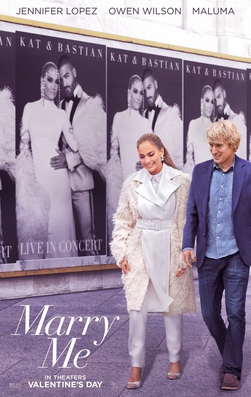
In Marry Me, Jennifer Lopez plays Kat Valdez, a superstar who has the number one single in the history of the world with Marry Me, a duet that she performs with her fiancé, Bastian (Maluma).  The plan is for Kat and Bastian to marry onstage, as the climax of one of Kat’s concerts.  For Kat, it will be her third marriage but she’s determined to make it work because, underneath all the glamour and show-biz glitz, Kat is a romantic at heart.  However, right before Kat is due to step out on stage to get married, TMZ reports that Bastian has been cheating on Kat.

Heart-broken, Kat steps out onstage.  She talks about the pain of being betrayed.  In the audience, one man nods along with her.  Kat sees the sympathetic look in the eyes of math teacher Charlie Gilbert (Owen Wilson) and she calls him up on stage.  “Kat,” the minister asks, “Do you take this guy?”  She says “I do.”  Charlie says that he does.  And …. they’re married!

Wait, what?

Now, of course, Charlie really isn’t sure who Kat Valdez is.  He came to the concert with his daughter and his best friend (played by Sarah Silverman) and the only reason that he was holding a sign that read “Marry Me,” was because it was handed to him at the last minute.  Charlie is far more interested in walking his dog, trying to connect with daughter, and coaching his students to victory in the upcoming mathalon.  As they leave the concert, Charlie explains that he just said “yes” because Kat appeared to need someone at that moment and that he certainly doesn’t expect to remain married to Kat.

However, Kat’s management suggests that maybe the two of them should stay married for three months, just for the sake of good publicity….

Wait, what?

Look, I could tell you that Marry Me is a deeply silly film but you probably already guessed that.  You probably guessed that from watching the trailer.  It’s a determinedly old-fashioned film, with the only thing indicating that the film was made after 2014 is the fact that it’s Jimmy Fallon who is shown making jokes about Kat’s marriage instead of Jay Leno.  The plot is not only silly but it’s also extremely predictable.  Do I really need to tell you that Kat is going to be charmed by Charlie’s simple life and that she’s going to end up helping his students prepare for the mathalon?  For that matter, do I have to tell you that Charlie is going to struggle with the feeling that he doesn’t fit in with Kat’s glamorous life style?  You know where this is going.

That said, it’s an amiable film, largely due to the two leads.  Jennifer Lopez is one of the few performers who can come across as being likable and down-to-Earth, even when she’s jumping into a limo and demanding that the driver take her to the airport.  The film also makes good use of Owen Wilson’s goofy charm.  The film’s story may be implausible but, if something that weird ever did happen, it would probably happen to Owen Wilson.  While I would have preferred a film with a bit more of a satirical edge and I think it’s one of those films for which you definitely have to be in the right mood, Marry Me is a likable romantic comedy.

Guilty Pleasure No. 56: Once You Understand By Think


Things get a little easier

Once you understand

That is the message of TSL’s latest guilty pleasure, a little song from 1971 called Once You Understand.  In case you missed that message the first time, don’t worry.  It will be repeated.  In fact, it’s the only lyric in the entire song.  The song starts with one voice singing, “Things get a little easier/once you understand” but soon, several other voice join in until there’s a heavenly choir of sorts.  It’s really enthusiastic choir, too.  In fact, it’s so enthusiastic that it’s a little bit creepy.  No one’s that happy about understanding.

While the voices are singing to us that things get a little easier once you understand, we also get to listen to a few scenes from the late 60s/early 70s generation gap.  The scenes are acted out by a bunch of uncredited actors who give it the old community theater try.  We listen to teenagers argue with their parents and parents talk down to their children and what we immediately notice is that no one is trying to understand and therefore, things will never get a little easier.

One mother accuses her daughter of doing more than babysitting and demands that she stay out of a certain neighborhood.  A father demands that his son get a haircut and reminds him that he had to work hard when he was young.  Another kid is super excited to have gotten a guitar and he’s planning on starting a band.  His father replies that there’s more to life than music.

Things get a little easier

Once you understand

Things get a little easier

Once you understand

Things get a little

Suddenly, the music stops.  We listen as one of the fathers gets a tragic phone call about his son, the one that he didn’t understand.  The father sobs uncontrollably as the song ends and I guess it could, in theory, have been a powerful moment if not for the fact that father is so obviously reading a script.  The other problem is that 99% of the song consists of parents acting like jerks but then, in the final few moments, it turns out that at least one of the parents was right about his son throwing his life away.  So maybe, it was the son who needed to understand.  Who knows?

Anyway, Once You Understand is one of those songs that’s often included in lists of the worst songs of all time.  However, much like The Dawn of Correction, I like Once You Understand because it is so totally a product of its time.  It’s a cultural artifact and listening to it is a bit like stepping into a time machine.  That said, I kind of doubt this song inspired anyone to understand.  If anything, everyone comes across as being kind of whiny.

Previous Guilty Pleasures

  1. Half-Baked
  2. Save The Last Dance
  3. Every Rose Has Its Thorns
  4. The Jeremy Kyle Show
  5. Invasion USA
  6. The Golden Child
  7. Final Destination 2
  8. Paparazzi
  9. The Principal
  10. The Substitute
  11. Terror In The Family
  12. Pandorum
  13. Lambada
  14. Fear
  15. Cocktail
  16. Keep Off The Grass
  17. Girls, Girls, Girls
  18. Class
  19. Tart
  20. King Kong vs. Godzilla
  21. Hawk the Slayer
  22. Battle Beyond the Stars
  23. Meridian
  24. Walk of Shame
  25. From Justin To Kelly
  26. Project Greenlight
  27. Sex Decoy: Love Stings
  28. Swimfan
  29. On the Line
  30. Wolfen
  31. Hail Caesar!
  32. It’s So Cold In The D
  33. In the Mix
  34. Healed By Grace
  35. Valley of the Dolls
  36. The Legend of Billie Jean
  37. Death Wish
  38. Shipping Wars
  39. Ghost Whisperer
  40. Parking Wars
  41. The Dead Are After Me
  42. Harper’s Island
  43. The Resurrection of Gavin Stone
  44. Paranormal State
  45. Utopia
  46. Bar Rescue
  47. The Powers of Matthew Star
  48. Spiker
  49. Heavenly Bodies
  50. Maid in Manhattan
  51. Rage and Honor
  52. Saved By The Bell 3. 21 “No Hope With Dope”
  53. Happy Gilmore
  54. Solarbabies
  55. The Dawn of Correction

What Lisa Marie Watched Last Night #220: Deadly Yoga Retreat (dir by Brian Herzlinger)


Last night, I watched the Lifetime film, Deadly Yoga Retreat!

Why Was I Watching It?

I watched this film for a number of reasons.  First off, yoga has been on my mind lately because, over the past two weeks, I have managed to strain my back not once but twice!  My mom also had trouble with her back and she was a big believer in yoga as something more than just an excuse to wear a cute outfit.  Myself, I have to admit that the outfit has always been the main appeal to me.

Secondly, the film was on Lifetime and it’s been a while since I’ve gotten to sit down and watch a good Lifetime film.

Third, I wanted an excuse to do one of my What Lisa Marie Watched Last Night reviews.  I have fun writing them.

What Was It About?

Remy Morrow (Jonathan Bennett) runs the most exclusive and demanding yoga retreat out there.  He expects you to show up on time.  He expects you to take yoga seriously.  He expects you to take him seriously.  If you don’t take him seriously, he’ll kick you out of the group.  And, if that’s not enough to get rid of you, he’ll just kill you.  Killing people over yoga?  That may sound extreme but Remy’s an extreme guy.

Isabella (Danielle C. Ryan) may just be planning on using the yoga retreat as a way to get away from her struggling marriage but she’s about to discover that Remy has his own plans for her and the other students.

What Worked?

Like many recent Lifetime film, Deadly Yoga Retreat takes a deliberately campy approach to its story.  It’s not meant to be taken seriously and Jonathan Bennett brings exactly the right sensibility to his performance as Remy, playing him as being the unhinged yoga instructor from Hell.  There’s not a single subtle moment to be found in Bennett’s performance but this isn’t a film that calls for subtlety.  This is a film that calls for someone willing to totally embrace the melodrama and go over the the top and, as anyone who saw him on Celebrity Big Brother can tell you, Bennett is certainly willing to do that.  Bennett’s approach was nicely balanced by Danielle C. Ryan, who was likable as Isabella.

When you sit down to watch a film called Deadly Yoga Retreat, you know what you’re getting into.  If there’s anything that I don’t have much use for, it’s people who act all offended or shocked that a movie like this would turn out to be deliberately campy and kitschy.  This is a Lifetime film and it’s about a psychotic yoga instructor.  You knew what you were getting into when you saw the title.  The title promises attractive people in cute outfits doing dangerous and sexy things in a lovely, beach-filled location.  Here’s the important thing: Deadly Yoga Retreat delivers exactly what it promised.

What Did Not Work?

As far as I’m concerned it all worked.

“Oh my God!  Just like me!” Moments

My best friend Evelyn and I occasionally went to a yoga class when we were in college.  The instructor was intense, though not murderous.  He always used to say stuff like, “Yoga is for lovers” and “This weekend should be all about you, yoga and a lover.”  Actually, he was pretty  creepy.  Anyway, he always used to get annoyed because we would giggle through his class but I don’t think he ever killed anyone.

Lessons Learned

Don’t say “Namaste” unless you mean it.

Guilty Pleasure No. 55: The Dawn of Correction


The year was 1964 and folk singer Barry McGuire had just released a new song called Eve of  Destruction.  In Eve of Destruction, McGuire painted an apocalyptic view of the world and put a lot of the blame on the Cold War.  McGuire wrote about 18 year-olds being sent to war when they weren’t even allowed to vote.  (At that time, the voting age was 21.)  McGuire wrote about the nuclear arsenals of the U.S. and Russia, saying that nuclear annihilation was just one push of a button away.  McGuire sang about the Civil Rights struggle and the feeling that all of the well-meaning protests hadn’t led to any real change.

Not surprisingly, this early protest song was as controversial as it was popular.  While many claimed that McGuire was one of the few singers willing to sing the truth, others said that he wasn’t being unpatriotic and excessively negative.

That’s where The Spokesmen came in.  The Spokesmen were a trio, made up of John Madera, David White, and Ray Gilmore.  Feeling that McGuire wasn’t being fair in his critique of the good old U.S., the Spokesmen released an “answer song,” one that addressed all of McGuire’s charges and which dismissed them all.  McGuire sang about the “Eve of Destruction.”  The Spokesmen decided that they would sing about the …. DAWN OF CORRECTION!

As the song’s chorus says: 

So over and over again, you keep sayin’ it’s the end
But I say you’re wrong, we’re just on the dawn of correction

What exactly is “the dawn of correction?”  I honestly have no idea.  But it probably sounded profound while the song was being written.  Plus …. destruction …. correction …. it rhymes!

Anyway, the Dawn of Correction was a minor hit when it was released, though it was soon forgotten about as the protest movement grew and teenagers in the 60s saw far more evidence to support McGuire’s vision of the world than the vision of the Spokesman.  Among music aficionados, Dawn of Correction has developed a reputation for being one of the worst songs ever written.

I have to admit though that, when I recently listened to the song, I kind of liked it, in much the same way that I like zero-budget polemical films and kitschy dance scenes.  It’s one of those songs that is so definitely rooted to one cultural moment that, from a historical point of view, it becomes rather fascinating.  It’s lyrics are just so strangely literal.  (It takes a certain …. something …. to try to put a positive spin on the policy of mutually assured destruction in a folk song.)  Even more than that, lead singer John Madera attempts to duplicate the raspy growl the McGuire used while singing Eve of Destruction and, even though he doesn’t succeed, there’s something oddly touching about how hard he tries.  With a Dylanesque harmonica playing in the background, the song is so determined to be “with it,” that you just know some government teacher in 1967 probably tried to reach her apathetic students by forcing them to listen to this song in class.  

Finally, to be honest, that chorus is kind of catchy.  Watch the band perform below and be sure to pay attention to the dancers.

Lyrics
The western world has a common dedication
To keep free people from Red domination
And maybe you can’t vote, boy, but man your battle stations
Or there’ll be no need for votin’ in future generations
 
So over and over again, you keep sayin’ it’s the end
But I say you’re wrong, we’re just on the dawn of correction
 
There are buttons to push in two mighty nations
But who’s crazy enough to risk annihilation?
The buttons are there to ensure negotiation
So don’t be afraid, boy, it’s our only salvation
 
So over and over again, you keep sayin’ it’s the end
But I say you’re wrong, we’re just on the dawn of correction
 
You tell me that marches won’t bring integration
But look what it’s done for the voter registration
Be thankful our country allows demonstrations
Instead of condemnin’, make some recommendations
I don’t understand the cause of your aggravation
You mean to tell me, boy, it’s not a better situation?
 
So over and over again, you keep sayin’ it’s the end
But I say you’re wrong, we’re just on the dawn of correction
 
You missed all the good in your evaluation
What about the things that deserve commendation?
Where there once was no cure, there’s vaccination
Where there once was a desert, there’s vegetation
Self-government’s replacing colonization
What about the Peace Corp. organization?
Don’t forget the work of the United Nations
 
So over and over again, you keep sayin’ it’s the end
But I say you’re wrong, we’re just on the dawn of correction

But I say you’re wrong, we’re just on the dawn of correction
 
So over and over again, you keep sayin’ it’s the end
But I say you’re wrong, we’re just on the dawn of correction

Previous Guilty Pleasures

  1. Half-Baked
  2. Save The Last Dance
  3. Every Rose Has Its Thorns
  4. The Jeremy Kyle Show
  5. Invasion USA
  6. The Golden Child
  7. Final Destination 2
  8. Paparazzi
  9. The Principal
  10. The Substitute
  11. Terror In The Family
  12. Pandorum
  13. Lambada
  14. Fear
  15. Cocktail
  16. Keep Off The Grass
  17. Girls, Girls, Girls
  18. Class
  19. Tart
  20. King Kong vs. Godzilla
  21. Hawk the Slayer
  22. Battle Beyond the Stars
  23. Meridian
  24. Walk of Shame
  25. From Justin To Kelly
  26. Project Greenlight
  27. Sex Decoy: Love Stings
  28. Swimfan
  29. On the Line
  30. Wolfen
  31. Hail Caesar!
  32. It’s So Cold In The D
  33. In the Mix
  34. Healed By Grace
  35. Valley of the Dolls
  36. The Legend of Billie Jean
  37. Death Wish
  38. Shipping Wars
  39. Ghost Whisperer
  40. Parking Wars
  41. The Dead Are After Me
  42. Harper’s Island
  43. The Resurrection of Gavin Stone
  44. Paranormal State
  45. Utopia
  46. Bar Rescue
  47. The Powers of Matthew Star
  48. Spiker
  49. Heavenly Bodies
  50. Maid in Manhattan
  51. Rage and Honor
  52. Saved By The Bell 3. 21 “No Hope With Dope”
  53. Happy Gilmore
  54. Solarbabies

Lisa Marie’s Week In Television: 5/29/22 — 6/4/22


Let’s check out the butcher’s bill for this week:

Allo Allo (Sunday Night, PBS)

Having returned from England, Rene was named the editor of the town newspaper.  He was expected to just publish propaganda.  Michelle was excited to have access to a printing press.  The latest plan to get the Airmen back to Britain is to make a raft out of telephone poles.  We’ll see how that goes.

Barry (Sunday Night, HBO)

Between Fuches somehow surviving getting shot at point blank range, Vanessa Bayer making silly noises as she explained what she thought Sally could bring to a show about Medusa living in SoHo, and that amazingly highway dirt bike chase, this week’s episode of Barry was one of the best overall episodes of the year so far.  Who would have thought Bill Hader would be so good at directing action?

Creepshow (Shudder)

I finished up season 3 of Creepshow this week.  What a wonderfully macabre show!  It’s just as ghoulish as American Horror Story without being so annoying self-impressed.

Full House (Sunday Evening, MeTV)

Much like Rene on Allo Allo, DJ become editor of the school newspaper!  Kimmie Gibbler wanted to report on sports.  It led to a big fight but things worked out in the end.  Meanwhile, Joey tried to direct a commercial with Danny and Rebecca.  It led to a big fight but things worked out in the end.  Did I already say that?  Anyway, it was indeed a very full house.

Maid (Netflix)

At ten episodes, this miniseries was a bit on the long side but it was still a very good show.  Margaret Qualley played an aspiring writer who, having left her abusive husband, finds work as a maid while trying to move forward with her life and her daughter.  Qualley gave a great performance in the lead role and the show dealt with serious issues without ever descending into melodrama.

Norm McDonald: Nothing Special (Netflix)

In his final comedy special, Norm McDonald talked about …. well, he actually spent a lot of time talking about death.  He was undeniably funny, an older comedian who could talk about how the world was changing without coming across as being either mean-spirited or performatively woke.  What was interesting about this special (which was recorded in his home studio, in one take) was watching how McDonald would seemingly just stumble from point to point while still always bringing everything together in the end in a way that revealed the fierce intelligence that hid beneath the “average guy who likes to drink beer” persona.  At first, I thought he was just rambling but then I noticed that he kept returning to his love of the color yellow.

The final 30 minutes of the special were made up of David Letterman, Conan O’Brien, Molly Shannon, Dave Chapelle, Adam Sandler, and David Spade talking about Norm and his special.  The roundtable was mostly interesting just for the obvious the affection that everyone involved had for Norm McDonald.  It was sweet to witness.

Pistol (Hulu)

I really enjoyed Danny Boyle’s six-episode miniseries about The Sex Pistols and, needless to say, I related to Sidney Chandler’s Chryssie Hynde.  I have no doubt that the miniseries offers a bit of a romanticized view of how things went down (that’s kind of Boyle’s thing) but it was well-acted, well-shot, and compulsively watchable.  The first four episode were the strongest.  The final two got a bit bogged down with Sid’s heroin addiction but the same can be probably be said of the band itself.  All in all, though, this was a good and respectful miniseries.  I know that Johnny Rotten is not a huge fan of the show and I can kind of understand why because, as I said earlier, it does tend to romanticize things.  But, as played by Anson Boon, Johnny is always one of the most compelling characters in the show.

Saved By The Bell (Peacock)

I watched the second and final season of Peacock’s Saved By The Bell revival on Friday.  This was actually a really good and clever comedy and it’s kind of a shame that it didn’t last longer.  Mario Lopez and Elizabeth Berkley Lauren were both a lot of fun to watch as they not only parodied their SBTB past but, at the same time, managed to make Jessie and Slater into actual human beings.  It was nicely done.

BEAT VALLEY!

We Own This City (Monday Night, HBO)

The finale of We Own This City aired on Monday.  As I watched the first half of the finale, I came dangerously close to writing the show off as just being an example of how heavy-handed David Simon can be when he doesn’t have an equally strong collaborator to work with.  However, I stuck with it and I’m glad I did.  The final 30 minutes, in which we watched the crooked cops get sentenced to prison while also learning that it all ultimately made no difference as far as Baltimore’s culture of corruption was concerned, were undeniably powerful.  The final flashback, to Jon Bernthal pumping up the cops about doing their job, was sad because it represented the failure of the cops to live up to their oath but it was also frightening because it perfectly captured the “warrior cop” mentality.

I have to give special mention to Jamie Hector, playing an otherwise honest homicide detective who was driven to suicide by the possibility of losing his job because he was on the periphery of corruption.  It took me a few episodes to get used to Hector (best-remembered as psycho drug lord Marlo Stanfield on The Wire) in a sympathetic role but he truly delivered an outstanding performance in the final episode.

Film Review: The Sky Is Everywhere (dir by Josephine Decker)


What is the best way to deal with the grief of losing a family member?

That is the question asked by The Sky Is Everywhere, the latest film from Josephine Decker.  The film’s answer seems to be that the first step is to have a quirky grandma who paints and a stoner uncle who is somewhat inevitably played by Jason Segel and to live in a big, rambling house that, in the real world, you probably wouldn’t be able to afford to keep up.  The second step is to be a member of the band at one of those weird high schools where everyone loves the band kids as opposed to finding them to be insufferably pretentious.  The third step is to have a chance to win admission to Julliard but only if you can play through your grief.  Finally, find yourself a bland and non-threatening love interest who is supposed to be a musical prodigy.  If you can complete those four steps, you might just make it!

The Sky Is Everywhere, which is based on a YA novel that I have not read, stars Grace Kaufman as Lennie Walker, who was extremely close to her sister, Bailey (played, in flashbacks and fantasy sequences, by Havana Rose Liu).  At one point, Lennie explains that she always felt like she was “a show pony” whenever she was next to her sister and that she never really had any identity outside of being Bailey’s supportive sister.  But then Bailey dropped dead while at rehearsals for Romeo and Juliet so Lennie has to find her own identity and decide whether to date the aforementioned bland musician, Joe Fontaine (played by Jacques Coliman), or Bailey’s ex-boyfriend, Toby (Pico Alexander).  Lennie’s real name, by the way, is Lennon and I assume she’s named after John Lennon because that’s just the type of film that The Sky Is Everywhere Is.  What if Lennie’s parents had been fans of the Starlight Vocal Band and decided to name her Taffy?  Would she still be the first chair clarinetist?  It’s something to think about.

(Also, who was Bailey named after?  I’m going to guess Connecticut political boss John Bailey.)

Grandma Walker (played by Cherry Jones) is a painter who keeps insisting that it’s time to pack up Bailey’s things.  Grandma also has a gigantic garden, one that is full of roses.  When Lennie and Joe listen to music together, they’re suddenly floating through the air and surrounded by Grandma’s flowers.  When it comes time for Grandma to finally express her grief over losing Bailey, she does so by destroying the least favorite of her paintings.  “Not my best work,” as Grandma puts it.  But, to be honest, all of Grandma’s paintings suck so I have to wonder how she managed to narrow down her least favorite painting to just one.  Does Grandma make her living as a painter?  I guess so, since Jason Segel’s Uncle Big doesn’t really do much other than smoke weed and pick bugs off his windshield.  

Anyway, I suppose this film was made with good intentions but it’s just too overwritten, overdirected, and overly quirky.  For a film that deals with grief, there’s really not a single authentic moment to be found in the film.  A huge part of the problem is that, though we always hear everyone talking about Bailey, we never really know who Bailey was.  The same is true of Lennie, who is on-screen all of the time but who always just seems like a collection of YA quirks.  She reads Wuthering Heights (presumably because she and Bailey are meant to be like the Bronte sisters).  She plays the clarinet.  She likes to walk among the redwoods and she writes messages on leaves.  These are all legitimate interests but they’re not a personality.  They’re not an identity.  It’s hard not to compare this film to something like CODA, where Ruby’s love of singing and her love for her family were all a big part of her life but they weren’t the only things that defined who she was as a person.  Ruby was an individual, which is something that really can’t be said for any of the characters in The Sky Is Everywhere.  Since none of the characters feel real, there’s no emotional authenticity to any of the big moments.  Instead, it just feels like we’re watching people who learned how to talk and act by watching other YA adaptations.

The Sky Is Everywhere tries so I guess it deserves a half-star for that.  But, in the end, it doesn’t add up too much.