The filmParty Monster, which I just reviewed, was a very bad version of the somewhat interesting true story of how Michael Alig went from being a New York nightlight celebrity to a convicted murderer. One of the biggest problems with the film was Macauley Culkin’s dull performance as Alig.
As bonus to my review of Party Monster, here’s a 1994 episode of — ugh — Geraldo, featuring Alig, the Club Kids, and the soon-to-be-deceased Angel. Alig and his club kids still come across as if they’re trying way too hard to be outrageous (they’re the ultimate conforming nonconformists) and I will warn you that watching this clip will mean spending 44 minutes with one of the most fatuous media personalities in American history. But still, this episode does feature a look at the story that Party Monster totally screwed up. Just two years after this episode aired, Alig would kill Angel and dismember him in a bathtub.
Michael Alig! He was the flamboyant, self-declared “King of the Club Kids.” He was a club promoter in New York City in the late 80s and the 90s. He had money. He had fame. He had a huge following. He used to appear regularly on the daytime talk shows. He was a regular feature in the gossip columns. He also had a raging drug addiction and an ego that most people couldn’t stand. He tried to position himself as the successor to Andy Warhol, overlooking the fact that Warhol himself actually had a bit of talent. And, in 1996, he became a murderer.
He and his roommate killed his drug dealer, a fellow club kid who was known as Angel. They hit him over the head and suffocated him before then dismembering him. Everyone knew that Alig was responsible for Angel’s disappearance, largely because he wouldn’t shut up about killing him. Alig even threw a party where the macabre and bloody decorations left little doubt that Alig had murder on his mind. Eventually, a group of children found Angel’s remains and Alig and his roommate were arrested. Due to a plea deal, Alig was sent to prison for manslaughter. He served 14 years before being paroled. Alig died of a heroin overdose in 2020.
Released in 2003 (while Alig was still in prison), Party Monster is a biopic of Michael Alig and also a look at New York club culture in the 90s. The film got a bit of attention when it came out because it starred Macaulay Culkin and Seth Green as, respectively, Michael Alig and James St. John, who was Alig’s mentor-turned-friend-turned-enemy. Unfortunately, the film itself isn’t very good and both Culkin and Green are lousy in their roles. Both of them come across like middle American high school kids trying to score cheap laughs by acting as self-consciously flamboyant as possible. At the time the film was made, Culkin did bear a passing a resemblance to Michael Alig but the same could have been said of Michael Pitt and, at the very least, we know that Pitt is capable of playing a character who is capable of murder. Culkin, on the other hand, seems to be trying so hard to make us forget that he’s Macaulay Culkin that he instead continually reminds us that we’re watching the star of Home Alone snort cocaine and urinate in wine glasses. (Ewwwww!) That said, Culkin and Green aren’t the only two giving bad performances here. I started giggling as soon as Dylan McDermott showed up wearing an eyepatch. Only Wilson Cruz as Angel and Chloe Sevigny as one of Alig’s associates feel in any way convincing in their roles.
For a film about a group of people who claimed “fabulousness” as their defining aesthetic, Party Monster is a visually dull film. Many scenes are overlit, to the extent that the performers look wan and washed out. That may be a good look for the drug-addled Alig who killed Angel but, in this film, Alig looks and seems burned out from the minute he shows up in New York City. The end result is a rather boring film that doesn’t offer up any insight into the Club Kids or the murders.
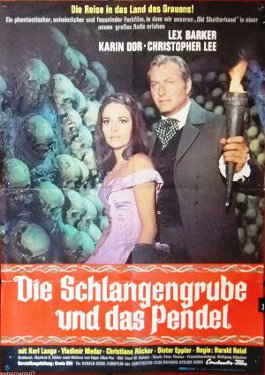
On Saturday night, I watched the 1967 German horror film, The Torture Chamber of Dr. Sadism.
I have to say that the film itself turned out to be quite a bit more entertaining than I was expecting it to be. It was an entertaining and atmospheric horror film, the type where travelers rode in stage coaches to gothic castles and Christopher Lee showed up as the villain. However, I was very disappointed to discover that, while the film did feature a torture chamber, there was not a character named Dr. Sadism anywhere to be found. In fact, I don’t think that the word “Sadism” was even mentioned in the film.
Of course, The Torture Chamber of Dr. Sadism was not the only title by which this film was released. As was typical of horror films in the 60s (especially international horror films), this film had many different titles. In Germany, it was known as Die Schlangengrube und das Pendel. It was also released under titles like The Blood Demon, The Crimson Demon, The Snake Pit and the Pendulum, and The Castle of the Walking Dead. That’s a collection of good names. It’s just too bad that they were all given to one film as opposed to being spread out amongst several films.
The Torture Chamber of Dr. Sadism (or whatever you want to call it) opens with a public execution. Count Regula (Christopher Lee) has been found guilty of the murder of 12 virgins. Regula is forced to wear a gold mask with a rather awkward smiley face on the front of it. He is then forced to lie down in the town square and his wrists and his ankles are tied to four horses. As the red-hooded executioner looks on, the horses run in four different directions and, though we don’t actually see it, Count Regular is ripped apart. Agck!
35 years later, Baroness Lilian von Brabent (Karin Dior, wearing a purple gown that is simply to die for) and her lawyer, Roger Mont Elise (Lex Barker) are invited to pick up an inheritance that is due to the Baroness. The only catch is that they’ll have to ride a stagecoach all the way to a forbidding castle that the locals refer to as being Blood Castle. On the way to the castle, they are joined by a highwayman who is pretending to be a priest (Vladimer Medar) and the Baroness’s maid (Christiane Rucker). They are ride through a forest where the trees are full of human limbs. They battle some mysterious robbers. They discover a burned out church and an apparent madman living inside the ruins. Eventually, they reach the castle where the resurrected Count Regula waits for them, along with his undead, green-blooded servant, Anatol (Carl Lange). Count Regula is eager to sacrifice a 13th virgin so that he can become immortal. Apparently, this will grant Regula immortality, which he does not yet have despite the fact that he’s somehow recovered nicely from being dismembered and beheaded. Regula announces that the Baroness will be his next virgin victim.
(See, there’s actually very real advantages to not waiting.)
The Torture Chamber of Dr. Sadism is one of those films that is described as being based on the writings of Edgar Allan Poe. In this case, that means that Roger ends up in a pit with a pendulum swinging over him. For a film with a title like The Torture Chamber of Dr. Sadism (or even The Blood Demon), there’s not really a lot of gore in this film. Instead, the film focuses more on creating and maintaining a properly gothic atmosphere. It’s surprisingly entertaining, largely due to the ominous design of the torture dungeon, Christopher Lee’s villainy, Vladimer Medar’s comedic relief, the beauty of Karin Dor, and the square-jawed heroism of Lex Barker. Lee, in particular, deserves some credit for embracing the melodrama in his role as Regula. Lee knows exactly the type of film in which he’s appearing and he appropriately modulates his performance.
Whatever title you see it under, The Torture Chamber of Dr. Sadism will keep you entertained.
In 1987’s Blood Harvest, college student Jill Robinson (Itonia Salochek) returns to her hometown in rural Wisconsin and discovers that there have been some changes.
For one thing, the local farmers are struggling and the bank is foreclosing on their land. Since Jill’s father is the president of the bank, people are not particularly happy to see her in town. (One farmer spits at her.) When Jill arrives at her parents home, she discovers insulting graffiti on the exterior and a strawman hanging in the front corridor. Even more upsetting, her parents are nowhere to be found!
Jill goes to see Sheriff Buckley (Frank Benson) about the graffiti but when they go back out to Jill’s house, both the graffiti and the strawman have vanished. The sheriff tells Jill not both him anymore and then leaves her alone at her home. Most people would probably panic about this but not Jill! Instead, Jill hangs out with her childhood friend, Gary (Dean West).
Gary’s has had a tough time of it recently. His parents recently died mysteriously and he now takes care of his brother, Mervon (played by 60s folk singer Tiny Tim). Gary and Mervon are an oddly matched pair of siblings. For one thing, Gary appears to be no older than 20 while Mervon is in his late 60s. Gary looks like a fresh-faced jock. Mervon has long stringy hair, speaks in a falsetto voice, and always wears clown makeup. Mervon, who prefers to be called The Magnificent Merv, also likes to sing about how Gary and Jill went up the hill to fetch a pail of water. As for Gary, he is disappointed to hear that Jill not only has a boyfriend at college but that she’s also engaged to him. It doesn’t help that Jill keeps saying stuff like, “If my father hadn’t caught us that time, it could have been you and me getting married!”
While Jill’s parents remain missing, she is visited by her boyfriend (Peter Krause, making his film debut) and her best friend, Sarah (Lori Minnetti). Because Jill isn’t particularly smart, she doesn’t notice when both her boyfriend and her BFF are dragged over to her family’s barn and brutally killed. (Jill does eventually start to worry about the whereabouts of her boyfriend but it’s not like Sheriff Buckley is going to help her….) Who is the person who is not only murdering Jill’s friend but also frequently drugging her and undressing her so he can take pictures? Well, there’s only two suspects and the scare scenes are so clumsily staged that you’ll see the killer’s face long before you were probably meant to.
Blood Harvest was directed by Bill Rebane, the Wisconsin-based filmmaker behind The Giant Spider Invasion and The Demons of Ludlow. (Ludlow even gets a shout-out.) It’s a typical Rebane film, with all of the inconsistent acting and incoherent plotting that he is typically known for. At the same time, it’s also a film that’s a bit more interesting that one might expect just from the plot description. There’s an interesting political subtext to Jill’s father being the banker who is responsible for the decline of Jill’s hometown and one gets the feeling that Rebane shared the anger of the film’s famers when it came to banks foreclosing on people’s land. One could never doubt Rebane’s love of rural Wisconsin and, even though the film itself is a bit grainy, the countryside looks lovely. Finally, I have to admit that I could actually relate to Jill, both in her desire to escape country living and her dislike of wearing pants while at home.
That said, the main attraction for most people will be the very odd screen presence of Tiny Tim, who gives a surprisingly earnest performance as poor old Mervo. Everyone may think Mervo’s crazy because of the makeup he wears but he is a clown who is definitely crying on the inside.
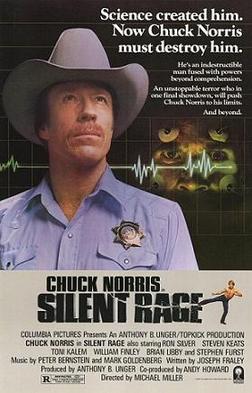
The 1982 film, Silent Rage, takes place in a small town in Texas.
John Kirby (Brian Libby) is the town troublemaker, an obviously mentally disturbed man with a violent and unpredictable temper. As the film starts, Kirby is murdering the members of the latest family to offer him a home. John is strong, fierce, and determined to create chaos. However, he’s about to face someone who is just as strong and determined. Sheriff Dan Stevens is a tough, tight-lipped western lawman who happens to be an expert in kung fu. Dan is such a badass that he’s played by Chuck Norris!
Dan is able to eventually slap the cuffs on Kirby but Kirby is so strong that he manages to break free from them and grab a shotgun. The other policemen are forced to gun him down. Barely clinging to life, Kirby is rushed to a secret institute where three scientists — Tom Halman (Ron Silver), Philip Spires (Steven Keats), and Paul Vaughn (William Finley) — are working on a process that they think will help cells to repair themselves. Philip and Paul think that Kirby will be the perfect test subject. Tom, whose sister (Toni Kalem) is dating Dan — mentions that it might not be a good idea because Kirby was a psychotic murderer and stuff. Philip decides to experiment on Kirby, regardless.
While the scientists are breaking the laws of God, Dan and his comic relief deputy (played, in a charming performance, by Stephen Furst) are dealing with local problems, like the bikers who hang out at a nearby roadhouse. (Apparently, it’s not a Chuck Norris film without a fight in a roadhouse.) However, Dan soon has more than just bikers to deal with. The experiments have succeeded. John Kirby has come back to life. He can’t speak and it’s debatable whether he even knows who he is. But he is now virtually immortal and super-strong and soon, he’s killing scientists and going on a rural rampage. Can even Chuck Norris stop him!?
That question is not just hyperbole. One reason why Silent Rage works as well as it does is because Chuck Norris has been established as America’s premiere fighting badass. There is an entire internet culture that has been built around the idea of Chuck Norris being the man who cannot be defeated. The world, we’re told, lives in fear and awe of a Chuck Norris roundhouse kick. And yet, when Sheriff Dan faces the resurrected Kirby, he finds himself fighting an opponent who is not intimidated or easily knocked down. The film establishes early on that Kirby will kill anyone, even the most likable characters in the film. Watching Dan fight Kirby, the stakes feel real and you don’t know who is going to win. Both Chuck Norris and Brian Libby deserve a lot of credit for their fight scene at the end of the movie.
Silent Rage is often described as being a slasher film because Brian does spend a lot of time stalking people and killing them in different ways. Personally, I would not call it a slasher film. Because it hinged on scientists who overlooked the obvious dangers to achieve their goals, I would refer to this as being a sci-fi horror film, with John Kirby becoming the human equivalent of the Xenomorph from Alien. There’s nothing scarier than a monster who can challenge Chuck Norris.
This small town is a sleepy coastal village, one that is dominated by a lighthouse sitting near the coast. The town has a lovely beach and friendly citizens. The storekeeper, Mr. Kocheck (Frank Arvidson), is a bit of a know-it-all. The town constable (Forrest Lewis) has the very easy job of keeping peace in the town. Little Jimmy (Wayne Berwick) is the annoying little kid who everyone in town looks after. Little Jimmy is the type who will walk right into the local store and go behind the counter. What a perfect town!
The only problem, when it comes to Piedras Blancas, is that some of the townspeople are a bit superstitious, especially when it comes to a belief in monsters that stalk the sea and the beach. The lighthouse keeper, Sturges (John Harmon), worries that there is a monster hiding in a nearby cave so he often goes down there and leaves food to keep the monster from attacking the town. Still, Sturges worries about his teenager daughter, Lucille (Jeanne Carmen), who has a habit of going down to the beach at night, stripping down to her underwear, and swimming in the ocean. Seriously, if anything is going to attract a horror movie monster, it’s that!
And there is a monster in the cave and yes, the Monster does eventually go on a rampage. As the bodies start to pile up and some of the town’s most beloved citizens are taken out, local scientist Sam Jorgensen (Les Tremayne) speculates that the creature could be a prehistoric amphibian who has somehow survived into the modern era.
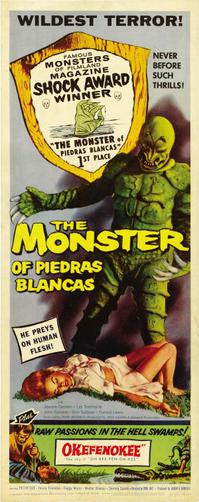
Independently produced and first released in 1959, The Monster of Piedras Blancas was clearly inspired by the success of The Creature From The Black Lagoon, with the boat crew replaced by the citizens of the town and Jeanne Carmen stepping into the role that was played by Julia Adams. The film was produced by Jack Kelvan, who also supervised the creation of the suit that Ricou Browning wore when he played the Gil-Man in The Creature From The Black Lagoon. And just, as with The Creature of Black Lagoon, the monster is the most effective part of The Monster of Piedras Blancas. Here he is!
Now, in close-up and still frame, you can tell that it’s obviously a rubber suit but, when seen in the shadows and stalking people on the beach, the monster is truly menacing. Whether the monster is ripping off someone’s head or carrying around the lighthouse keeper’s daughter, the monster is frightening to watch. I wouldn’t want to live anywhere near him. If the Creature From The Black Lagoon was often more misunderstood than malicious, The Monster of Piedras Blancas is just downright mean.
The Monster of Peidras Blancas does a good job of creating an ominous atmosphere, especially in the shots of Sturges heading down to the cave and the panicked townspeople walking through the town while carrying the body of the Monster’s latest victim with them. The film’s pace is a bit slow and the performances are inconsistent but the Monster definitely makes an impression.
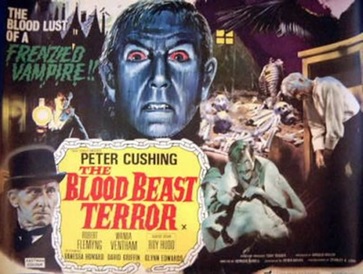
Today’s horror n the lens is the 1968 British film, The Blood Beast Terror! This film stars the great Peter Cushing and it is perhaps the only film to ever feature a …. WERE-MOTH!
Seriously, how can you resist Peter Cushing and a Were-Moth?
First released in 1975 and looking even older, Survival opens with a shot of a cougar stalking through the desert. As a narrator rambles on about the Bible and King Solomon, the cougar snarls. “How long will God tolerate us?” the narrator asks, right before the cougar mauls and kills a man holding a rifle.
The cougar was my favorite character in Survival, even though it only had limited screen time. My second favorite character was the narrator, who kept talking about how everything on Earth was destined to eventually die, regardless of how they lived their lives. Yes, the narrator was a bit judgmental but, at the same time, the narrator was right.
While two policemen search the desert for the cougar, a private airplane crashes atop a mesa. Everyone in the plane survives the impact but will they be able to survive the desert? The narrators seems to have his doubts. Mom and Dad are both upset about being stranded in the desert. The pilot, who is dating the daughter of the family, says that they better pray before they do anything else. Finally, the family’s 12 year-old son decides to run off and try to reach a nearby town on his own. It’s a two-day walk and his parents are not happy when they discover that he’s run off. It’s a pretty good thing that they don’t know that the small town is actually a ghost town and that the desert is not only home to the cougar but also plenty of rattlesnakes! While Mom and Dad worry about their son, the pilot and their daughter encourages them to keep praying. If their son dies, that’s all a part of God’s plan and it’s probably their fault for not going to church more often. To be honest, I wouldn’t want to be trapped in the desert with any of these people. The incredibly judgmental narrator seems to agree.
Survival was directed by Donald W. Thompson, who is better-known for directing the Thief In The Night films. As a director, Thompson knew how to frame a shot, which sets his work apart from a lot of other independent religious films. Watching this film, one can feel the oppressive heat rising up from the desert. That said, the heavy-handed dialogue is often stiffly-delivered. (At one point, the son worries that he has lost his wilderness survival pamphlet, just for someone to announce that they got him a new one before handing him a copy of the Bible. The lines are delivered so flatly that it almost feels like a parody of a church film.) It’s never a good sign when the cougar has more personality than the humans.
As I watched this film, I thought about how much I hate the desert. Would I have been able to survive as well as the characters in this film? Probably not. When I was 19, I dated a guy who owned his own private airplane. It was fun because he would fly me halfway across the state on a date. He would pick me up in Denton and then we’d fly down to San Antonio for dinner. Watching this film made me realize how lucky I was that we never crashed because I don’t think I would have been much help if we had. So, if nothing else, this film convinced me not to buy an airplane. That’s the important thing.
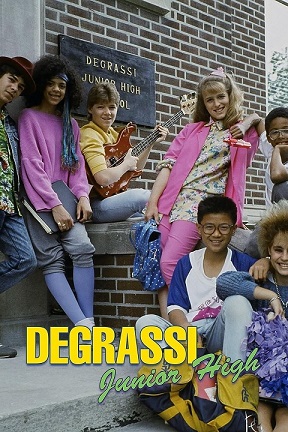
Welcome to Late Night Retro Television Reviews, a feature where we review some of our favorite and least favorite shows of the past! On Sunday, I will be reviewing the Canadian series, Degrassi Junior High, which aired on CBC and PBS from 1987 to 1989! The series can be streamed on YouTube!
This week, on Degrassi Junior High, Caitlin Ryan gets her first spotlight episode!
Episode 1.6 “Rumor Has It”
(Dir by Kit Hood, originally aired on February 22nd, 1987)
This week’s episode of Degrassi Junior High started the long and proud tradition of certain Degrassi episodes not being aired outside of Canada because of their content. In this case, several stations in the US and the the BBC in the UK declined to air this episode because it dealt with Caitlin having dreams about her teacher, Ms. Avery (Michelle Goodeve). Becuase Ms. Avery is rumored to be a lesbian, Caitlin starts to get nervous about what her dreams mean and whether she will also be the subject of rumors and whispers. This episode was not only the first Degrassi episode to not air in some markets but it was also the first one to focus on Caitlin who, as played by Stacie Mistysyn, would go on to become one the key figures in the franchise.
(Interestingly enough, this is also the first episode of Degrassi Junor High to not feature Joey, outside of a few scenes where he’s in the background. It’s perhaps for the best. Middle school Joey does not seem like he would be quite as sensitive about Caitlin’s feelings as adult Joey would have been on Degrassi: The Next Generation.)
For an episode that apparently quite controversial, this episode seems remarkably tame today. Indeed, half of the episode doesn’t even deal with Caitlin and her dreams but instead features Arthur and Yick following around Rick because they’re convinced that Rick stole a hundred dollars from Yick’s locker and then used it to buy a big bag of black licorice. Arthur, who dreams of either becoming a cop or at least heading up a neighborhood watch, even brings an oversized magnifying class so that he can investigate the crime. Arthur and Yick follow Rick everywhere, watching as he forced his big bag of black licorice on everyone he meets. Rick claims that he won a hundred dollars in the lottery. If you won a hundred dollars, would you waste it on a bag of black licorice? Then again, if you stole a hundred dollars from someone’s locker, would you waste it on a bag of black licorice? And seriously, who likes black licorice anyway? I mean, is life in Toronto so boring and unsatisfying that black licorice is actually the only thing that people have to look forward to? For that matter, Rick was introduced as the brooding delinquent who never smiled or talked to anyone. Since when does he care if everyone has black licorice? (This really does sound more like something Joey would have done.) Eventually, Rick gets tired of Arthur and Yick following him around and tells them to leave him alone or risk getting beat up. Immediately afterwards, Yick finds the missing money. It turns out that it was in the locker all the time!
Meanwhile, Caitlin is haunted by a dream in which Ms. Avery, her favorite teacher, calls her to the front of the class and praises her classwork. Suddenly, Caitlin is aware that all of her classmates are whispering about how both she and Ms. Avery must be lesbians. Caitlin wakes up, shaken.
The next day, at school, mean girl Kathleen lists all of the evidence that has convinced her that Ms. Avery is a lesbian. (It’s not a surprise that Kathleen is the one spreading the rumor.) Ms. Avery is unmarried. Ms. Avery does not have a boyfriend. In fact, the only man that Ms. Avery is ever seen talking to is Mr. Raditch and apparently, no one can imagine the idea of anyone ever dating Mr. Raditch. Ms. Avery is given a ride to school every day by a woman and, one day, Kathleen swears that she saw Ms. Avery and the woman kiss each other on the cheek.
Despite the fact that Kathleen and Caitlin have nothing in common and should, by all logic, hate each other, Caitlin still invites Kathleen to a sleep-over at her place. Kathleen, Susie Rivera, Melanie, and Caitlin spend their time prank calling teachers. When Caitlin calls Ms. Avery, she’s surprised when a woman answers and she quickly hangs up. It is, to be honest, the lamest sleep over ever.
Because Caitlin refuses to join in the rumor-mongering about Ms. Avery, Kathleen tells Susie that she should stop hanging out with her because Caitlin might be a lesbian and soon, everyone will think the same of Susie. When Susie tells Caitlin what people are saying, Caitlin freaks out. The next day, when Ms. Avery attempts to put her hand on Caitlin’s shoulder while praising her latest essay, Caitlin asks Ms. Avery not to touch her. Ms. Avery tells Caitlin to speak to her after class.
After class, Caitlin tells Ms. Avery that people think she might be a lesbian. Ms. Avery asks what evidence they have and then she explains that being single doesn’t make you a lesbian and neither does having a roommate and neither does sharing an innocent peck on the cheek with a friend. Ms. Avery and Caitlin step outside of the school together and …. hey, it’s Mr. Raditch, waiting to give Ms. Avery a ride home!
Sensitive by 1987 standards and tame by today’s standard, this episode cops out a little at the end by saying, “Ms. Avery’s sexuality is no one’s business …. but, by the way, she’s definitely not a lesbian.” Stacie Mistysyn and Michelle Goodeve deserve a lot of credit for their performances in this episode and, in the role of Kathleen, Rebecca Haines was the perfect mean girl. But, at the same time, there was also all of that stupid stuff with Arthur, Yick, and Rick. For all of its notoriety, this is actually a pretty uneven episode.
Eddie (David McIlwraith) used to be a rock star but now he’s a washed up alcoholic without a cent to his name. Needing to pay his bills, Eddie decides to make the ultimate sacrifice. He decides to go down to a pawnshop and sell his trademark guitar. However, a quirky woman named Elisabeth (Jill Hennessy) has another idea. Maybe …. he could just rob the pawn shop!
Did you know that, as a name, Lisa started out as a shortened version of Elisabeth?
This episode originally aired on December 16th, 1989.





 Through the Shattered Lens