Retro Television Reviews: T and T 2.1 through 2.4 “Straight Line”


Welcome to Retro Television Reviews, a new feature where we review some of our favorite and least favorite shows of the past! On Fridays, I will be reviewing T. and T., a Canadian show which ran in syndication from 1987 to 1990.  The show can be found on Tubi!

This week, season 2 begins with a supesized episode.

Episodes 2.1 through 2.4 “Straight Line”

(Dir by George Mihalka, originally aired on October 24, 1988)

Straight Line, the second season premiere of T & T, is one story that is told over the course of four, 30-minute episodes.  According to both Wikipedia and the IMDb, all four of those episodes aired on October 24th, 1988.  To me, that would seem to suggest that Straight Line originally aired as a made-for-TV movie and that it was later split up into four episodes for syndication.  It’s something that happens with a lot of shows, especially when it comes to season premieres.  Straight Line was also apparently released, direct to video, as a stand-alone film in 1990 and you have to wonder how many people ended up renting it without realizing that they were spending their money on a super-sized episode of T & T.

The second season begins with some changes to the opening credits.  Most of the supporting cast — including Decker, Aunt Martha, Sophie, and Detective Jones — no longer appear in the opening credits.  (Decker and Aunt Martha do appear in the episodes but both David Nerman and Jackie Richardson are credited as being “guest stars.”)  Instead, it appears that there are now only three regular members of the cast — Mr. T, Alex Amini, and Sean Roberge as a new character named Joe Casper.  (Roberge previously appeared during the first season, playing a character named Fabian.)

Joe Casper is a teenager who is in a bit of trouble.  He’s gotten involved with a neighborhood gang known as The Future and when the Future disrupts a campaign event for a reverend who is seeking to become Toronto’s first black mayor, it leads to a bomb going off and killing Joe’s mother.  Distraught by what’s happened, Joe attempts to jump off a bridge but T.S. Turner (who was at the rally) approaches Joe and says, “Take it easy, little brother,” and that’s all Joe needs to hear to turn himself into the police.  Joe is going to need a good lawyer so T.S. calls Amy, who rushes over the police station and….

OH MY GOD, WHAT IS AMY WEARING!?

Amy explains that she was at a banquet when T.S. called but still, I would probably put on a coat or something before heading over to Toronto’s dirtiest police station.

Anyway, Amy is able to keep Joe out of jail.  Joe is sent to a juvenile rehabilitation center that is run by Dr. Hammel (Kenneth Welsh).  Dr. Hammel is an ally of the preacher who is running for mayor and everyone thinks that Dr. Hammel is a good and devoted social activist.  Of course, the audience automatically knows that Dr. Hammel is the bad guy because he’s played by Kenneth Welsh, who I imagine is best-known in America for playing the totally evil Windom Earle in Twin Peaks.

T.S. investigates The Future and discovers that there started out as a neighborhood watch before being transformed into a bunch of Neo-Nazis.  He also discovers that Dr. Hammel is the one who is behind the organization.  T.S. and Amy have to expose Hammel and they better hurry because the preacher running for mayor has been assassinated and Hammel has just announced that he’s running for mayor of Toronto!

This all may sound pretty exciting but the second season premiere is actually a bit dull.  The main problem is that, as opposed to the first season, T.S. doesn’t get to do much in the episode.  He’s rather subdued and there’s none of the quirkiness that made the character so memorable during the first season.  He doesn’t talk about his love for cookies.  He hardly calls anyone, other than Joe, “brother.”  There’s not even a scene of him hitting a punching bag.  It’s disappointing!  As well, he and Amy were separated for the majority of the show, which kind of goes against the whole idea of them being T and T.  Instead, the majority of the episode was devoted to introducing Joe.  The episode ended with Joe, tears streaming down his face, walking away with T.S. and apparently renouncing his former affiliation with The Future.  Since Joe is in the opening credits now, I assume he’s going to become T.S.’s ward for at least the next few episodes.

Hopefully, the next episode will features T.S. acting more like T.S.  Otherwise, this is going to be a long season.

Late Night Retro Television Reviews: Highway to Heaven 1.6 and 1.7 “One Fresh Batch of Lemonade”


Welcome to Late Night Retro Television Reviews, a feature where we review some of our favorite and least favorite shows of the past!  On Thursdays, I will be reviewing Highway to Heaven, which aired on NBC from 1984 to 1989.  The entire show is currently streaming on Tubi and several other services!

This week’s episode finds Jonathan and Mark working as physical therapists!

Episodes 1.6 and 1.7 “One Fresh Batch of Lemonade”

(Dir by Michael Landon, aired on October 24th, 1984 and October 31st, 1984)

Deke Larson, Jr. (Ken Olandt) is a high school baseball star who is being watched by the scouts, much to the joy of his father, Deke, Sr. (Jim Haynie).  The elder Deke was quite an athlete in his day and his house is still full of the trophies that he won through the years.  Deke, Sr. was recruited to play professional baseball but he never made it out of the minor leagues.  As a result, Deke, Jr. has spent his entire life being prepared to do what his father never accomplished.

However, that dream comes to an end when Deke, Jr. has a motorcycle accident and is hit by a truck that is being driven by Richie Halbertson (Bart Conner), a gymnast who attends a rival high school.  As a result of the accident, Deke, Jr. loses both his legs.  Now, he spends his time at a rehab clinic, consumed by his own bitterness.

Jonathan and Mark are the clinic’s newest physical therapists.  While Jonathan tries to get Deke, Jr. to accept his condition and forgive Richie, Mark tries to talk to Deke, Sr.  With the help of a quadriplegic law student named Scotty (James Troesh), Deke, Jr. starts to realize that it’s better to focus on what he has instead of obsessing on what he’s lost.  Deke, Jr. starts to recover from his bitterness and soon, he’s even being nice to the classmate (Samatha Paris) who has a crush on him.  But when Jonathan suggests that Deke, Jr. could still compete as gymnast, will Deke, Jr. be able to accept being trained by Richie Halbertson?  And will Deke’s parents be able to set aside their own anger to support their son?

If you answered no to any of those questions, you’ve obviously never seen this show before.

This two-parter is pretty much the epitome of a typical Highway to Heaven episode.  It’s earnest, heartfelt, well-intentioned, and there’s isn’t a moment of cynicism to be found.  It’s the type of episode where Jonathan tells two snotty teenage boys that they shouldn’t park in a handicapped spot and, when the boys ignore him and go into a nearby bookstore, God turns their car upside down.  (Plus, they get a ticket!)  Even the episode’s title, which refers to the old-saying about making lemonade whenever life gives you lemons, pretty sums up Highway to Heaven‘s unapologetically positive outlook.   At the same time, it’s also an episode that, because it is so earnest, won’t take anyone by surprise.  If you can’t guess how this episode is going to end, I can only assume that you’ve never watched television or a movie before.

Predictable as it may be, it’s still an effective episode, largely because it is so unashamed of being sentimental and heartfelt.  You do have to wonder just how exactly Deke, Jr. managed to become a competition-worthy gymnast in what appears to have just been a matter of weeks but still, this is a case where the good intentions make up for the rough spots.

Next week, Jonathan and Mark help an industrialist who thinks that he is King Arthur.  Who does the grail serve?

Retro Television Reviews: Jennifer Slept Here 1.6 “One Of Our Jars Is Missing”


Welcome to Retro Television Reviews, a feature where we review some of our favorite and least favorite shows of the past!  On Thursdays, I will be reviewing Jennifer Slept Here, which aired on NBC in 1983 and 1984.  The entire show is currently streaming on YouTube!

This week, Jennifer is trapped in a jar!

Episode 1.6 “One Of Our Jars Is Missing”

(Dir by Charles S. Dubin, originally aired on November 25th, 1983)

Last week, I announced that George Eliot (played by Fiona Apple’s father, Brandon Maggart), was the worst character on Jennifer Slept Here and perhaps one of the worst  characters of all time.  This week, however, George is actually pretty tolerable.  Instead, it’s his son Joey who is terrible.

Since this series started, Joey has been having to adjust to having to live with the ghost of Jennifer Farrell and, for the most part, he seems to be doing a pretty good job of it.  Jennifer has helped out Joey with his problems and Joey has helped out Jennifer on numerous occasions.  They’ve been established as being friends.

However, this episode finds Joey and Jennifer uncharacteristically annoyed with each other.  Jennifer thinks that Joey makes too much noise in his room.  Joey thinks that Jennifer makes too much noise in the attic.  Joey spends a lot of time yelling at Jennifer, which makes him look crazy to everyone else.  After hearing his son yelling into thin air one too many times, George decides that Joey is truly convinced that there is a ghost in the house.

George’s solution?

Hire an exorcist!

Now, it should be noted that George doesn’t think that the house is haunted.  Instead, he thinks that Joey is delusional but George is convinced that an exorcism will cure Joey of those delusions.  It’s not a bad plan.  When Madame Wanda (played by Zelda Rubinstein, in a performance that is clearly meant to spoof her role in the original Poltergeist) shows up and performs her ritual, it’s obvious that she’s a fake.  And yet somehow, she is still able to trap Jennifer in a mason jar.

Joey takes the jar to his room.  Now, it should be understood that everyone else thinks that Joey is carrying an empty jar but Joey can see Jennifer trapped in the jar.  Instead of unsealing the jar and allowing Jennifer her freedom, he decides to leave her in the jar.  He puts the jar on his dresser and then pretends that he’s going to throw a baseball at it….

I mean, seriously …. WHAT THE HECK IS UP WITH THIS!?

It is true that Jennifer can be a bit self-absorbed and definitely more than a little eccentric but, for the most part, she’s been pretty respectful to Joey.  She helped Joey throw a fake séance.  She helped Joey get over his ex-girlfriend.  She’s been very supportive of the son of a man who repeatedly refers to her as having been a “tramp.”  And now, Joey’s just going to keep her trapped in a jar?  What type of sociopath is Joey?

Earlier in the episode, Joey wrote a rude letter to one of his teachers.  He wasn’t planning on mailing it but, when his mother (Georgia Engel) comes across the letter, she takes it to the post office.  Suddenly, Joey needs the help of someone who can walk through walls so he opens the jar and allows Jennifer to escape.  (So, yes, Joey let Jennifer out of the jar but only because he needed her to do something sneaky for him.)  However, Jennifer can no longer walk through walls!  Something must have happened with the exorcism.

Joey and Jennifer head over to Madame Wanda’s place, hoping that Wanda can reverse the spell.  Of course, Wanda is a fake and didn’t realize she was actually performing a real exorcism to begin with.  Wanda has no idea how to reverse anything.

Now, fear not, everything returns to normal by the end of the episode.  Jennifer is once again a ghost who can walk through walls and Joey is once again yelling at thin air.  As the episode ends, George listens to his son yell and then mutters that he just blew a lot of money on a worthless exorcism.  I’m a bit surprised that George is willing to give up that easily.  I mean, if someone in your house is apparently arguing with someone that only he can see, that’s cause for concern.  Has George never seen an Amityville film?  Can he not see the path on which Joey is walking?

This episode felt a bit mean-spirited, which is a shame because it had the potential to be fun.  But Joey acting like such a jerk ruined whatever humor could have been mined from Wanda and her attempts to exorcise the house.  This whole episode felt just a bit mean-spirited.

Next week, according to the IMDb, Jennifer learns that she can take over people’s bodies so Joey better watch out!

Late Night Retro Television Reviews: Monsters 1.6 “Where’s The Rest Of Me?”


Welcome to Late Night Retro Television Reviews, a feature where we review some of our favorite and least favorite shows of the past!  On Wednesdays, I will be reviewing Monsters, which aired in syndication from 1988 to 1991.  The entire show is streaming on Youtube.

This week, Monsters makes the mistake of getting political.

Episode 1.6 “Where’s The Rest Of Me?”

(Dir by Richard Benner, originally aired on November 26th, 1988)

On a Caribbean island, Dr. Wingite (Meat Loaf) is throwing a small party in his mansion/laboratory.  Attending the party is a football player named Joe (Franco Harris).  Dr. Wingite gave Joe a new knee and, as a result, Joe is having his best season ever.  Also at the party is a singer named Regina (played by Black-Eyed Susan).  Regina was losing her voice until Dr. Wingite gave her new vocal cords.  And finally, there’s a businessman named J.J. Marshall (Drew Eliot), who wants to develop the island by building a shopping mall.  J.J. was losing his eyesight until Dr. Wingite gave him new eyes.

As Wingite and his patients drink wine and talk about their greedy plans for the future, revolutionaries are firing guns and shouting outside.  The government is not popular and neither is Dr. Wingite, who is not only a mad scientist but also the government’s chief executioner.

Wingite takes his guests down to his lab, where they see Adam (Frank Tarsia).  Wingite explains that Adam was a rebel who was due to be executed.  Wingite, however, put him in a coma and the doctor has been giving away his body parts.  J.J. has Adam’s eyes.  Regina has Adam’s vocal cords.  Joe has Adam’s knee.  Adam is kept alive with machines but when Joe and Regina accidentally spill a beaker of liquid into Adam’s feed tube, Adam wakes up and comes back to life.  Adam stalks the guests through the mansion, determined ro regain his missing body parts.

Eh.  This episode was …. well, it was pretty bad.  The political subtext was pretty heavy-handed, with J.J. loudly declaring that Wingite’s experiments are “free enterprise!” and Adam shouting “Viva la revolution” as he seeks revenge on the doctor and his wealthy guests.  It had all the depth and the nuance of an essay written by a college freshmen who is convinced that he’s an expert on Marx because he took one class on him. I’m surprised that the episode didn’t feature Fidel Castro parachuting in to rescue Adam or maybe an appearance by the ghost of that bourgeois phony, Che Guevara.

Beyond the superficial political subtext, this episode suffered from some truly terrible acting.  Meat Loaf is totally miscast as a mad scientist and seeing that Dr. Wingite was obviously based on South America-based Nazi war criminals like Klaus Barbie and Josef Mengele, you have to wonder what led the show’s director to think, “This is a perfect role for a kind of goofy singer!”  From what I understand, Franco Harris was an actual football player and his performance makes the basketball players who appeared on Hang Time seem expressive by comparison.  The rest of the cast is neither as miscast as Meat Loaf nor as downright bad as Franco Harris but still, no one makes much of an impression.

This was a disappointing episode.  Sometimes, it’s best to avoid politics.

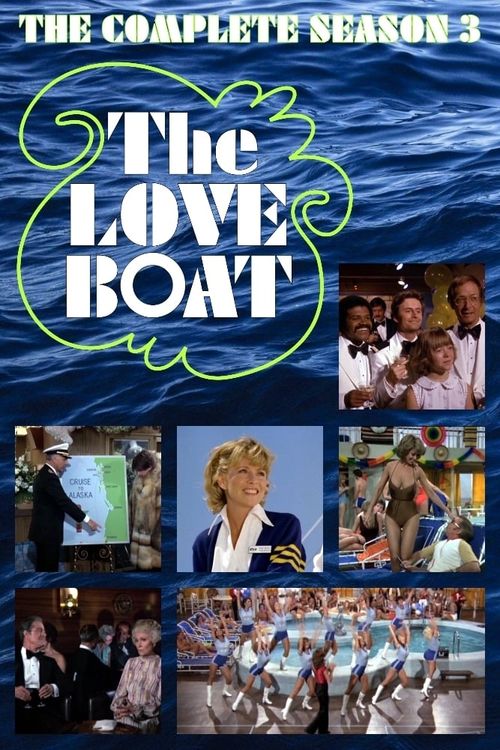
Retro Television Reviews: The Love Boat 3.15 “The Harder They Fall/The Spider Serenade/Next Door Wife”


Welcome to Retro Television Reviews, a feature where we review some of our favorite and least favorite shows of the past!  On Wednesdays, I will be reviewing the original Love Boat, which aired on ABC from 1977 to 1986!  The series can be streamed on Paramount Plus!

This week, Gopher falls in love.  Yes, Gopher.

Episode 3.15 “The Harder They Fall/The Spider Serenade/Next Door Wife”

(Dir by Richard Kinon, originally aired on December 8th, 1979)

After three seasons of being goofy comedic relief, Gopher finally got his heart broken in this episode.  He fell in love with a passenger named Claire Dalrymple (Jill St. John), who is on the boat by herself because she has recently separated from her husband, Nelson (Robert Sampson).  And Claire eventually fell in love with Gopher, especially after he dressed up like a mariachi singer and serenaded her with a song about the time that she asked him to kill a spider that was in her cabin.  This time, it was Gopher who ended up waking up in a cabin with a passenger.

(I’m sure some would say it was a bit unrealistic that Claire, upon seeing a spider in her cabin, would run out into the hallway, screaming while wearing only a towel.  I’ve done the exact same thing at a hotel because spiders are scary!)

But does Claire really love Gopher or if she just looking for someone to feel the void left by her separation.  When her husband shows up on the boat, he turns out to be a pretty reasonable and polite guy.  He tells Gopher that, while Gopher can give Claire anything she wants at sea, Nelson can give her everything she needs on land.  Is Nelson suggesting some sort of special arrangement here?  Well, if he is, it totally goes over Gopher’s head.  At the end of the cruise, Claire decides to leave with Nelson and Gopher can only sadly watch as she leaves.

Awwwwwww!  Poor Gopher!

It’s kind of weird to see Gopher in a sad story.  That’s not the fault of Fred Grandy, who always likable and did a pretty good job with the role.  Instead, it’s just that Gopher is such a goofy character that it takes a bit of adjustment to suddenly see him being sincere.  His storyline here worked well-enough, once you got used to the idea of Gopher being serious.  If anything, Gopher was so sad by the end of it that it suddenly made sense why he’s always telling jokes and trying to avoid any sort of emotional commitment.  He’s hurting inside!

The other two storylines were goofy enough to make up for Gopher’s serious turn.  Chet Hanson (James McArthur) is on the cruise with his girlfriend, Kim (Susan Buckner).  Chet’s wife, Carol, (Joanna Pettet) also shows up on the cruise and gives Chet the papers to sign for their divorce.  Chet and Carol are fairly friendly for a divorcing couple but Chet is still upset when Carol buys a ticket for the cruise and ends up staying in the cabin across the hall from him and Kim.  Soon, Carol is stopping by constantly and telling Chet about a man that she’s been flirting with.  Eventually, Chet realizes that he doesn’t want to get a divorce and he and Carol get back together.  That really sucks for Kim, who is surprisingly tolerant of being followed around by her boyfriend’s wife.  This storyline really did leave a sour aftertaste.  Chet was a jerk and Kim deserved better.

Finally, Ed “Flash” Taylor (Milton Berle) and Jack McTigue (Alan Hale, Jr.) were both boxers in their youth.  They fought one legendary fight, in which they not only beat the Hell out of each other but also knocked out the referee.  Now, they are both cruise line executives and they both end up on their boat at the same time.  As soon as they see each other, their rivalry reignites and they prepare for a rematch on the boat.  When Captain Stubing tries to stop the fight, he is accidentally knocked out by the two boxers.  Somehow, this leads to peace between Ed and Jack and not to Captain Stubing suing his bosses for punching him.  Seriously, the Love Boat is floating HR nightmare.

This was an okay episode, largely due to Gopher’s unexpectedly sad story.  The other two stories were just goofy but, when it comes to The Love Boat, the goofiness is the point.

Late Night Retro Television Reviews: Gun 1.6 “Father John”


Welcome to Late Night Retro Television Reviews, a feature where we review some of our favorite and least favorite shows of the past!  On Tuesdays, I will be reviewing Gun, an anthology series that ran on ABC for six week in 1997.  The entire show is currently streaming on Tubi!

Tonight, we finish up Gun!

Episode 1.6 “Father John”

(Dir by Jeremiah S. Chechik, originally aired on May 31st, 1997)

Father John, the final episode of Gun, is also one of its worse.  The only thing keeping it from being the absolute worst is that Robert Altman directed that episode that dealt with the country club presidency and then there was that episode with Daniel Stern as the guy having an elaborate Hollywood fantasy and, of course, there was last week’s episode with Kirsten Dunst…. actually, now that I think about it, of the six episodes of Gun that were produced, Father John is in the top 3 but only by default.

The episode stars Fred Ward as John Farragut, a newspaper columnist who is also a recovering alcoholic and who is always struggling to keep up with his alimony payments to his ex-wife, Joyce (Brooke Adams).  John doesn’t have much faith in the world but he has always worshiped his Uncle John, a priest for whom he was named.  When Uncle John dies, nephew John is shocked to discover that his uncle not only died with a lot of money hidden away in his room but that he also owned the pearl-handled gun that appears in every episode of this series.  What secrets were being hidden by Uncle John!?

Nephew John sets out to find out.  At first, he assumes that his Uncle must have been having an affair with a woman named Gloria (Angela Alvarado) but he then comes to learn that Gloria (whose real name is Gabriella) is a refugee who was rescued from a sex trafficking ring by his uncle.  Uncle John had the gun to protect Gabriella and now, it’s time for his nephew to continue to protect her.

It sounds pretty straight-forward and, to be honest, there really aren’t any unexpected twists in this episode.  That said, the episode itself is incredibly overwritten.  We not only get to watch as living John tries to solve a very simple mystery but, even worse, we have to listen to his narration as he tells us the details of what he’s doing.  Of course, we can already see what he’s doing so it all feels a bit redundant.  The narration itself is so hard-boiled that it feels almost like a parody of the detective genre and I found myself wondering why anyone would want to read anything written by a man whose narration is essentially a collection of clichés.  John Farragut is the type of guy who says, “If you sleep with dogs, you wake up with fleas,” as if he think he’s the first person to ever come up with it.  Surprisingly, Fred Ward is very much miscast as John Farragut.  With his weathered face and his weary tone, it’s hard to buy Ward as someone who 1) still hero-worships anyone and 2) would still be crying about having never met his father.  Farragut appears to be nearly 50 and he’s still whining about stuff that most people get over or have figured out by the time they graduate college.  Farragut’s actions often only make sense if you accept that idea that he is impossibly naïve about the world and that’s not the feeling one would ever get from a character played by Fred Ward.

With this episode, Gun ends on a boring note but, then again, it was never a particularly exciting series to begin with.  For all the notable actors who appeared in Gun, it’s hard to think of any stand-out episodes or performances.  If I had to rank the episodes, it would go something like this:

  1. Ricochet 
  2. Columbus Day
  3. Father John
  4. The Hole
  5. The Shot
  6. All The President’s Women

That’s not a very impressive list, to be honest.  Gun perhaps would have worked better if there had been some sort of continuity as far as the gun itself was concerned.  Perhaps the show would have worked if there had been a feeling of the gun following a natural journey from owner to owner.  Instead, it just randomly showed up in each story and sometimes, it was important and, far more often, it was just a prop.  The show certainly had nothing to say about American gun culture.  It was an uneven show.  The opening credits featured U2 covering Happiness Is Warm Gun and Bono’s overbaked interpretation of the lyrics felt appropriate for this show’s flashy but shallow style.

Next week, there will be a new show in this time slot.  What will it be?  Uhmmmm …. ask me next week.

Retro Television Reviews: Fantasy Island 3.22 “My Fair Pharaoh/The Power”


Welcome to Retro Television Reviews, a feature where we review some of our favorite and least favorite shows of the past!  On Tuesdays, I will be reviewing the original Fantasy Island, which ran on ABC from 1977 to 1986.  Almost the entire show is currently streaming is on Youtube!

This week, Fantasy Island goes to ancient Egypt!

Episode 3.22 “My Fair Pharaoh/The Power”

(Dir by George McCowan, originally aired on May 10th, 1980)

This week, Mr. Roarke welcomes two people with two very different fantasies.  Neither one of their fantasies really make much sense but you know Mr. Roarke.  He’s going to give the people what they want, unless he takes some sort of personal dislike to them.  Then, they’re totally going to get screwed.

Lucy Atwell (Joan Collins), for instance, has always fantasized about going back to ancient Egypt and living the life of Cleopatra.  Now, you may wonder why that is, seeing as how Cleopatra lost every man that she ever loved and was eventually killed by an asp.  But no matter!  Mr. Roarke sends Lucy into the past and Lucy quickly discovers that …. wait a minute!  She’s not Cleopatra!  Instead, she’s a part of the harem of Ptolemy (Michael Ansara)!  What the Hell, Mr. Roarke!?  What part of “I want to be Queen of Egypt” sounds like “I want to be a part of some old guy’s harem?”

However, Lucy does look exactly like the real Cleopatra and that might be useful, seeing as how the real Cleopatra is currently being held prisoner.  After a proper amount of royal training, Lucy fills in for Cleopatra and gets to meet and fall in love with Marc Anthony (Ron Ely).  When the real Cleopatra is killed by an asp, the fake Cleopatra gets to rule Egypt and it all works out nicely until …. the fantasy ends.

Oh well, it was a nice weekend.  Time for Lucy to go home except …. who is that waiting for the airplane?  Why, it’s Marc Anthony!  Except his real name is Eric Williams and apparently, he was just a guy living out a fantasy of his own.  He always wanted to know what it would be like to be Marc Anthony because who hasn’t fantasized about briefly ruling Rome and then being exiled and hounded to death by the forces of Augustus?  Anyway, Lucy finds her love and Joan Collins finally gets to play Cleopatra, the role that she was nearly awarded in 1960 before Elizabeth Taylor was selected instead.

Meanwhile, in the episode’s comedic fantasy, dorky Fred Webster (Larry Linville) wants to impress his girlfriend, Laura (Julie Sommars) by being telekinetic.  What?  Seriously, that’s how he wants to impress her?  I mean, it’s Fantasy Island!  Ask for a better job or a nicer car or something.  Anyway, Fred gets his power of telekinesis and uses it to cheat at gambling.  This brings him to the attention of Stephanie (Carol Lynley) and her goons.  When Fred realizes that Stephanie is evil, Stephanie has Laura kidnapped but she’s forgotten that Fred has telekinesis and can just mentally cause a fishing net to wrap up her and her men.  This was an extremely silly fantasy.  In fact, it was too silly for its own good, right down to the scenes where Fred’s eyes take on a green glow while he uses his powers.

This was a pretty forgettable episode but at least there were some nice costumes in the Egyptian fantasy.  Next week, season 3 comes to an end.

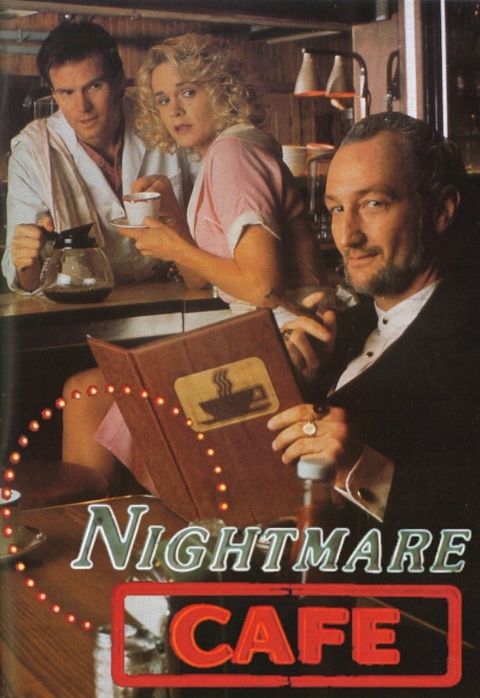
Late Night Retro Television Reviews: Nightmare Café 1.6 “Aliens Ate My Homework”


Welcome to Late Night Retro Television Reviews, a feature where we review some of our favorite and least favorite shows of the past!  On Mondays, I will be reviewing Nightmare Café, which ran on NBC from January to April of 1992.  The entire show is currently streaming on YouTube!

This week, Nightmare Café comes to an end!

Episode 1.6 “Aliens Ate My Homework”

(Dir by Wes Craven, originally aired on April 3rd, 1992)

When it came to the sixth episode of Nightmare Café, I don’t know if executive producer Wes Craven knew that it was going to be the final episode of the series when he decided to direct it.  It would be nice to think that Craven decided to say goodbye to the series by sitting in the director’s chair but the realities of network television make that doubtful.  It’s probably just a coincidence that the final episode of the series was directed by Wes Craven but it still feels appropriate.  Not only did Wes Craven create the series but he was directed the movie that made Robert Englund a big enough star that NBC was actually willing to make him the star and narrator of a prime time show.

(It’s interesting to consider that playing a viscous child murderer turned Robert Englund into a beloved pop culture legend but it says something about the natural friendliness that Englund projected that audiences still liked him even after he became most identified with playing the man of everyone’s nightmares.)

It’s a rather playful episode, one that eschews the drama and horror of the first five episodes for some rather broad comedy.  It’s also the episode that features the most narration from Blackie, as he both tells us what’s happening and also provides some commentary on the actions of the people in the story.  Robert Englund really seems to enjoy playing the character in this episode and it’s fun to watch him.

The episode focuses on tabloid reporter Harry Tambor (Bobby Slayton), who has been ordered by his new editor to hit the road and find an amazing story.  As ordered, Harry hits the road and, while driving through the country, he happens to pick up three little people (Jimmy Briscoe, Kevin Thompson, and Arturo Gil) who claim to be Romanian circus performers.  Harry’s new friends inform him that the town he is approaching has been the site of several mysteries disappearances.  It’s not humans disappearing, though.  It’s cows!

Since Bobby’s new editor just happens to be Blackie in disguise, it’s not a surprise that the town is not just home to a bunch of cows but also the Nightmare Café.  In fact, we learn that Harry is Frank’s favorite writer.  Fay thinks that you can’t believe anything that you read in the tabloids, which is a pretty judgmental attitude to have when you’re working in an extra-dimensional café that can randomly materialize anywhere.

Anyway, while stopping in the café for cup of coffee, Harry comes up with the brilliant idea to fake a UFO invasion.  He sends away for not only a fake flying saucer but also alien costumes that the Romanian circus performers agree to wear.  Harry fakes his UFO invasion but it causes a complete panic in the town and soon, Sheriff Filcher (Don S. Davis, best-known for playing Major Briggs on Twin Peaks) and the townspeople are looking to lynch the invaders.  Unfortunately, the Sheriff believes that the aliens are the folks working at the newly arrived Nightmare Café.  Who can blame him, really?  I mean, the place just showed up from out of nowhere!

As I said a few paragraphs ago, there’s nothing particularly serious about this episode of Nightmare Café.  Almost every plot development is played for laughs and there’s really not a subtle moment to be found in the entire episode.  We don’t really think of Wes Craven as being a comedic director, though all of his films displayed a certain subversive wit.  Craven does well-enough with the comedy in this show, though one gets the feeling that, if the episode had been any longer than 45 minutes, all of the running around and yelling would have gotten a bit exhausting to watch.  The comedy may be broad but everyone in the episodes — from Robert Englund to Don S. Davis — appears to be having fun and that goes a long way towards keeping things entertaining.

This episodes ends on a slightly different note than the other episodes of Nightmare Café.  Each character gets a title card, which explains what happened to them after the episode ended.  First, we learn about what has happened to the reporter, the circus performers, and the sheriff.  Then, the final title card informs us that Frank and Fay are still working at the Nightmare Cafe and they hope we’ll stop by if we’re in the area.  It’s a nice way to wrap up the series.

This was the final episode of Nightmare Café.  It was a fun show to watch and review.  Nightmare Café felt as if it was a bit before its time.  The show’s anthology format and it’s horror-themed stories would have made it a natural fit for the streaming era.  Unfortunately, it aired during the age of network television dominance and apparently, it never found an audience.  It’s a shame, because Jack Coleman, Lindsay Frost, and Robert Englund really did make for an intriguing team.

Next week, I’ll be reviewing something new in this time slot.  Who knows what it will be?  Certainly not me!  I have a few shows that I’m considering for Monday and Tuesday so we’ll see what happens.

Retro Television Reviews: Miami Vice 1.9 “The Great McCarthy”


Welcome to Retro Television Reviews, a feature where we review some of our favorite and least favorite shows of the past!  On Mondays, I will be reviewing Miami Vice, which ran on NBC from 1984 to 1989.  The entire show is currently streaming on Tubi!

This week is all about boats!

Episode 1.9 “The Great McCarthy”

(Dir by Georg Stanford Brown, originally aired on November 16th, 1984)

The people behind Miami Vice really liked speedboats.

That’s the best explanation that I come up with for The Great McCarthy, an episode in which the majority of the running time is taken up by scenes of people racing boats.  Even after Crockett, Tubbs, and Zito (John Diehl, getting to do more than usual) figure out how Louis McCarthy (William Gray Espy) is using his boats to smuggle drugs into Miami, their main concern remains winning the race that they’ve entered.

And there’s certainly nothing wrong with that.  After a run a grim and dark episodes, The Great McCarthy was a nice change of pace, a reminder that it’s okay to have a little bit of fun.  For the most part, this was a light and airy episode, featuring scenes of boats skimming across the ocean while Born To Be Wild plays on the soundtrack.  This episode also featured a very 80s party scene and not one but two weaselly informants!

The first informant was Izzy Moreno (Martin Ferrero), a talkative thief who, it turned out, had done some work for Louis McCarthy.  The second informant was Dale Gifford (Charles McCaughan), a crooked accountant who is helping to launder money for not just Louis but also Louis’s girlfriend, Vanessa (Maria McDonald).  Izzy will apparently be returning in the future.  Gifford will not as he ended up getting shot in the back of the head.  Crockett and Tubbs originally assumed McCarthy was the killer but, as Izzy reveals towards the end of the episode, it was actually Vanessa.

By this time, of course, Vanessa has already moved on from McCarthy and is now sleeping with Tubbs.  Crockett warns Tubbs that he’s getting in too deep with Vanessa but Tubbs replies that he’s got it all under control, almost as if he doesn’t remember that almost the exact same thing happened when they went down to the Bahamas to take out Calderone.  When the police show up to arrest Vanessa, Tubbs insists on doing it himself.  “I have to,” he tells her.  He’s a cop, after all.

Okay, so that ending was a little bit downbeat but, for the most part, this was just a fun episode of Miami Vice, one that didn’t require too much thought and which kept the existential dread to a minimum.  Probably the best scene in the episode didn’t even involve McCarthy or Vanessa but instead centered around Gina and Trudy arresting a philosophy professor who sold cocaine on the side.  (The professor was played by Richard Liberty, who also appeared in George Romero’s The Crazies and Day of the Dead.)  Gina and especially Trudy have been underused on this show so it was nice to finally see them getting to do their jobs and proving themselves to be just as effective as Tubbs and Crockett.

I do have to admit that I’m still kind of confused as to how Crockett is managing to maintain his cover as a criminal when almost every other petty criminal in Miami knows that he’s actually a cop.  If Izzy could figure it out, why not Louis McCarthy?  Perhaps McCarthy wasn’t so great after all.

Late Night Retro Television Reviews: Degrassi Junior High 1.8 “Nothing To Fear”


Welcome to Late Night Retro Television Reviews, a feature where we review some of our favorite and least favorite shows of the past!  On Sunday, I will be reviewing the Canadian series, Degrassi Junior High, which aired on CBC and PBS from 1987 to 1989!  The series can be streamed on YouTube!

On tonight’s episode …. hey, it’s Spike!

Episode 1.8 “Nothing to Fear”

(Dir by John Bertram, originally aired on March 8th, 1987)

This week’s episode of Degrassi Junior High is important because it’s the first to prominently feature the character of Christine Nelson.  Played by Amanda Stepto, Christine was better known as Spike, because of the punk rock-inspired hairstyle that she wore throughout Degrassi Junior High and Degrassi High.  Even when she appeared with far more conventional hair on Degrassi: The Next Generation, she was still frequently referred to her by her nickname.

Fans of the Degrassi franchise know that Spike is destined to get pregnant after having sex with her ill-fated junior high boyfriend.  They know that Spike is going to keep her daughter and that Emma Nelson is going to be the main character for the first few seasons of Degrassi: The Next Generation.  And, of course, Spike is destined to eventually marry Snake.  Most of that won’t happen for a while.  On this week’s episode, she’s mostly present as a study partner of Voula’s (Niki Kemeny) and L.D.’s (Amanda Cook).  When L.D.’s father has a heart attack, Spike and Voula visit him at the hospital but L.D. keeps finding excuses not to.

That may seem selfish on L.D.’s part but L.D. has been terrified of hospitals ever since her mother passed away.  L.D. finds excuses not to go to the hospital, from cleaning the kitchen to helping out at her father’s garage.  I knew exactly what L.D. was going through, as I’ve also hated hospitals ever since my mom passed away and it’s always a struggle for me to find the courage to step through the front doors of one of them.  My Dad has been dealing with Parkinson’s for the past few years and I often do drive him to his doctor appointments so I’ve had to set aside my fear and dislike of them so that I can help him when he needs the help but my nerves still go into overdrive as soon as I step into one of those places.

Anyway, Voula does eventually talk to L.D. about her fear of going to the hospital and L.D. finally finds the courage to visit her father.  She arrives just as he’s being released to go back home.  So, for once, Voula actually helped someone out.  I still think she’s been way too unfair to Stephanie during this season but I’m sure we’ll return to that story in an upcoming episode.

Meanwhile, Yick and Arthur accidentally set free the school snake and they have to spend the entire episode looking for it.  It was a bit of silly subplot and I get the feeling that it was included to keep the episode from feeling too grim.  That said, the snake silliness really didn’t seem to fit with the scenes of L.D. struggling to come to terms with losing her mother and potentially losing her father.

As the episode ends, L.D.’s father says, “If you think hospitals are scary, try being the father of a teenage daughter.”  Apparently, not even a heart attack can defeat dad humor.