The Academy Was Wrong: 20 Times That The Wrong Film Won Best Picture


Hi everyone! It’s Oscar Sunday which, as we all know, is a national holiday. 

And, like many holidays, things occasionally don’t go the way they should.  Often times, the day starts with such promise and ends with such bitterness as the Academy announces that the best film of the year is a film that we all know didn’t deserve the title.

Below, you’ll find a list of 10 instances when the Academy got it wrong.  Please note that these are just my own personal picks.  You may disagree and you are welcome to do so (as long as you understand that, ultimately, I’m always right.)

Also, please note that I have limited myself to only considering films that were actually nominated for best picture.  You could make a great argument for films like Psycho, 2001, The Dark Knight, and others.  However, none of those films were even nominated for best picture and therefore, I have not considered them for this list.

(Also, if this list seems to be dominated by more recent Oscar picks, that’s because it’s more likely that I’ve been able to see a film that was released in 2007 as opposed to film from 1927.)

Anyway, here’s my chronological list of 20+ nominees that should have won:

1941 — Citizen Kane (lost to How Green Way My Valley)

1952 — A Place In The Sun (lost to An American In Paris)

1967 — The Graduate (lost to In The Heart of The Night)

1973 — The Exorcist or American Graffiti (lost to The Sting)

1976 — All The President’s Men (lost to Rocky)

1986 — Hannah and Her Sisters or A Room With A View (lost to Platoon)

1990 — Goodfellas (lost to Dances With Wolves)

1994 — Pulp Fiction (lost to Forrest Gump)

1995 — Sense and Sensibility or Babe (lost to Braveheart)

1996 — Fargo (lost to The English Patient)

1999 — The Sixth Sense (lost to American Beauty)

2000 — Crouching Tiger, Hidden Dragon (lost to Gladiator)

2001 — In The Bedroom (lost to A Beautiful Mind)

2002 — Lord of the Rings: The Two Towers (lost to Chicago)

2003 — Lost in Translation (lost to Lord of the Rings: The Return of the King)

2004 — The Aviator (lost to Million Dollar Baby)

2005 — Capote or Brokeback Mountain (lost to Crash)

2006 — Babel (lost to The Departed)

2009 — An Education (lost to The Hurt Locker)

2010 — Black Swan (lost to The King’s Speech)

Lisa’s Thoughts On 10 Best Picture Nominees That She’s Recently Seen: The Alamo, Becket, Elmer Gantry, Gaslight, Gladiator, Kramer Vs. Kramer,Marty, Of Mice and Men, Out of Africa, and Wilson


Since it’s Oscar weekend, I’ve been watching past and present Best Picture nominees like crazy.  Here are my thoughts on ten of them.

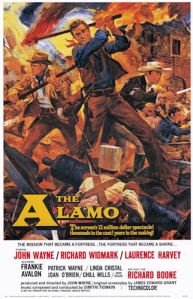
The Alamo (1960, directed by John Wayne, lost to The Apartment) — I’m a Texan which means that I’m legally required to watch both this film and the 2004 remake whenever they show up on television.  Both films are way too long and feature way too many characters speaking speeches as opposed to dialogue but, if I had to choose, I would have to go with the 1960 version of the story.  The original Alamo might be heavy-handed, poorly paced, and awkwardly acted but at least it’s sincere in its convictions.  I always cry when Richard Widmark dies.

Becket (1964, directed by Peter Glenville, lost to My Fair Lady) — This one is a personal favorite of mine.  The film is about the friendship and the eventual rivalry of King Henry II (Peter O’Toole) and Thomas Becket (Richard Burton).  Becket and Henry II start out the film drinking and whoring but eventually, Henry makes Becket Archbishop of Canterbury.  Becket, however, rediscovers his conscience and soon, Henry is famously asking, “Who will rid me of this troublesome priest?”  Becket is an exciting historical drama and Peter O’Toole is at his absolute best as the flamboyantly decadent Henry.

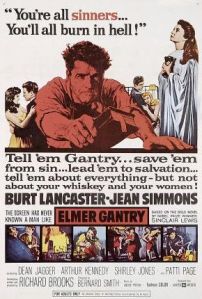
Elmer Gantry (1960, directed by Richard Brooks, lost to The Apartment) — Burt Lancaster plays Elmer Gantry, a traveling salesman and con artist who ends up falling in love with a saintly evangelist (played by Jean Simmons).  Gantry soon starts preaching himself and soon has an army of loyal followers.  However, Gantry’s new career is threatened when an ex-girlfriend-turned-prostitute (Shirley Jones) pops up and starts telling people how Gantry “rammed the fear of God into” her.  With its unapologetically corrupt lead character and its looks at how commerce and religion are often intertwined, Elmer Gantry makes a perfect companion piece to Paul Thomas Anderson’s There Will Be Blood.  Lancaster won an Oscar for his powerful and intense performance in the title role.

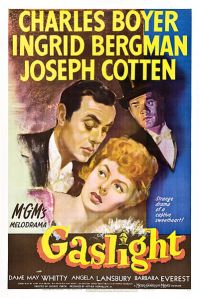
Gaslight (1944, directed by George Cukor, lost to Going My Way) — Evil Charles Boyer marries Ingrid Bergman and then attempts to drive her crazy.  Luckily, Inspector Joseph Cotten is on the case.  Gaslight is, in many ways, an old-fashioned melodrama but it’s still a lot of fun to watch.  Boyer is a suave devil and Joseph Cotten (one of my favorite of the old film actors) is a dashing hero.

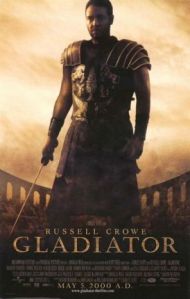
Gladiator (2ooo, directed by Ridley Scott, won best picture) — One thing that I’ve recently discovered is that men love Gladiator.  Seriously, they obsess over this film and hold Russell Crowe’s surly gladiator up as some sort of mystical ideal and if you dare to say a word against it in their presence, be ready for big and long argument.  So, I won’t criticize Gladiator too much other than to say that the film has always struck me as being kinda overlong, that the CGI is occasionally cartoonish, and that, despite his fearsome reputation, Russell Crowe is a lot more interesting as an actor when he plays a thinker as opposed to a fighter.  Joaquin Phoenix, playing the Emperor Commodus, is a lot of fun to watch.

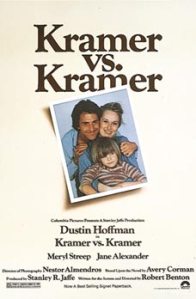
Kramer Vs. Kramer (1979, directed by Robert Benton, won best picture) — Dustin Hoffman plays a workaholic New York advertising executive who, after his wife Meryl Streep leaves him, ends up as a single father.  Kramer Vs. Kramer won best picture in 1979 but I have to admit that I didn’t care much for it.  Then again, I don’t think that I was the intended audience.  Instead, Kramer vs. Kramer appears to have been made to appeal to men frustrated with women wanting to have a life outside of being a domestic servant.  The film is well-acted though Hoffman’s character becomes insufferably smug once he gets comfortable with being a single father.

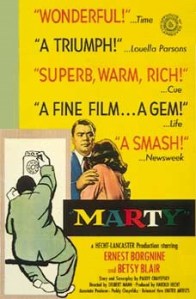
Marty (1955, directd by Delbert Mann, won best picture) — Lonely butcher Marty (Ernest Borgnine) romantically pursues a shy school teacher named Clara (Betsy Blair).  However, Marty’s friends and his family don’t like Clara and Marty soon finds himself having to choose between them.  Marty is a bit of an anomaly when it comes to best picture winners.  It’s not an epic, it doesn’t claim to solve any of the world’s problems, and it’s based on a tv show.  However, it’s also a sincerely sweet and heartfelt  film and also features excellent performances from Borgnine and Blair.

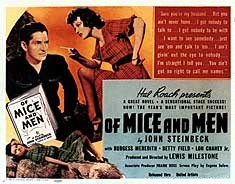
Of Mice and Men (1939, directed by Lewis Milestone, lost to Gone With The Wind) — “Tell me about the rabbits, George.”  Yes, it’s that film.  Smart and little George (Burgess Meredith) and big but simple Lenny (Lon Chaney, Jr.) are migrant farm workers who get a job working at ranch where Lenny ends up accidentally killing the rancher’s daughter-in-law.  Despite the fact that we all now tend to naturally smirk when we hear anyone say “Tell me about the rabbits, George,” Of Mice and Men remains an effective tear-jerker and both Meredith and Chaney give strong performances.

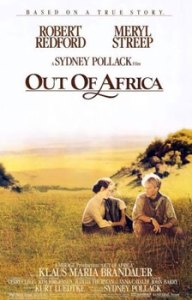
Out of Africa (1985, directed by Sydney Pollack, won best picture) — I recently sat down to watch this film because 1) my aunts love this film and get excited whenever they see that it’s going to be on TV and 2) Out of Africa was named the best film of the year I was born.  So, I sat down and watched it and then three or five hours later, I realized that the film was nearly over.  Anyway, the film is about a Danish baroness (Meryl Streep) who moves to a plantation in Africa and ends up having an affair with a British big game hunter.  The hunter is played by Robert Redford, who refuses to even try to sound British. (USA! USA! USA!)  Anyway, the film is pretty in that generic way that most best picture winners are but the film ultimately suffers because its difficult to care about any of the characters.  Streep acts the Hell out of her Danish accent but she and Redford (who seems to be bored with her) have absolutely no chemistry. I saw one review online that dismissed Out of Africa as a “big budget Lifetime movie” but Lifetime movies are a lot more fun.

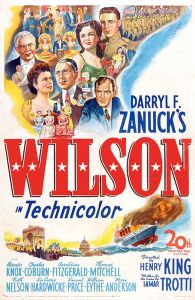
Wilson (1944, directed by Henry King, lost to Going My Way) — Wilson is a two-and-a-half biopic about Woodrow Wilson and his presidential administration.  Wilson is well-played by Alexander Knox, who later showed up in countless exploitation films.  Wilson shows up on cable occasionally and every time I’ve seen it, I’ve had mixed feelings about it.  The critical part of me tends to be dismissive of this film because it’s way too long, extremely stagey, and it glosses over the fact that Wilson was a virulent racist who idolized the Ku Klux Klan.  However, as a secret history nerd, I can’t help but enjoy seeing a film where Vincent Price plays the Secretary of the Treasury.

No Guts, No Glory, Part II: Lisa Marie Goes Down Into The Oscar Pool And Gets Wet


Since every other film blogger and wannabe Awards diva is doing so, I figured I might as well post my predictions as to who and what will actually win when the Oscars are handed out on Sunday.  Please remember, these are not the films and performers that I personally would choose to honor.  (Indeed, I’ve never disagreed with the Oscar nominations more than I have this year.)  These are just my predictions and random guesses at what will be honored on Sunday.

Best Picture: The Descendants

Best Director: Michel Hazanavicius for The Artist

Best Actor: George Clooney in The Descendants

Best Actress: Viola Davis in The Help

Best Supporting Actor: Christopher Plummer in Beginners

Best Supporting Actress: Octavia Spencer in The Help

Best Original Screenplay: Woody Allen for Midnight in Paris

Best Adapted Screenplay: The Descendants

Best Animated Feature Film: Rango

Best Foreign Language Film: In Darkness (Poland)

Best Documentary Feature: Paradise Lost 3: Purgatory

Best Original Score: War Horse

Best Original Song: “Man or Muppet” from The Muppets

Best Sound Editing: Hugo

Best Sound Mixing: Hugo

Best Art Direction: The Artist

Best Cinematography: The Tree Of Life

Best Makeup: Albert Nobbs

Best Costume Design: The Artist

Best Film Editing: The Descendants

Best Visual Effects: Hugo

Agree?  Disagree?  Confused as to what just the Hell I was thinking when I made some of these predictions?  Please let me know in the comments section below.

A Quickie With Lisa Marie: The Conversation (dir. by Francis Ford Coppola)


As a result of my continuing effort to see every single film ever nominated for best picture, I’ve been lucky enough to both discover and rediscover a handful of excellent films that, for whatever reason, have ended up forgotten and neglected in the years since they scored their nominations.  One of the more recent of these films was Francis Ford Coppola’s masterpiece of a paranoia, the 1974 Best Picture nominee The Conversation.*

The Conversation tells the story of Harry Caul (played by Gene Hackman), a surveillance expert who, along with his colleague Stan (played by the great John Cazale), is hired by a businessman (Robert Duvall) to bug a conversation between Duvall’s much younger wife (played by Cindy Williams) and a man who might be her lover (played by Fredric Forrest).  Harry, we quickly discover, is a man who values his privacy and who manages to find a balance between his unsavory job and his devout religious faith by maintaining an impenetrable shield of detachment from the rest of humanity.  He is a man who hides from the world inside of his apartment, only allowing himself to show the slightest hint of emotion when playing his saxophone.  In one of the film’s best scenes, Harry finds himself awkwardly socializing with a far more sleazy acquaintance (played by Alan Garfield, one of the great character actors of the 70s) and it becomes apparent that Harry may be the best in the business but he’s still the ultimate outsider.

However, Harry is forced to confront the contradictions of his own lifestyle when he listens to the conversation between Forrest and Williams and believes that he might have found evidence that both Forrest and Williams are in fear for their lives.  With Duvall’s operatives demanding the surveillance tapes, Harry Caul soon finds himself becoming more and more paranoid and unstable as he finds it more and more difficult to justify his detachment.  Harry finds himself obsessively listening to the conversation over and over again, going over every possible nuance and emphasis to try to figure out what’s actually being said.  Of course, by the end of the film, it’s obvious to both Harry and the audience that nothing is as simple as it sounds. 

Compared to the Godfather films and Apocalypse Now, the Conversation is a surprisingly low-key and rather muted film.  A lot of this is because, as opposed to the Corleones and Martin Sheen’s Captain Willard, Gene Hackman’s Harry Caul is a complete and total introvert, a man who makes his living by observing a world that he refuses to be a part of.  Though the film works quite well as a thriller, it works best when viewed as a sympathetic character study of a paranoid and anti-social human being.  Hackman full inhabits the role, bringing Harry — with all of his frustrating contradictions and conflicted actions — to oddly vibrant life.  The film ultimately serves as a sad-eyed look at how a good person can justify doing bad things and how the inevitable consequences of those bad things can only be delayed for so long.

On a final note, an impossibly young Harrison Ford shows up here as Duvall’s sinister assistant.  He plays the role with just the right amount of prissy arrogance and he has a great scene where he asks Harry is he wants to try a homemade cookie.  “They’re good,” Ford assures him.

So is The Conversation.

—–

* Of course, another Coppola film — The Godfather, Part II — beat the Conversation for best picture.  However, The Conversation did win the Palme D’Or at Cannes that year.  It was a good year to be Francis Ford Coppola.

Two Post Presidents Day Reviews: Frost/Nixon (dir. by Ron Howard) and All The President’s Men (dir. by Alan J. Pakula)


“Now Watergate doesn’t bother me/does your conscience bother you?” — Lynard Skynard, Sweet Home Alabama

As part of my continuing quest to see and review every film ever nominated for best picture, I want to devote my first post Presidents Day post to two films: 2008’s Frost/Nixon and 1976’s All The President’s Men.

During my sophomore year of college, I had a political science professor who, every day of class, would sit on his desk and ramble on and on and on about his past as a political activist.  He protested Viet Nam, he hung out with revolutionaries, he loved Hugo Chavez, and I assume he probably had a Che Guevara poster hanging in his office.  Whenever he wanted to criticize George W. Bush, he would compare him to Richard Nixon and then pause as if he was waiting for the class to all start hissing in unison.  He always seemed to be so bitterly disappointed that we didn’t.  What he, and a whole lot of other people his age, didn’t seem to understand was that Richard Nixon was his boogeyman.  The rest of us could hardly care less.

That was the same problem that faced the 2008 best picture nominee Frost/Nixon

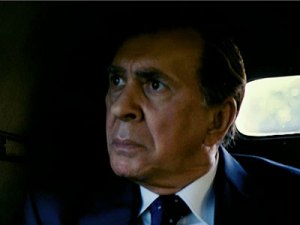
Directed rather flatly by Ron Howard, Frost/Nixon tells the true story about how a light-weight English journalist named David Frost (played by Michael Sheen) managed to score the first televised interview with former President Richard Nixon (Frank Langella).  Both Frost and Nixon see the interviews as a chance to score their own individual redemptions while Frost’s assistants (played by Oliver Platt and Sam Rockwell) see the interview as a chance to put Richard Nixon on trial for Watergate, the Viet Nam War, and every thing else under the sun.  That may not sound like a very exciting movie but it does sound like a sure Oscar contender, doesn’t it?

I’ve always secretly been a big history nerd so I was really looking forward to seeing Frost/Nixon when it was first released in 2008.  When I first saw it, I was vaguely disappointed but I told myself that maybe I just didn’t know enough about Richard Nixon or Watergate to really “get” the film.  So, when the film later showed up on cable, I gave it another chance.  And then I gave it a chance after that because I really wanted to like this film.  Afterall, it was a best picture nominee.  It was critically acclaimed.  The word appeared to be insisting that this was a great film.  And the more I watched it, the more I realized that the world was wrong.  (If nothing else, my reaction to Frost/Nixon made it easier for me to reject the similarly acclaimed Avatar a year later.)  Frost/Nixon is well-acted and slickly produced but it’s not a great film.  In fact, Frost/Nixon is epitome of the type of best picture nominee that inspires people to be cynical about the Academy Awards.

Before I get into why Frost/Nixon didn’t work for me, I want to acknowledge that this was a very well-acted film.  By that, I mean that the cast (Frank Langella, Michael Sheen, Kevin Bacon, Sam Rockwell, and Oliver Platt) all gave very watchable and entertaining performances.  At the same time, none of them brought much depth to their characters.  Much like the film itself, nobody seems to have much going on underneath the surface.  Frank Langella may be playing a historic figure but, ultimately, his Oscar-nominated performance feels like just a typically grouchy Frank Langella performance.  Michael Sheen actually gives a far more interesting performance as David Frost but, at the same time, the character might as well have just been identified as “the English guy.”  In fact, a better title for this film would have been The Grouchy, the English, and the Superfluous.

For all the time that the film devotes to Rockwell and Platt blathering on about how they’re going to be giving Richard Nixon “the trial he never had,” this film is ultimately less about politics and more about show business.  Ron Howard devotes almost as much time to the rather boring details of how the interviews were set up and sold into syndication as he does to the issues that the interview brings up.  Unfortunately, for a movie about show business to succeed, the audience has to believe that the show is one that they would actually enjoy watching,  This, ultimately, is why Frost/Nixon fails.  While the filmmakers continually tell us that the Frost/Nixon interviews were an important moment in American history, they never show us.  Yes, everyone has hideous hair and wide lapels but, otherwise, the film never recreates the period or the atmosphere of the film’s setting and, as a result, its hard not to feel detached from the action happening on-screen.  For all the self-congratulatory claims made at the end of the film, it never convinces us that the Frost/Nixon interviews were really worth all the trouble.  Much like my old poli sci professor, Frost/Nixon never gives us a reason to care. 

For a far more interesting and entertaining look at the Watergate scandal, I would recommend the 1976 best picture nominee All The President’s Men.  Recreating the story of how two Washington Post reporters (played by Robert Redford and Dustin Hoffman) exposed the Watergate scandal that eventually led to Nixon’s resignation, All The President’s Men is the movie that Frost/Nixon wishes it could be.  Despite being made only two years after Watergate, All The President’s Men doesn’t take the audience’s interest for granted.  Instead, director Pakula earns our interest by crafting his story as an exciting thriller.  Pakula directs the film like an old school film noir, filling the screen with menacing shadows and always keeping the camera slightly off-center.   Like Frost/Nixon, All The President’s Men is a well-acted film with a bunch of wonderful 70s character actors — performers like Ned Beatty, Jason Robards, Jack Warden, Martin Balsam, and Robert Walden, and Jane Alexander — all giving effectively low-key and realistic performances.   The end result is a film that manages to be exciting and fascinating to those of us who really don’t have any reason to care about Richard Nixon or Watergate.

Both of these two films were nominated for best picture.  Frost/Nixon quite rightly lost to Slumdog MillionaireAll The President’s Men, on the other hand, lost to Rocky.

Movies I Want To See: The Oscar


Well, it’s almost here!  One more week and then, it’s Oscar time.  This is the time of year that I always end up remembering an infamous little film from 1966 that I’ve always wanted to see.  The film in question was meant to be an expose of all the sordid side of show business but instead, it has since become legendary for the number of critics who have declared it to be one of the worst films ever made.  The film is calledThe Oscar” and it even scored nominations for both its sets and its costumes.  Each year, around this time, I swear that I’m going to track down and finally watch this movie.  Will this be the year that it finally happens?

Probably not.  To be honest, this is going to be a pretty busy week for me and, once this year’s ceremony is over with, I’ll probably be burned out on Oscar talk. 

It happens.

However, even if I don’t see the film anytime soon, I can still share this YouTube video of highlights from 1966’s The Oscar.

Enjoy!

What Lisa Marie Watched Last Night: Trader Horn (dir. by W.S. Van Dyke)


Last night, as I attempted to drift off to sleep, I switched over to TCM and watched the 1931 film Trader Horn.

Why Was I Watching It?

I’m on a mission to see every film ever nominated for best picture and Trader Horn was nominated back in 1931.  (It lost to the first western ever to win best picture, Cimarron.)  Trader Horn is a bit of an oddity among Oscar contenders in that it received no other nominations save for best picture and it has never been released on DVD.  When I saw it on TCM’s schedule last night, I figured that might very well be my only chance to see this forgotten best picture nominee.

What’s It About?

So Trader Horn (Harry Carey) is a heroic ivory hunter.  Yes, this film was made a long time ago. He makes his living in Africa where he spends his time killing animals and explaining how, whenever the natives start playing their drums, it means that “every black devil is in the bush.”  Again, this film was made a very loooooooong time ago.

Anyway, at the start of the film, Trader Horn is introducing his apprentice (Duncan Renaldo) to the facts of life in Africa.  Eventually, they meet a missionary (Olive Golden) who is looking for daughter who was kidnapped by a tribe years ago.  When Golden is killed, Trader Horn takes it upon himself to find her daughter (played by Edwina Booth) and bring her back to civilization.

What Worked?

Trader Horn was the first non-documentary to be filmed on location in Africa and, as you watch the movie, it quickly becomes apparent that the film’s plot is really just an excuse to show off all the nature footage that director W.S. Van Dyke managed to capture.  Countless time the film’s story comes to a complete halt while Carey and Renaldo simply stop to watch a grazing giraffe or to watch a leopard hunt a wildebeest.  Normally, this is the sort of thing I would complain about but, in this case, the story was so predictable and silly that I was happy for the interruption.  It helps that the 80 year-old nature footage is still visually impressive and exciting to watch.   According to the research I did on the Internet after seeing the film, Trader Horn’s footage was used as a stock footage in countless “jungle” films over the next three decades in much the same way that the same old distressing mondo footage tends to show up in every single Italian cannibal film.

There’s a scene were Renaldo finds a lion cub and oh my God, it’s just the most adorable little kitty ever!

Trader Horn actually has an interesting production history and I enjoyed reading about it after I watched the movie.  Apparently, Van Dyke spent seven months in Africa making this film and almost the entire crew ended up falling ill.  At least two cameramen were killed while filming the wild animals and Edwina Booth returned so sick that her film career was pretty much ended. 

On one final note, there was apparently a pornographic remake of this film in the late 60s.  Its title?  Trader Hornee.

What Didn’t Work?

Did I mention this film was made a really looooooong time ago?  Because, seriously, it was.  On occasion, I’ve heard an old film described as being “creaky.”  I never really understood what that meant until I saw Trader Horn because, quite frankly, this film is amazingly creaky.   It moves slowly, the performers are rather melodramatic (though Harry Carey does a good job), and. while the cultural attitudes may have been acceptable in 1931, they now come across as extremely racist and its hard not to feel really uncomfortable with scenes where Renaldo ogles the bare-breasted native women and says, “Why, they’re not savages at all!  They’re like little children!”

Bleh.

“Oh My God!  Just Like Me!” Moments:

I would have wanted to adopt that lion cub too.

Lessons Learned:

1931 was a long, long time ago.

A Quickie With Lisa Marie: The Ox-Bow Incident (directed by William A. Wellman)


As part of my continuing mission of see every single movie ever nominated for best picture, I’ve been watching a lot of TCM this month.  Last week, I caught the 1943 best picture nominee, The Ox-Bow Incident.

Taking place in Nevada in the 1880s, The Ox-Bow Incident is a western that examines both the mob mentality and takes on the issue of lynching.  (It should be remembered that when the Ox-Bow Incident was first released, lynchings were still a regular occurrence.)  Henry Fonda and Henry Morgan play two prospectors who ride into town one day and discover that everyone is on edge because there are apparently cattle rustlers about.  When it’s reported that a rancher has been murdered, the townspeople form a posse and go searching for the rustlers.  Realizing that until the real rustlers are caught they’ll be considered prime suspects, Fonda and Morgan join the posse.  Led by Major Tetley (Frank Conroy), who falsely claims to be a Confederate veteran, the posse comes across a camp with three men.  Though it quickly becomes obvious that the three men are probably innocent, the posse immediately makes plans to lynch the men.  Fonda and Morgan find themselves forced to either side with the bloodthirsty posse or to stand up to the mob.

To be honest, I’ve never been a big fan of Westerns.  On a personal note, Some of that is because whenever anyone from up north finds out that I’m from Texas, they always ask me if I’ve ever ridden a horse.  (For the record, I do not own a horse, I do not ride horses, and I’m pretty sure I’m allergic to them.)  On another note, Westerns often strike me as being predictable.  All of the dark strangers and the old maid school teachers and the tight-lipped gunslingers spitting tobacco all over the place — it all just makes me want to go, “Bleh!” 

However, I was surprised to discover that I really enjoyed The Ox-Bow Incident.  While the film’s well-intentioned message was a bit heavy-handed, director William Wellman emphasizes the psychological aspects of the story and the movie itself was well-acted by a large cast who brought a surprising amount of depth to characters who, in lesser hands, could have easily just been stereotypes.  Henry Fonda and Henry Morgan were both excellent and sympathetic leads while Jane Darwell dominated the film as one of the more bloodthirsty members of the lynching party.  A very young and very suave Anthony Quinn also shows up as one of the accused men.  Five decades before either Quentin Tarantino or the Coen Brothers, Wellman and his cast use the standard tropes of the western genre to comment on some very real issues and the end result is a fast-paced film that succeeds in making a moral debate just as exciting as any gunfight or stampede.

Released in 1943, The Ox-Bow Incident was nominated for best picture but, ultimately, it lost to Casablanca.  It’s hard to complain about any film losing to Casablanca but taken on its own terms, the Ox-Bow Incident remains an entertaining and intelligent film and one that I’m thankful that TCM gave me a chance to discover.

Lisa Considers The Great Dictator (dir. by Charles Chaplin)


I recently discovered that Uverse has select films from the Criterion Collection available OnDemand.  Last night, I took advantage of this service and watched 1940’s The Great Dictator.  Along with being Charlie Chaplin’s first all-sound film, the Great Dictator was also a best picture nominee.  (It lost to Alfred Hitchcock’s Rebecca.)

The Great Dictator is a broad comedy that, ultimately, has a very serious message.  Made at a time when the second world war was looking more and more inevitable, The Great Dictator features Charlie Chaplin in two roles.  As the film opens at end of World War I, Chaplin plays a meek but well-meaning Jewish barber who has found himself serving in the army of Tomania.  Though the barber manages to survive the war, he also loses his memory and ends up spending the next 20 years in a mental hospital.  When his memory finally does return, the barber returns to his barber shop and quickly discovers that things have changed.  His shop has been boarded up and the word “JEW” has been painted over the windows.  Thugs wearing military uniforms now patrol the streets and continually threaten to send people to concentration camps.  Tomania is now ruled by a dictator named Adenoid Hynkel.

Hynkel, who happens to look just like the barber (and who is, of course, also played by Chaplin) is quickly established as being a crazy and rather simple-minded buffoon.  As played by Chaplin, Hynkel gives long speeches in a harsh gibberish language that is designed to sound German without actually being German (fortunately, Hynkel has a translator on hand to tell us, after he has just spent two minutes harshly ranting, “Hynkel just explained his position on the Jews.”) and he continually runs throughout his palace in an attempt to prove that he’s capable of doing a hundred more things than the average person.  In his private time, he does a child-like dance with a big inflatable globe, speculates on how glorious it will be to be the “brunette dictator of the Aryan people,” and tries to maintain a shaky alliance with his fellow dictator Benzino Napaloni (Jack Oakie).  Playing a character that was the polar opposite of his usual persona, Chaplin’s performance manages to be both comedic and disturbing.  You laugh at Hynkel’s buffoonish behavior but you never forget that he’s a very dangerous man.  (Admittedly, I say that with a hindsight that was not possessed by either Chaplin or the audiences of 1940.)

The film proceeds to follow these two characters in two separate storylines that finally come together at the end of the movie with (SPOILER) Chaplin giving a nearly 5-minute plea for world peace.  While Hynkel schemes to conquer the world one country at a time, the barber attempts to adjust to his new life while sweetly romancing the outspoken Hanna (Paulette Goddard),  While the film is probably best known for Chaplin’s performance as Hynkel, I found the barber and Hannah’s relationship to be sweetly poignant.  Their relationship gives this film a heart to go along with its biting satire.

For me (and admittedly, I’m a secret history nerd), it’s interesting to watch The Great Dictator today and try to imagine how audiences first reacted to it in 1940.  According to Wikipedia, the Great Dictator was Chaplin’s most financially succesful film and Chaplin was even invited to the White House to recite the film’s climatic speech for President Roosevelt. And, of course, The Great Dictator also scored Oscar nominations for best picture, actor (Chaplin), supporting actor (Jack Oakie), screenplay, and original score.  Chaplin also said, in his later years, that if he had known what was truly being done by Hitler and the Nazis, he would never have made a comedy like The Great Dictator.

I think that would have been a mistake on his part because if The Great Dictator proves anything, it proves that satire and humor is often the most powerful weapon against the forces of evil.  Though Chaplin makes no secret of the fact that Hynkel is meant to be Hitler and Oakie is meant to be playing Mussolini, they could also serve as stand-ins for just about any dictator who has seized power through exploiting prejudice and hatred.  The sight of Hynkel dancing with that globe is actually a far more effective anti-totalitarian statement than the heartfelt and undeniably sincere speech that ends the film.

Lisa Marie Bowman Does Michael Clayton (dir. by Tony Gilroy)


As part of my continuing mission to see and review every single film ever nominated for best picture, I recently rewatched the 2007 Best Picture nominee Michael Clayton

The title character (as played by George Clooney) is a sleazy attorney who “fixes” problems for one of the biggest law firms in New York.  When Arthur Edens (Tom Wilkinson), one of the firm’s partners and Michael’s mentor, has a nervous breakdown while at a deposition in Minnesota and ends up in jail, Michael is sent to retrieve him.  Michael soon discovers that Arthur’s mental collapse was due to a class action law suit involving an evil, faceless corporation.  Before he reveals any more details, Arthur flees and is subsequently murdered by two assassins.  With the police calling Arthur’s death a suicide, Michael soon finds himself being pursued by the same assassins.

Though I’ve owned the DVD for a couple of years, this was only the second time that I had ever actually sat down and watched this film.  (The first time was during its initial theatrical run.)  There have been many insomnia-filled nights when I’ve gone to my DVD collection, fully intending on grabbing Michael Clayton and allowing the images of an unshaven George Clooney to flicker in my dark bedroom.  However, every time, I always ended up suddenly remembering a film that I wanted to see more. 

That’s the thing with Michael Clayton.  Having seen the film a second time, I can say that it remains a well-made film and an entertaining film and I can also say that I noticed a whole lot of small details that I had either missed the first time or had subsequently forgotten about.  Like a lot of best picture nominees, Michael Clayton is a good film.  It’s just not a very memorable one.  Seriously, is anyone surprised when business executives and attorneys turn out to be the villains in these type of films?  And if you couldn’t guess that Tom Wilkinson was going to end up dead from the minute he turned up on-screen then you may need to surrender your filmgoer card.

That said, Michael Clayton remains a fun little film and I enjoyed watching it even if it was predictable.  In fact, I may have enjoyed it even more the second time around because I currently work for an attorney so I was able to spend the whole movie playing the “What would my boss do in this situation?” game.  (Hopefully, the first thing he would do would be to send his loyal and capable red-headed assistant on a nice, long, all-expense paid vacation Italy.)  Beyond that, Tony Gilroy’s direction is efficient and fast-paced, George Clooney gives one of his less-smug performances (It can be argued that Michael Clayton — along with Up In The Air and The Descendants — forms Clooney’s Mediocre White Man Trilogy) and Tilda Swinton deserved the Oscar she won for playing a villain who isn’t so much evil as just really insecure.   However, for me, the best performances in this film come from two unheralded actors by the name of Robert Prescott and Terry Serpico.  Playing the two assassins who pursue both Wilkinson and Clooney, Serpico and Prescott play their roles with a nonchalant sort of respectability that is both compelling and genuinely frightening.  During those brief moments when Serpico and Prescott are on-screen, Michael Clayton actually becomes the film that it is obviously trying so hard to be.