One of the films I’ve really been following since last year and can’t wait to see this September is the latest film from Danish filmmaker Nicolas Winding Refn. I’ve loved his work since I first got introduced to his Pusher Trilogy and saw his two most recent work with Bronson and Valhalla Rising. He is following up the latter with what I could only describe as his own take on the neo-noir genre film, Drive.
At San Diego Comic-Con 2011, the latest trailer for Drive was introduced during the FilmDistrict panel which also had Guillermo Del Toro and his upcoming produced horror film, Don’t Be Afraid of the Dark. This latest trailer for Refn’s Drive is of the red band variety but from what I could tell from the trailer it shouldn’t be NSFW.
The trailer really doesn’t delve too much into all the plot points of the film. It does give a sense that the film has been influenced by past genre crime films and some of the classic grindhouse chase films of the 70’s. One thing I’m sure of is that this film’s cast looks to be one of the best for any film being released in 2011: Ryan Gosling, Carey Mulligan, Ron Perlman, Oscar Isaac, Albert Brooks, Bryan Cranston and Christina Hendricks just to name a few.
Drive is set for a September 16, 2011 release here in the United States.
There have always been films through the years which will garner extreme reactions from its audiences. These reactions will always take two sides on the film. People who see these films will either love them or they will hate them. There is to be little to no middle ground reaction when it comes to these films. In 2009, we had James Cameron’s epic scifi Avatar which had two sets of fans. Those who loved it to the point that it transcended simple fandom into something these people thought as important. Then there were the vocal minority who absolutely hated the film. Whether both fans were right in their opinions was (and continues) to be irrelevent. All that mattered to these people was that they’re right and the other side was wrong.
2011 is entering it’s second season and a film finally arrived which seem to have elicited the same sort of reaction from people who have seen it. Sure, there’s some who saw it merely as entertainment and left it at that, but there’s a growing rift between those who loved the film and those who hated it. The film which seem to have caused this is the action-fantasy film Sucker Punch.
To say that Zack Snyder’s latest visual extravaganza would create discussion amongst filmgoers would be an undertstatement. Sucker Punch has arrived to much genre fandom fanfare. This was a film that seemed to take genres from all corners like scifi, fantasy, anime and manga and mashed them all up into something new and serving it up to the legion of fans who love those very things. Zack Snyder has made his reputation as a filmmaker as a visual artist. His entire filmography from the Dawn of the Dead remake all the way up to his adaptation of the Alan Moore graphic novel Watchmen have all been very strong visually. His grasp of narrative structure continues to grow and improve but it’s always been his handling of dialogue which has tripped him up.
Sucker Punch is a tale within a tale about a young woman we come to know as Baby Doll (played with an almost angelic quality by Emily Browning). The film opens up with the curtain rising on a theater stage and we soon become witness to a dialogue-free opening sequence of the events which transpired to bring Baby Doll to the Lennox House mental institution. This entire opening sequence is a great example of Snyder as a master of creating a montage of striking visuals sans dialogue with only music to break the silence. It helped that the music chosen to accompany this scene was a haunting rendition by Emily Browning herself of the Eurythmics’ “Sweet Dreams (Are Made of These)”. Just like in Watchmen‘s own intro title sequence, Snyder was able to convey the beginnings of the story without the need for dialogue and do it so well that we as an audience understand fully all that’s transpiring on the screen.
Once this prologue ends we move onto the main setting of the film where Baby Doll gets put into the care of the Lennox House’s resident boogeyman in the form of Blue as played with slimy charm and panache by one Oscar Isaac (last scene chewing up the English countryside in Ridley Scott’s Robin Hood). The audience sees what Baby Doll sees as Blue gives her the tour of the facilities which finally ends at the “Theater” where all the female patients act out their problems and fears through the guidance and help of Doctor Gorski (played by the lovely and return Snyder performer, Carla Gugino).
The first 15 minutes of this film was pretty much a basic set-up of what Snyder will use as his blueprint for the rest of the film. All the different levels of fantasy Baby Doll will imagine and inhabit throughout the film is rooted deeply in this initial sequence of events which begins the film. The clues as to who the story is truely about could be found in this intro if one was paying attention to the film instead of being distracted and mesmerized by the visuals Snyder crafts to start the film. While it won’t become apparent until the reveal at the climactic events of the film. Once all are the cards were revealed, so to speak, the beginning of the film begins to make sense. From the curtain rising, the silent film-like scene to begin and the narration to open things up, all those give a hint to what the answer to the question the film’s narrative really asks: “Is what we’re seeing truly real or is it all just fantasy?”
Sucker Punch becomes a sort of a trip down the rabbit hole a la Alice In Wonderland once the film establishes Baby Doll’s predicament upon arriving at the Lennox House (she’s to be lobotomized in 5 days). The film moves from the gray and depressing confines of the Lennox House to the fantasy world centered on a burlesque establishment where Baby Doll is an orphan sold by a decadent priest (the form her stepfather takes in this fantasy) to Blue, the proprietor of this house of ill repute where orphaned young women become burlesque dancers and worst to the clientele. It is in this place we meet the rest of the gang Baby Doll will befriend to help her try to escape the place and thus avoif the “High Roller” who will come to collect her in 5 days.
The film shares something similar with Christopher Nolan’s Inception in that both films deal with different levels of reality or fantasy (depends on how one sees the different worlds shown in both films). Where Nolan’s ideas seem more rooted in what he would consider as more grounded to reality as much as possible Snyder goes the other way and takes the leashes off of Baby Doll’s imagination. This third level Baby Doll goes to as she begins her dance to distract the men of the burlesque house is her mind unfettered and where she’s not helpless but has power not just to protect herself but do so better than the men who inhabit this fantasy world of steampunk zombie soldiers, orcs, dragons, alien robot machines and many other scifi and fantasy tropes which define geek culture through the decades.
If there’s one reason to watch this film it would be just to bear witness to Snyder letting his imagination as a visual filmmaker take over. Some people may not like this and want a strong, structured narrative to balance out the visuals. I, too, would’ve liked to have seen something stronger in terms of story and plot, but there are just instances when the visuals are so striking and wildly imaginative that one just marvels at the scenes unfolding on the screen. If any, Snyder as a visual artist helps prop up the weakness in the story. Snyder would’ve served this film better if he went even further and turned Sucker Punch into an avant-garde silent film of the digital age. That beginning in the film just unfolded so strongly despite no dialogue that the rest of the film could’ve been done in the same manner and be the better for it.
Which brings me to what was the film’s near fatal flaw. A flaw that many of the film’s detractors have taken as the rallying cry to denounce the film as horrible and Snyder as a hack. The interesting thing is that these same people were also the ones who had been praising of Snyder prior to this film. Even those who begrudgingly gave Snyder his props for having some semblance of talent because of the very handling of the visuals that he has now have become much more vocal about how they always knew Snyder was never that good.
I would say that Snyder is not the second coming of Ridley Scott as some of his supporters have anointed him or is he a hack filmmaker who is all flash and no substance. I think he’s somewhere in the middle and still finding his true voice as a filmmaker. I’ve always seen Snyder as being weak when it comes to handling the slower scenes of dialogue and most visual filmmakers tend to be the same when starting out. The dialogue seem to get in the way of what they really want to do and tell the story through striking visual sequences. They’re like painters who don’t need words to convey the emotions they wish to convey. Sucker Punch I believe suffered from Snyder trying to combine his strength on the visual side of the equation with his handling of story through the dialogue which he still hasn’t mastered. If someone else had written, or at the very least, fixed and strengthened the script, I do believe that the film wouldn’t be getting so ripped and trounced by those who had been so excited to seeing one of Snyder’s personal projects.
The performances by the cast ranged from good to just being there. There really wasn’t anyone in particular who performed badly. Everyone from Emily Browning to Oscar Isaac all the way to Abbie Cornish did well enough with the material they were given. Oscar Isaac as both Blue in the insane asylum and as the pimp in the burlesque house did particularly well playing up the fun role of the villain in Baby Doll’s different levels of reality/fantasy. Of the ladies in the film I must point out the performance of Jena Malone and Abbie Cornish as sisters in the second level. While we only get a glimpse of Cornish’s Sweet Pea character in the Lennox House, once in the burlesque setting she becomes the anchor by which the rest of the women in the cast held onto. Jena Malone as the younger sister Rocket who still dreamed hopes of escape was a nice complement to Sweet Pea.
So, we have a film in Sucker Punch which seem to have strength on one side of the filmmaking equation and a major weakness on another. This is the kind of film that I would, in the past, have dismissed as another attempt by Hollywood to pander to the geek crowd with its mash-up of different scifi and fantasy imagery. But this time around I actually enjoyed the film both in a visual sense and how Snyder was able to play with the audience’s personal observations about the themes his film is trying to explore. It’s these very themes which have split audiences into two camps. While the gender politics and stereotypes people have brought up in discussing this film have made for some lively debate I refrain from adding my views on it in this review. I think I’m not well-qualified to debate such discussions.
For me, Sucker Punch succeeds more than it fails because Snyder didn’t play it safe with how he wanted to make his film. He was able to tell the film’s story through the different visual styles for each world the cast played in and did it quite well. While most of the time I wouldn’t give a film a pass for a weak narrative and average dialogue with this film I felt like the experience one gets from experiencing the visual canvas Snyder continued to paint with from beginning to end was enough to balance out the negative. It’s really a film that one must experience for themselves and make their decision on that experience instead of listening to other’s opinions (both good and bad) about the film. One may end up hating the film like some, but then again they may end up like me and forgive Snyder for trying to reach for the sun and failing to do so, but at least tried to with panache instead of playing it safe.
Last Friday, I went and saw Zack Snyder’s new film Sucker Punch with my sister Erin and a group of our friends. Sucker Punch was a film that I had been looking forward to seeing for a while and not even all of the scathingly negative reviews that I read before leaving for the theater could dampen my enthusiasm. Somehow, I knew I would love this film (despite the fact that Zack Snyder is, usually, one of my least favorite directors). And you know what? I did love it.
The plot has been criticized for being both overly complicated and not being complicated enough and I actually think that a case can be made for either one of those complaints. The film opens in the 1950s. Teenage Babydoll (Emily Browning) is sent to a mental asylum by her evil father. Her father has made a deal with an orderly named Blue (Oscar Isaac) to have Babydoll lobotomized. (By the way, this was actually a pretty common thing back in the 50s. I shudder to think what would have been done to me if I had been born five decades earlier.) As Babydoll waits for her lobotomy (scheduled to occur at the end of her first week as a patient), she is subjected to the therapy of Dr. Gorski (Carla Gugino) who plays music and encourages her (all female) patients to find peace by controlling their fantasies.
Suddenly, we’re in a fantasy (just who exactly is having the fantasy is one of the film’s mysteries that’s never really explained but is actually kinda fun to debate). In the fantasy, the insane asylum is actually a brothel/dance hall that is owned by Blue. Gorski is a choreographer. The patients are now all lingerie-clad dancers/prostitutes. Babydoll is the latest girl to be put into service in the brothel and she is being held over for “the High Roller” who is expected to show up in five days.
(The fact that the movie explicitly compares forced lobotomy to rape is one of the many interesting facts that the majority of negative reviews have chosen to ignore.)
Babydoll soon discovers that 1) she’s such a good dancer that when she does dance, men can only watch in stunned silence and 2) whenever she does dance, she finds herself transported into a fantasy world where, along with getting advice from the Wise Old Man (Scott Glenn), she also battles (and defeats) everything from giant Samurai to dead Nazis who have been reanimated by “steam power” to a dragon. These battle scenes, as odd as they are, are actually pretty exciting. Say what you will, Snyder knows how to direct a battle scene and Browning and the rest of the almost entirely female cast all seem to be having a blast getting to do the type of things that usually, only boys are allowed to do.
Anyway, as a result of her fantasies, Babydoll comes up with a plan to escape the brothel. She quickly recruits four other girls into her plan — Amber (Jamie Chung), Blondie (Vanessa Hudgens), the free-spirited (and really, really cool) Rocket (Jena Malone) and finally Rocket’s older sister, the world-weary Sweatpea (Abbie Cornish). In order to escape, they need to steal four different items. While Babydoll distracts their captors by dancing (and therefore going into one of her battle fantasies), the others steal whatever is needed. And everything works out just fine. Until it doesn’t….
Sucker Punch is a glorious mess of a movie and, perhaps because I’m a glorious mess myself, I loved it. In fact, it’s probably my favorite film of 2011 so far. In this regard, I know I’m going against the majority but so what? Throughout history, if one thing has always been consistent, it is that the majority sucks. Yes, Sucker Punch is a deeply flawed film that runs on for at least half-an-hour too long. And yes, I think it can be argued quite convincingly that this film is ultimately a happy accident, a film that’s strength comes not from directorial design but instead as the result of a few random elements that resonate in the subconscious. But no matter — happy accident or not, I loved Sucker Punch and I’m not ashamed to admit it.
Hmmm…that’s a familiar pose.
Let’s start with a few obvious points. As even those who hate this film seem to be admitting, it’s visually stunning. The battle scenes are kinetic and exciting, the film’s over-the-top production design (a mix of German Expressionism, 50s film noir, Bob Fosse choreography and old Zack Snyder films) is always a blast to look at, and the soundtrack kicks ass. Like other films in the so-called “Girls with Guns” genre, Sucker Punch allows its actresses to be something other than just scenery or helpless damsels.
Interestingly enough, for a film that takes place mostly in the world of fantasy, there’s no attempt to really make this film’s version of “reality” come across as anything other than an elaborate fantasy as well. The film’s opening scenes are played out in slow-motion and the film’s asylum (which, like most movie asylums, appears to have been borrowed from The Cabinet of Dr. Caligari) is so gray that the film might as well be in black-and-white. Blue and Babydoll’s father hold a melodramatic conference while standing directly behind Babydoll, their three heads filling the screen like flashes of manic paranoia. As such, the film — at times — becomes a fantasy taking place in a fantasy taking place in a fantasy. It takes a while for the viewer to get used to this and, at times, it can seem like there’s really nothing to give the film any sort of grounding. However, for me, the opening sequences are not meant to be “real” as much as they serve as a reflection for the way that the real world can imprison anyone but women in particular. As women, we know what its like to look up and suddenly realize that our entire world has somehow become gray and cold without our knowledge. Throughout history, when everything else has been taken away from us, fantasy has been our escape and salvation, our imagination being the one of those precious things that our fathers, our husbands, and our bosses would never be able to deny us.
One problem I did have with the film is that, for all the talk about how Babydoll’s dancing is essential to the escape plan, we never actually see her dance. Instead, we see Browning start to sway a little, her eyes cast down and then suddenly, we’re transported into a fantasy involving zombie Nazis or giant samurai. Once this fantasy mission has been completed, we’re suddenly back in the brothel where we see Babydoll ending her dance while her audience applauds.
To a large extent, I actually agree with Snyder’s approach here because I know, for me much as with the characters in this film, dance always presented an escape from the grayness of being. When I was dancing, I was literally living a fantasy and this seems to be the case with Babydoll as well. However, from simply a cinematic point of view, the constant talk of the importance of Babydoll’s dance leads the audience to naturally expect that they’ll get to see at least a little bit of the dance in question. When you don’t, it’s hard not to feel as if you’ve been teased. (I have to admit, as well, that all this dance talk got my competitive streak going as well. As I whispered to Erin, “They should see me dance.” “It’s a movie, Lisa Marie, not a challenge.” Erin replied.) Snyder, as a director, certainly probably has a strong enough visual sense that he could have found a way to make any dance that Emily Browning came up with look impressive and other worldly.
Oscar Isaac
As Arleigh has pointed out on both twitter and this site, Zack Snyder is a director who concentrates almost all of his effort on producing memorable visuals. That’s how he tells his stories and gets the whatever response he wants from his audience. Characters and dialogue are often kept simple so that they don’t get in the way of his visuals. Typically, I hate films like this and I’m hardly a fan of Snyder’s previous work. However, it didn’t bother me so much here, perhaps because I could relate to the overall theme of feeling trapped and needing an escape. (More on that later.) As with previous Snyder films, the performances here are mostly in service of the visuals. The actors don’t so much perform as much as they just pose against the stunning backdrops. As such, Emily Browning, Vanessa Hudgens, and Jamie Chung don’t really get much of a chance to make an individual impression. Playing sisters, Abbie Cornish and Jena Malone don’t have a lot to work with but they both are strong enough personalities that they manage to bring some life to their characters beyond simply serving as figures on a landscape.
(I should also mention — and Arleigh had the same reaction — that Cornish and Malone and their character’s relationship reminded me a lot of my relationship with my older sister, Erin — especially all the times that Rocket attempted to keep things fun and interesting just to be told, by Sweetpea, that she wasn’t being boring enough. I definitely related to that. Erin, for her part, says that she related to all the scenes where Sweatpea nearly got killed “because her bratty, little sister did something stupid that made absolutely no sense.”)
Abbie Cornish and Jena Malone (or Erin and Lisa) In Sucker Punch
I also have to mention Oscar Isaac and Carla Gugino, both of whom seem to understand just how far they can go with their characters without descending to the level of camp. Gugino — after this film, Sin City , and Watchmen — has got to be the Queen of digital filmmaking. She’s also the closest thing that American film has to an old school femme fatale right now. As well, as I told Erin as we watched the film, I can only hope that my tits look that good when I’m 60 years old. And speaking of looking good, Oscar Isaac certainly does look good here. Even when he has dark circles under his eyes and sports a glowering scowl, I would still throw Isaac on the ground and lick his face. Plus, he and Gugino contribute a great performance of Love Is The Drug which plays over the end credits.
Finally, Scott Glenn — looking a lot like the late David Carradine — plays the “Wise Old Man” who pops up as a father figure of sorts in Babydoll’s fantasies. Glenn does okay with his role though I wish his character had been a bit more clear. To be honest, simply from the point of view of empowerment, I kinda wish his character had been known as the “Wise Woman” and had been played by Cate Blanchett.
One huge issue that seems to be coming up a lot when people talk about Sucker Punch is the issue of “empowerment.” Does this film, which indulges in a massive schoolgirl fetish even while portraying girls kicking ass, empower or degrade women? Well, first off, I would suggest that the question itself is an inappropriate one because to argue that a film is either “empowering” or “degrading” and nothing else is basically the same as arguing that all women are going to have the exact same response to what they see regardless of their own life experiences or personal outlook. Quite frankly, because of some of my own personal experiences, I find the infamous, much-maligned 1970s rape/revenge film I Spit On Your Grave to be very empowering and I’m not alone in that regard. At the same time, I also know many very intelligent, very strong women who would consider that film to be anything other than empowering. It’s simply a matter of perspective.
I think the same can be said about Sucker Punch. To me, Sucker Punch was a very empowering film and, honestly, that’s the main reason that I loved it even with its flaws. First off, I think that any film in which women are allowed to do something other than stand around and panic until they’re rescued by a man, is going to be empowering because, far too often, we are taught that waiting for the right man to arrive is the only option available to us. As well, the main theme of Sucker Punch was the theme of escape, whether that escape was physical or mental. While I won’t presume to speak for all women, I can say that for many of us, escape is the usually the root of all fantasy and, at least to some extent, the ultimate goal. As I watched Sucker Punch on Friday night, it seemed to me that, for far too many of us, life is a series of prisons and asylums in which the walls are constructed out of the harsh judgments of patriarchal society. We allow ourselves to become trapped by the need to be a mother or a wife or a nurturer or a seductress or a whatever it is that society says a good woman has to be on any given day. The women in Sucker Punch are imprisoned because they’ve gone against the expectations of society and now, whether being lobotomized or sacrificing their bodies in the fantasy brothel, they are allowing their role and personality to be defined by men. Therefore, when Babydoll and her crew fight for their freedom, we can relate to them because that’s what we have to do every day of our lives.
My Dream Is Yours
But, the argument goes, how this be considered to be empowering when all the female images in the film are so hyper-sexualized? And it’s true that even when the film is supposed to be portraying reality, the camera does linger over the bodies of the actresses. In the brothel sequences, the film often looks like an outtake for some anime-inspired Victoria’s Secret fashion show. (Seriously, this film has a major lingerie fetish but you know what? So do I. Lingerie is fashion poetry and when I’m wearing something pretty, I feel like a poem.) Finally, there’s the image of Babydoll fighting her enemies and dodging explosions while flashing her underwear to the viewer. Many have argued that this is a degrading image, that it encourages male viewers to leer and to ogle.
Well, the fact of the matter is that this film was directed by a man and often times it is obvious that we’re watching the action through a male gaze. But, so what? Just as I believe that women should not be ashamed of their sexuality, I don’t see why men should be expected not to look. (Looking is not the problem. It’s the assumption that the right to look also gives one the right to judge.) And ultimately, I would argue, that being sexy is empowering because society, with its fucked up view of human sexuality in general, is so quick to tell us that the ideal woman is unaware of her sexuality or, at the very least, she should either hide it behind a facade of demure humility or else flaunt it to such an extent as to suggest that it’s all actually a sign of some deeper neurosis. What is rarely given as an option is the idea that we might want to show off a little just as a matter of pride. Men are applauded for showing off their muscles yet we are still expected to blush if we show a little cleavage. Being sexy is not degrading. What’s degrading are the conditions that society has attempted to impose on the right to be sexy. To me, it’s very empowering to see strong, independent women standing up for themselves and looking good while doing it.
Sexual Empowerment
And therefore, for me, Sucker Punch was a very empowering film. It’s entirely possible that this empowerment could be the result of a happy accident and that Snyder had no idea he was actually making a film that celebrated third wave feminism. In fact, I’m sure that’s probably the case.
Even with as much as I enjoyed Sucker Punch, I’m still not really sold on Zack Snyder as a director When his films work, they almost work despite his directorial flourishes than because of them. The slow-mo action thingee was kinda fun at first but now, everyone’s doing it and it’s hard to see why it was so exciting in the first place. Add to that, whenever I hear his name mentioned, I think about the Zach was on both seasons of Paradise Hotel and who, at one point, did this priceless drunken monologue about how he was apparently descended from lawyers. Seriously, he was such a tool. Well, why take my word for it? Here’s a clip of Zach that I found on YouTube…
But anyway, what about Zack Snyder? As I’ve mentioned earlier, there’s a lot of people right now who are gleefully hating on Sucker Punch in general and Zack Snyder in specific. What’s really odd is, to judge from twitter, a lot of these haters are people who previously loved Snyder’s more male-centric films. Which just goes to show what I’ve always said — men suck. Well, that and nothing breeds contempt quicker than success. The fact of the matter is that it was time, in the eyes many, for Snyder to take a fall. Personally, I think Zack Snyder could be a truly noteworthy director but his style — the slow-mo action and all that — is running the risk of becoming less a storytelling tool and more of a nervous tic.
In many ways, Sucker Punch is a happy accident, a film that works despite itself. I think that’s probably why so many male filmgoers are having such a negative reaction to it — in order to surrender to a happy accident, one has to surrender the illusion of control and men aren’t exactly good at that. (Of course, neither are most women but seriously, at least we’ll admit to being lost. I mean, goddamn, guys — if you don’t know where you are, you’re lost. Just deal with it.) I expect to have a lot of people disagree with me concerning my opinion of this film and I expect those same people will probably use Sucker Punch as some sort of code word for a “bad” or “disappointing” film from now until whenever David Fincher releases his Girl with The Dragon Tattoo remake. But I think, as time goes on, Sucker Punch will probably be one of the few Zack Snyder films to truly become a cult film. 300 will be forgotten but Sucker Punch will remain.
Still recovering from the SF Giants winning the 2010 World Series so my review of the pilot episode of The Walking Dead is still in need of completion. To show that I haven’t been slacking off on my postings (Lisa Marie’s really been on a posting tear these past couple days. So proud of her.) I decided that what better stopgap until the review is up than to post the newly released 2nd trailer for Zack Snyder’s upcoming fantasy film, Sucker Punch, that seems to be a who’s who of the industry’s hottest young actresses. It has Emily Browning, Abbie Cornish, Vanessa Hudgens, Jamie Chung and (one of Lisa Marie’s favorites) Jena Malone. To help chaperone this quintet of hotness are the mature stylings of Carla Gugino and Scott Glenn.
This latest trailer gives a bit more of the narrative to Sucker Punch, but even with that the visuals may be what brings in the audience. Snyder looks to be the king of the hyperstylized visuals in Hollywood today. Whether that translates into a well-made product is still being debated, but one can never accuse Snyder of not having the eye for the spectacular.
The trailer shows more action with dragons, anime-style mecha, samurai, Nazis and zombies. Interestingly enough the trailer skimps on the Moulin Rouge-type sequence the Comic-Con trailer showed. I’m sure those scenes will be in the final film, but Legendary Pictures look to be using the stylized action to sell the flick. I’m for it either way. If sex doesn’t sell then cool violence does in Hollywood.
I’m wondering how much Legendary Pictures ended up paying Led Zeppelin to use “When the Levee Breaks” to score this trailer. It has to be some major coinage which tells me that the studio has high-expectations about this film succeeding and raking in even more coinage.
Everyone views history in their own individual way. Some people remember past years by what they saw on the evening news (hence, 2004 becomes “the year Bush was reelected”) but I define them by what was playing at the nearest movie theater. Ask me when I was born and I won’t tell you, “1985.” Instead, I’ll tell you that I was born the same year that Terry Gilliam’s Brazil was butchered by Sid Shienberg. For me, the quality of a year is determined by the quality of the movies that were released during those twelve months. You may have hated 2009 because of the economy. I hated it because it was the year of the overrated movie, the year in which otherwise sensible people ignored great films like An Education, A Serious Man, District 9, and Inglorious Basterds (which, praised as it was, deserved considerably more) in favor of Avatar and The Hurt Locker.
2010, however, is shaping up to be a far better year. Though a final judgment can’t be passed on 2010 until 2011, here’s a few thoughts on the year so far.
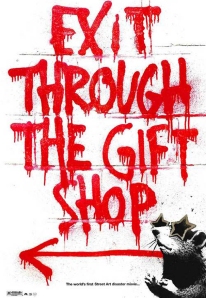
Best Film (so far):Exit Through The Gift Shop, a quasi-documentary that might just be one of the most perfectly executed mindfucks in modern history. Runners-up: The Girl With The Dragon Tattoo, Fish Tank, Please Give, Winter’s Bone, A Prophet, Toy Story 3, and Inception.
Best Male Performance of the year so far: John Hawkes, in Winter’s Bone. Hawkes has been overshadowed by Jennifer Lawrence but he dominates every scene that he appears in. Just consider the scene where he “talks” his way out of a traffic stop. Runners-ups: John C. Reilly in Cyrus, Ben Stiller in Greenberg, Leonardo DiCaprio in Inception and Shutter Island, and Sam Rockwell in Iron Man 2.
Best Female Performance of the year so far: Noomi Rapace as the Girl With The Dragon Tattoo and The Girl Who Played With Fire. Rapace is my new role model, a Ms. 45 for the 21st century. Runners-up: Jennifer Lawrence in Winter’s Bone, Katie Jarvis for Fish Tank, Rebecca Hall in Please Give, Greta Gerwig in Greenberg, and Chloe Grace Moretz in Kick-Ass.
Best Ending: The final shot of Inception.
Best Horror Film: The Wolf Man, which should have been oh so bad but instead turned out to be oh so good with Anthony Hopkins and Hugo Weaving both giving brilliant supporting performances.
Best Bad Movie: Sex and the City 2. Yes, if I’m going to be honest, it was a horrible movie. But it was fun. the clothes were to die for, and the film managed to bring new depths of shallowness to the examination of the oppression of women in the Middle East.
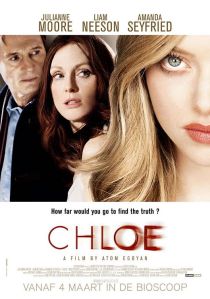
Worst Film Of The Year (so far): Chloe. Oh, Atom Egoyan, poor baby, what have you done, sweetheart? You made a trashy, campy softcore movie and then you forgot that these things are supposed to be fun! Runner-up: Robin Hood, because the entire freaking movie was a lie. However, it did feature Oscar Isaac screaming, “Outlawwwwww!” and that saves it from being named the worst.
Worst Horror Film So Far: The Black Waters On Echo’s Pond. So. Fucking. Bad.
The Get-Over-It-Award For The First Half Of 2010: The makers of Prince of Persia, who just had to try to turn an otherwise entertainingly mindless action film into yet another half-assed cinematic allegory for the Invasion of Iraq. Ben Kingsley will probably be playing thinly disguised versions of Dick Cheney for the rest of his life. I was against the Invasion of Iraq from the start but seriously, I’m so bored with every movie released using it as a way to try to fool the audience into thinking that they’re seeing something more worthwhile than they are.
The Read-The-Freaking-Book-Instead Award: The Killer Inside Me. A lot of viewers are disturbed by the violent way that the main character deals with the women in his life. I’m more disturbed by the fact that all the women in his life are presented as being simpering idiots. The original novel is by Jim Thompson and it is a classic.
The worst ending of 2010 so far: Splice with the Killer Inside Me as a strong runner-up.
Future Film I’m Not Looking Forward To: Roland Emmerich’s Gusher, an ecological thriller based on the BP oil spill, starring Will Smith as the President, Dev Patel as the governor of Louisiana, Paul Bettany as the head of the evil oil company, and Ben Kingsley as Dick Cheney who will be seen cackling as oil-drenched doves wash up on the shores of California. (How did the oil get to California? Emmerich magic.) Of course, the nominal star of the movie will be Jake Gyllenhaal as the young engineer who says stuff like, “This well is going to blow!” and who is trying to reconcile with his estranged wife (played by — does it really matter? Let’s just say Emily Blunt gets the role this time around). And let’s not forget Robert Duvall, who will play a grizzled old-timer who says a lot of grizzled old-timer stuff. Look for it in 2012.
My prediction for which film will be the most overrated of 2010: The Social Network, which has not opened yet but Sasha Stone at awardsdaily.com seems to think that it’s a slam dunk for greatness which is usually a pretty good indication that the end result is going to be a predictable, bourgeois crapfest.
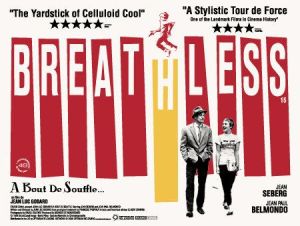
So, that’s 2010 so far. It’s shaping up to be a good year. I’m still looking forward to the release of Blue Valentine, Animal Kingdom, Get Low, The Disappearance of Alice Creed, The Last Exorcism, Wall Street, and the rerelease of Godard’s classic Breathless, which is one of my favorite movies and now I’m going to get a chance to see it in a theater! Life is good.
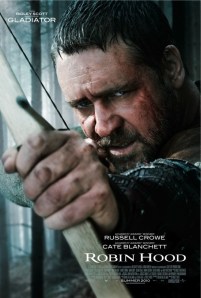
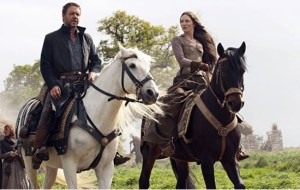
To make things clear, this movie is not really about Robin Hood. It’s about a common archer named Robin Longstride who fights in the Crusades, comes back to England, assumes another man’s identity, is adopted by a blind nobleman, ends fighting the French, and who discovers that his late father apparently wrote out the first draft of what will become the Magna Carta. Finally, at the end of the movie, Robin Longstride is declared an outlaw (or as Oscar Isaac, who plays King John, puts it, “AN OUTLAWWWWWWWWWW!) and it’s mentioned that he goes by the alias of “Robin of Hood.”
So, if you’re expecting a movie about Robin Hood or anything that is usually associated with Robin Hood — green tights, archery competitions, stealing from the rich and giving to the poor, that sort of thing — you’re pretty much out of luck.
On the face of it, this certainly isn’t an unwelcome idea. To be honest, I’ve always found whole idea of Robin Hood and his “merry men” to be a bit silly and rather dull. When it comes to English folklore, I’ve always preferred to read about King Arthur self-destructing. Add to that, it’s hard for me think about Robin Hood without thinking about the Dennis Moore episode of Monty Python’s Flying Circus.
(Remember Dennis Moore’s theme song — “Dennis Moore…Dennis Moore…He steals from the poor and gives to the rich…stupid bitch…”)
So, I really can’t complain about the way that the movie jettisons most of what one would traditionally expect from a film called Robin Hood. However, once the movie abandons tradition, it fails to come up with anything compelling to replace it with.
The movie opens with commoner Robin Longstride taking part in the Crusades. He’s a bitter, disillusioned archer who has grown weary of killing. So far so good. If nothing else, Ridley Scott has proven that he knows how to direct action and the early battle scenes are very well done. Robin is played by Russell Crowe and, even though he’s a bit too old for the role, Crowe has always been convincing playing men of action. Of course, this is largely because Crowe is himself a man of action but no matter. Crowe is believable in these scenes in ways that a more universally acclaimed actor like Leonardo DiCaprio never could be. It’s important that the movie convince on from the start that Robin is a master archer and both Scott and Crowe manage to do that. In fact, if the entire movie was just about an archer trying to survive of the chaos of the Crusades, it would have been a good deal better than Robin Hood.
(Speaking of archers, I’m actually quite a bit more skilled at with a bow than you probably think. Just three years ago, while visiting a city known as The Crossing, I used one shortbow and a quiver of 12 arrows to kills over 100 rats at Barana’s Shipyard. Of course, I should probably add that I was playing Dragonrealms at the time. I was a red-haired, Elven moon mage and my name was Cinzia, in honor of the Italian actress Cinzia Monreale. Sad to say, Cinzia was eventually killed by some sort of swamp monster but, while she lived, she was pretty good with a bow and arrow. But back to the movie…)
The movie starts to fall apart once Robin returns to England. In a set of circumstances that are way too tedious to go into now, Robin ends up assuming the identity of Sir Robert of Loxley and returning the crown of the dead King Richard the Lionhearted to London where it is promptly placed on the head of the new King John (Oscar Isaac).
Robin then departs on a personal mission of his own. He goes up to Nottingham to return the dead Sir Robert’s sword to his father, the blind Sir Walter of Loxley (Max Von Sydow, going overboard). In Nottingham, Robin meets Robert’s widow, the maid Marian. Marian is played by Cate Blanchett who, for some odd reason, appears to be recreating his award-winning role as Katharine Hepburn in the aviator for most of her performance. Robin, to his credit, does not pretend to be “Sir Robert” when he first arrives in Nottingham. However, Walter promptly asks him to do so and in return, Walter will tell Robin all about Robin’s father. And so, again, Robin agrees to pretend to be Sir Robert.
Meanwhile, Robin has been accompanied by three friends. One of them — Little John — is played by the same guy who played Martin Keamy on Lost. These three friends — along with Friar Tuck who assures us that he’s “not a churchy-type friar” — will eventually become Robin Hood’s band of merry men though not in this movie. In this movie, they’re just four red herrings that have little to do.
King John, it would seem, is something of a neurotic tyrant so he is easily manipulated by his good friend Sir Godfrey (Mark Strong) into allowing Godfrey and his private army to roam the English countryside and “collect taxes.” What John doesn’t realize, of course, is that Godfrey is actually half-French and all of Godfrey’s soldiers actually are French. How this escape John’s attention is hard to determine as all of Godfrey’s soldiers either speak French or English with a heavy French accent.
(Actually, Sir Godfrey reminded me of another life I experimented with in Dragonrealms, a Gor’Tog Barbarian named Ironcrotch. The less said about Ironcrotch, the better.)
Anyway, Godfrey’s real mission is to be so tyrannical while collecting taxes that the English people will rise up against their king and the whole country will plunge into civil war. While this is going on, the French will then invade England and easily conquer it. As long as it took me to type all of that up and for you to read, it feels even longer when you’re sitting in a theater watching it.
On paper, at least, Ridley Scott would look like the perfect director for this movie but, other than the early battle scenes, his direction here is often rather uninspired. He seems to be bored with the movie and, for that matter, so does Russell Crowe. Crowe gives a surprisingly dull performance. You believe him as a soldier but you never believe him as a leader and that’s unfortunate because, for this movie to work, you have to believe Crowe as a man so charismatic that he could become a beloved criminal. When you consider just how talented Crowe has proven himself to be over the years, his performance here becomes even more distressing and, finally, somewhat infuriating. Once could accept a less-than-brilliant performance from someone like Jason Stathan. But this is Russell-freaking-Crowe, for the love of God!
In fact, the only actor who really seems to truly invested in his role is Oscar Isaac and he’s actually the best thing in the entire film. For over a month, I’ve been mocking the way he’s seen shouting “OUTLAWWWWW!” in the trailer for Robin Hood. Divorced from the rest of his performance, it just seems like a ludicrously over-the-top moment. However, when seen in the context of the character that he creates over the course of the film, it makes perfect sense that King John would randomly shout such things. Isaac makes plays the monarch as a spoiled brat, a hedonist given to cowardice, insecurity, and histrionics. Wisely, he never plays John as evil and, in some scenes, he almost manages to make this historically reviled man into an almost sympathetic figure, While the rest of the movie merely goes through all of the expected paces, Isaac always manages to bring something unexpected to every scene he is in. If there is any redemption to be found in Robin Hood, it is in his performance.
I should also add that, as critical as I’ve been of Robin Hood, I still enjoyed listening to all the anti-taxation, anti-government rhetoric. I only wish the movie had gone even further with the whole idea of Robin Hood as a 12th century libertarian.
In the end, what can you really say about a movie like Robin Hood? It is what it is. It’s a summer movie that’s obviously designed to serve as the launching pad for a bigger film franchise. To criticize it is to almost invite some stranger to accuse you of being a spoilsport. Summer movies are meant to be big and loud and borderline obnoxious. They’re meant to be a collection of trailer-ready scenes that can entice you into paying way too much to sit through them. Summer movies are made to make money and ultimately, the only judgment that carries any weight is the verdict of the box office.
Interestingly enough, the theater where I saw Robin Hood was deserted except for me and my friend. A lot of this, of course, is due to us attending a matinée showing but still, even a matinée will usually manage to bring in a handful of retirees who want to spend their twilight years complaining about how difficult is to hear movies nowadays. But no, on this day, it was just me and my friend.
(This worked out nicely, to be honest, because it allowed me and him to…uhmm…well, yeah, anyway. Back to the review…)
To me, that nearly deserted theater pretty much sums up Robin Hood. It’s the movie that everyone wants to see but that nobody’s going to want to watch twice. It’s the type of movie that you forget even while you’re watching it. Considering all of the talent that was involved in the making of this movie, I think the viewer is justified in expecting something just a little more.



 Through the Shattered Lens