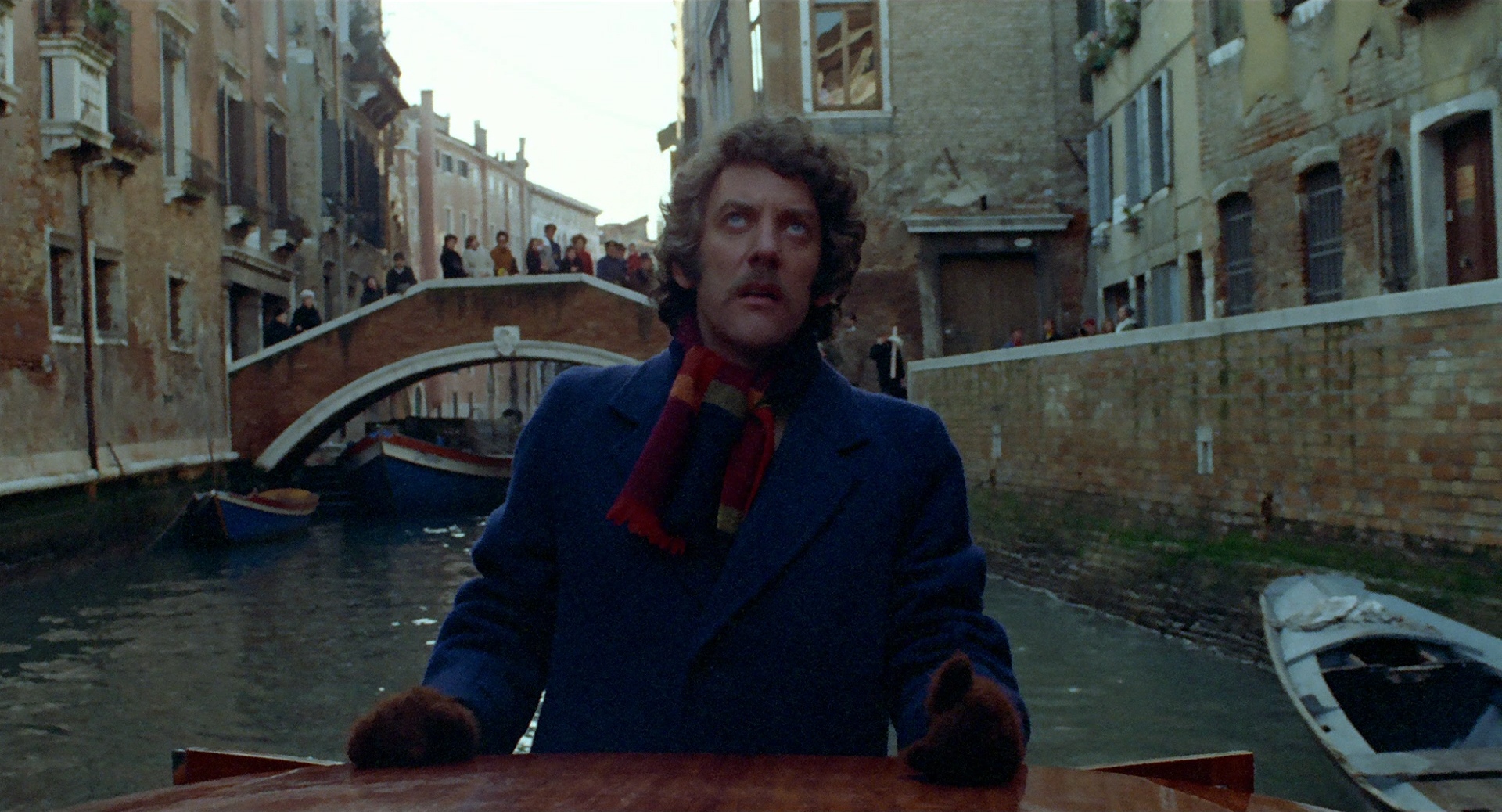
Donald Sutherland and Julie Christie in Don’t Look Now (1973)
I have to admit that I’m actually a bit embarrassed to say that Venice is my favorite city in Italy.
I mean, it’s such a cliché, isn’t it? Tourists always fall in love with Venice, even though the majority of us really don’t know much about the city beyond the canals and the gondolas. I spent a summer in Italy and Venice was definitely the city that had the most American visitors. Sadly, the majority of them didn’t do a very good job representing the U.S. in Europe. I’ll never forget the drunk frat boys who approached me one night, all wearing University of Texas t-shirts. One of them asked, “Are you from Texas?”
“No,” I lied.
“You sound like you’re from Texas!” his friend said.
“No, ah’m not from Texas,” I said, “Sorry, y’all.”
I mean, that’s not something that would have happened in Florence or even Naples! In Rome, handsome men on motor scooters gave me flowers. In Venice, on the other hand, I had to deal with the same assholes that I dealt with back home!
That said, I still fell in love with Venice. And yes, it did happen while riding in a gondola. At that moment, I felt like I was living in a work of art. I can still remember looking over the side of the gondola and watching as a small crab ran across someone’s front porch. That’s when I realize that, by its very existence, Venice proved that anything was possible.
I’ve often heard that Venice is slowly sinking. That Venice has a reputation as being a dying city would probably have come to a surprise to the drunk Americans who were just looking for a girl from Texas that summer. And yet, Venice has always been associated with death. Just consider Thomas Mann’s Death in Venice and the subsequent film adaptation from Luchino Visconti. Consider the controversial Giallo in Venice. And, of course, you can’t forget about the 1973 film, Don’t Look Now.
Oh my God, Don’t Look Now is a creepy movie. It’s probably best known for two things: the lengthy sex scene between Julie Christie and Donald Sutherland (which was apparently quite controversial back in 1973 but which seems rather tame when viewed today) and the film’s shock ending. It’s one of the best and most disturbing endings in the history of horror and I’m not going to spoil it in this review. The first time I saw the movie, the ending caught me totally off guard and gave me nightmares. Admittedly, it’s not hard to give me nightmares but what’s remarkable is that, upon subsequent viewings, the ending is still just as frightening and disturbing. In fact, knowing what’s going to happen makes the film even more chilling.
The film’s story is actually a rather simple one. After their daughter, Christine, accidentally drowns, John (Donald Sutherland) and Laura Baxter (Julie Christie) take a trip to Venice. Though they’re in Venice so that John can restore an ancient church, both John and Laura are mostly trying to escape their grief. Laura meets a blind woman, Heather (Hilary Mason), who claims to not only be a psychic but who also says that she can see Christine in the afterlife. Laura believes Heather and is concerned when Heather says that Christine wants them to leave Venice. John, on the other hand, believes that Heather is a fake.
When the Baxters get a phone call informing them that their son has taken ill, Laura flies back to the UK. Or does she? One day, John spots his wife riding on a boat with Heather and her sister. Has Heather abducted or brainwashed his wife? When John goes to the police, they are as skeptical of him as he was of Heather. In fact, they start to suspect that John may have something to do with a recent rash of murders.
Confused, John searches Venice for his wife but, instead of finding her, he spots a figure in the distance. It appears to be a young child, one who is wearing the same red coat that Christine was wearing when she drowned….
It’s a simple story but it’s told in a very complex fashion. Director Nicolas Roeg is best known for his fragmented narrative style. Roeg often mashes together scenes from the past, present, and future and leaves it up to the viewer to put it all together. (For instance, in Don’t Look Now, scenes of John and Laura making love are intercut with scenes of them getting dressed afterward.) Roeg’s style that can often come across as being pretentious but, in Don’t Look Now, it works perfectly. The audience is kept off-balance and is always aware that that’s more than one possible interpretation for everything that is seen. Is Laura in the UK or is she on a boat in Venice? Is Heather seeing Christine or is she just trying to con a grieving mother? Is John chasing the figure in the red coat or is she actually the one pursuing him? Is John chasing the figure because he believes that she’s his daughter or because he wants to prove, once and for all, that Christine is gone and never coming back? Roeg keeps you guessing.
Death seems to permeate every frame of Don’t Look Now, whether it’s Heather’s cheery descriptions of the afterlife or the sight of a bloated corpse being pulled out of the canal. Even when John is working in the church, he still nearly slips off a scaffolding. While John restores ancient buildings to the vibrant glories of the past, the present seems to grow more and more ominous and menacing. John and Laura may have traveled to Venice to escape their grief but their grief follows them. How they deal with that grief — both as a couple and as individuals — is what determines their fate. For a film that is full of mysteries, none is as enigmatic as Julie Christie’s smile when she’s on the boat.
I’m probably making Don’t Look Now sound like an incredibly grim film and, to a certain extent, it is. After all, early 70s cinema is not known for its happy endings. And yet, as dark and disturbing as this film may be, it’s impossible to look away from. Roeg does a fantastic job capturing both the beauty and the decay of Venice while Donald Sutherland and Julie Christie are so sympathetic as John and Laura that you find yourself rewatching and hoping that somehow, they don’t end up making the same mistakes that they made the last time that you watched.
Don’t Look Now is an essential horror film and one that’s as timeless as the sight of a crab running across someone’s front porch.
In the 1970 film Performance, a sadistic gangster named Chas (James Fox) goes on the run and ends up hiding out in a mansion that’s currently occupied by a burned-out rock star named Turner (Mick Jagger). Turner, we’re told, used to be great but then he “lost his demon.” Could Chas be his new demon?
Well, before the answer to that question can be revealed, Chas ends up under the influence of hallucinogenic mushrooms and that’s when he sees Turner transformed into a London mob boss and performing Memo From Turner, a song about his exploits.
Though this is a scene from a movie, it’s still most definitely a music video. In fact, it’s frequently cited as the first “true” music video. (I imagine that John’s Children, Procol Harum, and Nancy Sinatra would disagree.) Still, even if it’s not the first, it’s influence on subsequent videos is undeniable.
4 Shots From 4 Films is just what it says it is, 4 shots from 4 of our favorite films. As opposed to the reviews and recaps that we usually post, 4 Shots From 4 Films is all about letting the visuals do the talking.
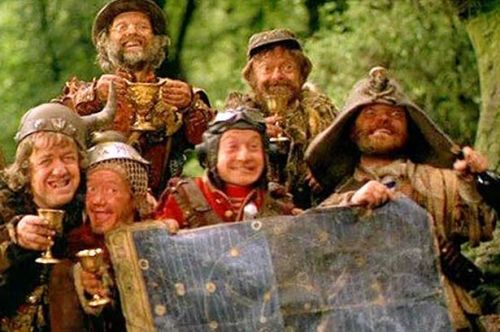
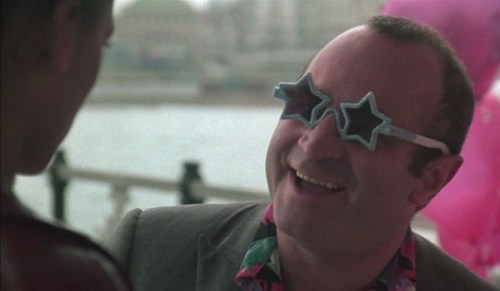
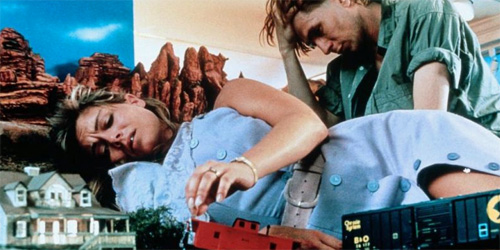
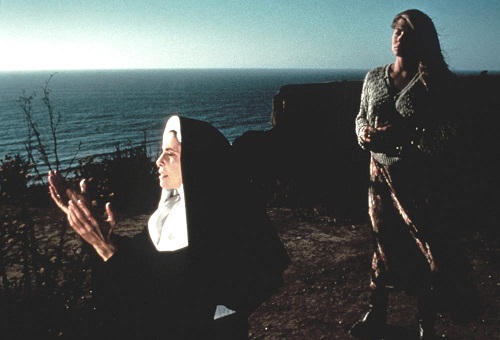
In 1978, George Harrison co-founded HandMade Films to finance Monty Python’s The Life of Brian. The company continued to produce films through the 80s and helped to reinvigorate the British film industry. All of the shots below come from HandMade films and credit George Harrison as executive producer.
4 Shots From 4 Films
Monty Python’s Life of Brian (1979, directed by Terry Jones)
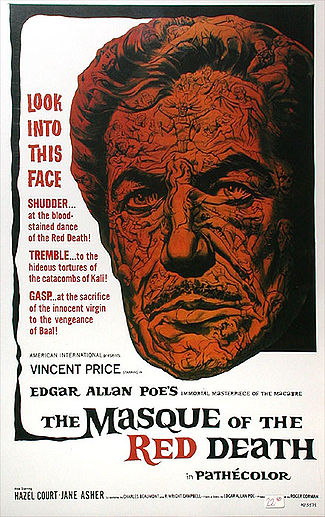
So here we are, 24 days into October, and I have yet to share an old Vincent Price film! It’s not October without at least a little contribution from Vincent. Well, allow me to correct that with today’s horror on the lens, the 1964 Roger Corman film The Masque of the Red Death.
Based on the classic story by Edgar Allan Poe, this film features Vincent Price giving one of his best performances as the doomed and decadent Satanist Prince Prospero. The film’s cinematographer was future director Nicolas Roeg and The Masque of the Red Death is probably one of the most visually impressive of all of Corman’s films.
So, guess what I did this morning? That’s right — I put on a blindfold, a stumbled over to my ever-growing Blu-ray, DVD, and even VHS collection and I randomly selected 12 films!
Why did I do this?
I did it so you, the beloved readers of Through the Shattered Lens, could once again have a chance to tell me what to do. At the end of this post, you’ll find a poll. Hopefully, between now and next Monday (that’s March 24th), a few of you will take the time to vote for which of these 12 films I should watch and review. I will then watch the winner on Tuesday and post my review on Wednesday night. In short, I’m putting the power to dominate in your hands. Just remember: with great power comes great … well, you know how it goes.
Here are the 12 films that I randomly selected this morning:
The Baader Meinhof Complex (2008) — This German film was nominated for Best Foreign Language Film. It tells the true life story of the left-wing German terrorist group, The RAF.
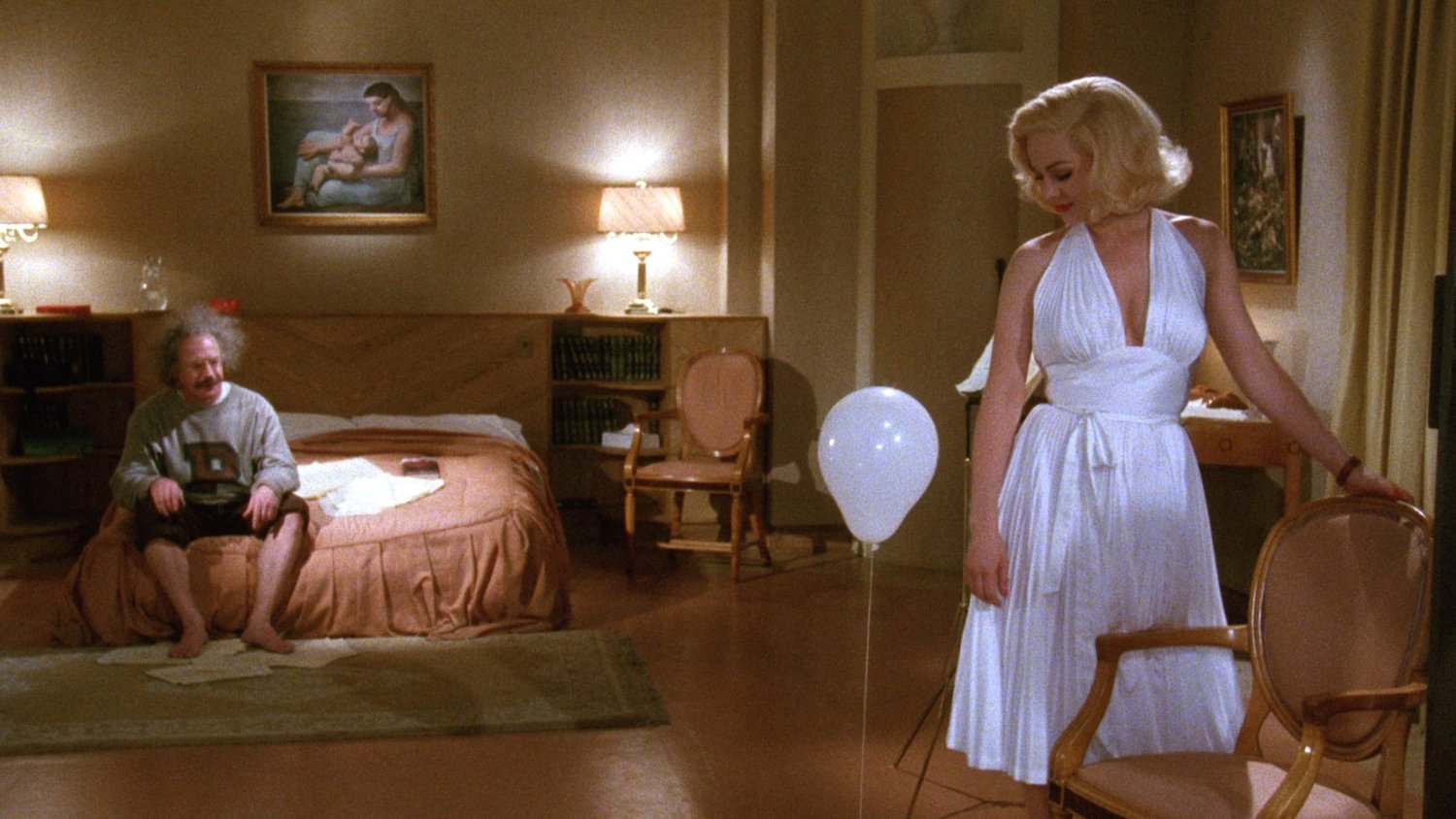
The Cat’s Meow(2001) — From director Peter Bogdonavich, this film speculates about the events that led to the shooting of silent film director Thomas H. Ince. Starring Kirsten Dunst as Marion Davies, Edward Herrmann as William Randolph Hearst, and Eddie Izzard as Charlie Chaplin.
Heavenly Creatures (1994) — The close relationship between two teenage girls (Melanie Lynesky and Kate Winslet) leads to both a vibrant fantasy world and real-life murder. Directed by Peter Jackson.
In A Lonely Place(1950) — In this film noir from director Nicholas Ray, Humphrey Bogart plays a screenwriter who may (or may not) be a murderer.
Liquid Sky(1983) — In this low-budget, independent science fiction film, an alien lands in New York and soon several members of the city’s underground art scene are vaporized. Not surprisingly, it all has to do with heroin.
Made in Britain (1983) — A very young Tim Roth makes his debut in this British film. Roth plays Trevor, a Neo-Nazi who — despite being intelligent and charismatic — also seems to be intent on destroying himself and everything that he sees.
Much Ado About Nothing(2013) — In between The Avengers and Agents of SHIELD, Joss Whedon found the time to direct this adaptation of Shakespeare’s play.
Peyton Place(1957) — In this Oscar-nominated film, the sordid secrets of an outwardly idyllic New England town are exposed.
Pretty Poison (1968) — Having just been released from a mental institution, Dennis (Anthony Perkins) finds himself involved with teenager Sue Anne (Tuesday Weld), who — despite her wholesome appearance — is actually psychotic.
Troll 2(1990) — A family moves to Nilbog, a small town that is populated by vegetarian goblins. This movie is widely considered to be one of the worst ever made.
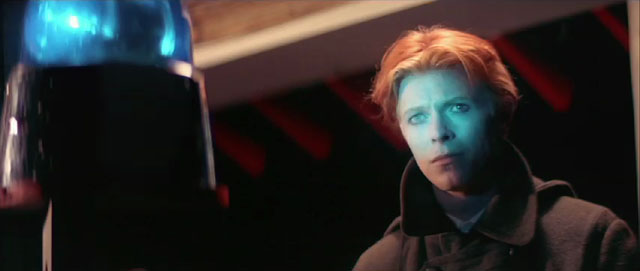
Walkabout (1971) — In this visually stunning Nicolas Roeg film, a teenage girl and her younger brother find themselves stranded and left for dead in the Australian outback. They try to survive with the help of an Aborigine.
Zabriskie Point(1970) — In this 1970 film, the great Italian director Michelangelo Antonioni takes a look at the 60s counter-culture. Airplanes are stolen, buildings explode, and orgies magically materialize in the middle of the desert.
So, guess what I did earlier today? That’s right — I put on a blindfold, a stumbled over to my ever-growing DVD, Blu-ray. and even VHS collection and I randomly selected 12 films!
Why did I do this?
I did it so you, the beloved readers of Through the Shattered Lens, could once again have a chance to tell me what to do. At the end of this post, you’ll find a poll. Hopefully, between now and next Sunday (that’s August 21st), a few of you will take the time to vote for which of these 12 films I should watch and review. I will then watch the winner on Sunday and post my review on Monday night. In short, I’m putting the power to dominate in your hands. Just remember: with great power comes great … well, you know how it goes.
Here are the 12 films that I randomly selected this afternoon:
Abduction — From 1975, this soft-core grindhouse film is based on the real-life abduction of Patty Hearst and was made while Hearst was still missing. Supposedly, the FBI ended up investigating director Joseph Zito to make sure he wasn’t involved in the actual kidnapping.
Aguirre, The Wrath of God — From director Werner Herzog and star Klaus Kinski comes this story about a Spanish conquistador who fights a losing battle against the Amazon.
Black Caesar — In one of the most succesful of the 70s blaxploitation films, Fred Williamson takes over the Harlem drug trade and battles the mafia.
Don’t Look Now — Donald Sutherland and Julie Christie are a married couple who attempt to deal with the death of their daughter by going to Venice, Italy. Christie quickly falls in with two blind psychics while Sutherland pursues a ghostly figure in a red raincoat through Venice. Directed by Nicolas Roeg.
The Lion In Winter — From 1968, this best picture nominee stars Peter O’Toole and Katharine Hepburn as King Henry II and his wife, Eleanor of Aquitaine. Taking place on Christmas Eve, Henry and Eleanor debate which one of their useless sons will take over a king of England. This film is also the feature debut of both Anthony Hopkins and Timothy Dalton.
Logan’s Run— From 1976, this sci-fi film features Michael York and Jenny Agutter as two future hedonists seeking Sanctuary and instead finding Peter Ustinov and a bunch of cats. Filmed in my hometown of Dallas.
Lost Highway — From director David Lynch comes this 1997 film about … well, who knows for sure what it’s about? Bill Pullman may or may not have killed Patricia Arquette and he may or may not end up changing into Balthazar Getty.
Mystic River— From director Clint Eastwood comes this film about murder, guilt, redemption, and suspicion in working-class Boston. Starring Sean Penn, Kevin Bacon, and Tim Robbins.
Naked Massacre — From 1976, this stark film is something a grindhouse art film. It takes the true life story of Chicago mass murderer Richard Speck and transfers the action to Belfast. Also known as Born for Hell.
Night of the Creeps— From 1986, this film features alien slugs that turn an entire college campus into a breeding ground for frat boy zombies. Tom Atkins gets to deliver the classic line: “Well don’t go out there…”
Petulia — Considered by many to be one of the best American films ever made and one of the definitive films of the 60s, Petulia tells the story of a divorced doctor (George C. Scott) who enters into an odd relationship with Julie Christie. Directed by Richard Lester, this film also stars Joseph Cotten, Richard Chamberlain, and the Grateful Dead.
What Have You Done To Solange? — From 1975, What Have You Done To Solange is a classic giallo that features dream-like murders, disturbing subtext, and one of the best musical scores of all time.
So, there’s your 12 films. Vote once, vote often, have fun, and I await your decision.
It’s time for another edition of Lisa Marie’s Favorite Grindhouse and Exploitation Trailers. This week’s edition has no set theme beyond the fact that, in-between typing up the six trailers featured here, I was also trying on different outfits. Multi-tasking!
From 1970, it’s the debut film of Nicolas Roeg (though technically, he co-directed by Donald Cammell). Reportedly, acting in this film led to costar James Fox having a nervous breakdown.
This is the trailer for Mario Bava’s infamous, trend-setting giallo. Bava’s preferred title for this film was Bay of Blood though it was released under several titles, including Carnage and my personal favorite, Twitch of the Death Nerve.
This 1978 film is from the criminally underrated director Pete Walker. The trailer has a similar feel to Lamerto Bava’s A Blade in the Dark. Who is Jack Jones and was he actually an international singing sensation? So many questions.
This trailer is from 1968, which — if you’ve seen the trailer — is kind of one of those “well, duh” facts. Based on a book by my fellow Texan Terry Southern (hence, the tag line), the film features Walter Matthau, Richard Burton, Ringo Starr, Marlon Brando, and James Coburn all taking advantage of Ewa Aulin (who, much like James Fox in Performance, reportedly had a nervous breakdown as a result of making this film). The film was directed by Christian Marquand who, years later, would play the main French Plantation Guy in Apocalypse Now Redux.



 Through the Shattered Lens