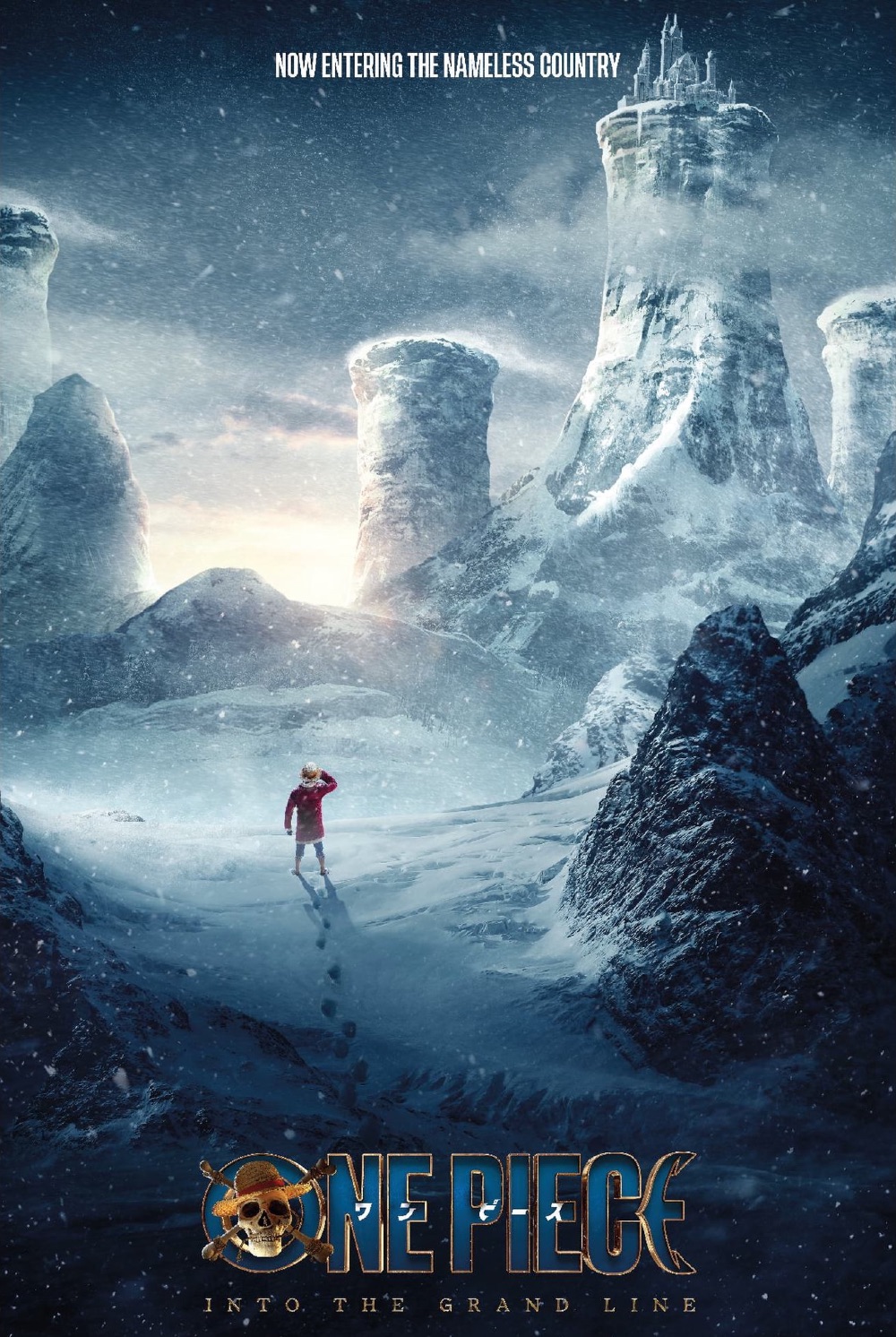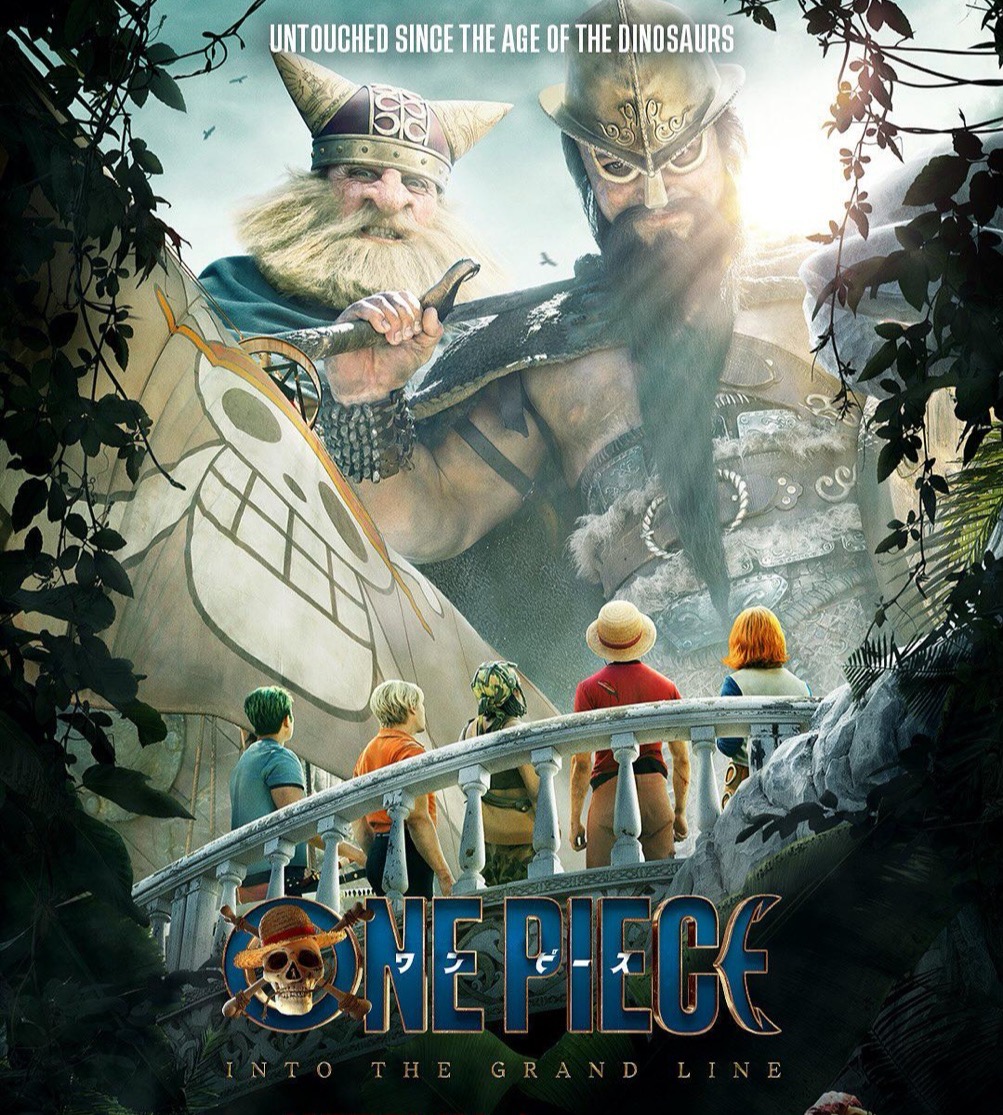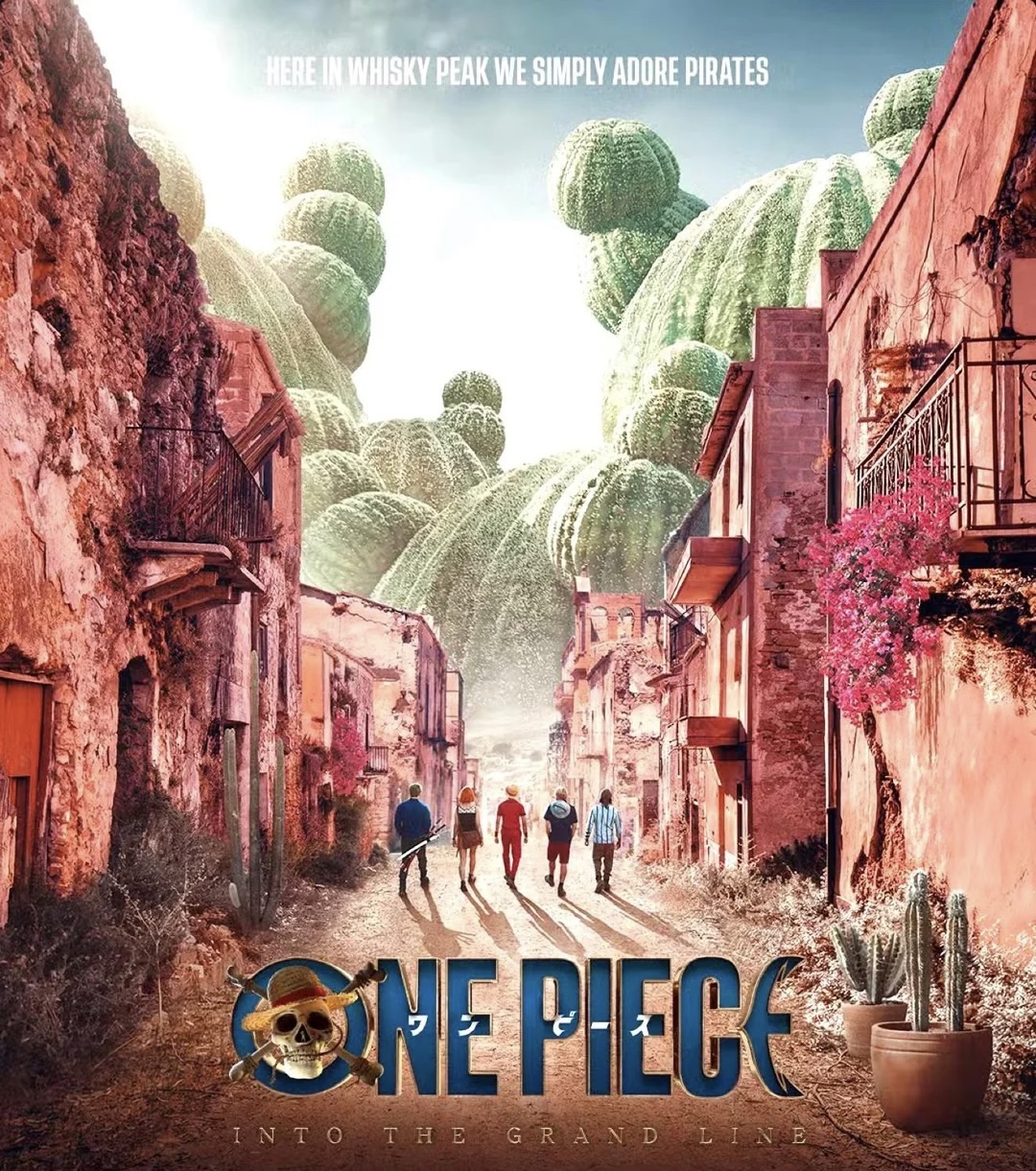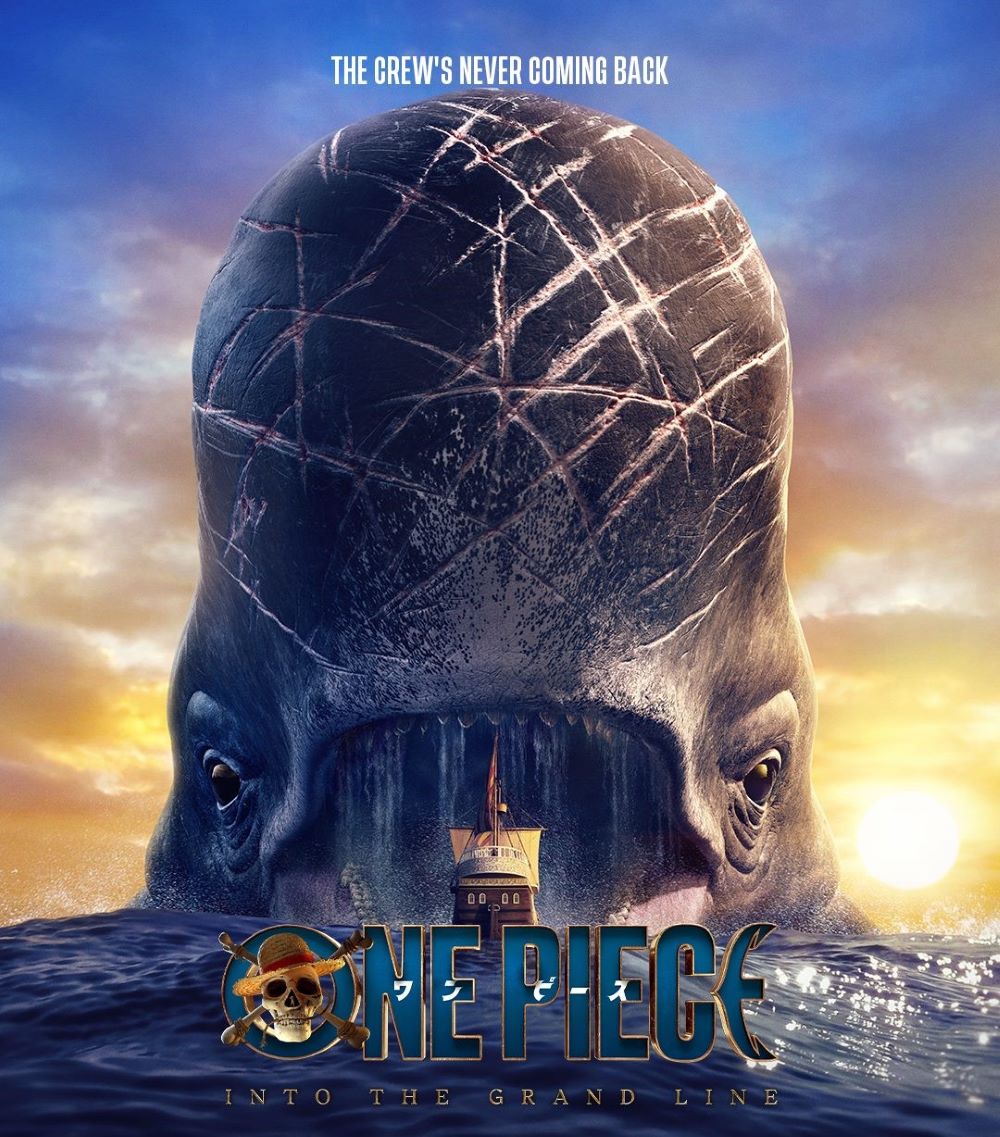
“Your Log Pose has set to an island called Little Garden. The dangers there will likely be your demise.” — Miss All Sunday
One Piece season 2 episode 4, “Big Trouble in Little Garden,” drops the Straw Hats onto a wild, prehistoric island that’s equal parts thrilling and chaotic, blending massive scale with some sneaky character moments. Right off the bat, the episode picks up from the Whisky Peak escape, with Miss All Sunday—Nico Robin in disguise—taunting the crew on the Going Merry before handing over an Eternal Pose and vanishing with her cryptic offer to join them later. It’s a smart transition that keeps the Grand Line’s mystery humming, as the crew sails into Little Garden, a lush spot frozen in time, complete with roaring dinosaurs and towering giants that make every step feel like a Jurassic Park fever dream.
The island’s vibe hits hard from the jump—think overgrown jungles, massive bugs, and those two legendary giants, Brogy and Dorry, locked in a century-long duel they can’t even fully remember why they’re fighting. Luffy, ever the food magnet, chomps on a giant’s meal, sparking a hilarious standoff that flips into hospitality when Brogy invites Nami and Usopp to chow down in his cave. Brogy’s tales of Elbaph and warrior honor give the episode a heartfelt core amid the spectacle, showing how the show grounds its fantasy in camaraderie. Usopp’s wide-eyed awe here shines, as he bonds with the giant over dreams of bravery, even if his lies start slipping under real pressure.
But let’s talk action, because Little Garden delivers on the chaos. The daily volcano eruption triggers Brogy and Dorry’s axe-clashing showdown, a brutal ballet of strength that’s visually stunning with practical effects blending into CGI for those colossal swings. Mr. 5 sabotages Brogy’s ale mug with an explosive bomb, tilting the fight unfairly and leading to what looks like a tragic end—Dorry lands the “killing” blow, only for Luffy to sniff out the foul play. It’s tense stuff, ramping up stakes as Baroque Works agents like Mr. 3 (played by David Dastmalchian), Miss Valentine, and the creepy kid Miss Goldenweek slink in with wax traps and personality-altering paints. That paint trick on Zoro (pink pants and all, turning him bubbly) and Nami (green-eyed loopiness) adds a trippy layer, messing with loyalties in fun, unpredictable ways.
Usopp steals the spotlight in the back half, though. After Brogy “dies,” he confronts a heartbroken Dorry alone, piecing together the sabotage without any backup. It’s a raw moment for the sniper who’s all talk—his “I can’t do this alone” plea turns into gritty resolve as he vows to save Nami from Miss Valentine’s capture. The episode nails his arc without overplaying it, showing growth through quiet desperation rather than big speeches. Meanwhile, Luffy’s chase after the bombers leads to a blue-paint funk courtesy of Miss Goldenweek, humanizing him with uncharacteristic moping. Vivi gets solid screen time too, balancing her Alabasta mission with crew loyalty, like when she hesitates to drag them into deeper danger.
Villain intros are a highlight—David Dastmalchian’s performance as Mr. 3 oozes sly charisma and offbeat menace, perfectly capturing the scheming wax-user’s awkward villainy with deadpan delivery and subtle physicality that hints at his weirdo charm from past roles like Polka-Dot Man. His take brings the candle coffin trap to gross, ingenious life, freezing Dorry while flashing those gross nails and a vibe that’s equal parts pompous and unhinged, promising slick, creative fights ahead. Miss Goldenweek’s paint hypnosis feels fresh, a non-combat threat that toys with emotions over brute force, fitting One Piece‘s eclectic Devil Fruit roster. Sanji and Zoro’s banter keeps the levity, with Sanji’s ladies-man schtick clashing against Zoro’s deadpan in ways that spark real chemistry, even if it’s sibling-rivalry adjacent. Dinosaurs rampage through it all, from roars that shake the screen to a chase that has Luffy grinning like a kid in a candy store—pure adventure fuel.
Pacing-wise, this one’s a mixed bag. The setup drags a tad compared to Whisky Peak’s tight punch-up, feeling like a bridge to bigger Little Garden payoffs in episode 5. More CGI for giants and dinos trades some tactile grit from prior fights for epic scope, which works but lacks the sweaty intimacy of hand-to-hand brawls. Still, the direction keeps energy high with dynamic jungle tracking shots and those giant-scale duels that dwarf the humans just right. Sound design pops too—the volcano’s rumble, axe clashes, and dino bellows build immersion without overwhelming dialogue.
Character dynamics evolve nicely with Vivi aboard, heightening tension as her secrets simmer. Luffy’s optimism clashes with her caution, while Nami’s weather smarts get sidelined by paint shenanigans, hinting at future utility. Zoro naps through half the threats, true to form, but his altered personality bit lands laughs without undermining his edge. The episode smartly foreshadows Baroque Works’ layered hierarchy, with Mr. 3 strong-arming Mr. 5 and Valentine into his giant-killing plot—sets up juicy inter-agent drama.
Fair’s fair, it’s not flawless. Some plot threads, like the paint’s full effects or Robin’s lingering offer, dangle without payoff here, making it setup-heavy. Usopp’s heroism feels earned but rushed in spots, and the giants’ honor code borders on repetitive exposition. CGI holds up under scrutiny less than practical stunts, with a few uncanny giant faces in close-ups. Yet these niggles don’t sink the fun—One Piece thrives on escalating absurdity, and Little Garden embodies that with heart-pounding scale and emotional beats.
Overall, “Big Trouble in Little Garden” clocks in as solid mid-arc fare, leaning on spectacle and Usopp’s growth to offset slower burns. It captures the manga’s spirit—wild locales, quirky powers, unbreakable bonds—while adapting smartly for live-action flair. Fans craving giant brawls and scheming foes get plenty, and newbies stay hooked on the crew’s charm. Can’t wait for the wax to melt and heroes to rise next time.
“I still have a long way to go to get to his level. That’s what the journey’s all about.” — Roronoa Zoro
One Piece season 2 is building serious steam, and episode 3, Whiskey Business, delivers a thrilling payoff after the previous episode’s quieter, more tragic tone centered on fan-favorite Laboon’s bittersweet backstory. While that installment leaned into emotional depth with less chaos, this one explodes into the Grand Line’s wild unpredictability as the Straw Hats wash up on Cactus Island, stepping into the deceptive oasis of Whiskey Peak amid the region’s bizarre “cyclone of seasons”—sweltering heat one moment, flurries the next. Luffy’s unshakeable optimism shines as he greets quirky newcomers like Mr. 9 and Miss Wednesday, setting up the intrigue that defines this arc. It’s a smart move to blend character beats with rising tension early on, reminding viewers why this crew clicks so effortlessly.
The episode wastes no time establishing Whiskey Peak as a deceptive paradise, a cactus-riddled town on Cactus Island that lures in pirates with open arms and flowing booze. The locals throw an over-the-top welcome party for the Straw Hats, complete with cheers and toasts that feel genuine at first glance. Luffy, ever the glutton for fun, dives right in, scarfing down food while bonding with the quirky newcomers—Miss Wednesday’s poised charm and Mr. 9’s bumbling bravado add fresh dynamics to the mix. Usopp and Sanji get their moments to shine too, with Usopp spinning tall tales that endear him to the crowd and Sanji whipping up dishes that steal the show. These lighter scenes ground the episode, highlighting the crew’s camaraderie before the rug-pull hits.
Then comes the turn, and it’s handled with precision. Zoro, still haunted by his loss to Mihawk, picks up on the off vibes during a tavern scuffle, sniffing out the trap laid by Baroque Works agents masquerading as friendly townsfolk. What follows is the episode’s crown jewel: a brutal, multi-tiered brawl where Zoro faces off against a hundred foes in a stunning set piece. The stunt work is top-tier, choreographed to feel relentless yet stylish, with Zoro’s three-sword style cutting through waves of attackers like a whirlwind. It’s not just mindless action; flashes of his internal struggle—Mihawk visions fueling his drive—add emotional weight, making his dominance feel earned rather than flashy for flashy’s sake. The production design elevates it all, turning Whiskey Peak‘s ramshackle buildings into a vertical battlefield that pops on screen.
Nami’s sharp instincts pair perfectly with Zoro’s blade work, as she uncovers the agents’ hidden weapons and signals the crew to snap out of their stupor. Sanji and Usopp jump into the fray too, their fights more scrappy but no less entertaining—Sanji’s kicks land with precision, while Usopp’s slingshot tricks show his resourcefulness under pressure. Luffy, true to form, stays mostly out of the melee, prioritizing his gut feeling about Miss Wednesday and Mr. 9, which plants seeds for future alliances. This balanced distribution of heroics keeps the episode from relying solely on one star, though Zoro undeniably carries the combat load.
Baroque Works emerges as a credible threat here, their numbers and coordination hinting at a larger syndicate without overwhelming the runtime. Mr. 9’s failed leadership and Miss Wednesday’s hidden agenda tease deeper lore, while the mayor Igaram’s reveal as Mr. 8 adds a layer of betrayal that stings. The episode smartly foreshadows bigger players like Miss Valentine and the enigmatic Mr. 0, building tension for the season without spoiling the payoff. It’s a fair adaptation choice, condensing the Whiskey Peak arc to heighten pacing while preserving Eiichiro Oda’s themes of deception and loyalty.
Emotionally, Whiskey Business punches above its weight. The crew’s kindness amid the carnage—sparing lives where possible—reinforces their pirate ethos, contrasting Baroque Works’ ruthless efficiency. A poignant beat with Vivi (Miss Wednesday’s true identity subtly emerging) tugs at heartstrings, her conflict over duty and friendship feeling authentic in the actors’ hands. Iñaki Godoy’s Luffy remains a beacon of joy, his infectious laugh cutting through the violence, while Mackenyu’s Zoro conveys quiet intensity that hints at growth ahead. The supporting cast nails their roles too; the Baroque agents’ over-the-top designs and quirks make them memorable cannon fodder rather than bland goons.
Visually, the episode impresses across the board. Cactus Island’s stark landscapes, from sun-baked dunes to the town’s mechanical underbelly, blend CGI with on-location shots seamlessly. The Grand Line’s “cyclone of seasons”—sweltering heat flipping to blizzards—amps up the peril right after arrival, selling the world’s dangers. Fights incorporate practical stunts where possible, with wire work enhancing the spectacle without veering into uncanny valley territory. Sound design deserves a nod too; clashing steel and Zoro’s grunts mix with a swelling score that echoes the anime’s adventurous spirit.
That said, it’s not flawless. Pacing dips slightly in the party scenes, stretching what could be tighter to build suspicion—some viewers might fidget before the action erupts. A few Baroque agents blend together, diluting their individuality despite fun powers like Miss Valentine’s weight-shifting (briefly teased). Luffy’s hands-off approach, while canon-faithful, sidelines him a tad in this early season outing, though it smartly spotlights the crew’s expanding talents. For manga veterans, the arc’s brevity skips minor gags, but show-only fans won’t miss much, as the core thrills land intact.
As a key early episode in season 2, Whiskey Business delivers on escalation. Season 1 nailed East Blue’s small-scale wonders; this ramps up to Grand Line stakes with bigger fights, richer world-building, and hints of political intrigue via Baroque Works’ shadow over Arabasta. It balances fan service—like Zoro’s Onigiri stance—with accessibility, ensuring newcomers stay hooked. The emotional core, blending laughs, bonds, and brutality, cements One Piece‘s live-action staying power. By episode’s end, as the Going Merry sails off with new questions about Vivi’s quest, you’re left buzzing for more—not revolutionary TV, but damn fun pirate escapism that honors its roots while carving its path.
“That whale’s been waiting over 50 years for pirates who ain’t coming back.” — Crocus
One Piece’s second season doesn’t ease you back in so much as fire you out of a cannon straight into the Grand Line, and Good Whale Hunting is where it really clicks that this show still knows exactly what kind of emotional rollercoaster it wants to be. Coming right after a premiere that’s busy setting up new Marines, new wanted levels, and the general sense that the East Blue training wheels are off, episode 2 narrows its focus to a single iconic manga arc and treats it with a surprising amount of patience and sincerity.
The season 2 opener (“The Beginning of the End”) is basically the big hand‑off episode: a Loguetown victory lap, a check‑in with Smoker and Tashigi as the new Marine threats, and a reminder that the Straw Hats are now sailing with real eyes on them. It’s longer, busier, and a bit more sprawling, juggling the execution platform legacy of the Pirate King with Luffy’s usual chaotic optimism and a few early‑teased antagonists the anime took its time introducing. As a premiere, it gets the job done—stakes are sketched in, the world opens up—but it can feel like it’s compressing two finales and a soft reboot into one hour‑plus block. The upside is that when episode 2 hits, the show finally breathes.
Good Whale Hunting is the first time this season where you can feel the adaptation relax into a single, weird, very One Piece idea: Reverse Mountain as a death trap, and a lovesick kaiju whale with abandonment issues. The sequence of the Going Merry grinding and climbing up the Grand Line’s infamous entry ramp is shot like a disaster movie: broken steering, a ship that’s very clearly outmatched by the environment, and a bunch of pirates who suddenly remember they’re not exactly seaworthy professionals. It’s a smart way to underline that, for all their wins in season 1, this crew is still held together with duct tape, vibes, and a rubber captain willing to literally turn himself into a human steering system just to survive the climb.
Once they crest Reverse Mountain and slam straight into Laboon, the episode goes full fairy tale without losing the slightly grounded texture the live‑action has worked hard to build. Splitting the cast—most of the crew trapped inside the whale while Luffy ends up outside on Twin Capes with Crocus—is a clever structural move because it lets the show alternate tones: goofy bickering and bafflement inside, melancholy exposition and quiet character beats outside. Clive Russell as Crocus brings that ornery performance the character deserves, playing him like the Grand Line’s grumpy lighthouse keeper therapist, always one snark away from sending these kids back down the mountain but clearly invested in both Laboon and their survival.
Laboon’s tragedy could have easily tipped into pure melodrama, especially in live action, but the episode mostly earns its feelings. The idea of a whale repeatedly smashing itself against a continent because it refuses to accept a broken promise is inherently big, almost mythic, and the show doesn’t overcomplicate it: Crocus explains the Rumbar Pirates’ disappearance, the Straw Hats process it in their own ways, and Luffy responds not with a speechifying monologue but with a mix of stubbornness and childlike logic. You can feel the writers leaning into what makes Luffy special as a live‑action protagonist—he doesn’t intellectualize the pain, he reframes it through action and a promise that’s simultaneously ridiculous and deeply sincere.
The Jolly Roger moment, where Luffy paints the Straw Hat symbol on Laboon’s head to give the whale a new “contract,” is the kind of scene that tests whether this adaptation can handle the manga’s emotional core. On paper, it’s almost absurd: the solution to suicidal grief is “don’t smash your head anymore or you’ll scuff my cool skull flag, and also, we’re totally coming back to have more adventures.” In practice, the actors sell the hell out of it—Luffy playing the clown and the knight in the same beat, Laboon responding like a giant, wounded kid, and the rest of the crew hovering between “this is insane” and “this is exactly why we follow this guy.”
As a follow‑up to the premiere, Good Whale Hunting also works as a mission statement for how season 2 plans to adapt the early Grand Line arcs. The pace is still accelerated compared to the anime, but not to the point where big emotional tentpoles get flattened into drive‑by cameos; Laboon and Crocus feel like a self‑contained short story inside a larger journey, not just obligatory canon boxes being ticked. The episode also builds up the Baroque Works roster by introducing Miss Wednesday and Mr. 9, which moves that plot point forward without derailing the Laboon storyline. The addition of these Baroque Works characters is done seamlessly, folded into the chaos of the Grand Line in a way that feels organic rather than forced.
Visually, the episode continues the show’s streak of making inherently cartoonish imagery feel tactile without draining it of personality. Reverse Mountain’s chaotic water physics, the internal “whale interior” sets, and Laboon himself all sit in that slightly heightened zone where you never fully forget you’re watching a fantasy, but you also buy the weight and texture of what’s on screen. Season 2’s budget seems to be focused in the right places too: the Grand Line feels bigger and more dangerous, and the effects work on Laboon gives him enough expressiveness that you’re not just staring at a big grey blob while the humans emote around him.
Performance‑wise, the core cast continues to feel more settled in their roles than they sometimes did back in the earliest episodes of season 1. Iñaki Godoy’s Luffy benefits a lot from material like this; you can see how much more comfortable he is playing the captain as both earnest idiot and moral center when the script gives him contained, character‑driven scenarios instead of just bouncing from fight to fight. The supporting Straw Hats get smaller individual spotlight moments here—this isn’t a huge Zoro or Nami showcase hour—but their reactions to Crocus, Laboon, Miss Wednesday, Mr. 9, and the sheer insanity of the Grand Line add warmth and humor that keep the episode from sinking under its own sadness.
The main fair criticism of both the premiere and Good Whale Hunting is that, because the season has to blaze through multiple arcs in eight episodes, some of the build‑up can feel like it’s happening off to the side. Loguetown’s significance as a turning point in pirate history, Smoker’s introduction as a real force of nature, and the mounting Marine pressure on the Straw Hats are all present but slightly undercooked compared to how much emotional space the anime gave them. For viewers who live and breathe the source material, that compression will always sting a bit, even when individual episodes like this one land emotionally.
Still, as a package—season 2’s two‑episode opening stretch capped by Good Whale Hunting—this is a strong re‑entry into the world of One Piece. The premiere lays the geopolitical and Marine groundwork, while episode 2 reminds you that this series survives or dies on whether you care about a whale with a broken heart and a captain who thinks the answer is a paint job and a promise. If you were worried the jump to the Grand Line would sand down the series’ weirder, more sentimental edges, this episode is a pretty clear sign the live‑action is still willing to get strange, sincere, and just a little bit corny in exactly the right ways.
“Don’t hold a father’s sins against his son. Blood doesn’t dictate destiny—everyone chooses their own path on this sea.” — Gol D. Roger
The Season 2 premiere of One Piece feels like a confident “we know what worked, and we’re doubling down” while also quietly admitting there’s still a long Grand Line of growing pains ahead. The episode is busy, sometimes overstuffed, but it’s rarely dull, and it mostly recaptures the scrappy charm that made Season 1 such an unexpected win for anime-to-live-action adaptations.
Season 2 picks up with the Straw Hats heading toward the Grand Line, and the show wastes no time reminding you how much the core ensemble carries this adaptation. Iñaki Godoy’s Luffy still feels like the glue: goofy, earnest, and occasionally dangerous in that “you can’t believe this idiot is a future legend” way that matches the spirit of the source without copying the anime’s louder extremes. Emily Rudd’s Nami and Mackenyu’s Zoro remain the show’s emotional and stoic anchors, respectively, and the premiere leans on their established dynamics rather than reinventing them. You feel like you’re hanging out with a crew that’s already lived together for a while, which is half the battle in making this world feel real.
The premiere’s biggest shift is structural. Season 2 is tasked with bridging Loguetown, Reverse Mountain, and the early Alabasta material, and you can feel the writers trying to thread a needle between faithfulness and streamlining. Instead of lingering on the smaller beats of each arc, the episode compresses them into a fast-moving chain of set pieces and character introductions. Loguetown becomes less a full-fledged arc and more a dense prologue to the Grand Line era, packed with Marines, pirate legends, and hints of the Revolutionaries. Depending on what you want from this adaptation, that’s either exciting or mildly frustrating.
On the positive side, the sense of scale is undeniably bigger. The Marines’ presence, especially with Smoker and Tashigi entering the mix, gives the premiere a sharper cat-and-mouse energy. Smoker arrives as a force of nature—less cartoonishly overpowered than in the manga, but still clearly the kind of threat that turns Luffy’s carefree adventuring into something riskier. The show smartly plays him as a guy who thinks he’s in a different, more serious story, which makes his clashes with the Straw Hats fun to watch. Tashigi, meanwhile, brings a softer, more idealistic edge that contrasts nicely with Zoro’s exhaustion with swordsmen who talk too much.
The premiere also continues the series’ habit of sliding in big-name players earlier than the manga did, and that’s where the episode gets more divisive. Nico Robin and Dragon show up as ominous presences in the larger world, giving you a clearer sense of the many factions circling this goofy rubber pirate. The upside is that it makes the One Piece universe feel interconnected sooner; casual viewers get a better roadmap of who matters long-term. The downside is that some of these appearances flirt with Marvel-style “universe building” more than organic storytelling. When every scene is either paying off an old setup or seeding three new ones, it can be tough to just sit in a moment and feel it.
Production-wise, Season 2’s extra time and budget show. The premiere gives Loguetown and the surrounding seas a lived-in, often cinematic atmosphere that outpaces Season 1’s more patchwork locations. Costumes continue to walk that tightrope between cosplay-accurate and functional; Smoker, in particular, looks like he walked straight out of a stylized military drama with just enough anime flair layered on top. The CGI still isn’t blockbuster-tier, but the show compensates with smart framing and selective use—powers and creatures are used to accent action, not dominate it, which keeps things from tipping into uncanny territory.
Action remains one of the adaptation’s better tools, even if it still doesn’t fully hit the insanity of Oda’s panels. The premiere emphasizes clarity over spectacle: you can actually follow where people are standing, how the fight geography works, and what the emotional stakes are. That’s a big improvement over a lot of modern genre TV. When Smoker crashes into the story or the Straw Hats get caught up in the chaos of Loguetown, the choreography sells impact even when the VFX can’t quite keep up with the wilder Devil Fruit abilities. You won’t mistake it for Hong Kong–tier action cinema, but it’s clean, readable, and character-driven, which matters more for this kind of swashbuckling adventure.
Where the episode stumbles most is pacing and tone. The premiere is under pressure to reintroduce the main cast, onboard new viewers, set up Loguetown, tease Reverse Mountain, and seed the Alabasta saga, all while dropping in cameos and lore nods for fans who know exactly where this is all heading. That leads to a few whiplash moments where the show jumps from lighthearted crew banter to life-or-death tension to ominous worldbuilding monologues in rapid succession. Season 1 sometimes had that problem too, but the stakes are higher now, and you can feel the strain.
Character-wise, the core Straw Hats come out of the premiere in good shape, but some of the supporting cast is still fighting for oxygen. Garp appears in a flashback, speaking to Gol D. Roger before he is sent to the gallows—a visit that teases the arrival of a future fan-favorite set for season 3. While it’s good to see that thread remain important, these cutaways occasionally feel like they belong to a spin-off series. That worked in Season 1 as a way to broaden the world; here, with even more plates spinning and new villains entering, it risks crowding an already packed episode. At the same time, those scenes help underline one of the show’s better instincts: it keeps asking what piracy and justice actually mean in a world this chaotic, rather than just treating the Marines as cartoon bad guys.
Thematically, the premiere starts nudging One Piece toward slightly heavier waters without losing its goofy heart. The looming Grand Line, the introduced Revolutionaries, and the presence of more morally gray Marines all hint at a story that will increasingly interrogate systems of power and inherited ideals. But the episode never forgets that this is, first and foremost, a story about a weird found family chasing impossible dreams. The crew’s conversations on the Going Merry, the small jokes, and the quiet beats where they process what lies ahead are what keep the whole thing grounded.
As a Season 2 premiere, this episode does its job: it reassures fans that the live-action experiment wasn’t a fluke, raises the narrative ceiling, and points the ship squarely at the Grand Line with confidence. It’s not flawless—worldbuilding occasionally overtakes character focus, the pacing can feel like a sprint, and not every early cameo lands as organically as it should. But if you liked Season 1’s mix of earnestness, scrappy visual ambition, and slightly awkward but heartfelt adaptation choices, this opener suggests you’re in for a bigger, messier, and still surprisingly sincere voyage. For a story built on the idea that chasing the horizon is worth the risk, that feels like the right kind of start.
“It’s not about us anymore. It’s warning everybody that thing’s coming.” — Staff Sergeant 81
War Machine is a slick, mid-budget sci-fi actioner that mostly does exactly what it promises: put Alan Ritchson in a killbox with something inhuman and let the cameras roll. It is also a film that keeps bumping up against more interesting ideas than it has time—or maybe courage—to fully explore.
Set around a Ranger Assessment and Selection Program (RASP) training exercise, War Machine drops a squad of U.S. Army candidates into what should be a controlled simulation and then twists the dial from “routine” to “existential threat” in a single, nasty turn. Patrick Hughes uses the military-training frame as a clean, modular structure: we get the briefing, the banter, the march into the woods, and then the sense that something is just off before the real problem reveals itself. That problem, teased heavily in marketing, is a non-human adversary that pushes the movie from grounded war-games thriller into full-on sci-fi horror-action.
On a pure premise level, the film is almost aggressively simple: what if you locked a handful of Rangers-in-the-making in with an advanced, alien threat and watched them improvise their way out? The script never strays far from that line. It moves briskly from beat to beat—contact, casualties, regroup, “this isn’t part of the exercise,” reveal—without a lot of digressions. That tightness keeps the pacing snappy, but it also means character work often comes in shorthand: a line about a family here, a rivalry there, enough to suggest depth without really digging for it.
Ritchson is easily the film’s biggest asset, and the filmmakers know it. Coming off Reacher, he arrives with a built-in persona: the big, capable, slightly sardonic soldier who you just instinctively trust to solve violent problems. War Machine leans into that, but it also asks him to play a little more vulnerability than his Amazon series typically allows. There are moments—usually between set-pieces—where you see the strain and confusion creeping in, and the performance keeps the movie from turning into a pure pose-fest.
Most of the supporting cast is drawn in broad strokes but works well enough in the moment. You get the expected squad dynamics: the true believer, the skeptic, the joker, the one who freezes when things get ugly. The film rarely surprises you with what these people do, but the actors sell the camaraderie, and when bodies start dropping, the losses feel at least momentarily sharp instead of purely mechanical. Still, if you walked out of the movie and had trouble naming more than two characters, that would be understandable; the movie cares more about how they move than who they are.
Hughes’ direction sits in that modern streaming-action pocket: clean, serviceable, with a couple of standout moments but nothing that radically redefines the genre. The early training beats are shot with a straight military grit that grounds the later sci-fi escalation; you can feel the weight of gear, the slog of the environment, the tight focus on lines of advance and retreat. When the alien threat fully enters the frame, the film shifts into a more stylized mode, with harsher lighting, heavier VFX integration, and some nicely framed silhouette shots that emphasize size and speed over detailed anatomy.
Action-wise, War Machine is at its best when it uses geography and tactics instead of just spraying bullets into darkness. A mid-film set-piece in a partially collapsed structure, where the squad tries to funnel the creature into a kill zone, shows how much more interesting the movie becomes when the characters think rather than simply react. You get coordinated movement, overlapping lanes of fire, and the sense of a plan barely holding together. Other sequences lean more on chaotic spectacle, with quick cuts and digital mayhem that get the job done without really sticking in your memory.
The creature itself—both in concept and in execution—is solid, if not iconic. Hughes has mentioned that his original instinct was to completely hide the sci-fi angle in marketing and even within the film for as long as possible, turning the reveal into a full-on genre pivot. You can feel that tension: the movie is structured like a long-burn mystery, but the way it’s framed assumes you already know there is some kind of alien or advanced threat in play. As a result, the first half can feel like it is coyly dancing around a surprise that you walked in expecting, which blunts some of the intended impact.
Once revealed, though, the alien threat has a tactile, physical presence that helps sell the danger, especially when Ritchson is forced into close-quarters encounters. The effects and practical elements blend reasonably well, particularly in dim environments where the film smartly avoids overexposing any weaknesses in the design. You’re never watching the thing and thinking “instant classic,” but you also rarely feel like you’re staring at a dated video-game cutscene, which is no small feat at this budget level.
Where War Machine wobbles is in its relationship to its own ideas. The RASP setting, the simulated-mission-gone-wrong structure, and the presence of an unprecedented threat all hint at questions about how militaries adapt to non-traditional warfare, how much human soldiers matter in a future of machines, and what “training” even looks like when the enemy doesn’t follow any known playbook. Every so often, the screenplay brushes up against those questions—usually in a line about command decisions or acceptable losses—and then quickly retreats back into “shoot, move, communicate.”
There is also a thread about trust in authority and the expendability of trainees that could have turned this into a sharper, more cynical film. Instead, War Machine opts for a more earnest, almost old-fashioned faith in individual bravery and brotherhood. The movie clearly admires these soldiers and wants you to admire them too, so it stops short of really indicting the system that put them in harm’s way. That choice keeps the tone accessible and avoids turning the movie into a lecture, but it also leaves some dramatic meat on the bone.
In terms of craft, this is very much a “Friday night streamer” movie—for better and worse. It looks good enough on a living room screen, with clean sound design that makes each impact and gunshot feel beefy without blowing out your ears. The editing rarely confuses basic spatial relationships, which already puts it ahead of a lot of action on the platform, but it also seldom lingers long enough on a moment to let you fully savor the choreography or the creature’s movement. You get the sense of a film that has been trimmed for pace and attention-span metrics more than for rhythm or mood.
There has already been talk of this being a “spectacle worth watching” if you like Ritchson and sci-fi action, paired with the caveat that it is a decent, familiar entry in a crowded space whose lead performance carries it over the line. That feels about right. War Machine is not trying to be the next genre landmark; it is trying to give fans of Reacher a chance to see their guy punch, shoot, and strategize his way through a different kind of nightmare. On that level, it mostly delivers.
The ending leaves the door open for more, without dunking you in a full-on cliffhanger. You can watch this, feel like you got a complete story, and still understand why the creative team is already floating sequel ideas and talking about “War Machines” in the plural. Whether that happens will depend on the usual streaming calculus—completion rates, social buzz, how long people keep it in their “Recently Watched.” Creatively, there is room to expand the world and dig into the implications that this first film mostly uses as background texture.
If you come to War Machine looking for tight, character-driven military sci-fi with big thematic swings, you’ll probably walk away thinking about what could have been. But if you want a solid, competently staged sci-fi shoot-’em-up anchored by a physically commanding lead turn, this is a pretty easy recommendation—especially if you are already waiting for the next season of Reacher and need something in the same physical, bruising register to fill a couple of hours.
“Now when they remember us, they ask themselves: Why didn’t we all get to come back? What does it all mean? You’ll need to find out yourselves. ‘Cause the answer is in you.” — Numa Turcatti
Society of the Snow is the kind of survival movie that sneaks up on you, starting as a rugby team’s joyride and morphing into an existential gut-punch about faith, God, and what binds people when hell freezes over. Directed by J.A. Bayona, it revisits the 1972 Andes crash of Uruguayan Air Force Flight 571, stranding the Old Christians rugby club, pals, and kin in a snowy nightmare 72 days long. No heroes hog the spotlight; it’s an ensemble of mostly newbie Uruguayan and Argentinian actors embodying a group forged by crisis, tackling taboos like cannibalism not as shock value, but as a collective leap of desperate faith.
The setup hooks you quick: carefree banter on the flight from Montevideo to Santiago, singalongs, rugby dreams bubbling. Then boom—the wings shear off, the fuselage cartwheels into a glacier, and 45 souls face subzero isolation with slim rescue odds. Bayona’s crash sequence is visceral chaos: screams swallowed by crunching metal, bodies tumbling, sudden silence under starlit peaks. It’s not Hollywood gloss; it’s the indifferent brutality of nature claiming lives, leaving the rest to improvise in a metal tomb.
Early days blur into tending wounds, rationing snacks, scanning skies for choppers that never come. Characters emerge gradually—Numa Turcatti’s narration grounds us, Nando Parrado’s grit shines later, Roberto Canessa’s smarts anchor medicine—but it’s the group’s dynamic that carries the load. Some introductions rush by, making deaths more statistical than soul-crushing at first, a fair knock since 16 eventually perish from crashes, avalanches, exposure. Still, that haze mirrors real panic, where faces and flickers of personality become your lifeline.
As weeks grind on, Society of the Snow almost becomes an existential exercise in the meaning of faith, belief in God, and how disaster can pull survivors together despite their differences to make that collective decision to perform something that others safe and sound would consider abhorrent. These devout Catholics debate God’s role: Is the crash punishment, test, or sheer accident? Priests invoke Eucharist parallels—body of Christ sustaining the living—while doubters rage at a silent heaven amid freezing nights and howling winds. Disaster doesn’t just bond them through shared misery; it forces this collective buy-in, where atheists, believers, and everyone in between hash it out in the fuselage’s dim light, snow piling up outside.
Differences in personality or background fade fast when hypothermia and starvation make every choice a referendum on humanity itself; rugby jocks, quiet thinkers, hotheads form a tribe, voting on the unthinkable: eating the dead to cheat death themselves. Safe outsiders might recoil in horror, but up there, it’s reframed as sacred reciprocity, a group oath blending survival instinct with spiritual rationale. Bayona doesn’t linger on gore—he shows enough to unsettle, focusing on the hushed consent, the tears, the way it reshapes their souls without breaking the bond.
Visually, it’s stunning restraint: Pedro Luque’s cinematography paints the Andes as majestic jailer, vast whites dwarfing ant-like survivors. Makeup sells the toll—cheeks hollow, skin ashen, eyes haunted—as bodies waste away on meager flesh. Sound design immerses: fuselage creaks like a dying beast, wind a constant roar, silence after avalanches deafening. Score stays subtle, melancholic strings underscoring faith’s quiet wrestling rather than cueing cheap tears.
Mid-film drags a tad, the routine of despair—avalanche buries them alive, failed expeditions limp back—testing patience as it mirrors their grind. At 144 minutes, repetition risks numbing, though it aptly conveys time’s cruelty. Humor peeks through: dumb jokes, rugby chants, home stories keeping spirits flickering, proving they’re not just victims but vibrant lives interrupted.
Climax shifts to Parrado and Canessa’s epic trek—shoeless, rag-wrapped, scaling cliffs with rugby posts as ice axes. Physically punishing to watch, it culminates in that eerie rescue meet: a gaucho across a torrent, civilization’s whisper after eternity. Their return sparks media frenzy, but the film ends introspective, faith renewed not in miracles, but in human will and collective defiance.
Bayona’s take earns widespread acclaim, including Oscar nods for International Feature, makeup, and score, praising its dignity over prior adaptations like Alive. It honors survivors’ input, shot partly on location with Uruguayan authenticity. Downsides? Ensemble sprawl blurs some arcs; heavy themes demand stamina, no popcorn thrills here. If gore or bleakness turns you off, skip it—but for raw humanity amid atrocity, it’s top-tier.
Ultimately, Society of the Snow lingers because it asks: What’s faith when God seems absent? How does abhorrence become salvation through unity? Just as Frank Marshall’s 1993 Alive left an indelible mark on that generation’s filmgoers, grappling with survival’s raw ethics amid the early ’90s thirst for true-story grit, this film resonates powerfully in today’s fractured world. In an age of endless online division and existential dread—from climate crises to global unrest—it spotlights unbreakable human bonds forged in the worst conditions, reminding us that shared ordeal can still transcend differences and redefine what we’re capable of. Disaster doesn’t divide; it welds them, turning horror into testament. Powerful, flawed, profoundly human.
“Being a pirate is not about raiding villages or perfect plans; it’s about adventure and freedom.” — Monkey D. Luffy
Netflix’s first season of the live-action One Piece is one of those rare anime adaptations that’s both messy and genuinely charming, often in the same scene. It doesn’t completely escape the usual problems that come with translating wild, cartoon logic into real people and real sets, but it gets enough right—especially the cast dynamics and worldbuilding—that it feels more like a real show than a cosplay experiment.
The basics: this first season covers the East Blue saga, following Monkey D. Luffy as he puts together the early Straw Hat crew and heads off toward the Grand Line. You get the big beats fans expect: Romance Dawn, Zoro’s introduction, Orange Town and Buggy, Syrup Village with Usopp and Kaya, Baratie with Sanji, and Arlong Park with Nami’s backstory as the emotional anchor. It’s condensed into eight hour-ish episodes, so you’re not getting a one-to-one remake of either the One Piece manga or the anime; this is very much a “greatest hits” version of that early stretch, with a ton of trimming, merging, and reordering to make it work as a bingeable live-action series.
Probably the easiest part to recommend is the core cast and their chemistry, which does a lot of heavy lifting. Iñaki Godoy’s Luffy is unapologetically goofy, earnest, and loud in a way that could’ve gone horribly wrong in live action, but he leans into the character’s optimism so hard that it mostly works. He feels like someone who really does believe he’ll be King of the Pirates and doesn’t see any reason to question it, and that unshakable confidence becomes the emotional center of the crew. Godoy also nails Luffy’s mix of childlike wonder and sudden steel; he can flip from grinning over a new ship to staring down a villain in a way that sells Luffy as more than just a rubbery himbo. His turn as Luffy ends up being the highlight performance of the season, because if he doesn’t work, nothing else does—and he absolutely carries the show’s heart on his sleeve.
Mackenyu’s Zoro is basically the polar opposite energy, which is why their dynamic works so well. He plays Zoro with a dry, deadpan coolness that never tips completely into parody, even when he’s doing something as inherently ridiculous as fighting with three swords. His line delivery is often clipped and understated, and that restraint gives him room to land some of the show’s funnier reactions just by raising an eyebrow or sighing at Luffy’s nonsense. Importantly, Mackenyu makes Zoro feel like someone who’s constantly sizing up the room and quietly choosing when to step in, which fits the character’s “honor-bound mercenary slowly becoming a real crewmate” vibe.
Emily Rudd’s Nami brings a different energy altogether, mixing competence, guardedness, and flashes of vulnerability in a way that really pays off once the Arlong Park material kicks in. Early on, she plays Nami with a kind of wary charm—she’s clearly the most practical person on the ship, always thinking about maps, money, and survival, and Rudd lets that edge peek through even when Nami is going along with Luffy’s madness. When the show finally digs into her backstory, she shifts gears into something rawer and more emotional without it feeling out of character, and her scenes in the latter part of the season give the story a genuine emotional spine. Alongside Godoy, Rudd’s performance is another standout, since the season’s biggest emotional payoff basically hinges on whether you buy Nami’s pain and eventual trust in the crew.
Jacob Romero as Usopp leans into the character’s role as the lovable coward and storyteller, but he doesn’t make him a total joke. His performance captures that mix of bluster and insecurity—he’s a guy who talks a big game, clearly doesn’t always believe himself, and still steps up when it matters. Romero’s physicality and timing help sell Usopp’s more exaggerated reactions, but he also gives the quieter moments with Kaya and the Going Merry a sincerity that keeps the character from being just comic relief. You can see why this crew keeps him around, even when he’s clearly terrified half the time.
Taz Skylar’s Sanji doesn’t show up until later in the season, but he makes a strong impression once he does. Skylar leans into Sanji’s suave, flirtatious side without making him completely insufferable, and he brings a surprising amount of warmth to the character’s loyalty toward Zeff and the Baratie. His fight scenes, built around kicks and flashy movement, give the action a slightly different flavor whenever he’s involved, and his banter with Zoro and Luffy slots into the group dynamic quickly. The show dials back some of Sanji’s more over-the-top anime tendencies, and Skylar’s performance sells that reined-in version pretty well.
One thing that helps the whole project feel less like a random “Hollywood take” and more like a genuine extension of the franchise is how closely One Piece creator Eiichiro Oda worked with the team to adapt his manga and anime for live action. His involvement doesn’t magically make every creative choice perfect, but it does temper some of the bigger changes from the original, since you get the sense that the tweaks to pacing, structure, and certain character beats were made with his blessing rather than behind his back. Even when the show compresses arcs or reshuffles events, it still feels guided by the spirit of One Piece as Oda sees it, which goes a long way toward making the adaptation easier to accept for fans who might otherwise bristle at every deviation.
The show spends a lot of time on relationships and backstory, and that’s both a strength and a weakness. On the plus side, those flashbacks—Luffy and Shanks, Zoro’s childhood, Nami’s history with Arlong, the way characters like Kaya and Usopp connect—give emotional weight to what might otherwise just be colorful pirate antics. By the time Arlong Park rolls around, you actually care enough about Nami and her village that the standoff with Arlong lands as the season’s big payoff rather than just another boss fight. On the minus side, the early episodes can feel overstuffed with introductions and tone-setting. There are a lot of characters and a lot of lore thrown at you quickly, and if you’re not already familiar with One Piece, it can feel chaotic and hard to latch onto at first.
Visually, the show is kind of wild—in a good way. One of the big fears with live-action anime is that the production design ends up feeling cheap, empty, or embarrassed by the source material. Here, the sets are large, busy, and distinct: each island or town has its own look and vibe, from circus-horror weirdness with Buggy to the ocean-front glam of the Baratie to the more oppressive, grimy feel of Arlong Park. There’s a sense that this is a big, strange world rather than just three reused soundstages and a backlot. The costumes, props, and little bits of world detail—like the transponder snails and offbeat outfits—lean into the original’s absurdity instead of trying to “ground” it into blandness, and that helps the show retain a lot of its personality.
The CGI and action are… pretty good, with caveats. Luffy’s rubber powers were always going to be a challenge, and sometimes the stretching looks a little off, but the show smartly leans into the inherent ridiculousness rather than pretending it’s supposed to look “realistic.” The action scenes are choreographed to be big and theatrical rather than gritty, which fits One Piece’s energy. There are moments where the limitations show—fights can be shorter than fans might want, and some sequences are clearly staged to avoid pushing the visual effects too hard—but when the show goes all-in, the results are genuinely fun. The key is that the action is always driven by character: Zoro’s swordsmanship, Sanji’s kicks, and Luffy’s unshakeable confidence all feel distinct and recognizable.
That brings us to the fishmen, which are easily one of the trickiest elements to pull off in live action. The make-up effects and prosthetics do a lot of heavy lifting, and from a distance the designs are bold and striking, but when the camera gets up close, things can get pretty rough. You can see the seams, the stiffness, and the slightly rubbery, mask-like quality that’s hard to completely disguise when you’re turning heavily stylized cartoon fish-people into real actors in costumes. By the time the show gets to that particular section of the season, though, the audience has more or less made its peace with the whole experiment: either you’ve bought into the concept that this is a live-action One Piece—with all the heightened, cosplay-adjacent weirdness that implies—or you haven’t, and the fishmen are just going to be one more thing you can’t get past. For viewers already on the show’s wavelength, the emotional stakes of Arlong Park matter more than the occasional rubbery jawline.
Performance-wise beyond the core Straw Hats, there are a few clear standouts in the supporting cast, and the obvious high point is Jeff Ward as Buggy. He takes a character who’s primarily used as broad, loud comedic relief in the manga and anime and plays him the same way on the surface—still ridiculous, still theatrical, still a clown-themed pirate—but with a bit more bite and cynicism underneath. There’s a mean streak and a sense of bruised ego in his version of Buggy that makes him feel less like a one-note gag and more like an actual threat who just happens to be funny. That extra edge helps his scenes pop whenever he’s on screen and makes Buggy one of the side characters you actually want to see come back later instead of just being a one-arc villain.
Tone-wise, season 1 walks a tightrope between over-the-top anime goofiness and more grounded live-action drama. The first couple of episodes lean heavily into cartoonish humor and big, exaggerated deliveries, which can feel jarring if you’re not already on board with that style. As the season goes on, though, the show settles into a more comfortable rhythm where the comedy and drama balance better. The horror-tinged atmosphere in some mid-season episodes, the emotional flashbacks, and the quieter character moments give it some texture beyond “loud and wacky.” Still, there’s no getting around the fact that some jokes are pushed too hard and some lines land awkwardly; not every animated beat translates cleanly to actors on a physical set.
One of the more interesting aspects is how the story has been compressed and rearranged. Plotlines that took multiple episodes in the anime get condensed, combined, or reordered so that they fit into an eight-episode season with a clear build toward Arlong Park as the climax. On the positive side, this keeps things moving and avoids the bloat that long-running anime can fall into. There aren’t many filler-feeling stretches; almost every scene is trying to push plot, character, or worldbuilding forward. On the negative side, there are moments where you can feel the rush: some conflicts resolve faster than they arguably should, certain relationships don’t get as much space to breathe, and some secondary characters end up feeling like sketches rather than fully realized people.
If you’re a long-time fan of the One Piece manga or anime, that editing is going to be a bit of a mixed bag. Some changes genuinely help the story flow better in live action, tightening up arcs that were originally more meandering. Other changes will probably rub purists the wrong way, especially when beloved scenes are trimmed, altered, or moved around. That said, the adaptation is more faithful in spirit than many other anime-to-live-action attempts. The Straw Hats act like themselves, the world still feels strange and adventurous, and the show never seems ashamed of its source material. It’s clearly designed as an accessible starting point for newcomers rather than a frame-by-frame recreation for existing fans.
Pacing is another area where the season both succeeds and stumbles. The length of the episodes means there’s room for characterization and little worldbuilding beats, but they can sometimes feel bloated, especially in the early going when you’re still figuring out how seriously to take anything. Some viewers may bounce off before the show fully finds its groove. However, once the series gets deeper into the crew’s emotional histories—especially in the middle episodes and leading into the Arlong material—it becomes easier to invest in what’s happening on screen. The season builds nicely toward its finale, even if the path there is occasionally uneven.
As a whole package, season 1 of Netflix’s One Piece is far from perfect but genuinely enjoyable if you’re open to what it’s trying to do. It’s big, colorful, sometimes clumsy, and often surprisingly heartfelt. Fans looking for a meticulous, panel-accurate adaptation are going to notice every shortcut and deviation. People who hate anime-style humor may find parts of it grating or too over-the-top. But if you’re okay with a show that’s earnest, occasionally awkward, and unafraid to be strange, there’s a lot here to like—especially the way the crew’s bond slowly becomes the emotional core of the story.
In the end, this first season feels less like a flawless triumph and more like a strong proof of concept. It shows that One Piece can work in live action without losing its identity, even if compromises have to be made in pacing, tone, and scale. The highlight performances from Godoy as Luffy and Rudd as Nami, backed by a solid ensemble that includes scene-stealers like Jeff Ward’s Buggy, Oda’s guiding hand, the ambitious production design, and the emotional beats of arcs like Arlong Park are strong enough that, by the time the final stinger hints at more adventures to come, it’s easy to imagine sticking around for another voyage with this crew—even if the make-up isn’t always convincing and the rubber powers don’t always look great.
“If pain and suffering were the kisses of Jesus, then he kissed the living fuck out of my mother.” — Roderick Usher
The Fall of the House of Usher delivers Mike Flanagan’s signature blend of gothic dread and modern moral reckoning, reimagining Edgar Allan Poe’s tales as a savage family implosion tied to corporate excess. This Netflix miniseries unfolds over eight taut episodes, framing the confessions of a pharmaceutical tycoon as his bloodline meets grisly, poetic ends. It balances sharp satire with emotional undercurrents, though its heavy-handed messaging and repetitive structure occasionally blunt the impact.
Roderick Usher, now a hollowed-out patriarch, recounts his empire’s collapse to a relentless prosecutor in the crumbling family mansion, flashing back to decades of ambition, betrayal, and supernatural intervention. His twin sister Madeline, the brains behind their Fortunato Pharmaceuticals fortune, shares equal narrative weight, their pact with a enigmatic figure sealing a curse that claims each heir in turn. The setup echoes Poe’s original story but explodes it into a sprawling anthology, with every installment riffing on a different work from the author’s macabre catalog. This structure keeps the momentum high, turning personal flaws into fatal traps, yet it risks formula once the pattern of vice-reveal-demise becomes predictable.
A standout early episode channels The Masque of the Red Death, where a debauched heir’s orgiastic gala spirals into carnage, blending excess with infectious horror in a sequence that’s equal parts thrilling and grotesque. Later, Goldbug skewers influencer wellness culture through a sibling’s pyramid-scheme downfall, its tech-glitch kills inventive and on-theme. These Poe-infused vignettes shine when they lean into visceral spectacle—impalements, immolations, animalistic frenzies—elevating routine family feuds into something operatic. However, weaker entries, like those fixated on lab accidents or courtroom paranoia, feel more procedural than poetic, diluting the supernatural menace amid procedural tangents.
Flanagan’s direction thrives in the atmospheric details: opulent sets that rot from within, shadows pooling like guilt, a score that swells with mournful strings underscoring inevitable doom. Performances anchor the excess, with Carla Gugino’s shape-shifting Verna stealing scenes as a devilish facilitator—charming one moment, apocalyptic the next. Bruce Greenwood lends Roderick a defeated majesty, his monologues on greed and legacy landing with gravitas despite their length. Mark Hamill’s fixer adds gravelly comic menace, a cold pragmatist navigating the Ushers’ moral sewer. The younger cast fares variably; some heirs pop as vicious caricatures—the coke-fueled playboy, the ruthless scientist—while others blur into interchangeable privilege.
Thematically, the series wields Poe’s obsessions—entombment, madness, retribution—against Big Pharma’s sins, drawing parallels to real-world opioid scandals without subtlety. Roderick and Madeline’s rise from rags via a addictive painkiller mirrors ethical shortcuts in pursuit of immortality, their “house” both literal estate and dynastic delusion. Verna embodies karmic balance, not mindless evil, her interventions exposing how wealth insulates sin until cosmic debt collectors arrive. This critique bites, especially in rants decrying humanity’s commodification of suffering, but preachy asides can halt the dread, turning horror into TED Talk territory. Flanagan fans will recognize his grief motifs, here twisted into generational poison rather than personal catharsis.
Pacing falters in the midsection, where flashbacks to the Ushers’ origin drag against the ticking present-day trial. The frame narrative, while elegant, withholds twists too long, making early hours feel like setup over payoff. Gorehounds get inventive set pieces, from pendulum blades to heart-pounding pursuits, but scares prioritize irony over outright terror—less Hereditary shocks, more Final Destination comeuppance. For a one-season arc, it wraps tightly, circling back to Poe’s raven as a symbol of unending loss, though the finale’s revelations feel more intellectually tidy than emotionally shattering.
As adaptation, it honors Poe’s spirit over fidelity, cherry-picking motifs from tales like The Tell-Tale Heart, The Black Cat, and The Pit and the Pendulum to fuel a contemporary revenge saga. Purists might chafe at the liberties—Poe’s claustrophobic intimacy traded for ensemble sprawl—but the result captures his misanthropy, updating crumbling aristocracy to cutthroat capitalism. It’s Flanagan’s angriest work, swapping supernatural melancholy for gleeful vengeance, yet retains his humanism: even monsters get poignant final beats, hinting at redemption’s flicker amid ruin.
The Fall of the House of Usher polarizes like much of Flanagan’s output—loved for audacity, critiqued for indulgence. Its ensemble and kills draw praise, but detractors note tonal whiplash between camp and sincerity. For horror enthusiasts craving literary flair over found-footage tropes, it’s a feast; casual viewers may tire of the lectures. Compared to Flanagan’s Hill House or Midnight Mass, it’s less introspective, more punitive, trading tears for dark laughs at the mighty’s tumble.
Ultimately, the miniseries succeeds as pulpy prestige, a bloody valentine to Poe that indicts modern excess without fully escaping melodrama’s clutches. Its highs—Gugino’s tour de force, baroque deaths, thematic ambition—outweigh the bloat, making it binge-worthy for gothic fans. In Netflix’s crowded horror slate, it stands out for wit and wickedness, a flawed but ferocious reminder that some houses, and legacies, deserve to fall.
“An idea, a feeling became clear to me. The hunter did not hate the wolf. The wolf did not hate the sheep. But violence felt inevitable between them. Perhaps, I thought, this was the way of the world. It would hunt you and kill you just for being who you are.” — the Creature
Guillermo del Toro’s long-awaited take on Frankenstein finally lumbers to life after years of speculation and teases, and it’s every bit the dark, hypnotic fever dream you’d expect from his imagination. The film, a Netflix-backed production running close to two and a half hours, stars Oscar Isaac as the guilt-ridden Victor Frankenstein and Jacob Elordi as his tragic creation. The result lands somewhere between Gothic melodrama and spiritual lament—a lush, melancholy epic about fathers, sons, and the price of neglect. It’s both a triumph of aesthetic world-building and a case study in overindulgence, the kind of movie that leaves you haunted even when it occasionally tests your patience.
From the very first frame, del Toro plunges us into a Europe steeped in rot and beauty. His world feels more haunted than alive—every misty street lamp and echoing corridor loaded with centuries of decay. Victor, introduced as both a visionary and a failed son, is shaped by years of cruelty at the hands of his domineering father, played with aristocratic venom by Charles Dance. That upbringing lingers in every decision he makes, especially when he turns to science to defy death. Del Toro shoots his laboratory scenes as though they were sacred rituals: the flicker of candlelight reflecting off glass jars, the close-up of trembling hands threading sinew into flesh. When the Creature awakens, lightning cracks like some divine act of punishment. It’s a birth scene that feels more emotional than monstrous—Elordi’s raw, wordless confusion gives it a painful tenderness that lingers longer than the horror. Del Toro discards the usual clichés of flat heads and neck bolts, opting for something far more human: an imperfect body full of scars and stitched reminders of mortality.
One of the most striking choices del Toro makes is reframing Victor and the Creature as mirror images rather than opposites. Instead of playing Victor as a simple mad scientist, del Toro paints him as a broken man desperate to reclaim the control he never had as a child. That fear and obsession ripple through the Creature, who becomes his unacknowledged shadow—an extension of Victor’s failure to love or take responsibility. The movie often frames the two in parallel shots, their movements synchronized across different spaces, suggesting that creator and creation are locked in a tragic loop. The audience watches both sides of the story—Victor’s guilt and the Creature’s anguish—without clear moral lines. This emotional split gives the film its heartbeat: the Creature isn’t a villain so much as a rejected child, articulate and lonely, begging to know why he was made to suffer.
Jacob Elordi’s performance is revelatory. He channels something hauntingly human beneath the layers of prosthetics and makeup. There’s a fragility to the way he moves—those long, uncertain gestures feel less like a monster testing its strength and more like someone trying to exist in a world that never wanted him. His eyes carry the movie’s emotional weight; the moment he sees his reflection for the first time is quietly devastating. Oscar Isaac, meanwhile, leans hard into Victor’s manic idealism, all sweat-soaked ambition and buried grief. He makes the character compelling even at his most despicable, though at times del Toro’s dialogue spells out Victor’s torment too bluntly. Still, the scenes between them—particularly their tense reunion in the frozen north—achieve the Shakespearean tragedy that del Toro clearly aims for.
Visually, Frankenstein is pure del Toro—sumptuous, grotesque, and alive in every corner of its composition. Each frame looks painted rather than filmed: flickers of gaslight reflecting on wet marble, glass jars filled with organs that seem to breathe, snow settling gently on slate rooftops. The film feels drenched in the texture of another century, yet vibrates with modern energy. Costume designer Kate Hawley, longtime collaborator of del Toro, deserves special recognition here. Her work helps define the story’s emotional tone, dressing Victor in meticulously tailored waistcoats that hint at obsession through precision, and the Creature in tattered fabrics that seem scavenged from several lives. Elizabeth’s gowns chart her erosion from warmth to mourning, using color and texture as silent narration. Hawley’s palette moves from opulent golds and creams to bleak greys and winter blues—visually tracing how ambition and grief drain the light from these characters’ worlds. The costumes, much like del Toro’s sets, feel alive with history, heavy with stories stitched into every seam.
Mia Goth gives a strong, if underused, turn as Elizabeth, Victor’s doomed fiancée. Her early scenes bring a spark of warmth to the story’s coldness; her later ones turn tragic in ways that push Victor toward his final breakdown. Minor characters—the townspeople, the academics, the curious aristocrats who toy with Victor’s discovery—carry familiar del Toro trademarks: grotesque faces, eccentric manners, glimmers of compassion buried in callousness. The composer’s score matches this tone perfectly, alternating between aching melodies on piano and surging orchestral crescendos that make even the quiet scenes feel mythic. Combined, the sound and visuals give Frankenstein a grandeur that most modern horror films wouldn’t dare attempt.
Still, not every gamble lands cleanly. Del Toro’s interpretation leans so hard into empathy that it dulls the edges of the original story’s moral conflict. Shelley’s Creature grows into a murderous intellect, acting out of vengeance as much as sorrow; here, his violence is softened or implied, as though del Toro can’t quite bring himself to stain the monster’s purity. The effect is powerful emotionally but flattens some of the tension—Victor becomes the clear villain, and the Creature, the clear victim. It fits del Toro’s worldview but leaves the viewer missing some ambiguity. The pacing also falters in the middle third. There are long, ornate monologues about divinity, creation, and guilt that blur together into a swirl of purple prose. The visuals never lose their grip, but the script occasionally does, especially when it slows down to explain what the imagery already tells us.
Those fits of overexplanation aside, del Toro’s Frankenstein stays deeply personal. The story connects directly to the themes he’s mined for years: innocence cursed by cruelty, love framed in pain, beauty stitched from the broken. The Creature isn’t just man made from corpses; he’s a kind of prayer for grace—a plea for understanding in a world defined by rejection. Victor’s failure to nurture becomes an act of spiritual cowardice rather than scientific arrogance. The parallels between them give the film its emotional voltage. Every time one character suffers, the other feels it by proxy, as if their bond transcends life and death.
By the final act, all the grand tragedy is distilled into the silence between two beings who can’t forgive each other—but can’t let go, either. The closing image of the Creature, trudging across a barren arctic plain beneath a rising sun, borders on mythic. His tear-streaked face and quiet acceptance of solitude bring the story full circle: a being born of man’s arrogance chooses forgiveness when his maker couldn’t. It’s sad, tender, and surprisingly spiritual, hinting at del Toro’s constant fascination with mercy in a cruel universe.
As a whole, Frankenstein feels like the culmination of del Toro’s career obsessions condensed into one sprawling film. It’s not perfect—it wanders, it sermonizes, and it sometimes sacrifices fear for sentiment—but it’s haunted by sincerity. You can see del Toro’s fingerprints in every gothic curve and crimson hue, and even when he overreaches, you believe in his conviction. Isaac anchors the film with burning intensity, Elordi gives it wounded humanity, and Goth tempers the heaviness with grace.
In the end, this version of Frankenstein isn’t about horror in the traditional sense. It’s not there to make you jump—it’s there to make you ache. The film trades sharp scares for bruised hearts, replacing terror with empathy. Del Toro reanimates not just flesh but feeling, dragging one of literature’s oldest monsters into our modern reckoning with parenthood, grief, and the burden of creation. It’s daring, messy, and undeniably alive. For better or worse, it’s exactly the Frankenstein Guillermo del Toro was always meant to make.
“Grace isn’t cheap. It’s bought with blood and fire, not your weak-kneed handshakes with sin.” Monsignor Jefferson Wicks
Wake Up Dead Man: A Knives Out Mystery is Rian Johnson’s latest entry in his whodunit series. It reunites Daniel Craig with his charismatic detective Benoit Blanc. The film trades the intimate family drama of the first movie and the over-the-top glamour of the second for a tense, small-town tale of faith, secrets, and an impossible crime at a rural church. It’s an ambitious evolution. Yet it doesn’t always land every punch in the trilogy.
To appreciate where this fits, glance back at the predecessors. The original Knives Out from 2019 burst onto the scene. It updated classic mystery tropes cleverly. The story centered on the death of a wealthy author. The dysfunctional Thrombey family circled like vultures over his estate. Blanc’s folksy charm cut through the lies with surgical precision. He delivered razor-sharp twists. His commentary bit into privilege and entitlement. All this wrapped in a snug, stage-play setup. It felt like a modern And Then There Were None. Every character popped—from Chris Evans’ smirking man-child to Ana de Armas’ wide-eyed nurse. The script’s misdirections kept you guessing until the final gut-punch reveal. It was tight, surprising, and endlessly rewatchable. Humor, heart, and social satire blended into a perfect whodunit package.
Glass Onion: A Knives Out Mystery followed in 2022. It cranked up the scale dramatically. A billionaire’s private island became the playground. A squad of self-important influencers played at being geniuses. The satire shifted gears. It skewered tech elites and performative allyship. Bigger laughs came from set pieces like the glass onion puzzle. Wilder ensemble clashes featured Edward Norton’s bumbling Miles Bron. Blanc unraveled the chaos with gleeful theatricality. Sure, it leaned heavier into farce than the original’s grounded tension. But those oh-so-satisfying reveals kept the momentum roaring. Janelle Monáe’s layered turn helped too. Each film stands alone as a self-contained puzzle. Yet they build Blanc’s legend incrementally. They refresh the murder-mystery playbook. Johnson’s signature flair nods to Agatha Christie roots.
Wake Up Dead Man arrives a few years after those events. Blanc looks more rumpled—bearded and brooding. He carries the visible weight of prior investigations. These have chipped away at his unflappable facade. Detective Benoit Blanc dives into a fresh case. It orbits a magnetic priest, Monsignor Jefferson Wicks. His tight-knit parish sits at Our Lady of Perpetual Fortitude. This is a fading rural church in snow-dusted upstate New York. A baffling death strikes right in the middle of services. It’s a stabbing during a Good Friday ritual. The congregation watches it unfold. It’s framed as an impossible crime with no clear entry or escape. Blanc must sift through hidden motives. He navigates frayed bonds and simmering tensions in the flock. His goal is to expose the culprit. Young assistant priest Rev. Jud Duplenticy becomes an unlikely ally.
Josh O’Connor stands out as Jud. He’s the earnest, ex-boxer priest. He brings raw vulnerability and quiet intensity. This grounds the film’s more outlandish elements. The powerhouse lineup fuels suspicion and sparks. Josh Brolin plays the commanding, domineering Wicks. His sermons blend fire-and-brimstone charisma with manipulative control. Glenn Close is the loyal church pillar Martha Delacroix. She’s his steely right-hand woman. She hides decades of devotion and resentment. Mila Kunis is police chief Geraldine Scott. She’s tough and skeptical but out of her depth. Jeremy Renner plays local doc Dr. Nat Sharp. His bedside manner conceals shadier dealings. Kerry Washington is attorney Vera Draven. She’s sharp-tongued and protective. Thomas Haden Church is reserved groundskeeper Samson Holt. He observes everything with cryptic folksiness. Andrew Scott plays best-selling author Lee Ross. He peddles scandalous exposes on the parish. Cailee Spaeny is the disabled former concert cellist Simone Vivane. Her ethereal presence masks deeper pain. Daryl McCormack is aspiring politician Cy Draven. He’s ambitious and entangled in family webs. Noah Segan pops up as sleazy Nikolai. It’s a fun callback to his earlier roles. This adds series continuity without stealing focus. The ensemble ignites every scene. Clashing agendas and barbed dialogue keep the paranoia boiling.
This installment carves its own distinct path. It embraces a darker, more introspective tone. Think faith-versus-reason noir laced with locked-room impossibility. The setting is a snow-dusted upstate New York parish. This contrasts the polished puzzle-box feel of the originals. The church throbs with simmering divisions. They feel palpably real. Fiery sermons alienate younger parishioners. They drive attendance into the dirt. Whispers hint at buried family fortunes. These tie to the church’s crumbling foundations. Rituals mask exploitation, abuse of power, and grudges. All hide under a veneer of piety.
Cinematographer Steve Yedlin works masterfully. He captures stark contrasts. Candlelit services flicker against vaulted ceilings. Shadowy mausoleums hide grisly secrets. Fog-shrouded grounds host midnight confessions that turn sinister. A cold, wintry palette amplifies isolation. Nathan Johnson’s score blends ominous orchestral swells. It adds subtle choral hints and dissonant organ tones. This creates a haunting vibe. It underscores spiritual unease without overpowering dialogue. Blanc prowls with trademark wit and theatrical flourishes. But a deeper layer emerges. He grapples with existential questions. These involve belief, deception, and waking from illusions. The title ties in directly. It calls amid apparent miracles, staged resurrections, and devilish symbolism. This blurs divine intervention and human malice.
The storyline thrives on classic misdirection. It piles on clues like a stolen devil’s-head knife from the altar. Vanished evidence dissolves in acid. Eerie occurrences hint at the otherworldly. Ghostly apparitions and bleeding statues appear. Then it snaps back to human frailty and greed. The film peels back the parish’s seedy underbelly. Hypocrisy rules the pulpit. Opportunism infects the flock. Buried sins span generations. It avoids preachiness or heavy-handedness. Instead, it fuels interpersonal fireworks. These erupt in confessionals, potlucks gone wrong, and heated vestry arguments.
Highlights abound. Blanc holds probing chats during tense masses. A single hymn masks frantic whispers. Late-night graveyard prowls use flashlights. They reveal half-buried scandals. A pulse-pounding chase winds through labyrinthine catacombs. Jud’s raw confession scenes blend vulnerability with defiance. The unmaskings cascade like dominoes. They form a brilliantly orchestrated finale. This echoes the first film’s precision. But it adds emotional stakes. Themes of redemption, forgiveness, and blind faith’s cost hit hard. They linger longer.
Flaws exist. The runtime stretches past two hours, leading to noticeable drag in the back half where explanatory flashbacks overstay their welcome and blunt the mounting tension. The crowded suspect list feels star-studded to a fault, with the expanded cast and their distinct personalities—from Renner’s oily doc to Washington’s sharp lawyer—often coming across more as a parade of familiar cameos than fully fleshed-out suspects. This dilutes the razor-sharp individual motivations that made the earlier entries so airtight, as some characters blend into the background despite the name recognition.
Craig remains the beating heart. He refines Blanc into a weary yet unbreakable warrior. Twinkling eyes hide hard-earned cynicism and quiet scars. This bridges the series’ growth perfectly. He evolves from wide-eyed newcomer to seasoned truth-seeker. Notably, his performance dials back bombastic Foghorn Leghorn bluster. It drops the scenery-chewing antics from Glass Onion. Instead, it opts for nuanced eccentricities. Subtle drawl inflections shift from playful to piercing. Haunted pauses carry unspoken regrets. Layered glances reveal a detective worn by deceptions. He keeps infectious charm and deductive brilliance.
He bounces off O’Connor’s conflicted priest. Their electric, buddy-cop chemistry grounds the mystery. It adds human connection amid supernatural tinges. Brolin chews scenery as tyrannical Wicks. His booming voice and piercing stare dominate. Close brings steely devotion to Martha. She layers quiet menace under pious smiles. The ensemble delivers scene-stealing turns. Renner’s oily doc has subtle tics. Washington’s lawyer cuts through BS like a blade. Church’s groundskeeper drops cryptic wisdom. Spaeny’s cellist haunts the score. The group dynamic crackles. Suspicion, snark, and alliances build tension. It doesn’t fully match Knives Out‘s intimacy. Nor does it rival Glass Onion‘s ego clashes. Raw charisma and sharp writing carry it far. Tighter arcs would elevate it further.
Behind the camera, Johnson amps visual and thematic style. It reflects the trilogy’s arc masterfully. The debut had cozy, rain-lashed Thrombey manor confines. The sequel brought flashy, tropical island excess. This film offers brooding parish grit. Sacred spaces twist into battlegrounds. Production design captures ecclesiastical opulence turned sinister. Vibrant stained glass casts blood-red shadows. Ancient relics whisper curses. Fog-shrouded grounds pulse with menace. It avoids campy parody. The balance feels reverent yet unsettling.
Dialogue pops with Blanc’s poetic rants. Extended musings explore faith’s illusions. They mirror “dead men walking” through empty rituals. This weaves personal growth into procedural beats. It never halts the pace. Screenplay-wise, it remixes boldly. It expands from domestic squabbles to global posers. Now it targets a fractured flock in dogma and greed. Subtle nods hint at Blanc’s odyssey. No direct sequel hook burdens it. No franchise baggage weighs it down.
In the end, Wake Up Dead Man solidifies the saga. It spins timeless whodunits freshly and vitally. Each outing sharpens the social knife. Targets evolve—from greedy kin to tycoons to holy hypocrites wielding faith. Pacing hiccups hit the bloated third act. The overwhelming ensemble poses challenges. Still, it grabs from the opening sermon-gone-wrong. It rewards with twists, depth, and a hopeful close. This lingers like a benediction. Devotees find layers to chew. Mystery fans geek over mechanics. Newcomers benefit from earlier starts. But this standalone shines. Johnson’s vision evolves fearlessly. Craig’s magnetism deepens. The door cracks for more mayhem. Pop the popcorn. Dim the lights. Let confessions begin.