4 Or More Shots From 4 Or More Films is just what it says it is, 4 shots from 4 of our favorite films. As opposed to the reviews and recaps that we usually post, 4 Shots From 4 Films lets the visuals do the talking!
Today, the Shattered Lens wishes a happy birthday to master of surrealism and the man who nearly turned Dune into a film before either David Lynch or Denis Villeneuve, Alejandro Jodorowsky! It’s time for….
4 Shots From 4 Alejandro Jodorowsky Films
Fando y Lis (1968, dir by Alejandro Jodorowsky, DP: Rafael Corkidi and Antonio Reynoso)
El Topo (1970, dir by Alejandro Jodorowsky, DP: Rafael Corkidi)
The Holy Mountain (1973, dir by Alejandro Jodorowsky, DP: Rafael Corkidi)
Santa Sangre (1989, dir by Alejandro Jodorwosky, DP: Daniele Nannuzzi)
For as long as I can remember, I always wanted to fall in love with a gangster.
*cue Layla piano coda*
How I Fell In Love With A Gangster is a three hour Polish film, one that the audience is told is based on the true story of Nikodem ‘Nikos’ Skotarczak (played by Tomasz Wlosok), a career criminal who became a bit of a celebrity in Eastern Europe during the late 80s and 90s. The film follows Nikos from his unhappy childhood in Poland to his time as one of Eastern Europe’s most notorious car thieves. He assembles his own crew and, while he does steal a lot of cars, he also seems to be a rather amiable criminal. He’s not the type of criminal who kills people or who even threatens to kill people. Instead, he’s just looking to make some extra money, have a good time, and defy anyone who would try to tell him what to do. He’s the type of criminal who would rather deal with trouble by escaping out a window than by drawing a gun. At least from the way that he’s portrayed in the film, it’s hard not to like him. As more than one character points out, he’s hardly a gangster.
Unfortunately, things change. Nikos does a few stints in prison. Each time he gets out, he discovers that the underworld had become a bit more violent and that it’s becoming increasingly more difficult to stay loyal to his old business associates. He may not be a gangster but the people around him definitely are. The cops are still after him. Two rival gangs expect him to support them in a gang war. Nikos just wants to snort cocaine, spend time with his latest wife, and try to be a good father but none of that turns out to be as easy as he was hoping. Also haunting Nikos is his own belief that his family has been afflicted with a death curse. Every six years, one of his relatives dies violently. Eventually, Nikos believes, it will be his turn.
It’s a bit of an odd film. The story features a framing device, in which a young reporter interviews an older woman who was in love with Nikos. The majority of the film is told in flashback but, throughout the flashbacks, Nikos’s friends and business partners often break the fourth wall and talk straight to the audience. Occasionally, this is used to good effect but it still leaves the viewer wondering just who exactly is telling the story. The film’s 3-hour running time also feels excessive. For every scene that really works (and there are quite a few), there are other scenes that are a bit too derivative of other gangster films. As soon as Nikos partnered up with a criminal named Silvio, it was obvious that the audience had reached the part of the film where the clever and honorable criminal mastermind would have to deal with an out-of-control subordinate.
Flaws and all, the film did work for me. A lot of that was due to Tomasz Wlosok’s charismatic performance as Nikos. Over the course of the film, Nikos went from being a fun-loving, hyperactive criminal to being a rather sad and defeated middle-aged man, isolated from his former associates and waiting for fate to intervene. Wlosok was never less than compelling in the role. Though the soundtrack was occasionally a bit too on-the-nose, the use of Moby’s One Of These Mornings added a certain poignance to the film’s final scenes. Finally, the film itself looked great, providing a nice contrast between the industrial drabness of communist-controlled Eastern Europe and the neon-infused glory of Nikos’s life as a criminal. In the end, Nikos emerges as a tragic figure, a man who just can’t understand how or why the underworld has suddenly become such a dangerous and unforgiving place.
If this aired during the Super Bowl, I missed it. Regardless, here is the DC — The World Needs Heroes trailer, which features scenes from several upcoming DCEU films.
Here’s the Netflix Super Bowl spot, which includes an extended look at The Adam Project. Netflix is promising a new movie every week. Hopefully, they’ll all be good.
4 Or More Shots From 4 Or More Films is just what it says it is, 4 shots from 4 of our favorite films. As opposed to the reviews and recaps that we usually post, 4 Shots From 4 Films lets the visuals do the talking!
I have to admit that I don’t know much about football but I do know quite a bit about football movies. Since today is Super Bowl Sunday, it seems appropriate to pay tribute to America’s unofficial holiday with….
4 Shots From 4 Football Films
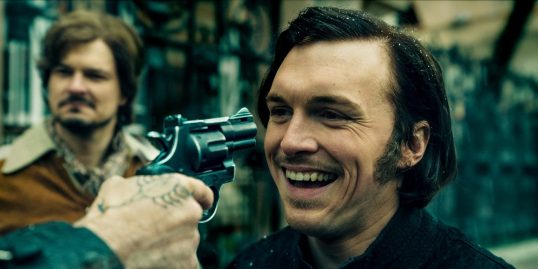
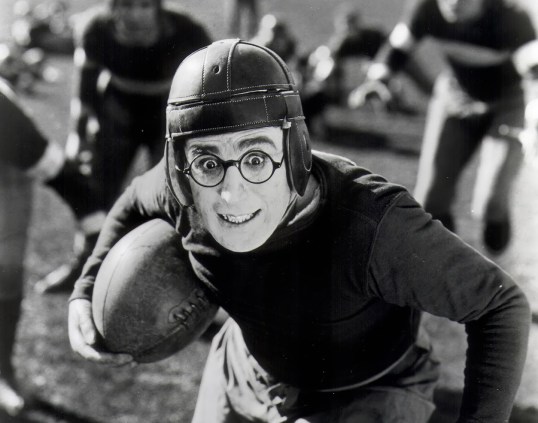
The Freshman (1925, dir by Fred C. Newmeyer and Sam Taylor, DP: Walter Lundin)
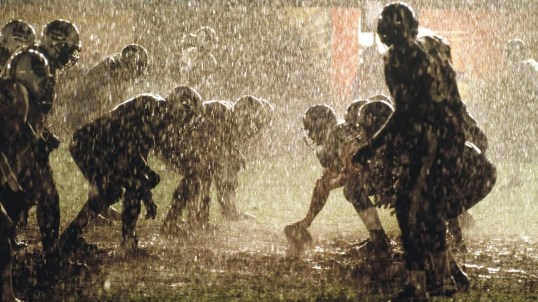
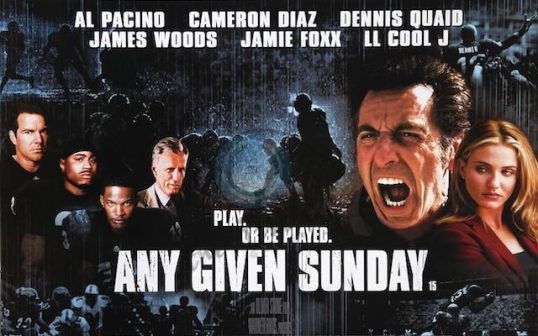
Any Given Sunday (1999, dir by Oliver Stone, DP: Salvatore Totino)
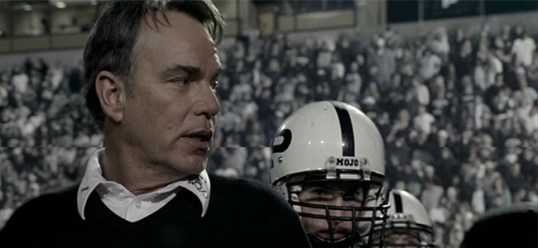
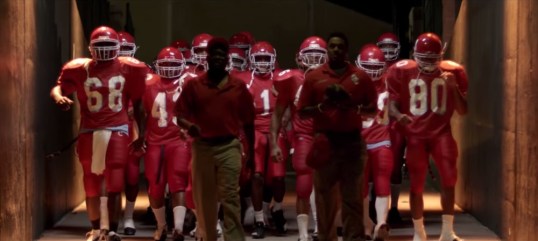
Friday Night Lights (2004, dir by Peter Berg, DP: Tobias Schliessler)
Carter High (2015, dir by Arthur Muhammad, DP: Ron Gonzalez)
I once read an article where Al Pacino’s lock room speech in Oliver’s Stone 1999 football film, Any Given Sunday, was described as being the most inspirational locker room speech ever.
I don’t really know if I agree with that.
I mean, to be honest, Al Pacino’s Tony D’Amato kind of looks really beaten down in this scene. It looks like, instead of spending the previous night studying game film and coming up with plays, the coach spent the previous night out drinking. If I was one of his players, I would be wondering if the coach was hungover and I might reset that. I might be like, “Hey, I’ve been staying off cocaine all week for this game and then coach shows up looking like he’s just killed Frank Lopez. Someone get Aaron Eckhart in here — he’s the coach we need!” Also, for the most part, his speech seems to be more about him than the team. It’s like, “I’ve got failed marriages, I’ve got this, I’ve got that …. life is a game of inches!” Well, that’s great, Tony, but how are we going to win the game? “I got problems!” Well, we’ve all got problems, coach! I mean, he’s talking to a room full of people who probably can’t stand up without hearing a hundred different things going snap in their knees.
Do locker room speeches really make that much of a difference? I’ve seen enough sports films that I often wondered this. Is it a requirement that a coach give a speech? If the coach refused to give a speech, the team would still be obligated to go out there and play hard, right? As I’ve said many a time, I really don’t get the point of long speeches but some of that is because of the ADD. There’s no way that I could listen to anyone talk about life being a game of inches for four minutes. I would just zone out.
What if a coach filibustered and just kept going and going in his speech? Would the team have to forfeit?
Would it have been more effective to show the team the Willie Beamon music video as opposed to forcing them to listen to a speech from hung over Tony D? Well, probably not. If I remember correctly, the team did win the big game and they did it even after Dennis Quaid got injured for like the 100th time. So, I guess the speech did work. That shows you everything I know about football.
Anyway, I know a lot of people love this speech. I mean, there’s a reason why it showed up in that car commercial. And, to be honest, it worked pretty well in that commercial. Certainly, it made more sense to use Tony’s “life is a game of inches” speech as opposed to Robin Williams’s poetry speech from Dead Poets Society. (Car commercials are weird.) So, in honor of those people and Super Bowl Sunday, here is the Tony D’Amato Any Given Sunday locker room speech:
The 1963 educational short film, Big Man on Campus, tells the story of Jerry, a 13 year-old with the attitude of a 16 year-old.
Jerry thought he was the coolest kid at his middle school. He thought throwing a milk carton was no big deal. He thought not studying for his classes wasn’t the worst thing in the world. He thought all of his classmates would like him if he rode his bicycle into traffic. He thought starting fights was no biggie. He thought everyone wanted to listen to another chorus of Grease Lightning. He thought Sandy was just a summer fling and that having the Ramones play at the local high school wouldn’t be a big deal. Jerry thought a lot of things.
Jerry was wrong.
Fortunately, the Vice Principal was there to set Jerry straight. That’s right, the vice principal. Jerry may thing he’s a big man on campus but he’s not even important enough to rate a meeting with the principal. Instead, he has to make due with the guy who teaches Chemistry. It takes a while for the vice principal to step out of his office but when he does, it’s obvious that the vice principal, with his navy haricut and his eyeglasses, isn’t going to stand for any nonconformity. Most afternoons, the vice principal would be busy tracking down and tearing up flyers for the Fair Play for Cuba Committee. Instead, on this day in November of 1963, the vice principal is having to discipline Jerry. Not only has Jerry caused a disruption at the school but he’s also allowed for the proliferation of pro-Castro propaganda. Can Jerry be saved or is he destined to become a pinball wizard with his own holiday camp?
You probably already know the answer. This educational film comes to us from Sid Davis, whose films were best known for their use of an extremely judgmental and rather dramatic narrator. The Sid Davis narrators were the ones who wouldn’t only explain what had happened but who would also offer up questions like, “You never thought one little action could ruin your life and the lives of so many others, did you?” That narrator is heard in Big Man on Campus but we also hear the voice of Jerry, trying to convince himself that his actions were no big deal and that everyone is totally overreacting.
Of course, deep down, Jerry knows that he’s no good. He knows that his mother is setting him up for a life of crime by arguing that “boys will be boys.” He knows that he’s destined to end up at juvenile hall and, after that, a life of unemployment. He knows all of this but he needs the help of a seriously annoyed adult to help him truly understand it. He needs the hard-earned, war-scarred, and apparently nearsighted wisdom of the vice principal.
Can Jerry be saved or is he destined to end up working a prop comic in Wichita Falls? Watch and find out!