A Movie A Day #341: Hot Pursuit (1987, directed by Steven Lisberger)


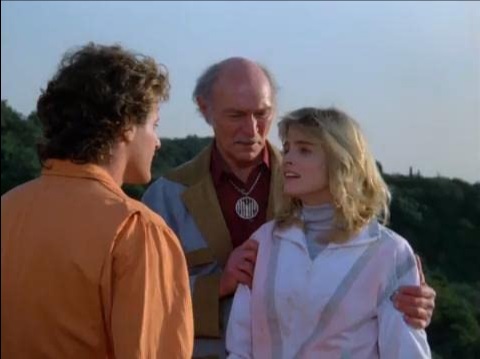
When high school student Dan Bartlett (John Cusack) is late arriving at the airport, he finds himself watching as the plane taking his girlfriend (Wendy Gazelle) and her parents (Monte Markham and Shelley Fabares) to the Caribbean takes off without him.  Dan catches the next available flight and tries to track down his girlfriend and her family.  Helping him out is a Ganja-smoking islander (Keith David) and a crusty sea captain (Robert Loggia).  Complicating matters is that Dan’s girlfriend has been kidnapped by pirates (Jerry Stiller and his son, Ben)!

John Cusack got his start appearing in dopey 80s teen comedies and Hot Pursuit shows why he eventually declared that he would never appear in another one.  Hot Pursuit relies on the idiot plot.  If everyone in the movie didn’t act like an idiot, there wouldn’t be much of a movie.  Cusack seems bored in his role, only waking up towards the end of the movie when he gets to pick up a machine gun and blow away the pirates’ hideout.  (Cusack even gets to do a Rambo-style yell while riddling the building with bullets.)  This was Ben Stiller’s film debut and he has a few funny scenes.  The movie probably would have worked better if Stiller and Cusack had switched roles.

One final note; Hot Pursuit was produced by Pierre David, who also produced several of David Cronenberg’s early films.  It’s probably not a coincidence that Wendy Gazzelle’s character is named Lori Cronenberg.

Cleaning Out The DVR, Again #5: We Are Still Here (dir by Ted Geoghegan)


1-we-are-still-here

The fifth film on my DVR was the 2015 haunted house film, We Are Still Here.  I recorded We Are Still Here off of the SyFy channel on March 20th.  Sad to say, I really can’t remember what I was doing or watching on March 20th while my DVR recorded one of the best horror movies of the previous year.  I was probably watching something pn Lifetime.  That usually seems to be the case.

But anyway, let’s talk about We Are Still Here.

As a self-professed lover of both horror and old grindhouse exploitation films, there is really no excuse for it to have taken me this long to see We Are Still Here.  We Are Still Here is one of those wonderfully low-budget indie films that mixes a traditional genre — in this case, the haunted house film — with a far less traditional view of humanity.  With its mix of bump-in-the-dark horror and cynicism about human nature, We Are Still Here feels like a mix of the Coen Brothers and H.P. Lovecraft.

Anne (Barbra Crampton, a veteran of horror films like Castle Freak and You’re Next) and Paul (Andrew Sensenig, who played the mysterious antagonist of Upstream Color) are a married couple who are struggling to deal with tragedy.  Their son, Bobby, was recently killed in a car wreck.  Anne is trapped in a prison of depression, while Paul just wants to move on with their lives.  Hoping that it will help them to forget their sadness, Paul and Anne buy a house in New England.

(New England, not coincidentally, was also the home of H.P. Lovecraft, as well as being the setting for some of his best-remembered stories.)

But, of course, the house proves to be anything but therapeutic.  From the minute they move in, Anne is convinced that they are not alone.  With every mysterious sound and strange happening within the house, Ann becomes more and more convinced that the spirit of Bobby is with them.

If you’re a horror fan, you will not be surprised to learn that they are not alone.  There is a presence in the house but is it Bobby or is it something far more sinister?  Shortly after moving in, Anne and Paul meet their new neighbors.  As friendly as they may be, there is definitely something off about Dave (Monte Markham) and his wife, Cat (Connie Neer).  Dave tells them that the house was originally a funeral home an about how it was owned by the mysterious Dagmar family.  The Dagmars were reportedly forced to leave town after it was learned that they were selling the bodies brought to them for burial and burying empty coffins.  Could this have anything to do with the strange vibe that Anne and Paul both get from the house?

Despite Paul’s skepticism, Anne invites her friends, May (Lisa Marie) and Jacob (Larry Fessenden), to come for a visit.  May and Jacob are both spiritualists and Anne hopes that they can contact Bobby’s spirit.  Again, it’s not a spoiler to reveal that they do contact something.  The surprise comes from what they contact and what happens as a result.

We Are Still Here is a chilly and dream-like film, one that wisely devotes as much time to creating and maintaining a properly creepy atmosphere as it does to all the expected scare scenes.  When the presence in the house is finally revealed, it’s a scary moment but for me, the most haunting scenes in the film are the shots of the snow-covered landscape surrounding the house.  The icy roads are as cold and unforgiving and as potentially dangerous as anything that might be living in the old Dagmar house.  And, just as the weather cannot be controlled, neither can the paranormal.

We Are Still Here is a deliberately paced film.  In fact, it’s probably a bit too deliberate to really be effective when viewed with commercial interruptions.  We Are Still Here works because it creates an atmosphere of foreboding and certain doom and it’s hard to maintain an atmosphere when, every 20 minutes or so, the action has to stop for a commercial about Tide pods.  To best appreciate this film and what it has to say about loss, faith, and delusion, it’s necessary to watch the story unfold without any pause to the narrative.

Fortunately, this intelligent and well-acted horror film is currently available on Netflix, where it can be viewed without commercial interruption!  If you’re a horror fan, you owe it to yourself to watch.

We-Are-Still-Here

Embracing the Melodrama Part II #50: Hustling (dir by Joseph Sargent)


hustling21I have to admit that I had ulterior motives for reviewing the film Hustle as a part of Embracing the Melodrama.  I was already planning on reviewing another 1975 film about prostitutes, one that I had recently watched on Netflix.  That name of that film was Hustling and, for whatever reason, it amused me to imagine being alive in 1975 and going to see Hustle at a movie theater and then coming home, turning on TV, and finding myself watching a film called Hustling.

So really, if I was going to review one of those films, I had to review the other, right?  It made perfect sense at the time!

Anyway, as for Hustling, it’s a film about prostitutes in New York and the wealthy magazine writer who decides to interview them for an article.  Watching the film, what I immediately noticed was that, even though the film had a properly gritty feel to it, none of the characters ever cursed and, for a film about sex workers, there was no nudity.  Though the characters continually talked about getting beaten up by their pimps, all of the violence occurred off-screen.  Even more importantly, whenever something dramatic happened, the scene would fade to black.  It was almost as if the movie was pausing for an unseen commercial.

Which, of course, it was.  Hustling was made for television and, as I watched it, it was easy for me to imagine that I was actually watching the latest Lifetime original film.  It certainly followed a pattern that should be familiar to anyone who has ever watched a movie on Lifetime.  Wanda (Jill Clayburgh, giving an excellent performance) is a veteran prostitute who, after being arrested for the hundredth time, is told that the charges against her will be dropped if she allows herself to be interviewed by magazine writer, Fran Morrison (Lee Remick).  At first Wanda refuses but, after her pimp refuses to pay her fine and suggests that she should just accept spending a few months in jail, Wanda reconsiders and accepts Fran’s offer.

The rest of the film charts Fran and Wanda’s unlikely friendship.  Wanda tells Fran what it’s like to be prostitute.  Fran encourages Wanda and the other prostitutes to stand up for their legal rights.  Wanda deals with a society that looks down on her.  Fran deals with a boyfriend (Monte Markham) who can’t understand why she’s so concerned about a bunch of prostitutes.  Wanda considers going back to her pimp.  Fran considers exposing all of the “respectable” men who use prostitutes.

So, Hustling is pretty predictable and, not surprisingly, rather dated but it’s also a fairly effective portrait of life on the margins of society.  Lee Remick is stuck playing a one-note character but Jill Clayburgh is great in the role of Wanda. If nothing else, Hustling was filmed on location in some of the sleaziest parts of 1970s New York City and therefore, the film serves as a bit of a historical document.

For those wishing to check it out, the film’s currently available on Netflix.

Embracing the Melodrama Part II #40: One Is A Lonely Number (dir by Mel Stuart)


one_is_a_lonely_number_ver2

You’ve probably never heard of the 1972 film One Is A Lonely Number.  I certainly hadn’t until, a few weeks ago, I happened to come across it on TCM.  Like a lot of films that have apparently been forgotten by history, One Is A Lonely Number is one that deserves to be remembered.

One Is A Lonely Number opens with the end of a marriage.  James Brower (Paul Jenkins), an arrogant college professor, coldly packs his collection of vinyl records into a box and tells his wife, Amy (Trish Van Devere), that he’s filing for divorce and that he’s leaving her.  She asks him why.  He coolly mentions something about her throwing out a prized copy of Paradise Lost and then leaves the apartment.

Shocked, Amy goes to the college and asks her husband’s students if they’ve seen him.  They tell her that James canceled his final exam and has since disappeared.  At first, Amy insists that James is going to come back and denies that they’re getting a divorce.  When she finally does accept that her marriage is over, Amy is forced to be independent for the first time.

What she quickly discovers is that the world is full of people who are looking to take advantage of both her vulnerability and her naiveté.  When she goes to an employment agency, she explains that she has a degree in Art History and that she minored in Philosophy.  Frighteningly (especially in the eyes of this particular holder of a degree in Art History), all this gets Amy is a job as a lifeguard at the local pool.  When she finally find herself attracted to another man, she doesn’t discover that he’s married until the morning after.  And when she finally discovers why her husband actually left her, she discovers that he was even more of a stranger to her than she realized.

Fortunately, there are a few good spots in Amy’s life.  Her best friends Madge (Jane Elliott) and Gert (Janet Leigh) provide support.  (“Men are shit,” Gert explains at one point.)  And she strikes up a poignant friendship with a widowed grocer (Melvyn Douglas).

There are so many scenes in One Is A Lonely Number that ring true, even when viewed today.  Amy finally realizes that her marriage is over while trying on clothes and ends up sobbing by herself.  Amy, Gert, and Madge get drunk and talk about their exes, laughing away their shared pain.  Amy discovers that the man from the employment agency (played, as a disturbingly plausible creep, by Jonathan Goldsmith who is best known for being the Most Interesting Man In The World for Dos Equis) expects her to “repay” him for his help in getting her a demeaning job as a lifeguard.  Amy panics when she can’t find what’s happened to that kindly grocer.

One Is A Lonely Number moves at its own deliberate pace but it’s still one that you should watch and stick with until the end.  It’s an intelligent and well-acted movie and the film’s poignant final scene will fill you with hope.  Watch it the next time that it shows up on TCM.