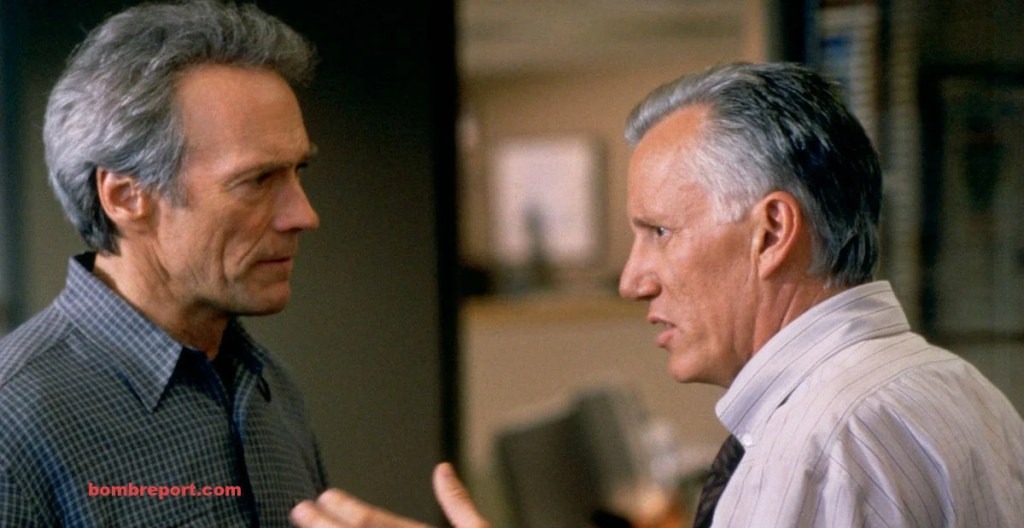
I review TRUE CRIME (1999) – starring Clint Eastwood and James Woods!


Here at The Shattered Lens, we’re celebrating Clint Eastwood’s birthday on May 31st. I decided to revisit his 1999 film, TRUE CRIME. 

Clint Eastwood directs and stars as ace journalist, Steve Everett, who also happens to be a bad friend, a terrible dad, and an even worse husband. Literally the only thing that he’s got going for him is his “nose,” his ability to sniff out a story where no one else can. Even that has begun to fail him, mostly due to his recents bouts with alcoholism, which he seems to somewhat have a handle on at the time of this story. When a young, beautiful colleague tragically passes away in an auto accident, Steve is given her previous assignment to cover the execution of convicted murderer Frank Beechum (Isaiah Washington). Not the kind to write a human interest “puff piece” like the Oakland Tribune is wanting, Everett begins digging into the past and pretty soon that nose of his starts telling him that Beechum is a victim of circumstantial evidence. Despite his editor Bob Findley’s (Denis Leary) objections, he’s able to convince his newspaper boss Alan Mann (James Woods) to let him dig deeper into the story. As he tries to juggle his myriad personal problems with his growing belief in Beechum’s innocence, Everett is also facing a clock that is ticking down to the midnight execution. Will he be able to find the crucial piece of evidence that will set Beechum free?

TRUE CRIME appears to be somewhat of a forgotten Clint Eastwood film. I saw it at the theater when it came out in 1999, but it was not financially successful, only bringing in $16 Million at the box office. Regardless of that, I still love the film. It’s certainly not perfect. It’s probably too long, Beechum is probably too angelic after being “born again,” and the resolution may be a little unrealistic, but I still enjoyed every second of it. One of the coolest things about Clint Eastwood is his willingness to play such flawed men on screen, yet we still love him. He’s great in this film! Anyone who’s read much of my work knows that my love of actor James Woods goes back to being in junior high and renting his movies BEST SELLER and COP. It’s such a treat seeing the legendary pair on screen together even if Woods’ role is sort of a glorified cameo. Woods is hilarious in his limited screen time. My last shout out is to Isaiah Washington as the innocent man who’s about to be put to death. After all these years and appeals, he’s accepted his fate, but the scene where he tells Everett his story and Everett tells him that he believes he’s innocent is so powerful. Add to that Washington’s scenes with his wife and daughter, and I was very much emotionally invested in this film. Washington’s performance was key to the film working, and he’s great!

Overall, TRUE CRIME is a film that takes its sweet time, but it ultimately tells a tense, engrossing story that ratchets up the tension to 10 prior to its last second resolution. I consider it very underrated and highly recommend it. I’ve included the trailer below:

Memoirs of an Invisible Man (1992, directed by John Carpenter)


An accident at a laboratory renders stock analyst Nick Holloway (Chevy Chase) invisible.  CIA agent David Jenkins (Sam Neill) wants to recruit Nick to be an assassin but Nick doesn’t want to kill people.  He just wants to make his date with Alice (Daryl Hannah).  With Jenkins and his agents in pursuit, Nick flees to a beach house belonging to his friend George (Michael McKean) and tries to figure out what to do with his life now that no one can see him.  Fortunately, Alice is staying at the beach house too.  Nick and Alice fall in love but Jenkins is close behind.

Based on a science fiction novel by H.F. Saint, Memoirs of an Invisible Man started out as a vanity project for Chevy Chase, who felt that the film’s mix of comedy and drama would establish him as a serious actor.  The project went through a series of directors, including Ivan Reitman and Richard Donner, but in the end no one wanted to work with the special effects necessary to create the impression of invisibility and, even more importantly, no one wanted to work with Chase.  When the film was finally offered to John Carpenter, he was reluctant to do another studio film because of his bad experience with They Live.  He finally agreed because it had been four years since his last film.

The special effects in Memoirs of an Invisible Man are still impressive and the chase scenes show off Carpenter’s abilities as an action director.  The movie flopped with critics and audiences but that was not Carpenter’s fault.  Carpenter keeps the story moving and gets good performances out of Sam Neill and even Daryl Hannah.  The problem with the movie is that Chevy Chase is miscast as an action hero and he tries too hard to give a serious performance.  Carpenter later said he wanted to add more comedy to the film and to emphasize Chase’s talent for physical comedy but Chase refused to do so.  Chase also resented wearing the blue bodysuit that would be used to render him invisible onscreen and often removed the suit early, ruining whatever else Carpenter had planned to shoot during the day.  You can add John Carpenter to the long list of directors who have said they will never work with Chevy Chase again.

One good thing did come out of Memoirs of an Invisible Man.  Carpenter met and enjoyed working with Sam Neill.  (Memoirs of an Invisible Man probably would have worked better in Neill and Chase had switched roles.)  Neill would go on to star in Carpenter’s next film, In The Mouth of Madness.

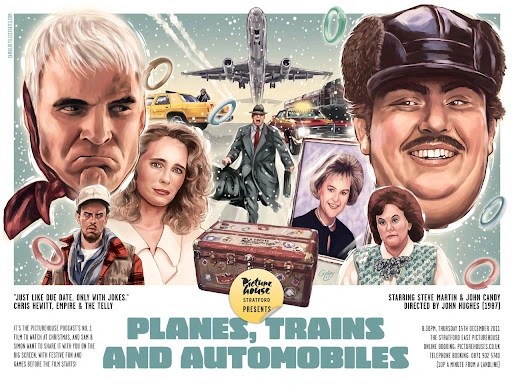
PLANES, TRAINS AND AUTOMOBILES and our family’s traditions.


I love Thanksgiving because I love spending time with my family. My Mom is one of 15 kids from a large Catholic family in central Arkansas, so this is the time of year that I get to see a big part of that extended family. A lot of people are spread out across the state and country so we don’t get to see everyone at Thanksgiving, but we do get to see a lot of people. We go to my aunt Jo Ellen’s house, and I get to hang out with a bunch of my aunts, uncles and cousins. We’ll have a giant feast from a potluck of items we’ve grown to love over the years…Aunt Jo Ellen’s turkey and dressing, Mom’s candied yams, Aunt Connie’s deviled eggs, the giant table of desserts, etc. Our family is all about traditions, and this is the time of year we share those with each other. I just love it! 

One of our movie-watching traditions is watching PLANES, TRAINS AND AUTOMOBILES together. And we do it every year. We still laugh at all the right parts…Kevin Bacon getting Steve Martin’s cab thanks to a mysteriously large trunk on the curb, John Candy reading The Canadian Mounted, Doobie’s Taxiola, “Those Aren’t Pillows,” Owen’s strange facial expressions and throat noises, “a couple of balls and an extra set of fingers,” the runway crossing, the car rental counter meltdown, “you’re going the wrong way,” the hotel destruction getaway, and the indestructible car radio. Odds are many of you are smiling as you read this quick summary of some of my favorite parts. We’ll watch the movie together while we’re settling in back at Dad and Mom’s house after a wonderful Thanksgiving lunch. It’s a guarantee that Dad will be snoring at some point. 

As much as I love to eat, to me, Thanksgiving is all about spending time with the ones I love. We’ll tell a lot of the same stories that we’ve told many times over the years, and we’ll laugh at them all over again. We’ll truly enjoy our time together. Our family is not perfect, and we don’t always see eye to eye on everything, but we love each other and that is more important than just about anything else. That’s a Crain family tradition passed down from my parents. One of the best things about PLANES, TRAINS AND AUTOMOBILES is that there are times when the laughs die completely down, and that’s when the movie reveals its heart. The same can be said for my family, and that’s something I’m truly thankful for.

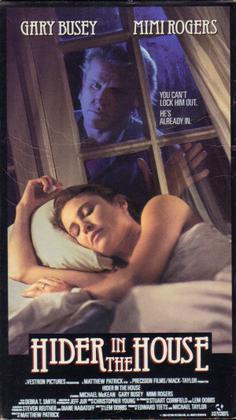
Hider In The House (1989, directed by Matthew Patrick)


After spending years in a mental hospital for murdering his abusive parents, Tom Dreyer (Gary Busey) is released and told to find somewhere else to live.  He ends up secretly living in the crawl space of the new home Julie (Mimi Rogers) and Phil Dreyer (Michael McKean).  Obsessed with Julie, he’ll do anything to be with her, including breaking up her marriage to Phil and killing anyone who comes to close to discovering him in the crawlspace, whether it’s the family dog, an exterminator, or Julie’s best friend.

Due to the distributor having financial issues, Hider In The House never got a theatrical release but it used to show up on HBO frequently in the late 80s and 90s.  I can also remember that our local video store had the film’s poster hanging on the wall near the cash register, creating the impression that Gary Busy was not only staring at Mimi Rogers but also judging whatever you decided to rent for the weekend.  Hider In The House was very popular amongst those of us who had a crush on Mimi Rogers, which was basically every guy on the planet back in the day.

It’s not a bad movie, even if it is predictable.  Both Mimi Rogers and a pre-motorcycle accident Gary Busey give good performance and it’s interesting to see Michael McKean playing a dramatic role for once.  The main problem with the movie is that it’s impossible to believe that big and hulking Busey could possibly live in someone’s attic and move around between the walls without everyone immediately noticing.  A Clydesdale would have more luck going unnoticed than Gary Busey.

Shortly after he completed filming on Hider In The House, Gary Busey was in a motorcycle accident that nearly killed him.  He fractured his skull and suffered permanent brain damage.  It’s always interesting to compare the Gary Busey of the 70s and 80s with the Gary Busey of today.  People are so used to the Busey who yells and speaks in riddles that it’s easy to forget that he was once a very good actor, even when he was appearing in something like Hider In The House.

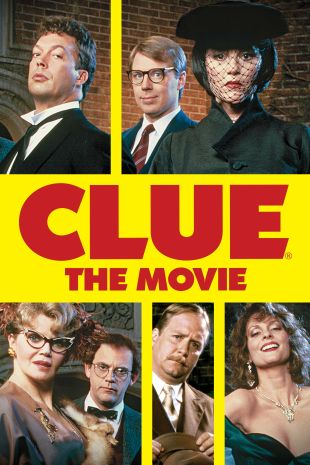
Film Review: Clue (dir by Jonathan Lynn)


It was a dark and stormy night in 1954….

The 1985 comedy, Clue, opens with a set of six strangers arriving at an ominous mansion in New England.  They’re meet by Wadsworth (Tim Curry), an oddly charismatic butler who explains that all six of the strangers have a few things in common.  They all work in Washington D.C.  They are all, in some way, involved with the government.  And they’re all being blackmailed by Mr. Boddy (Lee Ving), the owner of the house.

The six strangers have all been assigned nicknames for the night.

Miss White (Madeleine Khan) is the enigmatic widow of a nuclear physicist who may have had communist sympathies.  Actually, Miss White is a widow several times over.  All of her husbands died in circumstances that were a bit odd.  Is Miss White a black widow or is she just unlucky?  And what about the flames of jealousy that she occasionally mentions?

Professor Plum (Christopher Lloyd) is a psychiatrist who once worked for the World Health Organization and who has an unfortunate habit of sleeping with his patients.

Mr. Green (Michaele McKean) explains that he works for the State Department and that he is also secretly gay.  If his secret got it, he would be deemed a security risk or perhaps even a communist agent.

Mrs. Peacock (Eileen Brennan) is the wife of a U.S. Senator who forced to resign after getting caught up in a bribery scandal.

Colonel Mustard (Martin Mull) is a somewhat stuffy war hero-turned-arms dealer.

And finally, Miss Scarlet (Lesley Ann Warren) is Washington D.C.’s most powerful and most witty madam.

Once everyone is in the house, Wadsworth explains that the police have been called and will arrive in 45 minutes, at which point Mr. Boddy will be arrested and everyone’s secrets will be exposed.  Mr. Boddy’s solution is to suggest that one of the six kills Wadsworth.  After tossing everyone a weapon, Mr. Boddy turns out the lights.  When the lights come back on, Wadsworth is still alive but Mr. Boddy is not.  But who murdered Mr. Boddy?  And in what room?  And with what weapon?  And what to make of the other people who were either in the house or show up at the front door, like the maid, Yvette (Collen Camp), or the motorist (Jeffrey Kramer) who shows up to use the phone or the traveling evangelist (Howard Hesseman)?  Can the mystery be solved before the police show up and presumably arrest everyone?

Based on the old board game, Clue is a hilariously exhausting film, one that mixes smart wordplay and broad physical comedy to wonderful effect.  It’s not often that you see a film that gets equal laughs from two people colliding in a hallway and from characters accusing each other of being communists.  In fact, it’s so easy to marvel at the physical comedy (especially the lengthy scene where Tim Curry runs from room to room while explaining his theory about who committed the murders) that it’s easy to forget that the film is also a sharp satire on political corruption, national paranoia, 50s morals, and the McCarthy era in general.  Since all of the characters are already convinced that they’re either surrounded by subversives or in danger of being accused of being a subversive themselves, it’s not a great leap for them to then assume that any one of them could be a murderer.  I mean, if you’re willing to betray your country than who knows what you might be willing do in the study with a candlestick?

The cast is full of comedy veterans, all of whom know how to get a laugh out of even the mildest of lines and none of whom hold back.  Madeline Kahn, in particular, is hilarious as Miss White though my favorite suspect, in both the game and the movie, has always been Miss Scarlet.  Not only is she usually portrayed as being a redhead in the game but, in the movie, her dress is to die for.  In the end, though, it’s perhaps not a surprise that the film is stolen by Tim Curry’s energetic performance.  The film’s final 15 minutes are essentially a masterclass in physical comedy from Tim Curry but he’s just as funny when he’s delivering his frequently snarky dialogue.  Both Wadsworth the character and Tim Curry the actor appear to be having a blast, running from room to room and shouting out accusations.

When Clue was originally released, it was released with three different endings.  Apparently, the audience wouldn’t know which ending they were going to get before the movie started.  I guess that the idea was to get people to go the movie three times to see each ending but I imagine few filmgoers had the patience to do that and who knows how many viewers went to multiple showings just to discover that the randomly selected ending was one that they had already seen.  I’m surprised that I haven’t come across any reports of riots breaking out.  Fortunately, the version of Clue that is now available for viewing features all three endings.  Of course, none of the endings make much sense.  Hercule Poirot would demand a do-over, especially if he was being played by Kenneth Branagh.  But the fact that it’s all so ludicrous just adds to the comedy.  I watched Clue two Fridays ago with a group of friends and we had a blast.  It’s definitely a movie that’s more fun when you watch it with other people.

(That said, as far as incoherent solutions are concerned, the third one was my favorite and I think Poirot would agree.)

As for the board game itself, I used to enjoy playing it when I was a kid.  We had really old version from the 60s and I always used to imagine what all of the suspects were like when they weren’t being accused of murder.  I always imagined that Mr. Green and Miss Scarlet probably had something going on.  Today, I’ve got a special Hitchcock edition of the game.  It’s all good fun, this never-ending murder mystery.

The Unnominated: Auto Focus (dir by Paul Schrader)


Though the Academy of Motion Picture Arts and Sciences claim that the Oscars honor the best of the year, we all know that there are always worthy films and performances that end up getting overlooked.  Sometimes, it’s because the competition too fierce.  Sometimes, it’s because the film itself was too controversial.  Often, it’s just a case of a film’s quality not being fully recognized until years after its initial released.  This series of reviews takes a look at the films and performances that should have been nominated but were,for whatever reason, overlooked.  These are the Unnominated.

The 2002 film Auto Focus start out as almost breezy satire of the perfect all-American life and it ends with an act of shocking violence.  It’s based on a real-life mystery, a murder that revealed a secret life.

When we first see Bob Crane (Greg Kinnear), he’s a disc jockey and a drummer living in the suburbs of Los Angeles in the mid-60s.  He’s got what would appear to be the ideal life.  He’s got a nice house.  He and his wife (Rita Wilson) seem to be devoted to each other.  His children are adorable.  He goes to church.  He tells corny Dad jokes.  He’s got a quick smile and a friendly manner and it’s impossible not to like him.  When he gets offered the lead in a sitcom, his happiness and enthusiasm feels so generous that it’s impossible not to be happy for him.

Of course, the show is a comedy that takes place in World War II POW camp, which doesn’t really sound like a surefire hit or really anything that should be put on the air.  (“Funny Nazis?” Crane says in disbelief when he’s first told about the project.)  Still, with Crane in the lead role, Hogan’s Heroes becomes a hit and, for a while, Bob Crane becomes a star and it seems like it couldn’t have happened to a more deserving guy.

The problem, of course, is that Crane seems like he’s too good to be true and we all know what they say about things like that.  From the start, there are hints that Crane may be hiding another side of his personality.  His wife, for instance, is not happy when she discovers his stash of pornographic magazines in their garage.  (“They’re photography magazines!” Crane protests with a smile that’s a bit too quick.)  Crane obviously enjoys the recognition that comes from being the star of a top-rated show.  He starts hanging out at strip clubs, occasionally playing drums with the club’s band and watching the dancers with a leer that’s really not all that different from the smile that he flashes whenever he asks anyone if they want an autograph.

Crane also meets John Carpenter (Willem DaFoe), an electronics expert who introduces him to the then-expensive and exclusive world of home video.  As opposed to the clean-cut and smoothly-spoken Crane, Carpenter is so awkward that it’s sometimes painful to watch him move or listen to him speak.  He’s the epitome of the Hollywood hanger-on, the type who has deluded himself into thinking that his celebrity clients genuinely like him and enjoy his company.  He and Crane become fast friends, though it’s always obvious that Crane considers himself to be better than Carpenter.  However, Carpenter is the only person with whom Crane can share the details of his secret life.

The film covers several years, from the late 60s to the mid-70s.  Crane goes from being so clean-cut that he neither drinks nor curses to being so addicted to sex that he can stop himself even when it starts to destroy his career and leads to him losing everything that he loves.  Carpenter and Crane’s friendship becomes progressively more and more self-destructive until the film ends in violence and tragedy.

Auto Focus begins on a light and breezy note but, as Crane’s addiction grows, the film grows darker.  By the time the movie enters the 70s, the camerawork becomes more jittery and the once soft-spoken Crane seems to be drowning in his own anxiety.  He becomes the type who causally goes from talking to Carpenter about how he wants to direct the world’s greatest sex film to cheerfully announcing that Disney has decided to cast him in a film called SuperDad.  Auto Focus‘s key scene comes towards the end, when Crane is a guest on a silly cooking show and shocks the audience by harassing a woman sitting in the front row.  When the audience boos, Crane flashes his familiar smile and it becomes obvious just how much of Crane’s life has been spent hiding behind that smile.  By the end of the film, not even Crane himself can keep track of whether or not he’s a wholesome comedy star or a self-destructive sex addict.

Both Greg Kinnear and Willem DaFoe gave Oscar-worthy performance in Auto Focus, performances that hold your interest even after their characters sink to some truly low depths.  The film makes good use of Kinnear’s amiable screen presence and Kinnear convincingly creates a man who wishes that he could be the person that he’s fooled everyone into thinking that he is.  By the time he’s reduced to begging his agent (well-played by Ron Leibman) to find him a game show so that he can finally stop doing dinner theater, it’s hard not to have a little sympathy for him, even if the majority of his problems are self-created.  As Carpenter, DaFoe is convincingly creepy but, at times, he’s also so pathetic that, again, you can’t help but feel a little sorry for him.  At his worst, Carpenter is the 70s equivalent of the twitter user who stans a celebrity by sending them adoring tweets and then picking fights with anyone who disagrees.

Unfortunately, the Academy nominated neither Kinnear for Best Actor nor DaFoe for Best Supporting Actor.  The competition for Best Actor was fierce that year, with Nicolas Cage, Michael Caine, Daniel Day-Lewis, and Jack Nicholson all losing to Adrien Brody in The Pianist.  While Kinnear deserved a nomination, it’s hard to say who I would drop from that line-up to make room for him.  As for DaFoe, I would argue that he was more deserving of a supporting actor nomination than The Hours‘s Ed Harris or The Road To Perdition’s Paul Newman.  Perhaps DaFoe was just too convincing as the type of clingy groupie that most members of the Academy probably dread having to deal with.

Nominated or not, Auto Focus is a disturbing and ultimately sad look at the darkness that often hides behind a perfect facade.


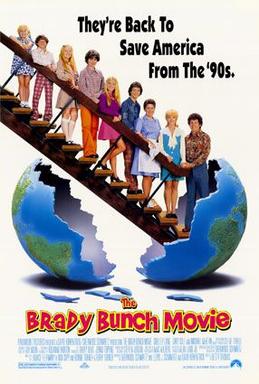
Film Review: The Brady Bunch Movie (dir by Betty Thomas)


“Put on your Sunday best, kids.  We’re going to Sears!”

I’m probably like a lot of people, in that I hate The Brady Bunch as a television show but I love the 1995 film version.  Of course, the film version acknowledges a lot of the things that make the TV show so difficult to sit through.  For instance, whenever I watch the TV show, I’m stuck by the fact that Robert Reed’s Mike Brady is kind of a jerk and he really doesn’t seem to know what he’s talking about half of the time.  Fortunately, in the movie, Gary Cole plays Mike Brady as being kind of a jerk who really doesn’t know what he’s talking about.  On the TV show, I’m always amazed that no one ever points out how dorky Greg Brady is or how no one ever seems to notice that Jan is slowly losing her mind.  The movie, however, is all about how dorky Greg is and how Jan is slowly losing her mind.

“Marcia Marcia Marcia!” Jan (played by Jennifer Elise Cox) exclaims and the audience is instantly divided between neglected middle children and those of us who were maybe a little bit spoiled when we were growing up.

“Johnny Bravo was just Johnny Rotten,” Greg (played by Christopher Daniel Barnes) confesses and it’s tempting to tell Greg not to be too hard on himself but it’s true.  That clown song really sucked and I don’t blame everyone for running away whenever Greg started to sing.

“Your father’s right, kids!” Carol (Shelley Long) says after every one of Mike’s long-winded soliloquies and the film hints that Carol might actually understand that Mike is rarely right but Carol is determined to do whatever needs to be done to keep the Bunch moving forward.  Myself, I’m more concerned by how long it’s taking Carol to read Jonathan Livingston Seagull.  My aunt owns a copy of that book and, if I remember correctly, it’s pretty short.

All of the Bradys (and Alice, too) get a chance to show off what they can do in The Brady Bunch Movie.  They’ve all pretty much got the same quirks as they did in the series but what made them so annoying on television actually makes them rather endearing in the film.  Of course, the film finds the Bradys living in the 90s, surrounded by crime, pollution, loud music, and a dastardly plot to steal their house.  (That’s what they get for living next door to veteran comedy villain Michael McKean).  The thing is that, while the rest of the world is a mess, the Bradys themselves still act and dress like they did on their television show.  They’re literally a family out of time.  That’s not a problem with Marcia, who all the boys love despite the 70s fashion sense and the belief that a hand on the knee is moving too fast.  But the rest of the family definitely sticks out, like a sore but always cheerful thumb.  And yet, because everyone around them is so obnoxious, it’s hard not to appreciate the Bradys and their nonstop earnestness.  They’re an antidote to everything negative in the world.  All they had to do was remain clueless about everything happening outside of their front door.

The Brady Bunch Movie makes me laugh every time I watch it.  It’s one of those films that I watch whenever I’m feeling extremely down.  It’s impossible not to be cheered up when the Bradys start dancing through Sears, amazed by the sight of their faces on television while Mike and Carol carefully examine a virbator in the background.  I’m thankful for this film.  It makes me laugh.

Every day is a sunshine day with the movie Bradys.

The television Bradys can go to Hell.


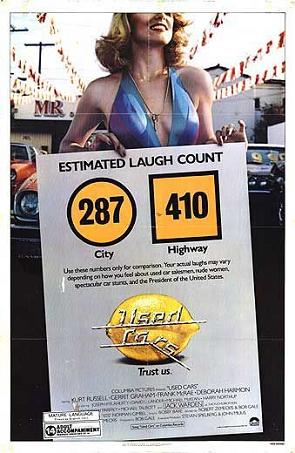
Shattered Politics #46: Used Cars (dir by Robert Zemeckis)


Used_Cars_film_poster

“Do you think we like being associated with the President of the United States?  I mean, we run an honest business here!” —

Jeff (Gerrit Graham) in Used Cars (1980)

As a film lover, I’ve sat through so many disappointing commentary tracks that, when I come across one that’s actually fun and informative, it causes me to like the film even more.  One of the best commentary tracks that I’ve ever heard was the one that Robert Zemeckis, Bob Gale, and Kurt Russell recorded for the DVD release of the 1980 comedy Used Cars.

The film — which was an early credit for both director Zemeckis and screenwriter Gale — tells the story of two rival used car lots.  The bad guy car lot is owned by Roy L. Fuchs (Jack Warden).  The good guy car lot is owned by Roy’s brother, Luke Fuchs (also played by Jack Warden).  The top salesman at the good guy car lot is Rudy Russo (Kurt Russell).  The film shows what happens when Luke dies and Rudy tries to prevent Roy from taking over the lot.

The commentary track is distinguished by just how much Zemeckis, Gale, and Russell seem to truly enjoy watching and talking about the film.  Kurt Russell, in particular, has an incredibly engaging laugh and his sense of fun is contagious.  However, for me, the most interesting part of the commentary track came when Bob Gale explicitly compared Rudy Russo and Luke’s daughter (played by Deborah Harmon) to Bill and Hillary Clinton and then even starts to do a surprisingly good imitation of Bill’s hoarse Arkansas accent.

What made it interesting was that the comparison was absolutely correct.

Politicians are salesmen.  Much as politicians will say anything to get your vote, the salesmen in Used Cars will say and do anything to get your money.  Politicians sell promises that are too good to be true.  Rudy Russo and Roy L. Fuchs do the same thing, claiming that their used cars are just as good and safe as a car that’s never been owned before.

In fact, one of the major plotlines in Used Cars is that Rudy is plotting to make the move from selling cars to buying votes.  There’s a vacancy in the state senate and Rudy is planning on running for the seat.  All he has to do is come up with the $10,000 necessary to buy the nomination from the local political machine. (I imagine it would be more expensive to buy a nomination today.)  Luke agrees to loan Rudy the money but, before he can, Luke goes on a test drive with a former race car driver.

The driver works for Luke’s evil brother, Roy.  Roy knows that Luke has a heart condition and he specifically sends over that driver to give Luke a fatal heart attack.  Just as Rudy is trying to sell a car to a costumer who is skeptical about whether or not he should pay an extra fifty dollar for something he doesn’t want (“$50.00 never killed anyone!” the customer insists), Luke staggers into the office and dies.

(The shocked customer agrees to pay the extra fifty dollars.  Ever the salesman, Luke grabs the fifty before he dies.)

With Luke dead and his estranged daughter nowhere to be seen, Roy is next-in-line to take over Luke’s car lot.  So, Rudy hides the body and tells everyone that Luke is down in Florida.  Both he and his fellow salesman, the hilariously superstitious Jeff (Gerrit Graham), conspire to make as much money as possible before anyone discovers the truth.

How do they do it?  Illegally, of course!

First off, they break into the broadcast of a football game and do an ad.  Then, they use strippers to attract customers.  And finally, Rudy comes up with his master plan, interrupting a televised address from the President of the United States.

“You can’t fuck with the President!” Jeff says.

“Hey, he fucks with us…” Rudy responds.

Seriously, I love Rudy.

In fact, I really liked Used Cars.  It’s a good combination of broad humor and clever satire and both Kurt Russell and Gerrit Graham give such likable performances that you can ignore the fact that they’re both playing total jerks.  (In fact, I would argue that one reason that we love Rudy is because he’s so honest about being so crooked.)  Not every scene worked perfectly.  The scene where Rudy and Jeff interrupt that football game goes on forever and, after a spokesmodel’s dress is ripped off, becomes so uncomfortable to watch that it actually takes the film a while to recover.  But then, after that, you get the interruption of the President’s speech.  You get Jeff freaking out over whether or not red cars or unlucky.  You get some fun driving school humor.  And, of course, you get a cute dog that can do tricks and helps to sell cars.  The film recovers and, ultimately, Used Cars is a celebration of small businesses everywhere.

And you know what?

I really hope Rudy did make it into the state senate.

We need more Rudy Russos in government.

And we really need more commentary tracks featuring Kurt Russell!