Guilty Pleasure No. 81: The Replacements (dir by Howard Deutch)


2000’s The Replacements finds America in crisis!

With the season already underway, football players are going on strike!  They want better contracts.  They want more money.  They want …. well, they want a lot of stuff.  Meanwhile, the fans just want to know who is going to make the playoffs.  There are only four games left in the season and the Washington Sentinels need to win three of them to make it into the playoffs.  The owner of the team (Jack Warden) recruits burned-out coach McGinty (Gene Hackman) to take over a team that will  be made up of replacement players.  McGinty says that he wants to pick his own players and he doesn’t want any interference from the team’s owner.  Anyone want to guess how long that’s going to last?

McGinty’s team is made up of the usual collection of quirky misfits who show up in movies like this.  Tight End Brian Murphy (David Denman, who later played Roy on The Office) is deaf.  One of the offensive linemen is a former SUMO wrestler.  Orlando Jones plays a receiver who has a day job at a grocery store.  The kicker (Rhys Ifan) is a Welsh soccer player.  (Okay, a footballer, I don’t care, call it whatever you want.)  Jon Favreau plays a berserk defender who is a member of the police force.  Leading them on the field is Shane Falco (Keanu Reeves), a quarterback with a confidence problem.  Cheering for them from the sidelines and falling in love with Shane is bar owner-turned-head-cheerleader Annabelle (Brooke Langton).  Backing up Annabelle is a cheer squad made up of former strippers, the better to distract the other teams.

It’s not often you see a film where the heroes cross a picket line but that’s what happens with The Replacements.  Then again, it’s not like the folks on strike are driving trucks or unloading freight for a living.  They’re multi-millionaires who want even more money and don’t even care about whether the team wins or loses.  When the replacement players actually start to win games and become beloved in the city, the striking players react by starting a bar brawl.  In the end, striking quarterback Eddie Martell (Brett Cullen) doesn’t even stick with his principles.  He crosses the picket line and creates a quarterback controversy, just in time for the last game of the season.

The Replacements is thoroughly predictable but also very likable.  The cast gels nicely, with Hackman especially standing out as the gruff but caring coach.  Keanu Reeves is not totally believable as a quarterback with a confidence problem.  You take one look at Reeves and you don’t believe he’s had an insecure day in his life.  But, as an actor, he’s so likable that it doesn’t matter.  The same goes for the entire cast, whether they’re on the playing field or singing I Will Survive in jail.  I don’t particularly care much about football but I did enjoy The Replacements.

Previous Guilty Pleasures

  1. Half-Baked
  2. Save The Last Dance
  3. Every Rose Has Its Thorns
  4. The Jeremy Kyle Show
  5. Invasion USA
  6. The Golden Child
  7. Final Destination 2
  8. Paparazzi
  9. The Principal
  10. The Substitute
  11. Terror In The Family
  12. Pandorum
  13. Lambada
  14. Fear
  15. Cocktail
  16. Keep Off The Grass
  17. Girls, Girls, Girls
  18. Class
  19. Tart
  20. King Kong vs. Godzilla
  21. Hawk the Slayer
  22. Battle Beyond the Stars
  23. Meridian
  24. Walk of Shame
  25. From Justin To Kelly
  26. Project Greenlight
  27. Sex Decoy: Love Stings
  28. Swimfan
  29. On the Line
  30. Wolfen
  31. Hail Caesar!
  32. It’s So Cold In The D
  33. In the Mix
  34. Healed By Grace
  35. Valley of the Dolls
  36. The Legend of Billie Jean
  37. Death Wish
  38. Shipping Wars
  39. Ghost Whisperer
  40. Parking Wars
  41. The Dead Are After Me
  42. Harper’s Island
  43. The Resurrection of Gavin Stone
  44. Paranormal State
  45. Utopia
  46. Bar Rescue
  47. The Powers of Matthew Star
  48. Spiker
  49. Heavenly Bodies
  50. Maid in Manhattan
  51. Rage and Honor
  52. Saved By The Bell 3. 21 “No Hope With Dope”
  53. Happy Gilmore
  54. Solarbabies
  55. The Dawn of Correction
  56. Once You Understand
  57. The Voyeurs 
  58. Robot Jox
  59. Teen Wolf
  60. The Running Man
  61. Double Dragon
  62. Backtrack
  63. Julie and Jack
  64. Karate Warrior
  65. Invaders From Mars
  66. Cloverfield
  67. Aerobicide 
  68. Blood Harvest
  69. Shocking Dark
  70. Face The Truth
  71. Submerged
  72. The Canyons
  73. Days of Thunder
  74. Van Helsing
  75. The Night Comes for Us
  76. Code of Silence
  77. Captain Ron
  78. Armageddon
  79. Kate’s Secret
  80. Point Break

A Movie A Day #81: The Great White Hype (1996, directed by Reginald Hudlin)


The Rev. Fred Sultan (Samuel L. Jackson) has a problem.  He is the richest and the best known fight promoter in America but the current (and undefeated) heavyweight champion is just too good.  No one is paying to watch James “The Grim Reaper” Roper (Damon Wayans) fight because Roper always wins.  Sultan has a plan, though.  Before Roper turned professional, he lost a fight to Terry Conklin (Peter Berg).  Conklin has long since retired from boxing and is now a heavy metal, progressive musician.  Sultan convinces Conklin to come out of retirement and face Roper in a rematch.  Since Conklin is white and Roper is black, Sultan stands to make a killing as white boxing fans get swept up in all the hype about Conklin being the latest “great white hope.”
In the days leading up to the fight, crusading journalist Mitchell Kane (Jeff Goldblum) attempts to expose the crooked Sultan before getting seduced into his inner circle.  Meanwhile, boxer Marvin Shabazz (Michael Jace) and his manager, Hassan El Rukk’n (Jamie Foxx), unsuccessfully pursue a match with Roper.  Conklin gets back into shape while Roper eats ice cream and watches Dolemite.

In its attempt to satirize boxing, The Great White Hype runs into a huge problem.  The fight game is already so shady that it is beyond satire.  This was especially true in the 90s, when the The Great White Hype was first released.  (Even more than the famous Larry Holmes/Gerry Cooney title fight, The Great White Hype’s obvious inspiration was the heavily promoted, two-minute fight between Mike Tyson and Peter McNeeley.)  The Great White Hype is a very busy film but nothing in it can match Oliver McCall’s mental breakdown in the middle of his fight with Lennox Lewis, Andrew Golota twice fighting Riddick Bowe and twice getting disqualified for low blows, or Mike Tyson biting off Evander Holyfield’s ear.

The Great White Hype has an only in the 90s supporting cast, featuring everyone from Jon Lovitz to Cheech Marin to, for some reason, Corbin Bernsen.  Damon Wayans is the least convincing heavyweight champion since Tommy Morrison essentially played himself in Rocky V.  The Rev. Sultan was meant to be a take on Don King and Samuel L. Jackson was a good pick for the role but the real Don King is so openly corrupt and flamboyant that he’s almost immune to parody.

When it comes to trying to take down Don King, I think Duke puts it best.

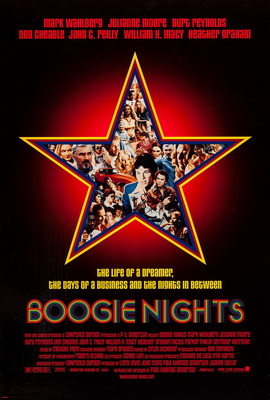
Embracing the Melodrama Part II #93: Boogie Nights (dir by Paul Thomas Anderson)


Boogie_nights_ver1The 1997 film Boogie Nights (which, amazingly enough, was not nominated for best picture) is a bit of an overwhelming film to review.  It’s a great film and, if you’re reading this review, you’ve probably seen Boogie Nights and you probably already know that it’s a great film.  And if you haven’t seen Boogie Nights, you really should because it’s a great film.  So, this review, in short, amounts to: Great film.

Boogie Nights takes place in the late 70s and the early 80s.  Eddie Adams (Mark Wahlberg) is a high school dropout who works as a busboy, lives with his parents, and has a really big cock.  (Indeed, one of the film’s most famous lines is, “This is a giant cock.”)  When we first meet Eddie, he’s likable and cute in a dumb sort of way.  Then he meets adult film director Jack Horner (Burt Reynolds) and becomes a star.  At first, everything is great.  Eddie changes his name to Dirk Diggler and no longer has to deal with his abusive mother (a chilling Joanna Gleason).  Jack and Amber Waves (Julianne Moore) become his new parents.  He gets a cool older brother in the form of actor Reed Rothschild (John C. Reilly, totally nailing the “People tell me that I look like Han Solo,” line).  He makes friends with other adult film actors, like the desperately unhip Buck (Don Cheadle), the free-spirited (and secretly very angry) Rollergirl (Heather Graham), and the poignantly insecure Jessie St. Vincent (Melora Walters).  He gets new admirers, like Scotty J. (Philip Seymour Hoffman).  He also gets addicted to cocaine.  And while Dirk falls from stardom, the adult film industry is taken over by gangsters like Floyd Gondolli (Philip Baker Hall) and self-styled artists like Jack Horner find themselves pushed to the side.

And you may have noticed that I mentioned a lot of actors in the paragraph above.  That’s because Boogie Nights is a true ensemble piece.  It’s full of great performances and memorable characters.  Along with everyone that I mentioned above, the cast also includes William H. Macy as cinematographer “Little Bill” Daggett.  From the minutes we first meet Little Bill, we get the feeling that he might be a little bit too uptight for pornography.  Maybe that’s because his wife — played by the inspiring sex positive feminist and veteran adult film star Nina Hartley — is constantly and publicly cheating on him.  Macy and Hartley do not have as much screen time as the rest of the cast but, ultimately, their characters are two of the most important in the film.

And then there’s Robert Ridgely, who is marvelously sleazy as the paternal but ultimately icky Col. James.  When we first meet the Colonel, he’s almost a humorous character.  But then, suddenly, there’s one chilling scene where he opens up to Jack Horner and we are forced to reconsider everything that we had previously assumed about both the Colonel and his business.

And how can we forget Luis Guzman, as a club owner who desperately wants to appear in one of Jack’s films?  Or Ricky Jay as a plain-spoken cameraman?  Or how about Thomas Jane, playing one of those tightly wound characters who you know is going to be trouble as soon as you see him?  And finally, nobody who has seen Boogie Nights will ever forget Alfred Molina, singing along to Sister Christian and running down the street, clad only in black bikini briefs and firing a shotgun.

But it’s not just the actors who make Boogie Nights a great film.  This was Paul Thomas Anderson’s second film and, under his direction, we feel as if we’ve been thrown straight into Dirk’s exciting and ultimately dangerous world.  When the film begins, the camera almost seems to glide, capturing the excitement of having everything that you could possibly want.  But, as things go downhill for Dirk, the camerawork gets more jittery and nervous.   A sequence where Anderson cuts back and forth between Jack trying to shoot a movie on video (as opposed to his beloved film) and Dirk nearly being beaten to death in a parking lot remains one of the best sequences that Anderson has ever directed.

And then there’s the music!  Oh my God!  The music!

And the dancing!

And the singing!

I’ll be the first admit that I have no idea whether or not Boogie Nights is a realistic portrait of the adult film industry in the 70s and 80s.  But ultimately, Boogie Nights is not about porn.  It’s about a group of outsiders who form their own little family.  At the end of the film, you’re happy that they all found each other.  You know that Dirk will probably continue to have problems in the future but you’re happy for him because, no matter what happened in the past or what’s going to happen in the future, you know that he’s found a family that will always love him.

As I mentioned at the start of this appreciation, Boogie Nights was not nominated for best picture.  Titanic was named the best picture of 1997.  As I’ve said before, I loved Titanic when I was 12.  But, nearly 18 years later, Boogie Nights is definitely the better picture.

It has stood the test of time.