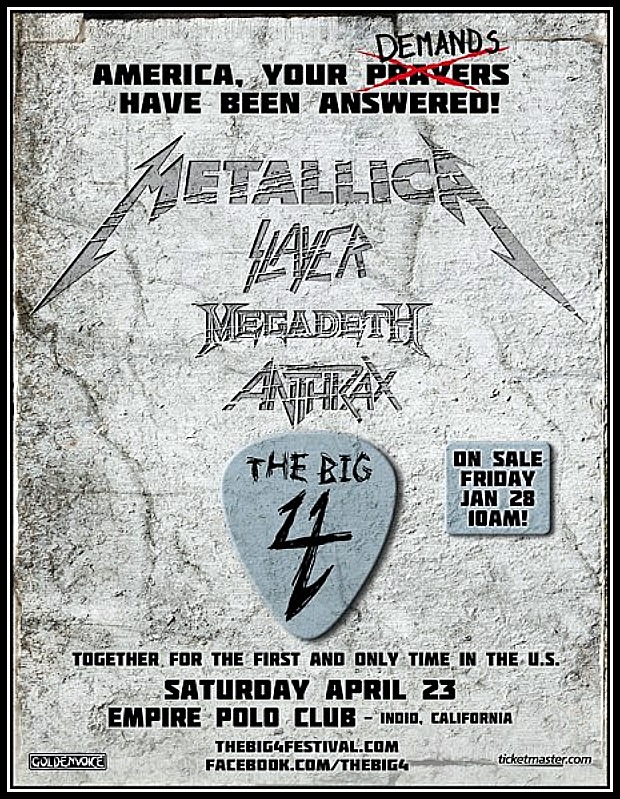
First news that 70,000 tons of metal wasn’t a scam and thus automatically becoming the greatest cruise ever to put out to see. Now, news of The Big 4 doing a show in the US a week after the Coachella Music Festival in Indio, California.
Who are The Big 4 and why do I sound excited about this news. Well, The Big 4 are the four greatest thrash metal bands and one could say four of the greatest metal bands to ever grace the land of heavy metal. The Big 4 show will include the bands Anthrax, Megadeth and Slayer with the biggest of the four in Metallica looming over everyone. Yes, these four bands will be performing together for the first and only time on U.S. soil. They had done a similar tour over in Europe last year and each show were sold out and were a headbanging success.
While I won’t be able to make the show (already committed to attending Anime Boston which will occur the same weekend) I’m sure there’s enough people who read this site who live in California and wish to partake on this very metal of an event.
Tickets will go on sale on January 28, 2011 so metal fans who want to attend better get to buying them tickets and raise the horns!
*I’m sure necromoonyeti wishes he could attend this show as well as 70,000 tons of metal.
*Also, the fact that the Coachella Music Festival seems to be lacking in the metal department makes that 3-day event an #epicfail
It took awhile but Metallica has finally made another appearance in the “song of the day” feature. This time around they return with one of their best songs. A song which has become iconic of early-Metallica amongst their most die-hard fans. The song is “For Whom the Bell Tolls”.
This track comes in third on the band’s second album and was inspired by Ernest Hemingway’s 1940 novel, For Whom the Bell Tolls. It is also the song which contains one of the best opening riffs in metal history. A riff not born from lead guitarist Kirk Hammett’s axe, but from it’s bassist Cliff Burton. This opening riff shows Cliff Burton at his best and the fact that people continue to mistake the riff as guitar instead of bass just shows how talented the man was.
This song is all about Burton’s work on the bass with Hetfield supplying the vocals and Hammett’s lead guitar work almost behaving like an accompaniment. It is no wonder that whenever talk comes around as to who is the best metal bassist (or just rock bassist) ever no discussion could ever be considered credible if Cliff Burton’s name was not included.
While Burton died just two years after the single’s release while th eband was on tour in Sweden his contribution as both writer and composer to this song will forever cement his legacy amongst metal and music fans for countless generations.
For Whom the Bell Tolls
Make his fight on the hills in the early day Constant chill deep inside Shouting gun, on they run through the endless grey On they fight, for they are right, yes, but who’s to say?
For a hill, men would kill, why? They do not know Stiffened wounds test their pride Men of five, still alive through the raging glow Gone insane from the pain that they surely know
For whom the bell tolls Time marches on For whom the bell tolls
Take a look to the sky just before you die It is the last time you will Blackened roar massive roar fills the crumbling sky Shattered goal fills his soul with a ruthless cry
Stranger now, are his eyes, to this mystery He hears the silence so loud Crack of dawn, all is gone except the will to be Now they see, what will be, blinded eyes to see
For whom the bell tolls Time marches on For whom the bell tolls
You probably haven’t heard of Michael Armstrong, but you might have heard of his musical project, Rockabye Baby. Armstrong (not to be confused with the Christian pop singer of the same name) has made his claim to fame by taking music by the likes of Radiohead, Tool, and Nirvana, and, through copius glockenspiel, converting their best hits into lullabies. But don’t roll your eyes at another Richard Cheese just yet. The Rockabye Baby albums are actually pleasant to listen to in their own right.
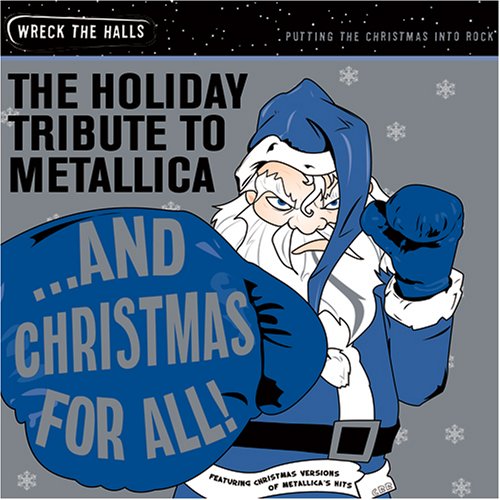
I suppose Christmas music was the logical next step.
It’s hard to give credit where credit is due concerning these; I’ve seen a number of different names associated with the Rockabye Baby series, but Armstrong’s definitely pops up the most. Individual credits for each album are difficult to come by. I’m pretty sure he is the composer of this holiday absurdity, but don’t quote me on it.
The latest song of the day is one of the best example of 1970’s classic rock. It’s “Turn the Page” by Bob Seger and was originally released in 1973 as part of Seger’s rock album, Back in ’72.
The song really didn’t enjoy very early success once it was released. It wasn’t until he performed the song live for his 1976 live album, Live Bullet. His performance of the song for that live recording and future live performances at concerts made it a favorite for classic rock stations which continues to give the song consistent radio airplay. Seger’s performance has been called a mixture of mournful and soul-shattering as he sang about the hard and difficult life of the on-the-road musician. It has been quite the influential song for other musicians down the years.
Metallica even covered the song for their 1998 cover album, Garage Inc. It is this Metallica cover of Seger’s song which introduced me to it. The Metallica cover pretty much stays along the same pacing and keep the lyrics intact, but giving the whole production a decidedly heavy metal tone.
Turn the Page
On a long and lonesome highway
East of Omaha
You can listen to the engine
Moanin’ out his one note song
You can think about the woman
Or the girl you knew the night before
But your thoughts will soon be wandering
The way they always do
When you’re ridin’ sixteen hours
And there’s nothin’ much to do
And you don’t feel much like ridin’,
You just wish the trip was through
Here I am
On the road again
There I am
Up on the stage
Here I go
Playin’ star again
There I go
Turn the page
Well you walk into a restaurant,
Strung out from the road
And you feel the eyes upon you
As you’re shakin’ off the cold
You pretend it doesn’t bother you
But you just want to explode
Most times you can’t hear ’em talk,
Other times you can
All the same old cliches,
“Is that a woman or a man?”
And you always seem outnumbered,
You don’t dare make a stand
Here I am
On the road again
There I am
Up on the stage
Here I go
Playin’ star again
There I go
Turn the page
Out there in the spotlight
You’re a million miles away
Every ounce of energy
You try to give away
As the sweat pours out your body
Like the music that you play
Later in the evening
As you lie awake in bed
With the echoes from the amplifiers
Ringin’ in your head
You smoke the day’s last cigarette,
Rememberin’ what she said
Here I am
On the road again
There I am
Up on the stage
Here I go
Playin’ star again
There I go
Turn the page
Here I am
On the road again
There I am
Up on the stage
Here I go
Playin’ star again
There I go
Turn the page
There I go
There I go
Zombies have either oversaturated pop-culture and media or there’s just not been many good entertainment examples with zombies in it. Most zombies films usually end up taking the direct-to-video route or, even worse, the direct-to-cable path. The very good films about zombies are very limited in numbers. For every Shaun of the Dead we get truly awful examples like Zombie Wars, Automaton Transfusion and the Day of the Dead remake. I blame this flood of bad zombie films on what makes the zombie such an interesting monster for filmmakers to use: they’re a blank slate. The zombie as envisioned by Romero are quite young in comparison to other monsters of film. They do not have the culturual and mythical history of vampires and werewolves.
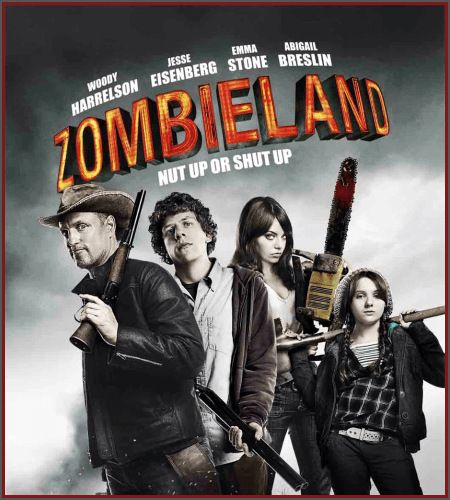
Zombie films are easy to make thus we get every amateur filmmaker thinking they’re the next Romero, pick up a digital camera and attempt to make the next zombie c!assic. What we get instead are dregs which give the genre a bad name. It is a breath of fresh air that Ruben Fleischer (using a screenplay penned by Rhett Reese and Paul Wernick) has made a zombie film which deserves to be seen in a theater and not on video or cable. Zombieland is a fun and hilarious romp which succeeds in delivering what it’s preceding hype had promised and ends up being a very good film despite first-time jitters from a first-time filmmaker.
Zombieland makes no bones about what it’s about right from the get-go. This is not a film where the audience watches the world fight for its existence against the growing undead. No, this film drops the audience to a world that’s beyond gone to hell and one that now belongs to the zombies which explains the title. We’re quickly introduced to the rules which now governs this new world. With narration from the film’s first lead (played by Jesse Eisenberg) we learn the so-called “rules” of how to survive zombieland. There’s a funny and inventive use of on-screen reminders of these rules throughout the film which looks similar to the captions Youtube uploaders add to their videos. The film quickly introduces Columbus’ (the film’s narrator) soon-to-be partner-in-survival. Where Columbus is quite obsessive-compulsive and more than just a touch cowardly Tallahassee (in a hilarious turn by Woody Harrelson) is the reckless, A-type personality and more than the opposite of Columbus. These two unlikely pair soon meet up with a pair of sisters who also happens to be veteran grifters who, on more than one occassion, give our hapless duo trouble in their journey through a devastated landscape.
The film has been called a zombie comedy and will be compared to the successful British zombie-comedy, Shaun of the Dead. While some are not wrong to compare Fleischer’s film to Wright’s the comparison really ends at both being zombie-comedies. While Wright’s film was a zombie film with comedic aspects mixed in it was first and foremost a horror film. Zombieland is the opposite and the way it starts, unfolds and finishes it’s really a comedy road trip like the National Lampoon Vacation films but this time with zombies instead of in-bred relatives, clueless motorists and tourist-traps. The film is quite funny froom beginning to end with the funniest and most hilarious being a surprise cameo of a well-known comedic actor playing himself right around the beginning of the second-half. This sequence got the most laughs and cleverly played up this actor’s particular quirks. Most of the comedy and gags in the film comes courtesy of the aforementioned rules and the interaction between the characters of Columbus, Tallahassee and the two con sisters, Wichita and Little Rock (they use the city of their origins for names throughout the film).
While the film’s story is quite basic what Fleischer and his small cast were able to do with them they did well. There really wasn’t a false note in any of the actors’ performances. Eisenberg and Harrelson played off each other well right from the time the two meet. Emma Stone as the punk-rock older sister Wichita to the younger Little Rock played by wunderkind child actor Abigail Breslin (girl has a future beyond her child role past). The road-trip of a story even has its own little quirks from Tallahassee’s irreverent quest for the final stock of Twinkies to the sisters’ goal of reaching the West Coast and an amusement park called Pacific Playland rumored to be free of the zombie menace.
Zombieland is not without its flaws. Some of the editing in the climacting reel of the film was to uneven at times. There were instances when the film was close to being bogged down but fortunately it never came to that end. The violence and gore in the film wasn’t as high as one would think for a film about zombies that have literally devoured the world. One could almost sense that the filmmakers were hedging their bet when it came to the grue and violence. It seemed as if they were being overly cautious about trying to get an R-rating instead of an NC-17. The film barely makes it past the PG-13 territory. While these flaws could be attributed to jitters and a somewhat unsure first-time director in the overall execution of the film all involved did very well in sticking to the plan.
Even the look of the film makes it seem more big-budgeted than it really was (rumored to be between 9-10 million). Most filmmakers with years to decades of experience make a mess of trying to shot a film fully inn HD using HD-cameras, but Fleischer and his cinematographer Michael Bonvillain acquit themselves in their use of Sony’s Gensis HD camera. The film looks crisp and clear, but without the glaring rough edges HD sometimes gives a film. The use of the Genesis camera makes possible the well-done intro sequence done in slo-mo to the tune of Metallica’s “For Whom the Bell Tolls”.
Zombieland is a good start to what could be a very promising career for one Ruben Fleischer. There’s skill in his work on this film despite some nitpicks that could be seen as flaws. The film in the end was very funny and fun to watch from start to end. While to story was very simplified (this probably helped in minimizing the pitfalls Fleischer had to avoid in his first major film production) with characters that was fleshed out just enough for the audience to connect with the final product delivered on the hypse which preceded this film. Zombie film fans would get a huge laugh and kick out of this very quick under-90 minute production while even those who are not into zombies much would still find themselves laughing and being entertained. Zombieland may not be scary in comparison to some of the great zombie films of past but it more than makes up for that with energy, life and a genius of a cameo scene that would be the talk of the town.