Holiday Film Review: Jingle All The Way (dir by Brian Levant)


Whatever else one may want to say about it, 1996’s Jingle All The Way is a cute film.

It’s necessary to point that out because Jingle All The Way has a terrible reputation and, if we’re going to be honest, it deserves a lot of the criticism that it has gotten over the years.  In many ways, it epitomizes the way a Hollywood studio can take an interesting idea and then produce a film that seems to have no understanding of what made that idea so interesting in the first place.  Arnold Schwarzenegger plays Howard Langston, an overworked mattress store manager who waits until Christmas Eve to try to buy his son a Turbo Man action figure.  (In the film, they call it a “doll,” which is one of the film’s false moments.)  The only problem is that the Turbo Man action figure is the most popular gift of the year and everyone is looking for one.  What starts out at as a satire of commercialism ultimately becomes a celebration of the same thing as Howard ends up dressed up as Turbo Man and taking part in his town’s Christmas parade.   The film becomes a comedy without any sharp edges.

That said, it’s a cute film.  It’s not cute enough to really be good but it is cute enough that it won’t leave you filled with rage.  Arnold Schwarzenegger is in True Lies mode here, playing a seemingly boring and suburban guy who is secretly a badass.  (In True Lies, Schwarzenegger was secretly a spy who had killed man people, though all of them were bad.  In Jingle All The Way, he’s just a parent who has waited too long to go Christmas shopping.)  Schwarzenegger’s main strength as an action star — even beyond his physique — was that he always seemed to have a genuine sense of humor and he’s the best thing about Jingle All The Way.  This film finds him acting opposite actual comedic actors like Jim Belushi and Phil Hartman and holding his own.  (The film also features Sinbad as another dad trying to get the Turbo Man action figure but Sinbad comes across as being more of a stand-up comedian doing bits from his routine than an actual character.)  The film’s set pieces grow increasingly bizarre and surreal as Howard searches for his Turbo Man and the film actually becomes less effective the stranger that it gets.  A scene of Howard fighting a crowd in a toy store works far better than a later scene where Howard battles a bunch of men dressed as Santa Claus and his elves.  (It doesn’t help that, after an intelligent and well-edited opening thirty minutes, the film seems to lose all concept of comedic timing.)  But there’s a sincerity to Schwarzenegger’s performance that keeps you watching.

Of course, today, Jingle All The Way feels like a relic from a different age.  All the kids want a Turbo Man and you’re so busy at work that the stores are closed by the time you get home?  Fine.  Hop on Amazon at three in the morning and order one.  Christmas shopping is a lot easier nowadays.

It’s just not as much fun.

The TSL’s Horror Grindhouse: Cutting Class (dir by Raspo Pallenberg)


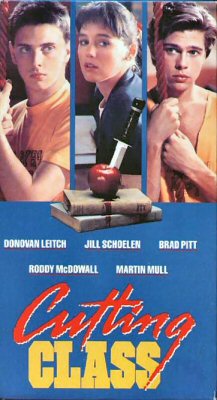
Someone is murdering the students and the teachers at the local high school and it’s up to Paula Carson (Jill Schoelen), the studious daughter of the local DA (Martin Mull), to figure out who is responsible!

Though the principal (Roddy McDowall, who seemed to be cast as a lot of bizarre school employees during the latter half of his career) is a perv and the janitor (Robert Glaudini) fancies himself as being some sort of bizarre ninja with a mop, it soon becomes apparent that there’s really only two viable suspects. One of them is Brian Woods (Donavon Leitch), who has just returned home after spending several months in a mental hospital where he was regularly given electroshock therapy. The other is Dwight Ingalls (Brad Pitt), the alcoholic jock who is under tremendous pressure to win a basketball scholarship and who also happens to be Paula’s boyfriend! Brian and Dwight were friends when they were younger. Now, Dwight spends all of his time bullying Brian and Brian spends all of his time staring at Paula. Who could the murderer be!?

Actually, you won’t be surprised at all when the identity of the murderer is revealed. You’ve probably already guessed who the killer is. A campy slasher film from 1989, Cutting Class doesn’t exactly win any points for originality. If Cutting Class is remembered for anything, it’s for providing Brad Pitt with an early leading role. Pitt, it should be said, is totally convincing as Dwight. On the one hand, he’s such a jerk that it’s difficult to really like him but, on the other hand, he looks like Brad Pitt so you totally can’t blame Paula for putting up with him. For that matter, both Leitch and Schoelen give convincing performances as well. When you’ve got a trio as talented as these three, it’s kind of a shame that Cutting Class wasn’t a better film.

Cutting Class tries to mix horror and comedy but the comedy is too broad (Roddy McDowall leers like a cartoon wolf) while the horror is not quite horrific enough and, as such, the film never really settles on a consistent or an interesting tone. Whenever the film starts to get into a horror grove, Martin Mull shows up like a character in an overplayed Saturday Night Live skit. Whenever the film starts to find itself as a comedy, someone is horribly murdered and you’re totally taken out of the mood. This is also another one of those films where the characters randomly switch from being ludicrously stupid to unnaturally intelligent from scene-to-scene. The killer, for instance, is diabolically clever until the film’s final moments, at which point the murderer suddenly gets very talky and very easily fooled.

Cutting Class is occasionally interesting as a time capsule. It’s from 1989, after all. And it’s interesting to see Brad Pitt playing the type of character one would more likely expect to see on a very special episode of Saved By The Bell. Otherwise, this one is fairly forgettable.

Film Review: Clue (dir by Jonathan Lynn)


It was a dark and stormy night in 1954….

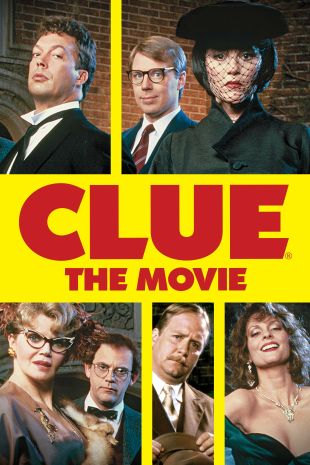
The 1985 comedy, Clue, opens with a set of six strangers arriving at an ominous mansion in New England.  They’re meet by Wadsworth (Tim Curry), an oddly charismatic butler who explains that all six of the strangers have a few things in common.  They all work in Washington D.C.  They are all, in some way, involved with the government.  And they’re all being blackmailed by Mr. Boddy (Lee Ving), the owner of the house.

The six strangers have all been assigned nicknames for the night.

Miss White (Madeleine Khan) is the enigmatic widow of a nuclear physicist who may have had communist sympathies.  Actually, Miss White is a widow several times over.  All of her husbands died in circumstances that were a bit odd.  Is Miss White a black widow or is she just unlucky?  And what about the flames of jealousy that she occasionally mentions?

Professor Plum (Christopher Lloyd) is a psychiatrist who once worked for the World Health Organization and who has an unfortunate habit of sleeping with his patients.

Mr. Green (Michaele McKean) explains that he works for the State Department and that he is also secretly gay.  If his secret got it, he would be deemed a security risk or perhaps even a communist agent.

Mrs. Peacock (Eileen Brennan) is the wife of a U.S. Senator who forced to resign after getting caught up in a bribery scandal.

Colonel Mustard (Martin Mull) is a somewhat stuffy war hero-turned-arms dealer.

And finally, Miss Scarlet (Lesley Ann Warren) is Washington D.C.’s most powerful and most witty madam.

Once everyone is in the house, Wadsworth explains that the police have been called and will arrive in 45 minutes, at which point Mr. Boddy will be arrested and everyone’s secrets will be exposed.  Mr. Boddy’s solution is to suggest that one of the six kills Wadsworth.  After tossing everyone a weapon, Mr. Boddy turns out the lights.  When the lights come back on, Wadsworth is still alive but Mr. Boddy is not.  But who murdered Mr. Boddy?  And in what room?  And with what weapon?  And what to make of the other people who were either in the house or show up at the front door, like the maid, Yvette (Collen Camp), or the motorist (Jeffrey Kramer) who shows up to use the phone or the traveling evangelist (Howard Hesseman)?  Can the mystery be solved before the police show up and presumably arrest everyone?

Based on the old board game, Clue is a hilariously exhausting film, one that mixes smart wordplay and broad physical comedy to wonderful effect.  It’s not often that you see a film that gets equal laughs from two people colliding in a hallway and from characters accusing each other of being communists.  In fact, it’s so easy to marvel at the physical comedy (especially the lengthy scene where Tim Curry runs from room to room while explaining his theory about who committed the murders) that it’s easy to forget that the film is also a sharp satire on political corruption, national paranoia, 50s morals, and the McCarthy era in general.  Since all of the characters are already convinced that they’re either surrounded by subversives or in danger of being accused of being a subversive themselves, it’s not a great leap for them to then assume that any one of them could be a murderer.  I mean, if you’re willing to betray your country than who knows what you might be willing do in the study with a candlestick?

The cast is full of comedy veterans, all of whom know how to get a laugh out of even the mildest of lines and none of whom hold back.  Madeline Kahn, in particular, is hilarious as Miss White though my favorite suspect, in both the game and the movie, has always been Miss Scarlet.  Not only is she usually portrayed as being a redhead in the game but, in the movie, her dress is to die for.  In the end, though, it’s perhaps not a surprise that the film is stolen by Tim Curry’s energetic performance.  The film’s final 15 minutes are essentially a masterclass in physical comedy from Tim Curry but he’s just as funny when he’s delivering his frequently snarky dialogue.  Both Wadsworth the character and Tim Curry the actor appear to be having a blast, running from room to room and shouting out accusations.

When Clue was originally released, it was released with three different endings.  Apparently, the audience wouldn’t know which ending they were going to get before the movie started.  I guess that the idea was to get people to go the movie three times to see each ending but I imagine few filmgoers had the patience to do that and who knows how many viewers went to multiple showings just to discover that the randomly selected ending was one that they had already seen.  I’m surprised that I haven’t come across any reports of riots breaking out.  Fortunately, the version of Clue that is now available for viewing features all three endings.  Of course, none of the endings make much sense.  Hercule Poirot would demand a do-over, especially if he was being played by Kenneth Branagh.  But the fact that it’s all so ludicrous just adds to the comedy.  I watched Clue two Fridays ago with a group of friends and we had a blast.  It’s definitely a movie that’s more fun when you watch it with other people.

(That said, as far as incoherent solutions are concerned, the third one was my favorite and I think Poirot would agree.)

As for the board game itself, I used to enjoy playing it when I was a kid.  We had really old version from the 60s and I always used to imagine what all of the suspects were like when they weren’t being accused of murder.  I always imagined that Mr. Green and Miss Scarlet probably had something going on.  Today, I’ve got a special Hitchcock edition of the game.  It’s all good fun, this never-ending murder mystery.

A Movie A Day #323: Ted & Venus (1991, directed by Bud Cort)


Strange movie, Ted & Venus.

Actor Bud Cort (you remember him from Harold and Maude) both directs and stars as Ted.  Ted is a homeless poet who lives on the beach and only has one friend, a mellow beach bum named Max (Josh Brolin).  Kim Adams plays Linda, who is the Venus of the title, a social worker who has a bodybuilder jerk for a boyfriend (Brian Thompson, who you might remember as the main villain in Cobra).  When Ted sees Linda, it is love at first sight and at first, the movie seems like it is going to be a quirky romantic comedy where Ted eventually wins Linda over.  When Linda turns down Ted’s advances, Ted does not give up.  Instead, Ted starts following her everywhere and making harassing phone calls.  Ted starts out as a nuisance and goes on to become a full-out stalker.  Everyone, even Max, tells Ted to stop bothering Linda but he is convinced that he can make her fall in love him.  He’s wrong.

Because of the presence of Cort both in front of and behind the camera, Ted & Venus sometimes seems like Harold and Maude: The Later Years.  Harold, the iconoclast that everyone loved, has grown up and become Ted, the unemployable stalker.  It’s an interesting idea and Cort pulls it off as an actor but not as a director.  You have to admire Cort’s devotion to his vision but it’s impossible to be certain what that vision was because the film’s tone is all over the place.  Cort gets a far better performance from himself than he does from the rest of the cast.

Speaking of the cast, the movie is full of familiar faces.  In fact, there are almost too many familiar faces.  It’s hard not to get distracted by all of the cameos.  If you somehow see this obscure movie, keep an eye out for: Woody Harrelson (who gets two lines and five seconds of screen time), Rhea Pearlman, Carol Kane, Martin Mull, Gena Rowlands, Pat McCormick, Vincent Schiavelli, Cassandra Peterson, and Andrea Martin.  When Ted is hauled into court, charged with stalking, the judge is played by LSD guru Timothy Leary.  I am not sure what Ted & Venus was trying to say but Bud Cort assembled an impressive cast to say it.

A Movie A Day #259: Take This Job And Shove It (1981, directed by Gus Trikonis)


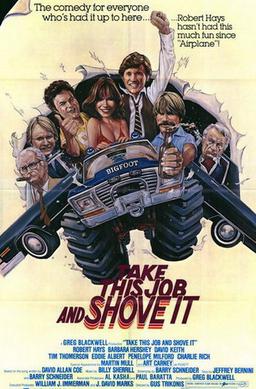
Originally from a small town in Iowa, Frank Macklin (Robert Hays) is a hotshot young executive with The Ellison Group.  When Frank is assigned to manage and revitalize a failing brewery in his hometown, it is a chance for Frank to rediscover his roots.  His childhood friends (played by actors like David Keith, Tim Thomerson, and Art Carney) may no longer trust him now that Frank wears a tie but it only takes a few monster truck rallies and a football game in a bar for Frank to show that he is still one of them.  However, Frank discovers that the only reason that he was sent to make the brewery profitable was so that his bosses could sell it to a buffoonish millionaire who doesn’t know the first thing about how to run a business.  Will Frank stand by while his bosses screw over the hardworking men and women of the heartland?  Or will he say, “You can take this job and shove it?”
Named after a country music song and taking place almost entirely in places stocked with beer, Take This Job And Shove It is a celebration of all things redneck.  This movie is so redneck in nature that a major subplot involves monster trucks.  Bigfoot, one of the first monster trucks, gets plenty of screen time and, in some advertisements, was given higher billing than Art Carney.

A mix of low comedy and sentimental drama, Take This Job And Shove It is better than it sounds.  In some ways, it is a prescient movie: the working class frustrations and the anger at being forgotten in a “booming economy” is the same anger that, 35 years later, would be on display during the election of 2016.  Take This Job And Shove It also has an interesting and talented cast, most of whom rise above the thinly written dialogue.  Along with Hays, Keith, Thomerson, Bigfoot, and Carney, keep an eye out for: Eddie Albert, Royal Dano, James Karen, Penelope Milford, Virgil Frye, George “Goober” Lindsey, and Barbara Hershey (who, as usual, is a hundred times better than the material she has to work with).

One final note: Martin Mull plays Hays’s corporate rival.  His character is named Dick Ebersol.  Was that meant to be an inside joke at the expense of the real Dick Ebersol, who has the executive producer of Saturday Night Live when Take This Job and Shove It was filmed and who later became the president of NBC Sports?

A Movie A Day #182: FM (1978, directed by John A. Alonzo)


Hey, California!  Are you ready to soft rock!?
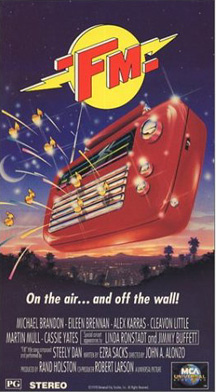
That is the question asked by FM, a movie about rock that tries to stick it to the man with some of the safest, least revolutionary music ever recorded.

FM is centered around Q-Sky, an FM radio station in Los Angeles.  Because the laid back station manager (Michael Brandon) allows his DJs to program their own music with little commercial interruption, Q-Sky has become one of the most popular radio stations in California.  The corporate suits, though, demand that Q-Sky play less music and air more commercials, especially one that is specifically designed to get mellow Californians to join the Army.  When Brandon refuses, he is fired.  Outraged, Q-Sky’s motley crew of DJs (who include Martin Mull, Cleavon Little, Eileen Brennan, and even former football great Alex Karras) barricade themselves in the station and lead a protest by playing their music without commercials.

That would all be well and good except that the DJs spend most of their time playing songs by such noted rockers as Jimmy Buffett, Billy Joel, and REO Speedwagon.  A major set piece of the film is Q-Sky’s attempt to secretly broadcast a Linda Ronstadt concert that is being sponsored by a rival station.  At a time when Johnny Rotten was still singing Anarchy in the UK,  Q-Sky’s idea of rebellion was to go from Bob Seger to James Taylor with limited commercial interruption.

The always reliable Martin Mull is always good for some laughs and this was the only movie directed by award-winning cinematographer John A. Alonzo so, if nothing else, FM always looks good.  With its ensemble cast and episodic narrative, FM tries hard to be an Altmanesque satire but, ultimately, it fails because the revolution is not going to sound like The Doobie Brothers.

(Even though The Doobie Brothers clearly rock.)

“Who likes The Doobie Brothers?”

Because Michael Brandon looked like Gary Sandy and Martin Mull possessed a passing resemblance to Howard Hesseman, some reference books state that FM was the inspiration for WKRP in Cincinatti.  However, the first season of WKRP was already in production before FM was released to theaters and FM was such a financial flop that it is doubtful it inspired anything.

Add to that, while Venus Flytrap probably could have made it work, Dr. Johnny Fever would never have fit in at Q-Sky.  Johnny’s frequent acid flashbacks would have unnerved the mellow Q-Sky vibes.  Herb Tarlek, on the other hand…

“It must be a struggle to match the belt with the shoes.”
“Sometimes, I can’t do it.”


Back to School #29: Private School (dir by Noel Black)


ps-title

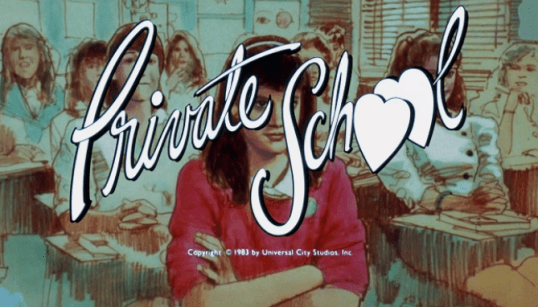
In my previous two Back To School reviews, I took a look at two classic teen comedies.  Fast Times At Ridgemont High and Risky Business both used and manipulated the standard teen comedy trappings to tell unusually nuanced stories about growing up.  These are films that used the audience’s familiarity with the genre to tell stories that ultimately challenged the viewer’s preconceived notions and expectations.  Having considered those two films, let us now consider Private School, a film that used all of the standard teen comedy clichés to make a very standard teen comedy.

According to the film’s trivia page on the IMDB (how’s that for an authoritative source!?), Private School was “”was supposedly market researched from stem to stern in order to ensure mass teen appeal”.  And it’s true because there’s literally nothing in Private School that you couldn’t find in almost every other teen comedy released in the 1980s.  In fact, Private School often feels like a compilation of clips from other teen comedies.

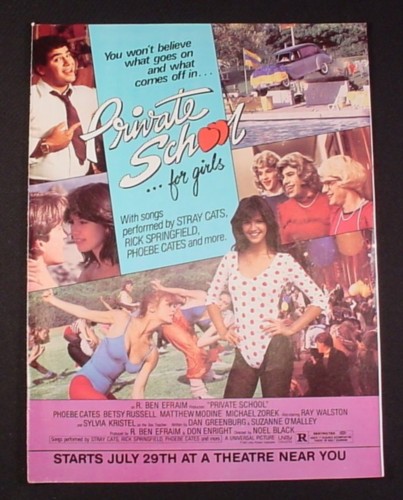
For instance, the film tells the story of two groups of three.  There’s the three girls who attend Cherryvale Academy: good girl Christine (Phoebe Cates), bad (and rich) girl Jordan (Betsy Russell), and vaguely asexual tomboy Betsy (Kathleen Wilhoite).  And then there’s three guys who attend Freemount Academy.  There’s a fat guy named Bubba (Michael Zorek), a short guy named Roy (Jonathan Prince) and a nice guy named Jim (Matthew Modine).  Bubba is dating Betsy.  Christine is dating Jim.  Jordan is dating no one because she’s too busy trying to steal Christine’s boyfriend.  Roy is also single, largely because adding a fourth girl would throw off the film’s group-of-three dichotomy.

There’s also a lot of boobs, largely because Private School was made to appeal to teenage boys and you really have to wonder how many of them left the theater thinking that all they had to do to get a girl to disrobe was spill some fruit juice on her dress and then suggest that she take it off.  There’s even a scene where Jordan rides a horse naked because — well, why not?

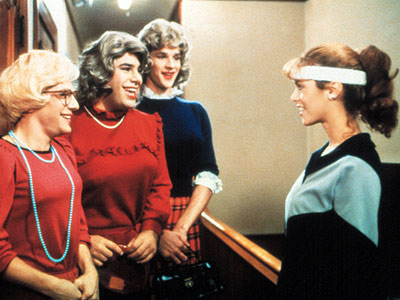
And then there’s an extended sequence where each of the three boys puts on a wig, a red dress, way too much lipstick and then sneak into the girl’s dormitory because cross-dressing is always good for a few easy laughs. Despite their best attempts to speak in falsetto voices,  Jim, Bubba, and Roy make for three of the least convincing women that I’ve ever seen but, to the film’s credit, that’s kind of the point.  It’s a stupid plan that leads to stupid results.

privschool_l

Of course, the film is also full of terrible adult authority figures.  And why not?  It’s not like anyone over the age of 18 was ever going to watch the film.  So, of course, Jordan’s father is going to be lecherous old perv with a trophy wife.  And, of course, all of Cherryvale’s teachers are going to be a collection of spinsters and alcoholics.  In the end, the only adult who isn’t a raging hypocrite is the friendly town pharmacist (played by Martin Mull) who, of course, is mostly present so he can make Jim feel nervous about buying condoms.

And, ultimately, Private School is one of those films that wants to be racy and dirty (in order to appeal to teenage boys) while also being sweet and romantic (in order to appeal to teenage girls).  The main plot revolves around Jim and Christine’s plans to go away for a weekend so that they can have sex for the first time and the film actually handles this pretty well.  Matthew Modine and Phoebe Cates both have a really sweet chemistry.  They’re a really cute couple and you hope the best for them.  But there’s just so many complications, the majority of which could have been avoided by Jim not being an idiot.  It never seems to occur to Jim that maybe he’d finally be getting laid if he wasn’t always doing things like dressing up in drag and trying to sneak into the girl’s dormitory.

That doesn’t necessarily mean that Private School is a terrible film.  As far as boob-obsessed teen sex comedies go, Private School is actually pretty well-done and watchable.  The cast is likable and director Noel Black keeps the action moving.  Even the film’s nominal villain is likable, with Betsy Russell playing Jordan as being more mischievous than spiteful.  But, ultimately, what makes Private School memorable is the fact that it is so predictable, that it does literally contain every single cliché that one would expect to find in a teen comedy.  This is a film so determined to not bring anything new to the genre that it becomes an oddly fascinated study in how to maintain a status quo.

In fact, perhaps the most innovative thing about Private School is the song that plays over the opening credits.  The song — which is called You’re Breakin’ My Heart and is performed by Harry Nilsson — starts with: “You’re breaking my heart/you’re tearing it apart/so fuck you…”

That’s about as close to being subversive as Private School ever gets.

4119046

Horror On The Lens: Cutting Class (dir by Rospo Pallenberg)


Cutting_Class_film_poster

it’s been said that, early in the career of every Oscar nominee, there’s a film or two that he probably wishes would be forgotten.  Today’s movie is one of those films, 1989’s Cutting Class.

Cutting Class is, in many ways, a fairly standard 1980s slasher comedy hybrid.  It features a stronger heroine than most and it does a bit of a better job than expected at making you guess who the killer is but, for the most part, Cutting Class is mostly memorable for being one of Brad Pitt’s first major roles.

The bad news is that the character he’s playing here is kind of an asshole and not even the fact that he looks like Brad Pitt can make him likable.

The good news is that Brad Pitt has always been hot.

And here’s the proof…