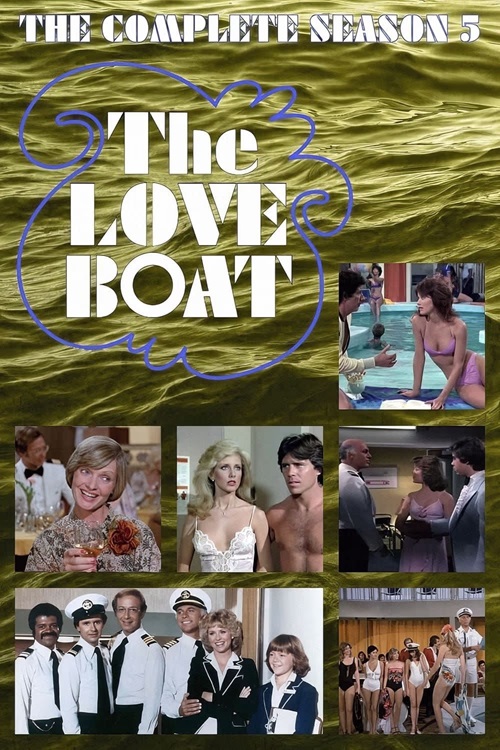
Retro Television Review: The Love Boat 5.12 “Take a Letter, Vicki/The Floating Bridge Game/The Joy of Celibacy”


Welcome to Retro Television Reviews, a feature where we review some of our favorite and least favorite shows of the past!  On Wednesdays, I will be reviewing the original Love Boat, which aired on ABC from 1977 to 1986!  The series can be streamed on Paramount Plus!

Set sail for adventure, your mind on a new romance….

Episode 5.12 “Take a Letter, Vicki/The Floating Bridge Game/The Joy of Celibacy”

(Dir by Richard Kinon, originally aired on December 12th, 1981)

Captain Stubing notices that Vicki seems to be depressed.  He asks his crew if they have any idea what’s wrong with her.

Actually, he could have just asked me.  Why is Vicki depressed?  Maybe it’s because she’s a teenage girl who spends all of her time on a boat surrounded by people who are all at least twenty to thirty years older than her?  Maybe it’s because she doesn’t have any friends her own age?   Maybe it’s because Julie’s now too coked up to be the surrogate mother figure that she was during the previous two seasons?  Seriously, there’s a lot reasons why Vicki might be depressed but they all have on solution.  Let Vicki go to school on the mainland and allow her to have some friends her own age!

The crew, however, thinks that the Captain should just hire Vicki to be his secretary.  Stubing agrees.  Vicki is happy to have a job and she immediately does the exact same thing that I would do under those circumstances.  She rearranges the captain’s entire office.  The Captain can’t find anything but personally, I think his office does look better once everything has been straightened up.  A messy office leads to a messy mind and, on a cruise ship, a messy mind can lead to a collision with an ice berg.

Vicki then issues a cheerful memo, telling all the members of the crew that they should give the Captain a daily run-down of their plans for the day.  Again, I think that makes total sense.  The crew, however, is outraged.  The Captain is worried that Vicki is taking her position too seriously but he doesn’t know how to fire her.  (When did Captain Stubing become a wimp?  This is a weird episode.)  The crew decides to give Vicki so much work that she’ll quite out of frustration but they discover that Vicki is determined to do a good job.  No one knows what to do….

LET HER HAVE FRIENDS HER OWN AGE AND A NORMAL LIFE!  THAT’S THE ONLY THING YOU HAVE TO DO!

Anyway, the overworked Vicki eventually falls asleep on the job.  The Captain uses that as an excuse to fire her.  Vicki smiles because she didn’t really enjoy the job in the first place.  Usually, the relationship between the Captain and Vicki is one of the better elements of The Love Boat but this episode left me feeling really bad for Vicki.  She’s really missing out on the best years of her life.

As for the other two stories, neither was very interesting.  A bridge club made up of four widows takes the cruise and are shocked when one of them (played by Nanette Fabray) decides she would rather spend time with a handsome dentist (Robert Alda) than play bridge.  My question here is why would you spend money to play bridge on a cruise while you could just play at home for free.  If you’re on a cruise, enjoy the scenery!  Don’t just play bridge.  Meanwhile, Barry Styles (Jim Trent) pretended to be a big believer in celibacy in order to get “ice queen” Linda Trent (Carlee Watkins) to fall for him.  Doc and Gopher made a bet on whether or not he would be successful.  DOC!  GOPHER!  You two know you’re better than that!

This week’s cruise was just sad.  The bridge club wasted a lot of money.  Linda was the center of a misogynistic bet.  Vicki is still going to be lonely and depressed next week.  What a sad trip on The Love Boat.

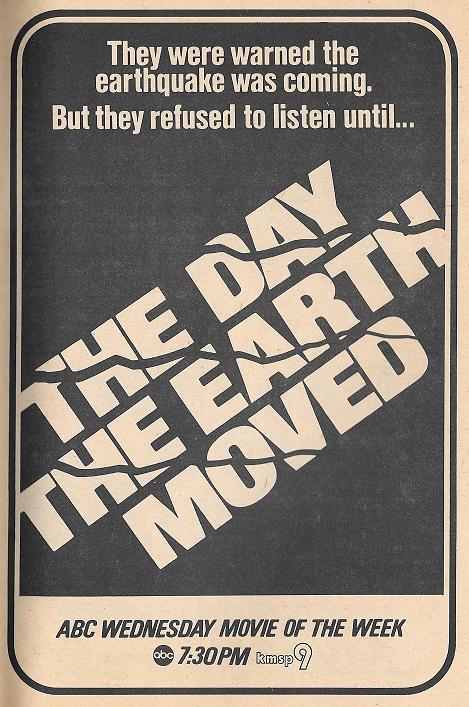
Retro Television Reviews: The Day The Earth Moved (dir by Robert Michael Lewis)


Welcome to Retro Television Reviews, a feature where we review some of our favorite and least favorite shows of the past!  On Sundays, I will be reviewing the made-for-television movies that used to be a primetime mainstay.  Today’s film is 1974’s The Day The Earth Moved!  It  can be viewed on YouTube!

Sitting in the middle of the Nevada desert, there’s a town called Bates.

Bates was once a thriving community but the years and the hot Nevada winds have not been kind to it.  Now, it consists of only a  few buildings and a speed trap.  Judge Tom Backsler (William Windom) is the most powerful man in this tiny community and he’s determined to return Bates to its former glory.  His plan is to open up a Christmas park and to remake Bates as “Santa Claus’s home away from the North Pole.”  In order to raise the money for that project, he and the police run an aggressive speed trap.  When pilot and photographer Steve Barker (Jackie Cooper) is caught in the speed trap, it turns out that he doesn’t have enough money to pay his fine.  So, his car is impounded and he’s put to work, sweeping up the dust and helping to get the Christmas park ready to open.

With the help of friendly little townsgirl, Steve is finally able to escape from Bates and return to his job.  He works with his wife, Kate (Stella Stevens), and his best friend, Harley (Cleavon Little), as surveyors.  When someone wants to buy a stretch of the Nevada desert, Steve and Harley fly over the land and take pictures.  Looking over the latest batch of pictures, Steve deduces that not only is there going to be an earthquake but it’s going to destroy the town of Bates!  Can Steve return to the town that once held him prisoner and convince the townspeople to leave with him before disaster hits!?

In many ways, The Day The Earth Moved is a standard made-for-TV disaster flick.  Only Steve and Kate realize what’s about to happen and they struggle to get anyone else to believe them.  Indeed, it seems like the world is almost conspiring to keep them from warning everyone about the incoming earthquake.  The film’s story checks off all of the expected disaster movie plot points.  That said, the town of Bates itself — with its gigantic Santa Claus standing in the middle of the desert — is a nicely surreal location and the repeated shots of a deserted farm being gradually destroyed by minor tremors achieve a certain ominous grandeur.  Jackie Cooper and Stella Stevens are believable as a husband and wife who love each other despite the fact that they’re often very annoyed with each other.  To the film’s credit, William Windom’s character is not portrayed as being a cardboard villain but instead as someone who simply wants to give his neighbors some place decent to live.  The Day The Earth Moved is predictable but well-done.

Of course, the main reason anyone will have to watch this film will be for the earthquake.  Unfortunately, this is where viewers will run into a common problem that has afflicted many made-for-TV movies.  The low-budget earthquake is just not that impressive.  For all the scenes of people yelling, it’s always pretty obvious that the camera is doing most of the shaking.  But you know what?  It’s a made-for-TV movie from 1974.  Cut it some slack and just go with it.

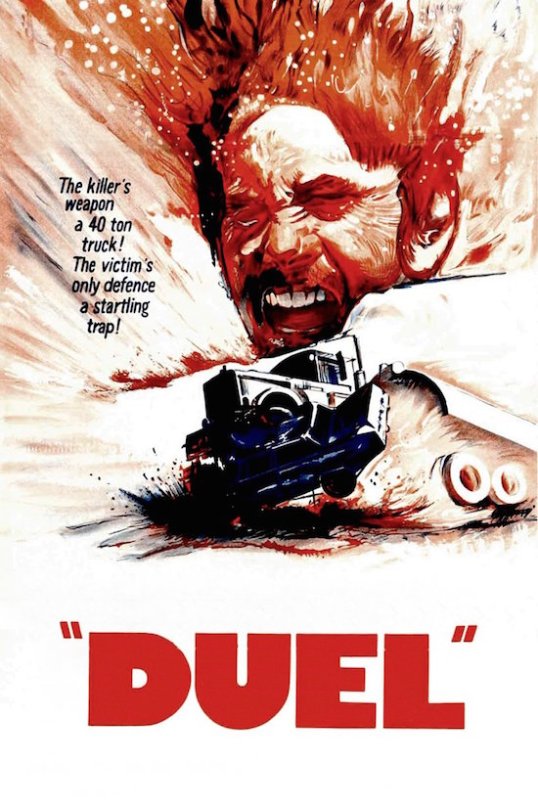
Cleaning Out The DVR Yet Again #24: Duel (dir by Steven Spielberg)


(Lisa recently discovered that she only has about 8 hours of space left on her DVR!  It turns out that she’s been recording movies from July and she just hasn’t gotten around to watching and reviewing them yet.  So, once again, Lisa is cleaning out her DVR!  She is going to try to watch and review 52 movies by the end of Tuesday, December 6th!  Will she make it?  Keep checking the site to find out!)

duel

On November 5th, I recorded the 1971 film Duel off of MeTV!

Duel tells the story of David Mann (played by Dennis Weaver).  The name is probably not a coincidence.  David is an “everyman,” if your idea of an everyman is a workaholic who is incapable of expressing his emotions.  David is driving through the California desert.  When he calls his wife (apparently, he left home in the morning without ever bothering to wake her), he tells her that he’s on a strict schedule and that he might lose an important sale if he’s delayed in any way.  You get the feeling, however, that David’s trip is less about business and more about a desire to get away from his life.  His conversation with his wife is strained and, when we watch him interact with a gas station attendant, we’re struck by how awkward David is.

Indeed, the only time that David seems to be really comfortable and relaxed is when he’s safely inside of his car.  When we first see him, he’s listening to a radio talk show and occasionally commenting on what he’s hearing.  David Mann has a better rapport with an unseen talk show host than he does with his own family.

Later, in the film, David is flagged down by a school bus that has stalled on the side of the road.  The bus driver asks David to give him a push.  For his part, David reacts with visible panic at the sight of several hyperactive children rushing towards his car. When they hop on his hood, David starts to frantically order them off.  It makes sense really.  The car is what he loves.

Of course, it’s not just bratty children that David has to deal with.  There’s also a gigantic truck traveling up and down the highway.  When David gets stuck behind the truck, he honks his horn.  He yells at the unseen driver.  He passes the truck at one point, just to have the truck promptly pass him so that it can continue to block him.  When the driver finally does motion for David to pass him, David changes lanes just to discover another car coming straight at him.

The truck’s driver, it turns out, wants to kill David.  Why does he want to kill David?  We’re never quite sure.  For that matter, we’re never quite sure what the truck is transporting, beyond the fact that it’s apparently flammable.  But the brilliance of Duel is that it doesn’t matter why the truck’s driver is trying to kill David. All that matters is that he’s determined to do so.

And David — the man who can’t even figure out how to have a conversation with his wife — must now try to figure out how to defeat a seemingly unstoppable predator…

Today, Duel is probably best known for being Steven Spielberg’s first film.  (It was a made-for-television production that got a theatrical release in Europe.)  Watching Duel (and Jaws, for that matter) it’s easy to imagine an alternative universe where, instead of becoming America’s best known creator of mainstream entertainment, Spielberg instead became one of America’s best horror director.  Duel is a suspense-filled thrill ride, one that’s scary because it remains rooted in reality.  Seriously, who hasn’t gotten nervous when they’ve found themselves sharing the road with a gigantic truck?

(If anything, I’d argue that Duel is scarier than Jaws.  I mean, I live in Dallas so it’s not like I have to worry about getting attacked by a shark.  On the other hand, I drive my car nearly every day.)

Dennis Weaver plays the archetype of what would become the typical Steven Spielberg protagonist and he does an excellent job in the role.  Weaver is on screen throughout the entire movie.  We see the entire story unfold through his eyes and Weaver gives a harrowing performance as a man who is slowly but steadily pushed to the verge of a breakdown by an enemy that he cannot even begin to comprehend.

If you haven’t seen Duel, you need to.

Embracing the Melodrama Part II #36: WUSA (dir by Stuart Rosenberg)


wusaI recently saw the 1970 film WUSA on Movies TV.  After I watched it, I looked Joanne Woodward up on Wikipedia specifically to see where she was born.  I was surprised to discover that she was born and raised in Georgia and that she attended college in Louisiana.

Why was I so shocked?  Because WUSA was set in New Orleans and it featured Joanne Woodward speaking in one of the most worst Southern accents that I had ever heard.  A little over an hour into the film, Woodward’s character says, “What’s all the rhubarb?”  And while “What’s all the rhu…” sounds properly Southern, the “…barb” was pronounced with the type of harshly unpleasant overemphasis on “ar” that has given away many Northern actors trying to sound Southern.  Hence, I was shocked to discover that Joanne Woodward actually was Southern.

That said, her pronunciation of the word rhubarb pretty much summed up every problem that I had with WUSA.  Actually, the real problem was that she said “rhubarb” in the first place.  It came across as being the type of thing that a Northerner who has never actually been down South would think was regularly uttered down here.  And I will admit that WUSA was made 16 years before I was born and so, it’s entirely possible that maybe — way back then — people down South regularly did use the word rhubarb.  But, for some reason, I doubt it.  I know plenty of old Southern people and I’ve never heard a single one of them say anything about rhubarb.

As for WUSA, it’s a long and slow film.  A drifter named Reinhardt (Paul Newman) drifts into New Orleans and, with the help of an old friend who is now pretending to be a priest (Laurence Harvey), Reinhardt gets a job as an announcer at a right-wing radio station.  He reads extremist editorials that he doesn’t agree with and whenever anyone challenges him, he explains that he’s just doing his job and nothing matters anyway.

Reinhardt also gets himself an apartment and spends most of his time smoking weed with long-haired musician types, the exact same people that WUSA regularly denounces as being a threat to the American way.  Living in the same complex is Geraldine (Joanne Woodward), a former prostitute who has a scar on her face and who says stuff like, “What’s all the rhubarb?”  She falls in love with Reinhardt but finds it difficult to ignore what he does for a living.

Meanwhile, Geraldine has another admirer.  Rainey (Anthony Perkins) is an idealistic and neurotic social worker who is regularly frustrated by his efforts to do good in the world.  Reinhardt makes fun of him.  The local crime boss (Moses Gunn) manipulates him.  And WUSA infuriates him.  When Rainey realizes that WUSA is a part of a plot to elect an extremist governor, Rainey dresses up like a priest and starts carrying around a rifle.

Meanwhile, Reinhardt has been assigned to serve as emcee at a huge patriotic rally.  With Geraldine watching from the audience and Rainey wandering around the rafters with his rifle, Reinhardt is finally forced to take a stand about the people that he works for.

Or maybe he isn’t.

To be honest, WUSA is such a mess of a film that, even after the end credits roll, it’s difficult to figure out whether Reinhardt took a stand or not.

Anyway, WUSA is not a lost masterpiece and I really wouldn’t recommend it to anyone.  The film’s too long, there’s too many scenes of characters repeating the same thing over and over again, and neither Newman nor Woodward are particularly memorable.  (You know a movie is boring when even Paul Newman seems like a dullard.)  On the plus side, Anthony Perkins gives such a good performance that I didn’t once think about the Psycho shower scene while watching him.

As boring as WUSA is, I have to admit that I’m a little bit surprised that it hasn’t been rediscovered.  Considering that it’s about a right-wing radio station, I’m surprised that there haven’t been hundreds of pretentious think pieces trying to make the connection between WUSA and Fox News.  But, honestly, even if those think pieces were out there, it probably wouldn’t do much for WUSA‘s repuation.  According to the film’s Wikipedia page, Paul Newman called it, “the most significant film I’ve ever made and the best.”  Paul Newman’s opinion aside, WUSA is pretty dire.