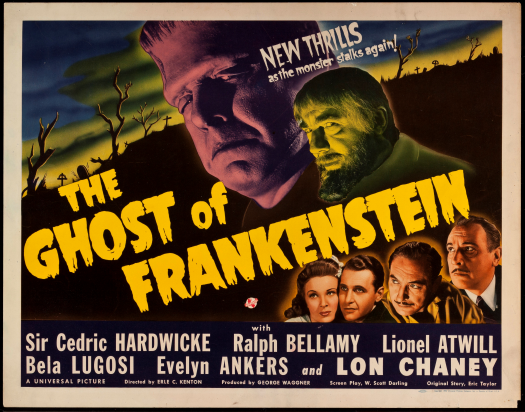
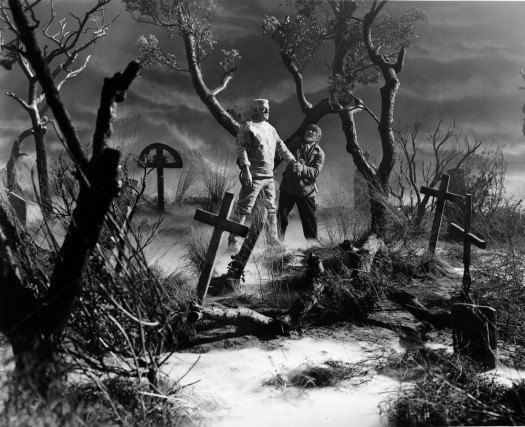
The success of Universal’s SON OF FRANKENSTEIN meant a sequel was inevitable, and the studio trotted out GHOST OF FRANKENSTEIN three years later. Horror stalwarts Bela Lugosi (as the broken-necked Ygor) and Lionel Atwill (although in a decidedly different role than the previous film) were back, but for the first time it wasn’t Boris Karloff under Jack Pierce’s monster makeup. Instead, Lon Chaney Jr., fresh off his triumph as THE WOLF MAN , stepped into those big asphalter’s boots as The Monster. But while SON OF was an ‘A’ budget production, GHOST OF FRANKENSTEIN begins The Monster’s journey into ‘B’ territory.
Old Ygor is still alive and well, “playing his weird harp” at deserted Castle Frankenstein. The villagers (including Dwight Frye! ) are in an uproar (as villagers are wont to do), complaining “the curse of Frankenstein” has left them in poverty, and storm the castle to blow it up…
Today’s horror on the lens is the surprisingly brutal 1956 B-movie, Indestructible Man!
I reviewed this movie back in 2013. It was definitely made on a low-budget and it features one of the most sexist endings in cinematic history and yet it’s also occasionally effective. The film’s biggest strength is that the Indestructible Man is played by Lon Chaney, Jr. Though Chaney was clearly dealing with his personal demons at the time this film was made, his surly manner and ravaged face make him very effective in the role of Charles “Butcher” Benson.
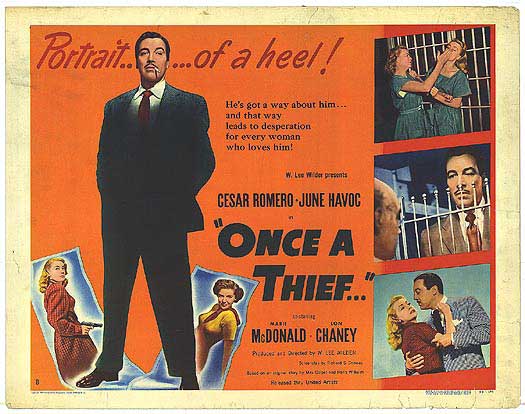
I devote a lot of time and space on this blog writing about ‘B’ Movies, those frequently overlooked quickies from days past made on the cheap for the bottom of a double feature bill. Some are highly innovative, others less so, but they served as a kind of on-the-job-training ‘film school’ before there was such a thing. Most (but not all) of them have something to offer, whether a performance by a cast member on their way up (or down) or an early effort by a future director of note. Recently, I watched ONCE A THIEF, and while it certainly broke no new ground, I found it a tight little ‘B’ noir featuring in this case a female protagonist trapped in that familiar downward spiral.
‘B’ Movie Queen June Havoc (sister of famed ecdysiast* Gypsy Rose Lee) is the troubled gal in question, a down on her luck lady named…
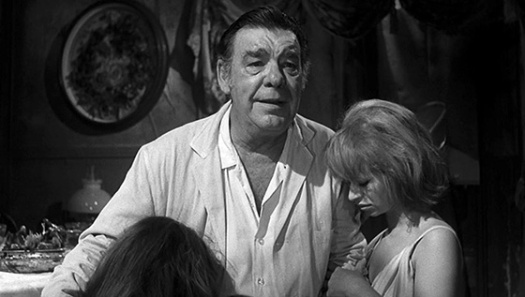
Around the time he was making SPIDER BABY, horror movie icon Lon Chaney Jr. recorded “Monster Holiday”, a cover of Bobby “Boris” Pickett’s yuletide follow up to “The Monster Mash”. Chaney’s certainly no Bing Crosby, but he sounds like he’s having a lot of fun! Backed by LA session musicians The Wrecking Crew, enjoy Lon croaking “Monster Holiday”!:
Lon Chaney Jr. made his first foray into Universal Horror with MAN MADE MONSTER, the movie that led to his studio contract and immortality with THE WOLF MAN . Both films were directed by George Waggner, who also wrote the script here under the pseudonym Joseph West. Lon’s large and in charge as the electrical monster, but top billing and acting honors go to Hollywood’s maddest of mad doctors, the great Lionel Atwill .
A bus crashes into high tension wires on a rain slicked highway, leaving all aboard dead save one. He’s Dan McCormick, a carny performer known as ‘Dynamo Dan, The Electric Man’. His seeming imperviousness to electricity piques the interest of scientist Professor Lawrence, who invites the jovial Dan to stay with him and his young niece June. Lawrence wants to run some experimental tests on Dan, but when he leaves for a medical convention his assistant…
No, actually, they don’t. If anything, they cause crimes to happen.
First released in 1971 and directed by Al Adamson, Dracula vs. Frankenstein may not be a good film but it’s definitely an unforgettable film. Yes, it may be thoroughly inept but it’s also perhaps the strangest take on the Dracula/Frankenstein rivalry that you’ll ever see.
Plus, it’s one of the final films of Lon Chaney, Jr. Unfortunately, Lon doesn’t exactly look his best in Dracula vs Frankenstein...
Speaking of slumming celebrities, long before he played Dr. Jacoby and inspired America to shout, “Dig yourself out of the shit!,” Russ Tamblyn played a biker named Rico in this movie.
Also, like every other exploitation film made in 1971, Dracula vs. Frankenstein features hippies, leading to the age old question: who needs the supernatural when you’ve got LSD-crazed hippies running around?
Another age old question: Is Dracula vs. Frankenstein merely inept or is it a classic of bad filmmaking?
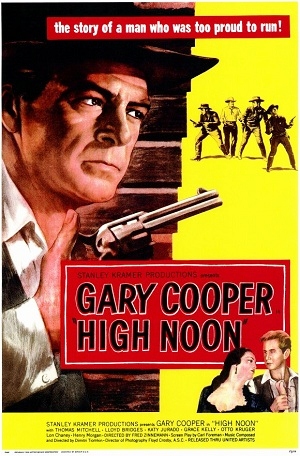
(I am currently in the process of cleaning out my DVR! I recorded the 1952 best picture nominee, High Noon, off of Retroplex on January 28th. This review is scheduled to posted at 12 noon, central time. Clever, no?)
High Noon is a testament to the power of simplicity.
It’s a famous film, one that continues to be influential and which is still studied today. It’s known for being one of the greatest westerns ever made but it’s also a powerful political allegory. Even people who haven’t seen the film know that High Noon is the moment of the day when someone shows their true character. Just as everyone knows the plot of Star Wars, regardless of whether they’ve actually watched the film, everyone knows that High Noon is about a town marshal who, after the entire town deserts him, is forced to face down a gang of gunmen on his own.
And yet, it really is a surprisingly simple movie. It’s the quintessential western, filmed in black-and-white and taking place in the type of frontier town that you would expect to find hiding on the back lot of an old movie studio. Though wonderfully brought to life by a talented cast, the majority of the characters are familiar western archetypes.
There’s the aging town marshal, a simple man of integrity. Gary Cooper won an Oscar for playing the role of Will Kane. When we first see Will, he’s getting married in a frontier courtroom. All of the town leaders have come to his wedding and all of them wish him luck in the future. Will is retiring and everyone agrees that the town would never have survived and prospered if not for Will Kane. After all, Will is the one who captured the notorious outlaw, Frank Miller. When the news comes that Miller has been pardoned and will be arriving back in town on the noon train, everyone tells Will that he should just leave town and go on his honeymoon. However, the new marshal will not be arriving for another day and Will is not willing to abandon the town. However, the town is more than willing to abandon him.
Will’s new wife is Amy Fowler (Grace Kelly). Amy is a Quaker and a pacifist. Amy begs Kane to leave town but Kane says that he’s never run from a fight. Amy tells him that she’ll be leaving on that noon train, with or without him. Helen Ramirez (Katy Jurado) is the former girlfriend of both Kane and Miller. She is one of the few people in town to call out everyone else’s cowardice but she is still planning to leave before Miller arrives. As she explains it to Amy, she would never abandon Kane if he were her man but he’s not her man anymore.
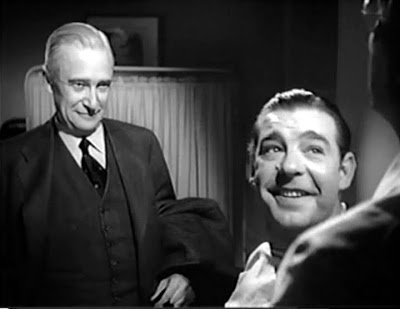
The townspeople, who first appear to be so friendly and honest, soon prove themselves to be cowards. None of them are willing to stand behind Will. The Mayor (Thomas Mitchell) publicly castigates Will for staying in town and putting everyone else in danger. Deputy Harvey Pell (Lloyd Bridges) says that he’ll only help Will if Will recommends him as his replacement. The town minister (Morgan Farley) is more concerned with why Will was married by the justice of the peace, instead of in the church. The town judge (Otto Kruger) leaves early, saying he can be a judge in some other town. One of the few people to show Will any sympathy is the former marshal (Lon Chaney, Jr.) but, unfortunately, he is too old and crippled by arthritis to provide any help.
Though it all, Frank’s gang sits at the train station and waits for Frank to arrive. One gang member is played be Lee Van Cleef. He looks really mean!
With a brisk running time of 84 minutes, High Noon unfolds in real time. Throughout the film, as Kane grows increasingly desperate in his attempt to find anyone brave enough to stand with him, we see clocks in the background of nearly every scene. We hear the ticking. We know that both noon and Frank Miller are getting closer and closer. We know that, soon, Will will have no other option but to stand on the street by himself and defend a town that doesn’t deserve him.
It’s simple but it’s undeniably powerful.
It’s been said that High Noon was meant to be a metaphor for the blacklist. Frank Miller and his gang were the fascists that, having been defeated in World War II, were now coming back to power. Will Kane was a stand-in for all the men and women of integrity who found themselves blacklisted. The townspeople represented the studio execs who refused to challenge the blacklist. That’s the theory and it’s probably true. But, honestly, the political metaphor of High Noon works because it can be applied to any situation. Will Kane is anyone who has ever had to face down the forces of totalitarianism. He is anyone who has ever had the courage to take a lonely stand while everyone else cowered in the corner.
It’s a powerful metaphor and it’s also a genuinely entertaining movie. The gunfight is thrilling. The romance between Will and Amy feels real. Even the town feels like an actual place, one that has its own history and culture. It’s a simple film but it’s a great film.
Like a lot of great films, High Noon was nominated for best picture. And, like a lot of great films, it lost. In High Noon‘s case, it lost to a film that is almost its exact opposite, The Greatest Show on Earth. However, Gary Cooper did win an Oscar for his unforgettable performance as Will Kane.
I think we tend to take classic films for granted. Don’t do that with High Noon. See it the next chance you get.
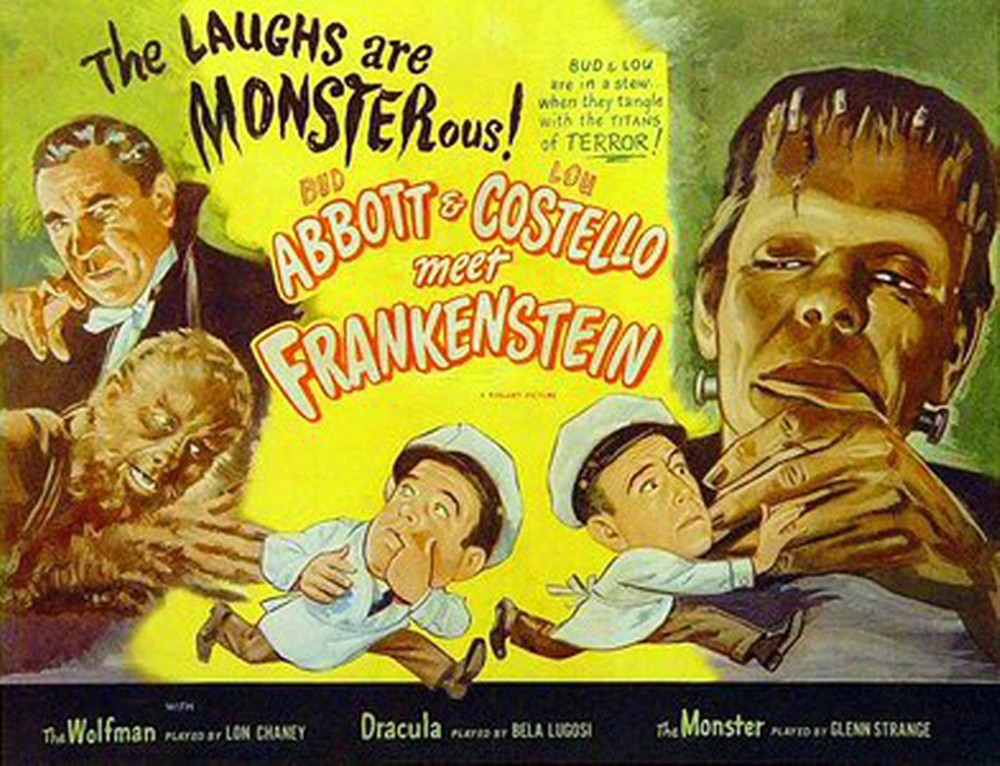
It’s Halloween, and we’ve finally made it to the Universal Classic Monsters! Frankenstein’s Monster, Dracula, and The Wolf Man had last appeared onscreen in 1945’s HOUSE OF DRACULA. Shortly thereafter, Universal merged with International Pictures and decided to produce only “prestige” pictures from then on, deeming their Gothic creature features no longer relevant in the post-war, post-nuclear world. The comedy team of Bud Abbott and Lou Costello were also in danger of becoming irrelevant, victims of their own success, as audiences were beginning to grow tired of them after twenty movies in a scant eight years.
That “prestige” thing didn’t work out so well, and Universal went back to what they did best…. producing mid-budget movies for the masses. Producer Robert Arthur developed a script called “The Brain of Frankenstein”, giving it over to Frederic Rinaldo and Robert Lees. Lou Costello hated it, and the team’s gag writer John Grant was brought it to punch things…
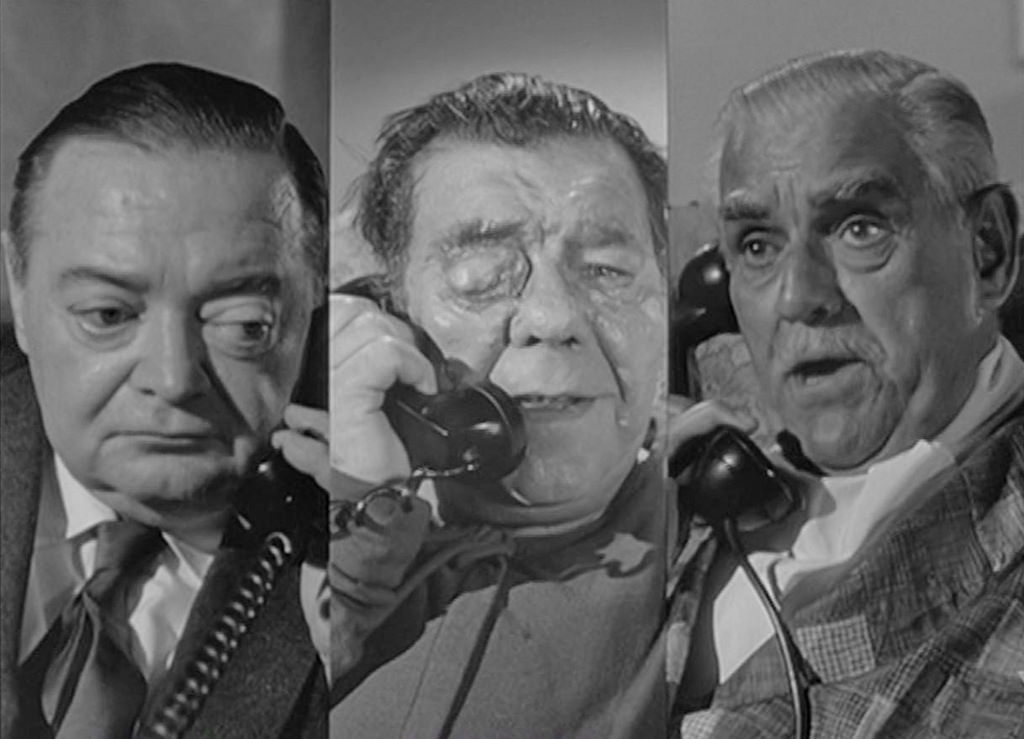
The TV series ROUTE 66 followed the adventures of two young men (Martin Milner, George Maharis) as they cruised the fabled highway in their spiffy Corvette. The 1962 Halloween episode featured a special treat for horror fans, with Boris Karloff, Peter Lorre, and Lon Chaney Jr. guesting as themselves. The three screen ghouls are debating the value of their old Gothic-style chillers vs the modern, “adult” horrors like PSYCHO. Karloff makes his final appearance in his Frankenstein makeup, while Lon dons the Wolf Man and Mummy makeups once again (and his dad’s Hunchback, too!). If you’re a classic horror lover, you’re absolutely gonna LOVE watching this Trio of Terror Titans (especially Chaney!) in “LIZARD’S LEG AND OWLET’S WING”:
(Also in the cast are Betsy Jones-Mooreland (Corman’s THE LAST WOMAN ON EARTH), Martita Hunt (GREAT EXPECTATIONS, Hammer’s THE BRIDES OF DRACULA), veteran Conrad Nagel (whose nephew Don co-starred in BRIDE OF THE MONSTER)…
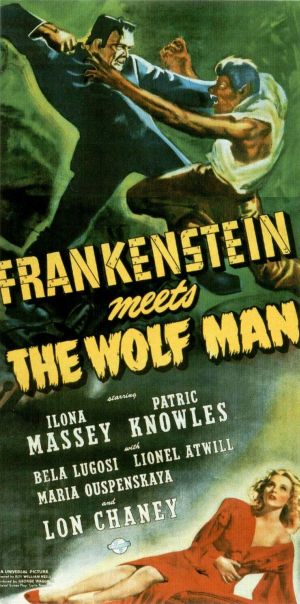
Long before Batman v. Superman, there was Frankenstein Meets The Wolf Man!
Released in 1943, Frankenstein Meets The Wolf Man was the first of the Universal horror movies to feature the monsters meeting. (Dracula would join both Frankenstein’s Monster and the Wolf Man in later films.) In our current age of the MCU and Zack Snyder super hero movies, that might not seem like a big deal but I’m sure it was huge in 1943. Were the Universal Monster Movies the first example of a shared cinematic universe? To be honest, I have no idea but it sounds good so let’s go with it.
Frankenstein Meets The Wolf Man starts, as so many Frankenstein films have, with a little bit of grave robbing. Except, this time, the grave robbers aren’t looking for body parts. Instead, they break into the Talbot family crypt because they’ve heard that Larry Talbot was buried with a lot of jewelry and money. As the grave robbers wander around the crypt, they recap for us everything that happened in The Wolf Man. Finally, they open up Larry’s coffin and are confronted with the dead body of Larry Talbot himself! (Larry is, once again, played by Lon Chaney, Jr.)
Unfortunately for our grave robbing friends, there’s a full moon out. As soon as the moonlight shines on Larry, he comes back to life and promptly transforms into … THE WOLF MAN!
After killing one of the robbers, the Wolf Man runs out of the tomb. The next morning, once again human and alive, Larry Talbot wakes up in some bushes. He’s arrested by the police. He’s sent to a mental hospital. He transforms a few more times and kills a few more stock characters. And during all of this, Larry tells anyone who will listen that he just wants to be cured of his condition so that he can die and stay dead.
It was at this point that it occurred to me that Larry Talbot is perhaps the whiniest werewolf in film history.
Eventually, Larry decides that maybe the famous Dr. Ludwig Frankenstein could help him! So, he breaks out of the hospital and travels to Germany (though, since the film was made during World War II, we’re never specifically told that he’s in Germany). Accompanying him is Malena (Maria Ouspenkaya), the gypsy woman from the first Wolf Man.
In Germany a generic Eastern European country, Larry finds out that Dr. Frankenstein is dead and his research is missing. Larry does, however, discover the frozen body of Frankenstein’s Monster (now played by Bela Lugosi). After reviving the monster, Larry is upset to discover that the Monster not only doesn’t know where to find Frankenstein’s research but that, after dealing with their crap for four movies, the Monster doesn’t really seem to care about doing anything other than harassing the local villagers.
Fortunately, Larry does get to meet Ludwig’s widow (Illona Massey) and get a chance to tell her about how much he wishes he was dead. Probably just to get him to shut up about how terrible his existence is, the widow agrees to help Larry. She gives him Ludwig’s research and Larry believes that he’s finally found a way to end both his life and the Monster’s!
Unfortunately, it doesn’t quite work that way. For one thing, Larry is working with a scientist (played by Patric Knowles) who doesn’t think that the Monster needs to be destroyed. Secondly, Larry keeps forgetting to keep track of the lunar cycles. That full moon is continually taking him by surprise.
It all leads to a final battle between Frankenstein’s Monster and the Wolf Man. It only lasts for a little less than 10 minutes so it’s hard not to be a bit disappointed but at least no one talks about having a mother named Martha.
(Can you imagine that conversation?
“Growl growl growl growl”
“Why you say Martha?”
“Growl growl.”
“But Monster’s mother named Martha!”
“Growl!”
“Friends!”
“growl…”)
(It’s been seven months since that damn movie came out and, here at the Shattered Lens, we’re still getting mileage out of “But my mother was named Martha!” jokes.)
Frankenstein Meets The Wolf Man isn’t necessarily a good movie but it is a lot of fun to watch. It helps, of course, if you’ve seen the other Universal horror films. Part of the fun is spotting members of the Universal stock company, like Lionel Atwill and Dwight Frye, and seeing who they’ll be playing this time around. One thing that I did legitimately appreciate is that the film made at least some sort of an effort to maintain a continuity with both The Wolf Man and Ghost of Frankenstein. It appears that some actual thought was put into explaining how both the Wolf Man and the Monster were still around after the events of the last two films. That shows more respect for the audience that you’ll find in most modern films.



 Through the Shattered Lens