Guilty Pleasure No. 90: Ice Station Zebra (dir. by John Sturges)


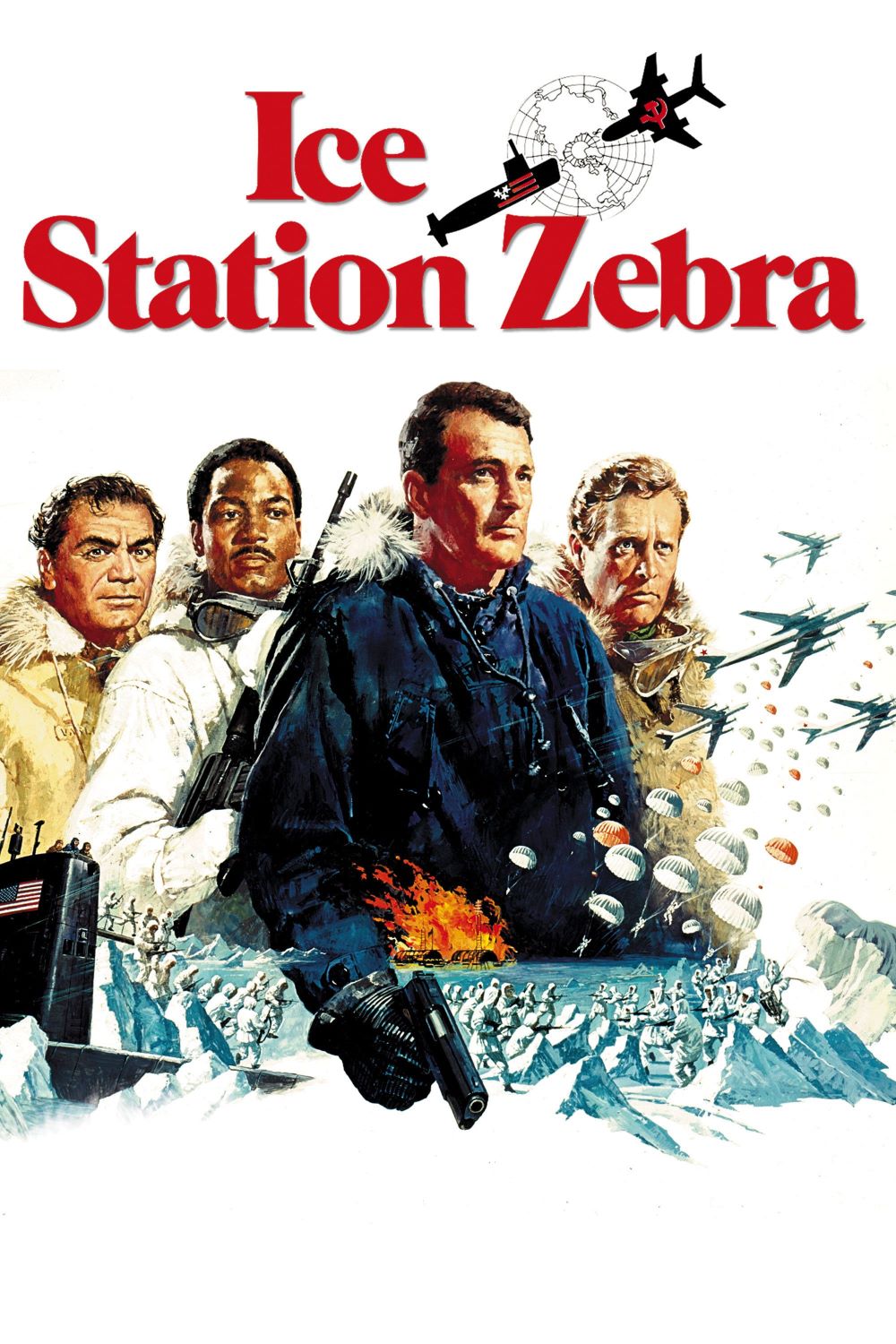
Ice Station Zebra, directed by John Sturges in 1968, slides into guilty pleasure territory like a submarine slipping under polar ice—full of big Cold War ambitions, shadowy spy games, and submarine peril that tease something epic, but so loaded with pacing hiccups, studio shortcuts, and earnest overreach that it ends up a lopsided, lovably messy ride. Sturges had already cemented his rep with crowd-roaring hits like The Magnificent Seven, where a ragtag posse of gunslingers delivered razor-sharp tension and quotable showdowns, or The Great Escape, a WWII breakout yarn crackling with clever schemes, sweaty escapes, and Steve McQueen’s motorcycle glory. Those films moved like a well-oiled engine, every scene stacking stakes and character beats into unforgettable momentum. By contrast, Ice Station Zebra feels like Sturges chasing that same high-wire ensemble vibe—a U.S. nuclear sub, the USS Tigerfish, barreling toward a trashed Arctic outpost—but bloating into a 148-minute sprawl that swaps tight plotting for endless red-lit corridor glares and withheld mission secrets. It’s not in the same league as his earlier triumphs, lacking their propulsive drive and lived-in grit, yet that very shortfall turns it into quirky comfort viewing for fans who dig flawed ’60s spectacle.

The setup hooks you quick: Commander James Ferraday, Rock Hudson’s square-jawed everyman at the helm, gets tapped for a hush-hush run to Ice Station Zebra after a satellite supposedly carrying spy photos crashes nearby. No full briefing for him, just orders to play it cool while three mystery passengers board—Mr. Jones, a buttoned-up British agent with evasive smirks; Boris Vaslov, Ernest Borgnine’s barrel-chested Russian turncoat oozing fake bonhomie; and Captain Anders, Jim Brown’s steely Marine barking orders over a squad of jarheads. As the Tigerfish dives under thickening ice floes, the sub’s innards come alive with flickering sonar pings, steam-hissing valves, and crewmen hunched over gauges in perpetual sweat. It’s claustrophobic gold at first, the hull creaking like it’s got a bad case of frostbite, echoing the trapped dread Sturges nailed in his POW camp classic but without the same spark of rebellion. Then sabotage strikes—a flooded missile bay, a wild plunge toward crush depth—and fingers start pointing. Who tampered with the ballast? Jones with his locked trunk of gadgets? Vaslov’s too-friendly vodka toasts? The Marines itching for a fight? The scene builds real sweat, divers suiting up in the nick of time, but Sturges lets the fallout drag, turning interrogation into a tea party of suspicions rather than the cutthroat blame game his best films thrived on.

These early stumbles set the tone for a film that’s promising yet perpetually off-kilter, far from the seamless revenge rhythm of The Magnificent Seven‘s dusty trails. Production fingerprints show everywhere: rumors swirl of Navy brass forcing script tweaks to glorify their boats, last-minute casting shifts from bigger names to Hudson, and a roadshow rollout with overture, intermission, and 70mm pomp that screams overambition. The Arctic plunge delivers tense highlights—the sub ramming upward through ice chunks like a whale breaching, sparks flying from shorted panels, crew barking damage reports—but lulls follow with tech jargon dumps and characters circling motives without committing to conflict. Hudson anchors it all with unflappable poise, barking commands like a TV dad in a crisis, but he lacks McQueen’s sly charisma or Yul Brynner’s brooding fire. Borgnine hams it up as Vaslov, his accent flipping from gravelly growl to vaudeville schtick during mess-hall ribbing, while McGoohan brings the sharpest edge as Jones, his dry barbs hinting at deeper layers. Brown’s Anders gets muscle but little nuance, leading a Marine crew that feels like stock tough guys waiting for their cue.

Pushing topside, the flaws bloom into full charm. The ice cap arrival unfolds in sweeping widescreen vistas—endless white expanses, howling gales whipping snow devils—but close-quarters betray the soundstage: actors plodding through “blizzards” in lightweight jackets, no puffing breath in the deep freeze, sets that wobble if you squint. It’s the kind of earnest cheesiness that sinks modern blockbusters but endears this relic, especially when the station siege erupts. Soviets drop from the sky in parachutes like deadly snowflakes, scouring the charred ruins for a buried film capsule packed with NATO missile coords. Americans fan out in white camo, trading potshots amid smoke grenades and collapsing tunnels, loyalties cracking as Vaslov’s true colors flash. Ferraday’s cool bluff seals a three-way stalemate, denying everyone the prize in a nod to mutually assured secrets. Michel Legrand’s score surges here, horns blaring over the chaos like a war drum, giving Sturges’ action chops a late workout. Yet even this payoff sprawls, talky standoffs eating screen time where his peak films would’ve sprinted to the finish.

What seals Ice Station Zebra‘s guilty pleasure status is embracing its dated quirks as features, not bugs—hammy all-male bravado, Cold War jitters turned quaint, plot gaps you could park a destroyer in. Sturges conjures submerged panic and frosty fireworks that nod to his glory days, the sub’s practical effects holding up better than some CGI today, but without the narrative steel of The Great Escape‘s tunnel triumphs or The Magnificent Seven‘s mythic standoffs, it coasts on atmosphere over precision. Clocking 148 minutes, it tests patience with filler like extended sail sequences and coy reveals, yet rewards surrender: grin at Borgnine’s bear hugs masking menace, chuckle at the Navy polish glossing gritty potential, savor the sheer balls of staging Arctic Armageddon on a backlot. Howard Hughes reportedly looped it endlessly in his casino screening rooms, and you get why—it’s hypnotic in its wonkiness, a time capsule of late-’60s Hollywood flexing before New Wave grit crashed the party.

Pop this on a stormy night with cocoa and zero expectations, and Ice Station Zebra shines as cozy flawed fun. Sturges’ touch keeps the chills coming amid the clunkers, delivering submarine squeezes, betrayals under the aurora, and a finale with enough brinkmanship bang to forgive the bloat. It’s no peer to his earlier masterpieces, more a quirky footnote, but that’s the hook: imperfect promise wrapped in icy spectacle, begging a rewatch to spot every goofy grace note. For ’60s thriller buffs, submarine nuts, or anyone needing a break from slick reboots, it’s a frosty, flawed feast worth the dive.

Previous Guilty Pleasures

  1. Half-Baked
  2. Save The Last Dance
  3. Every Rose Has Its Thorns
  4. The Jeremy Kyle Show
  5. Invasion USA
  6. The Golden Child
  7. Final Destination 2
  8. Paparazzi
  9. The Principal
  10. The Substitute
  11. Terror In The Family
  12. Pandorum
  13. Lambada
  14. Fear
  15. Cocktail
  16. Keep Off The Grass
  17. Girls, Girls, Girls
  18. Class
  19. Tart
  20. King Kong vs. Godzilla
  21. Hawk the Slayer
  22. Battle Beyond the Stars
  23. Meridian
  24. Walk of Shame
  25. From Justin To Kelly
  26. Project Greenlight
  27. Sex Decoy: Love Stings
  28. Swimfan
  29. On the Line
  30. Wolfen
  31. Hail Caesar!
  32. It’s So Cold In The D
  33. In the Mix
  34. Healed By Grace
  35. Valley of the Dolls
  36. The Legend of Billie Jean
  37. Death Wish
  38. Shipping Wars
  39. Ghost Whisperer
  40. Parking Wars
  41. The Dead Are After Me
  42. Harper’s Island
  43. The Resurrection of Gavin Stone
  44. Paranormal State
  45. Utopia
  46. Bar Rescue
  47. The Powers of Matthew Star
  48. Spiker
  49. Heavenly Bodies
  50. Maid in Manhattan
  51. Rage and Honor
  52. Saved By The Bell 3. 21 “No Hope With Dope”
  53. Happy Gilmore
  54. Solarbabies
  55. The Dawn of Correction
  56. Once You Understand
  57. The Voyeurs 
  58. Robot Jox
  59. Teen Wolf
  60. The Running Man
  61. Double Dragon
  62. Backtrack
  63. Julie and Jack
  64. Karate Warrior
  65. Invaders From Mars
  66. Cloverfield
  67. Aerobicide 
  68. Blood Harvest
  69. Shocking Dark
  70. Face The Truth
  71. Submerged
  72. The Canyons
  73. Days of Thunder
  74. Van Helsing
  75. The Night Comes for Us
  76. Code of Silence
  77. Captain Ron
  78. Armageddon
  79. Kate’s Secret
  80. Point Break
  81. The Replacements
  82. The Shadow
  83. Meteor
  84. Last Action Hero
  85. Attack of the Killer Tomatoes
  86. The Horror at 37,000 Feet
  87. The ‘Burbs
  88. Lifeforce
  89. Highschool of the Dead

Film Review: The Man I Married (dir by Irving Pichel)


In 1940’s The Man I Married, Joan Bennett stars as Carol Cabbott Hoffman.

Carol is a New York-based art critic.  She is young, sophisticated, wealthy, and politically naive.  Because she has been married to a German for seven years, she has been keeping up with what has been happening in Germany but it’s clear that she doesn’t really understand the full story of what she’s hearing.  As she says, at one point, she has heard bad things about the Nazis but she also tries to keep an open mind and not get drawn in by “propaganda.”

Her husband, Eric Hoffman (Francis Lederer), has not been back to Germany in ten years and he says that he has little interest in ever returning.  But, when he receives a letter from his father (Otto Kruger), Eric announces that he has to return home for a visit.  Before Carol, Eric, and their son, Ricky (Johnny Russell), leave for Germany, they are approached by their friend, Dr. Hugo Gerhardt (Ludwig Stossel).  He explains that his brother has been imprisoned in a concentration camp and he asks Carol and Eric to deliver money to him and to appeal to the American embassy for help.  Carol agrees to do so.  Eric is noticeably reticent.

As soon as they arrive in Germany and Eric learns that his father wants him to take over the family’s factory, Eric starts to change.  He and a former schoolmate named Freida (Anna Sten) are a bit too happy to see each other again.  Eric insists on listening to the nightly radio broadcasts from Dr. Goebbels.  When Freida mentions that it is illegal to joke about Hitler, Eric surprises Carol by defending the law.  With Eric spending all of his time with Freida and dismissing Carol’s understandable suspicions by saying that she’s just being jealous, Carol meets an American correspondent named Keith (Lloyd Nolan) who reveals to her the truth of life in Nazi Germany.  Carol discovers that, rather than being the economically-strong paradise that Eric and Freida claim it to be, Germany is a place where many citizens live in fear of being heard saying the wrong thing and, as a result, they’ve chosen to close their eyes to what is going on around them.

The Man I Married is an interesting film.  It’s an anti-Nazi film that was released at a time when America was still technically a neutral nation.  Indeed, the film almost feels like it was made to prepare Americans for the inevitability of war with Germany.  When Keith mocks Carol for trying to be neutral about the Nazis, it’s clear that he’s meant to be speaking to the audience watching the film.  Eric begins the film as an erudite and seemingly charming man but, as soon as he arrives in Germany and is reunited with Freida, he reveals himself to be a fervent Nazi.  The film warns the audience not to trust those who were trying to excuse or dismiss Germany’s actions.

This is also one of the few films made before World War II that really acknowledged just how central anti-Semitism was to the Nazi ideology, acknowledging the concentration camps at a time when many in the West were refusing to admit they existed, either because they were in denial or because they just didn’t care.  Towards the end of the film, a major character is discovered to have had a Jewish mother and the reaction to the news reveals the hate that was at the heart of the Third Reich.

The Man I Married, with its portrayal of a populace that has convinced itself that their government is never to be questioned and that all dissent must be punished, is a film that feels just as relevant today as it did in 1940.  It’s a film that warns viewers of the risk of disbelieving their own eyes.

Cleaning Out The DVR: An American Dream (dir by Robert Gist)


Loosely based on a novel by Norman Mailer, the 1966 film, An American Dream, tells the story of Stephen Rojack (Stuart Whitman).  Rojack’s a war hero, a man who has several medals of valor to his credit.  He’s married to Deborah (Eleanor Parker), the daughter of one of the richest men in the country.  He’s an acclaimed writer.  He’s got his own television talk show in New York.  He’s been crusading against not only the Mafia but also against corruption in the police department.  He has powerful friends and powerful enemies.  You get the idea.

He’s also got a marriage that’s on the verge of collapse.  Deborah calls Rojack’s show and taunts him while he’s on the air.  When Rojack goes to her apartment to demand a divorce, the two of them get into an argument.  Deborah tells him that he’s not a hero.  She says he only married her for the money and that she only married him for the prestige.  She tells him that he’s a lousy lover.  Being a character in an adaptation of a Norman Mailer novel, the “lousy lay” crack causes Rojack to snap.  He attacks Deborah.  The two of them fight.  Deborah stumbles out to the balcony of her apartment and it appears that she’s on the verge of jumping.  Rojack follows her.  At first, he tries to save her but then he lets her fall.  She crashes down to the street, where she’s promptly run over by several cars.  The cars then all run into each other while Rojack stands on the balcony and wails.  There’s nothing subtle about the first 15 minutes of An American Dream.

Actually, there’s nothing subtle about any minute of An American Dream.  It’s a film where everything, from the acting to the melodrama, is so over-the-top and portentous that it actually gets a bit boring.  There’s no relief from the screeching and the inauthentic hard-boiled dialogue.  When a crazed Rojack starts to laugh uncontrollably, he doesn’t just laugh.  Instead, he laughs and laughs and laughs and laughs and laughs and …. well, let’s just say it goes on for a bit.  It’s like a 60s version of one of those terrible Family Guy jokes.

Anyway, the police don’t believe that Deborah committed suicide but they also can’t prove that Rojack killed her.  Meanwhile, within hours of his wife’s death, Rojack meets his ex-girlfriend, a singer named Cherry (Janet Leigh).  Rojack is still in love with Cherry but Cherry is also connected to the same mobsters who want to kill Rojack.  Meanwhile, Deborah’s superrich father (Lloyd Nolan) is also on his way to New York City, looking for answer of his own.

An American Dream is a very familiar type of mid-60s film.  It’s a trashy story and it’s obvious that the director was trying to be as risqué as the competition in Europe while also trying to not offend mainstream American audiences.  As such, the film has hints of nudity but not too much nudity.  There’s some profanity but not too much profanity.  Rojack, Deborah, and Cherry may curse more than Mary Poppins but they’re rank amateurs compared to the cast of Who’s Afraid of Virginia Woolf?  It’s an unabashedly melodramatic film but it doesn’t seem to be sure just how far it can go in embracing the melodrama with alienating its target audience so, as a result, the entire film feels somewhat off.  Some scenes go on forever.  Some scenes feel too short.  The whole thing has the washed-out look of an old cop show.

All of that perhaps wouldn’t matter if Stephen Rojack was a compelling character.  In theory, Rojack should have been compelling but, because he’s played by the reliably boring Stuart Whitman, Rojack instead just comes across as being a bit of a dullard.  He’s supposed to be a charismatic, two-fisted Norman Mailer-type but instead, as played by Whitman, Rojack comes across like an accountant who is looking forward to retirement but only if he can balance the books one last time.  There’s no spark of madness or imagination to be found in Whitman’s performance and, as a result, the viewer never really cares about Rojack or his problems.

Noman Mailer reportedly never saw An American Dream, saying that it would be too painful to a bad version of his favorite novel.  In this case, Mailer made the right decision.

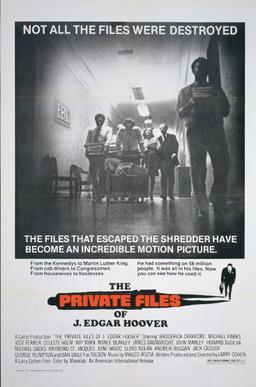
18 Days of Paranoia #3: The Private Files of J. Edgar Hoover (dir by Larry Cohen)


The 1977 film, The Private Files of J. Edgar Hoover, opens in 1972.

J. Edgar Hoover, the much-feared and long-serving director of the FBI, has just been found dead at his home and it seems like the entire city of Washington, D.C. is scrambling.  Not only are people jockeying for Hoover’s job but they’re also wondering what might be found in his secret files.  As quickly becomes apparent, Hoover had a file on everyone.  While Presidents lauded him and the press portrayed him as hero, Hoover spent nearly 50 years building up a surveillance state.  Hoover said it was to fight criminals and subversives but mostly, it was just to hold onto his own power.  Even President Nixon is heard, in the Oval Office, ordering his men to get those files.

Hoover may have known everyone’s secrets but, the film suggests, very few people knew his.  The film is narrated by a former FBI agent named Dwight Webb (Rip Torn).  Dwight talks about how he was kicked out of the FBI because it was discovered that he not only smoked but that he was having an adulterous affair with a secretary.  “You know how Hoover was about that sex stuff,” he says, his tone suggesting that there’s more to the story than just Hoover being a bit of a puritan.

We flash back to the 1920s.  We see a young Hoover (James Wainwright) as a part of the infamous Palmer Raids, an early effort by the Justice Department to track down and deport communist subversives.  Though Hoover disagrees with the legality of the Palmer Raids, he still plays his part and that loyalty is enough to eventually get him appointed, at the age of 29, to be the head of the agency that would eventually become the FBI.  Hoover may start out as a relatively idealistic man but it doesn’t take long for the fame and the power to go to his head.

Hoover (now played by Broderick Crawford) serves a number of Presidents, each one worse the one who proceeded him.  Franklin Delano Roosevelt (Howard Da Silva) is an avuncular despot while the Kennedy brothers (William Jordan as John and Michael Parks as Bobby) are two rich brats who think that they can control Hoover but who soon discover that Hoover is far more clever than they realize.  Hoover finds himself a man out-of-place in the 60s and the 70s,  Suddenly, he’s no longer everyone’s hero and people are starting to view the FBI as being not a force for law enforcement but instead an instrument of oppression.

Through it all, Hoover remains an enigma.  He demands a lot of from his agents but he resents them if they’re too successful.  Melvin Purvis (Michael Sacks) might find fame for leading the manhunt that took down Dillinger but he’s driven to suicide by Hoover’s cruel treatment.  Unlike Clint Eastwood’s film about Hoover, The Private Files of J. Edgar Hoover suggests that Hoover was not gay but that instead, that he was so repressed that he was essentially asexual.  When one woman throws herself at him, he accuses her of being a subversive and demands to know how anyone could find him attractive.  He’s closest to his mother and when she dies, he shuts off his emotions.  His own power, for better and worse, becomes the one thing that he loves.  He’s married to the FBI and he often behaves like an abusive spouse.

The Private Files of J. Edgar Hoover is an interesting film.  It’s an attempt to do a huge American epic on a less than epic budget.  At the start of the film, the low budget is undeniably distracting.  The 1920s are essentially represented by a back lot and two old cars.  The scenes of the FBI dealing with gangsters like Dillinger and Creepy Karpis feel awkward and slapdash.  But, as the film’s timeline gets closer to what was then the modern era, the film’s story tightens up and so does Larry Cohen’s direction.  (One get the feeling that Cohen was, perhaps understandably, more interested in the Hoover of the 60s and the 70s than the Hoover of the 20s and 30s.  There’s a sharpness to the second half of the movie that is just missing from the first half.)  Broderick Crawford gives a chilling performance as a man who is determined to hold onto his power, just for the sake of having it.  The scenes were Hoover and Bobby Kennedy snap at each other have a charge that’s missing from the first half of the film.  Michael Parks does a great job portraying RFK as basically being a spoiled jerk while Crawford seems to relish the chance to play up the resentful, bitter old man aspects of Hoover’s personality.  The film ultimately suggests that whether the audience previously admired RFK or whether they previously admired Hoover, they were all essentially duped.

Though the film never quite overcomes the limits of its low budget, it works well as a secret history of the United States.  In 1977, it undoubtedly took guts to make a film that portrayed Roosevelt and Kennedy as being as bad as Nixon and Johnson.  (It would probably even take guts today.  One need only rewatch something like The Butler or Hyde Park on Hudson to see the ludicrous lengths Hollywood will go to idealize presidents like Kennedy and dictators like FDR.)  While this film certainly doesn’t defend J. Edgar Hoover’s excesses, it often suggests that the president he served under were just as bad, if not even worse.  In the end, it becomes a portrait of not only how power corrupts but also why things don’t change, regardless of who is nominally in charge.  In the end the film’s villain is not J. Edgar Hoover.  Instead, the film’s villain is the system that created and then enabled him.  The man may be dead but the system remains.

Previous entries in the 18 Days of Paranoia:

  1. The Flight That Disappeared
  2. The Humanity Bureau


Film Review: Susan Slade (dir by Delmer Daves)


Shortly after this 1961 film begins, 17 year-old Susan Slade (Connie Stevens) announces, “We’ve been sinful!”

She’s talking to her first lover, Conn White (Grant Williams).  You would think that anyone — even someone as unbelievably naive and innocent as Susan Slade — would know better than to ever trust someone named Conn White but no.  From the minute that Conn and Susan met on an ocean liner heading from South America to California, it was love at first sight.  In fact, Susan was so sure of her love that she spent the night in Conn’s cabin, fully knowing that it would mean surrendering her status as an Eisenhower era good girl.

Conn laughs off her concerns about sin.  He also tells her that it makes perfect sense for her not to tell her parents (played by Dorothy McGuire and Lloyd Nolan).  “When we’re married,” he asks, “are you going to tell your mother every time that we make love?”

Wow, Conn still wants to get married even though he’s already had sex with her!?  And he’s also extremely wealthy and stands to inherit control of a multinational corporation!  He sounds like the perfect guy!  Way to go, Susan!

Unfortunately, it turns out that Conn does have one flaw.  He really, really likes to go mountain climbing.  In fact, he’s planning on scaling fearsome old Mt. McKinley.  While Susan and her family settle into life in Monterey, California, Conn heads up to Alaska.  He promises Susan that he’ll keep in touch but, when she doesn’t hear from him, she fears the worse.  Has he abandoned her?  Was he lying when he said he wanted to get married?  Then one day, she gets a call from Conn’s father, informing her that Conn fell off the mountain and died.  Susan’s almost father-in-law tells her that Conn’s body cannot be retrieved from the mountain.  Though it’s neither confirmed nor denied by the film, I decided that this was because Conn faked his own death to get out of having to spend any more time listening to Susan talk about sin.

Anyway, Susan’s single again but, fortunately, she does not lack for suitors.  For instance, there’s the spoiled Wells Corbett (Bert Convy), who is kind of shallow and arrogant but who has a lot of money.  And then there’s Hoyt Brecker (played, in reliably vacuous style, by Troy Donahue), who is poor but honest and who is also an aspiring writer.  “Someday,” Susan declares,”they’ll say that Robert Louis Stevenson, Jack London, and Hoyt Brecker wrote here!”  Who will Susan chose?  The sensitive artist who loves her unconditionally or the arrogant rich boy who smirks his way through the whole film?

Complicating matters is the fact that Susan is …. pregnant!  That’s right, this is another one of those movies from the early 60s where having sex outside of marriage always leads to an unplanned pregnancy.  And, because this movie is from 1961, the only solution is for the Slades to move down to Guatemala for two years, just so they can fool the people on Monterey into believing that the baby is actually McGuire’s and that Susan Slade is not an unwed mother but is instead an overprotective older sister.  Will either of Susan’s two suitors be waiting for her when she and her family return to California?

Now, please don’t get me wrong.  I do understand that there’s a big difference between 1961 and 2019 and that there used to be a lot more scandal attached to sex outside of marriage and unwed pregnancy.  In fact, I guess that difference is really the only thing that makes Susan Slade interesting to a modern viewer.  As soon as we see that this film was directed by Delmer Daves (the poor man’s Douglas Sirk) and that it stars Troy Donahue, we know who poor Susan is going to end up with so it’s not like there’s any real surprises lurking in the film’s plot.  And none of the actors, though Connie Stevens sometimes to be trying, seems to be that invested in the film’s story.  Instead, Susan Slade is mostly useful of a time capsule of the time in which it was made, a time when sex outside of marriage was unironically “sinful” and the only possible punishment was either pregnancy, death, or both.  Indeed, Susan Slade is less concerned about the hypocrisy of a society that would force Susan to lie about her new “brother” and more about whether bland lunkhead Troy Donaue will still be willing to marry Susan even if she’s no longer eligible to wear white at their wedding.  The film seems to be asking, “After being sinful, can Susan Slade become a good girl again?”  As a movie, it’s fairly turgid but as a cultural artifact of a time in which everyone was obsessed with sex but no one was willing to talk about it, Susan Slade is occasionally fascinating.

Poor Susan Slade!  If only she had gotten pregnant in a 1971 film instead of one made in 1961, her story could have been so different.  But no, she was sinful in the early 60s and that means she’ll be have to settle for Troy Donahue.


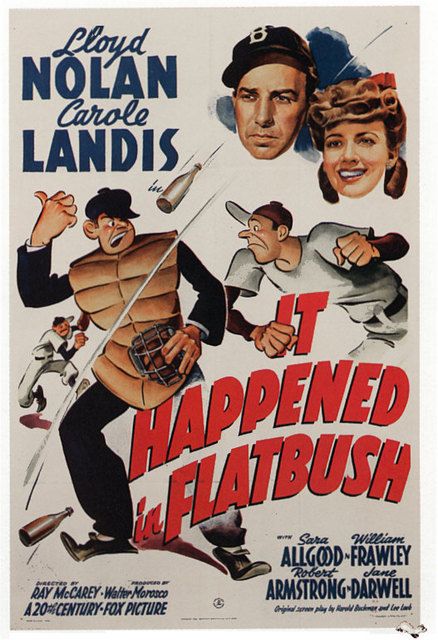
The Great American Pastime: IT HAPPENED IN FLATBUSH (20th Century-Fox 1942)


gary loggins's avatarcracked rear viewer

Major League Baseball’s Opening Day has finally arrived! It’s a tradition as American as Apple Pie, and so is IT HAPPENED IN FLATBUSH, a baseball movie about a lousy team in Brooklyn whose new manager takes them to the top of the heap. The team’s not explicitly called the Dodgers and the manager’s not named Leo Durocher, but their improbable 1941 pennant winning season is exactly what inspired this charmingly nostalgic little movie.

When Brooklyn’s manager quits the team, dowager team owner Mrs. McAvoy seeks out ex-player Frank Maguire, who seven years earlier was run out of town when an unfortunate error cost the team the pennant. She finds him running a club out in the sticks, and convinces him to come back to the Big Leagues. He does, bringing along his faithful bat boy/sidekick ‘Squint’, and just before the season’s about to begin, Mrs. McAvoy abruptly dies. Her family…

View original post 501 more words

Cleaning Out the DVR Pt. 22: Winter Under the Stars


gary loggins's avatarcracked rear viewer

I haven’t done one of these posts in a while, and since my DVR is heading towards max capacity, I’m way overdue! Everyone out there in classic film fan land knows about TCM’s annual “Summer Under the Stars”, right? Well, consider this my Winter version, containing a half-dozen capsule reviews of some Hollywood star-filled films of the past!

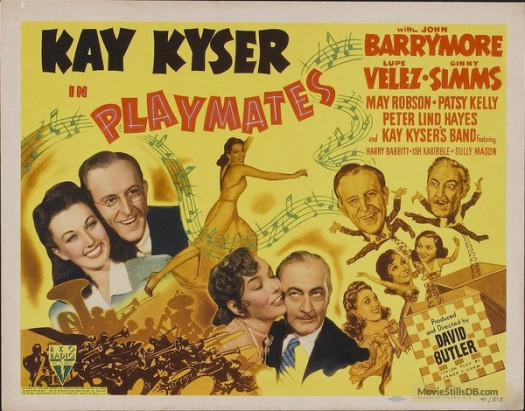
PLAYMATES (RKO 1941; D: David Butler ) – That great thespian John Barrymore’s press agent (Patsy Kelly) schemes with swing band leader Kay Kyser’s press agent (Peter Lind Hayes) to team the two in a Shakespearean  festival! Most critics bemoan the fact that this was Barrymore’s final film, satirizing himself and hamming it up mercilessly, but The Great Profile, though bloated from years of alcohol abuse and hard living, seems to be enjoying himself in this fairly funny but minor screwball comedy with music. Lupe Velez livens things up as Barrymore’s spitfire…

View original post 1,088 more words

Cleaning Out the DVR: Lady In The Lake (dir by Robert Montgomery)


(Lisa is once again in the process of cleaning out her DVR!  She recorded the 1947 film noir Lady In The Lake off of TCM on June 17th!)

You are Raymond Chandler’s world-famous private detective, Phillip Marlowe!

Well, no.  Actually, you aren’t.  Lady in the Lake is best-known for being one of the first (if not the first) film to be shot from the viewpoint of the main character but actually, the film goes out of its way to remind you that you’re seeing the story through Marlowe’s eyes but you’re not Marlowe yourself.  There are three scenes in which Marlowe (played by Robert Montgomery, who also directed the film) is seen sitting behind a desk and directly addressing the audience.  He shows up to fill in a few plot details and to assure the audience that, while the film they’re watching may be experimental, it’s not too experimental.  For his part, Montgomery looks and sounds absolutely miserable whenever he has to speak directly to the audience.  One gets the feeling that these scenes were forced on him by nervous studio execs, who were probably worried that the film would be too weird for mainstream audiences.

However, the rest of the film is seen totally through Marlowe’s eyes.  When Marlowe gets punched, we see the fist flying at him.  When Marlowe smokes a cigarette, we see the smoke float away from him.  When Marlowe leers at every single woman that he meets, the camera leers as well.  When Marlowe looks at himself in a mirror, we see his reflection.  When Marlowe passes out after a beating or a car accident, the image grows blurry before fading to black.  There’s even a rather clever scene when Marlowe leans in for a kiss, just to suddenly change his mind and pull back.

Today, of course, the film’s technique doesn’t seem quite as revolutionary.  We’re used to point of view shots and moving cameras.  Last year, Hardcore Henry told its entire stupid story through a point of view shot and the shaky cam effect actually made me physically ill.  In Lady in the Lake, there is no shaky, hand-held camera work and I was happy about that.  Marlowe may turn his head left and right and he may walk forward but he apparently has nerves of steel because the image stays steady and only shakes when Marlowe’s getting beat up.

As for the film’s plot, it opens with Marlowe explaining that, since he’s not making enough money as a P.I., he’s decided to try his hand at writing for a pulp magazine.  While his stories are not accepted, publishing executive Adrienne Fromsett (Audrey Totter) does hire him to track down the missing wife of her boss, Derace Kingbury (Leon Ames).  As Marlowe quickly figures out, nobody’s motives are exactly pure.  Adrienne wants to marry her boss and get her hands on his money.  The wife’s lover (Richard Simmons) claims that he hasn’t seen her in weeks but still lets slip that she may no longer be alive.  The police (represented by Lloyd Nolan and Tom Tully) are corrupt, rather rude, and may know more than they are letting on.  Even a seemingly innocent landlady (Jayne Meadows) might have a secret or two.

And, of course, there’s the dead woman who is discovered in a nearby lake.  Her identity holds the key to many mysteries…

It’s an intriguing puzzle and it actually helps to see everything through Marlowe’s eyes.  If nothing else, it cuts down on the red herrings.  If Marlowe stops to stare at something, you know exactly what he’s staring at and you can be sure that it will prove to be important at some point in the story.

By the way, did I mention that Lady In The Lake is not just an experimental film noir but a Christmas movie?  Seriously, it opens with holiday music playing in the background and the opening credits are printed on cheery Christmas cards.  It’s only after the credits are over that we see that there’s a gun underneath the cards.  As a director, Montgomery does a great job juxtaposing the cheeriness of Christmas with the sordidness of the people who Marlowe has to associate with on a daily basis.  He may be dealing with a bunch of murderers and greedy con artists but almost everyone has a Christmas tree in their apartment.

In fact, it’s so easy to get so wrapped up in the film’s technique that the viewer runs the risk of not noticing just how dark and cynical Lady in The Lake truly is.  Everyone that Marlowe meets is sleazy.  Marlowe, himself, does not come across as being particularly likable.  Every room that Marlowe enters is underlit.  Interestingly, with the exception of the opening credits and a driving montage, there’s not much music to be heard in the film, a reminder that we’re only hearing what Marlowe hears.  And, in Marlowe’s world, there’s no music playing in the background to provide relief from the tension.  There’s just a mix of lies and threats.

Lady in the Lake is an intriguing film and it shows up on TCM fairly frequently.  Keep an eye out for it.

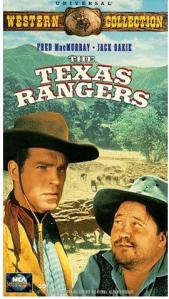
A Movie A Day #223: The Texas Rangers (1936, directed by King Vidor)


Sam (Lloyd Nolan), Jim (Fred MacMurray), and Wahoo (Jack Oakie) are three outlaws in the old west.  Wahoo works as a stagecoach driver and always lets Sam and Jim know which coaches will be worth holding up.  It’s a pretty good scam until the authorities get wise to their scheme and set out after the three of them.  Sam abandons his two partners while Jim and Wahoo eventually end up in Texas.  At first, Jim and Wahoo are planning to keep on robbing stagecoaches but then they realize that they can make even more money as Texas Rangers.

At first, Jim and Wahoo are just planning on sticking around long enough to make some cash and then split.  However, both of them discover that they prefer to be on the right side of the law.  After they save a boy named David from Indians, Jim and Wahoo decide to stay in Texas and protect its settlers.

The only problem is that their old friend Sam has returned and his still on the wrong side of the law.

Made to commemorate the Texas centenary (though it was filmed in New Mexico), The Texas Rangers is a good example of what’s known as an oater, a low-budget but entertaining portrayal of life on the frontier.   King Vidor does a good job with the action scenes and Fred MacMuarry and Jack Oakie are a likable onscreen team.  The best performance comes from Lloyd Nolan, as the ruthless and calculating Sam.  Sam can be funny and even likable but when he’s bad, he’s really bad.

Jack Oakie was better known as a comedian and The Texas Rangers provides him with a rare dramatic role.  Four years after appearing in The Texas Rangers, Oakie would appear in his most famous role, playing a parody of Benito Mussolini in Charlie Chaplin’s The Great Dictator.

A Movie A Day #158: The Girl Hunters (1963, directed by Roy Rowland)


Private detective Mike Hammer (Mickey Spillane) has spent the last seven years in the gutter.  Ever since his secretary, Velda, disappeared, Hammer has stopped working cases and, instead, spends all of his time drinking and passing out in alleys.  That is where he is found by his old friend, Captain Pat Chambers (Scott Peters).  Pat tells Mike that there has been a shooting.  A man named Richie is dying in the hospital and want to speak to him.  According to Richie, he was shot by the Dragon, the same communist super villain that Velda is currently hiding from.  That sobers Hammer up.  In fact, Mike Hammer is so tough that it only takes him a few minutes to shake off seven years of alcoholism.  Mike discovers that Richie’s murder is also connected to the murder of a senator.  Mike’s investigation leads him to both the senator’s bikini-clad wife (Shirley Eaton) and a communist conspiracy to take over the world.  What is strange is that it never leads him to Velda.  Maybe he would have found her if The Girl Hunters had gotten a sequel.

Many films were based on Mickey Spillane’s Mike Hammer novels but The Girl Hunters is unique because it stars Mickey Spillane as Hammer.  Spillane was not much of an actor but he was a genuine tough guy who, even after he became a successful writer, still looked like he had gone a few rounds with the world so he was not necessarily miscast in the role of Hammer.  The main problem with The Girl Hunters is that the mystery is not that interesting.  Mike Hammer does not really investigate anything.  He just goes from fight to fight.  At the end of the movie, he does come up with a clever trick to catch the killer but since there is only one suspect, the killer’s identity is not a surprise.s   The Girl Hunter is worth seeing for Shirley Eaton in a bikini and the novelty of Mickey Spillane playing his most famous creation but Kiss Me Deadly is still the best Mike Hammer film.

The French poster leaves no doubt about The Girl Hunters’ main selling point.