Retro Television Review: Darke of the Night 1.1 “Who’s Been Sitting In My Chair?”


Welcome to Retro Television Reviews, a feature where we review some of our favorite and least favorite shows of the past!  This Thursday, I will be reviewing Darke of the Night, which aired its only episode on the DuMont Network in 1955.  The show can be found on YouTube!
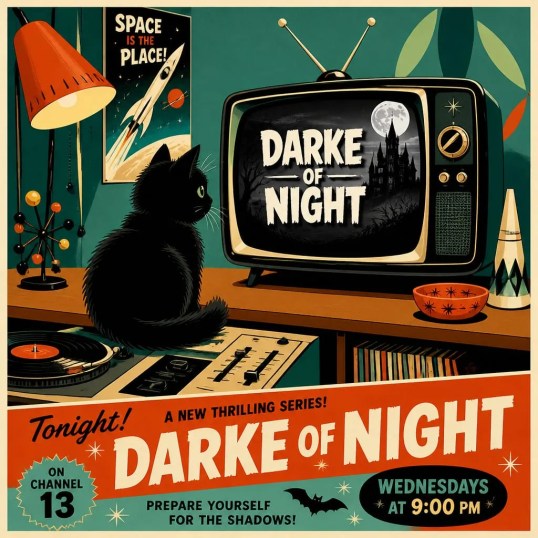
This week’s pilot originally aired as a part of the Studio 57 anthology show.

Episode 1.1 “Who’s Been Sitting In My Chair?”

(Dir by David Butler, originally aired on September 10th, 1955)

Johnny Darke (Jack Carson) is the hippest and coolest DJ in all of New York City .… or, at least, he’s as hip and cool as anyone could have been in 1955. All through the night, he spins records and talks to “the ghosts” who are listening. His station manager (Joseph Kearns) tells him that his sponsor doesn’t like it when Johnny talks about ghosts, but no one tells Johnny Darke what to do.

Johnny knows that a woman has been entering his apartment while he’s at the studio, but he doesn’t know why. (What I don’t know is why Johnny doesn’t just lock his door.) Johnny suspects that the woman is Margaret Canady (Jocelyn Brando), who lived in the apartment before Johnny moved in. Margaret’s boyfriend, Vincent Marsh (H.M. Wynant), is on death row for murder, but as Johnny learns about the case, he sees it as a story about two people who love each other as opposed to a woman who fell in love with a killer.

When Vincent breaks out of prison, he steals a guard’s gun and tells the guard that he’s going to use it to kill Margaret. (That was nice of him.) The police come down to the radio station and ask Johnny if he knows where to find Margaret. Johnny says that Margaret is probably at his apartment. After the police leave (and, strangely, do not immediately head over to Johnny’s apartment), Johnny calls his place and Margaret answers the phone. Apparently, Margaret’s not very good at secretly breaking into places.

When Johnny hears Vincent arrive over the phone, he hops over to his microphone and gives a cryptic message to “the ghost in the big brown chair” that the ghost who has just arrived is not in love with her. Then Johnny goes to his apartment and talks Vincent down.

This was a pilot for a series that would have featured Johnny Darke getting involved in the lives of his listeners. Jack Carson is likable as Johnny, which almost makes up for the fact that the story itself makes absolutely no sense. Why doesn’t Johnny just lock up his apartment before he heads to work? The implication is that Margaret is sneaking into the apartment to wait for Vincent to return, but there’s also a scene where it’s revealed that she’s secretly living with the building’s landlady. That scene is never followed up on. As I already mentioned, the biggest plot hole is that the police don’t immediately head over to Johnny’s apartment when they hear that Margaret is there. If they’re so determined to catch Vincent and they know that Vincent is planning on killing Margaret, why does it take them so long to actually go to the apartment? It seems like that should have been their priority.

Interestingly enough, the pilot ends with Jack Carson stepping out of character and offering up some statistics on the value of records purchased in 1957 ($4,000,000 worth) and the number of radio stations in the country. Carson explains that DJs are everywhere and every DJ has a million stories that could be adapted for Darke of the Night. He then brings on two actual DJs, Peter Potter and Al Jarvis. Both Potter and Jarvis endorse the idea of a weekly television series about a DJ.

It’s odd but, in its way, kind of touching. Jack Carson just seems so earnest and sincere about his desire to star as a radio DJ! Unfortunately, it didn’t happen for him. The pilot aired as part of the Studio 57 anthology series and that was that. Carson may not have gotten to play a DJ on a weekly basis, but two years later he co-starred in Cat on a Hot Tin Roof with Paul Newman and Elizabeth Taylor. Carson passed away in 1963 at the far too young age of 52, but he’ll live forever wherever classic movies are appreciated.
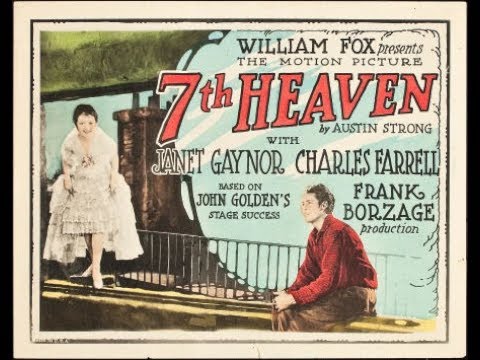
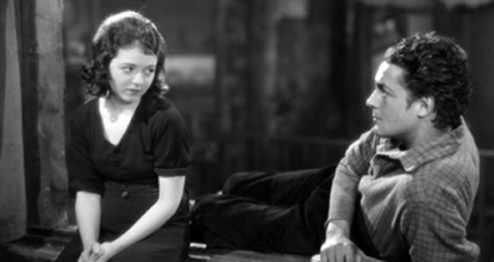
Lisa Reviews An Oscar Nominee: 7th Heaven (dir by Frank Borzage)


The 1927 melodrama 7th Heaven tells the story of two people in Paris.

Chico (Charles Farrell) works in the sewers but lives by the stairs.  Though he spends all of his days under the street and dealing with literally the worst that the world has to offer, Chico remains an optimist.  After all, he has his small apartment, which sits atop seven flights of stairs.  He has his dreams, which involve eventually getting promoted to being a street cleaner.  He doesn’t have much religious faith, which concerns Father Chevillon (Emile Chautard) but who knows?  Maybe something can happen to change that….

Diane (Janet Gaynor) is a desperately sad young woman who lives in squalor with her older sister, the cruel Nana (Gladys Brockwell).  When we first see Diane, she’s lying on the floor while being whipped by Nana and that’s pretty much the way her life goes for the first fourth of the movie.  Nana treats Diane less like a sister and more like a slave, sending her out to steal food and buy absinthe.  Diane and Nana’s father has made a good deal of money overseas but when he sees how they’re living in Paris, he rejects both of them.

How bad of a sister is Nana?  She’s so bad that, when she’s eventually arrested by the Paris police, she points out her sister on the street and demands that they arrest her as well.  Fortunately, Chico just happens to present at the scene.  Having already protected Diane from Nana’s abuse once before, Chico steps forward and announces that Diane is his wife!  The police ask Chico if he’s sure and then remind him that, if it’s found that he’s lying, both he and Diane could go to prison.  Chico, however, insists that it is true.

To keep the deception going, Chico allows Diane to move in with him.  When Father Chevillon arranges for Chico to get promoted to street cleaner, he also requests that Chico keep an eye on Diane.  Chico agrees and slowly but surely, the two of them fall in love.  Chico’s apartment, sitting atop 7 flights of stairs, becomes their 7th heaven.

However, World War I looms in the distance.  With all of Chico’s friends and coworkers receiving their draft notices and being sent to fight, Chico and Diane knew that it’s only a matter of time before the same thing happens to Chico….

As in so many other silent films, the shadow of World War I looms over every minute of 7th Heaven.  In the 20s, the Great War was still the main trauma that has shaped most viewer’s lives and one can imagine those viewers watching 7th Heaven and falling in love with the characters of Chico and Diane, all the while knowing that their happiness is only temporary.  If the 1st hour of 7th Heaven is a romantic mix of melodrama and comedy, the 2nd hour becomes a rather grim war film.  Even separated by war, Chico and Diane remain soulmates.  When Diane is told that Chico has been listed as having been killed in action, she knows that it’s not true because she can still feel their connection.  And yet, the final fourth of the film is so stylized and the final shot is both so beautiful and yet so artificial that the audience is left to wonder whether Diane is correct or if she’s simply dreaming what she (and, undoubtedly, the many other members of the audience who had also lost loved ones in the war) wishes to be true.

7th Heaven is a deliriously romantic film and watching it actually requires a bit less of an adjustment on the part of modern audiences than other silent films.  Director Frank Borzage keeps the action moving quickly and, even more importantly, Janet Gaynor and Charles Farrell both give sincere and naturalistic performances.  Never do they resort to the type of theatrical overacting that was featured in so many other silent films.  Instead, you watch the film and you truly believe that you are watching two people fall in love.  You’re happy when they’re happy and when tragedy strikes, you cry for them.  Their love is your love and their sadness is your sadness.

7th Heaven was one of the first films to even be nominated for Best Picture.  While Gaynor won Best Actress and Frank Borzage won Best Director, the award for Best Picture went to another World War I romance, Wings.

Cleaning Out the DVR Pt. 22: Winter Under the Stars


gary loggins's avatarcracked rear viewer

I haven’t done one of these posts in a while, and since my DVR is heading towards max capacity, I’m way overdue! Everyone out there in classic film fan land knows about TCM’s annual “Summer Under the Stars”, right? Well, consider this my Winter version, containing a half-dozen capsule reviews of some Hollywood star-filled films of the past!

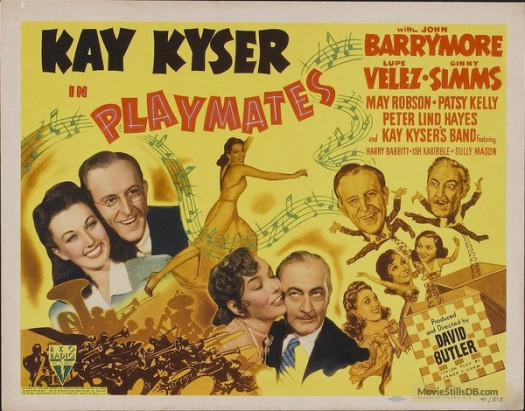
PLAYMATES (RKO 1941; D: David Butler ) – That great thespian John Barrymore’s press agent (Patsy Kelly) schemes with swing band leader Kay Kyser’s press agent (Peter Lind Hayes) to team the two in a Shakespearean  festival! Most critics bemoan the fact that this was Barrymore’s final film, satirizing himself and hamming it up mercilessly, but The Great Profile, though bloated from years of alcohol abuse and hard living, seems to be enjoying himself in this fairly funny but minor screwball comedy with music. Lupe Velez livens things up as Barrymore’s spitfire…

View original post 1,088 more words