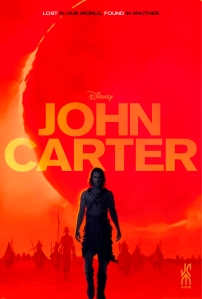
Quick Review: John Carter (dir. by Andrew Stanton)


John CarterThe First Impression:

John Carter is a cute Disney film that you may enjoy more than you’d thought you would. It’s lively like The Rocketeer was and really has some great moments and interesting characters. Both the leads carry their roles well, and are eye candy for the audience. It’s worthy of all of the love it should get, but obvious comparisons to movies that came before it (even though the story predates those films), along with a shockingly forgettable score by Michael Giacchino may actually hurt it. If you’re expecting blood and guts, not so much. It’s a Disney film. The kids should love it, though the pace of the film in the beginning may seem a little slow for younger audiences. Skip the 3D version and go for the 2D instead.

The Longer Version:

It’s really sad when you see a movie that deserves all the love in the world, but for some reason just doesn’t quite hit the mark. Part of that is due to the way this was marketed. It really didn’t feel to me that Disney was putting their all behind this. When you look at how heavily marketed Tron: Legacy was, this seemed like a “Hey, we made it, just give us money.” kind of push.

As far as John Carter is concerned, maybe it’s better to look at it like this. We tend to compare things to make sense of them:

This object reminds me of that object.

All of James Cameron’s Avatar reminds me of Ferngully.

Remember, Short Controlled Bursts. What movie comes to mind when I say that?

This is ultimately the problem with Andrew Stanton’s John Carter. In watching it, you’ll end up making comparisons to so many other films that came before it. However, knowing that it was based on the stories of Edgar Rice Burroughs, it’s a lot like seeing Lord of the Rings for the first time when all you know of Elves and Dwarves comes from Dungeons & Dragons, The Elder Scrolls games or World or Warcraft. Burroughs’ material predates just about everything it showcases, from a pop culture standpoint. Hell, for all I know, John Carter was probably the original inspiration for the Kwisatz Haderach in Frank Herbert’s Dune (though that’s just my speculation). The problem is, with comparisons being what they are, audiences may view John Carter as a copycat of all the movies that were probably influenced by it.

I didn’t walk into John Carter with a lot of expectations. Andrew Stanton, for me, has the track record of being Pixar’s Dark Horse. This is the same guy that killed off a mother and a hundred of her babies in the opening moments of Finding Nemo. A man who gave a bleak, dirty and desolate future in Wall-E. Yet, both of those films had a theme of love and of heroes that rose to the occasion, so seeing the previews for John Carter told me enough.

John Carter is the story of a man in search of a cave full of gold. He wants no part of anyone’s battles and when he’s asked to join a faction, he does his best to avoid it. This leads him to a situation where he’s transported to another world. Just as it was with Earth, he encounters a number of different factions (all of which seem to feel he could aid them), but he simply wishes to return home. When he meets a fierce female fighter (who also happens to be a scientist), they work on figuring out how he arrived on Barsoom and how to get back.

The beautiful thing about John Carter is that it really feels like one of those old serials, or to make a more modern comparison, like an adventure film on the Indiana Jones level of things. There are a number of scenes where I found myself genuinely laughing at what was on screen. The visuals could be better in some places, but it’s nothing that’s groundbreaking. I look at John Carter as a pop culture lesson. You can see where other stories have used elements in the Burroughs tale. In that, it worked for me. The action scenes were really enjoyable for me, but some of the scenes between that could have been tighter. When you find out the reasoning behind Carters arrival, you may end up wondering why more wasn’t done with it with that story arc (on a technical level, anyway). As I’m unfamiliar with the original John Carter stories, I watched a few interviews of the cast and Taylor Kitsch noted that in the books themselves, Carter was pretty much the same person through every one. Stanton added a bit of character depth to him, with a little help from Spider-Man 2 scribe Michael Chabon. Chabon’s also responsible for the great Wonder Boys and The Adventures of Kavalier and Clay, which I still haven’t finished as of this writing. Carter is a conflicted individual for Disney purposes, but you shouldn’t expect Oscar performances here. It’s far better then Immortals was, in that sense.

Both Taylor Kitsch and Lynn Collins do well with their roles. Having worked together for about a hiccup in X-Men Origins: Wolverine, they have a good chemistry together. Kitsch is gruff with his mannerisms, and I can almost forgive him for playing Gambit. Collins is beautiful, statuesque even, and her character really does a lot of damage, fight wise. She’s very strong in some areas, though later on in the film, it felt like they may have eased that down a bit. Willem Dafoe has an inspired role in the leader of one of the alien groups that find Carter first when he arrives in Barsoom. Of course, no film would be complete without a villain and John Carter features two in Dominic West (Zack Snyder’s “300”) and Mark Strong (who’s almost always a go to bad guy). West’s character is more of the take action baddie, while Strong’s character is more of a calculating, behind the scenes one. Of note are Samantha Morton (“Minority Report”) as Sola and a little creature called Woola, that really reminded me a lot of Dug from Disney / Pixar’s Up. I wouldn’t mind having a few of those around the house.

The music for this film worked when the scenes were slow. However, when it called for action, I really didn’t feel anything special about it. I stayed to watch the credits only to find that it was Michael Giacchino’s work, who’s normally really good. I don’t know, this one seemed like it was phoned in for the action scenes. It’s okay, but I didn’t have that urge to buy the soundtrack afterward (which I have done for more memorable scores after leaving the theatre).

Overall, John Carter was a fun film in the vein of Disney’s earlier movies, but it’s not anything you absolutely have to run out to the theatre for. I’d love to see it do well and hope that there’s a sequel on the way, but when you’re paying a good $15 dollars for a 3D movie ticket ($20 for an IMAX 3D showing), the visual return on investment isn’t all that great. The story was enjoyable and didn’t slow down too much, but you may find yourself thinking that you’ve seen this film before in the way that so many other movies reference Burrough’s tale.

As a bonus, Disney released 10 minutes of the film. Enjoy:
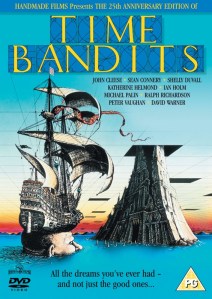
Quick Review: Time Bandits (dir. by Terry Gilliam)


My parents used to have some strange movies growing up. Time Bandits is one of those films that I kind of stumbled on, but grew to be one of my favorite British films. It was my gateway drug to all things Monty Python.

Produced by former Beatle George Harrison and his company, Hand Made Films and running off the success of Monty Python’s Life of Brian, Time Bandits runs off of a simple premise. The Supreme Being once had a map of all the points in time on Earth. A group of his servants steal this map in order to travel through time and use it to plunder various historical figures of their loot. Granted, it’s a strange story, but if you’ve watched anything Gilliam’s done, this film actually works (or did for me when I saw it).

Our story opens with a boy named Kevin (Craig Warnock), who dreams of a more interesting life than the one he shares with his parents while watching tv. One night, a set of little people dressed in steampunk attire climb out of his closet and threaten him bodily harm unless he tells them how to escape his dimension. They manage to locate an exit, only to be pursued by The Supreme Being, who warns them to return the map they’ve stolen from him. If I remember nothing else from this film, that one scene will always stay with me.

The crew, led by Randall (David Rappaport) arrive during Napoleon’s time (played quite convincingly by Ian Holm) and manage to become generals in his army after impressing him with a rendition of “Me and My Shadow”. This, coupled with their size helped out, I’m sure. As thanks for being part of his army, they get Napoleon drunk until he passes out and collect most of his loot before finding another time portal and leaping into Robin Hood’s time. Unfortunately for the Time Bandits, Robin Hood (John Cleese) assumes they’ve arrived to give their ill begotten goods to the poor and promptly gives it all away to them.

In the midst of figuring out their next step, the Bandits run into The Supreme Being again and distract him, giving Kevin a chance to escape on his own. However, when two portals open before him, he chooses the wrong one and ends up in Ancient Greece with King Agememnon (Sean Connery), who adopts Kevin as a Prince. Before he can fully enjoy it, however, the Bandits show up and “free” from the time period he doesn’t belong in.

There’s more to the tale, but let’s just say that the Evil Genius (one of David Warner’s best roles in my opinion – he had a knack for playing bad guys) gets wind of the Map and hatches his own plan to acquire it and use it for nefarious deeds.

The beauty of Time Bandits is the world it creates. Though grounded in real time periods, the fantasy elements are pretty interesting, much like Brazil was. Giants who wear ships on their heads, Ogres and creates with cow skulls for heads make up some of the strange visions Terry Gilliam brings to this story. Overall, it’s a fun and unique tale that’s good for at least a late night viewing, and one that I return to from time to time.

Quick Review: Haywire


Note that this probably won’t be the only review for Haywire. I think everyone at the Shattered Lens is going to see it, so it’ll be cool to see what we all thought of it. For any other reviews that come up, I’ll update this one to link to it.

I didn’t expect a great deal with Steven Soderbergh’s Haywire. Walking into it, I thought of Steven Seagal’s “Above the Law”, Pamela Anderson’s “Barb Wire”, Bruce Lee’s “Fist of Fury”, Antoine Fuqua’s “The Replacement Killers” and Jean-Claude Van Damme’s “Bloodsport”. All of those films worked to showcase either a martial arts star doing what they do best or a filming technique (in the case of The Replacement Killers’ John Woo love) to audiences. Ultimately, this is what Haywire is. It’s MMA fighter Gina Carano’s spotlight moment, giving her the chance to show what she’s got. In essence, you’re watching an expensive demo reel.

I’ve followed Carano through her MMA fighting career, thanks to a friend who introduced me to the Showtime fighting specials years ago. After her fall to Cristiane Cyborg (who is just as deadly in the ring), Gina kind of stepped away from a bit. I, for one, am happy to see her back in some form or fashion.

And she’s great as an action star, when there’s action happening. There’s just not enough of it, though. Watching Haywire for me was like seeing Jet Li in “Unleashed”. You’re begging for Soderbergh to just let Carano go wild just kick everyone’s ass, but alas, it only happens in short, controlled bursts. Perhaps that’s a good thing, considering that there is something of a story unfolding. When there isn’t any action, Gina’s Mallory Kane makes a brooding face and always looks poised for the next fight.

The movie does two smart things – It lets Carano do her thing, and gives her a cast that tries to help her out.

Soderbergh surrounds Carano with enough talent that you almost forget to concentrate on her and where she’s going. She does okay on her own with her focused stares and cool demeanor, but the supporting cast seems to help out when they can, some becoming human punching bags in the process. No one member of the supporting cast shines, but collectively, they do well.

Like the Bourne films, there’s very little music used during the actual fight sequences. That does help to let you focus on what’s going on in front of you. Musically, I’ll admit I liked it.  Instead of composer Cliff Martinez, who I felt did really well on Contagion, we have David Holmes again who worked with Soderbergh on all three Oceans films. He gives the movie a 70’s spy vibe that hinges on almost sounding like it could be used for the TV show Archer. Make of that what you will. I enjoyed it.

Haywire is the classic tale of a Government Agent on the run from the people who made them what they were. You’ve seen it before. Bourne, every other film like Bourne, and most of the Transporter series. What Haywire tries to bring to the table is someone who happens to be fully capable of taking and dishing the blows that come with the close quarter fight scenes that occur. Carano is easily Haywire’s strongest point.

Here are Haywire’s problems:

– Mallory is cool and all, but don’t expect much in the way of character development. This is an action movie. You’re not going to learn much about Mallory Kane other than she’s lethal and loves her father. That’s about it. If you want character growth spurts, you’re better off watching one of the Awards contenders.

– Don’t expect action all the way through. Haywire has some lull points as with any movie, and at the late night showing I went to, someone was snoring on the left side of the theatre. Be prepared for that.

– The movie has the potential of running a “See Gina Run”, “See Gina Fight”, “See Gina Run & Fight” loop. I personally didn’t mind this at all, but it may see to be a little repetitive to some. The fights are brutal and fantastic and I’d personally like to know if any stunt people were hurt.

Overall, for a January release, Haywire isn’t bad at all. I could easily see Gina Carano doing a few more of these and rising as an action star. Until then, I’ll be heading back to this one pretty soon.

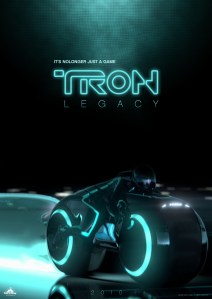
A Guilty Pleasure – Tron:Legacy


For January, one of the themes for this month were “Guilty Pleasures”- those films that you simply can’t get enough of, despite how good or bad they may actually be. My first contribution for this is 2010’s Tron: Legacy.

When I look at Tron:Legacy, I see two things. I see a missed opportunity in trying to break new ground for the story, and a hint of promise from it’s director, Joseph Kosinski. I attended the premiere for the movie at the IMAX with a friend and his son, and was totally with it for the first half of the film. However, in it’s second half, it slowed down just like the film before it and admittedly, I almost fell asleep. Let’s face it, Tron as an overall universe was never really that strong.

And yet, I watch it just about every time it’s on, if only for the Lightcycle Race and Clu’s speech. Seeing the grid in an updated view and the new look of the light cycles always brings a smile to my face. Granted, it could be listed just as a Scene I Love, but I find I can tolerate most of the film.

Let’s go with the Missed Opportunities first.

Tron: Legacy’s biggest problem is it really only gave the audience a rehash of the original tale. While the angle with Sam and Kevin Flynn were interesting, along with Clu being a villain this time around, I feel the writers really could have taken the story places. Instead, they went the lazy route and decided to go with what anyone who saw the original film could remember – a problem that I feel plagues many sequels / remakes of old films. I figure if you’re going to do a sequel to film that’s more than 5 years old, be seriously prepared to throw something (at least one thing) new on the table.

When James Cameron made Aliens back in 1986, he took Ridley Scott’s tale and built on it, expanding on the Aliens universe with the addition of the Colonial Marines and the Alien Queen, giving the creatures themselves a sense of heirarchy. For Tron: Legacy, the only real new element would be the ISO’s, but then we’re never really shown just what they’re capable of, within or outside of the grid. It’s an empty element that only serves the purpose for bring Sam and Kevin together.

Tron: Legacy also suffers from a Video Game Tie-In Syndrome, something I’ve hated ever since The Matrix Reloaded. Back when that movie was due to come out, Warner Bros. And Atari came up with the idea of making a Video Game that would bridge the gap between certain elements in the story. If you play Enter the Matrix, you’ll actually have a slightly more complete story than you would by just seeing the film. That robs the audience of content. Granted, they don’t need to know everything, but Tron: Legacy has a few elements that are only really understood in the story for it’s video game, Tron: Evolution.

Then there’s the sense of promise.

Joseph Kosinski was originally a commercial director, his most famous being one for the game Gears of War that featured the Gary Jules version of “Mad World”. Between this and his Halo commercials, it made sense that for the visual style that Tron: Legacy needed, he’d make a perfect fit. Tron needed something new, wasn’t that critical of a franchise to play with and gave Kosinski the freedom to take it wherever he wanted to go (within the constraints of what the writers gave him, of course). For a first time film director, I think he did very well, but that’s just me. It should also be noted that it was his idea to bring on Daft Punk for the soundtrack. If the movie is remembered for anything over time, it’ll be for the music, because that score is just cool.

Tron:Legacy on a visual scale is really beautiful, and it’s cool to see the design updates in the machines, by way of Digital Domain and other F/X companies. That alone is enough for me to watch this repeatedly (it’s on as I’m writing this). I haven’t found myself compelled to pick up the Blu-Ray, but Starz and Netflix have it available to watch.

If he’s lucky, Kosinski may end up getting a project that he’ll really take off with. Maybe it’ll be something of his own making or another remake, but for me it’ll be interesting to see where he goes.

Leonard’s Favorite Films for 2011


As we are all sharing our favorites films of 2011, here are some of my own off of the top of my head that stayed with me:

1.) Hugo (Directed by Martin Scorsese)

Of all of the films I’ve seen this year, Hugo was the only one that felt more like an Event than just watching a story. The story of a young boy who inherits an automaton from his father and is looking for a way to fix it, it’s simply a beautiful story of discovered paths, creative endeavors, and lost dreams. What makes the movie great is that the story centers on the birth of cinema. Any movie lover, once they see where the story moves is bound to end up with a smile on their faces. Strong performances by Ben Kingsley, Asa Butterfield and Chloe Grace Moretz help to move Scorsese’s film along, and the vibrant backgrounds are just beautiful. Hugo happens to be one of few live action motion pictures that really demands to be viewed in 3D. I’ve never seen a film use it better, and that statement actually includes James Cameron’s Avatar. Scorsese makes you believe he has a grasp of what the audience needs to see and it’s conveyed so well that I can imagine studios not making Hugo a Thanksgiving re-release next year. It truly is that good, and is my Best Picture Pick, though if Shame won, I wouldn’t be upset.

2.) Shame (Directed by Steve McQueen)

We all have our addictions (be it something that hurts or helps you) and it’s because of this that Shame hit a personal note with me. Sometimes you go into a film just expecting to see a story, only to find what you’re seeing has more to do with you than you previously thought. Last year, Black Swan was that film for me. Right now, with the exception of Gary Oldman in Tinker Tailor Soldier Spy, I can’t think of a better Best Actor nomination than Michael Fassbender. His Brandon Sullivan is a tortured soul who on the surface appears to be “normal” in every way, but is driven by his desires. The life he’s built for himself is thrown into turmoil with the arrival of his sister, Sissy (Carey Mulligan, in an equally strong role), who suffers from issues of her own. Brandon’s sex addiction drives him to different avenues, and the hopes you have that he’ll somehow make it through are picked away by every instance where he falls. McQueen pulls no punches, as the NC-17 rating explicitly displays the life Brandon leads, doing so in such a way that the audience can’t feel any sort of amorous feelings over what’s on screen. Not since Requiem for a Dream have I felt so hurt by a film. Both films show just how far people can fall. Case in point: When the credits came up in the dark on my showing of the film, no one in the audience moved for nearly 3 minutes, and sit in silence. That was the impact it had. Long tracking shots carry the audience with the characters, and I find that McQueen didn’t care about lighting. There is one point where characters speak but the lighting is dim, but it comes across as just real. Other situations have locations that I’ve been to from time to time, so it was easy to relate to. You’re not even told how Brandon and Sissy got to where they are. It’s not necessary for this particular story. The movie basically says, “This is the important part, deal with it.” and damn if that’s not cool. Overall, it’s Fassbender who carries the film and I wouldn’t be surprised to see more films from this pair in the future (note that I haven’t seen Hunger, yet).

3.) Melancholia (Directed by Lars Von Trier)

I’m not sure how to describe Melancholia. I could say that it’s simply a beautiful story about a girl suffering from depression. I could also say that it’s an artful tale about the end of the world. When I really think about it, Melancholia is about reactions (to me, anyway). Kirsten Dunst’s Justine suffers from Melancholia and because of it, her wedding isn’t going as well as her family would like. On the surface, it appears that she is the one the biggest problems, but when a small planet (also named Melancholia) also threatens to collide with the planet, Justine becomes the grounding individual when everyone else around her appears to be losing it, and I found that to be mesmerizing. The one person who everyone seemed to have a problem with (save for her most patient sister and loving fiancée) becomes the person you’d want by your side at the end of all things. The opening of the film may seem a little off-putting with it’s slow motion overture, but these are the moments that as a viewer you should be paying the most attention to. Ironically, it isn’t until the end of the film that you may realize you want to remember what you saw in those opening moments. An easily recommended film that stays with you long after it’s ended. I saw it last week, and it’s still on my mind.

4.) Tinker Tailor Solder Spy (Directed by Tomas Alfredson)

Tomas Alfredson’s Tinker Tailor Soldier Spy teaches us that the spy game really isn’t full of the fancy James Bond gadgetry. It lacks the Jason Bourne Jujitsu and freerunning. During the Cold War, we knew who our enemies were, they knew us and everyone moved like pieces on a Chessboard. Not willing to risk a third World War (which would undoubtedly be atomic), moves were quiet. Taking place in the early ‘70s, a botched mission that has the potential to reveal a mole within the upper echelon of a British Spy Network brings former spy George Smiley (a remarkable Gary Oldman) into the fray to find out who among the top four members could be the mole. While the film doesn’t move at a great pace (and given the time period, it really shouldn’t), it really deserves a viewing. Although Oldman’s Oscar worthy performance is bound to be noticed, I think that Benedict Cumberbatch also did really well here. Cumberbatch, who I never heard of before until the recent announcement that he’ll be in the next Abrahms Star Trek film, carries his own with the likes of Toby Jones, Ciaran Hinds and Oscar Winner Colin Firth with ease, and I’m sure he’ll be a picking up an award or two somewhere down the line for a future role. The film itself is a great thriller, but requires a lot of patience to be really appreciated.

5.) 50 / 50 (Directed by Jonathan Levine)

I already wrote a review for this film. The only thing I’ll add to what I said there is that for as simple as the movie is filmed, 50/50 gets its message out to the audience. The actors keep the film moving forward and Joseph Gordon-Levitt will have you alternately smiling and maybe tearful at some of the emotions he goes through. There’s very little I can say on that. This was just a great film to see.

6.) Sucker Punch (Directed by Zack Snyder) 

Sucker Punch is one of those unfortunate films where for some, the hype for it exceeded what the film gave the audience. I believe that this is partially due to the nature of the story. I think perhaps the audience may have been expecting to see girls kicking ass 24/7 throughout the movie but never run into any actual problems. The real world problems that the women in this movie endure are why the fantasies are made. The near rape sequence in the beginning of the film bothered me to the point that I couldn’t effectively write a review, but scenes like that and others helped to drive home the dangers the characters faced. This (their handling of things) was one of the elements I also loved about Sucker Punch. Viktor Frankl once stated that regardless of what happens to a person, they can choose how they react to a given situation. You can choose to let something hurt you, or choose to hold on your happiness. In Sucker Punch, Baby Doll chooses to hold on to her strength by using her imagination to her advantage. That’s all the fantasy sequences are really about. If it were shown without them, you’d basically have Escape from Alcatraz. Sucker Punch is stylish and in your face. No complaints here with that.

7.) Drive (Directed by Nicholas Winding Refn)

Drive is another movie I reviewed, and while I stand why what I said in that review, I have to note that based on Valhalla Rising, Drive is a stronger film than I previously mentioned. I’ll admit that I’m excited to be able see it again, knowing the tone of the film.

8.) Captain America: The First Avenger (Directed by Joe Johnston)

If you told me that Captain America was worth seeing, especially after I just walked out of seeing The Wolfman, I’d have laughed in your face. Truth be told, I saw Captain America twice in the theatre, I liked it so much. It was a great popcorn movie that didn’t take itself too seriously, yet cemented itself in the Avengers storyline stronger than all of the previous films before it (and that includes Thor). Green Lantern could have definitely learned something from this film.

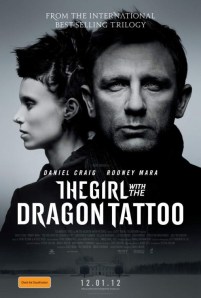
Quick Review: The Girl With The Dragon Tattoo (dir. by David Fincher)


Addendum: Leonth3duke has added his own thoughts on The Girl With The Dragon Tattoo, which are worth reading. Lisa Marie has also added her own viewpoint on the film.

I think had I not seen the Swedish version of The Girl With The Dragon Tattoo, this would be a far easier review to write, really. I tried reading the book a number of times, and found it really tough with Larsson’s exposition to stay with it. As such, this review is somewhat biased, perhaps heavily so, and it may be a little spoiler-ish. My assumption here is that with the novel having been available for some time now, and a separate movie to watch, there are very few people who don’t know what the story’s about.

A funny thing happened while watching David Fincher’s The Girl With The Dragon Tattoo the other night.  In the middle of the film, the projector turned off. After I calmed down, eyeing the exits and thinking the Blob might have made it’s way into my theatre, the audience had fifteen minutes of quiet to wait and give their thoughts on the movie.

One fellow stepped down from the seats, ready to ask for his money back when he stopped and turned around.

“Does anyone know what the F this movie is about? ‘Cause I’m frickin’ confused!” he raised his arms to the audience, pleading for reason.

“It’s about a girl with a Dragon Tattoo.”, Someone yelled back.

“What is supposed to mean!?” The angry man replied, sounding a lot like Rooney Mara in The Social Network. “All I’ve seen is Bond shiver his butt off and this chick type away on her laptop. This is garbage.” And with that, he left.”

“Yeah, this is some bulls—.”, Another fellow said as he left.

Needless to say, the movie resumed. There was a problem that caused their fire alarm to shut off and it stopped every film in the theatre. I’m not sure how much I may have missed, but I’ll probably see this again during the weekend.  I know, it’s not the best of review lead ins.

The simplest thing I can say about The Girl With the Dragon Tattoo is this:

– If you read the book and saw the Swedish film, this version only puts on a coat of Fincher Paint on the story. From the opening credits that rival the one in Se7en to the fade to black, it’s all distinctly Fincher’s touch on things.  You could almost argue that it feels like a Bond film, the way they did it. This basically means that the lighting might be dimmer in some places and the film may be more stylized. It comes across feeling more like a motion picture than the Swedish version, which to me felt a little more like a tv movie.

If you never read the book, I would highly recommend the Swedish version first. It’s on Netflix, and as some of the material is delicate, doing so would give you the freedom to hit the pause or fast forward button should you find yourself uncomfortable. That’s kind of hard to do in a movie theatre without walking out on the money you spent on a movie ticket.

And if you saw the Swedish Version, missed the book and are wondering if you should spend your money on this, Rooney Mara really is the only reason to give this a try. It’s essentially the same story, but with a different ending that’s tighter and closer to the book than the Swedish Film. While Rooney’s Salander may not be hard hitting as Noomi Rapace’s Salander , she deserves so much credit for throwing herself into this as deep as she did, and helping to create her own version of Lisbeth.  Daniel Craig, on the other hand, seems to be more restrained here.

The Girl With the Dragon Tattoo is the story of Mikael Blomkvist, an editor in chief of a magazine called Millenium in Sweden who is dealing with a mishap on a libel case against a magnate named Hans-Erik Wennerstrom. His recent notoriety catches the attention of Henrik Vanger (Christopher Plummer, who’s really having a great year), who asks him to investigate the 40 year old murder of his niece, Harriet. Of course, prior to asking Blomkvist to take on the case, Vanger’s lawyers perform a background check on him with the help of Lisbeth Salander (Rooney Mara). Salander happens to be both an ace Hacker and sports a photographic memory, which makes snooping into Blomkvist’s files a cinch.

Eventually, through his investigation of the Vanger Family on their private island, it becomes apparent that Blomkvist needs a little assistance, so he asks the lawyers if Salander can be brought on to work with him. It’s when the two characters meet that the story really picks up some steam.

While I loved it (I’m going back to see it again over the weekend, I think), there was the odd feeling that something was really off. At one point in the film, I find myself quirking my brow, because it occurred to me that there was just a little too much sex in the movie. I understand that’s not something one should complain about, but the Swedish version of the film led me to believe that Salander’s motives for any kind of passion were just a “want, need, have” and move on. In this version, she came across almost needy. It’s not even the right word. Where Rapace’s Salander felt cold and calculating even though the later parts of the story, Mara’s Salander feels like she’s warming up to Blomkvist emotionally. Of course, this could be attributed to screenwriter Steven Zaillian (Schindler’s List, Searching for Bobby Fischer) playing the story closer to the book than the other film, but it was strange for me in that sense. Fincher, who is notorious for control over his scenes may also be to blame here. If you have access to the behind the scenes for The Social Network, you can watch some of his interviews on the behind the scenes to get an idea of just how much he likes to control where a scene goes.

I don’t hate Fincher. I own Se7en, Fight Club and The Social Network and love all three of these, but even I have to admit that as cool and as stylish as the film is, something’s just off. I loved the film, but it’s just different.

The movie was advertised as the ‘feel bad film of the year’, and in that sense, they’re not lying. Keep the kids home, please. All three versions of the story contained a rape scene. Fincher and Co. Don’t pull any punches here, making it all a little disturbing for anyone not actually prepared for it. One standout to the film has to be the score, developed by Oscar Winners Trent Reznor and Atticus Ross (something I’ll never be fully able to handle saying, having been a Nine Inch Nails fan since the mid ‘90s). The movie has no clear-cut theme to it, but the music that fuels the scene add an extra layer to things. That I really enjoyed.

So, overall, the remake didn’t really need to be made, but it does make me interested to see what Fincher and Zaillian have in store if they decide to continue the Millenium Trilogy. My hopes are that they give Lisbeth Salander a bit of a sharper edge than she already has. Mara herself, they don’t have to worry about. She’s a definite lock as Salander, and I’m happy for her on that. It’s where they choose to take her that I’m concerned about.

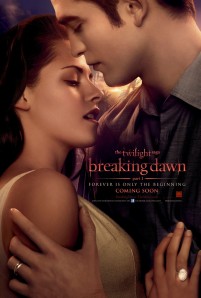
Film Review (plus a Twilight Primer): The Twilight Saga – Breaking Dawn, Part I (dir. by Bill Condon)


“Harry Potter is about confronting fears, finding inner strength and doing what is right in the face of adversity. Twilight is about how important it is to have a boyfriend.” – Stephen King

I have a problem with the notion that says you have to have someone in your life in order for your life to be considered perfect or grand. I’m of the mind that you step into the world alone and leave it the same same way. Even if you are surrounded by your nearest and dearest friends when you pass, you’re still the only one making that trip. And while I love the notion of Romance, I don’t believe it needs to translate to “Omigod, if you’re not near me, I’m going to jump off this building, I swear it because I can’t talk about you without stammering.” or the other obsessive notions that Twilight seems to bring up. This doesn’t mean I outright hate everything that Twilight is, but I’m not totally fond of the overall message it conveys. Perhaps I’m just emotionally cold that way.

And yet, I may know more about Twilight than any other guy in the known universe. It’s an enigma, I know.

A little background on why I, a guy, am writing a review for The Twilight Saga: Breaking Dawn, which is pretty much geared for girls. Note that I’ll refer to the film just as Breaking Dawn, because I really don’t see Twilight as a Saga by any means.

In the early 90’s, I hit a “Vampire Phase”. Between playing games of Vampire: The Masquerade and reading every Vampire Chronicle novel that Anne Rice wrote up until Tale of the Body Thief, I was pretty involved. I grew up with Vampires that were monsters to be feared (and sometimes admired), and dodged the sun more or less. I even owned two vampire encyclopedias. Somewhere between Mark Danielewski’s “House of Leaves” (a book I still haven’t finished) and Andrew Davidson’s “The Gargoyle”, I picked up a hardcover copy of Stephenie Meyer’s “Twilight” from Barnes & Noble. I didn’t think much of the books, save that they were quick reads. Meyer and her vampires were far from Rice and her universe lacked the erotic flair of Laurell K. Hamilton’s earlier books in the Anita Blake series. They were more or less books for teens, but they had vampires in them, so I pretty much inhaled all four books (Twilight, New Moon, Eclipse, and Breaking Dawn) twice in Hardcover. I even went so far to read Meyer’s “The Host” and have seen all of the other Twilight films in the theatre. While they all seem to be really close to the source material, there’s something strange in the translation. What made sense on paper really didn’t on screen (Sparkling Vampires jump to mind), but I guess that’s for an Editorial.

So, when it came to reviewing Breaking Dawn, we at the Shattered Lens drew straws. While we hold to the tenet that any movie can be reviewed by anyone even if the movie was previously reviewed by anyone else (for alternate viewpoints), this was a film that was pretty much off our collective radars. I think we all secretly wanted Lisa or Erin to take it, but both Lisa and my cousin gave the argument that I could probably give a different perspective on the film than all of the girls who planned to see it, most of whom would sprout something like the following:

“I love Edward so much, and that he took his time with Bella was just so heartfelt that I wanted to cry. I felt so bad for Jacob that he could haven’t have her. He deserves better than that!! If anyone doesn’t like what I’m saying, then I will come to their houses and stab them with rusty blades in their beds because no one – I mean no one – gets in the way of my Twilight Love!! You haters could suck it! Team Edward/Jacob Forever!!!!”

So, here I am, writing this. Let’s see what becomes of it, shall we?

For those of you who managed to avoid the Twilight books and movies like they were Sutter Cane novels, here’s everything you’ll ever need to know.

Twilight is the story of Isabella Swan (Kristen Stewart) who moves from Arizona (where Meyer lives) to Forks, Washington to live with her Sheriff father, Charlie (Billy Burke). While in school, she meets an interesting but strange fellow in Edward Cullen (Robert Pattinson). After being saved from a near fatal car crash in an impossible fashion by Edward, Bella becomes intrigued with who and what he may be. A little big of Googling and book buying leads her to discover that Edward is in fact, a Vampire. He explains he’s dangerous. She doesn’t care. He states he’s a killing machine. She loves the danger. He steps into the sunlight to show he doesn’t burn, he just sparkles. She’s just mesmerized.

The original Twilight was Bella’s introduction to The Cullens (who are more or less Vegetarians in that they don’t go after humans, but animals instead):

Carlyle (Peter Facinelli) – Father figure and Doctor. He recruited the rest of the family.

Esmee (Elizabeth Reaser) – Carlyle’s Wife and Mother Figure.

Emmett (Kellan Lutz) – The Muscle of the Family and companion to Rosalie.

Rosalie (Nikki Reed) – Emmett’s Companion and is pretty much opposed to Bella up until Breaking Dawn, for reasons she explains in Eclipse.

Alice (Ashley Greene) – Companion to Jasper and has the ability to see the decisions that others make before they make them.

Jasper (Jackson Rathbone) -The newest vampire of the group and companion to Alice. Has the ability to manipulate the emotional tides of others.

In Twilight, Bella and the Family run into a trio of vampires, one of which decides he has to hunt down and kill Bella (because she’s food). The family is able to kill the vampire and get on with their undead lives, not before a final parting shot showing the vampire’s girlfriend and her desire to kill Bella in return. Bella decides it’s in her best interests to become a vampire and tries to persuade Edward to change her, but he refuses, citing she has many years ahead of her worth living.

In New Moon, Edward decides to celebrate Bella’s birthday at his place. After an accident occurs that leaves her bleeding, Jasper loses it and attacks her. The family is able to save her, but this convinces Edward that it just won’t work out and the entire family leaves town. Left on her own, Bella spends the next four months crying and screaming in her sleep over Edward until her father convinces her to hang out with her friends. She ends up spending more time with Jacob Black (Taylor Lautner), a friend who lives on a nearby reservation that clued her into what the Cullens really were. They get closer as friends and eventually, she discovers that Jacob and his family are actually Werewolves. While cool, she also learns that the Werewolves don’t get along with Vampires and despise the Cullens. They haven’t killed the vampires because of a Treaty that was enacted long ago. Werewolves stay on their side, Cullens on the other and no humans get hurt. Victoria (the girlfriend of that dead vampire in Twilight) returns to town to kill Bella, but she’s protected by the Wolves. She ends up doing a little cliff diving, which catches Alice’s attention and she manages to reunite with the family, though learns that Edward plans to kill himself. Edward believes she died when she jumped off the cliff, volunteering himself to death by the Vampire Congress known as the Volturri.

Alice and Bella fly to Italy and intercede, rescuing Edward from his fate and meeting the Volturri. As Bella knows too much, the Volturri leader demands that within a year she has to becomes a vampire. This of course, excites Bella and annoys Edward, who throws in a “Let’s get Married First” clause into the works. The idea of this is to help give closure to all the humans in Bella’s life. She reluctantly agrees to it. Jacob catches wind of this and spends the next book & film, Eclipse, trying to convince Bella that she should live and that he’s the better choice of a love interest.

Okay, Eclipse. Victoria knows that she can’t get to Bella on her own without dealing with both the Werewolves and the Vampires. She finds a resident of Forks in Seattle named Riley Biers and changes him to a Vampire, convincing him that the Cullens are bad and killed her friend. He builds an army and they attack the Cullens en masse, but somewhere along the line, Victoria forgot to mention there may be giant dogs in the area. The Cullens and Werewolves join forces and defeat the newborns with ease. In the process, Bella learns more about the Wolves and their ability to “Imprint”, meaning they basically obsess over one person for the rest of their lives (much like whales, I suppose). Luckily, Jacob hasn’t Imprinted on Bella yet. Edward eventually dispatches Riley and Victoria, leaving the romance to continue. In Eclipse, the Cullens explain to Bella how they came to be, partially to help her what she has to look forward to, positive or negative.

And all that brings us to Breaking Dawn, Part I.

Of the Twilight movies, I still feel Eclipse was the strongest one. Breaking Dawn covers everything the 1st half of the book does and manages to do it without stepping past the PG-13 bounds it created. The film starts off with Edward and Bella’s Wedding, with different reactions from everyone. Jacob hates it, wolfs out and runs to Canada. The Cullens are ecstatic. Charlie manages to deal with it. The wedding ceremony is done well, and gives some screen time to all of the high school friends (who we won’t be seeing after the wedding). Stephenie Meyer herself even has a cameo here (and eerily looks like my mother). Even the honeymoon is done better than I thought it would. Anyone expecting Bella and Edward’s honeymoon to look like something out of a late night Cinemax series may be disappointed, but the romance is nice to see and there were some laughs in the audience. Again, it’s Twilight. I’m not expecting Jane Eyre or Sense & Sensibility romance levels. At least, that’s what the snoring mother sitting next to me who brought her kids felt, I think.

After the married couple’s wild honeymoon, Bella discovers she’s miraculously pregnant and even worse, the unborn child is sucking the very life from her. The wolves find out about this and feel that she needs to be eliminated, along with the rest of the Cullens, as it breaks the Treaty. Bella is rushed home while the Cullens try to find a way to save both the baby and the mother. Will Bella make it? Will the Wolves pounce on the vampires? Those are some of the questions brought to the table.

Jacob finds himself taking sides with the Cullens, which causes him to recall his Alpha Status in his wolf pack and stand alone (or nearly alone) against his family. In the book, this was done pretty well, but translated to the screen the scene with wolves telepathically yelling at one another seemed a little cartoonish. Just change back to people and talk it over. I guess it was done that way to show how animals have the whole Alpha / Omega relationship, and remains one embarrassing moment in a sea of scenes that were okay.

Visually, Eclipse was a serious step up from both Twilight and New Moon. Breaking Dawn seemingly returns to the look and feel of the original Twilight, right down to Carter Burwell’s score. With the exception of the Bella’s Lullaby theme (which worked incredibly well, especially at the last two minutes of the film), the music felt a little weak to me.  I actually preferred Howard Shore’s score to Eclipse. Don’t get me wrong, the movie goes where it’s supposed to, but you’d expect things to look a little better as it goes along. It would be nice if they improved on that.

One other thing I’ll give this (and that’s all of the Twilight mess) is the audience. I live for seeing audiences react to what they’re seeing on the screen, and I can’t remember a more reactive audience set since Captain America. Some of the girls who go to see this really go wild over it, and some of the guys grumble loudly. My theatre was packed, right down to the front seats where you have to crane your neck up to see everything. It’s the closest to a Midnight Movie experience you could have at a Matinee.

The big problem Breaking Dawn Part II will have will be trying to be exciting, because there isn’t a lot that occurs in the second half of the story that’s worthy of stretching it out to nearly two hours. It’ll be interesting to see what they do with that.

Overall, Breaking Dawn doesn’t really break any new ground in Vampire myths or anything like that. For anyone unfamiliar with the Twilight movies or books, it may feel slow and even a little boring at times. For it’s target audience (readers of the book), it gives them just about everything they wanted.

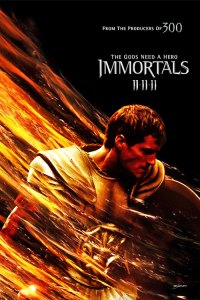
Quick Film Review: Immortals (dir. by Tarsem Singh)


Perhaps I’m jaded and spoiled by movies like Jason and the Argonauts and games like God of War.

I’m pretty sure that in an alternate dimension somewhere, audiences are sitting in the theatre and loving the hell out of Immortals. Maybe in some ways it’s actually good, but I can’t see them. At best, the film acts a great demo reel for Henry Cavill, who audiences will see as Superman sometime next year. For that reason, and perhaps Mickey Rourke’s Hyperion, Immortals is worth a peek. Even then, you may want to have someone take you to the movie, rather than pay for it yourself. Let’s put it this way. I spent more time on my iPhone with the brightness dimmed during the movie than I did actually watching it, and that’s a rarity for me. You’re better off waiting for the Netflix Edition. Everything you see in the trailer is basically the film in a nutshell.

The only other thing it really does have going for it is the 3D, which actually happens to be pretty good for the half hour that you can see it (and perhaps that’s just me, because it feels like it fades over time). The film does feel as if it were primarily filmed in 3D, and boasts some awesome visuals, but the story is a little jumbled. I won’t deny that Tarsem Singh has a really fantastic eye for painting a scene from The Cell to this point, but without sharp writing there’s something lost in the translation. It’s like watching David Fincher when he was still partnered with Darius Khondji on Seven or Spielberg with Kaminski in Minority Report. You can make pretty pictures, but there has to be some kind of meat and potatoes to it for the audience. That’s just how I felt here.

Eons ago, you once had mortals and you had gods. Zeus, Poseidon, Athena, Apollo, Dionysus, Aphrodite, etc. In Immortals, the gods learned that they had the ability to kill one another and as a result, there were a number of wars.  Enter Hyperion, who loathes the gods and wants them destroyed. In order to do this, he has to unleash the Titans, who were once servants of the gods but were punished for their treachery and sealed away in a special cage that can only be unlocked with an item called the Epirius Bow (which was one of the elements I truly enjoyed).

Our hero, Theseus (Cavill) lives a quiet life with his family when Hyperion’s forces attack. In the process, he witnesses his mother’s death at the hands of Hyperion himself and swears vengeance. Captured and left for dead with a number of others, he meets a mystic named Phaedra (played by Freida Pinto, who seems like she may be playing the same role emotionally that she did in Rise of the Planet of the Apes). Phaedra provides him with visions that allow him to reach the Bow.

Lead by Zeus, the gods watch all of this from Olympus, but are unable to interfere in the affairs of mortals on pain of death. These sequences (when they do happen) are the ones that you’re seeing in the trailers for the most part. Oceans rise and bad guys are cut down so fast that the first hardly has a chance to fall before the ninth one is hit. It’s amazing to see, it really is, but it’s been done before in movies as old as Jet Li’s The One. The film doesn’t lack in action, and in that, there’s a plus. What I had personally hoped for was something akin to giants or mythical creatures. Even though it was geared for teens, last year’s Percy Jackson and the Olympians offered more of a mystical element than Immortals did for me. It wouldn’t have hurt to have undead warriors or harpies or something. For all the money spent in effects, everything in this film seemed to be grounded in human based actions.

All of this culminates into a huge 300 like battle, right down to the narrow passageway that is used as an arena of battle. Theseus rallies his troops that are ready to retreat with a speech that’s helped along with the banging of shields. It was nice, but again, it wasn’t anything terribly new – “They’re only human!!” *clack clack clack* “We can beat them!” *clack clack clack* “For the children!!” *clack clack clack*

“And a tighter script!” I wanted to yell with a raised fist. “And maybe a refund!”

As for the audience, they seemed okay with it. There is a love scene which I don’t think younger audiences are ready for, but it was done in such a way that the “fade to black / open to the following morning” shot doesn’t let things get too far, visually.

When it gets to video, I may see Immortals again (because it is visually beautiful), but you’re better off treating yourself curling up somewhere and reading Homer’s The Odyssey for a while and letting your imagination fill in the pieces. It’s a okay film if you don’t ask for more than what it’s giving you.

Scenes I Love: Orphan – “Max’s Silent Bedtime Story”


The snow has me stuck inside today, so we’re going through different horror movies today. While going through some of the movies that were on, a Twitter friend mentioned the movie “Orphan”, which was reviewed here at the Shattered Lens a year ago. I know we’re doing horror this month, but I’ll get back to that a little later. This reminded me of my favorite scene in that movie, one that is neither scary nor fitting for Halloween, but still stayed with me.

In this scene, Vera Farmiga and Aryana Engineer, play a mother and daughter who share a bedtime story. Farmiga and the cast learned sign language in the film, and Engineer helped them along the way (who is hearing impaired herself). This ended up with what I felt was a very sweet scene. The sound is cut for the audience as well, but it’s really not needed. The message between the two is quite heartfelt. Enjoy.

Unfortunately, embedding isn’t allowed for this particular video, but it’s worth seeing.

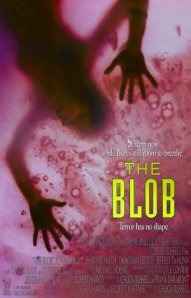
Quick Horror Film Review: The Blob (1988 Version – Dir. by Chuck Russell)


The Year was 1988.

My father was working in a precinct in Manhattan, and on occasion, my family would have to drive into the city to either get his check or help him file / retrieve something there. Whenever we went to Manhattan, we always saw something grand, like the “Ghost Building” which was shimmered in white light (this was actually Rockefeller Center, but my little sister, brother and I never knew). We once even saw the ’89 Batmobile tear through the city on it’s way to deliver the video release of Tim Burton’s Batman to the Tower Records uptown.

At a stop light, right by the Flatiron Building, I happened to glance around at some of the construction scaffolds. They always put movie posters on there, and I’d squint to see what was coming out soon. That’s when it caught my eye, a pink poster that looked like someone was swimming underwater. We got a little closer as my dad had to make a turn and I was then able to make it out.

“Oh no.”, I muttered, scrunching down in my seat. “They redid it.” All my childhood fears came flooding up in a wave of memories.

I once saw Larry Hagman’s Beware! The Blob (alternately known as Son of Blob) when I was really little. The idea that a gooey mass could squeeze under doors and through window cracks and anywhere there was a space freaked me out. This wasn’t Michael Meyers looking for his sister, or Jason Vorhees guarding Crystal Lake. There was no reasoning my little mind could use to feel better about it. Add to the fact it was only bothered by the cold, it made every summer a secret “look over the shoulder” one. When I attended my first bowling match for fun in college, I’ll admit I hesitated to step out into the bowling alley, if only for a second.

I never saw the movie in the theatre. I got so caught up in Who Framed Roger Rabbit, and everyone talked about Die Hard so much that The Blob became something of a blip to the school kids (from what I remember), but it remembered. I read the poster, and kept tabs on the writer’s names – Frank Darabont and Chuck Russell, who both went on to interesting projects over the years.

Okay, enough about my history with The Blob, let’s dig into the film, which is quite possibly one of the best remakes I’ve ever seen. It hits all of the notes of the original while setting down the groundwork for new directions when some fresh ideas. It’s not perfect, but it’s damn good.

The Blob is a re-telling of the classic 1958 film with Steve McQueen, only this time, Chuck Russell (The Mask) and Frank Darabont (The Shawshank Redemption, The Green Mile, The Mist) brought Kevin Dillon and Shawnee Smith aboard. It’s the story of a small town that receives a strange visitor from outer space in the form of a gelatenous mass inside of a meteor. When an old man gets a little too curious with a yard stick, it jumps out on and onto his hand. Needless to say, if you ever see anything fall from the sky, please, don’t go running to check it out. It never really ends well. At least, I’ve never heard of it doing so.

Anyway, like the original, the old man is found by the Gallant Hero (Donovan Leitch) and Heroine (Smith), who put him in their car and head to the local hospital. This results in the death of the old man, but also a twist in that the Gallant Hero is also killed / absorbed by the Blob. Shawnee’s character tries to save him, but to no avail. She’s should consider herself lucky that she made it through okay. While I didn’t see this in the theatre, I always wondered what effect that might have had on the audience. I mean, here you had the would be hero of the story and he’s taken out of the picture in the first act. That had to be amazing, I think.

As with the original, the Blob makes its way to the main part of town by way of the sewer, heading into the local movie theatre. Before getting there, there’s a interesting scene where Meg and Flagg (Dillon) – the bad boy turned reluctant hero – run into the Blob in a diner and hide in a nearby refrigerator. Rather than go with the classic “solidify it all in one piece”, Darabont and Russell decided to make the Blob’s freezing effect more like pieces of quartz. I thought this made things all the more scary – how could one really tell that all of it was ever collected while it was frozen?

One has to feel just a little sorry for Candy Clarke’s character. You run into a phone booth to make a phone call, only to have slime run down the sides. To top it off, you try to make a phone call for the local sheriff (played by Darabont favorite Jeffrey DeMunn from all of his films and The Walking Dead), and as if it answered for her, the Blob puts his decaying face right on the phone booth window. Another twist thrown in the remake is the death of a child. Usually in horror movies, kids are usually spared. Usually. Not so here, and it just adds to the horror of things. No one’s safe unless you’re walking around with some liquid nitrogen, and it’s not like that’s in great supply.

Eventually, we come to find – thanks to a lot of men in white suits and Crossroads Joe Seneca – that the Blob was actually man made, and it’s the scientists fault it came back the way it did. What I found interesting about that was the idea that they felt they had to burn it. Didn’t anyone think of bringing something cold? I mean, they’re scientists. Someone in the group had to have that idea at some point. Anyway, this all ends with a huge battle in the middle of a busy street and the townsfolk hiding in the municipal hall. Meg and Flagg do find a way to get everything fixed, but (as with many horror movies), we’re left with the promise of another sequel.

Overall, I loved The Blob. There’s very little I can find wrong with it, given that the source material was never really Oscar worthy to begin with. This was just a sit down for the adult in me, grab your popcorn and enjoy the film.

The kid in me prefers to watch this in a very cold room, just in case.