Airport ’77 is the one where the plane ends up underwater.
If the first two Airport movies emphasized the competence of the the crew in both the airplane and the airport, Airport ’77 takes the opposite approach. The first of the Airport films to be released after Watergate, Airport ’77 is a cynical film where no one seems to be particularly good at his or her job. Viewers should be concerned the minute they see that Jack Lemmon is playing Captain Don Gallagher, the pilot of the soon-to-be-submerged airplane. As opposed to Charlton Heston or even the first film’s Dean Martin, Jack Lemmon was always a very emotional actor. He excelled at playing characters who were frustrated with modern life. Just as with Heston and Martin, Lennon plays a pilot who is having an affair with a flight attendant. The big difference is that, this time, the pilot is the one who desperately wants to get married while the flight attendant (played by Brenda Vacarro) is the one who doesn’t want to get tied down. As an actor, Lemmon didn’t have the arrogance of a Heston or the unflappability of Dean Martin. Instead, Jack Lemmon was the epitome of midlife ennui. He’s disillusioned and he’s beaten down. He’s America at the tail end of the 70s.
Another sign that Airport ’77 is a product of the post-Watergate era is the character of co-pilot Bob Chambers (Robert Foxworth). Chambers might seem like a nice and friendly professional but actually, he’s the one who comes up with the plan to knock out all of the passengers with sleeping gas and fly the plane into the Bermuda Triangle so that his partners-in-crime can steal the valuable art works in the cargo hold. Chambers plans is to land the plane on an unchartered isle so that he and Banker (Monte Markham) can make their escape before the rest of the people on the plane even wake up. Instead, Chambers turns out to be as incompetent a pilot as he is a criminal. He crashes the plane into the ocean, where it promptly sinks to the bottom. The impact wakes up the passengers, all of whom can only watch in horror as the ocean envelopes their plane. With the water pressure threatening to crush the plane, Captain Gallagher and engineer Stan Buchek (Darren McGavin) try to figure out how to get everyone to the surface.
As usual, the passengers are played by a collection of familiar faces. Olivia de Havilland and Joseph Cotten play former lovers who are reunited on the flight. Christopher Lee is a businessman who is unhappily married to alcoholic Lee Grant. Grant is having an affair with Lee’s business partner, Gil Gerard. A young Kathleen Quinlan plays the girlfriend of blind pianist Tom Sullivan. Robert Hooks is the bartender who ends up with a severely broken leg. As the veterinarian who is called to doctor’s duty, M. Emmet Walsh gives the best performance in the film, if just because he’s one of the few characters who really gets to surprise us. Actors like George Furth, Michael Pataki, and Tom Rosqui all wander around in the background, though I dare anyone watching to actually remember the names of the characters that they’re playing. Airport ’77 has the largest number of fatalities of any of the Airport films, largely because even the good guys aren’t really sure about how to reach the surface.
George Kennedy returns as Joe Patroni, though his role is considerably smaller in this film than it was in the first two. He shares most of his scenes with James Stewart, who plays the owner of the plane. Fortunately, neither Stewart nor Kennedy were on the plane when it crashed. Instead, they spend most of the movie in a control room, getting updates about the search. They don’t get to do much in the film but it’s impossible not to smile whenever Jimmy Stewart is onscreen, even if he is noticeably frail.
Airport ’77 is the best-made of all of the Airport films. The crash is well-directed and the scenes of water dripping into the plane are properly ominous. There’s not much depth to the characters but Jack Lemmon and Darren McGavin are likable as the two main heroes and Christopher Lee seems to be enjoying himself in a change-of-pace role. Olivia de Havilland and Joseph Cotten, two old pros, are wonderful together. That said, Airport ’77 is never as much fun as the first two films. Even with the plane underwater, it can’t match the spectacle of Karen Black having to fly a plane until Charlton Heston can be lowered into the cockpit.
In 1939, an ocean liner named the MS St. Louis set sail from Hamburg. Along with the crew, the ship carried 937 passengers, all of whom were Jewish and leaving Germany to escape Nazi persecution. The ship was meant to go to Havana, where the passengers had been told that they would be given asylum. Many were hoping to reunite with family members who had already taken the voyage.
What neither the passengers nor Captain Gustav Schroeder knew was that the entire voyage was merely a propaganda operation. No sooner had the St. Louis left Hamburg than German agents and Nazi sympathizers started to rile up anti-Semitic feelings in Cuba. The plan was to prevent the passengers from disembarking in Cuba and to force the St. Louis to then return to Germany. The Nazis would be able to claim that they had given the Jews a chance to leave but that the rest of the world would not take them in. Not only would the Jews be cast as pariahs but the Germans would be able to use the world’s actions as a way to defend their own crimes.
Captain Schroeder, however, refused to play along. After he was refused permission to dock in Cuba, he then attempted to take the ship to both America and Canada. When both of those countries refused to allow him to dock, Schroeder turned the St. Louis toward England, where he planned to stage a shipwreck so that the passengers could be rescued at sea. Before that happened, Belgium, France, the Netherlands, and the United Kingdom jointly announced that they would accept the refugees.
Tragically, just a few days after the passengers disembarked, World War II officially began and Belgium, France, and the Netherlands all fell to the Nazi war machine. It is estimated that, of the 937 passengers on the St. Louis, more than 600 of them subsequently died in the Nazi concentration camps.
The journey of the St. Louis was recreated in the 1976 film, Voyage of the Damned, with Max von Sydow as Captain Schroeder and a collection of familiar faces playing not only the ship’s passengers and crew but also the men and women in Cuba who all played a role in the fate of the ship. In fact, one could argue that there’s a few too many familiar faces in Voyage of the Damned. One cannot fault the performances of Max von Sydow, Malcolm McDowell, and Helmut Griem as members of the crew. And, amongst the passengers, Lee Grant, Jonathan Pryce, Paul Koslo, Sam Wanamaker, and Julie Harris all make a good impression. Even the glamorous Faye Dunaway doesn’t seem to be too out-of-place on the ship. But then, in Havana, actors like Orson Welles and James Mason are awkwardly cast as Cubans and the fact that they are very obviously not Cuban serves to take the viewer out of the story. It reminds the viewer that, as heart-breaking as the story of the St. Louis may be, they’re still just watching a movie.
That said, Voyage of the Damned still tells an important true story, one that deserves to be better-known. In its best moments, the film captures the helplessness of having nowhere to go. With Cuba corrupt and the rest of the world more interested in maintaining the illusion of peace than seriously confronting what was happening in Germany, the Jewish passengers of the St. Louis truly find themselves as a people without a home. They also discover that they cannot depend on leaders the other nations of the world to defend them.
Defending the passengers falls to a few people who are willing to defy the leaders of their own country. At the start of the film, Nazi Intelligence Chief Wilhelm Canaris (Denholm Elliott) explains that Captain Schroeder was selected specifically because he wasn’t a member of the Nazi Party and could not be accused of having ulterior motives for ultimately returning the passengers to Germany. Canaris and his fellow Nazis assume that anti-Semitism is so natural that even a non-Nazi will not care what happens to the Jewish passengers. Instead, Schroeder and his crew take it upon themselves to save the lives of the passengers. It is not Franklin Roosevelt who tries to save the passengers of St. Louis. Instead, it’s just a handful of people who, despite unrelenting pressure to do otherwise, step up to do the right thing. Max von Sydow, who was so often cast in villainous roles, gives a strong performance as the captain who is willing to sacrifice his ship to save his passengers.
Flaws and all, Voyage of the Damned is a powerful film about a moment in history that must never be forgotten.
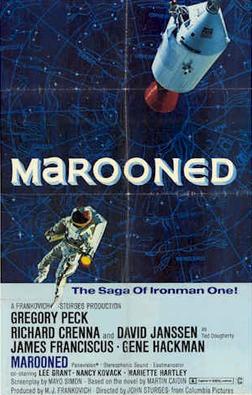
Imagine The Martian or Apollo 13 without any humor or narrative momentum and you’ve got an idea what Marooned is like.
Three American astronauts (played by Richard Crenna, Gene Hackman, and James Franciscus) are returning to Earth after serving on an experimental space station when the engine to their spacecraft fails. Now stuck in orbit around the Earth, they only have two days before they run out of oxygen. While flight commander Crenna tries to keep everyone calm and make sure that all the proper procedures are followed, Gene Hackman yells at NASA and demands to be rescued.
Down on Earth, the head of NASA (Gregory Peck) says that there’s nothing that can be done. There’s no way to get a rescue mission set up quickly enough to save the lives of the astronauts. Both the President and David Janssen disagree with him. Janssen demands to be sent into space immediately, regardless of the dangers, so that he can bring America’s astronauts home.
Marooned is a painfully slow movie that went into production at the height of the space race and which was released just a few weeks before the first successful moon mission. Because it was made at a time when there were still many who claimed that NASA was a waste of money, the movie goes out of its way to explain that, even though the astronauts are probably going to die in space, NASA is in no way to blame. Richard Crenna absolves NASA of blame after being told that a rescue mission isn’t feasible. Gregory Peck holds a press conference, where he gives a lengthy speech about why space exploration is still important. The movie is very detailed in showing that NASA is staffed by personality-free professionals, which might have boosted confidence in NASA but which also leads to a dull story. You’ll notice that I haven’t referred to anyone in this film by the names of their characters. That’s because their names don’t matter because, other than Gene Hackman and David Janssen, none of them is really distinguished by any sort of identifiable personality. Hackman chews the scenery while Janssen plays another surly character who seems like he has a permanent hangover. I wouldn’t trust Janssen to pilot a spaceship.
Marooned won an Oscar for its Special Effects, which were probably impressive back in 1969 but which are dull by modern standards. Winning that Oscar meant that Marooned would eventually earn the distinction of being the only Oscar winner to be featured on Mystery Science Theater 3000. On MST 3K, it aired under the title Space Travelers, which is a perfectly generic name for a perfectly generic film.
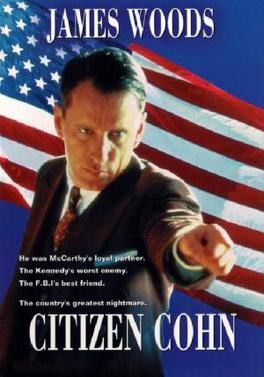
The year is 1986 and the powerful attorney Roy Cohn (James Woods) is dying. The official story is that Cohn has liver cancer but the truth is that he’s dying of AIDS. As he lies in his hospital bed, he thinks about his past and the events the led to him becoming one of the most feared and powerful men in America. He is haunted by the ghosts of his many enemies, people like communist spy Ethel Rosenberg (Karen Ludwig) and his former colleague, Bobby Kennedy (David Marshall Grant).
Not surprisingly, a good deal of Cohn’s memories center around his association with Sen. Joseph McCarthy (Joe Don Baker), a charismatic alcoholic who, in the 50s, charged that he had a list with the names of communist spies deep within the government. Cohn and Kennedy served as the counsels on McCarthy’s committees. Cohn is with McCarthy from the beginning and he’s with him until the end of the senator’s career. In fact, it’s Cohn’s own shadowy relationship with an army private that ultimately leads to McCarthy’s downfall.
Except for one aspect of the film, Citizen Cohn is one of the best films to ever be produced by HBO. The film covers a lot of history in a little less than 2 hours and it does so in a way that is always interesting and easy to follow. By including incidents from every phase of Cohn’s life, as opposed to just focusing on his time as McCarthy’, the film also shows how someone like Roy Cohn can become a behind-the-scenes power player despite the majority of the country having no idea who he is. James Woods gives one of his best performances as the hyperactive and unapologetically corrupt Cohn while Joe Don Baker is perfect as the self-pitying Joseph McCarthy.
The problem with the film, and your mileage may vary on how big an issue this is, is that it almost presents Cohn’s final days — dying of AIDS in a lonely New York hospital room — as being some sort of deserved fate for everything that he did wrong in life. For me, even in the case of someone like Roy Cohn, that’s a step too far and it comes very close to presenting AIDS as some sort of divine punishment (which, itself, comes dangerously close to mirroring the homophobic statements that were made — and still are being made — by anti-gay activists). That may not have been the film’s intention but, with the flashback structure and all of his dead enemies materializing to taunt Cohn as he lies dying, it’s still a very valid interpretation.
Some of that is perhaps unavoidable. Cohn, in both real life and the film, died largely unrepentant for anything he did during his life. As the central character of a biopic, Cohn never has the type of big moment that you would hope for, where he would realize that it was wrong for him to destroy so many lives and show at least a hint of contrition for his past behaviors. That Roy Cohn is even a compelling character is a testament to the talent of James Woods because it’s certainly not due to any sort of hidden goodness lurking underneath the surface of Cohn’s snarling personality. The lack of apologies and regrets that made Cohn a powerhouse in real life also makes him an ultimately unsatisfying subject for a movie.
The 1967 film, In the Heat of the Night, tells the story of two very different men.
Chief Gillespie (Rod Steiger) is the police chief of the small town of Sparta, Mississippi. In many ways, Gillespie appears to the epitome of the bigoted Southern cop. He’s overweight. He loses his temper easily. He chews a lot of gum. He knows everyone in town and automatically distrusts anyone who he hasn’t seen before, especially if that person happens to be a black man or from the north.
Virgil Tibbs (Sidney Poitier) is a black man from the north. He’s a detective with the Philadelphia Police Department and he’s as cool and controlled as Gillespie is temperamental and uncouth. Tibbs has no patience for the casual racism that is epitomized by lawmen like Chief Gillespie. When Gillespie says that Virgil is a “fancy name” for a black and asks what people call Virgil in Philadelphia, Virgil declares, “They call me Mister Tibbs!,” with an authority that leaves no doubt that he expects Gillespie to do the same.
Together …. THEY SOLVE CRIMES!
For once, that old joke is correct. When a Chicago industrialist named Phillip Colbert is discover murdered in Sparta, Chief Gillespie heads up the investigation and, assuming that the murderer must be an outsider, orders Deputy Wood (Warren Oates) to check out the train station for any suspicious characters. When Wood arrives at the station, he discovers Virgil standing on the platform. Virgil is simply waiting for his train so that he can get back home to Philadelphia. However, Wood promptly arrests him. Gilespie accuses him of murdering Colbert, just to discover that Virgil’s a police detective from Philadelphia.
Though neither wants to work with the other, that’s exactly what Gillespie and Virgil are forced to do as they investigate Colbert’s murder. Colbert was planning on building a factory in Sparta and his wife (Lee Grant) makes it clear that, if Sparta wants the factory and the money that comes with it, Virgil must be kept on the case. Over the course of the investigation, Gillespie and Virgil come to a weary understanding as both of them are forced to confront their own preconceived notions about both the murder and life in Sparta. In the end, if it’s impossible for them to truly become friends, they do develop a weary respect for each other. That is perhaps the best that one could have hoped for in 1967.
I have to admit that it took me a few viewings before I really appreciated In the Heat of the Night. Though this film won the Oscar for Best Picture of 1967, it’s always suffered when compared to some of the films that it beat. One can certainly see that the film was superior to Doctor Dolittle and Guess Who’s Coming to Dinner. But was it a better film than The Graduate or Bonnie and Clyde? Did Rod Steiger really deserve to win Best Actor over Dustin Hoffman and Warren Beatty? (Amazingly, Poitier wasn’t even nominated.)
To be honest, I still feel that In The Heat of the Night was probably the 3rd best of the 5 films nominated that year, superior to the condescending Guess Who’s Coming To Dinner but nowhere near as groundbreaking as Bonnie and Clyde or The Graduate. The first time I watched In the Heat of the Night, I thought Steiger blustered a bit too much and the film’s central mystery didn’t really hold together and, to a large extent, I still feel like that.
But, at the same time, there’s a lot to appreciate about In the Heat of the Night. On subsequent viewings, I came to better appreciate the way that director Norman Jewison, editor Hal Ashby, and cinematographer Haskwell Wexler created and maintained an atmosphere that was so thick that you can literally feel the Mississippi humidity while watching the film. I came to appreciate the supporting cast, especially Warren Oates, Lee Grant, Scott Wilson, Anthony James, and Larry Gates. (Gates especially makes an impression in his one scene, playing an outwardly genteel racist who nearly cries when Tibbs reacts to his slap by slapping him back.) I also came to appreciate the fact that, while the white cop/black cop partnership has subsequently become a bit of a cliche, it was new and even controversial concept in 1967.
And finally, I came to better appreciate Sidney Poitier’s performance as Virgil. Poitier underplays Virgil, giving a performance of tightly controlled rage. While Steiger yells his way through the film, Poitier emphasizes that Virgil is always thinking. As in the same year’s Guess Who’s Coming To Dinner, Poitier plays a dignified character but, here, that dignity is Virgil’s way of defying the demands and expectations of men like Gillespie. When Virgil does strike back, it’s a cathartic moment because we understand how many times he’s had to hold back.
In the Heat of the Night may not have been the best film of 1967 but it’s still one worth watching.
For today’s horror on the lens, we have the 1970 made-for-TV movie, Night Slaves!
In this atmospheric film, an estranged married couple (James Franciscus and Lee Grant) find themselves in a small town. It seems like a friendly enough place. I mean, Leslie Nielsen is the sheriff! How could anything go wrong in a town protected by Leslie Nielsen?
However, at night, the town changes. Only Franciscus seems to notice all of the townspeople wandering about like zombies. Is he going crazy or has he stumbled across something sinister?
I first saw There Was A Crooked Man as a part of TCM’s tribute to the great actor Warren Oates. Warren Oates was rarely cast in the lead but, as a character actor, he appeared in supporting roles in several great films. Unfortunately, There Was A Crooked Man is not one of them.
Directed by Joseph L. Mankiewicz and written by the screenwriting team of Robert Benton and David Newman (best known for writing Bonnie and Clyde), There Was A Crooked Man is meant to be a comedic western. Outlaw Paris Pittman (Kirk Douglas) is arrested while visiting a bordello. Paris is sent to an Arizona prison, where everyone tries to get him to reveal where he has hidden the stash from a $500,000 robbery. Pittman uses everyone’s greed to manipulate them into helping him attempt to escape. Standing in Pittman’s way is the new warden, a liberal reformer played by Henry Fonda.
There Was A Crooked Man is a long movie that features a lot of familiar faces. Burgess Meredith plays The Missouri Kid, who has been in prison for so long that he is now an old man. Hume Cronyn and John Randolph play a bickering gay couple who eventually become a part of Pittman’s scheme to escape. Even Alan Hale, the skipper from Gilligan’s Island, shows up as a guard named Tobaccy! There Was A Crooked Man is a big movie but it’s also not a very good one. It’s not serious enough to be a good drama but it’s not funny enough to be a good comedy either.
At least the movie has Warren Oates going for it. Oates plays Harry Moon, a prisoner who is drafted into Pittman’s escape plot. It is a typical Warren Oates supporting role but he steals every scene that he appears in. Even in the smallest of roles, Warren Oates was worth watching and he’s the best thing about There Was A Crooked Man.
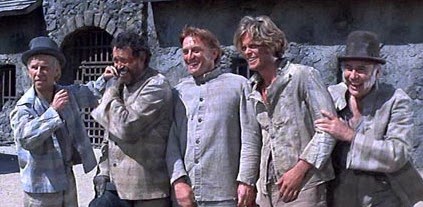
Hume Cronyn, Warren Oates, Kirk Douglas, Michael Blodgett, and John Randolph in There Was A Crooked Man
The first sequel to The Omen was 1978’s Damien: Omen II. Damien: Omen II is an odd film, one that is not very good but yet remains very watchable.
Damien: Omen II takes place 7 years after the end of the original Omen. Antichrist Damien Thorn (now played by Jonathan Scott-Taylor) is now 12 years old. He lives with his uncle Richard (William Holden) and Richard’s 2nd wife, Ann (Lee Grant). His best friend is his cousin Mark (Lucas Donat). In fact, the only problem that Damien has is that his great-aunt Marion (Sylvia Sidney) can’t stand him and views him as a bad influence. Fortunately, as usually seems to happen whenever someone puts an obstacle in Damien’s life, there’s always either a black dog or a black crow around to help out.
Damien and Mark are cadets at a local military academy where Damien deals with a bully by glaring at him until he falls to the ground, grabbing at his head. In history class, Damien shocks his teacher by revealing that he knows the date of every battle ever fought. Damien’s new commander, Sgt. Neff (Lance Henriksen), pulls Damien to the side and tells him to stop showing off and to quietly bide his time.
Meanwhile, Richard is busy running Thorn Industries. One of his executives, Paul Buhler (Robert Foxworth), wants to expand Thorn’s operations into agriculture but his plans are opposed by Richard’s executive vice president, Bill Atherton (Lew Ayres), who considers Paul to be unethical. However, during an ice hockey game, Bill falls through the ice and, despite the efforts of everyone to break through the ice and save him, ends up floating away. Paul is promoted and pursues his plans to make money off of world famine. In between all of this, Paul finds the time to speak to Damien and tell him that he has a great future ahead of him.
Along with Thorn Industries, Richard also owns the Thorn Museum in Chicago. The museum’s curator is Dr. Charles Warren (Nicholas Pryor) who was a friend of the archeologist Karl Bugenhagen (Leo McKern) who, in the first film, revealed that not only was Damien the antichrist but that the only way to kill him was by stabbing him with the Seven Daggers of Meggido. Dr. Warren is also friends with Joan Hart (Elizabeth Shepherd), a reporter who both knows the truth behind Bugenhagen’s death and who has also seen an ancient cave painting that reveals that the Antichrist looks exactly like a 12 year-old Damien Thorn.
Much as in the first film, just about everyone who comes into contact with Damien ends up getting killed in some odd and grotesque way. Crows peck out eyes. Trucks run over heads. One unfortunate victim is crushed between two trains. Another is chopped in half by an elevator cable. At times, Damien: Omen II feels less like a sequel to The Omen and more like a forerunner to Final Destination.
Damien: Omen II is one of those films that I like despite myself. It’s bad but it’s bad in a way that only a film from the 1970s could be and, as such, it has some definite historical value. The script is full of red herrings, the acting is inconsistent, and the film can never seem to make up its mind whether Damien is pure evil or if he’s conflicted about his role as Antichrist. As I watched the film, I wondered why the devil could so easily kill some people but not others.
And yet, Damien: Omen II is so ludicrous and silly that it’s undeniably watchable. If the first film was distinguished by Gregory Peck’s defiant underplaying, the second film is distinguished by the way that William Holden delivers every line through manfully clenched teeth. Everyone else in the cast follows Holden’s lead and everyone goes so far over-the-top that even the most mundane of scenes become oddly fascinating.
For me, the film is defined by poor Lew Ayres floating underneath that sheet of ice while everyone else tries to rescue him. On the one hand, it’s absolutely horrific to watch. I’m terrified of drowning and, whenever the camera focused on Ayres desperately pounding on the ice above him, I could barely bring myself to look at the screen. But, at the same time, we also had William Holden screaming, “OH GOD!” and Nicholas Pryror enthusiastically chopping at the ice with a big axe and dozens of extras awkwardly skating across the ice. Somehow, the scene ended up being both horrifying and humorous. It should not have worked but somehow, it did.
And that’s pretty much the perfect description of Damien: Omen II. It shouldn’t work but, in its own way, it does.
(Warning: This review contains spoilers. A lot of them.)
Last week, I posted a poll and I asked you, the Shattered Lens readers, which film I should watch on March 20th and then subsequently review. You voted and the winner was the classic 1967 trashfest, Valley of the Dolls.
Based on a best-selling (and trend-setting) novel by Jacqueline Susann, Valley of the Dolls starts out with a disclaimer that informs us that the story we’re about to see is totally fictional and purely imaginative. That disclaimer is probably the funniest part of the entire film as Valley of the Dolls is notorious for being one of the first films dedicated to showing middle America just how miserable and screwed up those famous show business types truly are. As such, the main reason for watching a movie like this is so you can sit there and compare the cinematic troubles of a character like Neely O’Hara to the true-life troubles of an actress like Lindsay Lohan. Valley of the Dolls tells the story of three aspiring stars who, as they find fame, also find themselves dealing with heartbreak, insanity, and dolls. No, not the type of dolls that my mom used to collect. These “dolls” are a bunch of red pills that do everything from keeping you thin to keeping you awake and focused. (Though the pills are never actually called anything other than “dolls,” they appear to be the same pills that I take for my ADD.)
The least interesting of our three heroines is Anne Welles (Barbara Parkins). Unfortunately, Anne is also pretty much the center of the rather draggy first hour of the film. Anne is a walking cliché, a naive girl from a small town in New England who moves to New York, gets a room at the Martha Washington Hotel for Women, and a job at a local theatrical agency. “I want to have a marriage like mom and dad…but not yet!” Anne breathlessly tells us. Anne eventually ends up as the mistress of Lyon Burke (played by Paul Burke), a writer-turned-theatrical-agent who you know has to be a cad because his name is Lyon Burke and he takes Anne’s virginity but then refuses to marry her afterward. Anne eventually becomes a model and finds fame as the face of Gilligan Hairspray but she soon finds herself forced to watch as her two best friends travel down a path of self-destruction.
Anne is the film’s token “good girl” and, as such, she’s rather bland and boring. However, her character is interesting when considered as a symbol for the confused sexual politics of the time. Valley of the Dolls was made in 1967, at a time when Hollywood was still trying to figure out how to deal with the emerging counter-culture. The end result? A lot of rather old-fashioned films that were full of jarringly out-of-place counter-culture moments. By the time Valley of the Dolls came out, it was allowable to acknowledge that a single girl might actually have sex but she still had to, at the very least, feel an unbelievable amount of angst about it. That certainly is the case with Anne. Watching the film today, it’s hard to understand just what exactly Anne’s feeling guilty about. Lyon isn’t married. Anne finds success even as she pursues her relationship with him. Up until the final half of the film (at which point the morality of the time demands that both Anne and Lyon suddenly start acting totally out-of-character), Lyon treats her with about as much respect as you could probably expect to get from a man in the 1960s. And yet, Anne can’t feel complete simply because Lyon is hesitant about marrying her. When she and Lyon finally do make love, they do it with the lights off so the only thing the viewer sees are two shadowy figures holding each other. Following the film’s logic, if the lights had been left on, the character of Anne would have had to have been punished later in the film for allowing the audience to see too much of her.
When Anne first comes to New York, she befriends two actresses. The more tragic of the two is Jennifer North (played by Sharon Tate, who would be tragically murdered two years after this film came out), an insecure blonde who is valued more for her body than her talent. Jennifer spends her spare time doing bust exercises (“To hell with them!” she declares at one point as she glares down at her chest, “Let ’em droop!”) and dealing with phone calls from her mother, demanding that Jennifer send her money. Jennifer eventually ends up marrying a singer named Tony (played by Tony Scotti). Tony is a well-meaning if simple-minded guy who is married to a creepily overprotective sister (played by Lee Grant). Eventually, it turns out that Tony has a neurological disease and he’s eventually checked into a sanitorium. Penniless, Jennifer goes France and makes “art films.” (In one of Valley of the Dolls’ better moments, we’re shown a clip of this “art film” and it turns out to be a pitch perfect satire of every single pretentious soft-core film to ever come out of Europe.) Upon returning to America, Jennifer discovers that she has breast cancer and, declaring “All I’ve got is my body,” she commits suicide.
Though Sharon Tate gets considerably less screen time than her co-stars, she probably gives the strongest performance in this film. Certainly, her story is the most emotionally effective (even if it’s hard not to feel that, as is typical of the films of both the 60s and today, Jennifer is being punished for taking off her clothes on camera). Tate perfectly captures the insecurity that comes from being continually told that you have nothing more to offer beyond how you look. In her first appearance, she’s wearing an outrageously large headdress. “I feel a little top-heavy,” she says. “You are a little top-heavy,” some guy replies while leering at her breasts. If you doubt that Sharon Tate was a good actress, just watch her reaction. She perfectly captures a pain that I personally know far too well. Her subsequent suicide scene, which has the potential to be the most tasteless part of this film, is actually the most powerful and again, it’s because Tate plays the role perfectly.
(It’s been nearly four years since I lost my mom to breast cancer and I have to admit, I had a hard time watching the scenes where Jennifer discusses her diagnosis. Tate gave a great performance here and it’s a shame that she’s been permanently linked in the public imagination with Charles Manson and the later accusations against her husband, Roman Polanski. She had real talent.)
As poignant of Sharon Tate was in her role, the film’s fame (and infamy) ultimately rests with our third heroine, Neely O’Hara (played by Patty Duke in a performance that suggests that she was literally possessed during the filming). Neely is a scrappy, aspiring singer who is fired from a broadway show when her singing threatens to upstage aging star Helen Lawson (played by Susan Hayward, who was brought in to replace Judy Garland). Neely, however, refuses to let anything keep her down and soon, she’s singing at a Cystic Fibrosis telethon and becoming a big star. She marries her boyfriend Mel (played by Martin Milner, who grits his teeth and spits out every line) and moves to California where she soon becomes a big star and then finds herself hooked on “booze and dolls.” (“I need a doll!” she insists on several occasions.)
One reason the film’s 2nd hour is so much more fun than the first is because the film’s focus shifts from boring Anne to out-of-control Neely. Increasingly temperamental and unstable, Neely soon starts to spend all of her time with dress designer Ted Casablanca (a great name, if nothing else.) “You’re spending more time than necessary with that fag Ted Casablanca,” Mel tells her to which Neely replies, “Ted Casablanca’s no fag and I’m the dame who can prove it.” This, of course, leads to a divorce and soon Neely is living with Mr. Casablanca who informs her, after he gets caught cheating, “You made me feel as if I was queer…that little whore makes me feel 9 feet tall.”
When Lyon and Anne attempt to force Neely to enter a sanitorium, she responds to running off to San Francisco where she enters a bar and shouts, “I’M NEELY O’HARA!” before then wandering down a sleazy street and ranting, “Boobies, boobies! Nothing but boobies! Who needs them!?” Needless to say, this leads to her eventually overdosing and ending up in that sanitorium where she has a huge freak-out before singing a duet with Tony and resolving to get her life back in order. This, naturally, leads to her getting released, having an affair with Lyon, and then returning to Broadway where, in the film’s most deliriously odd moment, she steals Helen Lawson’s wig and flushes it down a toilet.
Valley of the Dolls is, admittedly, a terrible film but it’s also a lot of fun and that’s largely because of Patty Duke’s berserk performance as Neely O’Hara. Earlier, I said that Duke’s performance appears to suggest that she may have been possessed but, honestly, that barely begins to describe it. Whereas Tate managed to find some truth in the film’s melodrama and Parkins gives a performance that suggests that the script put her in a coma, Duke attacks every inch of melodramatic dialogue, barking out her dialogue with all the ferocity of a yapping little chiuaua. Duke gives a performance that is so completely and totally over-the-top that it’s hard not to respect her commitment to capturing every overheated, melodramatic moment.
I have to admit that one reason why I love this film is because I’m hoping that someday some enterprising director will remake it and cast me as Neely O’Hara. Everytime I watch this film, I find myself thinking about how much it would be to respond to every petty annoyance by screeching out, “I’m NEELY O’HARA!” Seriously, just think about it. As a character, Neely is a talented, ambitious, emotional, unstable, immature, demanding, bratty, spoiled, and determined. Sound like anyone whose film reviews you might have been reading recently? From my previous experience as a community theater ingenue, I can assure you that I can deliver melodramatic dialogue with the best of them and, unlike Patty Duke in this film, I can actually dance. Unfortunately, I can’t carry a tune to save my life but I’m thinking maybe they could bring in Kelly Clarkson to serve as my singing voice. (Or maybe Jessica Simpson. Did I ever mention that we both went to the same high school? Though not at the same time, of course.) After all, if Patty Duke could be obviously dubbed, why not me? I can just see myself now, wandering down some sleazy city street, singing to myself and declaring at the top of my lungs, “Ted Casablanca’s no fag and I’m the dame who can prove it!” I know that Lindsay Lohan will probably insist that this is the role she was born to play, but seriously, who needs Linsday when you’ve got a Lisa?
Beyond the so-bad-that-its-good appeal of the film, Valley of the Dolls is a fascinating cultural artifact for the reasons that I previously hinted at while talking about the character of Anne Welles. Valley of the Dolls was made in 1967 and, as such, it’s a perfect exhibit of an unstable time when Hollywood was unsure about whether it should embrace the “new morality” or if it should continue to recycle the same sort of old-fashioned filmmaking that had nearly bankrupted the big studios. The result was several films that felt oddly schizophrenic in their approach and that is certainly the case with Mark Robson’s direction of Valley of the Dolls. Whether it’s the way the film continually hints at nudity and sex while carefully not revealing too much or the way that random psychedelic sequences seem to suddenly appear on-screen, this is a movie that perfectly captures an uncertain film industry trying to figure out where it stands in a scary new world.
As always, I enjoyed watching this undeniably bad but just as undeniably compelling film. Our readers chose well! Thank you to everyone who voted and I hope you’ve enjoyed reading this review almost as much I enjoyed writing it.
Sometimes, you have to be careful which films you choose to watch over the course of the day.
Such as, last Friday night, I heard the news that Jill Clayburgh had died and I ended up watching An Unmarried Woman. This, along with the fact that I also watched the Black Swan trailer, led to me dancing around the house in my underwear, en pointe in bare feet, and doing a half-assed pirouette in the living room. And I felt pretty proud of myself until I woke up Saturday morning and my ankle (which I don’t think has ever properly healed from the day, seven years ago, that I fell down a flight of stairs and broke it in two places) literally felt like it was on fire. That was my body’s way of saying, “You ain’t living in a movie, bitch. Deal with it.”
So, come Sunday, I decided to play it safe by watching something that I was sure wouldn’t lead to any imitative behavior on my part. Since I had previously reviewed Earthquake on this site, I decided that I would devote some time to the movies that started the entire 1970s disaster movie genre — Airport. Watching Airport led to me watching Airport’s three sequels.
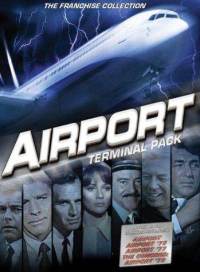
I was able to do this largely because I own the Airport Terminal Pack, a two-disk DVD collection that contains all four of the Airport films and nothing else. There’s no special features or commentary tracks. That’s probably a good thing because these films are so extremely mainstream that I doubt the commentary tracks would be all that interesting except to people who love “Me and Jennings Lang had the same lawyer…” style stories.
The movies are a mixed bag of ’70s sexism, mainstream greed, and casts that were described as being “all-star” despite the fact that they featured very few stars. They’re all worth watching as time capsules of a past time. Some of them are just more worthy than others.
Below are my thoughts on each individual film in the collection…
Airport (directed by George Seaton)
First released in 1970, Airport was nominated for 10 Academy Awards (including best picture), broke box office records, and started the whole 70s disaster movie trend. It also has to be one of the most boring, borderline unwatchable movies ever made. The fact that I managed to sit through the whole thing should be taken as proof that I’m either truly dedicated to watching movies or I’m just insane. Take your pick.
Anyway, the film is painstakingly detailed account of the every day operations of an airport. Yeah, sounds like a lot of fun, doesn’t it? Burt Lancaster runs the airport. His brother-in-law Dean Martin flies airplanes. Both of them have mistresses but we’re told that’s okay because Lancaster’s wife expects him to talk to her and Martin’s wife is cool with him fucking around as long as he comes home at night. I would be tempted to say that this is a result of the film having been made in 1969 and released in 1970 but actually, it’s just an introduction to the sexual politics of the typical disaster film. Men save the day while women get in the way. And if you think things have changed, I’d suggest you watch a little film calledf 2012…
The only interesting thing about the film is that Lancaster’s mistress is played by Jean Seberg who, ten years earlier, had helped change film history by co-starring in Jean-Luc Godard’s classic film Breathless. Nine years later, after years of being hounded by the American press and the FBI for her radical politics, Seberg committed suicide.
Airport 1975 (directed by Jack Smight)
As opposed to its predecessor, Airport 1975 is actually a lot of fun in its campy, silly way. This is the one where a small private plane (flown by Dana Andrews, the star of the wonderful film noir Laura) collides with a commercial airliner. The entire flight crew is taken out and head stewardess Karen Black has to pilot the plane despite the fact that she’s obviously cross-eyed. Luckily, since Black is a stewardess, she has a pilot boyfriend who is played by Charlton Heston. Heston talks her through the entire flight despite the fact that she was earlier seen trying to pressure him into not treating her like an idiot. Anyway, Heston does his usual clench-jaw thing and if you need a drinking game to go with your bad movie, just take a shot every time Heston calls Black “honey.” You’ll be drunk before the plane lands.
There’s some other stuff going on in this movie (for instance, Gloria Swanson appears as “herself” and doesn’t mention Sunset Boulevard or Joseph Kennedy once!) but really, all you need to know is that this is the film where Karen Black acts up a storm and random characters keep saying, “The stewardess is flying the plane!?”
Odd trivia fact: Airport 1975 was released in 1974.
Airport ’77 (directed by Jerry Jameson)
In Airport ’77, a group of art thieves attempt to hijack an airplane which, of course, leads to the airplane crashing into the ocean and somehow sinking down to the ocean’s floor without splitting apart. The crash survivors have to try to figure out how to get to the surface of the water before they run out of oxygen.
In this case, our resident sexist pilot is Jack Lemmon who has a really ugly mustache. He wants to marry head stewardess Brenda Vaccarro. Vaccarro doesn’t understand why they have to get married to which Lemmon responds, “Because I want a wife and kids!” The film also gives us Lee Grant as a woman who is married to Christopher Lee but who is having an affair with another man. She also drinks a lot and dares to get angry when she realizes that the airplane is underwater. While this sort of behavior is acceptable from Dean Martin, Charlton Heston, and Jack Lemmon, the film punishes Lee Grant by drowning her in the final minutes.
Technically, Airport ’77 is probably the best of the Airport films. The cast does a pretty good job with all the melodrama, the film doesn’t drag, and a few of the scenes manage to generate something resembling human emotion. (For instance, when the blind piano player died, I had a tear in one of my freaky, mismatched eyes.) Unfortunately, the movie’s almost too good. It’s not a lot of fun. Everyone plays their roles straight so the silly plot never quite descends into camp and the key to a good disaster film is always camp. This film also has the largest body count of the series, with most of the cast dead by the end of the movie. (And, incidentally, this film did nothing to help me with my fear of water…)
The Concorde: Airport ’79 (directed by David Lowell Rich)
The last Airport movie is also the strangest. Some people have claimed that this film was meant to be a satire of the previous Airport films. I can understand the argument because you look at film like Concorde and you say, “This must be a joke!” However, the problem with this theory is that there are moments of obvious “intentional” humor in this film (i.e., J.J. from Good Times smokes weed in the plane’s bathroom, another passenger has to go to the bathroom whenever she gets nervous) and none of them show any evidence of the type of wit and outlook necessary to come up with anything this silly on purpose. Add to that, the film’s story is credited to Jennings Lang, a studio executive. Studio execs do not take chances. (Plus, the actual script was written by Eric Roth, who went on to write the amazingly humorless The Curious Case of Benjamin Button).
No, this film is meant to be taken seriously and oh my God, where do I start?
Our pilots are George Kennedy and Alain Delon. The head stewardess (and naturally, Delon’s girlfiend) is played by Sylvia “Emanuelle” Kristel who, at one point, says, “You pilots are such men!” “Hey, they don’t call it a cockpit for nothing, honey,” Kennedy replies.
Meanwhile, Robert Wagner is trying to destroy the Concorde because one of the passengers is his girlfriend who has proof that Wagner has been selling weapons to America’s enemies. So, he attempts to blow the plane up with a guided missile and when that fails, he sends a couple of fighter planes after them. Kennedy responds by opening up the cockpit window — while breaking the sound barrier mind you — and firing a flare gun at their pursuers.
After this, there’s stop over in Paris where Delon arranges for Kennedy to sleep with a prostitute who assures Kennedy that he made love “just like a happy fish.”
The next day, everyone returns to the exact same Concorde — despite the fact that just a day earlier they’d nearly been blown up by a squadron of fighter planes — and take off on the second leg of the flight. Let me repeat that just to make sure that we all understand what this film is asking us to believe. After nearly getting blown up by a mysterious squad of fighter planes, everybody shows up the next morning to get on the exact same plane.
Oh, and it never occurs to Wagner’s ex-girlfriend that Wagner might have something to do with all of this.
Now sad to say, Concorde is the one of those films that’s a lot more fun to talk about than to actually watch. It should be a lot more fun in its badness than it actually is. Still, the movie has just enough camp appeal to make it fun in a “what the fuck…” sorta way.
And that’s how the Airport series comes to an end.




 Through the Shattered Lens