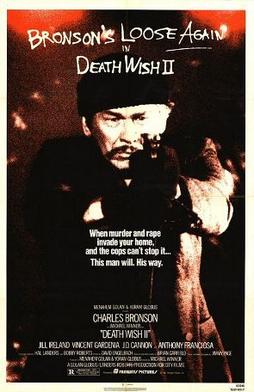
Bronson’s Back!: Death Wish II (1982, directed by Michael Winner)


To quote John McClane, “How can the same shit happen to the same guy twice?”

It has been eight years since Paul Kersey (Charles Bronson) lost his wife and single-handedly cleaned up New York City.  The first Death Wish ended with Paul in Chicago, preparing to gun down a new group of criminals.  I guess Chicago didn’t take because, at the start of Death Wish II, Paul is in Los Angeles and he’s working as an architect again.  He has a new girlfriend, a bleeding heart liberal reporter named Geri (Jill Ireland, Bronson’s real-life wife) who is against the death penalty and who has no idea that Paul used to be New York’s most notorious vigilante.  Having finally been released from the mental institution, Carol (Robin Sherwood) is living with her father but is now mute.

Crime rates are soaring in Los Angeles and why not?  The legal system is more concerned with the rights of the criminals than the victims and Paul has retired from patrolling the streets.  But when a group of cartoonish thugs rape and kill his housekeeper and cause his daughter to fall out of a window while trying to escape them, Paul picks up his gun and sets out for revenge.

Death Wish II was not the first sequel to Death Wish.  Brian Garfield, the author of the novel on which Death Wish was based, never intended for Paul to be seen as a hero and was disgusted by what he saw as being the film’s glorification of violence.  As “penance,” he wrote a sequel called Death Sentence, in which Paul discovered that he had inspired an even more dangerous vigilante.  When Menahem Golan and Yoram Globus bought the rights to produce a second Death Wish film, they decided not to use Garfield’s sequel and instead went with a story that was co-written by Golan.

It’s the same basic story as the first film.  Again, Paul is a mild-mannered architect who is a liberal during the day and a gun-toting reactionary at night.  Again, it’s a home invasion and a death in the family that sets Paul off.  Again, Paul gets help from sympathetic citizens who don’t care that the police commissioner (Anthony Franciosa) wants him off the streets.  Jeff Goldblum played a rapist with a switch blade in the first film.  This time, it’s Laurence Fishburne who fills the role.  (Fishburne also carries a radio, which he eventually learns cannot be used to block bullets.)  Even Detective Ochoa (Vincent Gardenia) returns, coming down to Los Angeles to see if Paul has returned to his old ways.

The main difference between the first two Death Wish films is that Death Wish II is a Cannon film, which means that it is even less concerned with reality than the first film.  In Death Wish II, the criminals are more flamboyant, the violence is more graphic, and Paul is even more of a relentless avenger than in the first film.  In the first Death Wish, Paul threw up after fighting a mugger.  In the second Death Wish, he sees that one of the men who raped his daughter is wearing a cross, leading to the following exchange:

“Do you believe in Jesus?”

“Yes, I do.”

“Well, you’re going to meet him.”

BLAM!

Death Wish II is the best known of the Death Wish sequels.  It made the most money and, when I was a kid, it used to show on TV constantly.  The commercials always featured the “You believe in Jesus?” exchange and, every morning after we saw those commercials, all the kids at school would walk up to each other and say, “You believe in Jesus?  Well, you’re going to meet him.”  It drove the teachers crazy.

Overall, Death Wish II is a lousy film.  Michael Winner, who was always more concerned with getting people into the theaters than anything else, directs in a sledgehammer manner that makes his work on the first film look subtle.  He obscenely lingers over every rape and murder, leaving no doubt that he is more interested in titillating the audience than getting them to share Paul’s outrage.  The script is also weak, with Geri so poorly written that she actually gets more upset about Paul going out at night than she does when she learns that Paul’s daughter has died.  When Paul sets out to track down the gang, his method is to merely wander around Los Angeles until he stumbles across them.  It doesn’t take long for Paul to start taking them out but no one in the gang ever seems to be upset or worried that someone is obviously stalking and killing them.

There are a few good things about the film.  Charles Bronson was always a better actor than he was given credit for and it’s always fun to watch Paul try to balance his normal daily routine with his violent night life.  Whenever Geri demands to know if he’s been shooting people, Paul looks at her like he is personally offended that she could possibly think such a thing.  Also, the criminals themselves are all so cartoonishly evil that there’s never any question that Paul is doing the world a favor by gunning them down.  For many otherwise sensible viewers, a movie like Death Wish II may be bad but it is also cathartic.  It offers up a simple solution to a complex issue.  In real life, a city full of Paul Kerseys would lead to innocent people getting killed for no good reason.  But in the world of Death Wish II, no one out after nightfall is innocent so there’s no need to worry about shooting the wrong person.

Finally, the film’s score was written by the legendary Jimmy Page.  The studio wanted Isaac Hayes to do the score but Winner asked his neighbor, Page.  Page took the film, retreated into his studio, and returned with a bluesy score that would turn out to be the best thing about the movie.  The soundtrack was the only one of Page’s solo projects to be released on Led Zeppelin’s record label, Swan Song Records.

Tomorrow, Bronson returns with Death Wish 3!

Film Review: Cherry 2000 (dir by Steve De Jarnatt)


Okay, so this one is kind of weird.

Remember how, a few nights ago, I watched and reviewed something called Prison Planet?  No?  Well, I don’t blame you.  I wish I could forget about it too.  Anyway, the movie that aired right before Prison Planet was yet another futuristic tale that was largely set in a desert wasteland.  This movie was originally released in 1988 and the title was Cherry 2000.

Cherry 2000 takes place in 2017, or perhaps I should say that it takes place in 2017 as imagined by someone in 1988.  In this film’s version of 2017, both the economy and the environment are a mess, America is divided into warring urban and rural zones, and all human emotion and creativity is being stifled by government bureaucracy.  In short, Cherry 2000‘s version of 2017 is a lot like the real world’s version of 2017…

In the future, everyone’s still obsessed with getting laid but all of the bureaucratic red tape has made things difficult.  Having sex now means first getting a lawyer to draw up a contract.  In order to avoid all of the legal complications, men are now marrying specially designed sex robots.  Again, this probably seemed way out there in 1988 but, in the current world, it just looks like my twitter timeline.

(Do they have sex robots for women in the world of Cherry 2000?  As far as I could tell, all of the sex robots in the film were designed for men’s pleasure, which doesn’t seem quite fair.)

Anyway, Sam Treadwell (David Andrews) is a business executive who thinks that he is deeply in love with his robot wife, Cherry 2000 (Pamela Gidley).  However, a mix of sex and a broken washing machine causes Cherry to short-circuit.  When Sam tries to get her repaired, he’s told that it’s a lost cause.  Cherry is beyond repair.  Add to that, apparently the Cherry 2000 model is no longer being manufactured.  If Sam wants a new Cherry, he’s going to have to go into Zone 7 and get one out of an abandoned factory.

So, of course, that’s what Sam does.  The only problem is that Sam is a business guy and Zone 7 is the most dangerous place in the world.  Why is it so dangerous?  Because it’s ruled by a warlord named …. Lester.  (No offense meant to anyone named Lester but that’s not exactly the most intimidating name in the world.)  Lester is played by B-movie mainstay Tim Thomerson, who appears to be having fun whenever he appears on-screen.

To help guide him through Zone 7, Sam hires E (Melanie Griffith).  E is the film’s saving grace, largely because she kicks everyone’s ass.  The great thing about E is that, from the minute she first appears, she makes no secret of the fact that she finds Sam and his sex robot to be just as pathetic and ridiculous as we do.  Griffith plays the role with just the right mix of humor and annoyance.  If I ever have to guide anyone through a desert wasteland to a sex robot factory, I hope that I can do it with half as much style and panache as E.

Anyway, Cherry 2000 is a weird little mix of the western and science fiction genres.  For a film about sex robots, it actually has a rather goofy and almost innocent feel to it.  It’s a film that raises a lot of issues but which is also smart enough not to spend too much time on any of them.  Director Steve De Jarnatt also directed one of my favorite 80s movies, the charming apocalyptic love story Miracle Mile.  Cherry 2000 may be a mess but it’s definitely a watchable mess.

The African American Film Critics Association Names Get Out The Best of 2017!


Earlier today, the African American Film Critics Association announced their picks for the best of 2017!

  • BEST PICTURE: GET OUT (Universal Pictures)
  • BEST DIRECTOR: JORDAN PEELE – GET OUT (Universal Pictures)
  • BEST ACTOR: DANIEL KALUUYA – GET OUT (Universal Pictures)
  • BEST ACTRESS: FRANCES McDORMAND – THREE BILLBOARDS OUTSIDE EBBING MISSOURI (Fox Searchlight)
  • BEST SUPPORTING ACTOR: LAURENCE FISHBURNE – LAST FLAG FLYING (Amazon Studios/Lionsgate)
  • BEST SUPPORTING ACTRESS: TIFFANY HADDISH – GIRLS TRIP (Universal Pictures)
  • BEST COMEDY: GIRLS TRIP (Universal Pictures)
  • BEST ENSEMBLE: DETROIT (Annapurna Pictures)
  • BEST INDEPENDENT: CROWN HEIGHTS (Amazon Studios/IFC Films)
  • BEST ANIMATED: COCO (Disney/Pixar)
  • BEST DOCUMENTARY: STEP (Fox Searchlight)
  • BEST FOREIGN: THE WOUND (Kino Lorber)
  • BEST SCREENPLAY: GET OUT (Universal Pictures)
  • BEST SONG: “IT AINT FAIR” — DETROIT – THE ROOTS featuring BILAL (Motown Records)
  • BEST NEW MEDIA: MUDBOUND (Netflix)
  • BEST TV SERIES (COMEDY): BLACKISH (ABC)
  • BEST TV SERIES (DRAMA): QUEEN SUGAR (OWN)
  • BREAKOUT: LAKEITH STANFIELD – CROWN HEIGHTS (Amazon Studios/IFC Films)

AAFCA TOP 10 FILM – 2017

  1. GET OUT (Universal Pictures)
  2. THREE BILLBOARDS OUTSIDE EBBING MISSOURI (Fox Searchlight)
  3. COCO (Disney/Pixar)
  4. GIRLS TRIP (Universal Pictures)
  5. DETROIT (Annapurna Pictures)
  6. CALL ME BY YOUR NAME (Sony Pictures Classics)
  7. THE SHAPE OF WATER (Fox Searchlight)
  8. GOOK (Samuel Goldwyn Films)
  9. CROWN HEIGHTS (Amazon Studios/IFC Films)
  10.  MARSHALL (Open Road Films)

A Movie A Day #265: Hoodlum (1997, directed by Bill Duke)


1930s.  New York City.  For years, Stephanie St. Clair (Cicely Tyson) has been the benevolent queen of the Harlem underworld, running a successful numbers game and protecting her community from outsiders.  However, psychotic crime boss Dutch Schultz (Tim Roth) is determined to move into Harlem and take over the rackets for himself.  With the weary support of Lucky Luciano (Andy Garcia), Schultz thinks that he is unstoppable but he did not count on the intervention of Bumpy Johnson (Laurence Fishburne).  Just paroled from Sing Sing, Bumpy is determined to do whatever has to be done to keep Schultz out of Harlem.
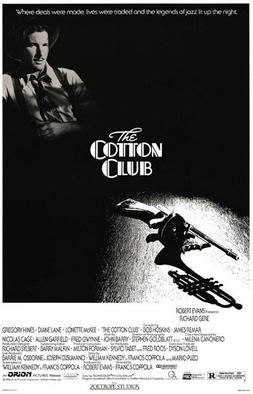
When I reviewed The Cotton Club yesterday, I knew that I would have to do Hoodlum today.  Hoodlum and The Cotton Club are based on the same historic events and both of them feature Laurence Fishburne in the role of Bumpy Johnson.  Of the two, Hoodlum is the more straightforward film, without any of the operatic flourishes that Coppola brought to The Cotton Club.  Fisburne is surprisingly dull as Bumpy Johnson but Tim Roth goes all in as Dutch Schultz and Andy Garcia is memorably oily as the Machiavellian Luciano.  Hoodlum is about forty minutes too long but the gangster action scenes are staged well.  Bumpy Johnson lived a fascinating life and it is unfortunate that no film has yet to really do him justice, though Clarence Williams III came close with his brief cameo in American Gangster.  (Interestingly enough, Williams is also in Hoodlum, playing one of Shultz’s lieutenants.)

One final note: Hoodlum features William Atherton in the role of District Attorney Thomas E. Dewey.  Atherton plays Dewey as being a corrupt and sleazy politician on Luciano’s payroll.  In real life, Dewey was known for being so honest that Dutch Schultz actually put a contract out on his life after he discovered that Dewey could not be bribed.  I am not sure why Hoodlum decided to slander the subject of one of America’s most famous headlines but it seems unnecessary.

A Movie A Day #264: The Cotton Club (1984, directed by Francis Ford Coppola)


The time is the 1930s and the place is New York City.  Everyone wants to get into the Cotton Club.  Owned by British gangster Owney Madden (Bob Hoskins), the Cotton Club is a place where the stage is exclusively reserved for black performers and the audience is exclusively rich and white.  Everyone from gangsters to film stars comes to the Cotton Club.

It is at the Cotton Club that Dixie Dwyer (Richard Gere) meets everyone from Dutch Shultz (James Remar) to Gloria Swanson (Diane Venora).  Shultz hires Dixie to look after his girlfriend, Vera (Diane Lane).  Swanson arranges for Dixie to become a movie star.  Meanwhile, Dixie’s crazy brother, Vincent (Nicolas Cage), rises up through the New York underworld.  Meanwhile, dancing brothers Sandman and Clay Williams (played by real-life brothers Gregory and Maurice Hines) are stars on stage but face discrimination off, at least until Harlem gangster Bumpy Rhodes (Laurence Fishburne) comes to their aid.

The Cotton Club was a dream project of the legendary producer, Robert Evans, who was looking to make a comeback after being famously charged with cocaine trafficking in 1980.  Having commissioned a screenplay by his former Godfather collaborators, Mario Puzo and Francis Ford Coppola, Evans originally planned to direct the film himself.  At the last minute, Evans changes his mind and asked Coppola to direct the film.  After working with him on The Godfather, Coppola had sworn that he would never work with Evans again. (When he won an Oscar for The Godfather‘s screenplay, Coppola pointedly thanked everyone but Robert Evans.)  However, by 1984, a series of box office flops had damaged Coppola’s standing in Hollywood.  Needing the money, Coppola agreed to direct The Cotton Club.

Evans raised the film’s $58 million budget from a number of investors, including Roy Radin.  Roy Radin was best known for putting together Vaudeville reunions in the 70s and being accused of raping an actress in 1980.  Radin and Evans were introduced to each other by a drug dealer named Lanie Jacobs, who was hoping to remake herself as a film producer.  During the production of The Cotton Club, Radin was murdered by a contract killer who was hired by Jacobs, who apparently felt that Radin was trying to muscle her out of the film production.

While all of this was going on, Coppola fell into his familiar pattern of going overbudget and falling behind schedule.  This led to another investor filing a lawsuit against Orion Pictures and two other investors, claiming fraud and breach of contract.  When the film was finally released, it received mixed reviews, struggled at the box office, and only received two Oscar nominations.

With all of the murder and drama that was occurring offscreen, it is not surprising that the film itself was overshadowed.  The Cotton Club is a disjointed mix of gangster drama and big production numbers.  As always with post-Apocalypse Now Coppola, there are flashes of brilliance in The Cotton Club.  Some of the production numbers are impressive and visually, this movie has got style to burn.   However, among the leads, neither Richard Gere nor Diane Lane seem to be invested in their characters while the talented Hines brothers are underused.  The supporting cast is full of good character actors who are all in a search of a better script.  A few do manage to make an impression: James Remar, Bob Hoskins and Fred Gwynne as veteran gangsters, Nicolas Cage as the film’s stand-in for Mad Dog Coll, and Joe Dallesandro as Lucky Luciano.  The Cotton Club is sometimes boring and sometimes exciting but the onscreen story is never as interesting as what happened behind the scenes.


Horror Film Review: Event Horizon (dir by Paul W. S. Anderson)


event_horizon_ver1

Event Horizon, a sci-fi/horror hybrid from 1997, is one of those films that starts out with a series of title cards:

“2015 First permanent colony established on moon.”

Wait … 2015?  How did I miss that?

” 2032 Commercial mining begins on Mars.”

Yay!  Only 16 more years to wait until we’re finally on Mars!

“2040 Deep space research vessel ‘Event Horizon’ launched to explore boundaries of Solar System. She disappears without trace beyond the eighth planet, Neptune. It is the worst space disaster on record.”

Wow, that sucks.  But things happen…

“2047 Now…”

Alright, let’s get this story going!

Seven years after it disappeared, the Event Horizon suddenly sends out a distress signal.  It turns out that it didn’t blow up like everyone assumed.  Instead, it’s still out in space.  The surly crew of the Lewis & Clark is called off of leave and sent on a rescue mission.  (And when I say surly, I do mean sur-ly!  Seriously, nobody on the Lewis & Clark is in a good mood … ever!)  Accompanying the crew is Dr. Weir (Sam Neill), the scientist who designed the Event Horizon.  Captain Miller (Laurence Fishburne) may not be happy about having Dr. Weir on his ship but, then again, Captain Miller always seems to be annoyed about something.

The Event Horizon appears to be deserted.  The walls are covered with blood.  The captain — at least it appears to be the captain — has been crucified and left on display.  Dr. Weir explains that the Event Horizon was designed to create an artificial black hole and it’s possible that the ship went into another dimension and that it may have brought something back with it.  Other crew members speculate that the Event Horizon may have accidentally been transported to Hell.  Either way, it’s not a good thing but, after the Lewis & Clark suffers some damage, the crew find themselves stranded on the Event Horizon.

Soon, the crew members are having hallucinations.  The ship’s doctor (Kathleen Quinlan) sees her son running through the ship.  Captain Miller sees the burning corpse of a friend that he had to abandon during a previous mission.  Another crewman appears to be possessed and attempts to commit suicide by opening up the airlock.  Dr. Weir has visions of his dead wife.  Things get darker and darker.  People die.  Eyes are ripped out of sockets.  A video of the original crew is found and it’s like something out of a painting by Hieronymus Bosch.  Miller wants to blow up the Event Horizon.  Dr. Weir replies, “We are home!”

Agck!

Seriously, Event Horizon is a curious film.  I’ve seen it a few times and I have to admit that it’s never quite as good as I remembered.  If you want to get really technical about it, Event Horizon is a poorly paced film that is overly derivative of the Alien franchise and it features perhaps the worst performance of Laurence Fishburne’s career.

(Yes, even worse than his performance in Contagion…)

But, at the same time, even if I’m always somewhat disappointed with the film, Event Horizon is also a movie that stays with you.  Whatever flaws the film may have, it is genuinely scary and disturbing.  Director Paul W.S. Anderson does a good job of turning that spaceship into the ultimate floating haunted house and, even more importantly, he keeps you off-balance.  This is one of the few horror films where literally anyone can die, regardless of whether they’re top-billed or have an Oscar nomination to their name.  Whatever the evil is that has possessed the Event Horizon, it is ruthlessly and sadistically efficient.

Plus, there’s that video.  If you’ve seen the movie, you know what I’m talking about.  Anderson has complained that the studio made him cut a lot of footage out of the video but what remains is disturbing enough.  Seriously, you’ll never want to hear another Latin phrase after watching Event Horizon.

John Wick: Chapter 2 Cordially Invites All to A Party In Rome


In 2015, a little film from Lionsgate came out during that time between the summer blockbuster and the awards seasons. It’s sort of the time of the cinematic year when a film is not good enough to be a blockbuster and not enough pedigree to be seen as awards-worthy.

This film was John Wick and it starred Keanu Reeves. It was also directed by two filmmakers more well-known for choreographing fights and action scenes than a full feature film.

John Wick had the last laugh as it surpassed everyone’s expectations to become one of the best action films of recent memory. It helped resurrect Keanu Reeves as a bonafide action star once again.

At this year’s New York Comic-Con the first teaser trailer for the second chapter of the John Wick story dropped to the howling delights of all attending.

We still have to wait until 2017 for John Wick: Chapter 2, but until then let’s stare in awe at John Wick doing what he does best.

Batman v. Superman Latest Trailer Drops


BatmanvSuperman

Batman v. Superman: Dawn of Justice has been gathering steam and buzz since it was first announced a couple years ago at San Diego Comic-Con. The film is now just a little over 4 months away from release. The fact that we’re even talking about latest trailers and clips about this film was an accomplishment all on its own.

This was a project that had been talked about for so many years, but never got on track. While some DC fans might decry what I’m about to say I do think they should thank the success of the Marvel Studios-produced films for getting this film on the fast track to being made. It made DC and Warner Bros. realize they weren’t the big bully in the blockbuster block anymore and needed something monumental to catch up.

With Man of Steel dividing comic book fans this film had to be made whether it made sense narrative-wise or not. Another so-so Superman film would not do. So, what better way to juice up the Son of Krypton franchise than by pitting him against DC’s other juggernaut property: Batman.

So, without further ado, here is the latest trailer for Batman v. Superman: Dawn of Justice.

Embracing the Melodrama Part II #77: Quicksilver (dir by Thomas Michael Donnelly)


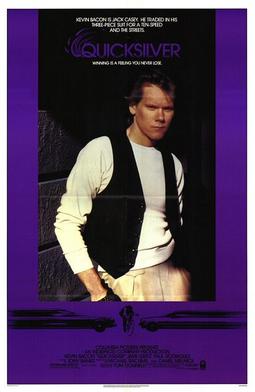
QuicksilverWho doesn’t love Kevin Bacon?

Seriously, I have yet to meet anyone who doesn’t have a positive reaction to seeing Kevin Bacon on screen.  He may not be a star in the way that Bradley Cooper or Bollywood sensation Shah Rukh Kahn are stars but still, he is one of those actors that everyone just seems to instinctively like.

I think, to a large extent, that is because, despite the fact that he’s been around and acting forever, Kevin Bacon himself still comes across as being a normal, blue-collar sorta guy.  Whenever you see him being interviewed, you get the feeling that Kevin Bacon basically shows up, does his job to the best of his ability, and, as opposed to many other actors, he doesn’t take himself or his movies too seriously.  He’s justifiably proud of the good films that he’s appeared in and he’s never had any problem admitting that he’s been in a lot of bad films as well.

In fact, it was Kevin Bacon’s openness about his bad films that led to me discovering 1986’s Quicksilver.  This is the film that, in a 2008 interview, Kevin Bacon referred to as being “the absolute lowest point of my career.”  (Consider, for a minute, that this is being said by the same Kevin Bacon who had an arrow shoved through his throat in the original Friday the 13th and that will give you some clue of how much disdain Kevin seems to have for Quicksilver.)

Naturally, having read that, I knew that I simply had to see Quicksilver.  I’ll admit right now that I was hoping to discover that it was some sort of loss and unappreciated classic.  I wanted this to be the review where I defended the unacknowledged brilliance of Quicksilver.  I wanted to say, “Don’t be so hard on yourself, Kevin!  Give Quicksilver another chance!”

But no.

Quicksilver doesn’t quite suck but it definitely comes close.

At the same time, it is interesting as a classic example of what happens when a filmmaker tries to assign some sort of deeper meaning to or find inherent nobility in an activity or job that really isn’t that interesting.  Often times, this will happen with sports movies.  A director or producer will make the mistake of thinking that just because he’s obsessed with beach volleyball that means that there’s a huge audience out there just waiting for someone to make the ultimate beach volleyball film.  Or, you’ll get a film like 1999’s Just The Ticket, where Andy Garcia is described as being the “world’s greatest ticket scalper” and the audience is supposed to be impressed.

In the case of Quicksilver, it’s all about being a bicycle messenger.  I’m assuming that, one day, director Thomas Michael Donnelly was stuck in traffic and he happened to see a bike messenger rushing down the street, whizzing past all of the stalled commuters.  And Donnelly probably thought, “I wish I was that guy right now!”  Every day after that, whenever Donnelly was stuck in traffic, he thought back to that bike messenger and slowly he grew obsessed.  All of his friends and his family got sick of listening to him talk about how much he envied the freedom of that bike messenger.  Finally, a little light bulb turned on over Donnelly’s head and he said, “I’ve got to make a movie out of this!”

And then the bulb burned out but nobody noticed.

Quicksilver-photo_625px_8col

Kevin Bacon plays Jack Casey.  When we first meet Jack, he’s a successful stock broker and he’s got a really bad, porn-appropriate mustache.  One day, he’s sitting in the back of a cab and he goads his driver into getting into a race with a bike messenger.  The messenger beats the cab.  Jack is amazed!

And then, perhaps the very same day (the film is so poorly edited that it’s hard to tell), Jack not only loses all of his money but all of his parents’ money as well.  Since poor men couldn’t afford facial hair in the 1980s, he shaves off his mustache.  Desperately needing work, Jack applies to be a  — you guessed it! — bicycle messenger.

The rest of the film is basically Jack delivering messages and talking about how he’s free now to live the life that he’s always wanted to live.  And the thing is, you like Jack because he’s being played by Kevin Bacon.  I mean, Kevin Bacon is so inherently likable that audiences even liked him when he was trying to kill Professor X and Magneto in X-Men: First Class.  But, at the same time, you listen to Jack go on and on about how much better his life is now and you just want to say, “Who are you kidding?”

Needless to say, Jack has a group of quirky coworkers.  Of course, by quirky, I mean that they are all quirky in a very predictable Hollywood sort of way.  For instance, there’s the crusty old veteran and the goofy fat guy and the hard-working Mexican guy who wants to start his own business in America and the cocky black guy who is mostly notable for being played by Laurence Fisburne.  One thing they all have in common is that they all love and damn near worship Jack, who has quite the common touch despite having formerly been a super rich stock broker with a bad mustache.

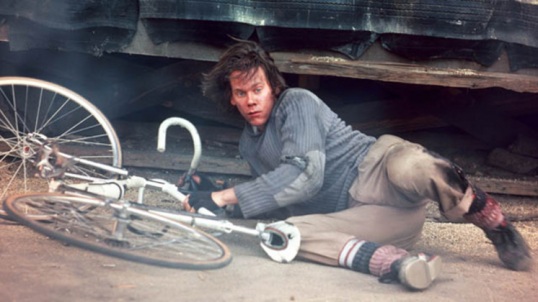
Anyway, Terri (Jami Gertz) also wants to become a bicycle messenger but she’s being used to deliver drugs by Gypsy (Rudy Ramos).  She and Jack fall in love and, along with helping out his quirky coworkers and finding a way to make back his fortune, Jack also has to deal with Gypsy.  It’s all very dramatic (though the drug dealer subplot feels as if it was awkwardly inserted into the film at the last moment) but mostly, the plot is just an excuse for scenes like the one below:

Quicksilver is … well, it’s not particularly good.  It has a few good bike weaving in and out of traffic scenes but it’s definitely no Premium Rush.  But it is kinda fun, in a “Oh my God, look at the 1980s” sorta way.  And, for what it’s worth, it’s a film that proves that Kevin Bacon can be likable in almost anything.

Batman v. Superman Finally States It’s Case to the Public


BatmanvSuperman

A funny thing happened to the Batman v. Superman: Dawn of Justice trailer that was set for a release at a special IMAX screening event next week. No one bothered to tell someone with a cellphone not to secretly record the trailer. A lo-res cam version of the first teaser trailer for Batman v. Superman: Dawn of Justice was leaked just hours after Disney released the second teaser trailer for the upcoming Star Wars: The Force Awakens.

Warner Brothers scrambled to take down the lo-res trailer and made sure to use their power to threaten with legal stuff if people continued to disseminate the illegal recording. During the 24 hours since the leak someone with a much more cooler head over at WB decided to just go the Avengers: Age of Ultron route (that film’s first teaser was also leaked ahead of a planned event) and release the hi-res version of the teaser trailer instead of waiting days for the planned screening event.

So, here’s the very first teaser trailer as Warner Bros. and DC Entertainment finally make their case that whatever Disney and Marvel can do they can do as well.

Batman v. Superman: Dawn of Justice is set for a March 25, 2016 release date.