Horror On The Lens: Invitation to Hell (dir by Wes Craven)


There’s one rule in life that should never be forgotten.

Any movie that opens with Susan Lucci casting a hex that causes a man’s head to explode is going to be worth watching.

That’s certainly the case with Invitation to Hell, a 1984 made-for-TV movie that was directed by Wes Craven and which casts Lucci as Jessica Jones, an insurance agent who lives and works in an upper class suburb in Southern California. Jessica not only sells insurance but she also runs the ultra-exclusive Steaming Springs Country Club! Anyone who is anyone in town is a member of Steaming Springs!  That include Matt Winslow (Robert Urich) and his family.  Matt soon comes to suspect that something strange might be happening at the club.  Fortunately, Matt’s spacesuit comes with a flame thrower, a laser, and a built-in computer that can determine whether or not someone is actually a human being. (Wearing the space helmet means viewing the world like you’re the Terminator.) Soon, it’s science vs. magic as Matt dons the suit and tries to rescue his family from country club living!

Totally ludicrous and a lot of fun, this is a film that has a little bit for everyone — familiar television actors, flamethrowers, space suits, demonic possession, exploding cars, and even a little bit of social satire as the film suggests that living in the suburbs is a terror even without weird country clubs and chic spell casters.


Retro Television Review: Fantasy Island 7.11 “Games People Play/The Sweet Life”


Welcome to Retro Television Reviews, a feature where we review some of our favorite and least favorite shows of the past!  On Tuesdays, I will be reviewing the original Fantasy Island, which ran on ABC from 1977 to 1984.  Unfortunately, the show has been removed from most streaming sites.  Fortunately, I’ve got nearly every episode on my DVR.

“Smiles, everyone …. SMILES, DAMMIT!”

Episode 7.11 “Games People Play/The Sweet Life”

(Dir by Cliff Bole and Don Weiss, originally aired on January 14th, 1984)

Three women who all work for a toy company come to Fantasy Island.  Nora Leonard (Lynda Day George) has closed off her heart after getting hurt in too many past relationships.  Barbara Jessup (Jenilee Harrison) wants her boss to look past her appearance and realize that she really does have a brain to go with her beauty.  Sandy Hoffman (Berlinda Tolbert) wants to have the courage to present her ideas….

Oh hey, it’s a Wizard of Oz thing!  Except it’s not.  There’s no Dorothy and there’s no Toto.  There’s a corporate spy named Steven Curry (John McCook), who wants the details of the company’s new video game and who also falls for Nora.  And there’s Dick York as Mr. Sutton, who wears a bowtie as all toy company execs do.

What there is not is an interesting fantasy.  Even with three separate fantasies in one, this storyline was pretty blah.  Everyone seemed a bit bored, even the usually dependable Lynda Day George.

The other fantasy was slightly more interesting, but only because it featured the great character actor Kevin McCarthy as Daniel Koster.  Daniel wanted to give his wife and his children the lifestyle they could have had if Daniel had been rich.  In fact, Daniel sent his family to Fantasy Island ahead of him so that they could enjoy being rich without him around.  (What?)  I was always under the impression that guests at the Island only stayed for a weekend.  Daniel comes to the Island and discovers that his family appears to be very happy, even if his son is still writing bad poetry.  (There’s no money in poetry, Daniel gruffly explains and, as a poet, I can say that’s very true.)  Along with his son’s rhyming habits, Daniel has other things to deal with, like his bad heart.

In fact, Daniel dies of a heart attack while on the Island but not before realizing that his family always loved him, even if they weren’t rich.  Having Daniel die was depressing.  What made it even worse is that Roarke apparently knew Daniel was probably going to die on the Island but he didn’t really seem to do anything to try to prevent it from happening.  Instead, he just made a bunch of cryptic comments to Lawrence about how Daniel’s weekend on Fantasy Island could be his last.  Lawrence looked concerned but didn’t do anything to help.  Why is Lawrence even there?

Eh, this episode.  I always enjoy watching Kevin McCarthy and he gives a typically solid performance but otherwise, this was a disappointing trip to the Island.

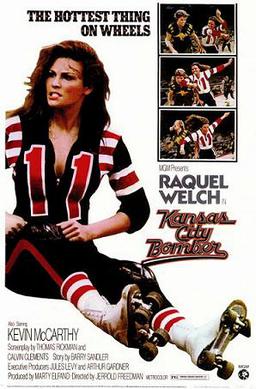
The Unnominated #14: Kansas City Bomber (dir by Jerrold Freedman)


Though the Academy of Motion Picture Arts and Sciences claim that the Oscars honor the best of the year, we all know that there are always worthy films and performances that end up getting overlooked.  Sometimes, it’s because the competition too fierce.  Sometimes, it’s because the film itself was too controversial.  Often, it’s just a case of a film’s quality not being fully recognized until years after its initial released.  This series of reviews takes a look at the films and performances that should have been nominated but were, for whatever reason, overlooked.  These are the Unnominated.

In 1972’s Kansas City Bomber, Raquel Welch stars as KC Carr.

KC. is a star on the roller derby circuit, a tough fighter who is loved by the audience and who shows no fear when it comes to skating around the track and getting into brawls with the other team.  The audience especially loves it when she fights Jackie Burdette (Helena Kallianiotes), madly cheering over every punch landed and every elbow thrown and every strand of hair pulled.  It’s not glamorous work but KC loves the adulation of the crowds and the comradery of her team.  She’s a single mother and putting on roller skates and getting bruised in fights allows her to support her daughter, Rita (a pre-Taxi Driver Jodie Foster).

But then KC is traded to another team, the Portland Loggers.  It takes KC a while to fit in with her new team.  She’s viewed with suspicion, especially when she starts to date the owner of the team, Burt Henry (Kevin McCarthy).  Burt may seem charming but KC soon discovers that he has a jealous side.  When KC spends too much time with her best friend and roommate, Burt trades her to another team.  When a male skater named “Horrible” Hank (Norman Alden) reveals that he has a rather obvious crush on KC, Burt goes out of his way to humiliate Hank.  Burt wants to start a new team in Chicago and he’s promised to make KC a star.  Will KC give up her own freedom to be Burt’s well-compensated star or will she stand up for herself and show that she doesn’t belong to anyone?

You already know the answer.  The wonderful thing about Raquel Welch is that she was tough.  She didn’t let people push her around and, if that resulted in people in Hollywood whispering that she was difficult, so be it.  Like KC Carr, Raquel Welch didn’t make any apologies.  Kansas City Bomber is one of the few of Welch’s early 70s films to celebrate and show how just how tough she was.  For once, Welch is given an actual character to play and she proves herself to be a strong and fierce actress.  It’s fun and more than a little empowering to watch her performance here.  Everyone underestimates KC Carr, just as everyone underestimated Raquel Welch.  In both cases, the doubters are proven wrong.

Kansas City Bomber is not a great film.  (The pacing is totally off and the supporting characters are not quite as memorable as either Welch or Kevin McCarthy.)  But Raquel Welch gave a great performance.  That Welch was never Oscar-nominated isn’t really a surprise.  She didn’t appear in the type of movies that received Oscar attention and she was often cast in roles that didn’t give her much of an opportunity to show off what she could do.  She definitely deserved a nomination for Kansas City Bomber.  

Previous entries in The Unnominated:

  1. Auto Focus 
  2. Star 80
  3. Monty Python and The Holy Grail
  4. Johnny Got His Gun
  5. Saint Jack
  6. Office Space
  7. Play Misty For Me
  8. The Long Riders
  9. Mean Streets
  10. The Long Goodbye
  11. The General
  12. Tombstone
  13. Heat

Film Review: Buffalo Bill and the Indians, or Sitting Bull’s History Lesson (dir by Robert Altman)


1976’s Buffalo Bill and the Indians, or Sitting Bull’s History Lesson takes place in the waning years of the Old West.  Civilization is coming to America and the “wild” west’s days are numbered.  And yet, even as the days of outlaws and gunslingers come to an end, America is already in the process of building up its own mythology.

Buffalo Bill (Paul Newman) owns a popular wild west show, one where his stars put on a show that claims to recreate the great moments of western history.  The show is made up of a motely collection of performers, some of whom are more talented than others.  This is a Robert Altman film and, as usual, the emphasis is more on watching how his large ensemble of actors interact as opposed to highlighting any one actor.  Indeed, it can be hard to keep everyone in the film straight and one gets the feeling that this was intentional on Altman’s part.  Buffalo Bill and the Indians may be a revisionist western and a satire of American history but it’s also a showbiz film.  The emphasis is on people continually coming and going, sticking around long enough to either prove their worth as a performer or moving on to a hopefully more receptive audience.

Geraldine Chaplin plays Annie Oakley, the sharp shooter who takes joy in firing her gun and who barely seems to notice that her husband (John Considine) is terrified of getting shot.  Joel Grey serves as the unflappable manager of the show while Harvey Keitel is miscast as Buffalo Bill’s somewhat nerdy assistant.  (Keitel, with his natural intensity, seems like he’s desperately waiting for a chance to explode, a chance that never really comes.)  Burt Lancaster plays Ned Buntline, the writer who made Buffalo Bill into a celebrity and who provides a somewhat sardonic commentary as Bill’s current activities.  Shelley Duvall shows up as the wife of President Grover Cleveland (played by Pat McCormick), who comes to the show and is amused until an Indian points a gun towards the president.

Throughout it all, Buffalo Bill enjoys his fame and pushes his vision of the Old West on those who come to see his show.  Newman plays Bill as being a blowhard, an eccentric who is obsessed with opera and whose entire persona is a fake.  He can’t shoot straight.  He can barely ride a horse.  His trademark long hair is actually a wig.  The only people who take Bill seriously as those who come to see his show.  Those who know him view him as being a buffoon but they also understand that he’s a very successful and very famous buffoon and that ultimately matters more than any sort of historical truth.

What conflict there is in the film occurs when Sitting Bull (Frank Kaquitts) and his translator (Will Sampson) arrive on the scene.  Sitting Bull has agreed to appear in the show but only under his own terms.  Buffalo Bill grows frustrated with Sitting Bull and his refusal to pretend to be a savage but he also knows that this audience wants to see the last remaining great Indian chief.

It’s a big and sprawling film and it’s really not entirely successful.  Altman was an intelligent director who was willing to take risks and no one deserves more credit for popularizing the idea of the ensemble film.  That said, he could also be a bit heavy-handed and that’s certainly the case here.  It takes a certain amount of courage to cast a star like Paul Newman as a thoroughly unlikable character and it also took a bit of courage on Newman’s part to give the performance that he did.  At the same time, neither the shallow Buffalo Bill nor the dignified Sitting Bull are really compelling enough characters to carry a film that runs for more than two hours.  The film’s message is an obvious one and it’s also one that Altman handled in a much more memorable way with Nashville.

That said, the film is a memorable misfire.  It’s at its best when it abandons the politics and just concentrates on the community of performers that popular Buffalo Bill’s show.  The film’s best moments are not the ones with Paul Newman growling but instead the ones with John Considine hoping that Geraldine Chaplin won’t accidentally shoot him.  As with many of Altman’s film, Buffalo Bill and the Indians works best when it focuses on the misfit community at the center of its story.


Retro Television Review: Mary Jane Harper Cried Last Night (dir by Allen Reisner)


Welcome to Retro Television Reviews, a feature where we review some of our favorite and least favorite shows of the past!  On Sundays, I will be reviewing the made-for-television movies that used to be a primetime mainstay.  Today’s film is 1977’s Mary Jane Harper Cried Last Night!  It  can be viewed on YouTube.

Damn.

I mean, seriously!  I have seen some depressing films before but nothing could have quite prepared me for Mary Jane Harper Cried Last Night.

Susan Dey stars as Rowena, a young single mother whose 3 year-old daughter, Mary Jane Harper (Natasha Ryan), is taken to the hospital with a broken arm.  Dr. Angela Buccieri (Tricia O’Neil) doesn’t believe Rowena’s claim that Mary Jane is just accident prone and when she discovers what appears to be cigarette burns on the little girl, Dr. Buccieri goes to the head of pediatrics (played by veteran screen villain John Vernon) and requests a full set of X-rays to see if there are any previously healed injuries.  Buccieri’s request is denied.  It turns out that Rowena comes from a wealthy family and her father (Kevin McCarthy) is a trustee of the hospital.  Even after Dr. Buccieri opens up about her own experiences as an abused child, she is told to drop the matter.

She doesn’t drop it.  Instead, she goes to a social worker named Dave Williams (Bernie Casey).  Dave does his own investigation but none of Rowena’s neighbors want to talk about all of the crying and the screaming that they hear coming from Rowena’s apartment.  Rowena presents herself as being a stressed but loving mother.  Dave suggests a support group that she can attend.  When Rowena goes to the group, she opens up a little about how overwhelmed she feels.  Unfortunately, she leaves Mary Jane in the apartment alone and, when a fire breaks out, Mary Jane is lucky to survive.

As intense as all of that is, it’s also only the first half of the movie.  The second half is even more intense and emotionally draining and it all leads up to one of the most devastating final lines ever uttered in a movie.  Throughout the film, the system fails both Rowena and Mary Jane.  Mary Jane is failed when all of the evidence of the abuse that she has suffered is either ignored or shrugged away by the same people who are supposed to be looking out for her.  Rowena is failed when no one pays attention to her obvious emotional instability.  When she finally does have a breakthrough during a therapy session, her psychiatrist (played by James Karen) curtly tells her that they’ll have to talk about it next week because their hour is up.

Rowena is a character who I both hated and pitied.  Like many abusers, she herself was a victim of abuse.  Even when Rowena tries to get support, no one wants to admit that a mother is capable of abusing their own child.  That said, Mary Jane Harper is at the center of the film. She’s a little girl who is desperate to be loved by a woman who often terrifies her.  She is continually failed by the people who should be looking after her and it’s just devastating to watch.  I’m sure I’m not the only person who was moved to tears by this film.

What a sad film.  At the same time, it’s also an important one.  If the film takes place at a time when no one wanted to admit to the abuse happening before their eyes, we now live in a time when people toss around allegations of abuse so casually that it’s led to a certain cynicism about the whole thing.  Even when seen today, Mary Jane Harper Cried Last Night works as a powerful plea to watch out and care for one another.

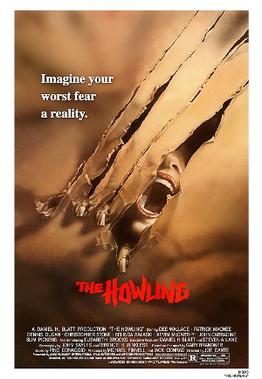
Horror Film Review: The Howling (dir by Joe Dante)


The 1981 film, The Howling, takes place at The Colony.

The Colony is a lovely place, a nice resort out in the middle of the countryside.  It’s a place that celebrity therapist George Waggener (Patrick Macnee) sends his clients so that they can recover from trauma.  It’s a bit of a grown-up version of the ranch to which Dr. Phil used to send juvenile delinquents.  Of course, the Colony is full of adults and they’re an eccentric bunch.  I mean, one of them — named Erle Kenton — is actually played by John Carradine!  That’s just how eccentric the place is.  Sheriff Sam Newfield (Slim Pickens) keeps an eye on the place but everyone knows that there’s nothing to worry about when it comes to The Colony.  Dr. Waggner does good work.

Karen White (Dee Wallace) is a Los Angeles news anchor who was held hostage by a serial killer named Eddie Quist (Robert Picardo).  While she was with Eddie, she was forced to not only watch videos of Eddie’s crimes but she also saw something happen with Eddie that terrified her to such an extent that she has blocked it from her mind.  Karen was rescued by the police but she is haunted by nightmares.  Dr. Waggner arranges for Karen and her husband, Bill Neill (Christopher Stone, who was married to Dee Wallace when they co-starred in this film), to spend some time at the Colony.

Bill loves the Colony, especially after he attracts the eye of Marsha (Elisabeth Brooks), the resort’s resident seductress.  Karen, however, is less enamored of the place.  The Colony feels off to her and she’s not happy about the howling in the distance or the fact that Bill has suddenly started to grow distant from her.  Could it be that The Colony is actually crawling with werewolves and that Bill has become one of them?  (It’s totally possible and, to The Howling‘s credit, it doesn’t waste any time letting us know that.)  Karen’s friend, Terry Fisher (Belinda Balanski), and her boyfriend, Chris Halloran (Dennis Dugan), do some research of their own into Eddie Quist, The Colony, and whether or not werewolves exists and they meet a helpful bookstore owner named Walter Paisley (Dick Miller).

To understand the approach that director Joe Dante and screenwriter John Sayles take to The Howling, one needs to only consider the names of some of the characters.  George Waggner.  Bill Neill. Terry (which can be short for Terence) Fisher.  Fred (or is that Freddie) Francis.  Erle Kenton.  Sam Newfield.  Jerry Warren.  All of these characters are named after horror film directors.  This is the type of werewolf film where Chris Halloran has a copy of The Three Little Pigs sitting on his desk.  Veteran actors like Kevin McCarthy, John Carradine, Slim Pickens, and Kenneth Tobey show up in small roles.  Roger Corman mainstay Dick Miller plays yet another character named Walter Paisley and he kicks Forrest J. Ackerman out of his bookstore.  Roger Corman himself plays a man making a phone call.  After a werewolf is shot on live TV, the program immediately cuts to a dog food commercial and we see a blank-faced child telling his unconcerned parents that someone just turned into a wolf.  The Howling was made by people who obviously love B-horror and that love is present in every frame of the film.

Like Dante’s Piranha, The Howling is a film with a sense of humor but it’s not a comedy.  The werewolves are still impressive, even forty-two years after the film was first released.  The character of Eddie Quist (“I’m going to give you a piece of my mind”) is a terrifying monster and the sight of his signature smiley face will fill you with dread, especially when it shows up in a place where it really shouldn’t be.  The film cynically ends on a note of noble sacrifice that will apparently not make much difference, with the suggestion being that human beings are either too distracted or too jaded to realize that there are monsters among them.  The Howling is a fast-paced and well-directed homage to B-horror and it’s still terrifically entertaining.

Retro Television Reviews: A Great American Tragedy (dir by J. Lee Thompson)


Welcome to Retro Television Reviews, a feature where we review some of our favorite and least favorite shows of the past!  On Sundays, I will be reviewing the made-for-television movies that used to be a primetime mainstay.  Today’s film is 1972’s A Great American Tragedy!  It  can be viewed on YouTube!
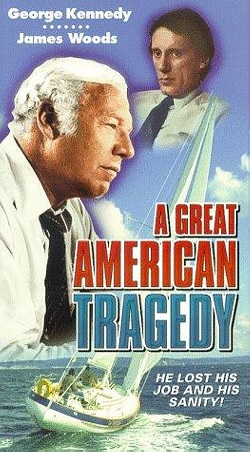
Brad Wilkes (George Kennedy) had a good career, working as an aerospace engineer.  He was able to buy a nice house.  With his wife, Gloria (Vera Miles), he was able to raise a good family.  He was even able to buy a sailboat, one that is the pride of the entire marina.  But then, one day, he’s told that the company is letting him go.

Returning to his home, Brad tells Gloria that he’s lost his job but that everything’s going to be okay because not only does he have a $10,000 pension but he’s sure he can find a new job.  “Of course, I might not be making $35,000 a year….” he says.

(Watching at home, I said, “Pfffft!  I make more than that!”  But, of course, Brad is talking about $35,000 in 1972 money, which would be the equivalent of a quarter of a million today.)

However, Brad soon discovers that getting a new job will not be as easy as he assumed.  It turns out that there are a lot of people out there looking for work and most of them are younger, cheaper, and better educated than Brad.  The bills start to pile up.  His former boss (Robert Mandan) informs Brad that his pension is going to be $7,000 less than he thought.  Brad forces himself to go down to the unemployment office so that he can collect $25 a week and then suffers the humiliation of being offered a loan by his well-meaning son-in-law (played by a youngish James Woods).  Gloria gets a job at the same clothing store where she used to shop and her lecherous boss (Kevin McCarthy) starts to hit on her.

For Brad, the final humiliation comes when he has to sell the boat.  A younger boat owner (Tony Dow, with a huge mustache) puts Brad in contact with a woman named Paula (Natalie Trundy).  Paula wants to buy the boat and, after they take it out on the water, Brad finds himself tempted to cheat on his wife.  It all gets to be too much for Brad and soon, he’s on a plane to Nevada where hopefully one good night at the craps table will be enough to pay his bills….

Watching this film, I found myself feeling very sorry for Brad while, at the same time, becoming very frustrated with him.  On the one hand, his company tossed him out after years of loyal service and then tried to screw him out of his pension.  On the other hand, Brad spent almost the entire movie in denial about how bad things actually were.  It’s one thing to be proud and it’s another to just be stubborn.  Knowing that he has next to no money, Brad still insists on throwing his annual 4th of July party and he even invites his former boss to come over and celebrate.  Brad simply cannot bring himself to admit that his old life is over but really, who can blame him?  He’s not the one who chose to be fired.

A Great American Tragedy was directed by J. Lee Thompson, who also did Cape Fear, The Guns of Navarone, the Planet of the Apes sequels, and several Charles Bronson films.  There are no fight scenes to be found in A Great American Tragedy but Thompson does get good performances from his cast and the film makes great use of George Kennedy’s likability.  The viewer remains sympathetic to Brad, even when he makes mistake after mistake.  A film about a formerly secure family suddenly discovering just how much the economy sucks, A Great American Tragedy remains just as a relevant today as when it was first made.

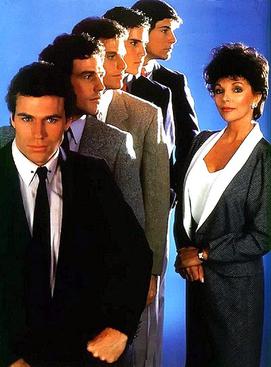
Retro Television Reviews: Making of a Male Model (dir by Irving J. Moore)


Welcome to Retro Television Reviews, a feature where we review some of our favorite and least favorite shows of the past!  On Sundays, I will be reviewing the made-for-television movies that used to be a primetime mainstay.  Today’s film is 1983’s Making of a Male Model!  It  can be viewed on YouTube!

While visiting the set of an outdoor shoot in Nevada, high-powered modeling agent Kay Dillon (Joan Collins) spots a ranch hand named Tyler Burnett (Jon-Erik Hexum).  Tyler is tall, athletic, handsome, and polite.  When Kay asks Tyler if he’s ever modeled, Tyler scoffs at the idea.  Him?  A model?  He’d rather stay in Nevada and work on the ranch.  However, when the girl he likes turns him down because he doesn’t have any money, Tyler reconsiders Kay’s offer.

Before you can say Midnight Cowboy, Tyler is walking around Times Square while dressed like a cowboy.  At first, Tyler is resistant to Kay’s suggestions on how to improve his look.  He doesn’t want anyone messing with her ear or trimming his eyebrows.  But, after a humiliating meeting with a photographer who tells him that he just doesn’t have the right look, Tyler agrees to let Kay turn him into a male model.  Not only does she fix his look but she also takes him to bed.

Soon, Tyler is one of the country’s most well-known faces.  He branches out into commercials, using his sex appeal to sell products to the men who want be him.  And yet, Tyler still feels lost.  He’s not sure if Kay actually loves him or if she’s just using him.  Meanwhile, his roommate, Chuck Lanyard (Jeff Conaway), is a former model who is now hooked on drugs and who constantly warns Tyler that all models are washed up by the time they hit 35.  Tyler becomes disillusioned with his life as a model but is he capable of giving up the fame and the money and returning to Nevada?  Or is he destined to follow in Chuck’s footsteps and head down a path of drugs and self-destruction?

Welcome to the world of decadence, 80s style!  Making of a Male Model is one of those films where the synthesizer-heavy soundtrack plays through every scene and the only thing more dramatic than the line readings is the hair and the shoulder pads.  It’s all a bit silly, none more so that when Tyler and Kay go to a costume party.  Kay dressed up like Cleopatra.  Tyler wears a cowboy hat.  One random extra wears an oversized headpiece with two gigantic eyes painted at either end.  It’s not so much Studio 54 as much as it’s Studio 54 as imagined by someone who has heard of the place but never visited.  It’s decadent but it’s never quite authentic.  The film captures the joy of not only looking good but also knowing that you look good but it never captures the tedium that can go into being on a shoot.  It’s a film about the reality of modeling that never bothers to get that real but so what?  You don’t watch a film called Making of a Male Model because you’re looking for reality.

Joan Collins appears to be having fun in the role of Kay.  John-Erik Hexum, who was a real-life model, gives a rather stiff performance in the role of Tyler.  He looks good but he struggles whenever he has to show any emotion beyond being slightly annoyed.  If anyone really stands out in the cast, it’s Jeff Conaway.  Conaway brings a bit of genuine sadness to his role but you’ll guess what’s going to happen to Chuck long before it actually does.  Finally, Kevin McCarthy (the actor, not the Congressman) plays one of Kay’s business rivals.  He doesn’t get to do much but it’s always nice to see Kevin McCarthy playing yet another sophisticated but ruthless businessman.

In the end, the film doesn’t have anything surprising to say about the world of modeling and Tyler is never that interesting of a protagonist.  However, there’s just enough 80s melodrama and 80s fashion to keep things watchable.

Book Review: “They’re Here….” Invasion of the Body Snatchers: A Tribute, edited by Kevin McCarthy and Ed Gorman


On Saturday night, I watched Piranha, which featured the great character actor Kevin McCarthy in a supporting role. This led to me remembering McCarthy’s iconic performance in the original Invasion of the Body Snatchers (as well as his cameo in the 70s version). And that led to me remembering a book that I found at Half-Price Books a few years ago.

First published in 1999, They’re Here is a tribute to Invasion of the Body Snatchers, featuring essays about the films and interviews with some of the people involved. For instance, Stephen King and Dean Koontz both write about how seeing the original film influenced their later approach to horror. Jon L. Breen, James Combs, and Fred Blosser write about Jack Finney, the author of the book that served as the basis for the film. Other essays take a look at the remakes that were directed by Philip L. Kaufman and Abel Ferrara. Ferrara is himself interviewed and is as outspoken as ever. Also interviewed is Dana Wynter, who co-starred in the original.

However, the majority of the book is taken up with a terrifically entertaining and informative interview with Kevin McCarthy himself. McCarthy not only talks about filming the original Invasion of the Body Snatchers but also his entire career, his friendship with Montgomery Clift, and his status as pop cultural icon. Sometimes it can be disillusioning to read or listen to an interview in which an icon turns out to be kind of boring (call it the Steven Soderbergh syndrome) but, fortunately, McCarthy comes across as being just as eccentric, intelligent, interesting, and downright lovable as you would hope he would be. Kevin McCarthy, who passed away in 2010 at the age of 96, was one of the great character actors and this interview shows that he was …. wait for it …. quite the character! (Sorry.) The interview is a great tribute not only to McCarthy’s most famous film but also the man himself.

Seriously, if you’re a Body Snatchers fan but just appreciate great character acting, order a copy of this book!

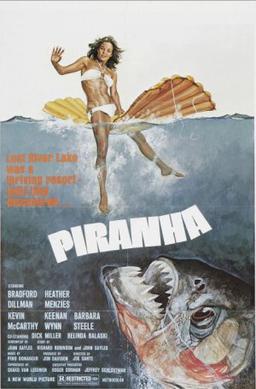
Horror Film Review: Piranha (1978, dir by Joe Dante)


At the height of the Vietnam War, the U.S. Government came up with a plan that could have changed the course of the war.

What if the government developed gigantic, super-fast, occasionally jumpy piranha?  And what if they set those killer fish loose in the rivers of Vietnam?  Would those fish swim through North Vietnam and take out the VC?  Sadly, the war ended before the government got a chance to test out Operation Razorteeth.  With the war over, the government was stuck with a bunch of killer fish.  Scientist Robert Hoak (Kevin McCarthy) ignored all orders to destroy his mutant fish because they were his life’s work.  (Awwwwwwwww!)  He kept an eye on them and did everything he could to prevent them from getting into the nearby river.

Unfortunately, Dr. Hoak’s best wasn’t good enough.  Because the piranha have gotten loose and now they’re making their way down to the river!  They start out eating skinny dipping teenagers, fisherman, and Keenan Wynn.  (They’re good enough not to eat Wynn’s adorable dog, which I appreciated.)  Further down the river, there’s a summer camp and a water park!  It’s definitely not safe to get back in the water but sadly, that’s what several people insist on doing throughout this film.  Even when the water is full of blood, people will jump in.  (It’s easy to be judgmental but it is a pretty river.  I don’t swim but I honestly wouldn’t mind living near a river that looked that nice.  Instead, I have to make due with a creek.)

Floating down the river on a raft and trying to warn everyone is the unlikely team of Maggie (Heather Menzies) and Paul (Bradford Dillman).  Maggie is a detective who has come to town to track down the two teenage skinny dippers who were eaten at the start of the film.  Paul is a drunk.  Well, technically, Paul is a wilderness guide and he does spend the entire movie wearing the type of plaid shirt that would only be worn by someone who goes camping every weekend but really, Paul’s main personality trait seems to be that he enjoys his booze.  Paul’s daughter is away at the summer camp.  Yes, that’s the same summer camp that’s about to be visited by a school of piranha.  AGCK!

Produced by Roger Corman and obviously designed to capitalize on the monster success of Jaws, Piranha was an early directorial credit for Joe Dante.  Dante would later go on to direct films like The Howling and GremlinsPiranha was also an early screenwriting credit for the novelist John Sayles, who would use his paycheck to launch his own directing career.  As a director, Sayles specializes in politically-themed ensemble pieces, which is something you might not guess while watching Piranha.  (Piranha does have an anti-military subplot but then again, it’s a film from the 70s so of course it does.)  Like the best of Corman’s film, Piranha works because it sticks to the basics and it delivers exactly what it promises.  Piranha promises killer fish biting away at anyone dumb enough to get in the water and that’s what it gives us.  As an added bonus, we also get some occasionally witty dialogue and Joe Dante’s energetic, self-aware direction.

As is typical with the films of both Corman and Dante, the cast is full of familiar faces.  Along with Kevin McCarthy as the mad scientist and Keenan Wynn as the eccentric fisherman, Dick Miller shows up as the waterpark owner.  Richard Deacon, who made a career of playing bosses and neighbors on various sitcoms in the 50s and 60s, plays the father of a missing teenager.  Director Paul Bartel plays the head of the summer camp, who may be a jerk but who still heroically jumps in the water to save several campers.  (Bartel’s moment of heroism is one of Piranha’s best scenes and, significantly, it’s played without irony.  You’ll want to cheer for the guy.)  Finally, the great Barbara Steele plays the government scientist who shows up to clean up Operation Razorteeth.

Piranha is simple but entertaining.   Dante’s direction is energetic and, despite the film’s self-referential tone, the killer fish are just savage enough to be scary.  It’s a film that tell us not to get back in the water but which understands that the temptation might just be too strong.