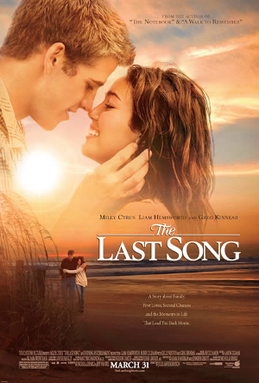
Ronnie Miller (Miley Cyrus), who is 17 and way too rebellious to be likable, travels to Georgia to spend the summer with her father, a former concert pianist named Steve (Greg Kinnear). Ronnie is a sarcastic brat up until she discovers that a racoon is trying to eat a nest of turtle eggs. She tries to protect the turtles. The aquarium sends over a volunteer named Will (Liam Hemsworth) to watch over the turtle eggs and he and Ronnie fall in love over the course of several nights on the beach. Ronnie starts to straighten out her life but then she learns that her father has cancer and that the reason he invited her and her brother to Georgia was so he could have one last summer with her.
This is a Nicholas Sparks story so, of course, someone has to die. I always tell myself that I’m not going to cry whenever I watch a Nicholas Sparks movie and then I do. Greg Kinnear was really likable as Steve and Liam Hemsworth was really cute as Will and I know I would have fallen in love with him too if we were protecting turtle eggs together. When the eggs hatched, the baby turtles were adorable.
It’s too bad Miley Cyrus can’t act because her performance was so bad that it ruined the movie. Even the racoon that tried to steal the turtle eggs outacted her. I got tired of Ronnie and her attitude. No matter what happened, Ronnie had to be sarcastic about it. Even when she finally realized that the world didn’t revolve around her, Miley still delivered all of her lines in the same flat, smartass tone of voice so I didn’t buy her change of heart at all.
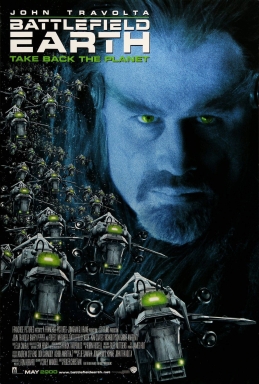
After avoiding it for 25 years, I finally watched the infamous 2000 fiasco, BattlefieldEarth, last night.
BattlefieldEarth, based on a superlong novel by creepy cult guru L. Ron Hubbard, was a longtime passion project of John Travolta’s. Travolta, a Scientologist, had long wanted to make a movie out of Hubbard’s science fiction epic and, on a hot streak following films like PulpFiction and GetShorty, he finally did so in 2000. He played Terl, a member of a giant alien race called the Psychlos. The Psychlos have conquered Earth and humanity has regressed back to an almost prehistoric standard of living. When a brave human, Johnnie Goodboy Tyler (Barry Pepper), defies his elders and proceeds to venture out into the ruins of Denver, he’s captured by Terl. Eventually, Johnnie is shown a copy of the Declaration of Independence and it inspires him to lead a revolution against the Psychlos.
BattlefieldEarth turned out to be just as bad as I had heard, a charmless wannabe epic that used far too many Dutch angles and relied on slow motion to try to create a heroic (or, in some cases, tragic) feel to the action. The plot of the film felt like something recycled from an old 1930s serial, which makes sense when you consider that L. Ron Hubbard was a pulp writer before he decided to become a guru. What I was not prepared for was just how mind-numbingly dull BattlefieldEarth is. Most bad movies can at least make the claim of being entertaining in their badness. If nothing else, you can often admire them for their ambition. Take a film like Plan 9 From Outer Space.Plan9From Outer Space is often derided as being the worst film of all time but it’s still terrifically entertaining and there’s a likable earnestness at the heart of it. Director Ed Wood may not have had a budget and his main star may have been present only through stock footage but, dammit, Wood was determined to make a science fiction epic that would double as a plea for world peace and he did just that. There’s a heart at the center of Plan 9 From Outer Space and that makes it a film that you can mock but you never quite dislike. For all the talk of Battlefield Earth being a passion project for Travolta, the end result is an empty and rather soulless film.
(I nearly listed BattlefieldEarth as being one of our Icarus Files but then I remembered that Icarus at least managed to get close to the sun. BattlefieldEarth can’t even get out of Denver.)
Travolta’s career has never really recovered from BattlefieldEarth. He is an actor who can claim to have appeared in two of the biggest, most influential films of all time — Pulp Fiction and Saturday Night Fever — but his legacy appears to be walking around on stilts in Battlefield Earth. As for Barry Pepper, he does probably about as well as anyone could with the role of Johnnie Goodboy Tyler but still, it’s sad to see a good actor wasted in such a bad movie. (In fact, there’s quite a few good actors — Forest Whitaker, Kim Coates, Richard Tyson — wasted in this movie.) From what I understand, the movie only covered the first 400 pages of Hubbard’s 1100-page novel. Travolta had hopes to do a sequel but that’s not going to happen.
It’s for the best. If people need to see a movie about L. Ron Hubbard’s belief system, they can always rewatch The Master.
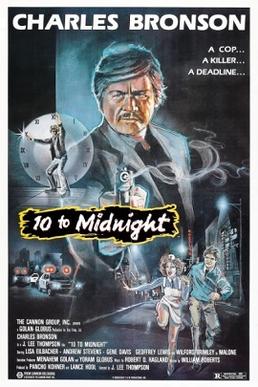
Charles Bronson is Leo Kessler, a veteran detective who’s seen it all and has grown sick of a system of justice that he thinks favors criminals over their victims. When girls start getting murdered, he immediately suspects the arrogant Warren Stacy, played by Gene Davis in the best role of his career. When Kessler and his partner Paul McCann (Andrew Stevens) start putting the pressure on Stacy, the killer responds by going after Kessler’s daughter Laurie (Lisa Eilbacher). Needless to say, our hero will do anything to stop the madman, ANYTHING!
10 TO MIDNIGHT is a special movie in my house because it’s my wife’s favorite Charles Bronson film, even when she didn’t have any overall appreciation for Bronson as an actor. Luckily for her, she had me to introduce her to the rest of the iconic actor’s voluminous catalog of movies. I saw 10 TO MIDNIGHT myself when I was pretty young, probably 13 or so. I remember being scared that first night after I watched the movie when I was trying to go to sleep. My wife and I watched it today on my old VHS tape that I’ve owned going back to the late 1980’s.
There are several elements that elevate 10 TO MIDNIGHT above the average cop / slasher thrillers of the 1980’s. First, it’s Charles Bronson in the lead role. Bronson has such a strong presence on screen that his presence alone elevates almost any material. He looks great in the film, and the role gives him some good opportunities, as both a mentor to the young cop, and even more importantly, as a dad who wants to do better for his daughter. It’s a solid role that seems to fit Bronson like a glove. Second, we know from the very beginning of the movie that Warren Stacy is in fact the killer. We also know that the law seems to be working in his favor. And because of that, we’re on Kessler’s side as he goes to extreme lengths to stop his reign of terror. Finally, the script and director J. Lee Thompson go all in on the sex and violence. Examples include Stacy killing his often naked victims while he himself is in the nude. There is much talk in the film about items of a sexual nature and Stacy even has a sexual release device that almost has to be seen to be believed. It definitely adds a decadent and voyeuristic feel to the proceedings. And I haven’t even mentioned yet that it has one of the very best endings of any Bronson film, second only to THE MECHANIC, in my humble opinion.
I highly recommend 10 TO MIDNIGHT!
For a more detailed review of 10 TO MIDNIGHT, check out Lisa’s review from a couple of years back below:
My wife and I have been watching a Christmas movie every night for the last week or so. We’ve already watched DIE HARD 1 and 2, LETHAL WEAPON, HOME ALONE 1 and 2, CHRISTMAS VACATION, YES VIRGINIA THERE IS A SANTA CLAUS, FOUR CHRISTMASES and a Hallmark movie called THE MOST WONDERFUL TIME OF THE YEAR with Fonzi. She’s been wanting me to watch JACK FROST with her for a while now. I’ve been somewhat hesitant because a movie about a talking snowman not named Frosty doesn’t seem that appealing to me. I was explaining this reluctance to a couple of my co-workers at the accounting office, and they both assured me that it’s a good movie. With this newfound confidence that I would enjoy the film, my wife and I settled in to watch JACK FROST a couple of nights ago…
JACK FROST is about a guy named Jack Frost who is having a difficult time with his work life / home life balance. He loves his wife Gabby (Kelly Preston) and his son Charlie (Joseph Cross) very much, but his musical group, The Jack Frost Band, is taking up a lot of his time. He’s one of those dads who says he’ll “for sure” be at his son’s hockey game but then misses it because the band’s recording session runs late. It’s always something like that with Jack Frost. Tragically, before Jack can get this stuff figured out, he dies in a car accident on Christmas Eve. Jump forward a year later where a depressed Charlie decides to build a snowman like he and his dad always did together for Christmas. Just go with me here… through the magic notes of Jack’s old harmonica as played by his son Charlie, Jack’s spirit is transferred to the snowman, and the two have another chance to bond like they always wanted to. Will Jack be the father he should have been now that he’s a magical snowman dad? How long will he be around this time? Will an abnormally warm Colorado winter melt him? Will he get to watch Charlie play one more hockey game? These are just a few questions to be answered over the course of the film’s 100-minute running time.
I have always been drawn to movies that focus on the relationships between fathers and their sons. For example, FIELD OF DREAMS and FREQUENCY are two of my very favorite films. The reason I love both films is that dads and their boys are able to reconnect and experience each other in a way that resolves pain or regret from the past. The movies may not be realistic in how that happens, but I think each of the films tap into a universal truth about the connections between kids and their parents. If you want to see me cry, just watch either of those movies with me. JACK FROST seems to have this noble intention of magically re-connecting a father and his son for a second chance, and I give it credit for that. Only the most cold-hearted cynic would blow off the scene where Jack’s wife and son get to see him in his human form just one last time. It was touching. I also enjoy some of the songs on the soundtrack. I was able to take my wife to see Stevie Nicks in concert here in Little Rock earlier this year. I enjoyed when her “Landslide” played as Charlie made a snowman for the first time after his dad passed away. I thought that was a strong scene. With that said though, for me, JACK FROST doesn’t come together in a way that packs much of an emotional punch even though it’s clearly going for the heart. Part of that could be the fact that Michael Keaton turns into a snowman, and statements like “snow-dad is better than no-dad” are made. When I think of the other films, sure there are supernatural elements at play, but they’re still set in the real world, even if that place is in Iowa! In the case of JACK FROST, neither the comedy nor the drama worked well enough for me to get emotionally invested. The filmmakers overestimated the comedic nature of a snowman in general, and they seemed to dwell on that one note way too long, and to the film’s detriment. I did think a scene where Charlie’s hockey coach, played by Henry Rollins, refuses to allow the word “snowman” to be spoken in his presence was funny, but that was the exception and not the norm.
After watching JACK FROST, I do understand why Frosty has retained his place as the world’s favorite talking snowman even after this film’s 1998 release. I think the idea of a talking snowman works much better in Frosty’s context. As a matter of fact, I think I’ll go ahead and watch Frosty the Snowman again when I’m done here. But you never know, JACK FROST just may grow on me. Since my wife loves it, I know we’ll be watching it this same time next year!
The 1983 film, 10 to Midnight, opens with LAPD detective Leo Kessler (played by legendary tough guy Charles Bronson) sitting at his desk in a police station. He’s typing up a report and taking his time about it. A reporter who is in search of a story starts to bother Leo.
“Jerry,” Leo tells him, “I’m not a nice person. I’m a mean, selfish son-of-a-bitch. I know you want a story but I want a killer and what I want comes first.”
It’s a classic opening, even if Leo isn’t being totally honest. Yes, he can be a little bit selfish but he’s really not as mean as he pretends to be. He may not know how to talk to his daughter Laurie (Lisa Eilbacher) but he is also very protective of her and he wants to be a better father than he’s been in the past. He may roll his eyes when he discovers that Detective Paul McAnn (Andrew Stevens) is the son of a sociology professor but he still tries to act as a mentor to his younger partner. Leo may complain that the criminal justice system “protects those maggots like they’re an endangered species” but that’s just because he’s seen some truly disturbing things during his time on the force and, let’s face it, Leo has a point. When one of Laurie’s friends is murdered, Leo is convinced that Warren Stacy (Gene Davis) is the murderer and he’s determined to do whatever he has to do to get Warren off the streets. “All those girls,” Leo snarls when he sees Warren, his tone letting us know that his mission to stop Warren is about more than just doing his job.
Warren Stacy is handsome, athletic, and he has good taste in movies. (He’s especially a fan of Butch Cassidy and the Sundance Kid. Just don’t try to trick him by saying Steve McQueen played the Sundance Kid.) Warren is also a total creep, the type of guy who complains that a murder victim “wasn’t a good person,” because she trashed him in her diary. When Leo takes a look around Warren’s apartment, he finds not only porn but also a penis pump. (“It’s for jacking off!” Leo yells at Warren, enunciating the line as only Charles Bronson could.) Warren is also a murderer but he’s a clever murderer, the type who sets himself up with an alibi by acting obnoxiously in a movie theater. Warren strips nude before killing his victims, in order to make sure that he doesn’t leave behind any evidence. (This film was made in the days before DNA testing.)
Leo knows that Warren is guilty but, as both his gruff-but-fair captain (Wilford Brimley, naturally) and the D.A. (Robert F. Lyons) point out, he has no way to prove it. When Warren starts to stalk Laurie and her friends (including Kelly Preston), Leo decides that he has no choice but to frame Warren. But when Warren’s amoral attorney, Dave Dante (Geoffrey Lewis, giving a wonderfully sleazy performance), threatens to call McAnn to the stand, McAnn has to decide whether to tell the truth or to join Leo in framing a guilty man.
10 to Midnight is a violent, vulgar, and undoubtedly exploitive film, one that features a ham-fisted message about how the justice system is more concerned with protecting the rights of the accused as opposed to lives of the innocent. And yet, in its gloriously pulpy way, this is also one of Bronson’s best films. It’s certainly my personal favorite of the films that he made for Cannon.
Director J. Lee Thompson and Charles Bronson were frequent collaborators and Thompson obviously knew how to get the best out of the notoriously reserved actor. Bronson was not known for his tremendous range but he still gives one of his strongest performances in 10 to Midnight, playing Leo as being not just a determined cop but also as an aging man who is confused by the way the world is changing around him. Stopping Warren isn’t just about justice. It’s also about fighting back against the the type of world that would create a Warren Stacy and then allow him to remain on the streets in the first place. Interestingly, though Leo doesn’t hesitate when it comes to framing Warren, he is also sympathetic to McAnn’s objections. Unlike other Bronson characters, Leo doesn’t hold a grudge when his partner questions his methods. Instead, he simply know that McAnn hasn’t spent enough time in the real world to understand what’s at stake. McAnn hasn’t given into cynicism. He hasn’t decided that the best way to deal with his job is to be a “mean son of a bitch.” Bronson and Andrew Stevens, who had worked together in the past, have a believable dynamic. McAnn looks up to Leo but is also conflicted by his actions. Leo may be annoyed by McAnn’s reluctance but he also respects him for trying to be an honest cop. Their partnership feels real in a way that sets 10 to Midnight apart from so many other films about an older cop having to deal with an idealistic partner.
One of the most interesting things about the film is Leo’s relationship with his daughter, Laurie. Over the course of the film, Leo and Laurie go from barely speaking to bonding over liquor and their shared regrets about the state of the justice system. When McAnn first meets Laurie, she’s offended when McAnn suggests that she takes after her father. But, as the film progresses, she comes to realize that she and Leo have much in common. (To be honest, I related quite a bit to Laurie, especially as I’ve recently come to better appreciate how much of my own independent nature was inherited from my father.) Lisa Eilbacher and Charles Bronson are believable as father-and-daughter and they play off of each other well. The scenes between Laurie and Leo give 10 to Midnight a bit more depth than one might otherwise expect from a Bronson Cannon film. Leo isn’t just trying to protect his daughter and her roommates from a serial killer. He’s also trying to be the father who he wishes he had been when she was younger. He’s trying to make up for lost time, even as he also tries to keep Warren Stacy away from his family.
As played by Gene Davis, Warren Stacy is one of the most loathsome cinematic villains of all time. Warren’s crimes are disturbing enough. (Indeed, the surreal sight of a naked and blood-covered Warren Stacy stalking through a dark apartment is pure nightmare fuel.) What makes Warren particularly frightening is that we’ve all had to deal with a Warren Stacy at some point in our life. He’s the sarcastic and easily offended incel who thought he was entitled to a phone number or a date or perhaps even more. As I rewatched this movie last night, I wondered how many Warrens I had met in my life. How many potential serial killers have any of us unknowingly had to deal with? Warren tries to strut through life, smirking and going out of his way to let everyone know that he knows more than they do but the minute that Leo turns the table on him, Warren starts whining about he’s being treated unfairly. During his final, disturbing rampage, Warren yells that his victims aren’t being honest with him, blaming them for his actions. The film deserves a lot of credit for not turning Warren into some sort of diabolical and erudite supervillain. He’s not Hannibal Lecter. Instead, like all real-life serial killers, he’s a loser who is looking for power over those to whom he feels inferior and for revenge on a world that he feels owes him something. He’s a realistic monster and that makes him all the more frightening and the film all the more powerful. Warren is the type of killer who, even as I sit here typing this, could be walking down anyone’s street. He’s such a complete monster that it’s undeniably cathartic whenever Leo goes after him.
How delusional is Warren Stacy? He’s delusional enough to actually taunt Charles Bronson! At one point, Warren informs Leo that he can’t be punished for being sick. Warren announces that, when he’s arrested, he might go away for a while but he’ll be back and there’s nothing Leo can do about it. (The suggestion, of course, is that Warren will be back because he committed his crimes in California and all the judges were appointed by a bunch of bleeding heart governors. Warren may not say that out loud but we all know that is the film’s subtext. Some people may agree with the film, some people may disagree. Myself, I’m against the death penalty because I think it’s a prime example of government overreach but I still cheered the first time that I heard Clint Eastwood say, “Well, I’m all torn up about his rights,” in Dirty Harry.) How does Leo react to Warren’s taunts? I can’t spoil the film’s best moment but I can tell you that 10 to Midnight features one of Bronson’s greatest (and, after what we’ve just seen Warren do, most emotionally satisfying) one-lines.
The title has nothing to do with anything that happens in the film. In typical Cannon fashion, the film’s producers came up with a snappy title (and 10 to Midnight is a good one) and then slapped it onto a script that was previously called Bloody Sunday. Fortunately, as long as Bronson is doing what he does best, it doesn’t matter if the title makes sense. And make no mistake. 10 to Midnight is Bronson at his best.
Last week, the Dodgers won the World Series and brought the 2020 MLB season to a close. For me, it was a disappointing season because the Rangers ended up with the worst record in the American League and came nowhere close to the playoffs. I should be used to that by now but it still hurts every season.
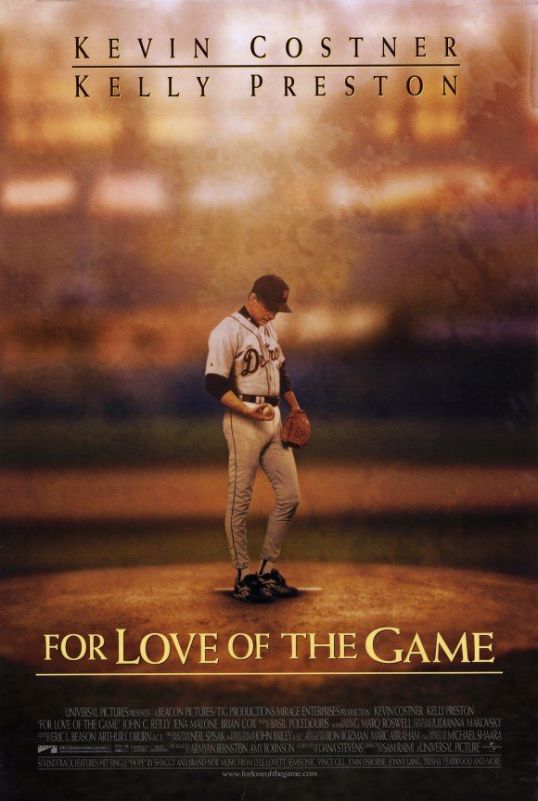
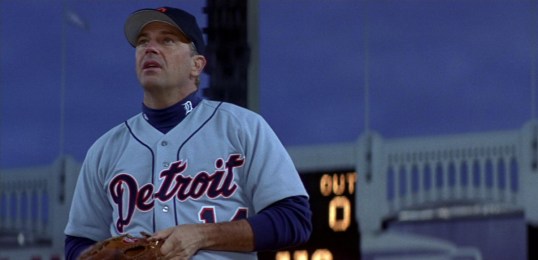
If only we could have had a pitcher like Billy Chapel, who Kevin Costner plays in For Love of the Game. Billy Chapel is a forty year-old veteran who has been playing baseball his entire life and who has spent his entire major league career as a member of the Tigers. Before the start of the team’s final game against the Yankees (the Yankees have already clinched the playoff berth while the Tigers are at the bottom of their division, kind of like my Rangers), Billy is told that the Tigers have been sold and that Billy is going to be traded to the Giants. Will Billy go to San Francisco or will he retire and go to London with the woman he loves, Jane Aubrey (Kelly Preston)?
That’s the decision that Billy is going to have to make. But first, Billy’s going to throw a perfect game against the New York Yankees.
While Billy is pitching the game, he’s also thinking about Jane and having flashbacks to how they first met and fell for each other. Billy loves Jane but he also loves playing baseball and it keeps the two of them apart. Jane doesn’t want to be a baseball groupie and she needs a man who she knows is going to be there for her and her daughter, instead of spending most of the year traveling around the country. Billy, meanwhile, doesn’t want to give up the game that’s defined his life. As Billy throws his perfect game, he has to decide whether or not to keep playing until he can no longer get the ball across the plate or whether to start a new chapter with Jane. Meanwhile, Jane is stuck in an airport, watching Billy play the game of his life.
For Love Of The Game is a good love story but it’s a great baseball movie. I loved the scenes of Billy standing out on the mound, carefully evaluating each batter while blocking out all of the noise around him. (The only villains in this movie are the New Yorkers who won’t stop yelling at Billy during the game.) I enjoyed the interplay between Billy and the catcher (John C. Reilly) and I especially appreciated the way that the movie showed that it takes more than a good pitcher to have a perfect game. It takes teamwork and focus. It’s not just Billy’s perfect game. It’s the entire team’s perfect game.
For Love of the Game may be a romantic drama but it’s also a celebration of everything that makes baseball great. It’s America’s pastime and this movie shows why. Watching Billy Chapel get his perfect game made me look forward to seeing what will happen next year. Who knows? Maybe the Rangers will even shock everyone and make the postseason. If Billy Chapel can throw a perfect game while playing the Yankees in New York City, then anything can happen!
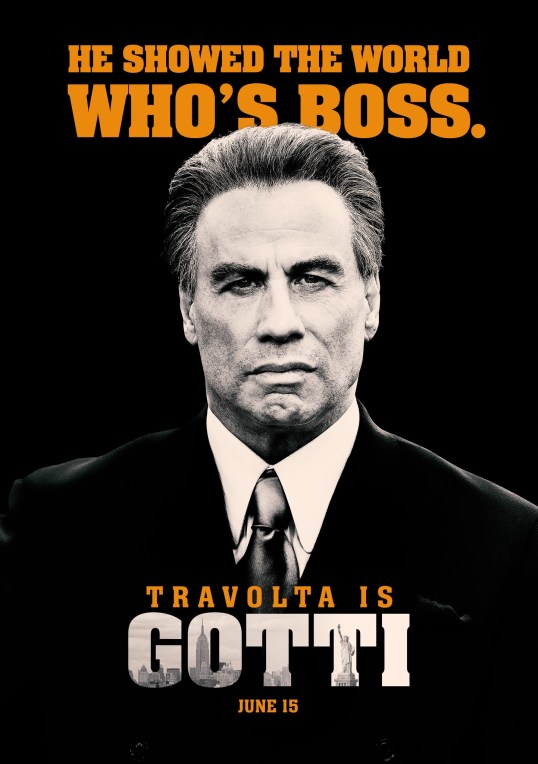
Few recent films have been as misunderstood as Gotti.
When this film was first released in 2018, it was slammed by critics and it flopped at the box office. On Rotten Tomatoes, it managed a score of 0% from the critics. At the same time, the opening day audience score was 80%. (Over subsequent days, the audience score would drop to 46%.) This disparity was blamed on studio employees inflating the audience score, though I think it’s more likely that, after months of negative press about the film’s troubled productions, critics were already looking forward to slamming the film before they even had a chance to see it. At the same time, the buzz on Gotti was so bad that the opening day audience was made up of a combination of John Travolta die-hards (whoever they may be) and people who were expecting such a trainwreck that all Gotti had to do to surpass their expectations was to occasionally be in focus.
Then again, it could be that some members of the audience understood what I instinctively understood when I first watched Gotti. Gotti is not really a film about John Gotti, the flamboyant New York mob boss who ruled the streets with an iron fist and who eventually ended up dying of cancer in prison. Instead, whether it was the filmmaker’s actual intention or not, Gotti is a film about the audience’s fascination with not only gangsters but also the movies that have been made about them.
It’s true that John Travolta may be playing someone namned John Gotti but the film goes out of its way to remind you that he’s not the real John Gotti. The film is full of archival news footage of the real John Gotti, either laughing it up with reporters or smirking while sitting in a courtroom. Every time that we’re shown footage of the real John Gotti, we’re reminded of the fact that, at not point during the film, does Travolta look anything like John Gotti. Add to that, the real Gotti is always smirking whereas Travolta always looks somewhat grim. At the time this film came out, many claimed that this was evidence of lazy filmmaking but I viewed it as being a Brechtian distancing device. Whenever the real Gotti makes an appearance, we’re reminded that we’re just watching a movie and then we’re encouraged to ask ourselves why we would want to watch a movie about such a disreputable figure.
The movie opens with John Travolta standing next to the Brooklyn Bridge and speaking directly to the camera. Though Travolta is meant to be speaking to us as John Gotti, the sight of him standing near a bridge in New York will automatically remind some viewers of a previous Travolta film, Saturday Night Fever. The character that Travolta played in Saturday Night Fever, Tony Manero, has come to epitomize New York in the 70s. The film suggests that, in much the same way, Gotti epitomized New York in the 80s and 90s. Gotti, the film is saying, is as much of an icon of the popular imagination as Tony Manero dancing in a white suit.
Why is Gotti speaking directly to us in that scene? It may seem like a framing device until, a few minutes later, we see a bald and sickly Gotti in a prison meeting room, telling his life story to his son, John, Jr. (Spencer LoFranco). Gotti talking in prison is then established as the narrative’s other framing device. So, why was Gotti speaking to us on the bridge and why did he look so healthy and have a full of head of hair when the film has made it clear that the newly bald Gotti is going to die in prison? When I first saw the film, my initial thought was that the Gotti who speaks directly to the audience was meant to be a ghost. But then it occurred to me that he’s actually not meant to be John Gotti at all. Instead, the Gotti who talks to us on the bridge is meant to be our popular conception of what gangsters like John Gotti as like. He’s what we imagine gangsters to be — i.e., tough-talking, well-dressed, and played by an iconic actor. As such, the film’s narration is not being provided by John Gotti. Instead, it’s being provided by the person that we imagine someone like Gotti to have been.
Is the imprisoned Gotti meant to be the real Gotti? Perhaps. However, it’s hard not to notice that, over the course of the film, Gotti’s son never ages. Though several decades pass, Gotti’s son always looks like he’s in his mid-twenties. When he visits his father in prison and talks about having teenage children of his own, it feels odd because he barely looks old enough to be out of high school. That may seem like lazy filmmaking but again, I would argue that this is a distancing device. It’s a reminder that we’re not watching reality. Instead, we’re choosing to watch actors pretending to be gangsters.
Once you accept that Gotti is a film not about John Gotti but instead about those of us in the audience who are watching, the film makes a lot more sense. The film’s cliches about life in the Mafia are revealed to be not so much the result of an uninspired script as they’re an homage to American folklore. Of course, there’s going to be a scene where Gotti tells his children never to rat on their friends. Of course, there’s going to be random shootings and burly men demanding respect. This is a gangster movie, after all. By populating the cast with people who you normally wouldn’t expect to see playing members of the Mafia — Stacy Keach, Chris Mulkey, Pruitt Taylor Vince — Gotti continually reminds you that you’re watching a movie. The real mafia isn’t like this, Gotti is saying, but the mafia of the popular imagination is. Why are we horrified by real-life crime and yet we flock to movies that claim to recreate it for our entertainment? This is the issue at the heart of Gotti.
Gotti’s flaws are there to remind us that we’re just watching a movie. They’re also there to make us wonder why we’re watching that particular movie. Gotti asks us why audience idolize killers like John Gotti. Why do we turn them into folk heroes? Is it because we imagine them to be characters in films as opposed to actual human beings? Whether or not one feels that the film succeeded in its goal, this is an offer that you cannot refuse.
Harry Mitchell (Roy Scheider) is a businessman who has money, a beautiful wife named Barbara (Ann-Margaret), a sexy mistress named Cini (Kelly Preston), and a shitload of trouble. He is approached by Alan Raimey (John Glover) and informed that there is a sex tape of him and his mistress. Alan demands $105,000 to destroy the tape. When Harry refuses to pay, Alan and his partners (Clarence Williams III and Robert Trebor) show up with a new tape, this one framing Harry for the murder of Cini. They also make a new demand: $105,000 a year or else they will release the tape. Can Harry beat Alan at his own game without harming his wife’s political ambitions?
Based on a novel by the great Elmore Leonard and directed by John Frankenheimer, 52 Pick-Up is one of the best films to ever come out of the Cannon Film Group. Though it may not be as well-known as some of his other films (like The Manchurian Candidate, Seconds, Black Sunday, and Ronin), 52 Pick-Up shows why Frankenheimer was considered to be one of the masters of the thriller genre. 52 Pick-Up is a stylish, fast-paced, and violent thriller. John Glover is memorably sleazy as the repellent Alan and the often underrated Roy Scheider does an excellent job of portraying Harry as a man who starts out smugly complacent and then becomes increasingly desperate as the story play out.
One final note: This movie was actually Cannon’s second attempt to turn Elmore Leonard’s novel to the big screen. The first attempt was The Ambassador, which ultimately had little to do with Leonard’s original story. Avoid The Ambassador but see 52 Pick-Up.
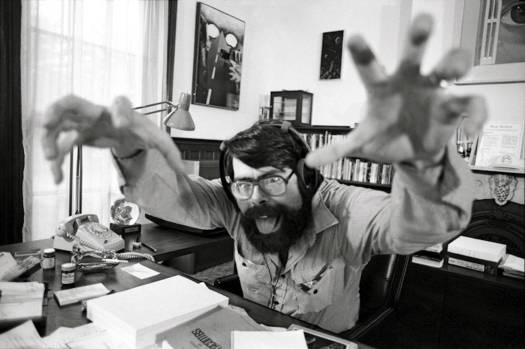
Stephen King turned 70 last month, and the Master of Horror’s grip on the American psyche is stronger than ever, thanks to the unprecedented horror hit IT!, now playing at a theater near you. King’s macabre novels have been adapted for the screen since 1976’s CARRIE with varying degrees of success; some have been unabashed genre classics, others complete bombs, most lie somewhere in the middle.
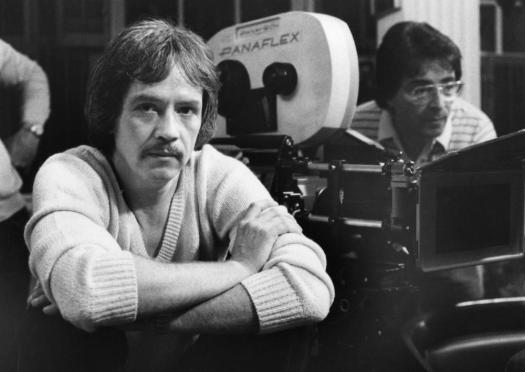
Top: Stephen King 1983 Bottom: John Carpenter 1983
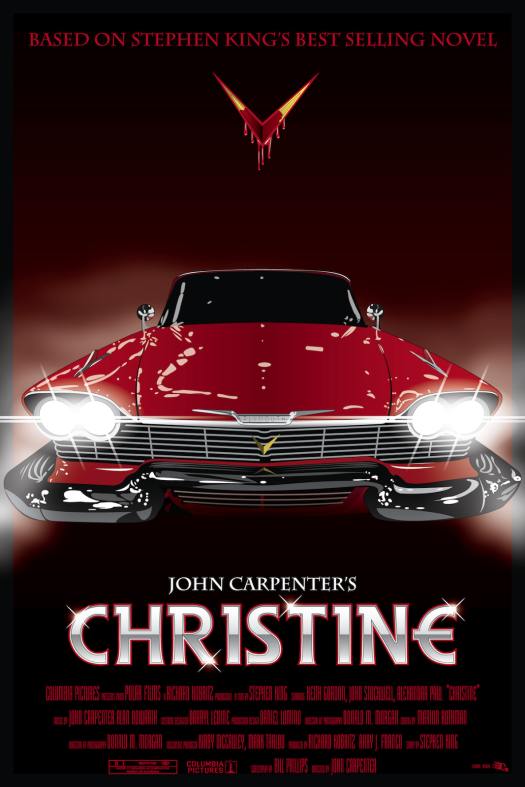
Director John Carpenter had a string of successes beginning with 1978’s seminal slasher film HALLOWEEN, but his 1982 remake of THE THING, now considered a masterpiece of the genre, was a box office disappointment. Carpenter took on King’s novel CHRISTINE as a work-for-hire project. I recently watched it for the first time, and think not only is it one of the best adaptations of King’s work to hit the screen, it’s one of Carpenter’s best horror…
Jeff Mills (Tim Daly) is an attorney who might be unlucky in love but who still owns a copy of every movie that Frank Capra has ever directed. (There is even a scene where two of his friends are seen looking at his movie collection and saying, “He’s got every movie Capra ever made!”) Miranda (Kelly Preston) is the beautiful and mysterious woman who Jeff saves from an abusive boyfriend. Within minutes of meeting her, Jeff invites Miranda to say with him in his apartment. For Jeff, it is love at first sight but his friends (Rick Rossovich and Diana Bellamy) worry that Jeff is getting in over his head with a woman about whom he knows nothing. Weird things start to happen in Jeff’s apartment and a woman (Audra Lindley) shows up in his office, taunting him about how she dug up his mother’s bones and used them in a black magic ceremony. Eventually, Miranda confesses that she is on the run from a Satanic coven that was planning on sacrificing her but is she telling the whole truth?
Spellbinder is an enjoyably daft movie, especially if you are a fan of Kelly Preston. It’s not that the rest of the cast isn’t good but this really is Preston’s show and her mix of All-American beauty and otherworldly sexiness is put to good use as the enigmatic Miranda. It is easy to believe that Jeff would fall in love with her despite not knowing much about her. The movie also has a few good scare scenes, like one in which the faces of all the members of the coven suddenly appear crowded around a window, staring in. A slickly made example of how Hollywood made money off of the Satanic panic of the 1980s, Spellbinder is essentially The Wicker Man set in Los Angeles and is more entertaining than Neil LaBute’s actual remake. (Even if it doesn’t have any bees.)


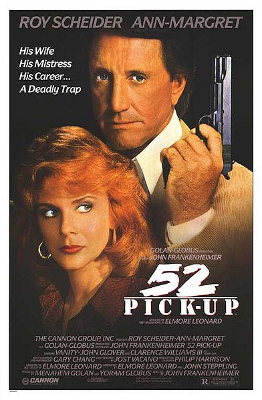 Harry Mitchell (Roy Scheider) is a businessman who has money, a beautiful wife named Barbara (Ann-Margaret), a sexy mistress named Cini (Kelly Preston), and a shitload of trouble. He is approached by Alan Raimey (John Glover) and informed that there is a sex tape of him and his mistress. Alan demands $105,000 to destroy the tape. When Harry refuses to pay, Alan and his partners (Clarence Williams III and Robert Trebor) show up with a new tape, this one framing Harry for the murder of Cini. They also make a new demand: $105,000 a year or else they will release the tape. Can Harry beat Alan at his own game without harming his wife’s political ambitions?
 Jeff Mills (Tim Daly) is an attorney who might be unlucky in love but who still owns a copy of every movie that Frank Capra has ever directed. (There is even a scene where two of his friends are seen looking at his movie collection and saying, “He’s got every movie Capra ever made!”) Miranda (Kelly Preston) is the beautiful and mysterious woman who Jeff saves from an abusive boyfriend. Within minutes of meeting her, Jeff invites Miranda to say with him in his apartment. For Jeff, it is love at first sight but his friends (Rick Rossovich and Diana Bellamy) worry that Jeff is getting in over his head with a woman about whom he knows nothing. Weird things start to happen in Jeff’s apartment and a woman (Audra Lindley) shows up in his office, taunting him about how she dug up his mother’s bones and used them in a black magic ceremony. Eventually, Miranda confesses that she is on the run from a Satanic coven that was planning on sacrificing her but is she telling the whole truth?
 Through the Shattered Lens