We’ve now come to the penultimate episode of The Walking Dead‘s first season. If there’s been one thing about this tv adaptation — of the Robert Kirkman comic book series which it’s based on — has proven it’s that the show is willing to go off the reservation when it comes to following the source material. The show has made some interesting storytelling and character choices right from the start. Scenes which occur later in the comic book have been moved up and combined with others. New characters, both recurring and disposable ones, have been introduced to the original numbers from the book.
Some of these changes have been welcomed by old fans of the book, but there’s a vocal minority who don’t see why there’s a need for such changes and additions. To new fans whose experience with this franchise has been just through the show the changes don’t mean a thing. They’re coming into this fresh and with open eyes. For long-time fans this need to watch this show with open eyes instead of clutching at the strict canonical material that are the books it would be a hard time going. I’m one of those who have been reading the books since the beginning and for the most part I’ve accepted these changes. Even the major departure introduced to end this episode I find quite interesting and with guarded optimism that it will lead to a surprising season finale and set-up season two properly.
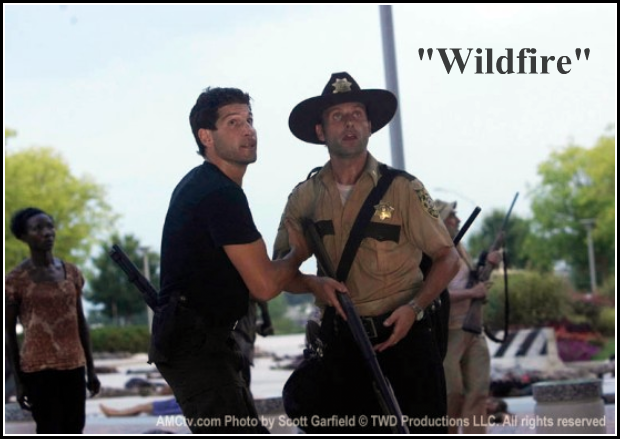
We begin the show the very morning after the zombie attack on the camp which ended the previous episode. The survivors are cleaning up the bodies of both the “walkers” put down and those people they lost. The scenes showing how both Carol deals with her abusive husband’s corpse and how Andrea deals with her younger sister Amy were quite powerful in their own way. In one scene, we see an abused and beaten down wife taking out her anger and relief on the source of her problems with a pickaxe. In another, we see an older sister remembering past regrets of never being there for her much younger sister despite promises to do so. The scene with Andrea goes against much of what most zombie survival aficionados would do, but it brings to light just how much the Andrea loved her sister and even if it means seeing her come to a semblance of life just one more time to say her goodbyes she would do it. Knowing what she would need to do in the end just made her tearful final goodbye that more powerful.
The third farewell doesn’t happen until 3/4’s of the way into the episode (though we do see Morales and his family go their own way. Going to miss him going for the fences with that baseball bat) and involves Jim. An injury incurred from the fight during the night leaves him and the group with a problem that gets resolved in one of the more poignant scenes in this series, so far. As Morgan Jones from the pilot episode instructed Rick the “walkers” and their bites are a death sentence. The two competing leaders of the group in Rick and Shane want to solve their Jim problem using different methods. Rick wants to take the group to the one place he thinks could still help Jim and that’s the CDC near Atlanta. While Shane, with enthusiastic support from Daryl, wants to put Jim down before he becomes a dangerous liability.
In a scene reminiscent of a similar one from Romero’s original Dawn of the Dead, Jim makes the final and ultimate decision about his life. The goodbyes made by everyone to Jim after he’s made his decision to be left behind was very heartbreaking. Jim might have been a secondary support character but the last couple episodes have fleshed out his character enough that we care what happens to this man who has lost everything and thinks his predicament will reunite him with those he has lost.
The growing schism between best friends Rick and Shane gets a few more nails added to it as we see Shane gradually losing his command of the group. The group looks to be gravitating towards Rick as their leader now and even the wildcard in Daryl seem to look to Rick for the answers. The scene between the two as they patrol the woods near the camp definitely widens the gulf between the two even if Rick looks to be unaware of what’s really going on with Shane. The sudden appearance of ever stalwart and ever watchful Dale sure thinks something is amiss.
It’s the final ten minutes of the show where we finally know why the episode was titled “WildFire”. In another departure, one that would be called huge by fans of the comic books, we see the lone surviving researcher within the CDC sending video reports on what’s being called “Wildfire” and how research on the so-called “disease” has remained useless with no answer in sight.
The whole entire sequence reminds me of the early parts of Stephen King’s own apocalyptic epic novel, The Stand, as scientists desperately try to stem the tide of the approaching apocalypse to no avail. It’s little subtle references to other apocalyptic stories and tales like this which keeps some of the changes and departures from the source material bearable and, at times, even welcome.
It’s this major departure that will send some long-time fans of the comic book apoplectic. The vocal minority will definitely get even louder as to why Darabont and the writers are messing with the timeline and the stories in the original comic book. As one of those fans I should be screaming just as loudly, but the zombie and apocalyptic genre fan in me actually like how this show has gone off the beaten path of the original source material.
If they had stayed word-for-word and panel-for-panel true to the comic book then there’s no surprises to be experience. Knowing how everything unfolds right from the start could get boring even if it is about something read and re-read with love. There’s still no guarantee that the final pay-off of this particular major detour from the comic book will end in a good way, but the possibility of not knowing how this story-arc will end this first season is both exciting and tense-inducing. It could succeed in the best way, but also fail in an epic one. Either way the path now is not set in stone and everything moving forward will be undiscovered country.
Extras
* Quote of the night: “I think tomorrow I’m gonna blow my brains out, I haven’t decided. But tonight, I’m getting drunk!” – nameless CDC researcher.
* For once Glenn doesn’t have a witty quip or remark which just highlights the somber mood of this episode.
* There’s still no news on the whereabouts of one Merle Dixon though he gets name-dropped a couple times.
* A sneaking suspicion that Merle will not appear again this season, but may in the next or later ones.
* Bear McCreary’s score and choices of music for the episode the best in the series, so far to date. Especially, the use of John Murphy’s Adagio in D Minor from the sci-fi drama Sunshine which was recently used in Kick-Ass.
We’re now into the first episode of the second half of this initial season. The Walking Dead has been a definitive hit for cable network AMC who has been hyping up the show every week for months. The pilot episode has been hailed as one of the best premiere shows and it helped that showrunner Frank Darabont wrote and directed it. Then we had the follow-up episode which have been hit-or-miss for some people with the second one being a miss for some who began to question whether Robert Kirkman’s comic book series will have the legs to last several seasons and beyond. The third episode allayed some of those fears, but still some people were still doubting whether the show can truly balance the intense drama and character interaction with the zombie mayhem and gore.
Now we’re on the fourth episode and when people heard that creator Robert Kirkman would be writing the episode more doubts started to creep in. I say this because as critically-acclaimed and popular the comic book series is there’s a vocal segment of the fans who think the book succeeds despite Kirkman’s writing which tend to be heavy on the exposition. They see him not knowing the concept of “less is more”. As a long-time fan I can see what these fans mean, but I also think he’s quite good in creating the scenarios his characters must navigate through.
With this fourth episode titled “Vatos” we get Robert Kirkman writing not as a comic book writer but as someone who knows its a new medium and must write accordingly. In what I consider the best episode since the Darabont written and directed pilot, Robert Kirkman has shown just why millions of fans have flocked to read the comic book and why millions more have fallen in love with it’s tv adaptation.
The episode begins with a beautifully shot prologue of Amy and Andrea sitting in a boat fishing in the quarry lake and reminiscing about their father. It’s a nice tender moment which takes on a sad note as they finally voice every survivor’s fear. Are their parents alive? Maybe where they lived wasn’t hit hard. It’s survivor’s guilt to the nth degree as we and these characters know that the odds of any of the camp’s loved ones in far off places being alive are miniscule to none.
We also see a disturbing portent of what may yet come to pass as Jim, the mechanic from the past episode, seem to be losing his edge. It falls to Dale to notice Jim’s erratic behavior and then down to Shane to take care of things before Jim finally goes over the deep end and hurts not just himself but everyone else. I liked how Jim’s little revelation about what happened to his family arrived quite naturally and the effect it had on Lori and the others. Lori, Carol and Andrea may still have a semblance of a family, but Jim is the prime example of someone who has lost everything and may not have anything left to live for.
Now, we ended the third episode with Rick and his little band of Merle rescuers finding their quarry missing and not just from the roof but the hand he was cuffed with. We see the aftermath of Merle’s improbable, but quite the badass, escape from the roof. While we don’t see Michael Rooker as Merle in this episode his presence looms over everything and everyone. It’s during Rick and the groups attempt to find not just where Merle went but also the bag of guns Rick dropped in the pilot episode that we finally meet the episode’s title characters.
At first, it seemed like another attempt by Kirkman and the writers to drop stereotypical characters into an already crowded plate. Latino gangbangers becoming an immediate threat to Rick and his group. They even had a smooth-talking and intelligent leader that some may see as the show’s attempt on the typical drug lord. The confrontation between the two groups don’t come off so smoothly the first, second and third time, but it takes the intervention of the kindly grandma-type to ease the tensions. Tensions which reveals that people shouldn’t judge a book by it’s covers.
I definitely think this is like Kirkman’s shot across the bow of his detractors who think he cannot write beyond wordy exposition. The dialogue in this episode was some of the strongest and I’d say just slightly above of the pilot’s. There were more characters involved with two paralleling storylines to manage. Kirkman has shown with this episode that he actually knows the concept of “less is more” and that his true calling may not be writing comic books but writing teleplays for tv. I wouldn’t mind if all the episodes of The Walking Dead were written by just Darabont and Kirkman. I truly believe that this episode won’t be last time we see a Kirkman-written episode and that’s a good thing to look forward to.
In the end, “Vatos” more than lives up to the high standard the pilot episode set. It was an episode which was able to combine not just the dramatic interaction between character and groups (and not just conflicts, but the quieter moments) but also the very zombie mayhem and carnage fans of the genre expect the show to have. The episode which begins so calm and serene ends on a horrifying and sad way. This episode has finally illustrated what the comic book was all about. A story and journey of survivors living day by day trying to retain a semblance of their old lives only to have the ever-present threat of the zombie apocalypse shatter such misguided attempts.
Extras
* KNB EFX founder Greg Nicotera makes an appearance as a zombie in the second-half of the episode.
* Merle Dixon never appearing on-screen but still ends up being the badass of the episode.
* Guillermo’s (leader of the Vatos) hounds from hell.
* “Admit it, we only came back to Atlanta for the hat” (Glenn seeming to be the one person in every episode with the witty quip and remark to lighten things a bit)
* Breakin’ Bad veteran-director Johan Renck’s masterful handling of the episode’s climactic scene in the camp.
* The show loses a regular character and one of the cardboard ones.
Ok, the second episode of The Walking Dead was seen by some as being too much like every past zombie films and stories that’s ever been told. It was too much about the typical zombie siege of a group of survivors inside a building with little to no way out of the predicament. Now add in the elements of infighting within the group not to mention a dangerous wild card of a character and some viewers were turned off by it. The fact that the episode was one of the goriest episodes of any show ever put on non-premium cable never got much press.
One character introduced in episode 2 which really polarized viewers was the one played by veteran genre actor Michael Rooker. The character was one Merle Dixon and he instantly appeared in the show as an uncouth, loud, abrasive redneck racist that for some the only thing missing was the song “Dixie” playing in the background. I must admit that the character of Merle Dixon was written and introduced rather awkwardly, but to say that the zombie apocalypse wouldn’t include such blatant racists individuals have way too an optimistic view of humanity.
It is how we start the third episode, titled “Tell It to the Frogs”, that has redeemed the character of Merle Dixon to some skeptics. I wouldn’t say redeemed as in they accepted the racist but that he might still have a part to play in this 6-episode first season of the show. In the second episode Merle was left behind by Rick and the group handcuffed on the roof of the very building which was now overrun by “walkers”. Fortunately for Merle, T-Dog (who had happened to drop the cuff keys down the drain in his attempt to free Merle) had chained and padlocked the door to the roof to keep Merle from becoming the next sun-burned meal for the walkers. Unfortunately for Merle the chain and padlock had some slack to it that the door could be opened with enough of a gap for a walker to stick its head through.
Merle opens the third episode talking to himself as he reminisces about punching some Army officer in the past. Right from the get-go we see Merle might have lost his mind somewhat. But as soon as his trip down racist memory lane ends he finally snaps back to reality and realizes he’s cuffed to the roof, no key to the cuffs and the zombies as working their damndest to push the chained roof door wide enough to get through. Before the scene moves to the intro credits me last see Merle trying to use his belt to pull the steel hacksaw to him while praying and condemning Jesus in equal amounts.
That was some fine acting from Michael Rooker and was one of the highlights of the episode. While it still doesn’t answer the question of how such a racist was even with the group in the building, it does confirm that Merle might not be all there mentally. The appearance of his brother Daryl halfway through the episode and showing the younger Dixon to be as racist but not as unhinged reminds me of the two characters from Of Mice and Men except these two are of the racist variety. George being the younger Dixon and the Lennie role taken on by Merle. It’ll be interesting how these two new characters to the series will unfold as the first season rushes towards its conclusion. The scene in the end with Daryl finding the aftermath of Merle’s attempts to escape his cuffs was another fine moment in an episode that was more about character interaction and drama than about violence and gore (thought there’s some of that in the episode).
While the episode begins and ends with the fate of Merle Dixon the bulk of the episode was the reunion of the Grimes family and how Rick’s miraculous arrival has changed the camp’s group dynamics with Shane Walsh (Jon Bernthal in a performance which turned his character of Shane from hated “black hat” of the show to one that was a complex character who may or may not still be a simple “black hat”) and his wife Lori.
The scene where Rick slowly makes himself seen by the camp was very touching and showed hints of the love triangle the show will be exploring between Rick, Lori and Shane. The fact that Shane’s the first to see Rick and his expression turns from curiosity about who this new survivor was to one of shocked disbelief that the man he had spoken of as being dead has come back to his life. A life he seemed to be remaking with Lori as his partner and him a surrogate father to Rick’s son Carl. The reaction by Lori to suddenly seeing her husband back in her life healthy and alive ran the spectrum of surprise, shock and guilt.
Even the complex reactions from Shane and Lori didn’t diminish the heartwarming reunion between father and son as Rick literally fell to his knees in tears to hug his son Carl. That scene definitely was a tearjerker for many and Lincoln’s performance was very believable. One could almost see the burden and tension drain away from Lincoln’s Rick. The goal he had set for himself since episode 1 was now complete and nothing else mattered at that moment.
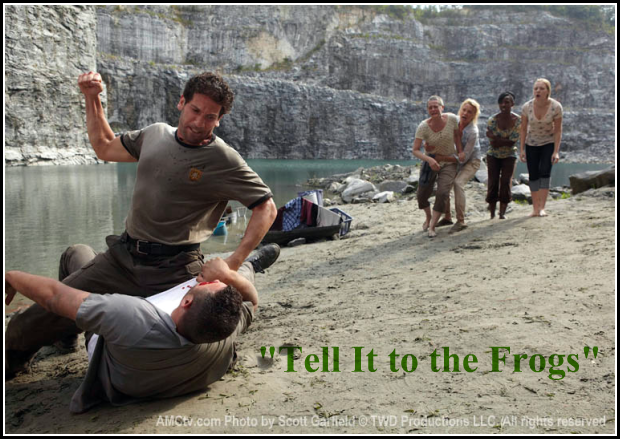
The show did have some moments which showed Darabont and the writers still feeling their way around Kirkman’s source material. One of it being the introduction of an abusive husband for one of the book’s regular faces in Carol. In the book the husband was only mentioned as not having survived the trip to Atlanta but no mention of him ever being abusive. Like the introduction of Merle in the previous episode, the appearance of Ed as the caveman husband was done too haphazardly. Almost like someone out of stereotype casting call, Ed bullied his way around the women in the camp until Shane had to step in and put on an epic beating that added some depth to the character of Shane but also made one wonder if the addition of Ed was just as a way to give Shane an outlet for the anger and frustration he was feeling from the return of Rick and the subsequent frosty attitude by Lori towards him.
In the end, “Tell It to the Frogs” was a much stronger return for the show after a second episode that some thought was being too stereotypical of a zombie story. I enjoyed the second episode but understand why some reacted to negatively to it after such a powerful initial pilot episode. The crew of Darabont, Kirkman and the other writers definitely have a balance to do between dramatic storytelling and zombie mayhem as the show continues through this first season and into the next. While some of the characters, both new and old, do seem too one-dimensional and more like plot devices for the main characters the show is only in its third episode and to judge the whole thing on such a small sampling is not fair to the show and the people behind it. I think the show has hit a nice balance of drama and mayhem. Time will tell if the show will live or die by balancing the two or finally landing on one side or the other.
PS: Oh yeah, anyone who happens to be fans of Bambi and her mom will have a hard time watching this episode.
“I may have dropped into Normandy on D-Day, but I still had Liberty in Paris or London. You Gyrenes had jungle rot and malaria.”
In 2001, HBO came out with a mini-series that detailed the experiences of the men of Easy Company, 506th Parachute Regiment of the 101st Airborne. This series was produced with loving care by Tom Hanks and Steven Spielberg. Two men who were instrumental in the success of an earlier World War 2 project called Saving Private Ryan. This series was called Band of Brothers and became one of the most critically-acclaimed mini-series of its time and has become part of the staple of military-themed shows and films that gets shown on Memorial and Veterans Day in the United States.
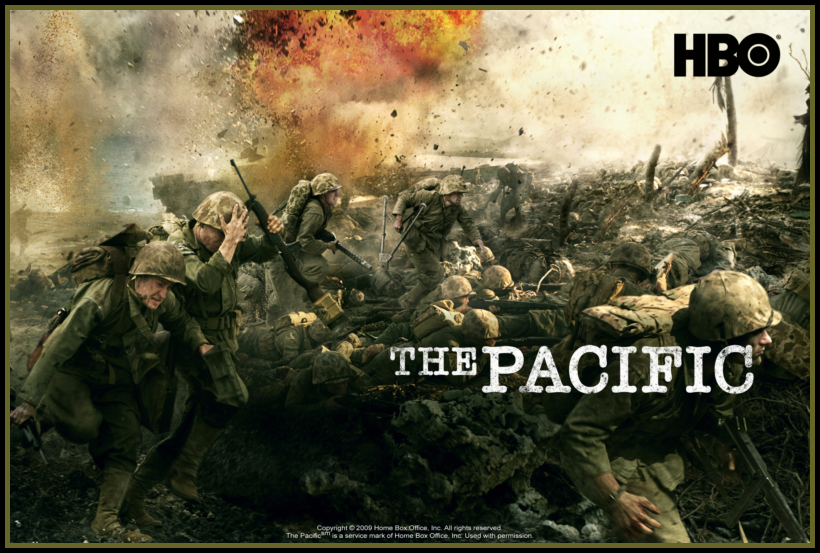
Even as this series was only a year old there was talk from some of its admirers about whether HBO and the team of Hanks and Spielberg would re-visit this era Tom Brokaw called “The Greatest Generation”. To re-visit and tell the stories of the men who fought on the other side of the European Theater in what was an even more hellish battlezone in the Pacific. It took almost 9 years, but the ending result is the mini-series called simply The Pacific.
The Pacific tells the story of three Marines of the 1st Marine Corps Division from their time before their unit ships out to the Pacific Theater of Operations and through some of the bloodiest and most savage battlefields of World War 2. There’s Gunnery Sgt. John Basilone (played by Jon Seda) who would show the sort of stoic heroism people nowadays would dismiss as a figment of Hollywood writers, but who actually did all the things only seen in action films. Bookending Basilone would be two newcomers to the art of war in PFC Robert Leckie (James Badge Dale of AMC’s recently cancelled series, Rubicon) and Cpl. Eugene “Sledgehammer” Sledge (Joseph Mazzelo from Jurassic Park). These two Marines are our guide through the unending hell that were the battles in Gen. MacArthur’s island-hopping campaign to beat back the Army and Naval forces of Imperial Japan.
It’s also these two men and their memoirs which detail their experiences during the war in the Pacific which make up the bulk of the narrative for the series. One would be Sledge’s With the Old Breed: At Peleliu and Okinawa which many consider as one of the best first-hand accounts of combat in the Pacific. The other one is Helmet for My Pillow by Leckie which was a more personal account of his time from Marine boot camp and experiencing a type of warfare in the Pacific which was new to a young man from the States. A type of warfare where the enemy didn’t surrender and would sacrifice his life in the service of one’s Emperor.
Basilone, Sledge and Leckie’s stories never come together but were told in concurrent fashion to show the audience the differing views of each. All three would go through the same meat-grinder that were the battles in immortalized places named Guadalcanal, Cape Gloucester, Peleliu, Iwo Jima and Okinawa.
We see Basilone’s heroism on Guadalcanal make him into a Stateside hero and taken away from those he fought beside to help push war bonds for the government. This change in environment for him doesn’t sit well with Basilone as we see the survivor’s guilt in him. Why does he get all the celebrity attentions when others like him were still fighting and dying the same battles he was just in months before. His story is the most poignant of the three as he finds happiness while training new Marines for the war only for his need to get back into the fight win out. The fact that all this happened for real makes his story even more memorable. Hollywood writers have tried to capture such moments and often-times fail. It was great to see Basilone’s story told for everyone to see that the world past, present and future has real-life heroes that Hollywood could never replicate but only imitate.
Jon Seda’s performance was in-line with what one thinks a gung-ho Marine should be but he brought a sense of realism to the role. He didn’t try to make Basilone more a hero than he already was. I like to compare his performance to that of Tom Hanks’ Capt. Miller in Saving Private Ryan and Damian Lewis’ Maj. Dick Winters in Band of Brothers. He was a man who did acts of bravery as seen by others on the battlefield and one which made him a celebrity to the civilians Stateside. But in the end he just saw it as him doing his job as he was trained and trying to keep his men alive. He didn’t see himself as a hero and while his Stateside role of war hero pushing war bonds did bring some perks he never fit in. Seda’s work in Part Eight where he meets his future wife was some of the best work in this series.
In Leckie’s story we see a man swept up in the great enlistment drive which happened right after the Japanese attack on Pearl Harbor. His story sees a cocky and smart young man wanting to do his part for the war effort yet not knowing the sort of sacrifices he’ll have to make or the horrors he will witness and inflict to survive day-to-day. We see Leckie quick to make friends in his unit during their training and then through their baptism of fire in the Battle of Tenaru before seeing the real horror of the war in the Pacific as his unit and the rest of the 1st Marine Division land of the island of Guadalcanal.
His time on Guadalcanal would soon erase any romanticized notion of honor and glory in battle Leckie may have had when he decided to enlist. As a writer in his civilian life prior to the war’s start he would continue to write his experiences in-between battles and skirmishes with the Japanese. Even when friends in his unit would die each and every day it seems Leckie seemed to want to keep that savagery at bay with his writing which would become a basis for his wartime memoirs. His story ends midway through the series and we won’t see him again until the final denouement as we see Leckie’s life as a civilian once again after the war. His final time in the warzone would be on the Battle of Peleliu (one of the bloodiest battles in USMC history and one that would be steeped in tragedy afterwards) where a severe concussive blast would render him unable to fight. It’s scenes on one of the hospital ships off the coast of Peleliu where Leckie’s own survivor’s guilt is temepered by the realization that any more time out in the battlefield would surely strip him of his humanity and turn him into the growing examples of battle-scarred and psychologically damaged Marines who have seen and done too many horrible things to ever return back to their civilian life intact.
The final episode shows Leckie (with James Badge Dale in a confident and cocky turn) the one who seem to adjust to the life back to civilian life with a modicum of ease. While he still carries the scars of battle in his psyche its that time in the Pacific which has also given Leckie the confidence to get his old job back at the local paper he used to work for and woo the pretty girl next door he had been shy and awkward with in the very first episode. While his performance wasn’t as good as Seda it was still a noteworthy one which brought the person of PFC Robert Leckie to the masses watching this series.
Lastly, we come to the third of the three whose story the series revolves around. The story of one Cpl. Eugene Sledge who, like Leckie, wanted to do his part for the war effort. While his young age at the start of the war prohibited him from enlisting without his parents’ consent he finally gets a chance a year later when he is of age and just in time for him to join the Corps, train and see his first taste of combat in the Pacific on the killing grounds of Peleliu then the hellish nightmare battlefields of Okinawa.
Sledge’s story is the most complex and runs the gamut of dark emotions a young man should never have to take. His young idealism in helping his country in its time of need will get some tempering even before he ships out to become a Marine. His father tells him of having to treat young men from an earlier era from another major war which had engulfed the world. His father spoke about how some of these young men who came back whole physically didn’t do so psychologically. He spoke about how the horrors of war seemed to have “ripped the souls” from these returning young men and how he didn’t want his son to go through the same thing. But as young, headstrong men who think they’re invincible are wont to do he enlists anyway.
The performance by Joseph Mazzello (hard to believe this young man is the same young boy who ran and escaped from CGI raptors and T-Rex on Spielberg’s Jurassic Park) tops all other performances in this cast full of noteworthy and great acting work. We don’t just see his Sledge go through each horrific scene after scene of battle and its aftermath with is emotional and psyche gradually sliding down into the abyss, but we could actually see Mazzello’s body, mannerisms and the look in his eyes make the same changes. I fully bought into his performance as the young idealistic young man from Mobile, Alabama slowly turned into the same uncaring, savage Marine one had to become to survive the war in the Pacific. He had seen enough bodies of Marines and enemy Japanese torn apart and strewn about everywhere one looked that one became inured to them.
One of the most powerful scenes in the series has Sledge confronted by the aftermath of what he and his mortar-team might have been responsible for. It was deep into the campaign to take the island of Okinawa and Sledge and his fellow Marines have been brought to the edge of insanity by all the fighting. A fight which has some of them questioning why the enemy just doesn’t surrender. An enemy willing to suicide charge into heavily armed Marines and also willing to herd Okinawan civilians into the line of fire. It’s this brutality by the enemy and mirrored by his fellow Marines which brings Sledge to a darker side of his nature which we as an audience don’t see a way out for him. But in the scene close to the very end of Part Nine brings Sledge back from the abyss and reminds him that there’s still humanity in him and the very Marines he has been with since the beginning. His reaction afterwards to a group of new Marines killing a young Japanese soldier for sport sickens him. We see Sledge realizing how just days and months before he was spouting the very same savage hate for the enemy as these newly arrived Marines looking for their first kill.
Of the three it’s Sledge who will carry the deepest scars of the Pacific for the rest of his life. We see the extreme difficulty he has in adjusting back to civilian life. Nightmares haunt his nights and flashbacks of the battlefields hound his steps in the daytime. His mental and emotional breakdown as he tries to go back to hunting with his father encapsulates this series at its most basic core. This series doesn’t have the camaraderie and brotherhood established between fellow soldiers that its predecessor had. While Band of Brothers also showed the horrors of war in Europe it was balanced by the hope that everyone in Easy Company had their brothers in arms to back them up when the bullets flew and shells exploded. This wasn’t the case in the Pacific.
Sure the were the same camaraderie and brotherhood, but the type of enemy fought in abject conditions which made downtime from battle almost as bad as the battle themselves didn’t bring hope. It only brought misery and a fatalistic view of the world Sledge and his fellow Marines existed right there and then. His breakdown in the final episode shows how those who fought in the Pacific definitely bore deeper scars and returned more damaged than their European brothers. Scars not just inflicted by the enemy but those they’ve inflicted on themselves by fighting savagery with their own form of savagery. It was a kill or be killed world and returning back from that brink didn’t happen to everyone and those who were able to return did so not whole.
I understand that some were disappointed by how The Pacific turned out. How it didn’t live up to the standards created by Band of Brothers. Some have said that there was no main focus to the narrative the way its predecessor strictly followed the men of Easy Company through the battles in Europe. They’ve pointed out how some episodes took too much time to get to the battle scenes. I think trying to compare The Pacific to Band of Brothers is foolish and a doesn’t give this follow-up mini-series the proper due it deserves.
The Pacific wasn’t trying to tell Band of Brother in the Pacific. While the two series do take place in the same world war the circumstances surrounding the storylines in both series diverge to take different paths. The first series almost seem like men fighting for a common cause and the good fight against tyranny. The Pacific is all about revenge. Revenge and payback for Pearl Harbor at first then as the series moves forward it becomes revenge and brutality for seeing their buddies die. This series showed nothing noble about the fighting in the Pacific. It was just a struggle to survive from one day to the next.
So, while this series may not be the second coming of Band of Brothers it does stand on its own merits and I think was the more powerful of the two. It didn’t flinch away or dismiss the darker side of the “good guys” and showed that war truly is hell and that those who fight and live through it were truly never the same. I say watch The Pacific and stop trying to compare it to Band of Brothers or any of the several shows dealing with the current wars. The Pacific should be watched as seen as the bookend to Band of Brothers. A darker journey to seeing the war of the “Greatest Generation” from the eyes of those who fought and died on the islands and jungles of the Pacific.
It’s now just a little over a month to go before one of the most anticipated new shows on TV hits the airwaves. AMC’s tv series adaptation of Robert Kirkman’s critically-acclaimed and fan favorite comic book series The Walking Dead will premiere on Halloween night 2010 at 10pm. The show will also premiere within days in over 40-plus countries which would be an unprecedented feat for a first time tv series.
Frank Darabont and his band of writers seem to have taken Kirkman’s story and made the necessary changes to make it work on tv. One aspect of Kirkman’s storytelling was how some people thought it to be too expositionary. This left each page with too much talking while at the same time not fleshing out each character to be distinct from each other. While I can see that I don’t buy into that particular flaw in the story too much. This is a story of the end of the world and stress definitely plays a key role in how everyone reacts to their new environment.
From the AMC “sizzle” reel the network has released just in the last few days it looks like the show’s writers have taken Kirkman’s story, ideas and dialogue and made them flow much more naturally. Final judgement on whether this actually happens will have to wait until the show premieres, but Darabont has always been a writers first and filmmaker second so I definitely have much faith that he and his team will come out with a great product that takes the best from the comic book and trims the fat and gristle off by the wayside.
There’s also one thing the “sizzle” reel above shows which should answer the trepidations that some of the comic book’s fans have had since hearing th news of the adaptation. This was whether AMC will keep the gore and violence from the comic books or will it be toned down. From the looks of some of the scenes shown in the reel above the gore and violence is on-hand and from the look of things this may be the most gory thing on tv that’s not premium cable. I see blood, gore, viscera and all the nice gooey things that happens when a body’s insides are exposed to the environment. YUM!
Halloween 2010 needs to come now, but until then revisiting the comic books the series is adapting is a good way to pass the time.
It may be weeks before AMC puts up a much more high-quality version of this trailer, but until then this is the only one non-Comic-Con goers can watch. The trailer definitely shows enough of what Darabont and his writers are going for to assuage any fear I have that they’re straying too far away from Kirkman’s laid out plans and that they may be staying too loyal to the original source.
I really like how the trailer shows enough scenes from the comic book’s first couple issues that fans have memorized. This series (6 episodes in total) will definitely be the show to watch this coming tv season. That scene with the zombies swarming in, around and over the tank sent chills up my spine.
I also love how loud and well the panel attendees received the trailer. Now time for the series to impress the non-fans. If the series does that then The Walking Dead will join Mad Men and Breaking Bad in creating a trifecta of the best shows on basic cable and probably tv in general.