Brad reviews THE STONE KILLER (1973), starring Charles Bronson!


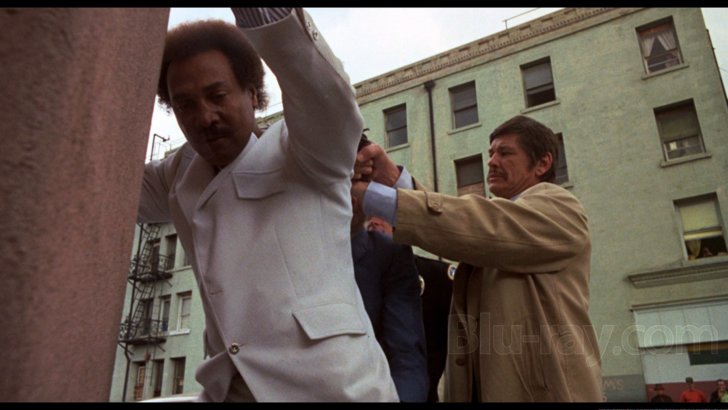
THE STONE KILLER opens in Spanish Harlem with detective Lou Torrey (Charles Bronson) following a young man, who had just shot a cop, into an abandoned building. When the young man refuses to turn himself in, and even tries to shoot Torrey, he gets blown away. In trouble with his superiors on the force, and being dragged in the press for the shooting, Torrey decides to change locations and continue his law enforcement career under his friend Les Daniels (Norman Fell) in Los Angeles. Soon after he arrives in Los Angeles, Torrey and his partner Mathews (Ralph Waite) are working a case against a drug dealer, when they arrest “Bootlace” Armitage (Eddie Firestone), a drug addict, but also a well-known hitman from New York. Torrey is delivering the “mechanic” back to New York for outstanding warrants when Armitage says that he is willing to give up some big information on “Wexton” in exchange for a reduced sentence. When Armitage is gunned down in what is obviously a professional hit, it’s clear that there is something going on that involves the name Wexton. We soon learn more as we meet mafia leader Al Vescari (Martin Balsam). As Vescari walks through a cemetery, he tells the leader of his operation, Lawrence (Stuart Margolin), of his plans to get revenge for a string of mafia killings that occurred 42 years earlier by using “stone killers,” in this case, former military men with no connection to the mob. As the film moves forward, Detective Lou Torrey and his fellow cops will eventually put the pieces together and find themselves taking on these “stone killers” and the mob! 

I’ll just go ahead and say up front that I’m a big fan of THE STONE KILLER these days, but that’s because the movie has grown on me over the years with repeat viewings. When I first watched the film as a teenager in the 1980’s, I enjoyed it as a tough cop film, but it wasn’t one of my favorites. I think that part of the reason I didn’t appreciate it as much back then is the more convoluted plot of the film. Most Bronson films have simple and easy to follow plot lines, but THE STONE KILLER includes a somewhat complicated mafia assassination plan, and it also sends the cops on wild goose chases that have nothing to do with the actual story. Watching the film as an adult, I appreciate Director Michael Winner taking us with him on some of those 1970’s flavored tangents that include getting to hang out with some hippies at an ashram, as well as some unjustly accused black militants. 

Even though the plot is more complicated than the average Charles Bronson film, director Michael Winner gives us some of the best action sequences of Charles Bronson’s career. There are two sequences in particular that stand out to me. After the impressive opening scenes where Torrey blows away the gun wielding young man in Spanish Harlem, it takes a while to get to the next extended action sequence, but it’s definitely worth the wait. The scene involves Detective Torrey in a car chase where he’s after one of the stone killers, Albert Langley (Paul Koslo), who’s on a motorcycle. In an era of great car chases, this is a doozy that features many amazing and dangerous stunts. The late 60’s and early 70’s are an embarrassment of riches for cinematic car chases and this one stands the test of time. The next great action sequence occurs later in the film when Detective Torrey and the cops bust the home and facility where the killers have trained for the planned massacre. Bronson is still in his physical prime in 1973, and his athletic prowess is clearly on display as he slides across floors, jumps on tables, and does anything else that is required to take down the bad guys. The film is not wall to wall action, but what’s here is as badass as it gets. 

Detective Lou Torrey is a really good role for Charles Bronson. In his best roles, Bronson is tough, but you can also tell that he cares about other people. That’s definitely the case here as he consistently shows empathy for some of the people he’s after. For example, at the beginning of the film, he has to shoot the young man in Spanish Harlem in self-defense, but he later explains to his sister that he didn’t want to do it, even expressing some understanding of how the young man may have found himself in that situation. A little later while arresting a drug dealer with his partner Mathews, Torrey is clearly disgusted when his partner uses racial slurs during the arrest. Torrey then talks to the man with respect and gets the needed information to arrest the man buying the drugs. There are further examples later in the film as he deals with other drug addicts and militants. I say none of this to insinuate that Bronson’s character is weak in any way. Rather, he seems to want to do his job and arrest criminals in a professional manner. He’s also a complex character in some ways as he will bend the rules to get what he needs if he has to. He does end up punching the car thief, Jumper (Jack Colvin), a couple of times during an interview. While this is definitely not legal, in the context of this film, it’s required in order to get to the facts of the case. Bronson is actually quite great in the film. 

Besides international superstar Charles Bronson, Michael Winner put together an amazing cast for THE STONE KILLER. Martin Balsam had won an Oscar a few years earlier, and he’s good here as the mafia boss with four decades worth of patience for revenge. Ralph Waite is also excellent as Bronson’s incompetent, racist partner Mathews. It’s hard to believe the guy would go on to play Papa Walton based on the ignorance he shows in both this film and in the Bronson/Winner collaboration CHATO’S LAND from the prior year. It’s fun watching both Norman Fell and John Ritter work together in this film, especially knowing that they would be making television history a few years later on the classic TV sitcom “Three’s Company.” The last two actors I want to mention are Stuart Margolin as the leader of the stone killers, Lawrence, and Paul Koslo as the bi-sexual badass musician Albert Langley. Both actors, especially Koslo, are good here and would have important roles with Bronson the next year as well. Margolin was an important character in DEATH WISH, and Koslo may have even outdone his work here the next year as a particularly slimy weasel in MR. MAJESTYK. Oh yeah, be sure to look for a short, uncredited cameo from B-movie queen Roberta Collins! I also want to shout out the musical score from Roy Budd, who also did the score for GET CARTER (1971). Thanks to Budd’s work, the opening credits are very cool and memorable. 

THE STONE KILLER was marketed as Charles Bronson’s “Dirty Harry” and meant to be his breakout hit in America. Unfortunately, while the film was an international hit, the actual grosses in the United States were respectable but not as much as the filmmakers had hoped for. As such, we didn’t get any more entries in the case log of Detective Lou Torrey and Bronson would have to wait another year for his American box office breakout with DEATH WISH. But that’s okay because THE STONE KILLER has stood the test of time as an excellent 1970’s cop film, emerging in my personal rankings as a major feather in the cap of Charles Bronson’s career. 

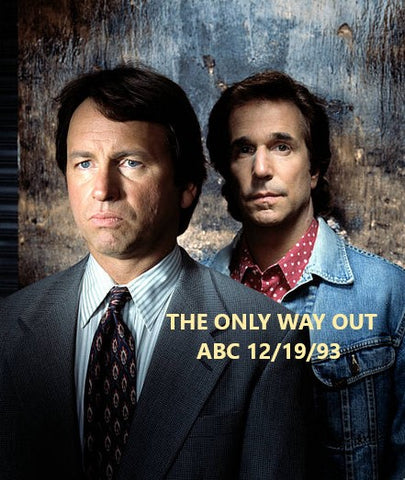
Retro Television Review: The Only Way Out (dir by Rod Hardy)


Welcome to Retro Television Reviews, a feature where we review some of our favorite and least favorite shows of the past!  On Sundays, I will be reviewing the made-for-television movies that used to be a primetime mainstay.  Today’s film is 1993’s The Only Way Out!  It  can be viewed on YouTube.

“I’ll kill you before I let you go,” Tony (Henry Winkler) says to his terrified girlfriend, Lynn (Stephanie Faracy).

Agck!  Those are frightening words and they are certainly not something that you would expect to hear from a character played by notorious Hollywood nice guy Henry Winkler.  And, indeed, it would probably shock most of the characters in the film if they knew how Tony talked to Lynn.  Tony is a grad student who has worked at any number of jobs.  While some people might say all of those jobs prove that Tony has a hard time sticking to anything, Tony has obviously learned how to convince people that he’s actually a just a determined man working his way through grad school and taking whatever job will help to pay the bills.  Tony is friendly and romantic and given to grand gestures.  He’s the type who shows up unexpectedly at Lynn’s place of employment with flowers.  He’s the type of guy that strangers applaud while those close to him look for any way to escape.

Lynn knows all about the other side of Tony.  Tony is controlling, obsessive, and abusive.  He hits her.  He barks orders at her kids.  When she tells him that she wants him out of her life, he refuses to go and blames her for all of their problems.  He’s someone who can quickly go from being everyone’s friend to being a monster.  He preys on insecurity and, whenever anyone stands up  to him, he plays the victim.  Tony is a classic abuser and the fact that he’s played by the likable Henry Winkler makes him all the more disturbing.  Like most abusers, Tony knows how to turn on the charm.  He knows the power of a smile and a few complimentary words.

Lynn is in the process of getting divorced from an architect named Jeremy (John Ritter).  It’s been a remarkably amicable divorce, with Jeremy and Lynn agreeing on joint custody and apparently not bearing any ill feelings towards one another.  The only problem is that Lynn cannot bring herself to actually sign the divorce papers.  Jeremy wants to marry Susannah (Julianne Phillips) and Susannah is not happy about the long wait.  She’s even less happy when Jeremy takes it upon himself to try to protect Lynn from Tony.  Soon, Tony is stalking Jeremy and Jeremy finds himself considering a particularly extreme solution to his problem.

It’s John Ritter vs Henry Winkler and the casting of two of Hollywood’s best-known nice guys as violent rivals works surprisingly well.  Winkler is memorably unhinged while Ritter plays a guy who is struggling to hold onto a life that, until Tony shows up, seemed to be perfect.  In the end, it’s not just Tony who catches us by surprise by just how far he’s willing to take things.  The film’s ending took me by genuine surprise.  Featuring excellent dramatic turns from two actors best known for their comedic skills, The Only Way Out is a superior melodrama.


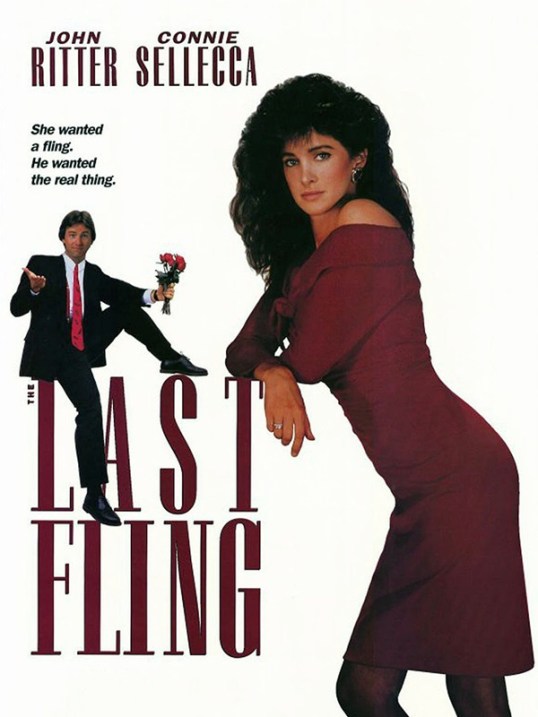
Retro Television Review: The Last Fling (dir by Corey Allen)


Welcome to Retro Television Reviews, a feature where we review some of our favorite and least favorite shows of the past!  On Sundays, I will be reviewing the made-for-television movies that used to be a primetime mainstay.  Today’s film is 1987’s The Last Fling!  It  can be viewed on YouTube and Tubi.

Phillip Reed (John Ritter) is an attorney who has never gotten married, despite all of his friends trying to set him up with single women.  Even his law partner (Scott Bakula) worries about how Phillip’s love life is going.  Phillip’s married best friends (Paul Sand and Kate Zentall) think that Phillip is scared of commitment.  Phillip’s mother (Paddi Edwards) thinks he’s gay.  Joanne Preston (Shannon Tweed) enjoys sleeping with him but she owns a lot of cats that make him sneeze.  And since he’s played by John Ritter, you better believe that every sneeze is more dramatic than the last.

Gloria Franklin (Connie Selleca) is engaged to marry Jason Elliot (John Bennett Perry) but she worries that her rigidly controlled lifestyle has caused her to miss out on enjoying her time as a single person.  When she finds out that Jason is going to go to Las Vegas for a wild bachelor party, she decides to have one last fling of her own.

Phillip and Gloria meet each other at the zoo.  (Again, because Phillip is played by John Ritter, there are multiple shots of him making monkey noises while looking at the gorillas.)  Gloria tells Phillip that her name is Marsha Lyons.  Their meeting leads to Phillip and Gloria/Marsha spending the weekend in Mexico together.  (A very young, pre-Saved By The Bell Mario Lopez shows up as the kid who gives them their renal car.)  Despite an unseen mishap that causes their car to catch on fire, Phillip and Gloria spend a romantic night at a villa.  When Phillip wakes up the next morning, he’s convinced that he’s finally found the woman with whom he wants to spend the rest of his life.  However, Gloria is already gone.  She leaves behind a video confession, in which she tells Phillip that she’s going to be getting married.

Phillip returns to Los Angeles, determined to track down the mysterious Gloria and stop that wedding.

The Last Fling is an uneven romantic comedy.  It starts out as an amiable and sweetly funny film, with both Connie Sellecca and John Ritter giving likable performances.  But once Phillip returns from Mexico and starts searching for Gloria, it gets a bit too manic for its own good.  Instead of being a funny movie about two human beings looking for love, it instead becomes a live-action cartoon with John Ritter running from one location to another while being chased by Gloria’s husband-to-be.  The movie ends up getting so frantic that it actually becomes a bit annoying, which is a shame considering how things started.  By the end of the movie, Phillip is so obsessive that it’s hard not to feel that Gloria would be better off just staying single and maybe spending the next weekend in Mexico with Scott Bakula.

The director of The Last Fling played Buzz in Rebel Without A Cause.  Fortunately, no one plays chicken in this movie.

Real Men (1987, directed by Dennis Feldman)


Due to a chemical spill that is spreading through the ocean, life on Earth is going to end in five years unless something is done.  A group of friendly alien offer to give Earth either the “Good Package” or the “Big Gun.”  The Good Package can clean up the ocean.  The Big Gun is a big gun.  They both sound good to me!  The aliens only want a glass of water in return and they want that glass to be delivered by CIA Agent Pillbox.

Unfortunately, Pillbox has been killed in the field so the government tracks down a meek office worker named Bob Wilson (John Ritter) who looks just like Pillbox.  Tough and streetwise Nick Pirandello (Jim Belushi) is sent to recruit Bob and take him to the aliens.  Trying to stop Nick and Bob are a group of rogue CIA agents who would rather get the Big Gun than the Good Package.  Nick teaches Bob how to be a “real man” and Bob teaches Nick how to be a real friend.  They also beat up clowns.

A box office failure that did even worse with the critics, Real Men is a movie that was saved by cable.  When I was a kid, Real Men used to show up on HBO all the time.  Whatever flaws the film may have had, the mix of John Ritter’s physical comedy, Jim Belushi’s wiseguy attitude, and the action scenes made it the type of movie that was ideal for home viewing, especially if you had just gotten out of school and wanted to watch something before your parents came home and asked if you had done your homework.  Real Men was fun enough to hold up to repeat viewings but it was also slight enough that it wasn’t a huge tragedy if the channel got changed before the movie ended.

When I rewatched Real Men, I thought the film’s storytelling could have been tighter but it still turned out to be better than I was expecting.  There were a lot of classic buddy movies released in the 80s and while Real Men may not be the equivalent of a 48 Hours or a Midnight Run, John Ritter and Jim Belushi are still an entertainingly mismatched team.  Ritter again shows that he was a master at physical comedy while Belushi provides sarcastic commentary from the side.  A lot of the odd couple-style banter is predictable (Bob doesn’t smoke but Nick does) but Ritter and Belushi deliver their lines with enough conviction to still make it work.  Nick teaches Bob to believe in himself and Bob is able to both save the world and tell off the neighborhood bullies.  The film’s mix of action, science fiction, and broad comedy confounded critics in 1987 but it holds up today.

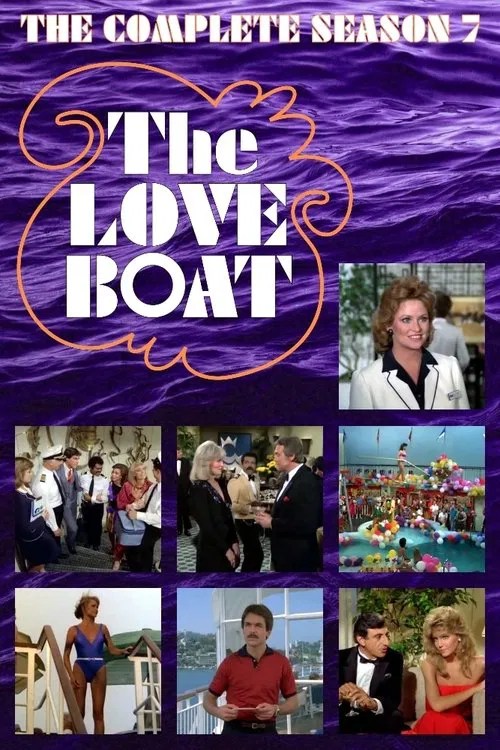
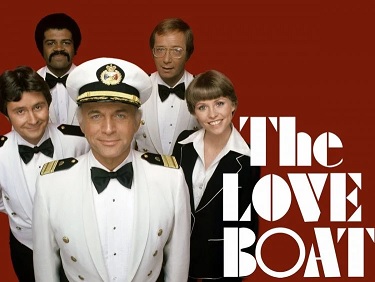
Retro Television Review: The Love Boat 1.2 “A Tasteful Affair / Oh, Dale! / The Main Event”


Welcome to Retro Television Reviews, a feature where we review some of our favorite and least favorite shows of the past!  On Wednesdays, I will be reviewing the original Love Boat, which aired on ABC from 1977 to 1986!  The series can be streamed on Paramount Plus!

It’s time to set sail on adventure and set your mind on a new romance!

Episode 1.2 “A Tasteful Affair / Oh, Dale! / The Main Event”

(Directed by Richard Kinon, Adam Rafkin, and Stuart Margolin, originally aired on October 1st, 1977)

The second episode of The Love Boat was all about fighting lovers.

For instance, one storyline — I assume it’s the one that was called “The Main Event” — features Sherman Hemsley as Maurice Marshall and LaWanda Page as his wife, Stella.  From the minute that they get on the boat, Maurice and Stella are arguing but it soon becomes obvious that, like many couples who have been together for a while, arguing is just the way that they express their love for each other.  The insults may be frequent but they’re always affectionate, which is kind of sweet.  Anyway, while on their way to dinner in the ship’s lounge, they get stuck in an elevator.  After arguing about the best way to escape from the elevator, they end up making out.  Of course, when the doors to the elevator do finally open, Captain Stubing and Gopher see that the couple, rather than being dead, are instead making good use of the space.  Everyone laughs.  Seriously, that’s the entire story.  Two people get suck in an elevator and make out.  That’s it.  You know, you can fool around on a moving elevator as well.  You don’t have to fry the circuitry ahead of time.  Just listen for the ping before the elevator doors open.

In a rather more serious storyline, Jaclyn Smith plays Janette Bradford, the wife of a wealthy but heartless man named Lucas (David Knapp).  Lucas is convinced that Janette is only taking the cruise alone because she’s planning on cheating on him.  Lucas hires a private investigator named Dennis Kingsley (Dennis Cole) to watch her on the boat.  Dennis soon discovers that Janette is not cheating on her husband but instead, she took the cruise because she needed a break from his controlling and emotionally abusive ways.  Dennis ends up falling in love with Janette and Janette with him.  However, Dennis also knows that he’s going to have to tell her the truth about why he’s on the cruise.  It doesn’t quite lead to heartbreak but it’s still far more serious than anything you might expect to see on a show of The Love Boat‘s reputation.  Jaclyn Smith, it should be said, does a wonderful job in the role of Janette, capturing both the vulnerability of someone in an abusive relationship and also her growing determination to escape from Lucas’s control.

Unfortunately, while all of this is going on, you have to deal with John Ritter playing a guy whose lover actually is cheating on him.  Ritter plays Dale.  Dale wants to follow his girlfriend on the cruise for the same reason that Lucas hired Dennis to spy on Janette.  Dale suspects that he’s being cheated on.  However, the cruise is almost entirely sold out.  There’s only one ticket left but it’s to share a cabin that’s already occupied by a woman.  Since Dale is not a woman, he can’t buy the ticket.  So, of course, Dale steals a blonde wig and a suitcase full of the frumpiest dresses imaginable.  Can you guess where this is going?  Dale gets his cabin, falls in love with his cabinmate (played, in a likable performance, by Tovah Feldshuh), and spends a lot of time changing clothes in the ship’s linen closet.  Captain Stubing ends up getting a crush on the mysterious woman with the big blonde hair and the ugly dresses and yes, it’s as stupid as it sounds with a heavy dose of cringey 70s gay panic humor tossed in to boot.  It doesn’t help that John Ritter gives such a frantic performance in the role that I actually got nervous watching him.  “Calm down!” I wanted to say.

As you can guess, the tone is all over the place in this episode.  That’s to be expected when you’re telling three stories at one time but there’s such an imbalance between Jaclyn Smith acting depressed and fragile and John Ritter doing pratfalls that it ultimately takes away from both stories.  With the second episode of The Love Boat, it seems obvious that the show was still struggling to find the right balance between drama and comedy.  As well, this episode suffers because the crew isn’t given much to do.  The first episode was enjoyable because the main cast had a fun chemistry but, in this episode, everyone is a bystander except for Captain Stubing.  Unfortunately, this episode couldn’t even treat Stubing consistently as the elevator storyline requires Stubing to be significantly smarter than the Stubing who appears in the John Ritter storyline.

Would the show ever succeed in finding and striking the right balance?  We’ll see what happens next week!

Flat Broke In The ’70s: Americathon (1979, directed by Neal Israel)


The year is 1998 and America is flat broke.  Paper currency is now worthless and, to the joy of Ron Paul supporters everywhere, all transactions are done in gold.  After the country ran out of oil, people started using skateboards and bicycles for transportation and many turned their cars into homes.  While the citizenry spends their time consuming a steady diet of sitcoms and reality television, the government tries to figure out how to pay back the loan that it took from Sam Birdwater (Chief Dan George), a Native American who made billions after buying Nike.  Birdwater wants his money back and he is prepared to foreclose on the entire country.

Newly elected President Chet Roosevelt (John Ritter) is not helping.  A combination of Jack Tripper and Jerry Brown (who was gearing up to challenge Jimmy Carter in the Democratic primaries when Americathon was first released), Chet Roosevelt is a spaced-out former governor of California who speaks in 70s self-help slogans and who is more interested in getting laid than leading the country.  Roosevelt governs out of The Western White House, a condo in California.  When an ad exec named Eric McMerkin (Peter Reigert) suggests a month-long telethon to raise the money to pay off the loan, Roosevelt leaps at the chance.

Hosted by Harvey Korman, the telethon (which is called, naturally, the Americathon) features a wide variety of acts.  There’s a ventriloquist.  Jay Leno boxes his grandmother.  Meat Loaf destroys a car.  Even Elvis Costello and Eddie Money make brief appearances.  While Chet falls in love with one of the performers, his chief-of-staff (Fred Willard) plots, with the leaders of a new Middle Eastern superstate, to sabotage the telethon.

Based on a play by the Firesign Theater, Americathon has a big, talented cast that is let down by Neal Israel’s uncertain direction and a script that is only rarely funny.  The idea of America hosting a tacky telethon to pay its debts sounds like a good SNL skit (especially if Bill Murray played the host) but the premise is too thin for a feature film.  Like Airplane! or The Naked Gun films, Americathon is a movie that tosses every joke it can against the wall to see what will stick.  If the jokes are good, like in Airplane!, that formula can lead to a comedy classic.  If the jokes are bad, not even John Ritter, Harvey Korman, and Fred Willard can make them funny.

Today, if Americathon is remembered, it’s because it supposedly predicted several future events.  Americathon does take place in a future where China is an economic superpower, Nike is a huge conglomerate, and reality game shows are very popular.  But, even with those correct predictions, Americathon is a such a film of its time that it was probably dated from the minute that it was released.  Just the sight of John Ritter in a condo permanently marks Americathon as a film of and about the ’70s.

George Carlin does score a few laughs as the narrator and Elvis Costello performs both Crawlin’ To The USA and (I Don’t Want To Go To) Chelsea.  Eagle-eyed viewers might want to keep an eye out for the tragic Playboy playmate, Dorothy Stratten, who has a brief non-speaking role.  Otherwise, Americathon is as hopeless as the country it’s trying to save.

Horror Film Review: It (dir by Tommy Lee Wallace)


Last month, before I saw the latest film version of Stephen King’s It, I watched the 1990 miniseries version.

This was my first time to watch the It miniseries, though I had certainly heard about it.  Most of the reviews that I had read seemed to be mixed.  Everyone seemed to agree that Tim Curry was the perfect choice for the role of Pennywise the Dancing Clown.  However, many other reviewers complained that the program’s television origins kept It from being as effective as it could be.  “Not as scary as the book,” everyone seemed to agree.  The actors who played the members of the Loser Clubs as children all seemed to receive general acclaim but not everyone seemed to be as enamored with the adult cast.  And everyone, even those who liked the miniseries as a whole, complained about the show’s finale, in which Pennywise took the form of a giant spider.

Well, I have to agree about the giant spider.  That spider looked painfully fake, even by the standards of 1990s television.  Not only does the spider look too fake to truly be scary but, once that spider showed up, that meant that Tim Curry disappeared from the film.  Curry deserved every bit of acclaim that he received for playing the role of Pennywise.

All that said, the miniseries was still a lot better than I had been led to believe.

Certainly, it’s not as frightening as the book or the movie.  Considering that the It miniseries was produced for network television, that’s not surprising.  As opposed to the movie, the miniseries attempts to cover King’s entire novel.  That’s a lot of material, even when you have a five hour running time.  Obviously, a good deal of the story had to be cut and there are a few scenes in the miniseries that feel a bit rushed.  Characters like Audrey Denbrough and Stanley Uris, who were compelling in the novel, are reduced to being mere bystanders.  Some of the novel’s most horrific scenes — like Henry Bowers cutting Ben — are either excised or heavily toned down.  If the novel was as much about the hypocrisy of the adults of Derry as the paranormal horror of Pennywise, that theme is largely left out of the miniseries.

That said, It still had its share of memorable moments.  The image of a clown standing on the side of the road, holding balloons, and waving is going to be creepy, regardless of whether it’s found in a R-rated film or on ABC.  The death of little George Denbrough is horrific, regardless of whether you actually the bone sticking out of his wound or not.  Even the library scene, in which a grown-up Richie Tozier deals with a balloon filled with blood, was effectively surreal.

As for the actors who played the members of the Losers Club, the results were occasionally uneven.  The actors who played them as children were all believable and had a credible group chemistry.  You could imagine all of them actually being friends.  As for the adults, some of them I liked more than others.  Harry Anderson, Dennis Christopher, and Tim Reid gave the best performances out of the group.  John Ritter and Annette O’Toole were somewhere in the middle.  Richard Thomas was absolutely awful and I found myself snickering whenever he was filmed from behind and I saw his pony tail.  Richard Masur, unfortunately, wasn’t around long enough to make much of an impression one way or the other.

Ultimately, though, the miniseries (much like the book) suffers because the adults are never as interesting as Pennywise.  Tim Curry dominates the entire movie and, when he’s not onscreen, his absence is definitely felt.  Watching the miniseries made me appreciate why the film version kept Pennywise’s screen time to a minimum.  Pennywise is such a flamboyant and dominant character that, if not used sparingly, he can throw the entire production out of balance.

Despite its flaws, I liked the miniseries.  Yes, it’s uneven.  Yes, it’s toned down.  Yes, it works better in pieces than as a whole.  But, taken on its own terms, It was effective.  Director Tommy Lee Wallace creates a suitably ominous atmosphere and the child actors are all properly compelling.  And, finally, that damn clown is always going to freak me out.

Just for fun, here’s a trailer for It, recut as a family film:

Bronson’s Best: The Stone Killer (1973, directed by Michael Winner)


Stone_killerAfter tough New York detective Lou Torrey (Charles Bronson) lands in hot water for shooting and killing a teenage cop killer, he moves to Los Angeles and gets a job with the LAPD.  Working under an unsympathetic supervisor (Norman Fell), saddled with an incompetent partner (Ralph Waite), and surrounded by paper pushing bureaucrats, Torrey still tries to uphold the law and dispense justice whenever he can.  When a heroin dealer is murdered while in Torrey’s custody, Torrey suspects that it might be a part of a larger conspiracy, involving mobster Al Vescari (Martin Balsam).

Vescari is plotting something big.  It has been nearly 40 since the “Sicilian Vespers,” the day when Lucky Luciano, Frank Costello, and Busy Siegel killed all of the original mafia dons at the same time.  Viscari has invited mafia leaders from across the country to attend a special anniversary dinner.  During the dinner, all of Vescari’s rivals will be assassinated.  To keep things a secret, Vescari will not be using any of his usual hitmen.  Instead, he has contracted a group of mentally unstable Vietnam vets, led by Lawrence (Stuart Margolin).

Charles Bronson has always been an underrated film star.  His legacy has been tarnished by the cheap films he made for Cannon and, unlike Clint Eastwood, he never got a chance to really take control of his career and reinvent his image.  But during the 1970s, not even Clint Eastwood was a more convincing action star than Charles Bronson.  Bronson may have never been a great actor but he was an authentic tough guy with a physical presence that dominated the screen.

It was during this period that Bronson made his first four movies with director Michael Winner.  Though Death Wish and The Mechanic are the best known, The Stone Killer may be the best.  Tough, gritty, and action-packed with a great car chase, The Stone Killer was filmed on location in Los Angeles and some of the best parts are just the scenes of Bronson awkwardly interacting with the local, California culture.  If you have ever wanted to see Charles Bronson deal with a bunch of hippies, this is the film to see.  The Stone Killer also has more of social conscience than the usual 70s cop film, with Bronson’s character not only condemning excessive police brutality but also his racist partner.

(Ironically, Bronson and Winner would follow The Stone Killer with Death Wish, a film that many critics condemned as being racist and which suggested that the police were not being brutal enough.)

The other thing that sets The Stone Killer apart is that it has a great cast, featuring several actors who would go on to find success on television.  Balsam, Fell, and especially Waite and Margolin are all great.  Keep an eye out for a very young John Ritter, playing one of the only cops in the film who is not portrayed as being either corrupt or incompetent.

Though it may not be as well-known as some of his other action films, The Stone Killer is one of Bronson’s best.

Things Could Be Better: 5 Fictional Presidents Who Were Surprisingly Good At Their Job


americathon

Since we already looked at 8 fictional presidents who were terrible at their job, here are 5 fictional presidents who were surprisingly good at their job.

1) President Dwayne Elizondo Mountain Dew Herbert Camacho (Terry Crews) in Idiocracy (2006)

Sure, it’s easy to be critical of President Comacho.  During his presidency, there was famine, pestilence, death, and a total economic collapse.  His decision to irrigate the nation’s crops with sports drink called Brawndo did not help.  When Secretary of Interior Not Sure (Luke Wilson) decided to use water on the crops, instead of Brawndo, President Comacho sentenced him to die in a monster truck rally.  President Comacho did many things that we might disagree with but he was just giving the people what they want.  During the Comacho administration the people were happy.  Stupid but happy.  To his credit, when shown filmed proof that the water making crops grow better than Brawndo, President Comacho pardoned Not Sure and appointed him Vice President.  A good President always surrounds himself with the best and the brightest people available.

2) President Thomas “Tug” Benson (Lloyd Bridges) in Hot Shots! Part Deux (1993)

What can we say about President Thomas “Tug” Benson that hasn’t already been said?  The former admiral did many controversial things as President.  He complained that his ambassadors always left the country right after he appointed them.  He nearly invaded Minnesota.  He mistook the first lady for a spy.  He hit every other living President with a shovel (except for Gerald Ford, who just fell down on his own).  But what other President could swim to Iraq and personally engage Saddam Hussein in a  light saber duel?  To quote President Benson, “We’ll do this the old Navy way.  First man to die, loses!”

3) President Chet Roosevelt (John Ritter) in Americathon (1979)

When Chet Roosevelt is elected president, the former governor of California brings a sunny disposition, an optimistic outlook, and an encyclopedic knowledge of affirmative sayings to the White House.  America needs it because all of the oil has dried up, many of its citizens are living out of their cars, and a cartel of wealthy Native Americans are threatening to repossess the entire country unless their money is paid back.  How does President Roosevelt save the country?  First, he smokes a joint.  After that, he puts together a telethon — an Americathon — to raise the money to save the country!  Teddy and FDR would be proud!

4) President Taffy Dale (Natalie Portman) in Mars Attacks! (1996)

At the end of Mars Attacks!, 15 year-old Taffy Dale succeeds to the presidency after her father, President James Dale, is killed the Martians.  That may not be constitutional and Taffy is legally too young to serve but since there are only 10 people left alive at the movie and Tom Jones doesn’t want the job, an exception to the rules can be made.  By awarding the medal of honor to Richie Norris and his grandmother, President Taffy Dale lets those 10 people know that America will rebuild.

5) President John “Bluto” Blutarsky (John Belushi) in National Lampoon’s Animal House (1978) and Where Are They Now?: A Delta Alumni Update (2003)

We should only be so lucky.

President Blutarsky