Our song of the day comes from 1984’s Red Dawn, directed by the great John Milius.
AVENGE ME!
Our song of the day comes from 1984’s Red Dawn, directed by the great John Milius.
AVENGE ME!
Today, the Shattered Lens celebrates the 82nd birthday of the iconic screenwriter and director, John Milius!
While director Francis Ford Coppola definitely put his own stamp on 1979’s Apocalypse Now, the film started life as a script written by John Milius and the film itself is full of dialogue that could only have been written by Milius. The most famous example is Robert Duvall’s monologue about the smell of napalm in the morning. Actually, the entire helicopter attack feels like pure Milius. Reportedly, Duvall’s character was originally named Colonel Kharnage but, by the time the movie was made, his name had become Kilgore. It’s still not exactly a subtle name but it’s not quite as obvious as Kharnage.
(When James Caan read the script, he loved the role so much that he was offended to not be offered it and, as a result, he turned down offers to play not only Willard but also Kurtz.)
Happy birthday, John Milius!
“Someday, this war is going to end.”
4 Or More Shots From 4 Or More Films is just what it says it is, 4 shots from 4 of our favorite films. As opposed to the reviews and recaps that we usually post, 4 Shots From 4 Films lets the visuals do the talking!
Today is John Milius’s birthday and you know what? It should be a national holiday!
It’s time for….
4 Shots From 4 John Milius Films

Dillinger (1973, dir by John Milius, DP: Jules Brenner)
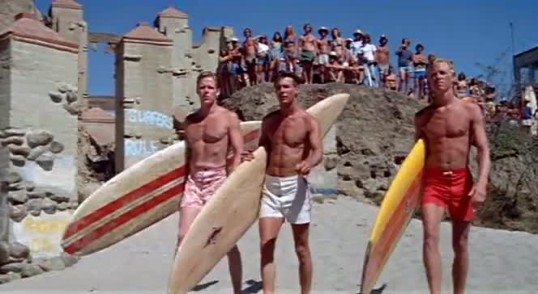
Big Wednesday (1978, dir by John Milius, DP: Bruce Surtees)
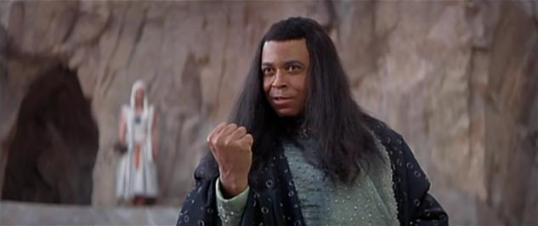
Conan The Barbarian (1982, dir by John Milius, DP: Duke Callaghan)

Red Dawn (1984, dir by John Milius, DP: Ric Waite)
4 Or More Shots From 4 Or More Films is just what it says it is, 4 shots from 4 of our favorite films. As opposed to the reviews and recaps that we usually post, 4 Shots From 4 Films lets the visuals do the talking!
Today, we remembers the great James Earl Jones. It’s time for….
4 Shots From 4 James Earl Jones Films
Conan The Barbarian (1982, dir by John Milius, DP: Duke Callaghan)
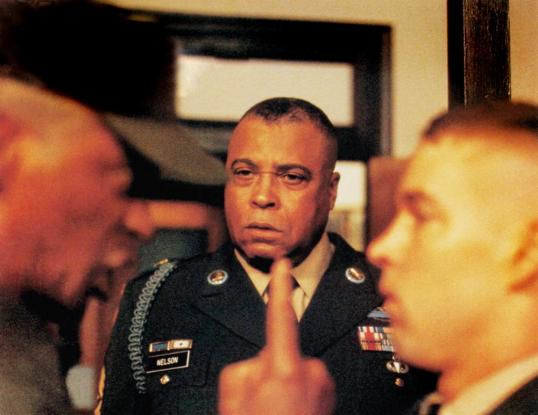
Gardens of Stone (1987, dir by Francis Ford Coppola, DP: Jordan Cronenweth)
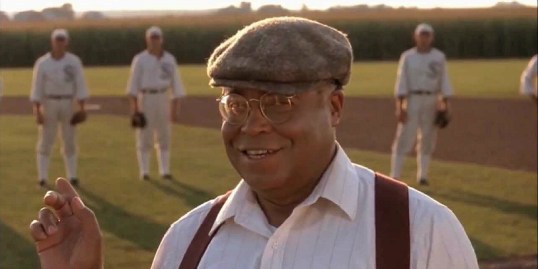
Field of Dreams (1989, dir by Phil Alden Robinson, DP: John Lindley)
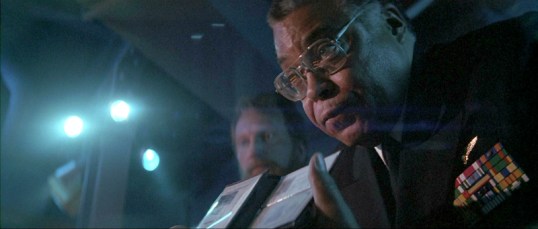
The Hunt for Red October (1990, directed by John McTiernan, DP: Jan de Bont)
1979’s Apocalypse Now reimagines the Vietnam War as pop art.

Jim Morrison sings The End in the background as slow-motion helicopters pass in front of a lush jungle. The jungle erupts into flame while in a dingy hotel room, Captain Benjamin Willard (Martin Sheen) gets drunks, practices his karate moves, and smashes a mirror before collapsing to the floor in tears. The next morning, the hung-over and bandaged Willard ends up at a U.S. military base where he has a nice lunch with Lt. General Corman (G.D. Spradlin) and Col. Lucas (Harrison Ford) and a nearly silent man wearing an undone tie. Willard is asked if it’s true that he assassinated an enemy colonel. Willard replies that he did not and that the operation was classified, proving that he can both lie and follow military protocol. Willard is told that a Col. Walter Kurtz (Marlon Brando) has gone rogue and his mission is to go into Cambodia and terminate his command with “extreme” prejudice. It’s a famous scene that features G.D. Spradlin delivering a brilliant monologue about good and evil and yet it’s often missed that Willard is getting his orders from Roger Corman and George Lucas.

(Roger Corman was the mentor of director Francis Ford Coppola while the pre-Star Wars George Lucas was Coppola’s business partner. Indeed, Apocalypse Now was originally somewhat improbably planned to be a George Lucas film.)

Up the river, Willard heads on a patrol boat that is populated with characters who could have come out of an old World War II service drama. Chief (Albert Hall) is tough and no-nonsense. Lance (Sam Bottoms) is the goofy comic relief who likes to surf. Clean (Laurence Fishburne) is the kid who is obviously doomed from the minute we first see him. Chef (Fredric Forrest) is the overage, tightly-wound soldier who just wants to find mangoes in the jungle and who worries that, if he dies in a bad place, his soul won’t be able to find Heaven. The Rolling Stones are heard on the boat’s radio. Soldiers on the other patrol boats moon the boat and toss incendiary devices on the roof. It’s like a frat prank war in the middle of a war.

Colonel Bill Kilgore (Robert Duvall) is a badass calvary officer whose helicopter raids are legendary amongst the enemy and a dedicated surfer who tries to turn every night into the equivalent of an AIP Beach Party film. He’s a brilliant warrior who speaks with Malibu accent (“Charlie don’t surf!”) and who doesn’t flinch when a bomb goes off near him. “I love the smell a napalm in the morning,” he says and, for a few moments, you really wish the film would just abandon Willard so we could spend more time with Kilgore. “Some day this war is going to end,” he says with a reassuring nod, showing a non-neurotic attitude that is the opposite of Kurtz’s. Willard says that he could tell Kilgore was going to get through the war without even a scratch and it’s true. Kilgore doesn’t try to rationalize or understand things. He just accepts the reality and adjusts. He’s a true surfer.

The film grows progressively more surreal the closer the boat heads up the river and gets closer to Cambodia. A USO show turns violent as soldiers go crazy at the sight of the Playboy Bunnies, dressed in denim outfits and cowboy hats and twirling cap guns like the love interest in a John Wayne western. A visit to a bridge that is built every day and blown up every night is a neon-lit, beautiful nightmare. Who’s the commanding officer? No one knows and no one cares.

The closer Willard gets to Kurtz, the stranger the world gets. Fog covers the jungles. A tiger leaps out of nowhere. Dennis Hopper shows up as a photojournalist who rambles as if Billy from Easy Rider headed over to Vietnam instead of going to Mardi Gras. Scott Glenn stands silently in front of a temple, surrounded by dead bodies that feel as if they could have been brought over from an Italian cannibal film. Kurtz, when he shows up, is an overweight, bald behemoth who talks in riddles and who hardly seem to be the fearsome warrior that he’s been described as being. “The horror, the horror,” he says at one point in one of the few moments that links Apocalypse Now to its inspiration, Joseph Conrad’s Heart of Darkness.

Directed by near-communist Francis Ford Coppola and written by the unapologetically right-wing John Milius, Apocalypse Now is actually less about the reality of Vietnam and more about how the images of the war shaped pop culture the world over. It’s a reminder that Vietnam was known for being the first television war and that counterculture was not just made up of dropouts but also of writers, actors, and directors. Kurtz may say that Willard’s been sent by grocery store clerks but actually, he’s been sent by the B-movie producers who first employed and mentored the directors and the actors who would eventually become the mainstays of the New Hollywood. The film subverts many classic war film cliches but, at the same time, it stays true to others. Clean dying while listening to a tape recording of his mother telling him not to get shot and to come home safe is the type of manipulative, heart-tugging moment that could have appeared in any number of World War II-era films. And while Coppola has always said the film was meant to be anti-war, Col. Kilgore remains the most compelling character. Most viewers would probably happily ride along with Kilgore while he flies over Vietnam and plays Wagner. The striking images of Vietnam — the jungle, the explosions, the helicopters flying through the air — stay in the mind far more than the piles of dead bodies that appear in the background.

It’s a big, messy, and ultimately overwhelming film and, while watching it, it’s hard not to get the feeling that Coppola wasn’t totally sure what he was really trying to say. It’s a glorious mess, full of stunning visuals, haunting music, and perhaps the best performance of Robert Duvall’s legendary career. The film is too touched with genius to not be watchable but how one reacts overall to the film will probably depend on which version you see.

The original version, which was released in 1979 and was nominated for Best Picture, is relentless with its emphasis on getting up the river and finding Kurtz. Willard obsesses on Kurtz and really doesn’t have much to do with the other people on the boat. It gives the story some much-needed narrative momentum but it also makes Kurtz into such a legendary badass that it’s hard not to be disappointed when Willard actually meets him. You’re left to wonder how, if Kurtz has been living in the jungle and fighting a brutal and never-ending guerilla war against the communists, he’s managed to gain so much weight. Brando, who reportedly showed up on set unprepared and spent days improvising dialogue, gives a bizarre performance and it’s hard to view the Kurtz we meet as being the Kurtz we’ve heard about. As strong as the film is, it’s hard not to be let down by who Kurtz ultimately turns out to be.

In 2001 and 2019, Coppola released two more versions of the film, Redux and The Final Cut. These versions re-inserted a good deal of footage that was edited out of the original cut. Most of that footage deals with Willard dealing with the crew on the boat and it’s easy to see why it was cut. The scenes of Willard bonding with the crew feel out of character for both Willard and the rest of the crew. A scene where Willard arranges for Clean, Lance, and Chef to spend time with the Playboy bunnies seems to go on forever and features some truly unfortunate acting. Worst of all, Redux totally ruins Kilgore’s “I love the smell of napalm in the morning” monologue by having Willard suddenly steal his surf board. Again, it’s out of character for Willard and it actually feels a bit disrespectful to Duvall’s performance to suddenly turn Kilgore into a buffoon.

But then there are moments that do work. I actually like the lengthy French Plantation scene. By the time Willard, Lance, and Chef stumble into the plantation, the journey upriver has gotten so surreal that it makes a strange sort of sense that they would run into a large French family arguing politics while a clown tries to keep everyone distracted. The new versions of the film are undeniably disjointed but they also shift the focus off of finding Kurtz and place it more on Willard discovering how weird things are getting in Vietnam. As such, it’s less of a disappointment when Kurtz actually shows up. Much as with the French Plantation scene, the journey has become so weird that Kurtz being overweight and pretentious feels somehow appropriate.

What all the versions of the film have in common is that they’re all essentially a neon-lit dream of pop cultural horror. Is Apocalypse Now a horror film? Critic Kim Newman argued that it owed a lot to the genre. Certainly, that’s the case when Willard reaches the temple and finds himself surrounded by corpses and and detached heads. Even before that, though, there are elements of horror. The enemy is always unseen in the jungle and, when they attack, they do so quickly and without mercy. In a scene that could almost have come from a Herzog film, the boat is attacked with toy arrows until suddenly, out of nowhere, someone throws a very real spear. Until he’s revealed, Kurtz is a ghostly figure and Willard is the witch hunter, sent to root him out of his lair and set his followers on fire. If the post-60s American horror genre was shaped by the images coming out of Vietnam then Apocalypse Now definitely deserves to be considered, at the very least, horror-adjacent.

Apocalypse Now was controversial when it was released. (It’s troubled production had been the talk of Hollywood for years before Coppola finally finished his film.) It was nominated for Best Picture but lost to the far more conventional Kramer vs Kramer. Robert Duvall was the film’s sole acting nominee but he lost the award to Melvyn Douglas’s turn in Being There. Douglas was very good in Being There and I imagine giving him the Oscar was also seen as a way of honoring his entire career. That said, Duvall’s performance was amazing. In his relatively brief screen time, Duvall somehow managed to take over and ground one of the most unruly films ever made. The Oscar definitely should have gone to him.

As for the film itself, all three versions, flaws and all, are classics. It’s a film that proves that genius can be found in even the messiest of productions.

4 Or More Shots From 4 Or More Films is just what it says it is, 4 shots from 4 of our favorite films. As opposed to the reviews and recaps that we usually post, 4 Shots From 4 Films lets the visuals do the talking!
Today is John Milius’s birthday and you know what? It should be a national holiday!
It’s time for….
4 Shots From 4 John Milius Films
Dillinger (1973, dir by John Milius, DP: Jules Brenner)
Big Wednesday (1978, dir by John Milius, DP: Bruce Surtees)
Conan The Barbarian (1982, dir by John Milius, DP: Duke Callaghan)
Red Dawn (1984, dir by John Milius, DP: Ric Waite)
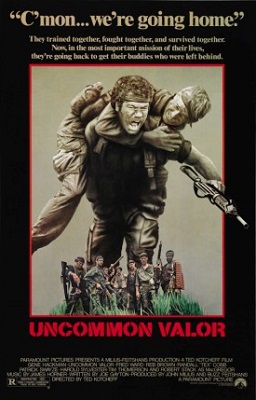 Retired Marine Colonel Jason Rhodes (Gene Hackman) and oilman Harry MacGregor (Robert Stack) share a tragic bonf. Both of them have sons that served in Vietnam and are listed as being MIA. Believing that their sons are still being secretly held in a POW camp in Loas, Rhodes and MacGregor put together a team to sneak into Southeast Asia and rescue them.
With MacGregor supplying the money and Rhodes leading the mission, the team includes Blaster (Red Brown), Wilkes (Fred Ward), Sailor (Randall “Tex” Cobb), and Charts (Tim Thomerson), all of whom served with Rhodes’s son. Also joining in his helicopter pilot Curtis Johnson (Harold Sylvester) and former Marine Kevin Scott (Patrick Swayze), whose father was also listed as being MIA in Vietnam. After a rough start, the group comes together and head into Laos to bring the prisoners home!
Uncommon Valor is one of the many movies released in the 80s in which Vietnam vets returned to Asia and rescued those who were left behind. In the 80s, there was a very strong belief amongst many Americans that soldiers were still being held prisoner in Vietnam, Cambodia, and Laos and Hollywood was quick to take advantage of it. The box office success of Uncommon Valor set the stage for films like Rambo and Missing In Action, film in which America got the victory that it had been denied in real life.
What set Uncommon Valor apart from the films that followed was the cast. Not surprisingly, Gene Hackman brings a lot more feeling and nuance to his performance as the obsesses Col. Rhodes than Sylvester Stallone and Chuck Norris brought to their trips to Vietnam. The film surrounds Hackman with a quirky supporting cast, all of whom represent different feelings about and reactions to the war in Vietnam. Fred Ward’s character suffers from PTSD. Randall “Tex” Cobb, not surprisingly, is a wild man. Patrick Swayze’s character is trying to make the father he’ll never know proud. Robert Stack and Gene Hackman represent the older generation, still trying to come to terms with everything that was lost in Vietnam and still mourning their sons. The raid on the POW camp is exciting but it doesn’t feature the type of superhuman action that’s present in other POW-rescue films. Col. Rhodes and his soldiers are ordinary men. Not all of them survive and not all of them get what they want.
Uncommon Valor started out as a screenplay from Wings Hauser, though he’s not present in the cast of the final film and he was only given a “story” credit. John Milius served as producer. Director Ted Kotcheff is best-known for First Blood, another action film about America’s struggle to come to terms with the Vietnam War.
Welcome to Retro Television Reviews, a feature where we review some of our favorite and least favorite shows of the past! On Mondays, I will be reviewing Miami Vice, which ran on NBC from 1984 to 1989. The entire show can be purchased on Prime!

This week, it’s Reb Brown vs Don Johnson!
Episode 3.22 “Viking Bikers From Hell”
(Dir by James Quinn, originally aired on April 3rd, 1987)
Biker Reb Gustafson (Reb Brown) has been released in prison, just in time to seek vengeance for the death of his mentor, The Wire. The Wire was killed in a drug deal gone bad so Reb decides to just track down every dealer that The Wire did business with during the final two weeks of his life and kill every one of them. Working with Lascoe (John Matuszak) and Toad (Sonny Landham), Reb cuts a trail of terror through Miami’s underground. Soon, there’s only one name left on the list …. SONNY BURNETT!
At this point, of course, everyone in Miami should know that Sonny Burnett is actually Sonny Crockett. I’ve lost track of how many time Crockett and Tubbs have gotten their undercover identities blown. Usually, the people who figure out that Sonny and Rico are undercover end up dying almost immediately afterwards. But a few of their enemies have survived and it’s odd that they never seem to bother to tell anyone, “Hey, those guys are actually cops.”
This episode of Miami Vice is violent that it verges on self-parody. (I guess that’s to be expected as the script was written by the great John Milius, Milius was credited as “Walter Kurtz.”) Reb Brown is an amusing actor. He never showed much emotion but he always looked believable whenever he was relentlessly tracking down someone that he wanted to kill. Brown is both this episode’s greatest strength and its greatest weakness. As played Brown, Reb Gustasfson barely flinches when he gets shot. He’s a relentless killing machine, the terminator on a motorcycle. That does certainly make him an intimidating figure. At the same time, this episode also features Reb Brown doing his signature yelling and, for me, it was hard to watch this episode without thinking about all the close-up, high-pitched screaming that he did in Space Mutiny.
Tubbs ends up in the hospital in this one. An attack by Reb and his biker pals leaves Tubbs with a concussion. Crockett visits the hospital and there’s a scene where he attempts to have a conversation with a heavily drugged Tubbs. Tubbs’s comments make about as much sense as the last words of Dutch Schultz but it’s still kind of nice to see that Crockett actually does care about his partner. The two of them haven’t always seemed particularly happy with having to work together over the course of the third season.
Biker fans will also be happy to note that Kim Coates has a small role in this one. Crockett and Tubbs beat him up in a biker bar while demanding information about Reb. The odd thing here is that Crockett and Tubbs go into the biker bar and make no attempt to hide the fact that they’re actually cops. And all of the bikers in the bar seem to already know that they’re cops. Seriously, were Crockett and Tubbs the two worst undercover cops in history?
This was an enjoyably over-the-top episode. It was a bit silly but, when it comes to Reb Brown, would you want it any other way?
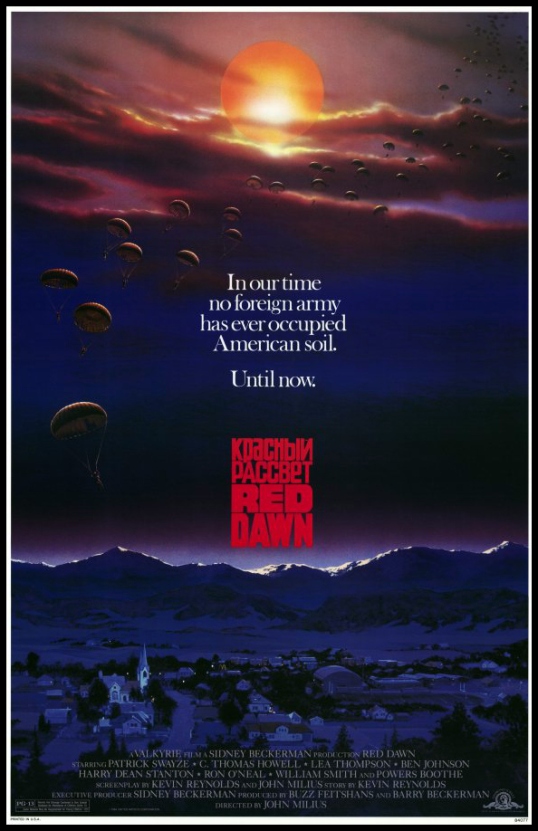
The original Red Dawn doesn’t get as much credit as it deserves.
It’s often described as just being an anti-communist film but actually, it’s a lot more complex than that. Yes, it’s about a group of teenagers who wage guerilla warfare against communist invaders. But it’s also about how those teenagers lose their innocence as a result and how they all come to realize that war is not as simple as they thought it was. The movie celebrates the Wolverines while also mourning that they were put in the position to have to risk and sacrifice their lives in the first place.
That’s what today’s scene that I love is all about. After they are tracked down and attacked by a group of Russian soldiers, the Wolverines discover that one of the original members of the group visited his father in town and was forced to swallow a tracking device. In this scene, the group is forced to deal with the reality of war. The fact that the traitor was a friend to all of them and popular enough to be president of his class just adds to the difficulty of emotionally processing with his betrayal. Patrick Swayze can’t bring himself to pull the trigger. C. Thomas Howell, on the other hand, is so quick to shoot his former friend that you realize just how consumed by hate he has become.
Today’s scene was directed by the brilliant John Milius.
4 Or More Shots From 4 Or More Films is just what it says it is, 4 shots from 4 of our favorite films. As opposed to the reviews and recaps that we usually post, 4 Shots From 4 Films lets the visuals do the talking!
Today is John Milius’s birthday and you know what? It should be a national holiday!
It’s time for….
4 Shots From 4 John Milius Films
Dillinger (1973, dir by John Milius, DP: Jules Brenner)
Big Wednesday (1978, dir by John Milius, DP: Bruce Surtees)
Conan The Barbarian (1982, dir by John Milius, DP: Duke Callaghan)
Red Dawn (1984, dir by John Milius, DP: Ric Waite)
 Through the Shattered Lens