Trailer: Kick-Ass 2 (Extended Red Band)


KickAss2

This past week saw the largest collection of nerd, geek and comic book fandom gathered in one magical place. The place in question is San Diego and the event is called San Diego Comic-Con or simply just uttered in awed whispers as Comic-Con. It is a place that many outsiders have shunned as a place that has no place in good, normal society yet they continue to arrive in larger numbers to ply their products to those they shun. Even this blog has it’s shamers and ignorant individuals who spew insults yet they too continue to visit because deep in their subconscious they know, like those who ridicule Comic-Con and those who attend them with a passion, that they’re the ones out of step with whats not accepted in society.

What does this mean when it comes to the latest trailer for Kick-Ass 2 that just came out of Comic-Con?

Absolutely nothing other than the trailer and the film itself is just another weird meeting of the two cultures. It’s a film that celebrates the ridiculousness and absurdity of the comic book culture, yet it’s one that’s funded by the very same people who insulted the scene just a decade ago.

The first film was a revelation and helped introduced the world to one Chloe Grace Moretz, but it also showed that comic books and films made from them didn’t have to be PG or even PG-13. There was a place for ultra-violence in our comic book films. It also helped bring the name of Matthew Vaughn into the forefront of comic book fandom. While he’s not directing this sequel (he elected to go with X-Men: First Class and we’re all the better for it), he did help in bringing it to life and hand-picked his successor in Jeff Wadlow.

While Kick-Ass 2 is not getting the same sort of buzz from Comic-Con the original film did it is still one film I’m quite interested in seeing just to find out what has happened to our young superheroes and vigilante crime fighters since the last film. Plus, it’s main villain likes to call himself “Motherfucker”.

Trailer: Kick-Ass 2 (Red Band)


KickAss2

2010’s Kick-Ass was one of those films that you either loved or hated. It was a film adapted from the Mark Millar and John Romita, Jr. comic book of the same name that also had a similar reputation of having extreme opposites in regards to how people perceived it.

I, for one, loved the film despite just being “meh” when it came to the comic. Where the film by Matthew Vaughn was a darkly comic deconstruction of the superhero story the comic book that gave birth to it was just an exercise in shocking the readers without working for it. Yet, despite that the film was a hit with both the fans of the comic book and those who didn’t even know it was a comic book. That popularity allowed the film to make enough profit that a sequel was greenlit even before a second volume of the comic book was even started by Millar and Romita, Jr.

Kick-Ass 2 sees the return of both Hit-Girl and Kick-Ass with Red Mist now calling himself The Motherfucker and the film’s main antagonist. The sequel sees Matthew Vaughn return as producer with Jeff Wadlow stepping in as director.

Kick-Ass 2 is set for an August 16, 2013 North American release date with the film premiering earlier on July 19, 2013 in the UK.

What Lisa Watched This Morning: One For The Money (dir. by Julie Anne Robinson)


This morning, as it stormed outside, I watched One For The Money, the Katherine Heigl film that quickly came and went earlier this year.

Why Was I Watching It?

 How did I end up watching One For The Money this morning?  I blame the toadsuckers out there who insist on mowing their lawns every chance they get.  By constantly mowing their lawns, these people are releasing particles of grass into the air where they turn into pollen and they make life difficult for sweet, innocent girls like me who happen to have fairly severe asthma.  Because of everyone mowing their lawns, my asthma started to act up last night and I ended up calling in to work today.

So, there I was: curled up on the couch, clutching my inhaler and listening to the thunder rumbling and the rain falling outside.  Our cat Doc walked over to the couch and stared up at me for a few minutes before going, “Meh.”  I took that to mean: “Let’s watch a movie On Demand.”  So, I checked to see what was available and, after I realized that I had no interest in Red Tails, I decided to go with One For The Money.

What’s It About?

So, Stephanie Plum (Katherine Hiegl) lives in New Jersey and has no job but she does have a kinda creepy cousin named Vinny (Patrick Fischler, who looks like he would be a creepy cousin named Vinny) who owns a place called Vinny’s Bail Bonds.  Stephanie reminds Vinny of a time that he attempted to get all incestous-like with her so Vinny hires her as a bail enforcement agent (otherwise known as a bounty hunter).  Stephanie’s first assignment is to catch Joe Morelli (Jason O’Mara), a former cop who is wanted for murder.  Stephanie is happy to accept this assignment because, back in high school, she lost her virginity to Joe and then attempted to run him over with her car after he dumped her.

However, it quickly turns out that 1) Joe isn’t that easy to catch and 2) he might be innocent.  In between getting bounty hunting lessons from Ranger (Daniel Sunjata) and catching other assorted bail jumpers, Stephanie tries to help Morelli prove his innocence and also finds herself falling in love with him, despite the fact that he’s kind of a jerk.

What Worked?

This film has gotten some of the worst reviews I’ve ever seen and not just from the usual gang of overpaid film critics who always hate on films starring Katherine Heigl.  Even the reviews left on the imdb are amazingly negative, a lot of them being left by fans of the series of books that this film is based on.  I have to admit that I haven’t read any of Janet Evanovich’s Stephanie Plum novels and maybe that’s why I didn’t think this film was that bad.

This film was essentially a big budget Lifetime film and it was at its best when it accepted that fact.  It had a few cute moments and there’s a moment, where the inexperienced Stephanie Plum goes, “Oh, I forgot I had a gun!” that made me laugh out loud because I know that’s exactly the sort of thing that I’d end up saying if I ever took up bounty hunting for a living.  While I agree with those who have said that Heigl was miscast as Stephanie, I could still relate enough to the character that the film (for the most part) managed to hold my attention.

Jason O’Mara and Daniel Sunjata are both easy on the eyes.  Stephanie’s not the only one to have fantasies about being handcuffed by Jason O’Mara while naked.

A lot of the negative comments that I’ve read about this film centered on just how bad Heigl’s New Jersey accent was.  As a Texan who speaks with a twang in her voice, all I can say to that is “Welcome to my world, bitches.”  If nothing else, maybe this film will let Yankees know how it feels to have their accent butchered by someone who grew up in Connecticut.

What Did Not Work?

 Just because the film wasn’t that bad doesn’t mean that it was all that good.  It’s a fun film to watch when you’re sick and it’s raining outside because it’s so lightweight and insubstantial that it doesn’t require you to think about what’s happening on-screen or really to even pay that much attention.  If you do pay attention, you’ll quickly realize that Heigl (who I, as opposed to lot of people, usually like) isn’t believable as a member of the working class, the film’s story is predictable, and that John Leguizamo plays essentially the same annoying character that John Leguizamo always plays in films like this.

I’m also assuming that Heigl’s voice-over narration was an attempt to capture Evanovich’s authorial voice on-screen but, honestly, it just came across as being heavy-handed and unnecessary.

“Oh my God!  Just Like Me!” Moments

There were a few.  To be honest, I get the feeling that if I ever became a bounty hunter, I would probably be kind of a klutzy one like Stephanie Plum is in this film.  Add to that, Stephanie has to spend a lot of time listening to people complain about her driving and I can certainly relate to that.  Seriously, you get a few tickets for running a red light and then you jump a few medians and suddenly, everyone’s making you out to be some sort of menace.

Lessons Learned:

What might be annoying on the big screen is perfectly acceptable when you’re curled up on the couch and watching TV.

Review: Vanishing On 7th Street (dir. by Brad Anderson)


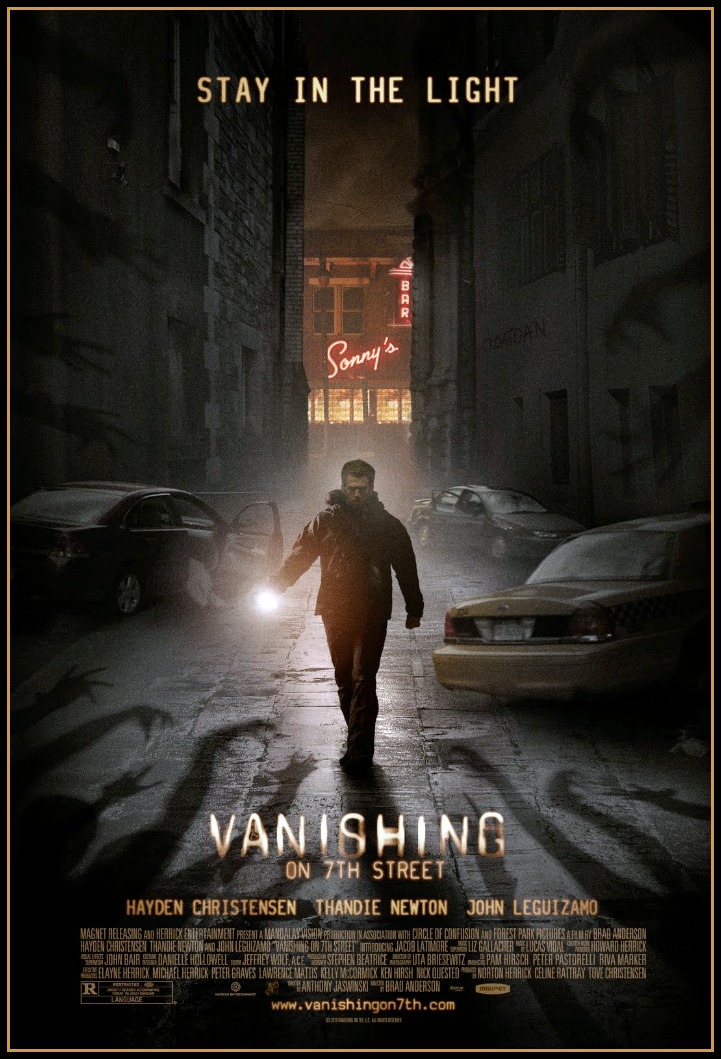
In the genre world of horror and thrillers there’s been one name who always seem to be on the verge of breaking out. He has done some exceptionally well-crafted horror and thrillers which never could get a mainstream audience to commit to but always gathering a cult-following upon their release. He has done some wonderful work as a TV director for such acclaimed shows as Fringe, Treme, Boardwalk Empire and The Wire. His best known work was a thriller collaboration with Christian Bale in The Machinist. While it’s a film more well-known for the extremes an actor was willing to go for to make their performance as authentic as possible it was also a film which showed style and talent in it’s filmmaker. The person I speak of is Canadian filmmaker Brad Anderson whose latest film was another low-budget horror-thriller which looks to be gaining a cult-following once again despite not being well-received by the mainstream critics. Vanishing On 7th Street was a film using the screenplay of Anthony Jaswinski which puts an interesting, claustrophobic and, at times, entertaining twist on the oft-used and well-ridden post-apocalyptic genre.

The film begins with film projectionist Paul in his projection booth reading up on the lost colony of Roanoke and the mysterious word left behind: CROATOAN. It’s through his point of view that we first see the beginning of what could be the end of the world as lights begin to flicker then go out throughout the theater and the mall it’s located in. Paul investigates this event only to discover sets of clothing and accessories where theater patrons and employees used to be in. With each passing moment the darkness — punctuated by just the flashlights of Paul and a lone mall security guard — becomes to take on an ominous tone before the film sudden moves ahead three days into what would become the major setting for the film: a lit bar on a deserted and darkened stretch of 7th Street in Detroit, Michigan.

We meet the rest of the main cast in this bar. There’s Luke who used to be a TV anchorman who discovers to his horror just what might have been the cause of the disappearance of most everyone in the world as he tries to find his girlfriend at the TV station they both worked at. It’s in these flashbacks to Luke’s early experience with the dark apocalypse that we see some of the most perfectly shot scenes of a major city devoid of life. An urban setting where the sudden disappearance of people during the power outage the night before has caused an eerie detritus of crashed vehicles, empty clothing and, in a sudden and violent sequence, a lone airline crashing in the background. It’s through Luke and the lone survivor in the bar, a 12-year old boy named James (Jacob Latimore), that we begin to try and piece together just what might have caused the event which continues to plague those left behind for the last three days.

The film posits the basic concept that darkness itself was the culprit for the disappearance of everyone and what continues to stalk those still left behind, alive and desperate for answers. While the film never really give definite answers as to the cause the two other characters in the back outside of Luke and James bring their own theories. There’s Rosemary (Thandie Newton), the distraught mother searching for her infant son, who thinks what’s going on around them is the the prophecized Rapture and those left behind were those who have sinned and were now being tormented for whatever sins they might have committed. On the other side is Paul from the beginning of the film who Luke rescues from an illuminated bus stop shelter who believes the very thing which caused the disappearance of the Roanoke colony during the 16th-century has now returned on a global-scale. His reasonings run the gamut of scientific causes from wormholes, black holes, gamma ray burst, nanotech gone amok and even an accident from a particle collider.

The audience are left to decide amongst themselves which explanation holds merit since neither one has enough backing to be the true answer. Vanishing On 7th Street leaves much of the questions raised by the dark apocalypse around these surviving characters to be left ambiguous and unanswered which at times becomes a detriment to the narrative as a whole. It’s a testament to Brad Anderson’s direction that the film was able to move past the apparent weaknesses in Anthony Jaswinski’s script and deliver a taut thriller (the film never truly gets to the level of horror) that just builds and builds with tension from beginning to an end that seemed almost too rushed.

With a low-budget and minimal cast the film tries to create some of the tension in the film be a construction of the differences between the four main characters. The actors were pretty game to try and make their characters more complex than what the script have provided, but in the end they still seem too basic for anyone of them to become sympathetic for the audience to truly care for their well-being. The film has to finally rely on just them as the last people on the planet as the main crux for the audience to latch onto. All the actors involved never become too cartoonish or stereotypical in their performance, but some of their decision-making in the middle and latter section of the film were too horror-typical, but they do add to the film’s many scenes of mounting terror as characters drop flashlights, lose light sources and other such problems with the living shadows in the darkness creeping up to try and take those still left. These scenes do look to be too stereotypical of other horror films but under Anderson’s direction there’s a palpable sense of claustrophobia and menace in these shadows.

What truly sells the film despite these flaws outside of Anderson’s direction would be the minimalist score by first-time film composer Lucas Vidal. His composition for the film were at once ominous and haunting. At times his score shows off hints of influences from the more doom-laden scores of Philip Glass. The other component of the film which definitely added to the atmosphere of inevitable doom to the film was Uta Briesewitz cinematography which made great use of darkness and solitary light sources to create islands of safety in a sea of encroaching terror we never truly comprehend. It’s the trifecta of Anderson’s directing, Vidal’s minimalist doom orchestration of a score and Briesewitz’s cinematography which gives Vanishing On 7th Street enough reasons to be a film which stands out as a fine piece of genre filmmaking despite weaknesses in the script.

Brad Anderson truly seem to be a filmmaker destined to remain in the fringes of mainstream cinema. His Vanishing On 7th Street continues to be another example of his great work in the horror-thriller genre. Despite same flaws which could turn off some of those who see this film it doesn’t diminish the fact that even at it’s worst this film was still an entertaining piece of post-apocalyptic work which brings some new ideas into the genre. Maybe a stronger treatment of the script would’ve made for a near-perfect thriller and one which could’ve had more horror to it, but Anderson was able to make a good enough film with an average script that I think deserves for this film to be seen by more people. For every horror remakes we get from Michael Bay’s Platinum Dunes to the latest in the Saw-like torture porn horror it’s good to see that such films as Vanishing On 7th Street exist to be the solitary beacon of light in a sea of cookie-cutter, by-the-numbers horror films that seem to dominate each film year after the other.

Review: Gamer (dir. by Neveldine/Taylor)


No one will ever mistake the writer-director duo of Neveldine/Taylor (Mark Neveldine and Brian Taylor) as the next Coen Brothers, but they definitely have made their mark in creating entertaining films which some have called exploitative, pandering to the lowest common denominator and exercises in excess. Maybe these critics are right, but they also seem to view the films by these two filmmakers through the narrow-minded lens of their elistist and so-called cineaste sensibilities. They won’t be the next Coen Brothers but they’re way ahead of other so-called filmmaker duos such as The Spierig Brothers (Undead and the pretentious and awful Daybreakers) or The Strause Brothers (AvP: Requiem and the awful Skyline). They came onto the scene with their cult classic action thrillers Crank and it’s sequel, Crank: High Voltage.

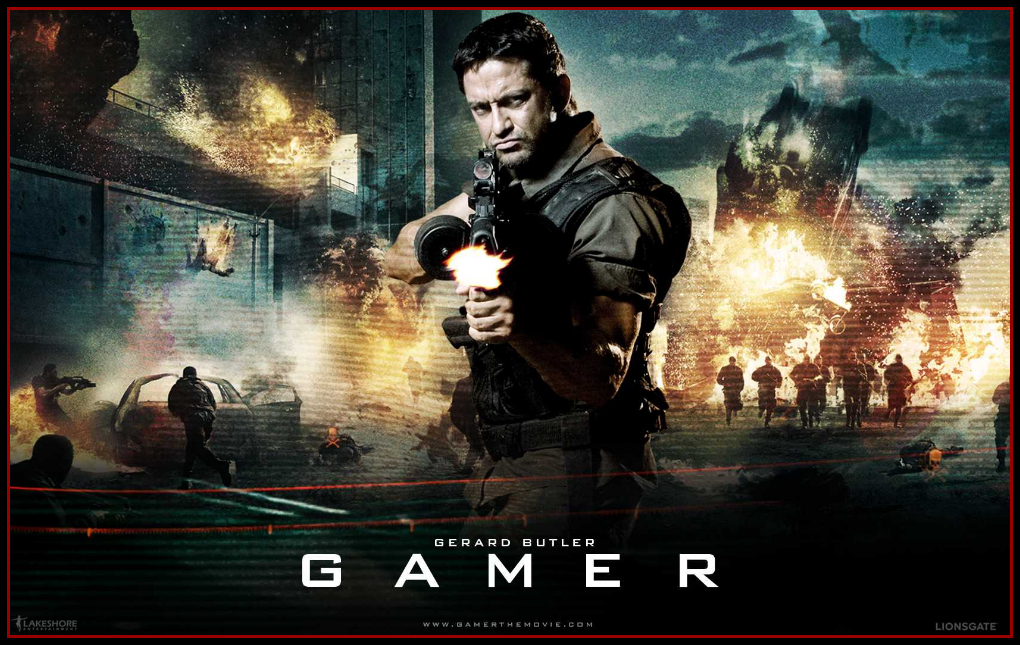
Their third film took the gaming influences so inherent in their first two films (which for all intents and purpose were video games that happened to be film) and went the next step. Gamer is all about a near-future world where two games with on-line social media foundations have become the rage of the entertainment world. One is a game called “Society” that looks to be the nightmare evolution of privacy advocates everywhere to the on-line virtual world Second Life and The Sims. It is the other game in this film which makes up the foundation of the film’s plot. “Slayers” takes the ultra-popular multiplayer on-line experiences of games such as Call of Duty and HALO to the next level by allowing gamers to actually control real people (inmates sentenced to death) to act as their avatars in a real-life battlefield arena with real weapons and real deaths.

These games which have become the obsession of hundreds of millions of people worldwide are the brainchild of the film’s antagonist. Michael C. Hall plays the creator of these games and his performance looks to combine the sociopathic charm of his Dexter character with that of Steve Jobs is the latter was openly honest about his douchebag tendencies. Playing his opposite is the character of Kable who happens to be the reigning champion of the game Slayers and who knows a secret that could tear down the billion-dollar empire created by Castle. Gerard Butler plays the desperate but very capable inmate Kable who just wants to survive past the final match and earn his freedom thus return to his wife and young daughter on the outside.

Gamer posits the question of how far are we willing to go to experience realism in our games and entertainment. With the game Society people pay to be able to control other people in a social setting (albeit in a controlled area). These so-called avatars will do anything and everything their real-life controllers tell them to do. In the film these avatars get paid to become virtual slaves and with most people signing up for the job being the socially desperate. Their situation is not so dissimilar from the condemned inmates who populate the game Slayers. The film hits the audience with a sledgehammer that these virtual entertainments have become popular worldwide because people have stopped looking at these “volunteers” as real people. Morality has been replaced by the need for instant gratification by way of these virtual on-line systems.

The film doesn’t make any apologies for the heavyhanded delivery of it’s message and also doesn’t skimp on the entertainment side of the equation. Neveldine/Taylor have shown that they have a certain flair for creating visual chaos and action on the screen. Their unique visual style does look like something out of a video game especially those from hyperrealistic shooters such as Call of Duty and its ilk. The filmmakers have always accomplished the high-quality visual look of their films despite the low to modest budget given to them by the studios they’re working for. Gamer is no exception and the film benefits from the decision by these two filmmakers to continue working with the Red One digital cameras thus allowing them to add in the visual effects right into the shot scenes the very same day of shooting.

It’s this very style of hi-tech guerrilla filmmaking which makes Neveldine/Taylor this current era’s Cormans. Unlike most low-budget filmmakers they don’t use the size of their budget to dictate how their films turn out visually, aurally and narratively. The first two this film succeeds in ways that makes an audience think the film was higher budgeted than it really was. The third would depend on the viewer whether the film succeeds or not. For those who seem intent on viewing every film as if they were made to be worthy of high awards and accolades would probably dismiss and hate this piece of exploitation cinema. Gamer succeeds in a narrative sense because it delivers on the promise of telling a story about a world where free will has been seconded to control in the need of a population in search of a the next virtual playground. It’s a heady premise that has been explored in past films such as the Matrix Trilogy and another film similar to this one which came out weeks later in Surrogates.

Gamer doesn’t have the philosophical and existential sermoning in combination with futuristic action sequences as the Wachowski Brothers’ trilogy, but it does have the same visceral action DNa as those three films and also more entertaining than the Bruce Willis vehicle Surrogates. This film will appeal to the very people who it condemns as sheep to the rising tide of on-line control in entertainment, but then that’s what all exploitation films tend to do best. Cater to the very people it uses as examples of what’s wrong in society and build an entertaining film around them and what they represent.

The film’s cast revolves around Gerard Butler and Michael C. Hall and the roles they play. Whether its Amber Valletta playing Kable’s desperate wife who has sold herself to become a controllable avatar in Society to try and earn enough to get her young daughter back or to Logan Lerman playing the role of Simon the gamer who controls Kable during the Slayer matches. They all do enough with their roles to keep their characters from becoming less than one-notes. Again, for some having a film with characters that are quite basic and one-note might make for a bad film, but when put into context of the story being told they’re quite good and needed to become motivators for Butler’s character.

In the end, Neveldine/Taylor have made a modern day exploitation and grindhouse film in Gamer without having to resort to the visual tricks used in the Rodriguez/Tarantino grindhouse homage film Grindhouse. A film doesn’t need to have film scratches, overexposed film stock, scratchy audio track or missing film reels to be grindhouse. It just have to espouse the very nature of the films which made up the kind of films which became prime example of grindhouse/exploitation cinema. Gamer won’t win any awards, but I suspect that more people who saw it were entertained by it’s blatant, in-your-face entertainment than would normally admit to it. It’s a film that has cult status and guilty pleasure written all over it.

Plus, this film is definitely worth at least a curiosity viewing if just to see the musical number performed by Michael C. Hall at the climactic sequence near the end of the film. I don’t think any film has ever combined gratuitous violence, musical dance numbers using bloodied death row inmates and Michael C. Hall singing Frank Sinatra’s “Ive Got You Under My Skin“. That sequence alone is worth a rental or Netflix Instant streaming.