First released in 1960 and based on a novel by Leon Uris, Otto Preminger’s Exodous is two films in one.
The first half of the film takes place in Cyprus in the days immediately following World War II. A young war widow named Kitty (Eva Marie Saint) is sightseeing when she learns of the Karaolos Internment Camp, where the British are interning thousands of Jewish refugees who demand to be allowed to go to the land that will eventually become the State of Israel. Kitty visits with General Sutherland (Ralph Richardson), who oversees the camp and who is rumored to secretly be Jewish because of his relatively benevolent attitude towards the internees. Disgusted by the anti-Semitism displayed by many of the British officers (one of whom is played by Kennedy in-law Peter Lawford), Kitty volunteers at the camp and learns about the Holocaust from those who survived it. She also meets Ari Ben Caanan (Paul Newman), a former officer in the British army. Ari manages to get control of a cargo ship, one that is renamed Exodus. Six hundred refugees stage a hunger strike, vowing that they will willingly starve to death rather than be returned to Europe.
The second part of Exodus takes place in what will become the modern State of Israel. It follows Ari, Kitty, and several of the passengers of the Exodus as they adjust to life and continue to fight for a land of their own, despite the opposition of the British and much of the rest of the world. Karen (Jill Haworth) is a young woman who searches for her father, a brilliant man who has been driven into a nearly catatonic state by the horrors of the Holocaust. Dov Landau (Sal Mineo) is an explosives expert who survived Auschwitz as a Sonderkommando and who was repeatedly raped by the guards at the camp. Dov joins the Irgun, a paramilitary organization that the British consider to be terrorists. Leading the Irgun is Ari’s uncle, Akiva (David Opatoshu), and Dov soon finds himself being targeted by both the British and the Arabs who, despite the moderating efforts of men like Taha (John Derek, who would later direct Ghosts Can’t Do It), want to violently force the Jews out of the land.
Legend has it that, after a private screening on Exodus, comedian Mort Sahl turned to director Otto Preminger and said, “Otto, let my people go.” And it’s true that Exodus is a very long film. Preminger, who started out making film noirs like Laura, spent the latter part of his career making “important” epics and, like many Golden Age directors struggling to compete with television and the 60s counterculture, he tended to make long, star-studded films that dealt with current events and which pushed the envelope just enough to be controversial without actually being radical. However, I would argue that the three-hour running time of Exodus is justified. To understand why Ari, Dov, Karen, and the other passengers of the Exodus would rather risk their lives by staying in what will become the State of Israel, one has to understand both what they went through to get there and also the anti-Semitism that they faced even in post-World War II Europe. If Exodus were made today, it would be a mini-series. Since it was made in 1960, it was instead a 3-hour film with an intermission.
Exodus holds up relatively well, with the sprawling action anchored by the presence of a cast of familiar faces. Paul Newman and Eva Marie Saint bring a good deal of movie star glamour to scenes that would have otherwise just been dry exposition. The film’s heart truly belongs to Jill Haworth and Sal Mineo, both of whom bring two life characters who have very differing views of the world. Karen remains an optimist, one who is convinced that people can live together. Dov, fueled by his own guilt and anger, has no room for negotiations and compromises. Mineo received his second and last Oscar nomination for his performance in Exodus, though he lost to Peter Ustinov’s showy turn in Spartacus. Exodus itself was clearly made with a hope for Oscar glory. While Exodus did pick up a handful of nominations, it was left out of the five movie Best Picture slate. The Academy only had room for one historical epic and they went for John Wayne’s The Alamo. The eventual winner was The Apartment, the best of the nominated films. (Indeed, even if Exodus had taken the Alamo’s spot, The Apartment would still be the best of the nominees.) The Oscars aside, Exodus remains a good example of the type of epic filmmaking that once defined the Hollywood studios.

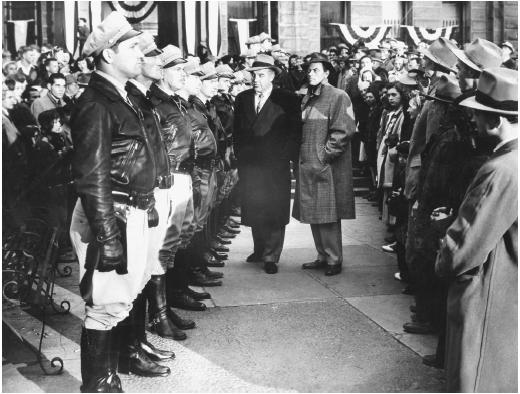
 Knock On Any Door opens with the murder of a policeman in New York City. Nick Romano (John Derek) is arrested for the crime. Nick is a troubled young man who has grown up in the slums and is fond of saying that his goal is to “Live fast, die young, and leave a good-looking corpse.” Now on trial for his very life, Nick reaches out to lawyer Andrew Morton (Humphrey Bogart), who once unsuccessfully defended Nick’s father in a similar criminal trial. At first, Morton wants nothing to do with Nick but he changes his mind, partially out of guilt over Nick’s father and partially because Morton himself came from the same slums that produced Nick. Even as the district attorney (George Macready) goes for blood, Morton argues that Nick isn’t a menace but instead a victim of a society that left him with little choice but to become a criminal.

 Through the Shattered Lens