Stripes (1981, directed by Ivan Reitman)


Bill Murray and Harold Ramis join the army.

Wait, that can’t be right, can it?  Bill Murray and Harold Ramis were cinematic anarchists.  Early in his career, Bill Murray was the ultimate smart aleck slacker who did not have any respect for authority.  Harold Ramis was hardly a slacker but he came across as someone more likely to be marching on the Pentagon than guarding it.  Stripes is one of the ultimate examples of a comedy where the laughs come from things  that don’t seem to go together suddenly going together.

John Winger (Murray) at least has a reason to join the army.  He has a dead end job.  He has just broken up with his girlfriend.  The country appears to be at peace so why not spend four years in the Army?  It’s harder to understand why John’s friend, Russell (Ramis), also decides to enlist, other than to hang out with John.  Along with Ox (John Candy), Cruiser (John Diehl), Psycho (Conrad Dunn), and Elm0 (Judge Reinhold), they enlist and go through basic training under the watchful eye of Sgt. Hulka (Warren Oates).  John and Russell go from treating everything like a joke to invading East Germany in a tank that’s disguised as an RV.  They also meet the two sexiest and friendliest MPs in the service, Stella (P.J. Soles) and Louise (Sean Young).  Russell goes from being an proto-hippie who teaches ESL to asking John if he thinks he would make a good officer.  John goes from not taking anything seriously to picking up a machine gun and rescuing his fellow soldiers.

It’s a comedy that shouldn’t work but it does.  It’s actually one of my favorite comedies, full of memorable lines (“Lighten up, Frances.”), and stupidly funny situations.  The cast is full of future comedy legends and P.J. Soles shows that she deserved to be a bigger star.  This was early in Bill Murray’s film career and he was still largely getting by on his SNL persona but, in his confrontations with Hulka, Murray got a chance to show that he could handle drama.  With all the comedic talent in the film, it’s Warren Oates who gets the biggest laughs because he largely plays his role straight.  Sgt. Hulka is a drill sergeant who cares about his men and who knows how to inspire and teach  but that doesn’t mean he’s happy about having to deal with a collection of misfits.  (Watch his face when Cruiser says he enlisted so he wouldn’t get drafted.)

The movie does get strange when the action goes from the U.S. to Germany.  What starts out as Animal-House-In-The-Army instead becomes an almost straight action movie and the movie itself sometimes feels like a recruiting video.  Join the Army and maybe you’ll get to steal an RV with PJ Soles.  That would have been enough to get me to enlist back in the day.  But the combination of Murray, Ramis, and Oates makes Stripes a comedy that can be watched over and over again.
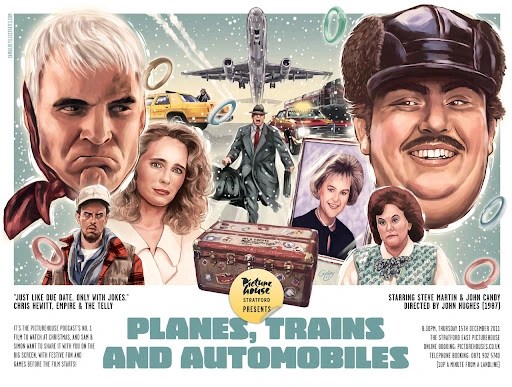
PLANES, TRAINS AND AUTOMOBILES and our family’s traditions.


I love Thanksgiving because I love spending time with my family. My Mom is one of 15 kids from a large Catholic family in central Arkansas, so this is the time of year that I get to see a big part of that extended family. A lot of people are spread out across the state and country so we don’t get to see everyone at Thanksgiving, but we do get to see a lot of people. We go to my aunt Jo Ellen’s house, and I get to hang out with a bunch of my aunts, uncles and cousins. We’ll have a giant feast from a potluck of items we’ve grown to love over the years…Aunt Jo Ellen’s turkey and dressing, Mom’s candied yams, Aunt Connie’s deviled eggs, the giant table of desserts, etc. Our family is all about traditions, and this is the time of year we share those with each other. I just love it! 

One of our movie-watching traditions is watching PLANES, TRAINS AND AUTOMOBILES together. And we do it every year. We still laugh at all the right parts…Kevin Bacon getting Steve Martin’s cab thanks to a mysteriously large trunk on the curb, John Candy reading The Canadian Mounted, Doobie’s Taxiola, “Those Aren’t Pillows,” Owen’s strange facial expressions and throat noises, “a couple of balls and an extra set of fingers,” the runway crossing, the car rental counter meltdown, “you’re going the wrong way,” the hotel destruction getaway, and the indestructible car radio. Odds are many of you are smiling as you read this quick summary of some of my favorite parts. We’ll watch the movie together while we’re settling in back at Dad and Mom’s house after a wonderful Thanksgiving lunch. It’s a guarantee that Dad will be snoring at some point. 

As much as I love to eat, to me, Thanksgiving is all about spending time with the ones I love. We’ll tell a lot of the same stories that we’ve told many times over the years, and we’ll laugh at them all over again. We’ll truly enjoy our time together. Our family is not perfect, and we don’t always see eye to eye on everything, but we love each other and that is more important than just about anything else. That’s a Crain family tradition passed down from my parents. One of the best things about PLANES, TRAINS AND AUTOMOBILES is that there are times when the laughs die completely down, and that’s when the movie reveals its heart. The same can be said for my family, and that’s something I’m truly thankful for.

Spaceballs (1987, directed by Mel Brooks)


°ëØ

A long time ago, in a galaxy far far away…

President Skroob (Mel Brooks), the evil and incompetent leader of Planet Spaceball, has squandered all of the air on his planet and is planning on stealing the atmosphere of the planet Druida.  To pull this off, he arranges for the idiotic Prince Valium (Jim J. Bullock) to marry Vespa (Daphne Zuniga), the princess of Druida.  (All together now: “She doesn’t look Druish.”)  Vespa and her droid, Dot Matrix (voice by Joan Rivers), flee Druida with Lord Dark Helmet (Rick Moranis) and Colonel Sandurz (George Wyner) in pursuit.

In debt to the intergalactic gangster, Pizza the Hut (voiced by Dom DeLuise), a mercenary named Lone Star (Bill Pullman) and his associate, the man-dog hypbrid Barf (John Candy), accept a contract from Vespa’s father (Dick Van Patten) to track down his daughter.  They take off in their space Winnebago to bring Vespa home.  Though they start only interested in money, Lone Star and Barf come to learn about love, freedom, and a mystical power known as the Schwartz.  (“No, the Schwartz!”)

Back when I was growing up and just being able to have HBO made you the coolest guy on the block, Spaceballs was one of my favorite movies.  I watched it every time that it came on cable.  As usual with Mel Brooks, there were a lot of double entendres that went over my young head but there was also enough goofy humor that I could laugh at what was going on.  I could quote all the lines.  I laughed whenever Rick Moranis showed up in his Darth Vader-costume.  I laughed at John Candy’s facial expressions.  I laughed when Mel Brooks showed up as Yogurt, the Spaceballs version of Yoda.  Pizza the Hut?  That’s hilarious when you’re a kid!

I recently rewatched the film.  Revisiting it was a lesson in how your memory can trick you.  I could still quote most of the lines with reasonable accuracy but nothing was quite the way I remembered it.  Rick Moranis and John Candy were still hilarious and, being older, I could better appreciated the frustration felt by George Wyner’s Colonel Sandurz.  I also realized what a good performance Bill Pullman gave as Lone Star.  While everyone else mugged for the camera, Pullman played his role straight.

I also discovered that a lot of the scenes that I remembered as being hilarious were actually just mildly amusing.  Mel Brooks was always hit-and-miss as a director, the type who would toss everything and the kitchen sink into his films.  Spaceballs has a lot of hilarious scenes but it’s obvious that Brooks didn’t have the same affection for the source material as he did with Young Frankenstein or Blazing Saddles or even High Anxiety.  Brooks is poking fun at Star Wars because it’s popular but he doesn’t seem to have any strong feelings, one way or the other, about George Lucas’s space epic.

I still laughed, though.  Even if Spaceballs wasn’t the masterpiece that I remembered it being, I still enjoyed rewatching it.  The jokes that hit were funny enough to make up for the ones that missed.  Even with his weaker films, Mel Brooks is a national treasure.

The Great Outdoors (1988, directed by Howard Deutch)


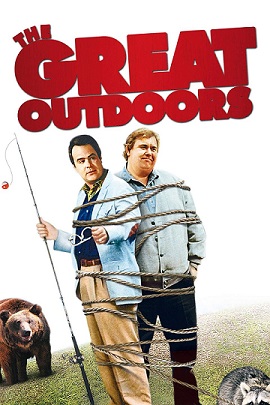
Chet Ripley (John Candy) wants to have a nice vacation up at the lake with his wife (Stephanie Faracy) and their two sons, Buck (Chris Young) and Ben (Ian Giatti).  Unfortunately, no sooner has he arrived than the vacation is crashed by Chet’s sister-in-law (Annette Bening, making her film debut) and her husband, Roman (Dan Aykroyd).  Roman represents everything that that the mild-mannered Chet hates.  Roman is loud, obnoxious, and obsessed with showing off his wealth.  Roman knows nothing about how to survive in the great outdoors and he treats Chet like he’s a loser but, for the sake of giving his family a good vacation, Chet tries to get along with Roman.  At first, it doesn’t work but eventually, Chet and Roman have to team up to find Roman’s daughters and deal with not only a bear but also talking raccoons.  Meanwhile, Buck falls in love with local girl, Cammie (Lucy Deakins).  I imagine the same can be said of a lot of people who caught this film on HBO when they were twelve.

The Great Outdoors is very much a comedy of the late 80s.  Roman may be a crass Yuppie but it doesn’t appear that Chet is suffering financially either.  The humor is broad and physical but the film never resorts to the gross-out style that has since come to define cinematic comedy.  It’s a film that makes fun of the obligations of family life while also celebrating them and you won’t be shocked to learn that the script was written by John Hughes.  John Candy is likable and Dan Aykroyd has a demented twinkle in his eye.

It’s not a bad movie but I just wish it had been funnier.  Don’t get me wrong.  When you’re a kid and you come across The Great Outdoors on cable, it’s hilarious because it’s got John Candy waterskiing and a bear and, of course, the talking raccoons.  Watching it as an adult, though, it’s easier to see just how much the material and the film’s family-safe approach holds back both Candy and especially Aykroyd.    Both of them were capable of being wild comedic performance but, in The Great Outdoors, the movie doesn’t let either one of them really go crazy and that’s too bad.  Instead of being a showcase for the best of SNL and SCTV, it becomes an amusing but ultimately very safe family comedy.  (Arguably, Hollywood never really figured out the best way to use Candy and Aykroyd’s comedic talents, though Candy’s films before his untimely death suggested that he was on the verge of a genuine breakthrough.)

I did laugh when I rewatched The Great Outdoors but I didn’t laugh as much as I did when I was a kid.  Now, I feel old and I’m thinking about how unfortunate it is that John Candy died before production could start on the biopic of Fatty Arbuckle that Candy was tentatively set to star in.  Much like Phil Hartman, it’s hard to watch John Candy today without thinking about how he was taken when he was on the verge of probably doing what would have been his best work.

Time to cheer myself up with What About Bob?

Monster Chiller Horror Theatre: Deadly Companion (1980, directed by George Bloomfield)


Deadly Companion starts with John Candy sitting in a mental institution and snorting cocaine while happily talking to his roommate, Michael Taylor (Michael Sarrazin).  Michael has been in the institution ever since the night that he walked in on his estranged wife being murdered.  Because of the shock, he can’t remember anything that he saw that night.  When his girlfriend Paula (Susan Clark) comes to pick Michael up, Michael leaves the institution determined to get to the truth about his wife’s murder.  Once Michael leaves, John Candy disappears from the movie.
Michael suspects that his wife was killed by her lover, Lawrence Miles (Anthony Perkins) but there is more to that night than Michael is remembering.  Deadly Companion is a typical low-budget shot-in-Toronto thriller from the early 80s, with familiar Canadian character actors like Michael Ironside, Al Waxman, Kenneth Welsh, and Maury Chaykin all playing small roles.  Michael Sarrazin is a dull lead but Anthony Perkins gets to do what he did best at the end of his career and plays a thoroughly sarcastic bastard who gets the only good lines in the film.

What’s interesting about Deadly Companion isn’t the predictable plot and it’s certainly not Michael Sarrazin.  Instead, what’s strange is that several cast members of SCTV show up in tiny supporting roles, though none of them get as much of a chance to make as big an impression as John Candy.  Deadly Companion is a serious thriller that just happens to feature Candy, Joe Flaherty, Eugene Levy, Catherine O’Hara, and Dave Thomas.  It’s strange to see Michael Sarrazin trying to figure out who killed his wife while Eugene Levy loiters in the background.  It leaves you waiting for a punchline that never comes.

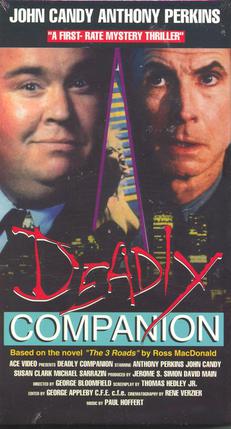
The SCTV people are in the film because it was directed by George Bloomfield, who also directed several episodes of SCTV.  Since this film was made before SCTV really broke into the American marketplace, it was probably assumed that no one outside of Canada would ever find the presence of John Candy in a dramatic murder mystery distracting.  Of course, when Deadly Companion was later released on VHS in the late 80s, Candy and the SCTV crew were all given top billing.

An Olympic Film Review: Cool Runnings (dir by Jon Turtletaub)


Like all good people, I am currently obsessed with the Winter Olympics.  Earlier this week, I asked some of my closest friends if they could recommend some good films about the Winter Games.  Almost everyone who replied recommended that I check out Cool Runnings, a film from 1993.

So, I did.

And I’m glad that I did.

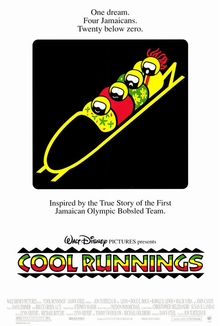
Cool Runnings is one of those sports movies that’s based on a true story, though I imagine it’s probably a very loose adaptation.  Jamaica is a country with a long and proud Olympic history.  Since the 1948 Summer Olympics, Jamaican athletes have won a total of 77 medals, the majority of them in individual and relay sprinting events.  However, Jamaica didn’t compete in the Winter Olympics until 1988, when the Jamaican Bobsled Team made their debut.  According to contemporary news reports, the Jamaicans were folk heroes at the ’88 Winter Games and other teams would frequently help them out by lending them equipment.  Though the Jamaicans were never really a medal contender, they were personally popular and everyone was upset when their bobsled crashed during one of their qualifying runs.

That, of course, isn’t exactly the story that’s told in Cool Runnings.  In Cool Runnings, the Jamaican bobsled team is ridiculed by all of the snobs on the other teams, with the Germans especially going out of their way to be condescending.  Their first run is a disaster but their second run puts them into medal contention and causes people all over the world to spontaneously break into applause.  It’s a sports film, after all.  For a sports film to work, there has to be adversity before there can be victory.  Cool Runnings does stick close enough to the real story that the Jamaicans do end up crashing their sled.  However, in the film version, the team proudly carries their bobsled over the finish line while, again, people all around the world applaud.  Even a woman with a Russian flag claps.  And yes, it’s all pretty hokey but who cares?  It made me cry.
It’s a well-done film, one that is unapologetically sentimental and all the better for it.  Before I watched the film, I didn’t know anything about how the bobsled worked, beyond the fact that it involved four people and that everyone had to jump into the sled after launching it.  But, ultimately, it didn’t matter that I didn’t know much about bobsledding.  From the moment that film started, with scenes of aspiring Olympians running across sunny Jamaica, it had my attention.

When the film starts, Derice Bannock (Leon Robinson) is hoping to compete in the Summer Olympics but, at the qualifying trial, Derice and another runner, Yul Brenner (Malik Yorba), end up tripping over yet another runner, the likable and enthusiastic Junior Bevil (Rawle D. Lewis).  Out of contention for the Summer Olympics, Derice decides to try to find a way to go to the Winter Olympics.  Fortunately, there’s a former Olympic bobsledder, Irv Blitzer (John Candy), living nearby and Derice’s best friend, Sanka (Doug E. Doug) is a champion push cart racer.

The film follows Irv and the four Jamaicans on their unlikely journey to Canada.  It’s a comedy with a dramatic heart.  Yes, Sanka may need help getting his helmet over his hair (“Thanks, coach,” he says whenever Irv pounds down the helmet) but the film also takes the time to explore why it’s so important for these four to compete in the first place.  It might be tempting to make fun of Yul Brenner when he talks about how he wants to live in Buckingham Palace but the film makes clear just how important this improbable dream is for Yul and everyone else.  No one may give the Jamaican bobsled team a chance but Jamaica never stops believing in them.

It’s an incredibly sweet little movie, featuring likable performances and a heart-warming story.  I highly recommend it to anyone looking for a good sports story.

Music Video of the Day: Ghostbusters by Ray Parker Jr. (1984, dir. Ivan Reitman)


I wish the literal video for this was still up. Oh, well.

All these years later, I still don’t have any idea why she goes into that house. I guess we are supposed to believe she lives there with these two kids that miss their cue?

These other kids nail it.

Despite finding lists of all the celebrities in this video, I have no idea who this guy is that Ray Parker Jr. becomes for this bit.

I also wonder why she didn’t see him while turning away from the moving table to go to the window.

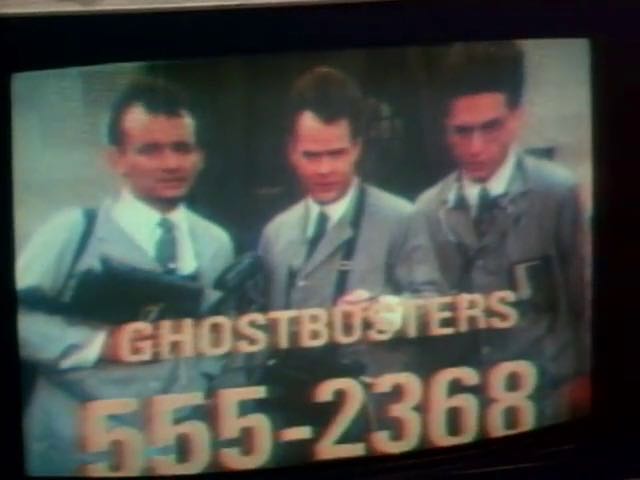
In the window is footage of the movie that has aged horribly. Parker Jr. is blue screened in there for this famous shot.

He ain’t afraid of no ghost. A lawsuit on the other the hand, that’s a different matter. I hope this music video doesn’t remind me of a Huey Lewis & The News video as well.

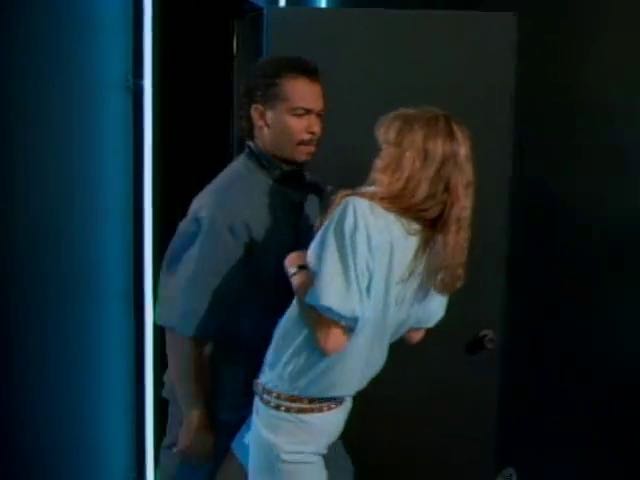
Now Ray Parker Jr. stands creepily outside of her window.

This is looking familiar.

Chevy Chase can call Ghostbusters if he has a ghost problem…

but what about if he gets stuck in Benji again?

Who can he call then?

I knew this looked familiar.

Do You Believe In Love by Huey Lewis & The News (1982)


Do You Believe In Love by Huey Lewis & The News (1982)

I’m sure it’s a coincidence. I just find it humorous to see that considering the lawsuit saying that this song ripped off, to one extent or another, the Huey Lewis & The News song I Want A New Drug. The scene above is from the video that helped kick off their career on MTV and set the tone for their future videos since it was such a success despite being ridiculous. Is the riff in You Crack Me Up…

sound like the same riff from Johnny And Mary by Robert Palmer?

Or is it just me?

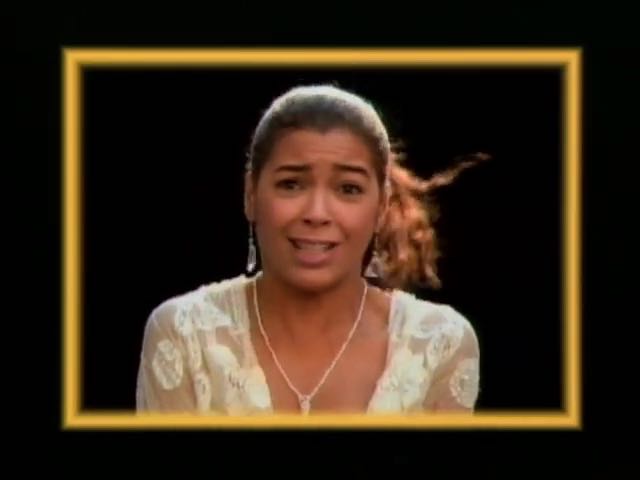
What a feeling. Thanks for making that one easy, Irene Cara.

Something tells me that Cindy Harrell was hired by someone who saw the movie Model Behavior (1982), which she was in.


Model Behavior (1982, dir. Bud Gardner)


Model Behavior (1982, dir. Bud Gardner)

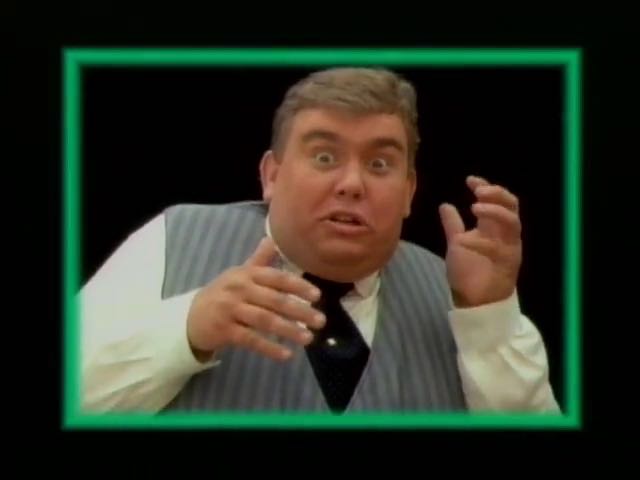
From what I’ve read, they just showed up on the set of a movie Candy was shooting to try and get him to make this cameo appearance.

Ray Parker Jr. rising from the top of the stairs like he’s Michael Myers come to kill her. Why?

Or at least scare her. It’s probably a reference to Gozer.

Melissa Gilbert. I have no idea what she’s doing here. I’ve only seen an episode or two of Little House On The Prairie, so I guess there could have been some episodes with ghosts. Some of these cameos feel like they happened because the celebrities were involved with NBC.

Speaking of cameos I can’t explain, it’s former baseball player Ollie Brown.

Boundaries!

I do like that for the majority of the shot it looks like she should be falling over but isn’t.

More people that Parker can summon for some reason.

Don’t worry about them.

Pose for the featured image of this post.

Thank you.

Jeffrey Tambor.

Is it 555-5555…

or 555-2368 as you showed earlier?

George Wendt apparently got in trouble with the Screen Actors Guild for his appearance in this video. I’ll link to the article with that information at the end.

Senator Al Franken.

Now we get a series of confusing cameos.

Danny DeVito. I think this is only the second music video he has ever been in. The other one was for the song Billy Ocean did for The Jewel Of The Nile (1985).

Carly Simon for some reason. She would go on to do the theme song to Working Girl (1988) with Sigourney Weaver. Maybe they were friends. I don’t know.

Umm…one more thing. Have you tried calling the Ghostbusters? No clue as to why Peter Falk is here.

The breakdancing was improvised. So was Parker Jr. pushing Bill Murray around.

I think Teri Garr has one of the best cameos.

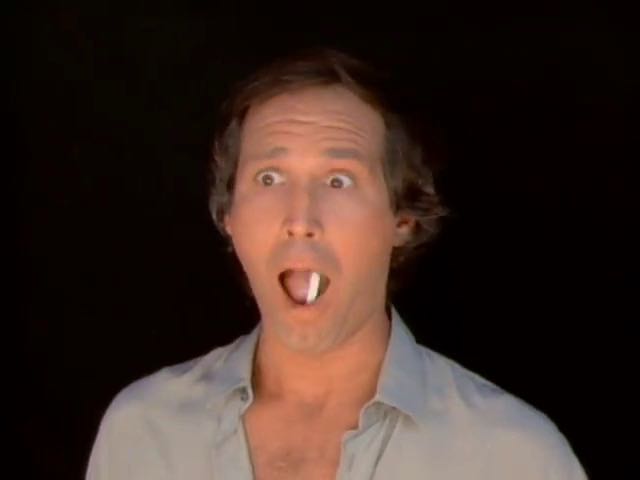
Don’t swallow that cigarette, Chevy.

Fun fact: In European and other non-US markets, the “no” sign was flipped.

If you want to read some more information about the video, then follow this link over to ScreenCrush where they have a write-up on the video with information from people who worked on the video.

According to mvdbase, Ivan Reitman directed, Keith Williams wrote the script, Jeff Abelson produced it, Daniel Pearl shot it, and Peter Lippman was the production manager.

If you ever get a chance to watch the literal music video for this, then do so. I doubt it will surface again though seeing as this music video almost didn’t get an official release because of the issues surrounding all the cameos.

Enjoy!

A Movie A Day #224: Armed and Dangerous (1986, directed by Mark L. Lester)


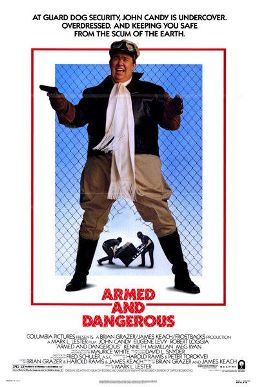
John Candy and Eugene Levy make a great team in the underrated comedy, Armed and Dangerous.
John Candy plays Frank Dooley, a member of the LAPD.  One of the first scenes of the movie is Frank climbing up a tree to save a little boy’s kitten and then getting stuck in the tree himself.  When Frank discovers two corrupt detectives stealing televisions, Frank is framed for the theft and kicked off the force.

Eugene Levy plays Norman Kane, a lawyer whose latest client is a Charles Manson-style cult leader who has a swastika carved into his head.  After being repeatedly threatened with murder, Norman asks for a sidebar and requests that the judge sentence his client to life in prison.  The judge agrees on the condition that Norman, whom he describes as being “the worst attorney to ever appear before me,” find a new line of work.

Frank and Norman end up taking a one day training course to act as security guards and are assigned to work together by their tough by sympathetic supervisor (Meg Ryan!).  Assigned to guard a pharmaceutical warehouse, Frank and Norman stumble across a robbery.  The robbery leads them to corruption inside their own union and, before you can say 80s cop movie, Frank and Norman are ignoring the orders of their supervisors and investigating a crime that nobody wants solved.

Armed and Dangerous was one of the many comedy/cop hybrid films of the 1980s.  Like Beverly Hills Cop, it features Jonathan Banks as a bad guy.  Like the recruits in Police Academy, all of Frank and Norman’s fellow security guards are societal misfits who are distinguished by one or two eccentricities.  There is nothing ground-breaking about Armed and Dangerous but Mark Lester did a good job directing the movie and the team of Candy and Levy (who has previously worked together on SCTV) made me laugh more than a few times.

Armed and Dangerous was originally written to be a vehicle for John Belushi and Dan Aykroyd.  It’s easy to imagine Belushi and Aykroyd in the lead roles but I think the movie actually works better with Candy and Levy, whose comedic style was similar to but far less aggressive than that of Belushi and Aykroyd.  One of the reasons that Armed and Dangerous works is because John Candy and Eugene Levy seem like the two last people to ever find themselves in a shootout or a car chase.  With Belushi and Aykroyd, it would have been expected.  After all, everyone’s seen The Blues Brothers.


A Movie A Day #210: Who’s Harry Crumb? (1989, directed by Pat Flaherty)


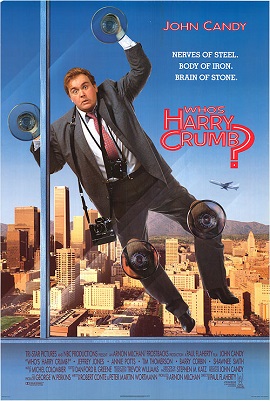
Who’s Harry Crumb?

He is a private detective, the latest in a long line of gumshoes.  While Harry’s father and his grandfather may have been great detectives, Harry is about as incompetent as can be.  He is a self-styled master of disguise but not much else.  He is employed at Crumb & Crumb Detective Agency, solely because of his family background.  When the head of the agency, Eliot Draisen (Jeffrey Jones), engineers the kidnapping of a millionaire’s daughter, he gives the case to Harry because he knows Harry will never be able to solve it.

Who’s Harry Crumb?

He is John Candy, the much beloved and much missed comedic actor from Canada.  As anyone who has ever seen an old episode of SCTV knows, John Candy could be one of the funniest men alive but Hollywood rarely knew what to do with him.  Other than the movies that he made with John Hughes, Candy was always stuck in either supporting roles or in bad comedies.  In Art Linson’s A Pound of Flesh, veteran film producer Linson writes that, because of Candy’s size, some Paramount executives wanted to cast him as Al Capone in The Untouchables.  That is something that I would have enjoyed seeing.  Instead, some actor named Robert De Niro got that role and Candy ended up making movies like Who’s Harry Crumb?

Who’s Harry Crumb? tries to be a mix of comedy and mystery but, due to a weak script and uncertain direction, it does not really succeed as either.  John Candy delivers a few laughs because he was a naturally funny actor but, as a character, Harry Crumb is not that interesting.  Instead, the film is stolen by Annie Potts, playing a duplicitous femme fatale.  Potts and Candy previously came close to working together in the original Ghostbusters.  (Candy pulled out of the role of Louis Tully so that he could play Tom Hanks’s brother in Splash.  He was replaced by his SCTV co-star, Rick Moranis.)  The rest of the cast seems bored and uninterested in what they are doing.  Even Jeffrey Jones, usually so reliable in smarmy bad guy roles, seems bored.

John Candy died just 5 years after the release of Who’s Harry Crumb?, leaving behind two intriguing dream projects, one a biopic of Fatty Arbuckle and another an adaptation of A Confederacy of Dunces.  Sadly, Hollywood never really figured out what to do with this talented comedian.


Boobs, Music, and Sci-Fi: Heavy Metal (1981, directed by Gerald Potterton)


Heavy MetalI think I was twelve when I first saw Heavy Metal.  It came on HBO one night and I loved it.  So did all of my friends.  Can you blame us?  It had everything that a twelve year-old boy (especially a 12 year-old boy who was more than a little on the nerdy side) could want out of a movie: boobs, loud music, and sci-fi violence.  It was a tour of our secret fantasies.  The fact that it was animated made it all the better.  Animated films were not supposed to feature stuff like this.  When my friends and I watched Heavy Metal, we felt like we were getting away with something.
Based on stories from the adults-only Heavy Metal Magazine, Heavy Metal was divided into 8 separate segments:

Soft Landing (directed by Jimmy T. Murakami and John Bruno, written by Dan O’Bannon)

Heavy Metal opens brilliantly with a Corvette being released from a space shuttle and then flying down to Earth, surviving reentry without a scratch.  Who, after watching this, has not wanted a Space Corvette of his very own?

Grimaldi (directed by Harold Whitaker)

On Earth, a terrified young girl listens a glowing green meteorite called the Loc-Nar tells her that it is the source of all evil in the universe.  This sets up the rest of the film, which is made up of stories that the Loc-Nar tells about its influence.  The Loc-Nar is the film’s MacGuffin and, seen today, one of Heavy Metal’s biggest problems is that it has to find a way to force the Loc-Nar into every story, even if it meant sacrificing any sort of consistency about what the Loc-Nar was capable of doing.  Even when I was twelve, I realized that the Loc-Nar was not really that important.

Harry Canyon (directed by Pino Van Lamsweerde, written by Daniel Goldberg)

In this neo-noir tale, futuristic cabby Harry Canyon (voiced by Richard Romanus) is enlisted to help an unnamed girl (voiced by Susan Roman) to find the Loc-Nar.  Slow and predictable, Harry Canyon does feature the voice of John Candy as a police sergeant who attempts to charge Harry for police work.

den_1268427864Den (directed by Jack Stokes, written by Richard Corben)
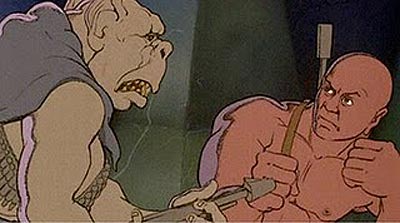
Nerdy teenager David (voiced by John Candy) finds a piece of the Loc-Nar and is transported to the world of Neverwhere, where he is transformed into Den, a muscular, bald warrior.  As Den, David gets to live out the fantasies of Heavy Metal‘s target audience.  On his new planet, Den rescues an Earth woman from being sacrificed, overthrows an evil queen and a sorcerer, and gets laid.  A lot.  Den is the best segment in Heavy Metal, largely because of the endearing contrast between the action onscreen and John Candy’s enthusiastic narration.

Captain Sternn (directed by Paul Sebella and Julian Harris, written by Bernie Wrightson)

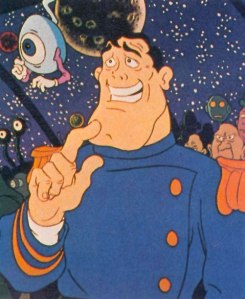
heavy-metal_captain-sternOn a space station orbiting the Earth, Captain Lincoln F. Sternn is on trail for a countless number of offenses.  Though guilty, Captain Sternn expects to be acquitted because he has bribed the prosecution’s star witness, Hanover Fiste.  However, Hanover is holding the Loc-Nar in his hand and it causes him to tell the truth about Captain Sternn and eventually turn into a bloodthirsty giant. Captain Sternn saves the day by tricking Hanover into getting sucked out of an air lock.
Captain Sternn was a reoccurring character in Heavy Metal Magazine and his segment is one of the best.  Eugene Levy voices Captain Sternn while Joe Flaherty voices his lawyer and Dean Wormer himself, John Vernon, is the prosecutor.  Even National Lampoon co-founder Douglas Kenney provided a voice.

 B-17 (directed by Barrie Nelson, written by Dan O’Bannon)

After the Loc-Nar enters Earth’s atmosphere, it crashes into a bullet-riddled World War II bomber, causing the dead crewmen within to reanimate as zombies.  Scored to Don Felder’s Heavy Metal (Takin’ a Ride), B-17 is one of the shorter segments and its dark and moody animation holds up extremely well.

So Beautiful and So Dangerous (directed by John Halas, written by Angus McKie)

Nubile Pentagon secretary Gloria is beamed aboard a spaceship that looks like a giant smiley face.  While she has sex with the ship’s robot captain, the two crew members (voiced by Harold Ramis and Eugene Levy) pour out a long line of cocaine and shout “Nosedive!” before snorting up every flake.  So Beautiful and So Dangerous is so juvenile and so ridiculous that it is actually all kinds of awesome.

Taarna

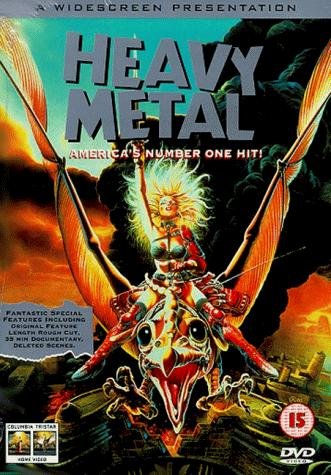
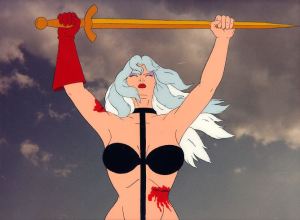
SacrificedIn the film’s final and most famous segment, Taarna, the blond warrior was featured on Heavy Metal‘s poster, rides a pterodactyl across a volcanic planet, killing barbarians, and finally confronting the Loc-Nar.  She sacrifices herself to defeat the Loc-Nar but no worries!  We return to Earth where, for some reason, the Loc-Nar explodes and the girl from the beginning of the film is revealed to be Taarna reborn.  She even gets to fly away on her pterodactyl.  Taarna was really great when I was twelve but today, it is impossible to watch it without flashing back to the Major Boobage episode of South Park.
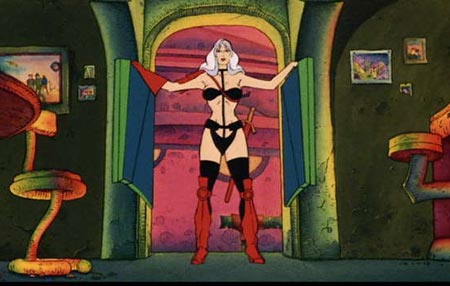
Much like Taarna, Heavy Metal seems pretty silly when I watch it today.  But when I was twelve, it was the greatest thing ever.

Taarna_Heavy_Metal