The new version of Salem’s Lot, which has finally been released on Max after sitting on the shelf for nearly three years, is not very good.
At the same time, it’s definitely not terrible. There are a few effective scenes. The finale, which is a bit different from what happens in the book, is enjoyably berserk. The film made good use of Gordon Lightfoot’s Sundown and, as a history nerd, I appreciated the fact that the movie used the book’s original 70s setting as opposed to trying to update the whole thing. When writer Ben Mears (Lewis Pullman) wants to investigate the history of the old Marsten House, he has to go to the library. People looking up stuff on microfiche is always, from a cinematic point of view, more compelling than them pulling up Wikipedia.
Ultimately, the movie is just kind of forgettable. It’s mediocre in the bland way that so many recent horror films have tended to be. The movie’s style has far more in common with David Gordon Green’s unfortunate forays into horror than to anything done by Mike Flanagan. While it may not have originally been meant for a streaming release, streaming is where it begins because it feels like something that would get dumped on Netflix without much fanfare.
It’s a shame because Salem’s Lot really is one of Stephen King’s better novels, written at a time when King was still embracing his pulpy side and without any of the self-important commentary that’s come to mar some of King’s more recent works. The novel is essentially a small town soap opera, documenting the often sordid lives of the citizens of Jerusalem’s Lot. King introduces a vampire to the mix and most of the town’s problems are solved by folks dying and then coming back from the dead. Ben Mears is a typical King protagonist, a writer from Maine who is trying to deal with a childhood trauma and who discovers that ‘Salem’s Lot has a long and apparently cursed history. In both the book and the movie, Ben teams up with a group of vampire hunters to battle Kurt Barlow (played here by Alexander Ward) and his human servant, Straker (Pilou Asbaek).
The book works because it takes the time to turn Salem’s Lot into a vivid community and, as such, it’s hard not to feel the loss as the town dies off as a result of Barlow’s vampiric invasion. Clocking in at less than two hours, the movie really doesn’t have time to do that. The movie’s version of the town just comes across as being another stereotypical New England town, full of flinty characters and mudrooms. The community never comes to life and, as such, there’s not much emotional resonance as the community dies off. (It’s not a coincidence that the most successful adaptation of Salem’s Lot was a miniseries.) Add to that, the 2024 film features some truly unfortunate acting, which again makes it difficult to accept the town as a community with its own traditions and culture.
There are certain character types and themes that seem to appear in all of Stephen King’s novels and the subsequent adaptations. At its worst, the new Salem’s Lot feels like it’s quickly going through a checklist of all of the expected Stephen King elements. It’s like, “Main setting — check! Writer protagonist — check! Schoolyard bully — check! Child in danger — check!” The end result is a film that feels almost like a parody Stephen King, containing all of his familiar tropes without any of the literary flair that made the original book a classic of vampire literature.
The good thing is that the Tobe Hooper adaptation holds up well and it’s also available on Max. Check it out this weekend.
Forever My Girl is a film about a country music star who doesn’t understand how voicemail works.
It’s been nearly a decade since Liam Pace (Alex Roe) fled his Louisiana hometown. On the plus side, fleeing his town gave Liam the chance to become a country music star. He plays to sell-out crowds. His manager keeps him endlessly supplied with groupies and vodka. Apparently, he once got so strung out that, afterward, he didn’t even remember telling his father, the Reverend (John Benjamin Hickey), that he never wanted to talk to him again. The Reverend Pace did have some important news to give to Liam but … oh well.
On the negative side, when Liam fled his hometown, he also left behind his fiancée, Josie (Jessica Rohe). In fact, they were supposed to be married on the day that Liam left town. Eight years ago, Josie left him one message. Every day since then, Liam has listened to that voicemail. When a groupie accidentally steps on his ancient flip phone, Liam freaks and ends up running barefoot to the closest phone store. He’s chased by a group of adoring fans. Video of barefoot Liam goes viral! Liam doesn’t care. He’s just desperate to get the phone repaired because, again, Liam doesn’t understand how voicemail works.
(As we learn later in the film, Liam also doesn’t understand how to order stuff online. He doesn’t even carry his own credit cards. He’s a celebrity. People do stuff for him.)
Anyway, when an old friend of Liam’s dies, Liam returns to his hometown for the funeral. He doesn’t actually attend the funeral, of course. He just sits outside the church and listens to his Dad give the eulogy. Josie, when she spots him, proceeds to punch him in the stomach and then introduce him to her daughter, Billie (Abby Ryder Fortson). Billie is cute and adorable and 7 years old…
OH MY GOD!
LIAM HAS A DAUGHTER!
(Personally, I think it would have been funny if Josie had replied, “No, she’s your best friend’s daughter and she was conceived right after I called you and left that message…”)
Nobody in town thinks that Liam will ever be responsible enough to be a good father. They’re probably all looking at him and thinking, “How is he going to be a father when he’s still using a flip phone from 2008?” But Liam is determined to prove that he can be a good father and also to win back Josie. Fortunately, it doesn’t turn out to be too hard to win back Josie. Apparently, she hasn’t had a date in 8 years. But being a good father, that’s another challenge all together…
Forever My Girl, which is based on a novel by Heidi McLaughlin, is being advertised as a film for people “who love Nicholas Sparks movies.” Superficially, Forever My Girl may look similar to a Nicholas Sparks adaptation but actually, it’s never comes close to equaling the over the top melodrama of a good Nicholas Sparks film. If anything, Forever My Girl is such a mild and innocuous film that it feels more like something you’d expect to find on the Hallmark Channel rather than playing in theaters. You could easily imagine the film being turned into a television series where, every week, Liam would learn another lesson that would lead to him better appreciating small town life.
Forever My Girl is a sweet-natured movie and Alex Roe and Jessica Rothe are appealing in the lead roles. It’s a film that doesn’t feature people shooting guns or blowing stuff up and, for some people, that’s going to provide a nice diversion from the usual January releases. But, ultimately, the film is too thin and insubstantial to make much of a lasting impression.
What’s an Insomnia File? You know how some times you just can’t get any sleep and, at about three in the morning, you’ll find yourself watching whatever you can find on cable? This feature is all about those insomnia-inspired discoveries!
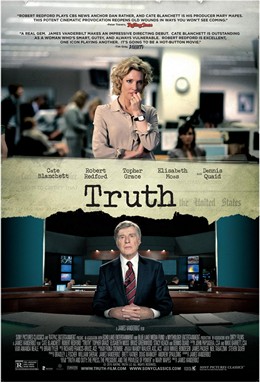
If, last night, you found yourself awake at three in the morning, you could have turned over to Starz and watched the 2015 film, Truth.
I can’t say for sure whether or not Truth would have put you to sleep. It kept me awake, largely because I was in a state of shock that any movie could be as bad as what I was watching. Without running the risk of hyperbole, I can say that Truth is one of the worst fucking movies that I’ve ever seen in my entire life. It’s not just that the film is poorly scripted, inconsistently acted, and directed in the most heavy-handed way possible. No, the problems with Truth went far beyond mere execution. Truth is a film with an agenda, one that I kind of agree with, but it’s such a total misfire that it ends up doing more damage to its cause than good. Truth is meant to be a defense of the much maligned mainstream media but it’s so poorly put together that it’s easy to imagine it being one of Donald Trump’s guilty pleasures. Remember how all of us musical theater nerds used to hatewatch Smash? I imagine that the White House staff does the same thing with Truth.
Truth is ostensibly based on a true story. In 2004, veteran anchorman Dan Rather (played by Robert Redford) reported a story that then-President George W. Bush got preferential treatment while he was serving in the Air National Guard. This story was considered to be especially big because 1) the Iraq War was deeply unpopular, 2) Bush was in a tight race for reelection, 3) his opponent, John F. Kerry, didn’t have much to offer beyond having served in Vietnam, and 4) questions were being raised about what Kerry actually did in Vietnam.
One of the most important pieces of evidence in Rather’s story were four memos that had been provided by a retired Lieutenant Colonel from the Air National Guard, a veteran Bush-hater named Bill Burkett (played, in the film, by Stacy Keach). Shortly after the story aired, conservative bloggers claimed that the memos were obvious forgeries. After spending weeks defending the story and haughtily dismissing anyone who didn’t collect an eight-figure paycheck from CBS, Rather admitted on air that the authenticity of the memos could not be verified. In the wake of the scandal, Rather’s longtime producer, Mary Mapes (Cate Blanchett), was fired. Rather retired a year earlier than expected and went on to become one of those reliably dull commentators who occasionally emerges to complain about how the world hasn’t been the same since Adlai Stevenson died. Mapes later wrote a book, which argued that 1) the memos were authentic and 2) it didn’t actually matter whether they were authentic, even though they like so totally were.
With all the current talk about fake news and whether both the media and Hollywood exist in a bubble, Truth is a film that should be especially relevant but, as previously stated, it’s so clumsy and heavy-handed that it actually does more harm than good. About halfway through the film, there’s a hilarious scene in which literally the entire country is shown watching 60 Minutes with awe-struck expression on their face. Children are watching. Customers in a bar are watching. The cooking staff in the kitchen pauses in their work to watch the report. Heroic music rises on the soundtrack. This scene, with all of its self-important grandeur, pretty much sums up everything that’s wrong with Truth. It’s one thing to argue that the news media does, should, and must play an important role in American life. It’s another thing to make your argument by constructing a fantasy world where the entire country plots their lives around watching 60 Minutes. But that’s the way Vanderbilt directs the entire film. He’s so high on the fumes of his good intentions that he doesn’t realize his film basically comes across like a parody of those intentions.
Especially in the second half of the film, there’s a lot of speeches about why journalism is important. And those speeches may actually make a great point but the problem is that none of them convince us that Mary Mapes and Dan Rather didn’t get fooled by some painfully obvious forgeries. In its laudable effort to defend journalism, Truth makes the mistake of excusing shoddy journalism. When, towards the end of the film, Mapes exclaims that the memos were only a minor part of the overall story and not necessary to prove that Bush got preferential treatment, you want someone to ask her, “If you could prove the story without them, then why did you include these unverifiable documents in the first place, especially considering that they were received from a questionable source?” But nobody does because none of the film’s saintly characters have been written or portrayed with the nuance necessary to be able to survive a question like that. Truth‘s problem is that it wants to have it both ways. “It doesn’t matter that this story was based on obviously fake documents,” Truth says, “And, because Mary Mapes and Dan Rather were sent by God to tell the truth, the obviously fake documents were completely real.”
And then there’s the film’s performers. Stacy Keach is great as Burkitt and his eccentric performance suggests the film that Truth could have been if it wasn’t so concerned with trying to portray its lead characters as saints. But then there’s Robert Redford, whose portrayal of Dan Rather has all the nuance and personality of a wax figure. (Redford wears suspenders. That’s the extent of his performance.) As Mary Mapes, Cate Blanchett is totally wasted. She doesn’t really have a character to play, beyond her male director’s conception of what a professional woman is supposed to be like. (She also has a traumatic back story of abuse, which the film trots out in such a klutzy manner that it’s actually incredibly insulting to real-life abuse victims.) Dennis Quaid, Topher Grace, and Elisabeth Moss all show up as members of Mapes’s team. Quaid is playing a military man so he gets to salute in slow motion. Grace is playing a hipster with a beard so he gets this embarrassing scene where he rants about how he’s being targeted not because of sloppy reporting but because of a corporate conspiracy. (This was obviously meant to be a huge applause moment but, like a lot of the movie, it doesn’t explain how the progressive cause is helped by shoddy journalism.) Moss doesn’t get to do anything, other than sit in the background. To waste a cast of this quality is a crime.
So why did this mostly terrible film get respectful reviews? Why did Sasha Stone and Jeff Wells insist that Truth was destined to be an Oscar contender? Call it confirmation bias. Truth plays to mainstream liberals (which includes the majority of film reviewers) in much the same way that God’s Not Dead 2 plays to Christians. But just because you agree with a film’s ideology, that doesn’t make it an example of good filmmaking. While artistic films are often political, it’s rare that political films are ever art. If every anti-Bush film was an artistic masterpiece, we would be living in a cinematic golden age.
Here’s the thing. We live in a time when the media is under attack and being used a convenient scapegoat for every bad thing in America. Donald Trump largely won in 2016 by portraying the media as being biased and that’s a charge that will undoubtedly be repeated many times over the next four years. A heavy-handed mess like Truth doesn’t help anything.
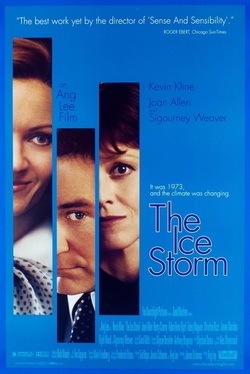
The 1997 film The Ice Storm is kind of a schizophrenic film, which makes sense since it’s set in 1973 and, just from what I’ve seen in the movies, it appears that the early 70s were kind of a schizophrenic time.
It’s a film that deals with two sets of people who all live in an upper class Connecticut community. One part of the film deals with parents who are freaking out about suddenly being adults. The other part of the film deals with the children, most of whom seem destined to make the same mistakes as their parents. It’s a film that is occasionally bracingly realistic and relatable, one that reminds us that being directionless in the 70s isn’t necessarily that different from being directionless in 2016. At other times, the film feels a bit too studied for its own good. This is one of those films that features a Tobey Maguire voice-over and, as good an actor as Maguire has always been, he’s always at his worse when reciting a pseudo-profound voice over. And then there are other times when the film feels a bit too cartoonish for its own good. Elijah Wood’s a stoner. Sigourney Weaver walks around with a bullwhip. David Krumholtz shows up as a character named Francis Davenport.
Fortunately, the film is directed by Ang Lee and Ang Lee is probably one of the few filmmakers who can overcome tonal inconsistency. Lee is so good with actors and is such a good storyteller that even his lesser films are usually worth watching. The Ice Storm would just be another silly sin-in-the-suburbs film if it had been made by any director other than Ang Lee.
The main adult in the film is Ben Hood (Kevin Kline). Ben is married to Elena (Joan Allen) but he’s having an affair with his neighbor, Janey (Sigourney Weaver). Elena may be upset when she finds out about the affair but she’s still willing to accompany her husband to a key party. A key party was a 70s ritual in which husbands would throw their car keys into a big punch bowl and then the wives would randomly pick a key and have sex with the owner. Basically, anytime a TV show or a movie takes place in the suburbs during the 70s, there has to be at least one key party.
And The Ice Storm‘s key party is kind of fun to watch. Kevin Kline and Joan Allen both give really good performances and Ben is such a loser that it’s fun to watch him freak out when Janey gets a key other than this own. Elena, meanwhile, ends up going off with Janey’s husband (Jamey Sheridan, pretty much looking the same in this 1997 film as he did in Spotlight and Sully) and they share a really good scene together, one that reveals that none of the film’s adults are really as mature or liberated as they claim to be.
While the adults attempt to play, their children attempt to find some sort of meaning to their empty existence. Ben and Elena’s daughter, Wendy (Christina Ricci), wears a Richard Nixon mask and enjoys sexually teasing her classmates, especially Janey’s youngest son, Sandy (Adam Hann-Byrd). Ben and Elena’s oldest son, Paul (Tobey Maguire) is in New York, hoping to lose his virginity to Libbits (Katie Holmes) despite the fact that Libbets is far more interested in his boarding school roommate, Francis Davenport (David Krumholtz). Paul also compares his family to the Fantastic Four so, assuming Paul survived both the 70s and 80s, he’s probably still living in Connecticut and telling everyone who disappointed he was with last year’s film.
And, of course, there’s Mickey (Elijah Wood). Mickey is Janey’s oldest son and he’s permanently spaced out. When the ice storm of the title occurs, Mickey is the one who decides to wander around outside and appreciate the beauty of nature’s remorseless wrath.
Needless to say, the ice storm is also a really obvious metaphor for the way all of these very unhappy (but very prosperous) characters tend to view and treat each other. Despite all the attempts to pretend otherwise, everyone has a frozen soul. Nobody’s capable of maintaining any sort of real emotional connection. Of course, someone dies and everyone’s forced to take a look at the sad reality of their lives and the film ends with a sudden and spontaneous display of actual human emotion. It’s one of those ideas that probably works better as a literary conceit than a cinematic one.
That said, The Ice Storm is flawed but very watchable. I enjoyed it, even if it did occasionally seem to be trying way too hard. It’s well-acted and, if nothing else, I enjoyed getting to see all of the amazingly tacky clothes and the interiors of all those big houses. These people love their wide lapels and their shag carpeting. The Ice Storm is not Ang Lee’s best but it’s still good enough.
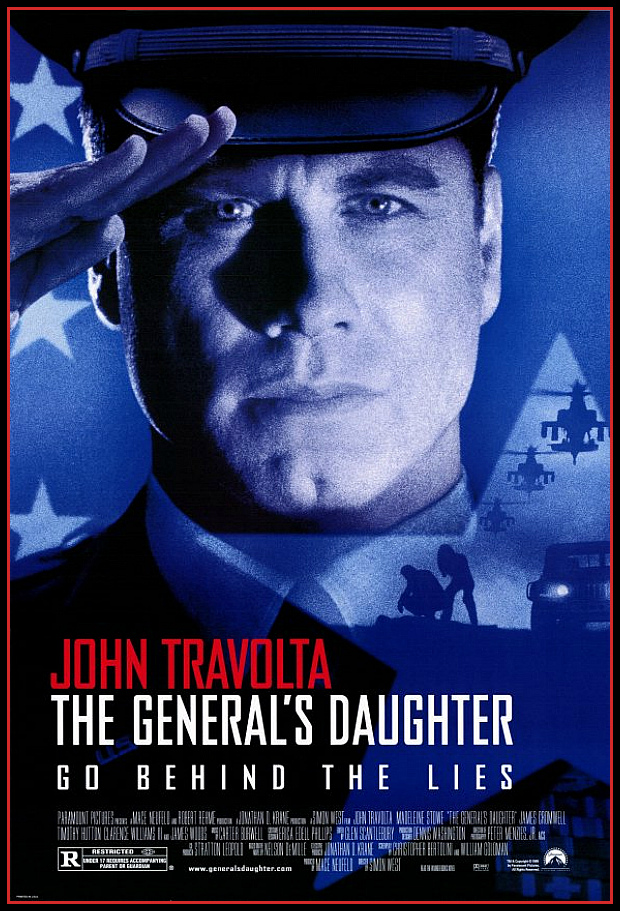
The time around the late 1990’s saw a slew of filmmakers who seemed to have been influenced by the filmmaking style of one Michael Bay. In 1998 one such film which had a certain Michael Bay look to it was the crime thriller The General’s Daughter by filmmaker Simon West (fresh off his success from the previous year’s Con-Air). This film adaptation of the Nelson DeMille novel of the same name starred John Travolta when he was still enjoying the second renaissance of his career brought on by his role in Pulp Fiction.
The General’s Daughter was pretty much a crime procedural wrapped around the secretive and insular world of military life. It has Chief Warrant Officer Paul Brenner (played by Travolta) of the Army’s CID investigating what seems to be the apparent rape and murder of a female officer who also happens to be the daughter of the base’s commandant and political-minded general. Brenner’s soon joined by another CID agent, Sara Sunhill (Madeleine Stowe), who must now navigate the insular world which makes up the officer ranks of the military. They find suspects cropping up faster than they could handle and the one prime suspect in base psychologist Col. Moore (James Wood in an over-the-top performance) has secrets about the victim that could jeopardize the lives and career of not just most of the officers on the base but the victim’s own father. This set-up and the basic understanding of the plot should make for a great thriller, but the by-the-numbers direction by Simon West and the over-the-top performances by too many of the characters in the film sinks The General’s Daughter before it could soar.
The story in of itself really has nothing to drag down the film. From the beginning the screenplay does a great job in tossing red herrings to keep the true murderer secret until the very end. It’s these red herrings which manages to bring out the ultimate reason as to the death of Capt. Elisabeth Campbell (Leslie Stefanson) and how a traumatic event in her past became the one major link which would lead to her death early in the film. It’s how these events were acted out which brings down the script. It’s been said that great performances could raise a mediocre script, but the same could be said for the opposite. Very average to bad performances could drag down a great script.
Travolta’s performance was good enough most of the time. He’s especially good when pouring on the Southern charm to try and gain an advantage over those he’s interacting with, but when he suddenly switches over to tough Army investigator that he goes from just beyond campy to over the line into full-blown camp. The same could be said for pretty much everyone in the film from Stowe’s character who manages to just stand around doing nothing but act as a sort of “gal Friday” for Travolta’s character until the very end when she suddenly becomes a crack investigator to help move the plot along. Clarence Williams III really hams it up as the base general’s right-hand man and one would wonder if he realized he wasn’t actually in a grindhouse or exploitation film when it was time to act.
Despite the performances dragging the film down I must admit that The General’s Daughter was quite watchable and entertaining to a certain level. It’s the film’s inadequacies which also makes it quite a disposable fare that should’ve been more. One wonders how the film would be done today with a different set of actors and a filmmaker who knew the nuances of how to navigate around a thriller. Until the inevitable remake from Hollywood gets greenlit (the way things get remade now it’s bound to happen) it’s this version of The General’s Daughter that’d be on record and it’s a film that has too many bad performances for a great screenplay to overcome. A film that ultimately remains mildly entertaining but forgettable in the end.

 Through the Shattered Lens